I Wanted to Build a Universe • Tonianne Bellomo
What happens when it's not just you, the writer, who struggles with the screen, but your characters? In this lyric essay, Tonianne Bellomo walks us through the negotiations she makes with her characters. What does she do to bring them to life? She builds them paper homes.

By Tonianne Bellomo
I wanted to build a universe.
I wanted to write stories like the ones that made me forget reality. I wanted to build worlds from letters. I wanted to draw in the margins and give readers a glimpse of the realms that rested behind my eyes.
I can’t do that on a computer, at least not at first. There’s no highlighting, scribbling, pasting, scratching out, ripping. There are just clean white backgrounds, perfect font, and the tapping of keys.

That is not world-building; that is a job.
The novel I’m editing is rough, probably in every sense of the word. It sometimes gets so dark that I forget which way is the way home, and I find myself suffocating.
It makes it hard to write.
The computer makes it worse. I feel like I’m cheating. My characters hate it, too. It’s like they refuse to be slighted, refuse to be clinically typed in perfect Times New Roman onto my computer rather than scrawled in a bastardization of Catholic school cursive. They’ll just stand at my mind’s door, arms crossed, heads turned away like I’ve insulted their mothers.
So, I give the characters what they want.
I give them paper homes.
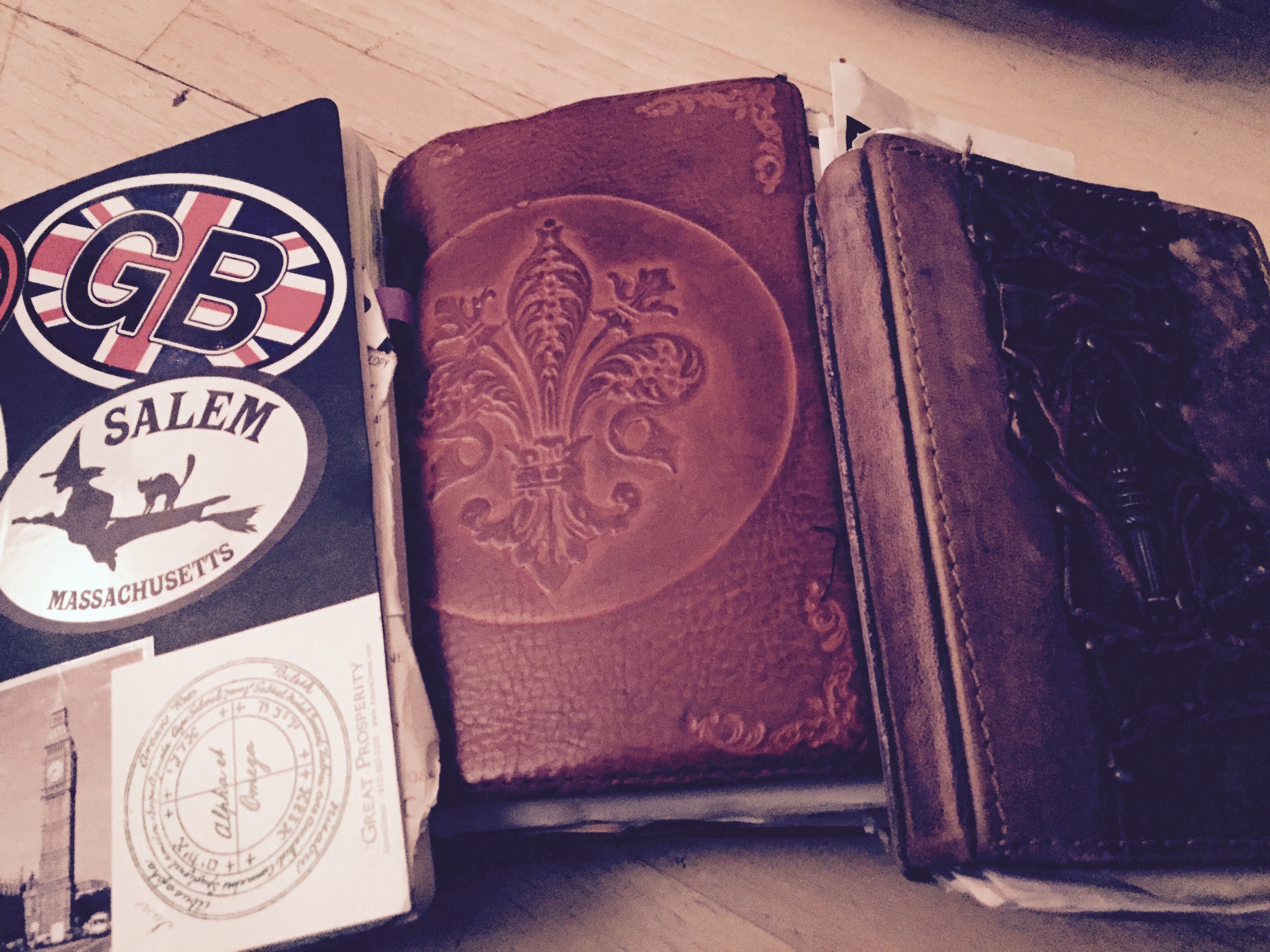
The characters grow in those spaces, whether I realize they’re characters or not. They are lines from a poem, a feeling evoked from a song, lyrics, ticket stubs, a Polaroid. The characters are a lot of things that would have never come together if I didn’t handwrite first.
Handwriting makes it feel like art.

I know by definition writing is an art. I just never feel like I’m making art. Handwriting my stories, though, and putting in all those extras makes me feel like I’m creating worlds for them, like the little girl with a dollhouse that she’s putting together.
Tristan, the protagonist of my novel, even has a journal that is featured on his blog. It originally just started out as a Tumblr blog, but I couldn’t “feel” him in that blue screen. I went out, bought a Moleskin (because he would totally have one) and started drawing and writing in his voice.
It made me feel like I could breathe again. Like the darkness wasn’t so suffocating because I could understand his thought process — I could follow his thoughts home.

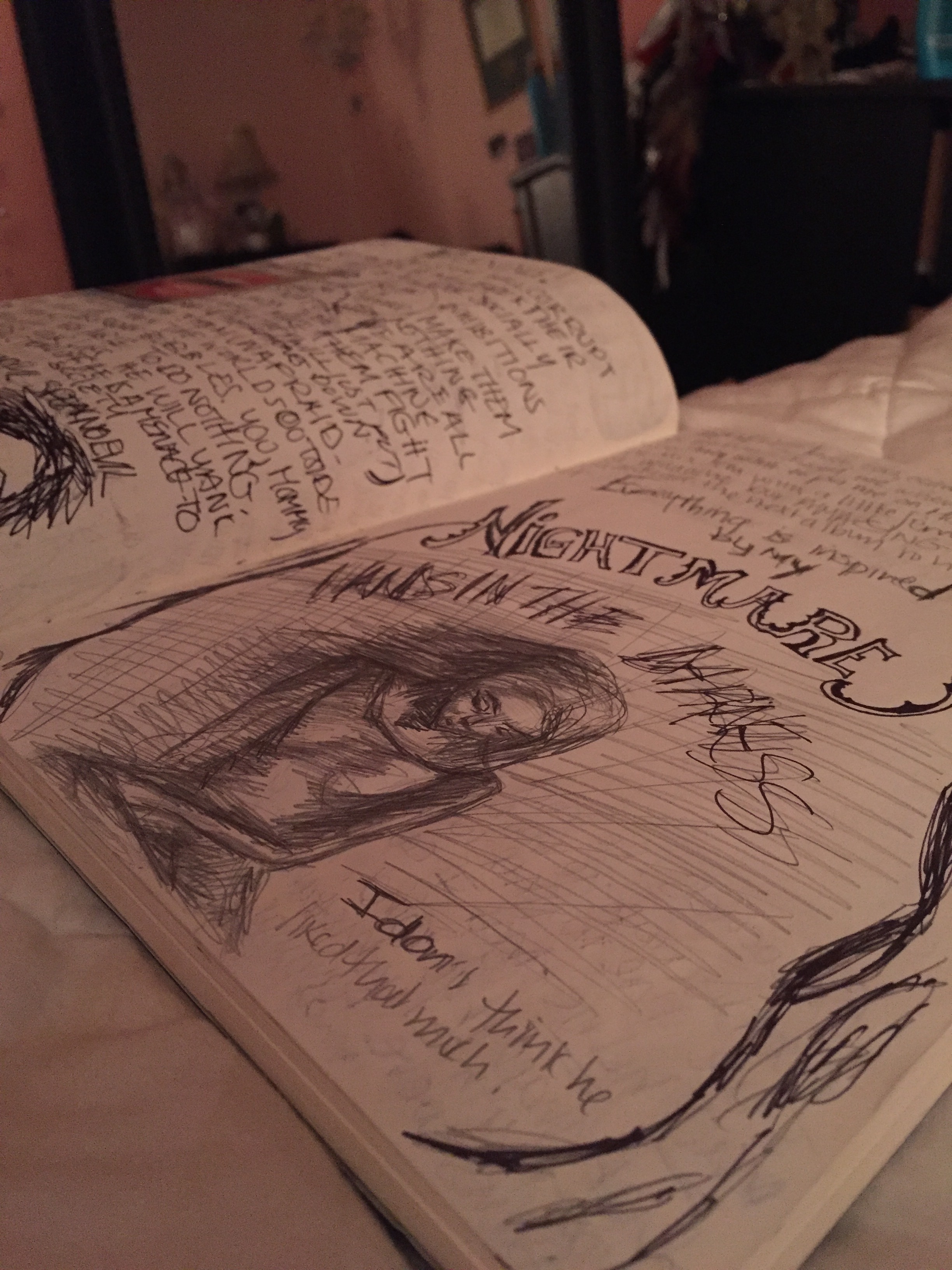
He’s real now. The moment I handwrote his first entry, he became real. The fourth wall broke, and he fell into reality. I can see him sitting in O Café sipping his Americano while sketching in his journal or pasting photos of Richey Edwards or Ian McCulloch onto the pages.
Handwriting and plotting my stories in my journal — it all helps me make worlds. It helps me create the universes that I want my readers to inhabit. And it helps me remember that before all the workshops and degrees and frustrations, there was just me, my journal, and the universes I wanted to build.


Tonianne Bellomo is a graduate of The New School MFA program and an adjunct lecturer at Baruch College where she teaches writing. She is currently editing a novel and blogging from her protagonist's POV at http://wax-and-wings.tumblr.com.
No Other Place Publishes Process • The Origins of Handwritten

In early Spring of 2015, Sarah Madges set out on a project surrounding the Handwritten word and recalled Brett mentioning a project he had recently begun. She reached out to ask if the project was still alive. It was, barely. The exchange served to reignite the project and has since turned into this site, which Sarah is also to thank for, as she since came on board as a central curator for the project. Below is their initial exchange about the idea for the site you are seeing today, which is constantly evolving.

SARAH MADGES: What inspired you to develop a publication/project surrounding the handwritten word? What is your own experience with handwriting?
BRETT RAWSON: I knew I wanted to start something last winter. I took a course at The New School that had us look at digital storytelling, and I found great calm mixed with wild energy in this embrace of and attitude toward technology - how can we use technology to promote our passions, digital or otherwise? On a morning in February, I was on the L train brainstorming for a separate project when the word Handwritten appeared from somewhere. I had my notebook in hand so I scribbled it down. I happened to be heading toward a workshop put on by PEN, so I wonder if that had something to do with the whole thought. At any rate, the word opened up the idea itself: a home for the handwritten word online.
There is no place that publishes things other than finished products. I wanted to promote process. There's a bunch of theories and thoughts about handwriting, penmanship, and personalities. I do think about them, and I care about them, but I am not specifically concerned about them. I don't really care much about their outcomes or conclusions. For example, I find it interesting what people think my handwriting says about me, but I care more about saying things with and through my handwriting. What comes of it in the end is not really something I can consider while I am doing it.
The idea is pretty simple—for people to express themselves with pen and paper, and be published for it. It's also to be a preserve of sorts—for letters written by those who have passed, for example. I am always writing by hand. I don't always write my stories by hand, though most things usually begin on paper—in a journal, on a napkin, or a legal pad. I do, however, write a lot of letters. It's how I ease myself into writing for the day. I can't jump into writing on the computer without starting by hand. I have to start somewhere free. In this sense, it's like stretching, doing yoga, starting out slow, or warming up.
MADGES: What is the project's mission statement?
RAWSON: A place in space for pen and paper. But I have been thinking about changing it to something a mentor of mine once said: writing is a physical activity.
MADGES: Are you concerned that handwriting / cursive lessons are being eclipsed by keyboard proficiency lessons in U.S. elementary schools?
RAWSON: I'm not so sure I am that worried about cursive. But that's probably because mine is horrific. In fact, my regular handwriting sort of looks cursive. Or maybe it looks like it is cursing. It's hard to tell. Someone once said my handwriting looks like a string of wasted wingding characters, which is offensive, but true. But handwriting altogether, what a horrific waste of natural talent. The hand is how we gain access to our inner self. I really don't think the computer can access that wild, raw energy inside each of us. When using a computer, I get an external feeling (usually in the form of mild swells of panic), whereas when I write by hand, the noise from everywhere really quiets down, and I can finally hear my own voice.
The people making these policies, or mistakes, probably don't write by hand much. I imagine they see it as a waste of time, or something of the past, that we should get with the times and technology. This measurement feels imprecise. And it isn't a matter of sentimentality. It also isn't about one or the other. I wonder when people will wake up and coexist - to stop living in some world of ones. I write on the computer all the time. I have four twitter accounts, a Facebook profile, page, and group, five Instagram accounts, one tumblr, and three websites. You know? It's not like I don't get the beauty and power in the computer, let alone its efficiency, insanity, and amusement. I am a user, and I love using it. But what a fucking mistake to not teach kids how to write by hand. So I guess I am concerned.
MADGES: Do you notice a difference in the kinds of things you write when you use pen/pencil as opposed to a computer / word processor? How do you think the writing tool affects content/style/etc? How do you think it affects the editing process?
RAWSON: Absolutely. The medium affects everything. The effect is also bilateral. The reader adjusts his or her expectations based on the medium. A letter is sort of like dining out—there is an experience to it. An email is more like take-out, delivery, or TV dinner - it is often more quick, requires less from me, and can be done while doing something else.
That being said, I don't see it as a matter of good or bad, better or worse. It is simply different. Writing by word processor is more about a product or outcome—a finished something—and so pieces composed there are usually toward that end. But with handwriting, it is more so a work of progress, or process. It is, inherently, more private and intimate. Computers are meant to connect, gather, and scatter. And the screen in between becomes a kind of reflection and projection, which can be a disorienting feeling that registers at a deeper level. Handwriting is about process on two levels -- one, it is about the process, but two, it is a way to process things. Not necessarily produce a product.
MADGES: Phenomenologists have argued that the self falls away when we are engaged in an intense activity, usually one that collapses the sense of the mind-body split by activating both elements. Do you think the writing implement of choice could act as a bodily extension, and that writing by hand helps combine subject and object in ways that promote intimacy with a text, whereas typing into a word document promotes separateness of subject and object?
RAWSON: Fascinating. I imagine this has to be. There is a oneness when it comes to things like painting, the piano, or even running, and so it would make sense that it carries over to hand-writers. It makes me think of meditation for some reason, only I don't really know why. There is intense freedom within limitation, which might be why the computer is such an energy vampire. It pokes so many holes in our concentration containers that after a short period of time, we feel totally drained. Whereas with the handwritten word, I think of a dam and what happens when everything flows through a single thing—it harnesses a new kind of energy. Because with handwriting, you aren't concerned really with what you're writing. There is something hypnotic about the way in which the hands moves.
MADGES: Anything else you would like to add?
RAWSON: Keep the beautiful pen busy!