
A Mother’s Day Reflection • Interview with Rozanne Gold by Allison Radecki


A note from curator Rozanne Gold: It is Sunday morning, Mother’s Day, 2017 and I am missing my mother terribly. It is especially poignant, then, to be writing this curator’s note. I am grateful to Allison Radecki for conducting this interview with me about my beloved “Ma.” Always, “Ma.” Marion Gold, my best friend, soul mate, guiding light. She died in 2006 and never got to meet my daughter, Shayna, whom we adopted at age 11-1/2 less than a year after my mother died. They would have loved each other deeply. My mother’s love of food was infectious, but it was another level of nourishment — of a more spiritual, humanistic nature — that fed me best. It is also meaningful to write this today (our 30th feature) on the first-year anniversary of “Handwritten Recipes."

ALLISON RADECKI: Since the first handwritten recipe profiled in this column was one that you penned and framed as a gift to your own mother, Marion Gold, for Mother’s Day in 1980, it seems fitting that we feature one of her own recipes today. Which handwritten recipe of your mother’s were you drawn to as you approached this holiday weekend?
ROZANNE GOLD: I have a recipe for my mother’s Garlic Broiled Shrimp — with a debatable “s” at the end. She really never said “shrimps,” but she might have questioned herself while writing the title. Her handwriting is as elegant and finum (a Hungarian word for refined that she often used) as she was.
I was excited about the clarity and straightforward simplicity of this dish. Although I never follow a recipe — ever — I followed this one with great results. Michael (my husband) and I ate the whole thing standing up at the counter and were almost giddy from its clean, pure flavors, its stunning plainness. The second time I made it, I embellished a bit — a bit of tarragon and a splash of wine — and ruined it.
That day, with great intention, I summoned her up so that I could see her standing in her kitchen in Queens. There was a smile at the edge of her lips, her shoulders gently sloping, like the curve of her “m” in minced. She minced fresh garlic with her small, favorite knife that was never sharp enough. Would she peel and de-vein the shrimp? I imagine her long piano fingers delicately removing the black vein along the curve of each shrimp’s back. And there was all that curly parsley, meant to be finely chopped. I mean, curly parsley! When was the last time I bought curly parsley? This was a dish for company meant to be served with rice. A box of Carolina Rice was as iconic to me as a Warhol soup can.
RADECKI: Where did your Mom keep her recipes? And where do you now keep hers?
GOLD: My mother kept her recipes in a blue kitchen binder decorated with simple and colorful illustrations of kitchen utensils and ingredients. It has large yellow envelopes as dividers in which you could stuff too many recipe cards. After she died, I found a stash of additional recipes in an old-fashioned tin, filled with blue-lined index cards all in her graceful handwriting festooned with her beautiful swoops and swishes: chicken cutlets, fresh string beans, sour cream coffee cake. The binder and tin now nestle together in the drawer of my pine kitchen table.
RADECKI: Did your mom like to cook? Did she cook often? What do you remember about her cooking?
GOLD: Every night. She cooked every night and made the things we loved. Cabbage and noodles, another dish of stunning simplicity, was my comfort food growing up. Mornings were made special with her apricot-filled ultra-thin crepes called palascintas; meatloaf was always in the shape of a heart.
My mother also made something she called “Tunk-a-lee,” soft scrambled eggs with tomato, pepper, and onion — very Hungarian flavors — but every culture seems to have a version. Another dish I loved was a stew of hot dogs, cut on the bias, with potatoes and onions in a ketchup-y broth. And pot roast. She made the most fabulous pot roast with so many onions, a bay leaf, and splash of dry vermouth. She made it all the time and later revealed that she hated pot roast.
My mother loved to entertain. She’d take white bread, cut the crusts off, and roll it paper-thin with a rolling pin — so thin, it became like pastry. She’d then cover each slice with creamy blue cheese spread and put a fat canned asparagus on it. They would get rolled up tight, brushed with melted butter, and baked. Oh, how many of these I used to eat before company came! Lethal.
RADECKI: How would you describe your relationship with your mother?
GOLD: Ours was an amazing love story. It would be impossible to describe all the joys in our life together, but there was lots of sadness and loss, turmoil and drama, too. But there was also lots of happiness that we shared in big and small ways. I liked the small ways best. Laughing until we cried, playing scrabble; cooking, doing things to please or surprise each other, or just talking ten times a day on the phone. There were trips and travels and innumerable nights of splendor at The Rainbow Room and Windows on the World. There were victories and milestones to celebrate. And I got a chance to write about her in many of my books and magazine articles, too. She was modest and never believed in "tooting her own horn,” and told me never to toot my own. But, nothing came close just to being together.
RADECKI: You have often said that your mother was “More Zsa Zsa than Julia.” Can you paint a picture of the mom you see in your mind’s eye?
GOLD: My mother was a seeker of wisdom and beauty. She was such a beautiful woman. She loved people. She loved children. It always felt like she was doing something special, wanting to please.
She grew up in Florida in a tiny town called Belle Glade, near Pahokee. It was just her, her mom, and her dad. They were poor, but she didn’t know it. She grew up happy. She was always a tall drink of water, though her bosomy mother was only four foot ten.
Mom escaped to the University of Miami, back when it was just one building. Her parents died in her early thirties within six weeks of each other. My mother told me that when her mother died, she felt as though her heart had broken. She carried a lot of sadness. There were deep feelings.
She was a teacher, a hospital volunteer and a medical assistant, but I think she wanted to be an actress. She could be the most glamorous person; a bit like Zsa Zsa.
On her 80th birthday, three weeks before she died, it took her quite a while to get ready. We weren’t going anywhere but she wanted to make it a special occasion. She was so weak but spent hours in her bedroom getting ready. When she finally came out, there were high heels, a mink jacket, and sequined glasses. She could hardly breathe, but she dressed up like a movie star. This is how she wanted us to remember her.
RADECKI: You and I often talk about how recipes — especially handwritten ones — ignite connections. In the spirit of sparking a memory or two, let’s play a quick game. Tell me the first thing that comes to mind about your mother when I say:
Scent: Onions and her own sweet perfume. We each had our own scent. I wore Rive Gauche. She was a sexy, sensual woman.
Sight: It’s summertime, and she’s in the backyard drinking an iced cold Heineken. It’s so out of character, but that’s what I see.
Sayings: "Kickups." If I acted out, she would say, "kickups." As in, "Watch out. You’re about to head into trouble."
Right before she died my mother said the most amazing things. Look deep inside your heart and you will find the answer. Have the courage of your convictions, even if you are wrong. Have more faith in life. Have fun! And love and care will make everything all right. That one is most important. I still keep them with me: in my wallet, handwritten down.
RADECKI: When, do you think, was your mom proudest of you?
GOLD: One night, we had a real New York City evening planned. She came to meet me in the city to hear Michael Feinstein at the Regency. She came in by taxi from Queens. It was a real moment, to see us together in that way, dressed to the nines. We became elegant and adult together. Yet it was a moment of exquisite recognition of our separateness.
RADECKI: When were you proudest of your mom?
GOLD: Although we could get so angry with one another, there was never a time I was not proud of her. That may be my deepest connection to her. I always felt so proud of her.
RADECKI: You’ve credited your mother for recognizing that you had a future in food, and urging you to pursue that passion, even at a time when women were not prominent in professional kitchens. How did she see your path and encourage you to do what you loved?
GOLD: When I was in college at Tufts, I got a phone call from my mom. She had just heard an interview with the Hungarian restaurateur George Lang. That was the very first time I heard the idea of a restaurant consultant. I was a dual major in psych and education, but the food, she knew. I mean, she let me become a bartender at age sixteen, when she knew it wasn’t legal.
My mother was the one to see that I was spending more time cooking in the kitchen than working on my Masters degree. I dropped out of graduate school and became the first chef to New York Mayor Ed Koch when I was twenty-three. She enjoyed visiting me at Gracie Mansion, but felt bad about the grueling hours.
Again, always wanting to please. There was a restaurant, Villa Secondo, in Queens where my parents would always go. But, one day my mother called me to say, “Rozanne! Secondo, it’s gotten so much better!” Years later, I found out who the new chef was. It was Lidia Bastianich. She knew! My Mom just knew. She had that food sense.
RADECKI: In 2009, a few years after your mother’s death, you bought and saved over six thousand cookbooks from the library of Gourmet Magazine and donated them to the N.Y.U. Fales Library in your mother’s name. What does it mean to you to see her name Marion Gold on the nameplate of every book in that Gourmet collection?
GOLD: It felt so full circle…so right.

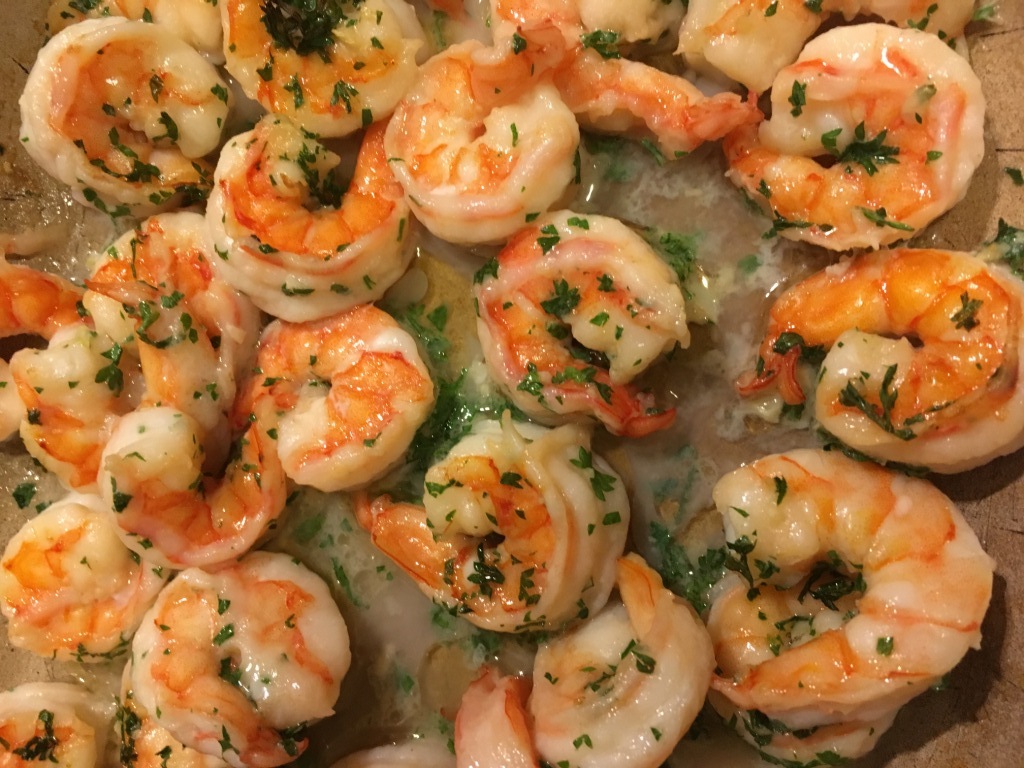
Garlic Broiled Shrimp
Note: You can buy large cleaned, deveined shrimp. Reduce cooking time depending on size of shrimp. Do not overcook.
INGREDIENTS:
Two lbs. raw shrimps
½ cup olive oil
2 garlic cloves, minced
2 Tsp. salt
½ cup chopped parsley
Lemon wedges
DIRECTIONS:
Arrange shrimps in shallow baking pan. Sprinkle with olive oil, garlic, salt, and half of parsley.
Broil about 4 inches from source of heat for 5 to 7 minutes on each side – Sprinkle with remaining parsley and serve with lemon wedges.

To see the rest of Rozanne Gold's "Handwritten Recipes," click here.
Handwritten Recipes and A Taste of the Past • A Radio Interview with Linda Pelaccio of Heritage Radio Network
BY HANDWRITTEN
"When was the last time you cooked
from a recipe from a handwritten card or paper?"
On February 2nd, we were invited to Linda Pelaccio's radio show, A Taste of the Past, which is a weekly journey through culinary history. It's housed in the back of Robertas, a true palace of pizza, and is the permanent home to Heritage Radio Network, which hosts over 35 weekly shows from their little wooden den.

Linda caught wind of Rozanne Gold's column, Handwritten Recipes, which does something similar to her radio show: exploring the connections between food and language. For forty-five minutes, we chopped it up about handwriting, recipes, and secret ingredients. To date, Rozanne has curated 28 of these Handwritten Recipes, and we have no intentions of slowing down. This living cookbook has a life of its own.
To hear the podcast, click here. You can also see the podcast on iTunes. We hope you enjoy hearing more about the column, the origins of this site, and where we're headed.

Handwriting Continues to Prove Its Nimble Nature • A Conversation Mary Savig, with Curator of Manuscripts
"Technologies of communication, from telegrams to texting, have long threatened the written word. And yet, handwriting continues to prove its nimble nature."
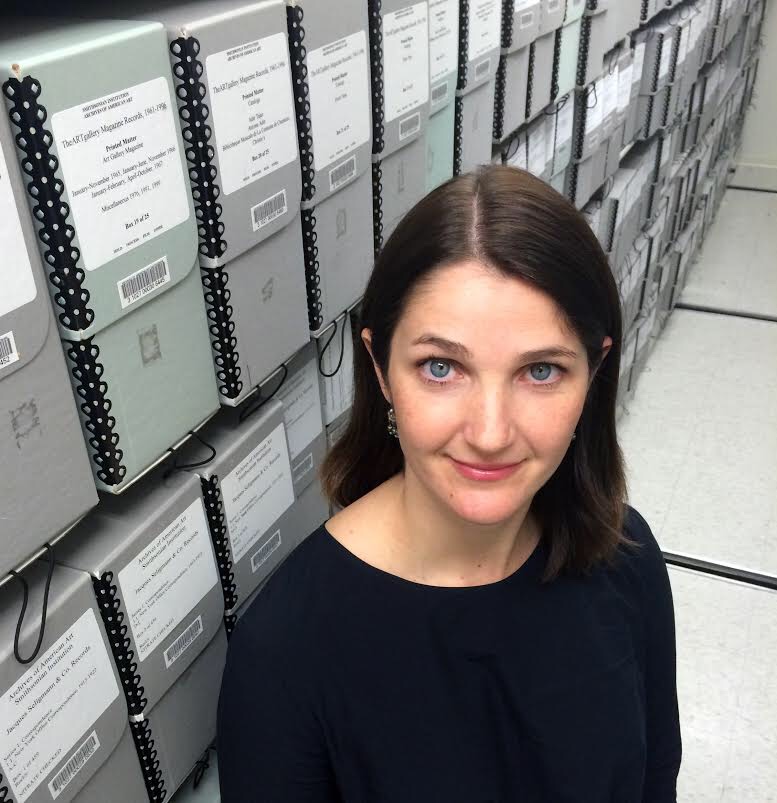
This conversation was a part of our collaboration with The Smithsonian's Archives of American Art, Pen to Panel. Here, we talk with Curator of Manuscripts Mary Savig about the creation of their latest anthology, which was the root of our collaboration, Pen to Paper.

SAY MADGES: I read in the review on the Smithsonian website that the idea for the exhibition and eventually this book came from a discussion amongst colleagues about how easily recognizable A.D. Reinhardt's handwriting is. Are there some other artists whose handwriting you can spot from across the room? Georgia O'Keefe's handwriting is so distinctive!
MARY SAVIG: Yes, Georgia O’Keeffe’s lyrical, bold handwriting shouts for attention and is impossible to forget. Hans Hofmann and Maxfield Parrish also boast distinct penmanship: Hofmann’s handwriting is twiggy but deliberate, and there is no confusing it for another artist’s hand. Parrish’s graceful penmanship doesn’t jump off the page like the others, but its inimitable elegance is as recognizable as his paintings.
SAY: What factored into your decision about which artists, and their letters, to feature?
MARY: The artist’s handwriting had to intrigue me. It was also important to represent the broad scope and scale of American art, from the nineteenth century through the present, as well as artists from different geographical regions who worked in various media, like sculpture, photography, graphic arts, abstract painting, landscape painting, and crafts. The book includes outsider artists and conceptual artists, feminists and immigrants, and more. As a whole, this selection reflects the depth of resources at the Archives of American Art.
SAY: In your introduction to the book you talk a lot about the historical development of handwriting in the U.S. Obviously you've researched this topic quite a bit — what was the most surprising or interesting thing you learned?
MARY: Much ink has been spilled on handwriting’s tenuous relationship with technology. “Once upon a time, before there were electronic typewriters, or tape records, or Xerox machines, boys and girls had to write by hand,” began a New York Times article lamenting the current state of penmanship in 1967. Technologies of communication, from telegrams to texting, have long threatened the written word. And yet, handwriting continues to prove its nimble nature. The craft of handwriting has flourished online, especially on social media. Artists, thinkers, and makers alike are experimenting with penmanship in innovative ways. Along these lines, the Archives continues to digitize and make our vast handwritten records available online for new generations to discover.
SAY: What's your favorite letter in the book?
MARY: Don’t make me choose! My answer really depends on the day and since it’s a sunny Friday morning, I’m thinking of a charming letter by the Reverend Howard Finster. Liza Kirwin, deputy director at the Archives of American Art, writes, “Reverend Howard Finster was a consummate entertainer and an old-timey Bible-belt evangelist. His handwriting, most often in block capitals, was like his preaching — purposeful, emphatic, and an integral part of his art, his “sermons in paint.” This description encapsulates the spirit of the book.
SAY: Who transcribed all of these letters? The book cites Transcription Center volunteers. How did people tackle the less legible ones?
MARY: Transcription Center volunteers helped with the bulk of transcriptions (a few of the letters had been previously transcribed). The volunteers are especially amazing at deciphering difficult hands. Many of them have compared translation to solving a puzzle: you have to be able to discern whether the faintest line might indicate a dash, a period, or a dotted i, while keeping in mind the bigger picture of the letter because it holds so many context clues.
SAY: You note that for this book the writers focused on visual content over verbal. Why was it important that they do that? What were you hoping would emerge in the contributors' essays as a result?
MARY: Many of the writers had spent months, often years, in the Archives of American Art scouring these letters for details like the locations of artworks, sale records, notable collaborations, and the like. The goal of this project was to get the writers to step back from the content and instead approach the letter as if it’s a painting or a sculpture. What might the curves, dashes, and density of line tell us about the artist? I was always fascinated and often surprised by the diversity of responses. What emerged from this project is that primary sources, and handwritten letters in particular, remain relevant and poised for interpretation. I hope this book prompts others to look at our materials with a fresh perspective.

No Other Place Publishes Process • The Origins of Handwritten

In early Spring of 2015, Sarah Madges set out on a project surrounding the Handwritten word and recalled Brett mentioning a project he had recently begun. She reached out to ask if the project was still alive. It was, barely. The exchange served to reignite the project and has since turned into this site, which Sarah is also to thank for, as she since came on board as a central curator for the project. Below is their initial exchange about the idea for the site you are seeing today, which is constantly evolving.

SARAH MADGES: What inspired you to develop a publication/project surrounding the handwritten word? What is your own experience with handwriting?
BRETT RAWSON: I knew I wanted to start something last winter. I took a course at The New School that had us look at digital storytelling, and I found great calm mixed with wild energy in this embrace of and attitude toward technology - how can we use technology to promote our passions, digital or otherwise? On a morning in February, I was on the L train brainstorming for a separate project when the word Handwritten appeared from somewhere. I had my notebook in hand so I scribbled it down. I happened to be heading toward a workshop put on by PEN, so I wonder if that had something to do with the whole thought. At any rate, the word opened up the idea itself: a home for the handwritten word online.
There is no place that publishes things other than finished products. I wanted to promote process. There's a bunch of theories and thoughts about handwriting, penmanship, and personalities. I do think about them, and I care about them, but I am not specifically concerned about them. I don't really care much about their outcomes or conclusions. For example, I find it interesting what people think my handwriting says about me, but I care more about saying things with and through my handwriting. What comes of it in the end is not really something I can consider while I am doing it.
The idea is pretty simple—for people to express themselves with pen and paper, and be published for it. It's also to be a preserve of sorts—for letters written by those who have passed, for example. I am always writing by hand. I don't always write my stories by hand, though most things usually begin on paper—in a journal, on a napkin, or a legal pad. I do, however, write a lot of letters. It's how I ease myself into writing for the day. I can't jump into writing on the computer without starting by hand. I have to start somewhere free. In this sense, it's like stretching, doing yoga, starting out slow, or warming up.
MADGES: What is the project's mission statement?
RAWSON: A place in space for pen and paper. But I have been thinking about changing it to something a mentor of mine once said: writing is a physical activity.
MADGES: Are you concerned that handwriting / cursive lessons are being eclipsed by keyboard proficiency lessons in U.S. elementary schools?
RAWSON: I'm not so sure I am that worried about cursive. But that's probably because mine is horrific. In fact, my regular handwriting sort of looks cursive. Or maybe it looks like it is cursing. It's hard to tell. Someone once said my handwriting looks like a string of wasted wingding characters, which is offensive, but true. But handwriting altogether, what a horrific waste of natural talent. The hand is how we gain access to our inner self. I really don't think the computer can access that wild, raw energy inside each of us. When using a computer, I get an external feeling (usually in the form of mild swells of panic), whereas when I write by hand, the noise from everywhere really quiets down, and I can finally hear my own voice.
The people making these policies, or mistakes, probably don't write by hand much. I imagine they see it as a waste of time, or something of the past, that we should get with the times and technology. This measurement feels imprecise. And it isn't a matter of sentimentality. It also isn't about one or the other. I wonder when people will wake up and coexist - to stop living in some world of ones. I write on the computer all the time. I have four twitter accounts, a Facebook profile, page, and group, five Instagram accounts, one tumblr, and three websites. You know? It's not like I don't get the beauty and power in the computer, let alone its efficiency, insanity, and amusement. I am a user, and I love using it. But what a fucking mistake to not teach kids how to write by hand. So I guess I am concerned.
MADGES: Do you notice a difference in the kinds of things you write when you use pen/pencil as opposed to a computer / word processor? How do you think the writing tool affects content/style/etc? How do you think it affects the editing process?
RAWSON: Absolutely. The medium affects everything. The effect is also bilateral. The reader adjusts his or her expectations based on the medium. A letter is sort of like dining out—there is an experience to it. An email is more like take-out, delivery, or TV dinner - it is often more quick, requires less from me, and can be done while doing something else.
That being said, I don't see it as a matter of good or bad, better or worse. It is simply different. Writing by word processor is more about a product or outcome—a finished something—and so pieces composed there are usually toward that end. But with handwriting, it is more so a work of progress, or process. It is, inherently, more private and intimate. Computers are meant to connect, gather, and scatter. And the screen in between becomes a kind of reflection and projection, which can be a disorienting feeling that registers at a deeper level. Handwriting is about process on two levels -- one, it is about the process, but two, it is a way to process things. Not necessarily produce a product.
MADGES: Phenomenologists have argued that the self falls away when we are engaged in an intense activity, usually one that collapses the sense of the mind-body split by activating both elements. Do you think the writing implement of choice could act as a bodily extension, and that writing by hand helps combine subject and object in ways that promote intimacy with a text, whereas typing into a word document promotes separateness of subject and object?
RAWSON: Fascinating. I imagine this has to be. There is a oneness when it comes to things like painting, the piano, or even running, and so it would make sense that it carries over to hand-writers. It makes me think of meditation for some reason, only I don't really know why. There is intense freedom within limitation, which might be why the computer is such an energy vampire. It pokes so many holes in our concentration containers that after a short period of time, we feel totally drained. Whereas with the handwritten word, I think of a dam and what happens when everything flows through a single thing—it harnesses a new kind of energy. Because with handwriting, you aren't concerned really with what you're writing. There is something hypnotic about the way in which the hands moves.
MADGES: Anything else you would like to add?
RAWSON: Keep the beautiful pen busy!