A Surprise Wedding and the 52 Postcards That Followed • Carly Butler Verheyen

BY CARLY BUTLER VERHEYEN
Nothing about our wedding was ordinary. In fact, that morning I woke up thinking it was the day of our engagement party, but I got the surprise of a lifetime after reading a letter from my fiancé telling me that our engagement party that was planned for that day was actually our wedding day. While I was away for 6 months retracing the steps of my Grandmother's love letters in London, England, he was at home planning our big day. We had a date set the following year, so we were planning things together here and there, but little did I know that things we were planning were actually being moved to an earlier date: the date of our surprise wedding.
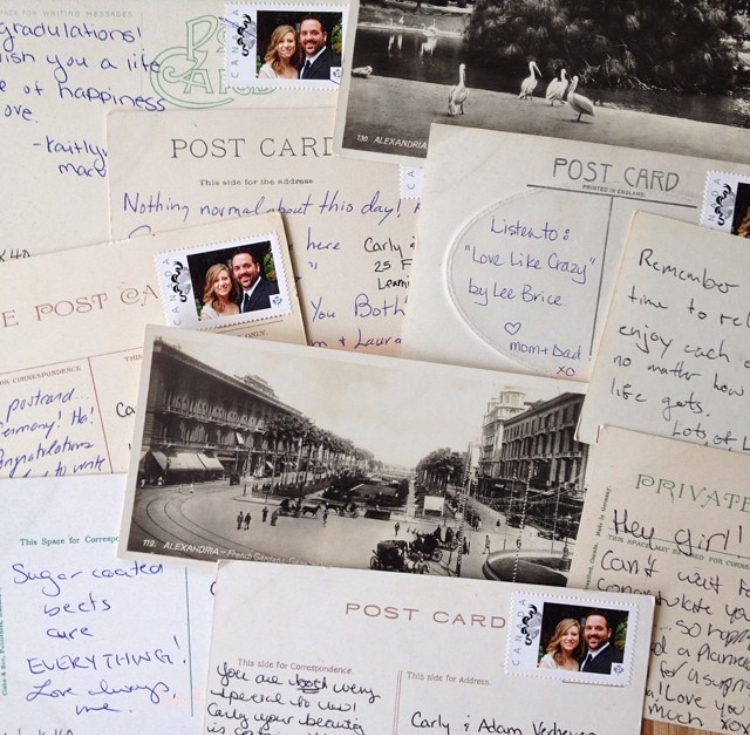
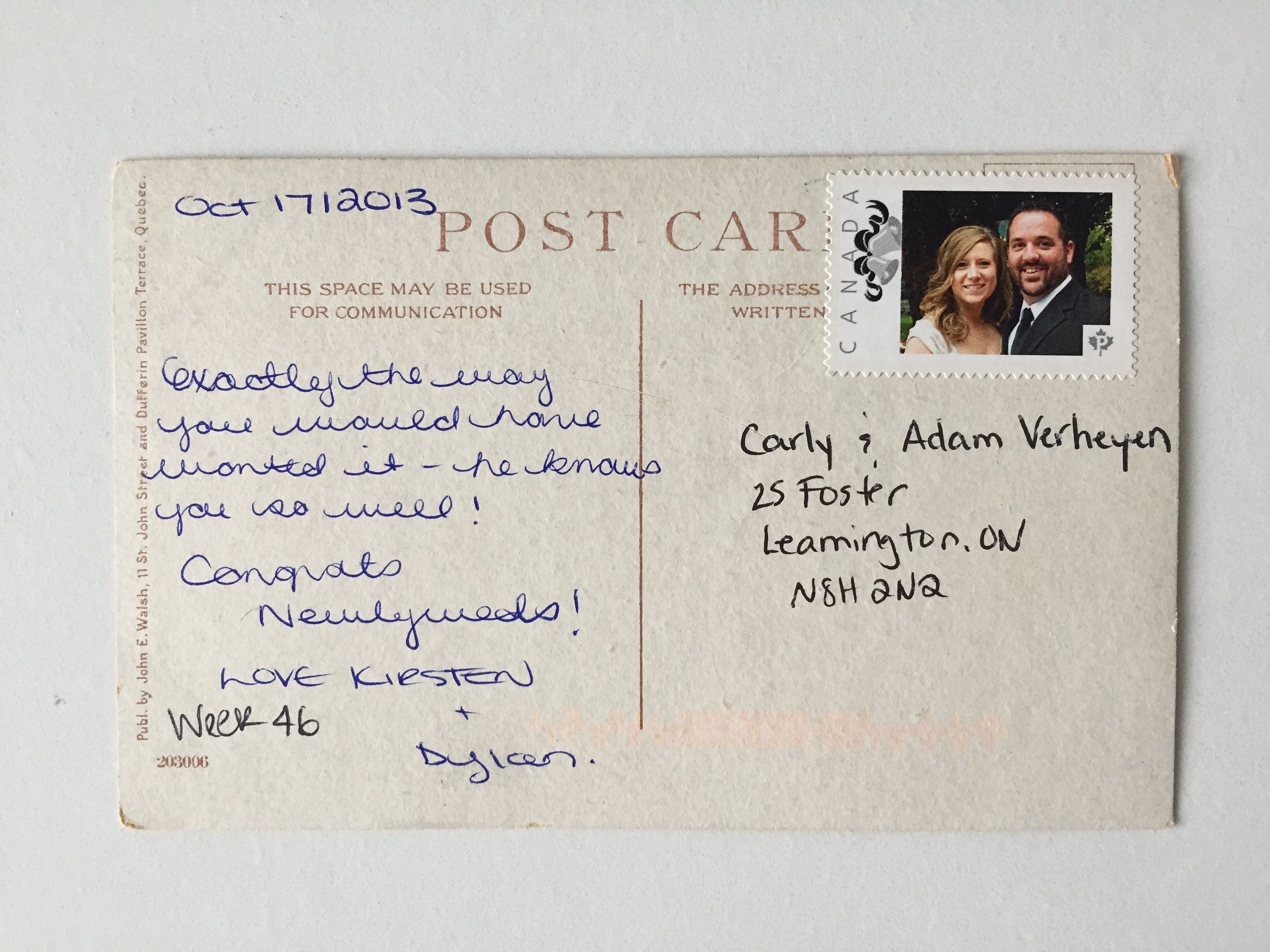
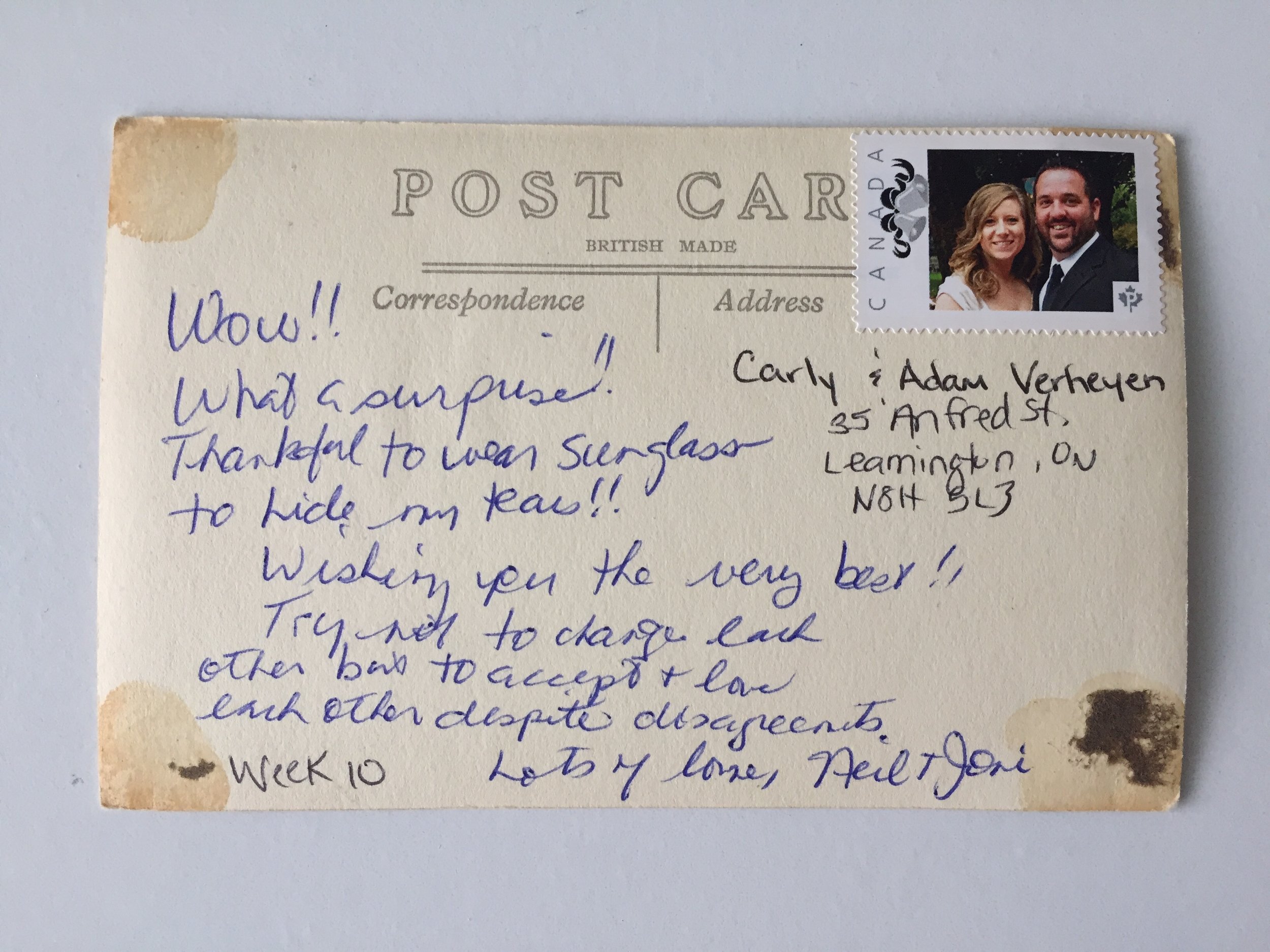
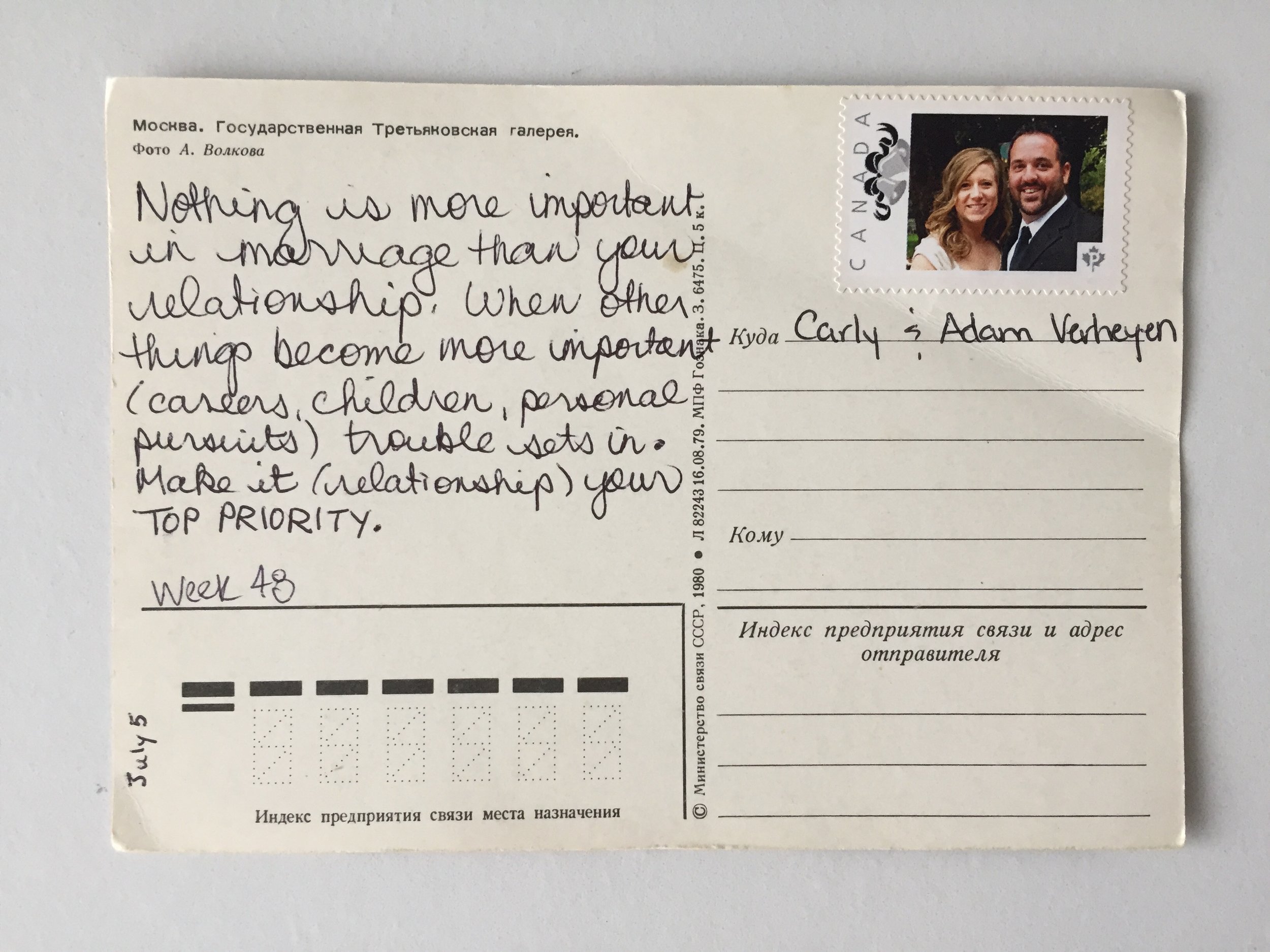
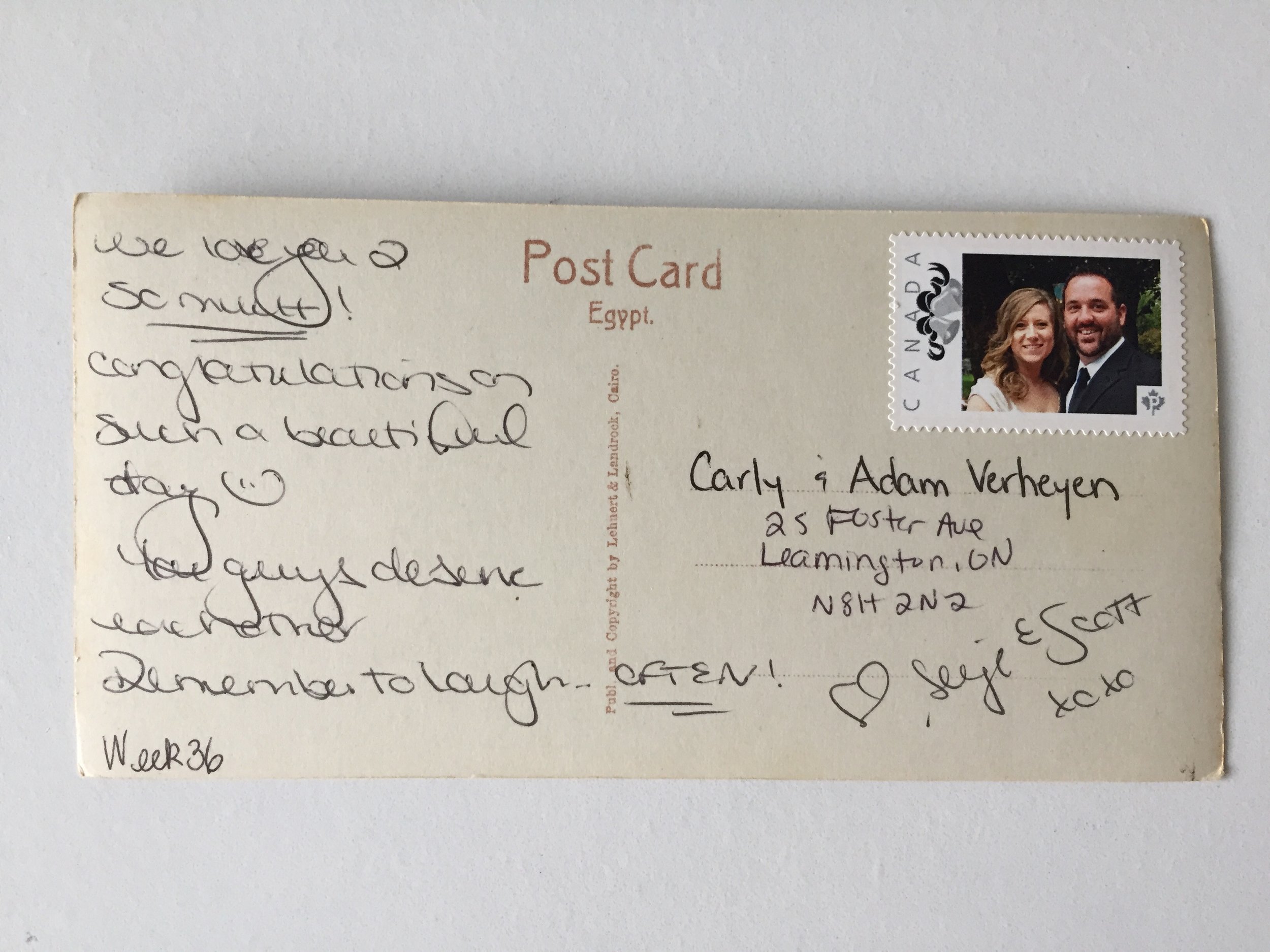
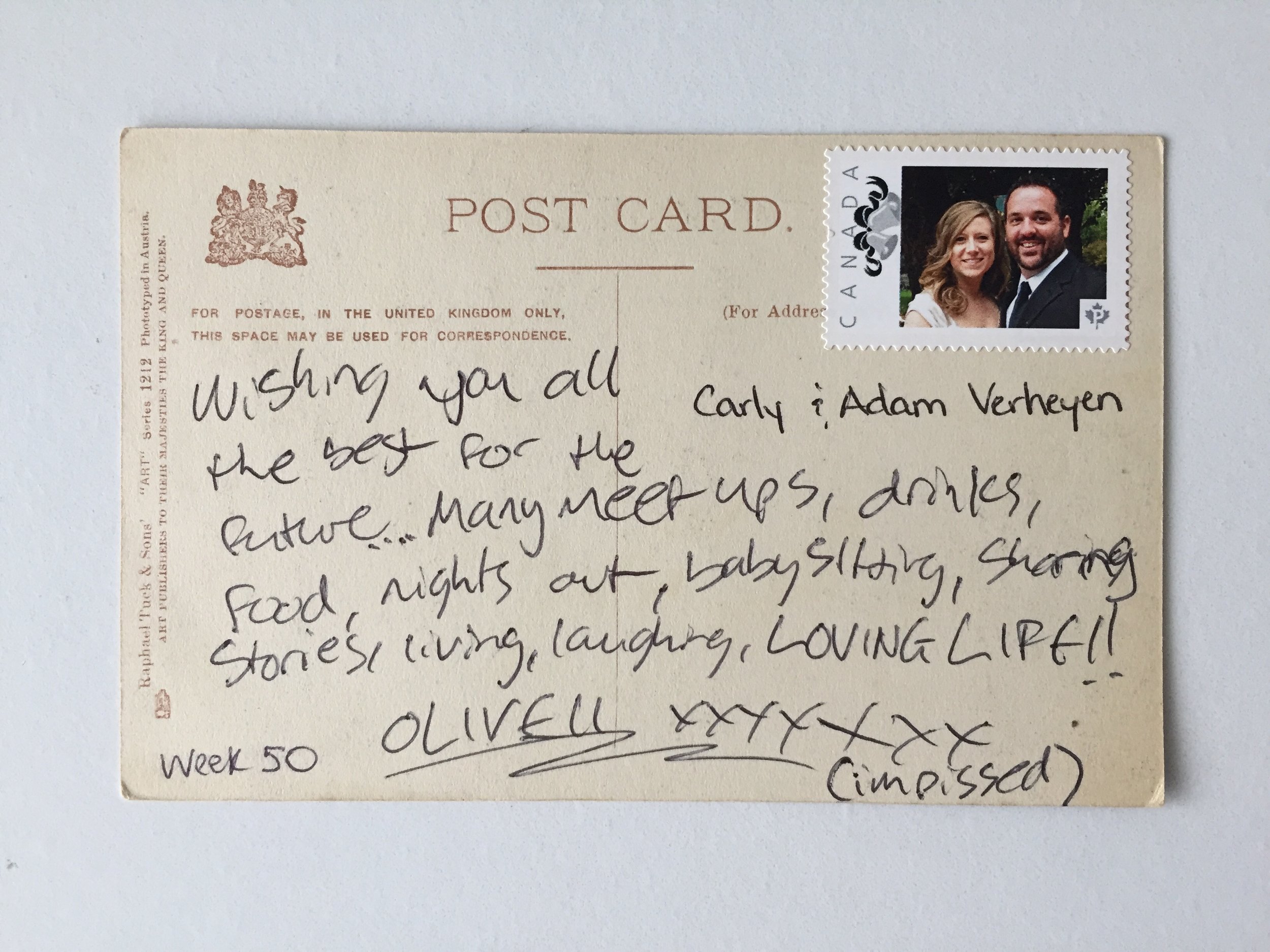
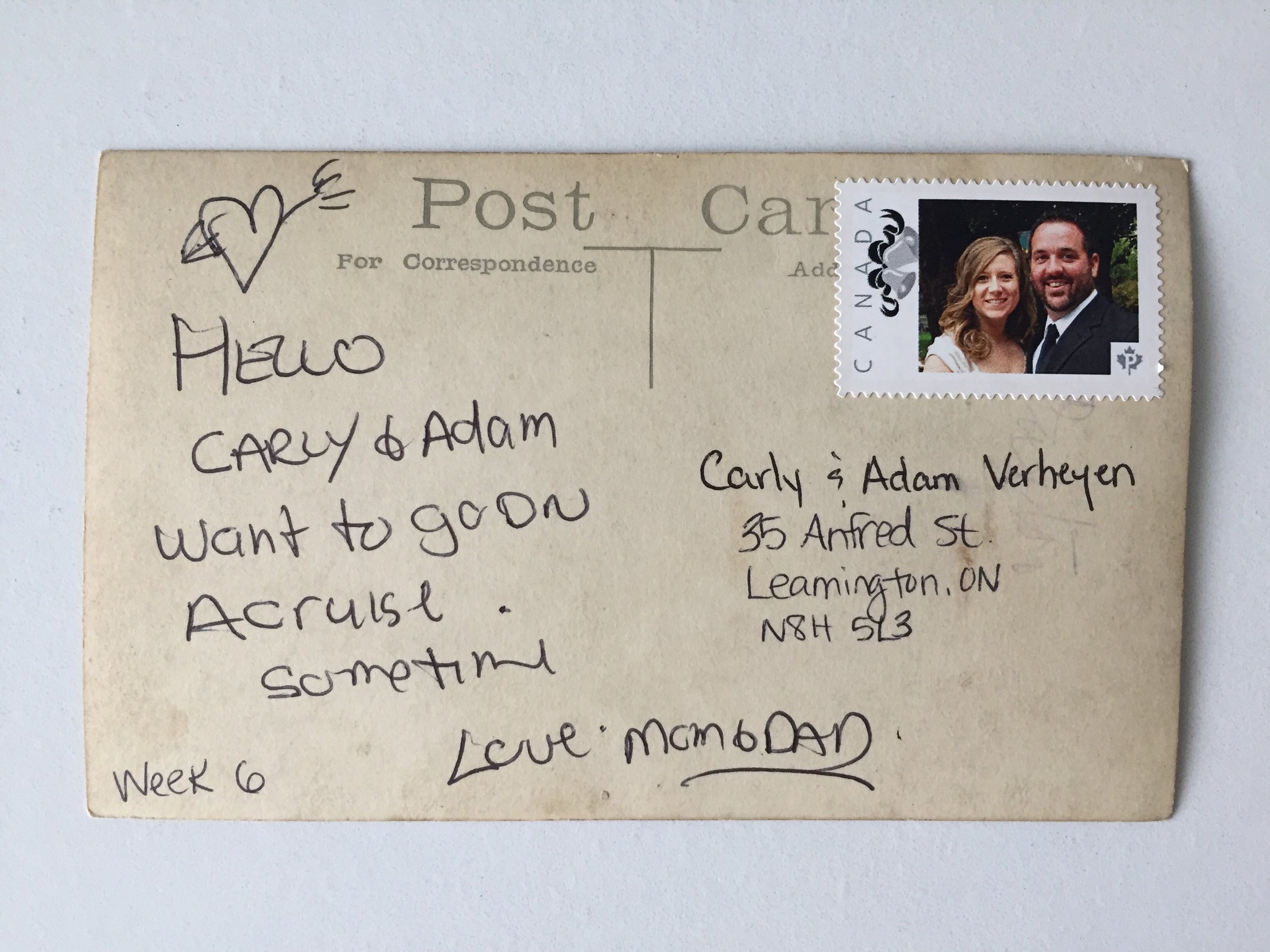
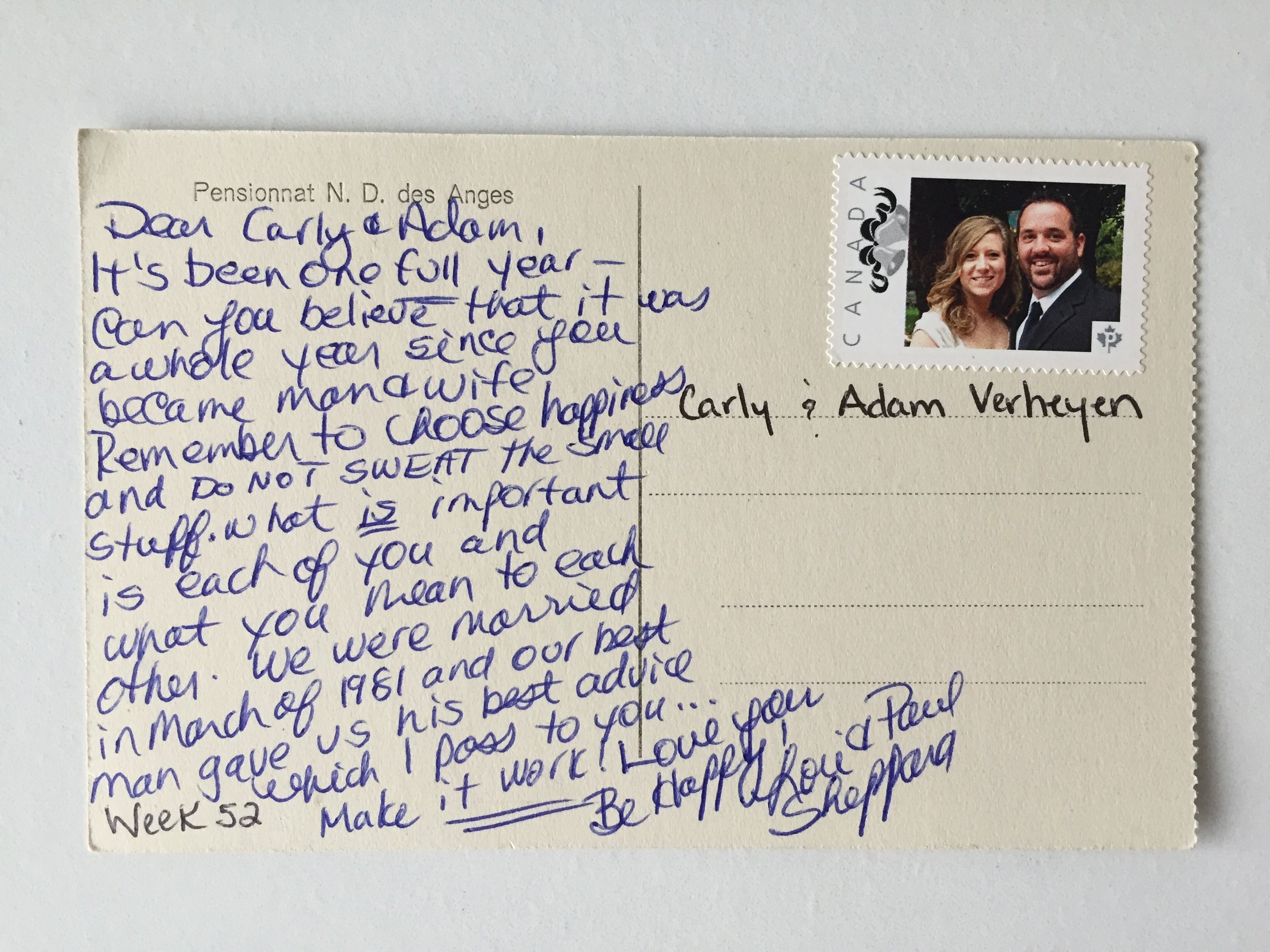
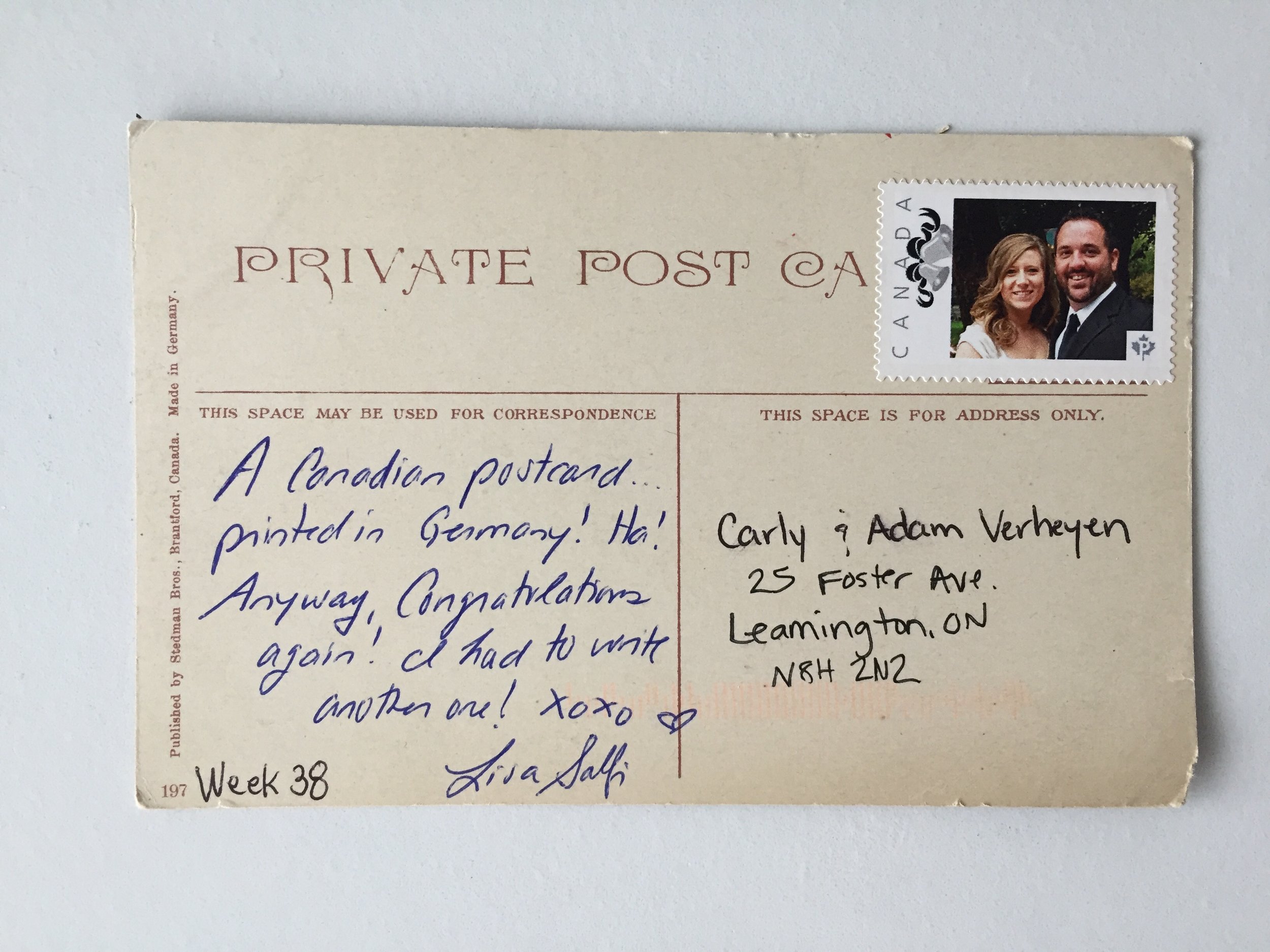
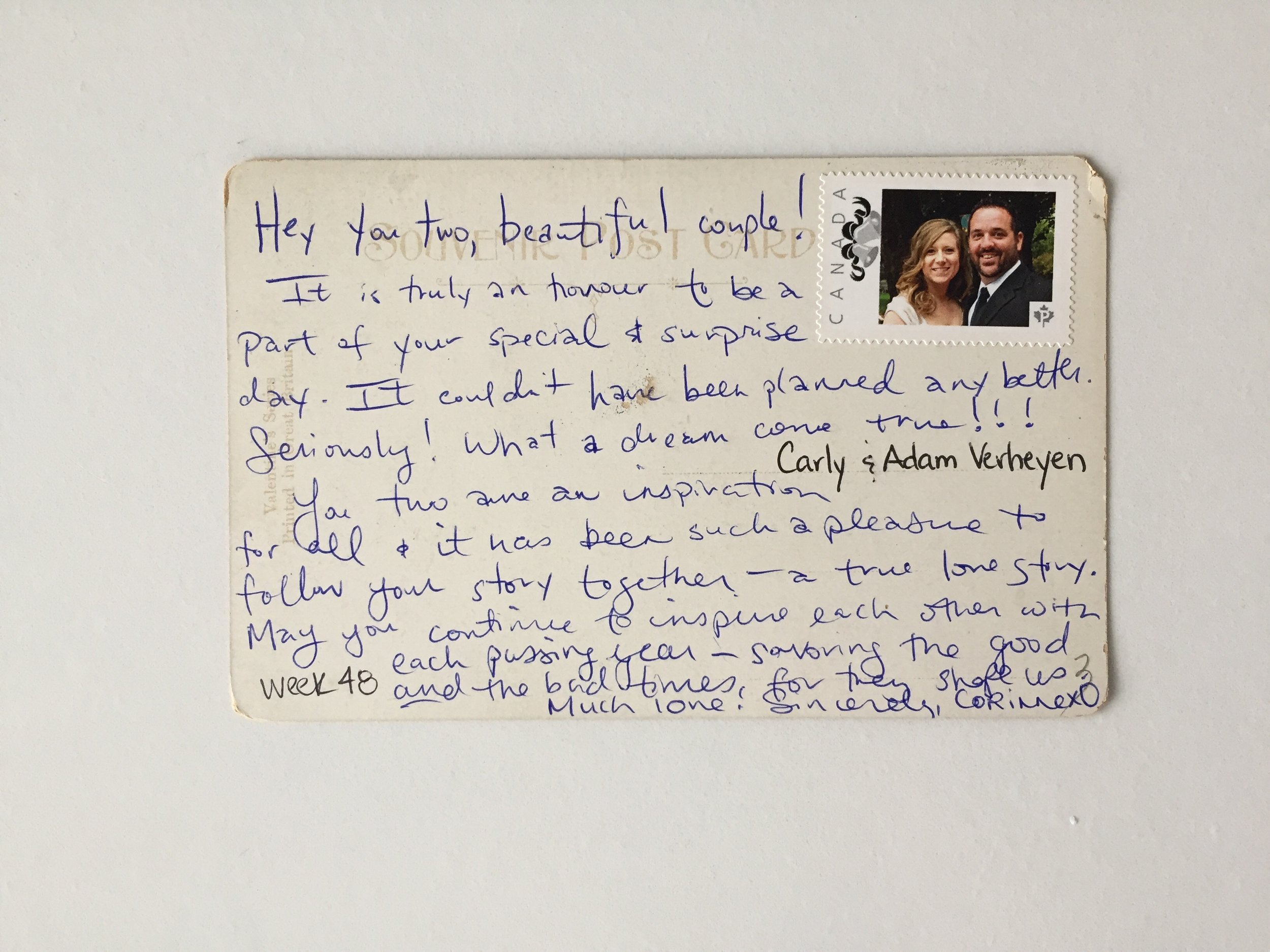
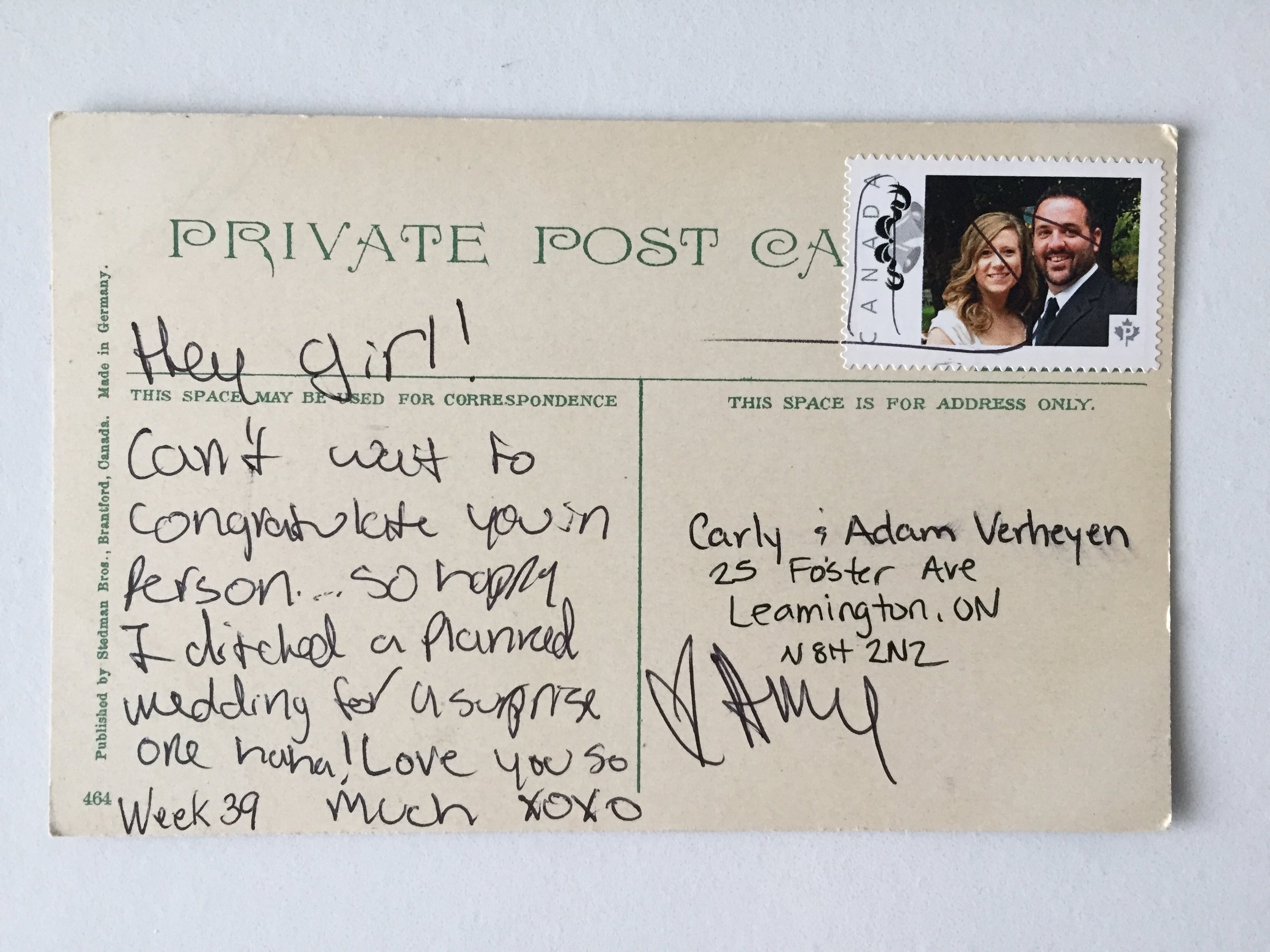
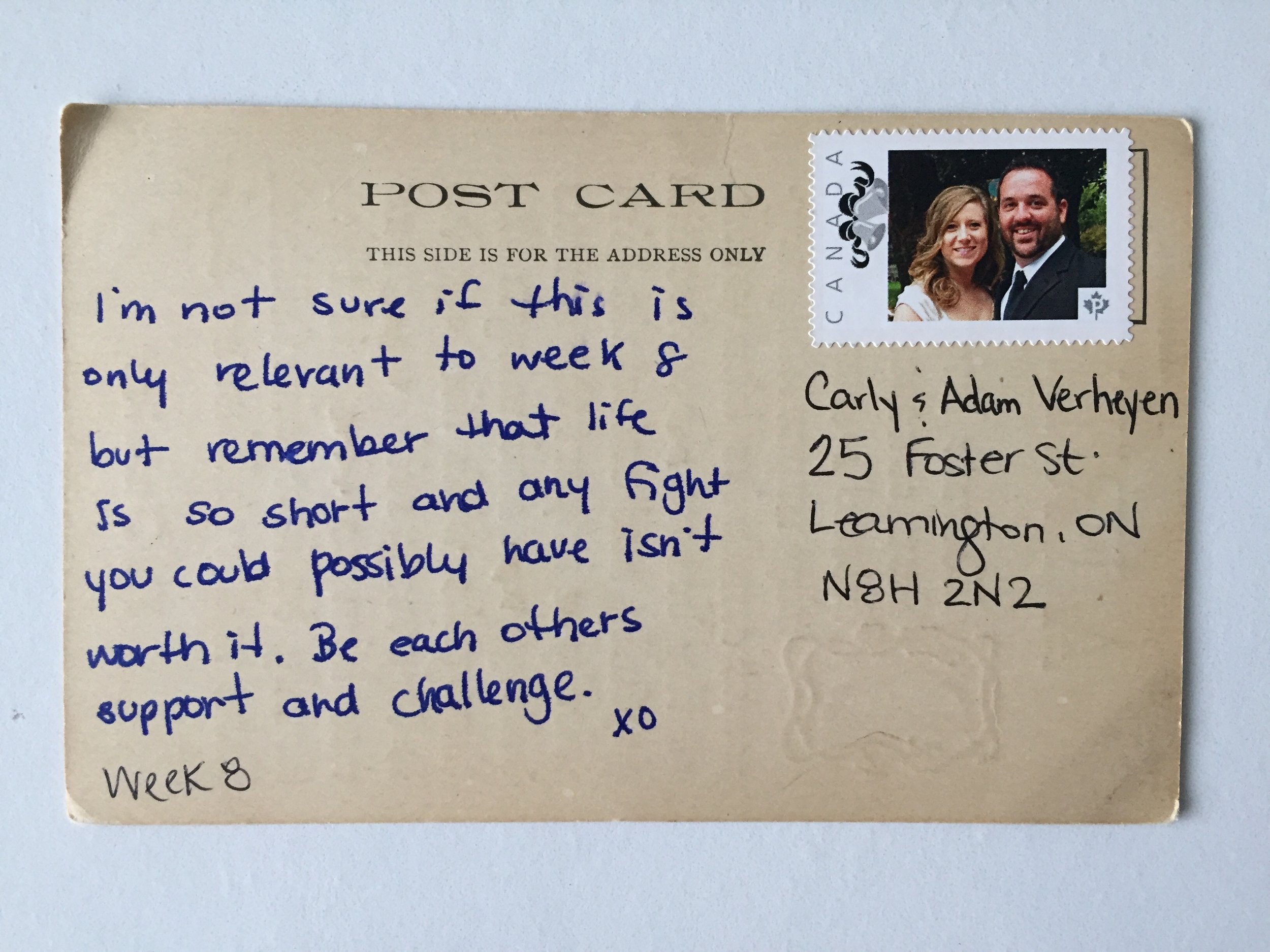
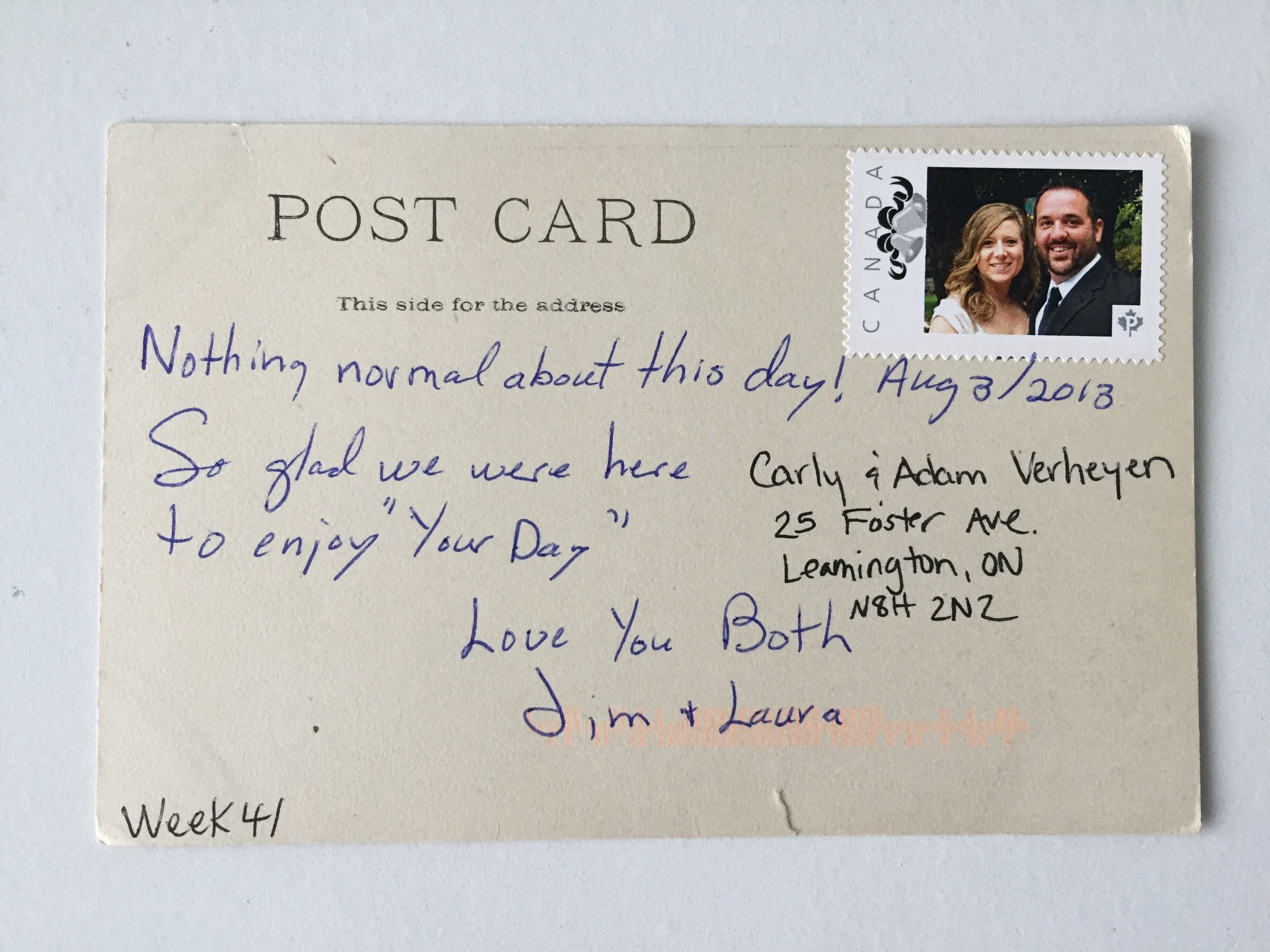
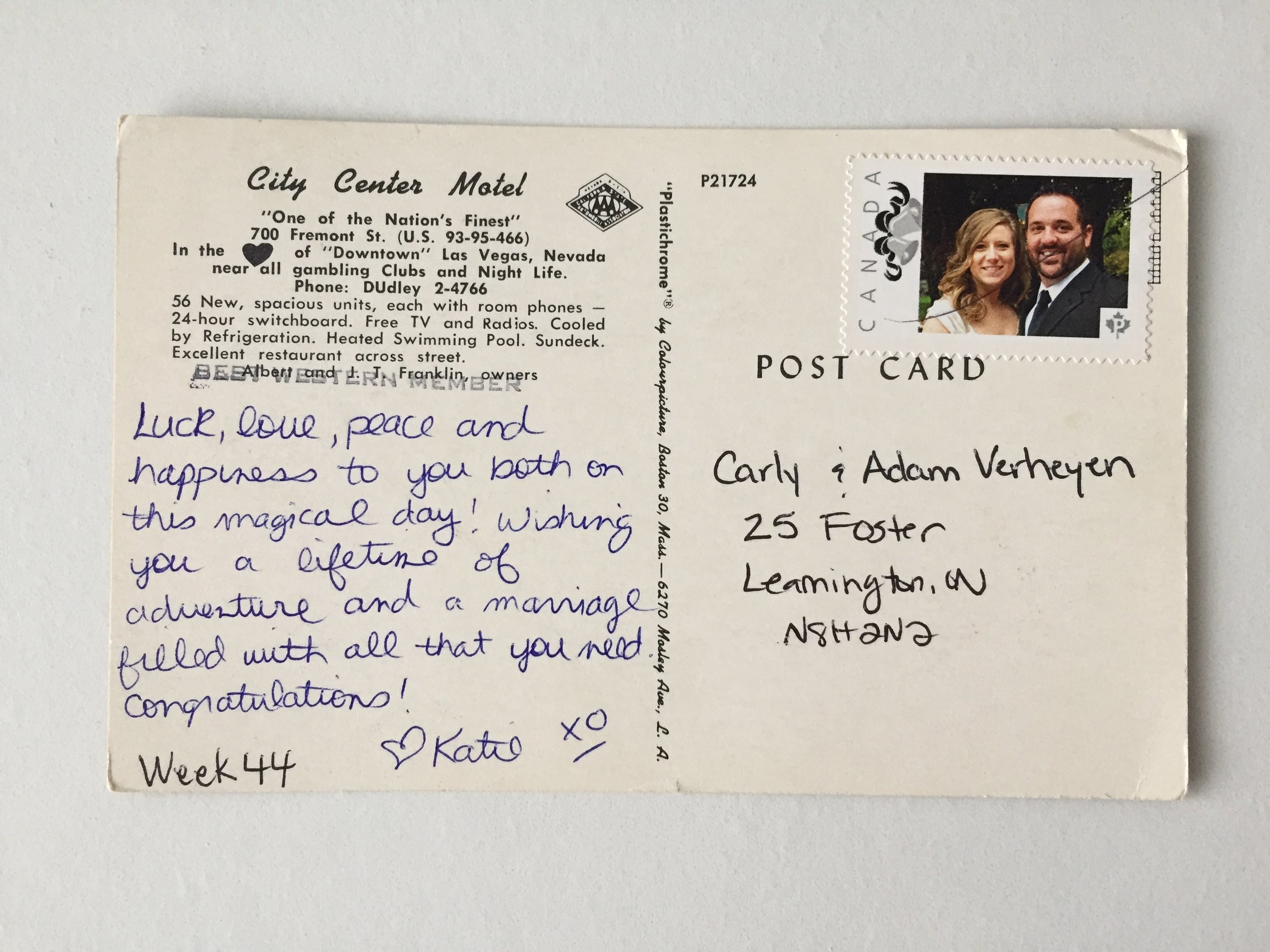
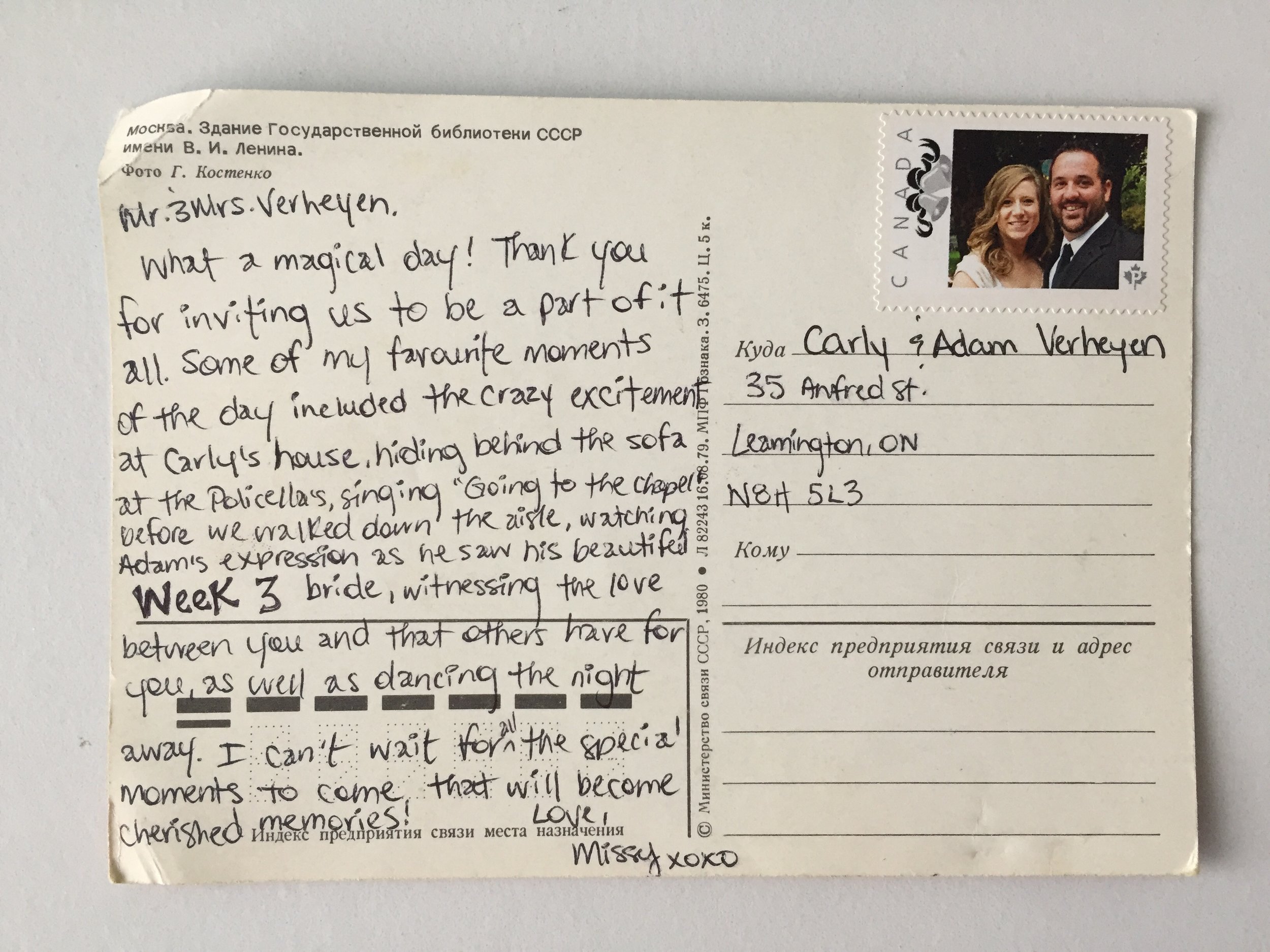
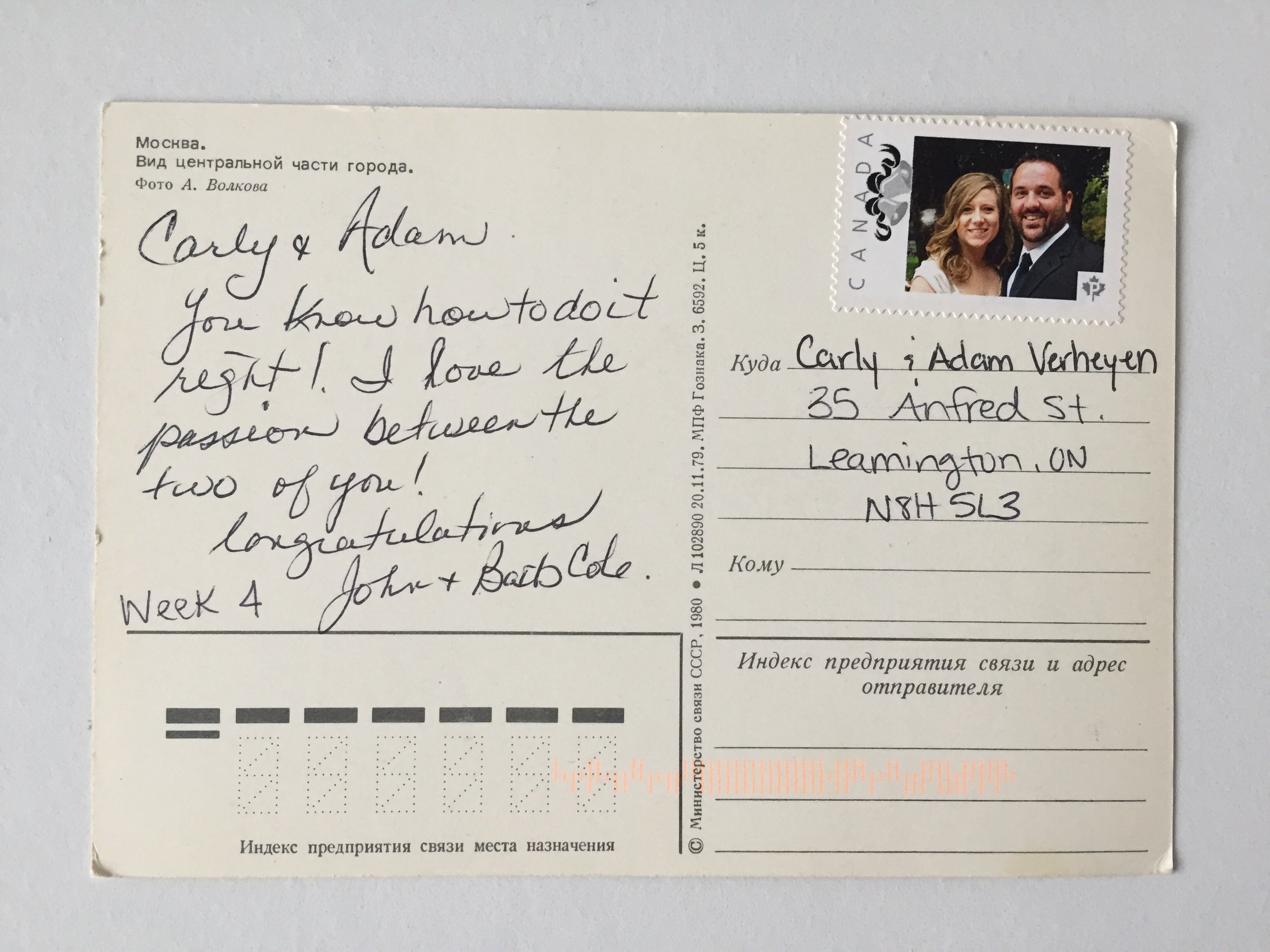
The surprise didn't end that night. The guests of our surprise wedding filled out postcards that had a number from 1 – 52 in the corner, and every week of our 1st year of marriage, a vintage postcard from one of our wedding guests came in the mail. Some of the guests took them home with them to fill out and send themselves, while others wrote a message that day or night and left it in a mailbox by the end of the night for our good friend to mail to us each week.
Some had marriage advice, some had memories of our wedding day, and others had drunken messages of love and well wishes. It was such a treat to feel the love from our wedding guests all year long.
A few of our faves are below.
The Keepers • Sharon W. Huget

BY SHARON W. HUGET
As I go through three months worth of papers that have accumulated in piles trying to put the keepers into files, I find the letter my Auntie Mary Ann wrote in early January. It was a response to our annual family Christmas card. It immediately catches me and I bring it to the table so I can re-read it over my Sunday tea. Ah Sunday—a day for quiet, un-hurried, sit down tea, sipped slowly while still hot.
The delicate handwriting with it's curves and fancy loops echoes the scalloped edged stationary, eggshell blue with pink roses framing the page. A what's happening letter—about life and change and questions about the happenings in our lives as my own kids grow up and we grow older.
It has been years since all my cousins were at her place searching for coloured hard-boiled Easter eggs hidden in corners of the basement, around storage boxes and in my uncle's work boots. Christmas memories of cousins relegated to playing in the basement and giggle fits as the pack of us are ordered to sleep, squished wonderfully side by side, sleeping bag to sleeping bag. I remember the sounds from the downstairs guest room and hearing the late night footsteps of clean up in the kitchen, lingering laughter of adult siblings and in-laws visiting upstairs and the early morning hurried stomps of getting breakfast out and the roast in before dressing in Sunday clothes and heading for church. So long ago—and yet, the familiar script has brought her close again for a moment of cherished remembering.
It’s a keeper—a piece of caring and love from my dear Aunt Mary Ann.

Some People Live a Whole Lifetime, and They Never Learn to Love the Rain • Adrienne Pieroth

BY ADRIENNE PIEROTH
I received this letter towards the end of my freshman year in college. I was away from my hometown of Denver, Colorado, attending Drake University in Des Moines, Iowa. It had been a year of adjustments for me — some good, some challenging — like most 18 year-olds spending their first long period of time away from home. My mother had always been the center of my life, the touchstone I would return to over and over again for comfort, love, a hug, a laugh, or a cup of tea and a much-needed chat. My mother was British and had me late in life the at 39 years old.
Perhaps it was her older, wiser years that made her such a solid and grounded figure in my life. If you asked me what defined the word “home” for me, I would say without hesitation, my Mum. While being away from the comforting home and life she had created for me was difficult at first — her care packages and letters she sent each week made all the difference. Most of the letters were about daily stuff — what was happening at home, with my Dad, or how the cats were doing. But towards the end of the year, this letter arrived. I knew it was special from the minute I opened it. I had no way of knowing that less than five years later, I would be sharing the words in this letter as part of the eulogy I gave at her funeral.
Throughout my high school years my mother battled a rare form of cancer. During those years, I lost track of the number of surgeries, and the radiation and chemotherapy treatments. But all the while, I never once remember her complaining, or asking “why me?” Perhaps the fact that my mother grew up in England during World War II, where nights spent in bomb shelters, rations and stories of sacrifice and bravery defined her youth. All I knew was that my mother had incredible strength, optimism, and not for one minute did she ever believe she wouldn’t survive her battle with cancer.
When I first read it, the part of the letter that struck me most was that she was proud of me. My mother always told me she loved me and how proud she was of me, but it was something different to see it in words, written on a page, in her beautiful handwriting — handwriting, by the way, I couldn’t read until I was nearly ten. My mother had been a secretary and knew shorthand, so her writing was a combination of cursive and shorthand in a style all it’s own.
Years later, at her funeral, it was her last words that spoke to me most, and the ones I shared with family and friends gathered to say goodbye. They were:
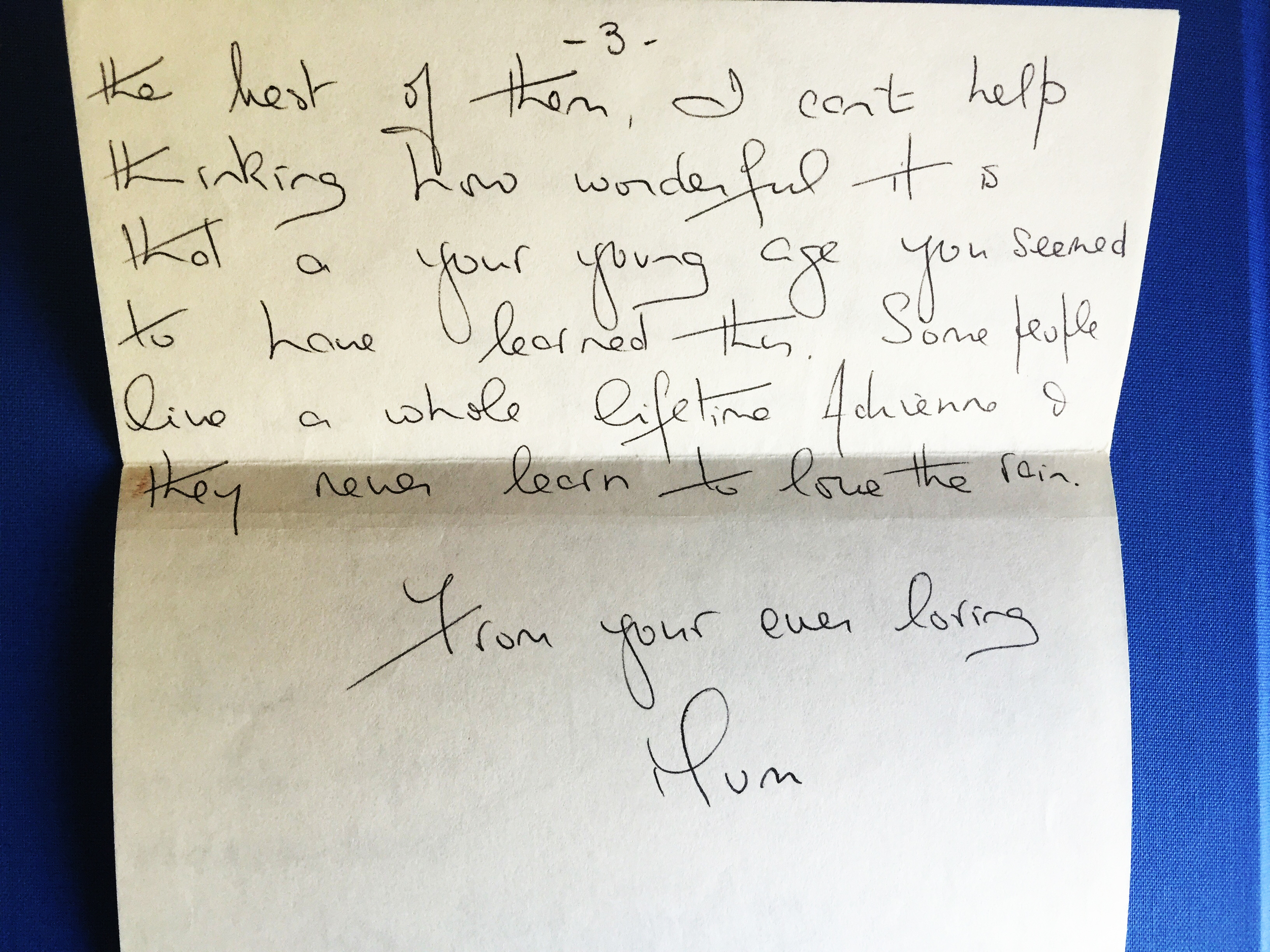
...we have to have some grey days in our lives in order to appreciate the bright sunny ones, and we have to make the best of them. I can’t help thinking how wonderful it is that at your young age you seemed to have learned this. Some people live a whole lifetime, Adrienne, and they never learn to love the rain.
If I learned to love the rain, I learned from my mother’s example. Looking back, I wonder which of her grey days she was remembering as she wrote those words. The day I read those words as part of her eulogy was the greyest day of my life to date, even 26 years later, but the brightness of her love and the memories of my time with her outshine the rain. Whenever I want to remember this, I need only to open the envelope that contains my mother’s beautiful words of love and support to be reminded.


April 29th, 1985
My Dear Adrienne,
I am looking forward so much to having you home for the summer. To hear the front door open & to hear you say, “Hi it’s me.” Your dad & I have missed your very much since you went off to college but we know this is the first stage of our daughter’s independence. We love you very much & we are so very proud of you. We know you have worked long & hard in all of your classes & it’s been a struggle, so many times wanting to go out & have fun, or go to a party, but knowing that you have homework to do and that the studies come first.
You have always been able to appreciate the small things in life, Adrienne – a diamond ring – a new 28oz – a trip around the world! So just kidding, I really mean the small & important things in life. When we talked on the phone last week I remember your comment on the weather. It was raining & you said when you were passing a couple of students they were complaining about the rain; how wet & miserable it was. You told me you were smiling inside because it brought back memories of England back to you & the air smelt so sweet & fresh.
Life is a little like that – we have to have some grey days in our lives in order to appreciate the bright sunny ones, & we have to make the best of them. I can’t help thinking how wonderful it is that at your young age you seemed to have learned that. Some people live a whole lifetime Adrienne & they never learn to love the rain.
From your ever loving,
Mum
A photo of Adrienne and Mum










I Don't Create With Any Intention of Meaning • Tatiana Roumelioti
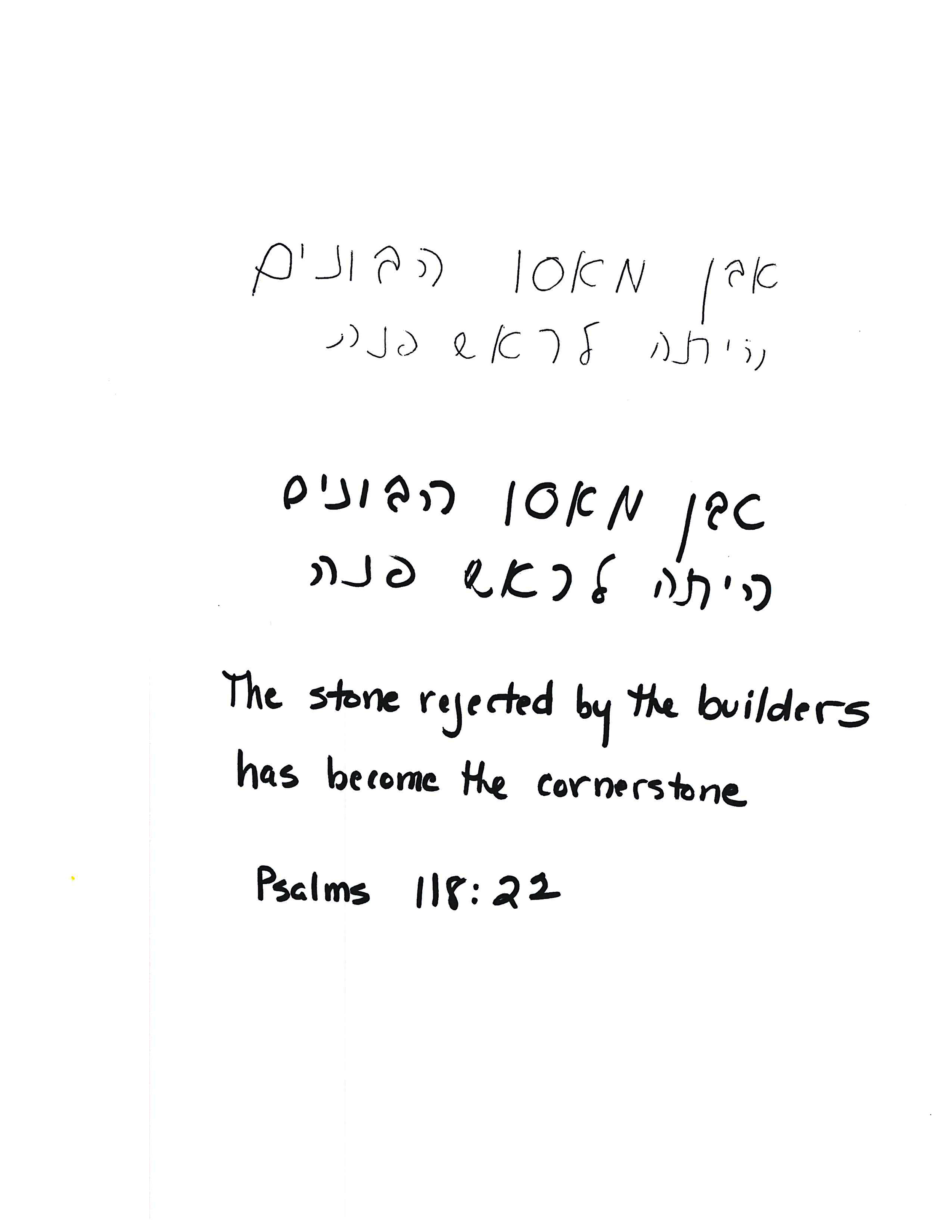
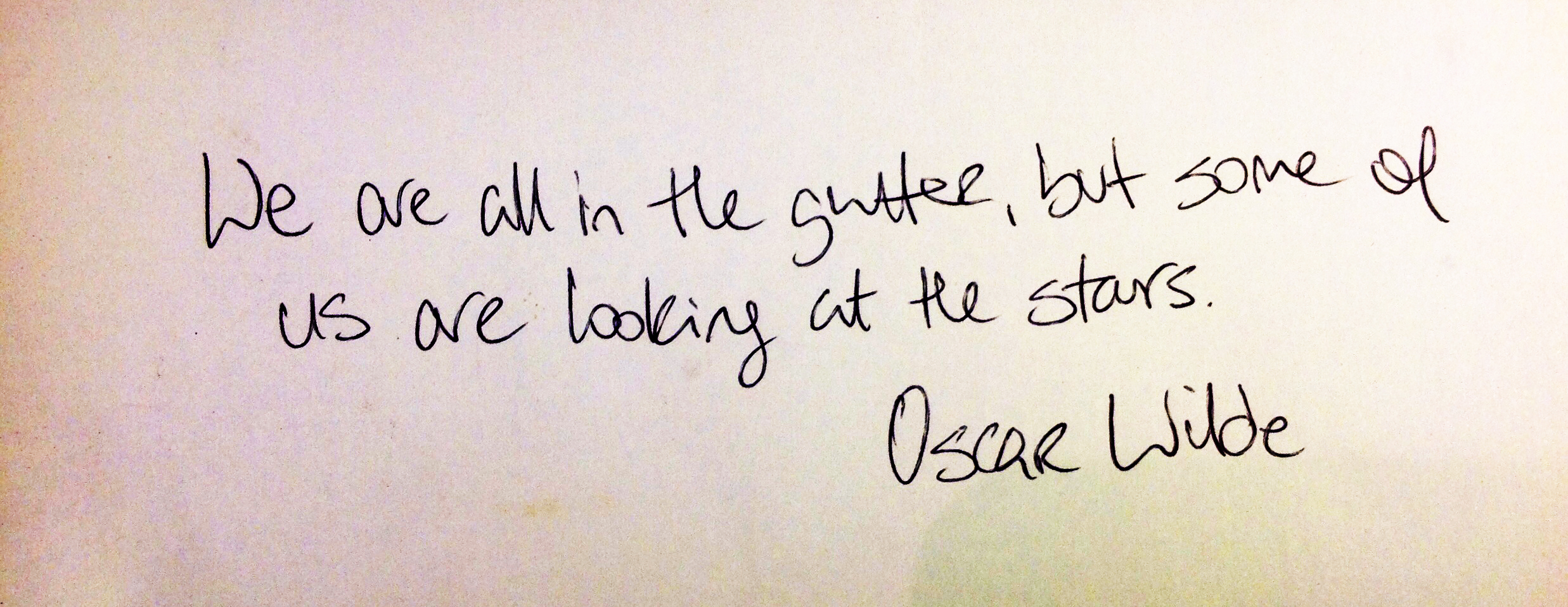
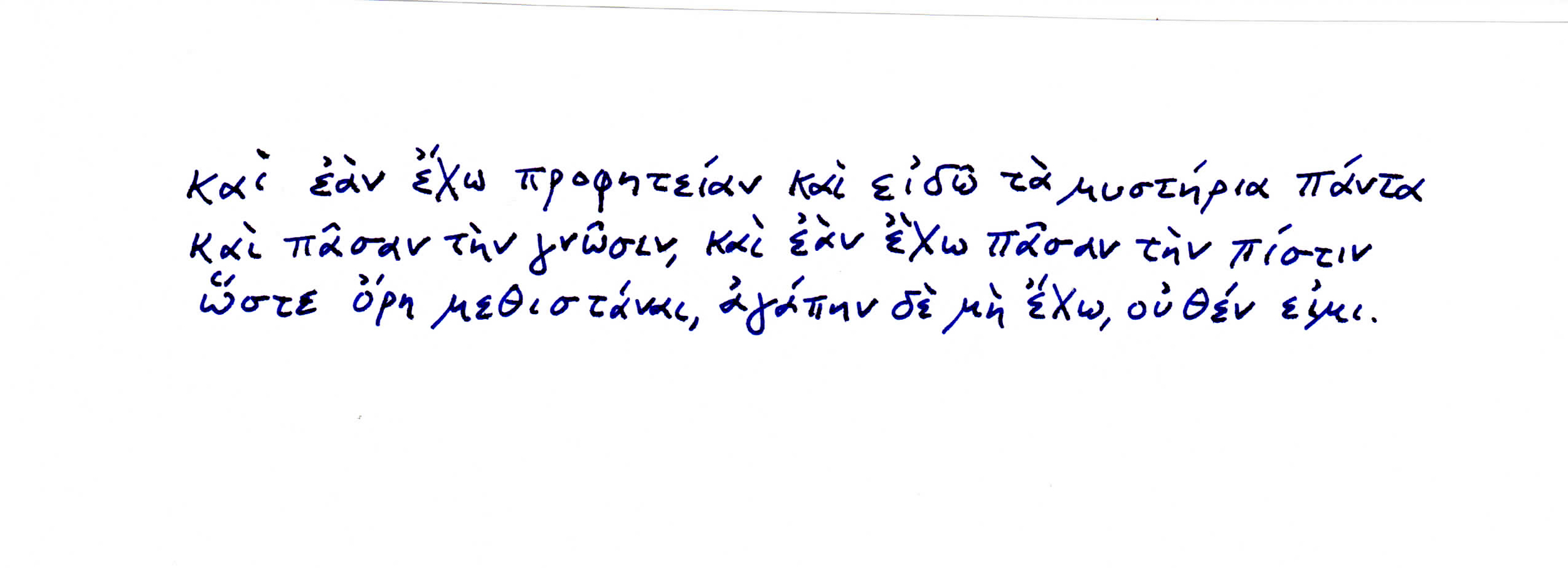
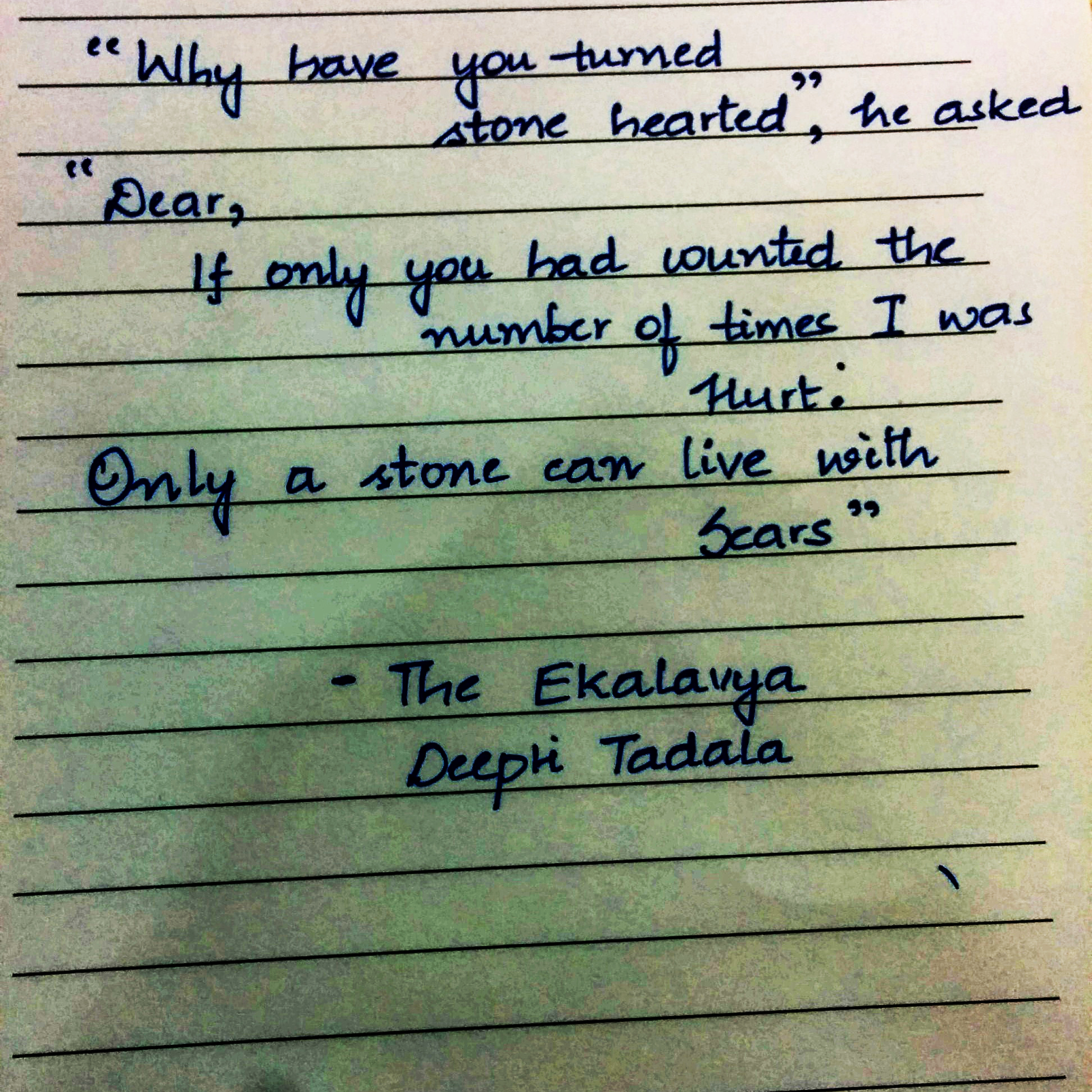
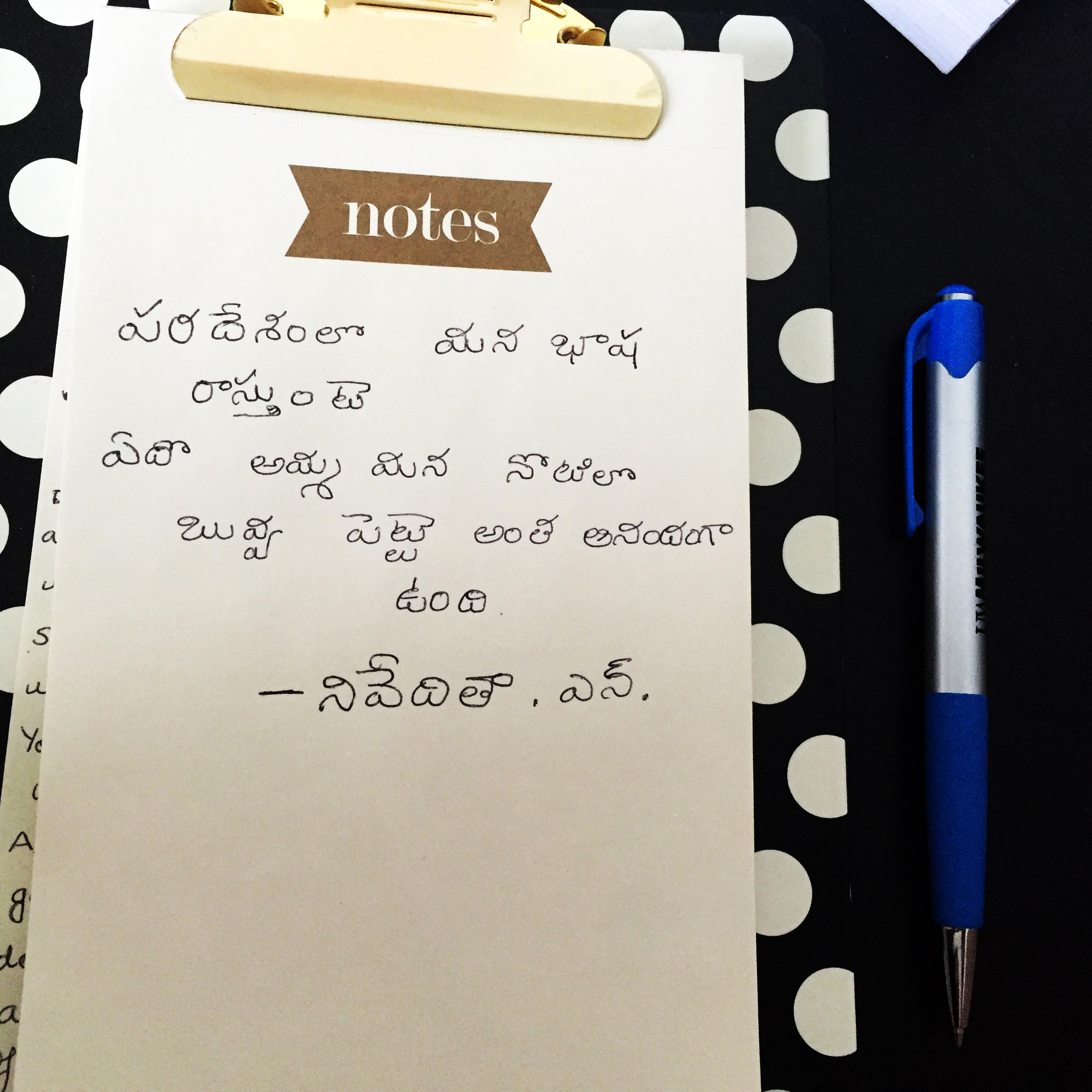
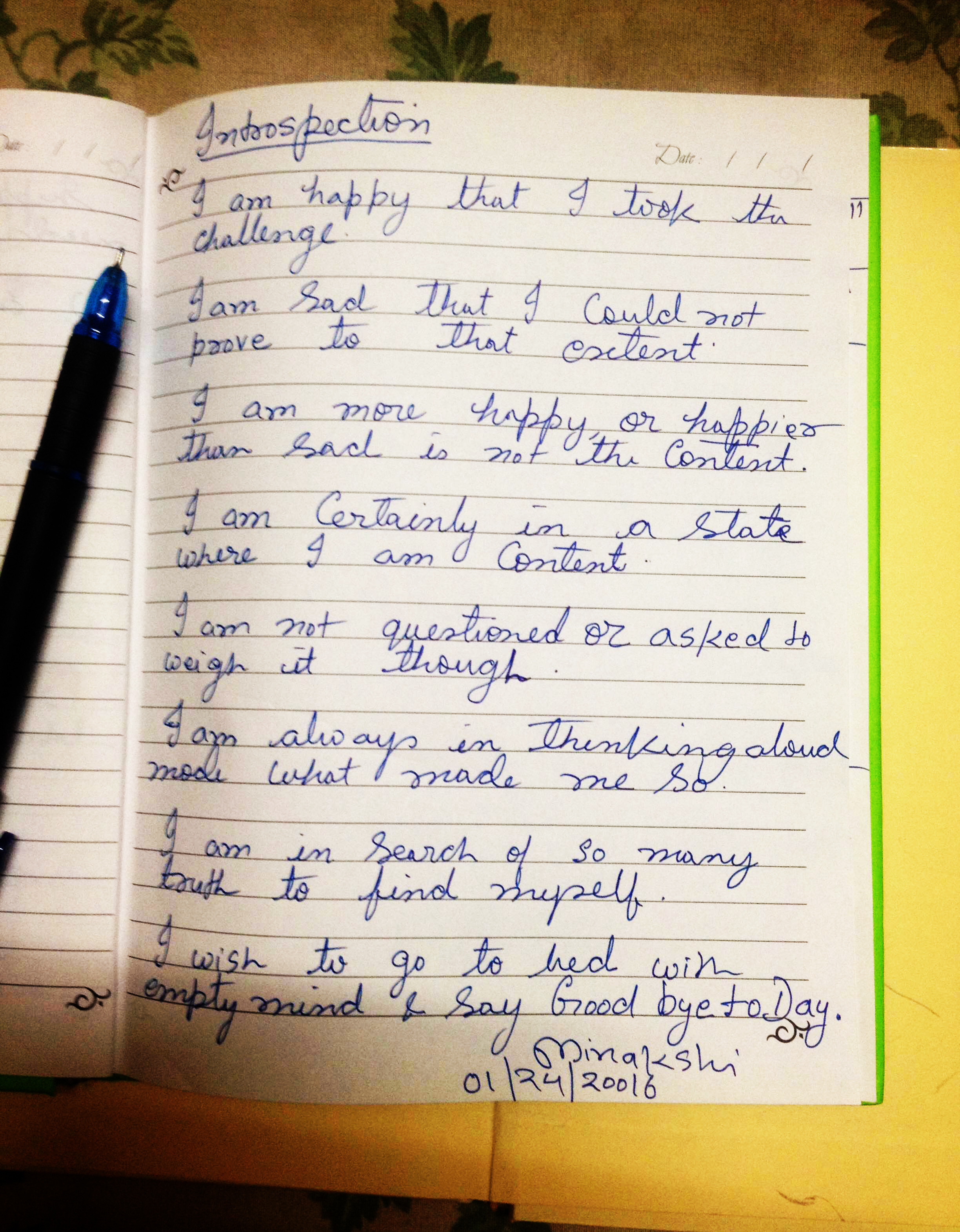
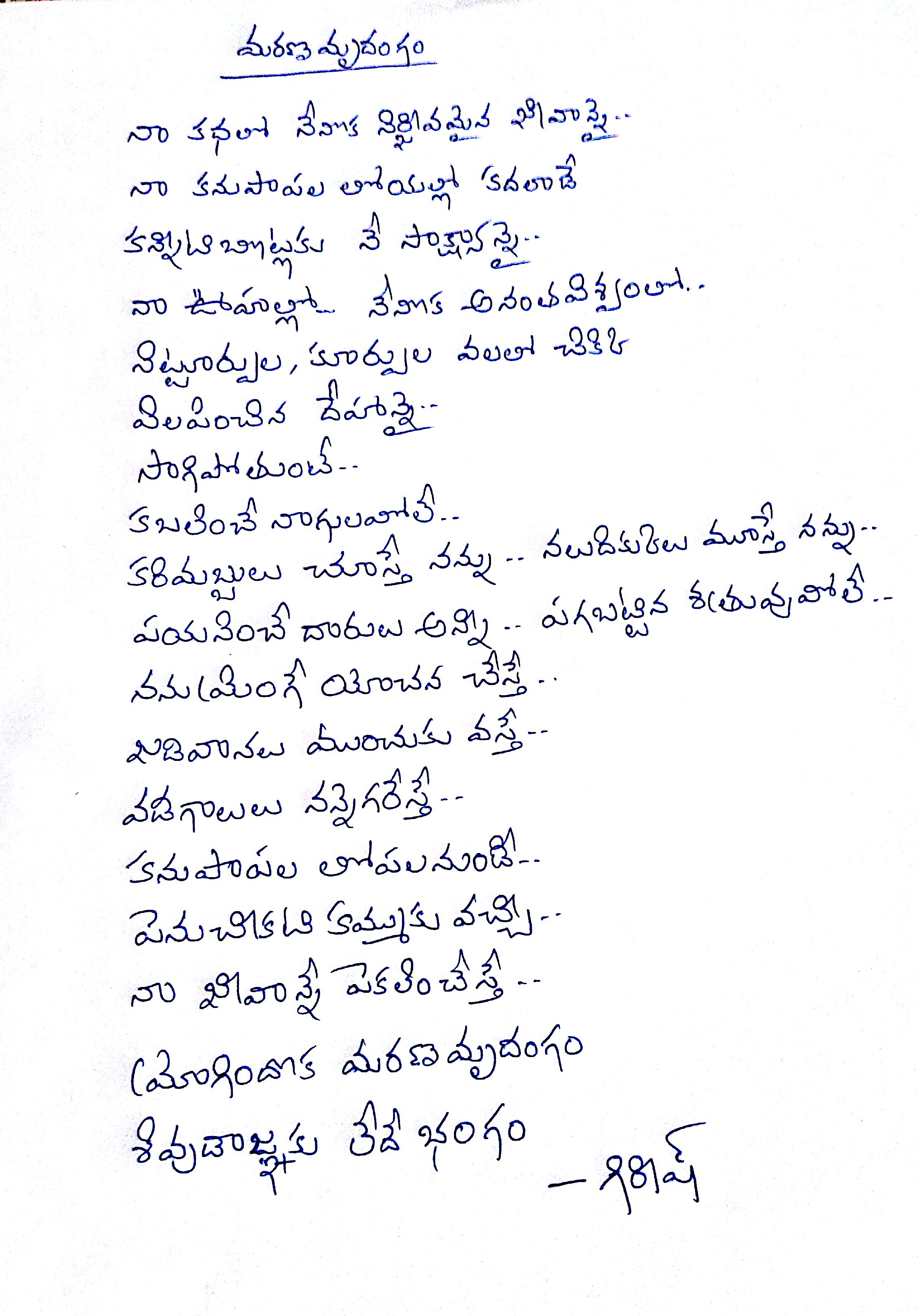
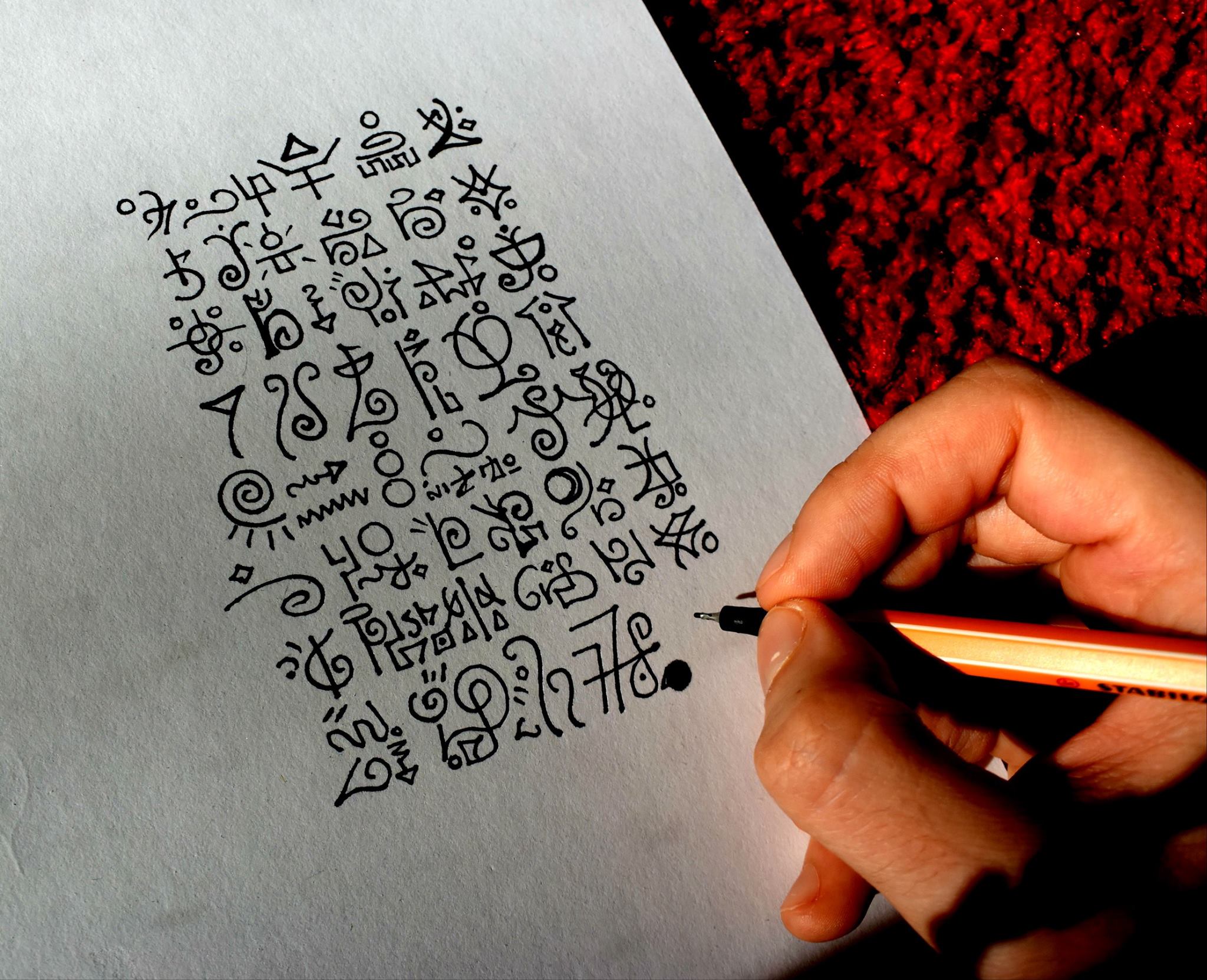
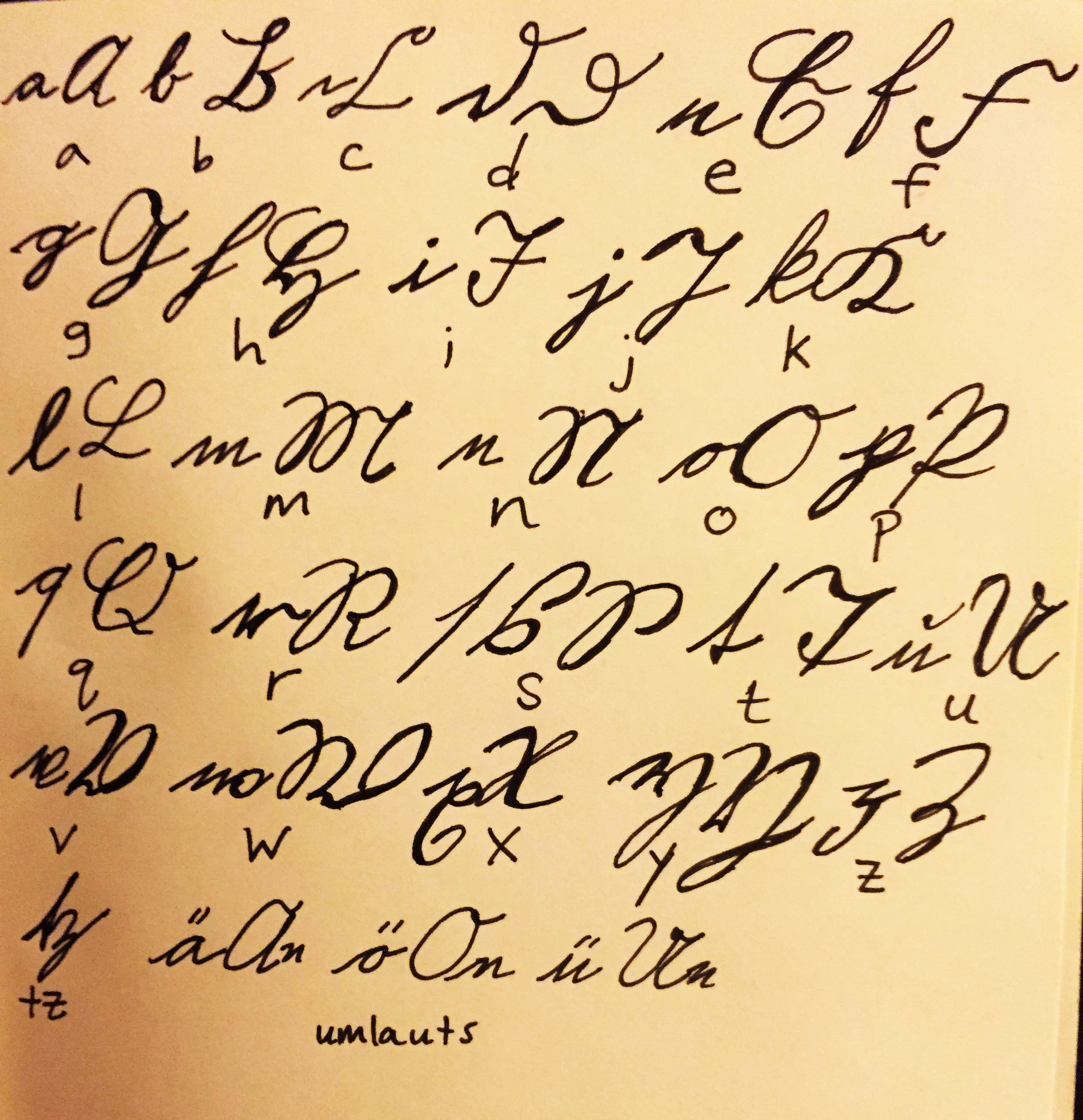
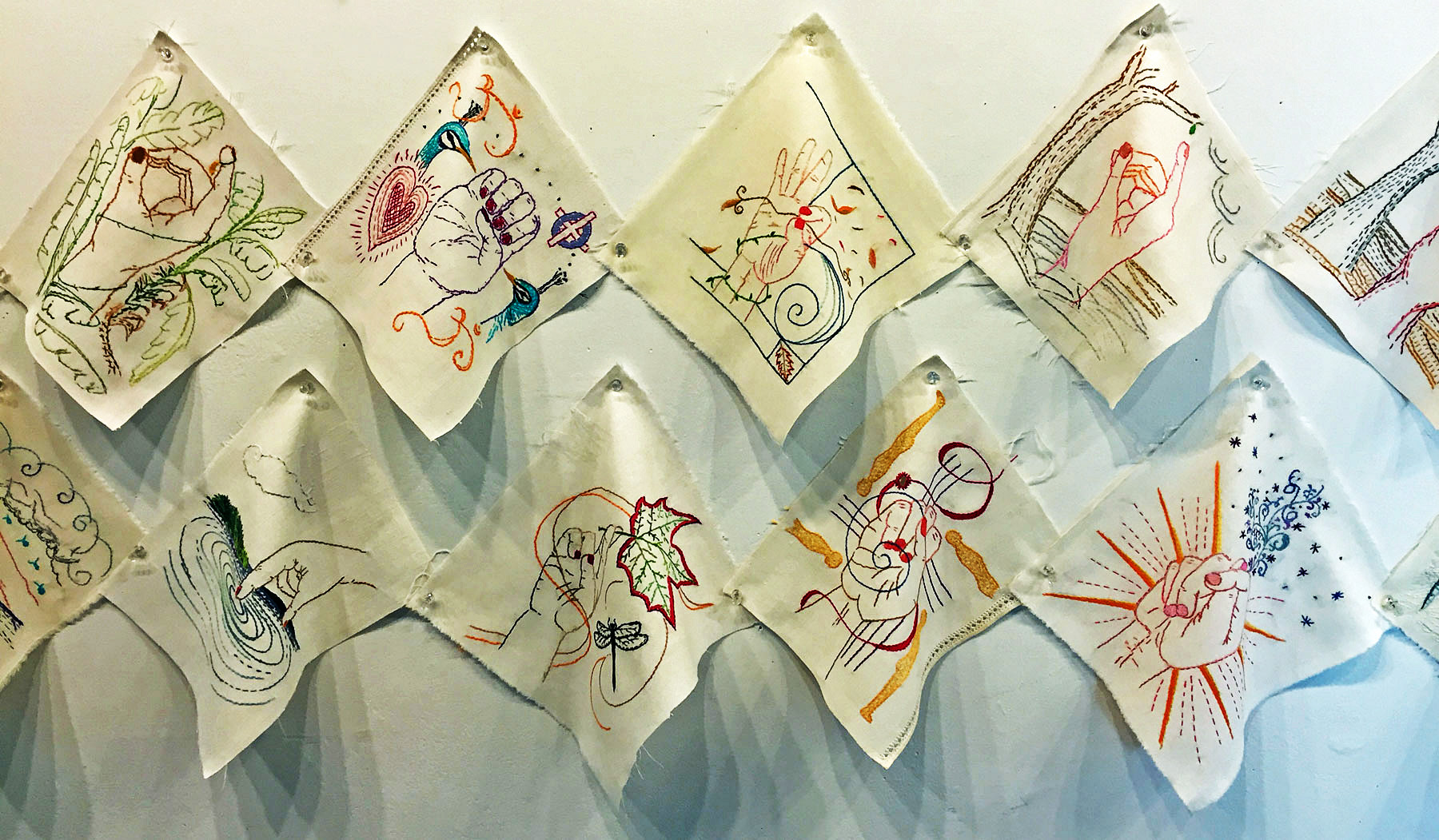
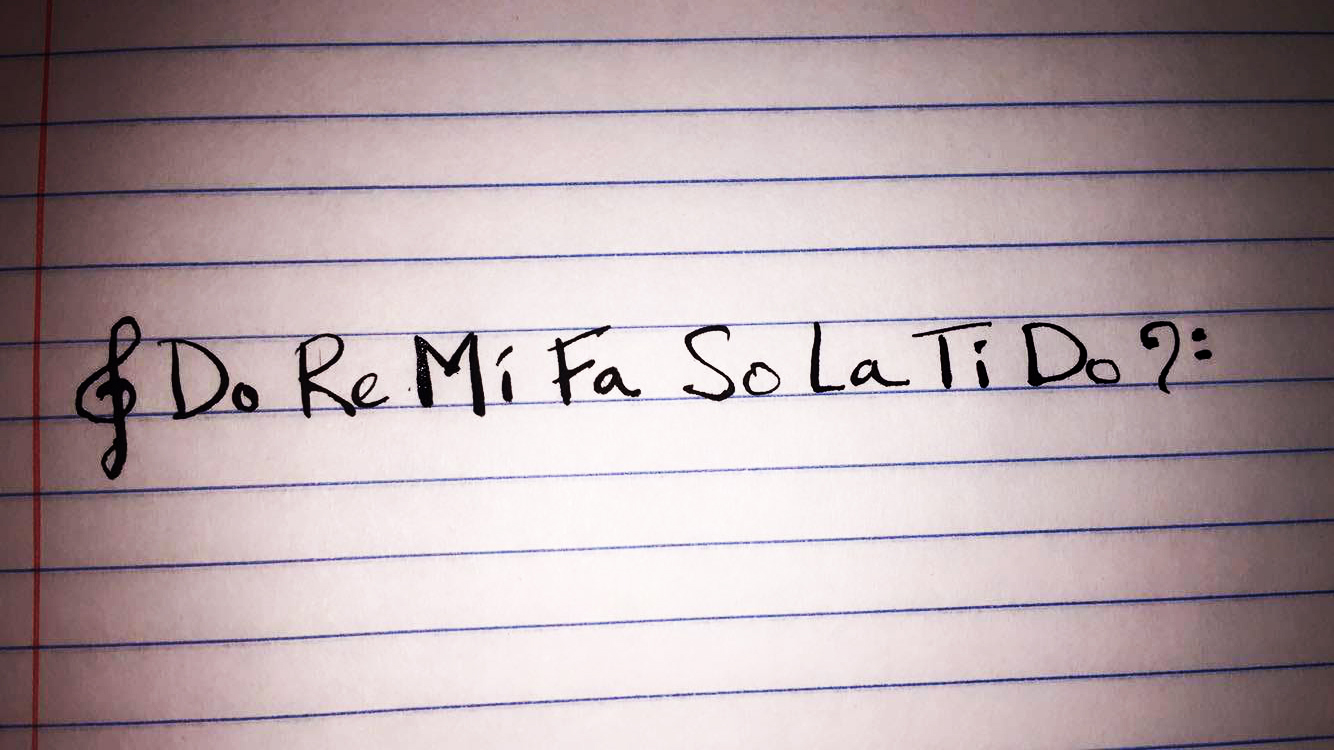
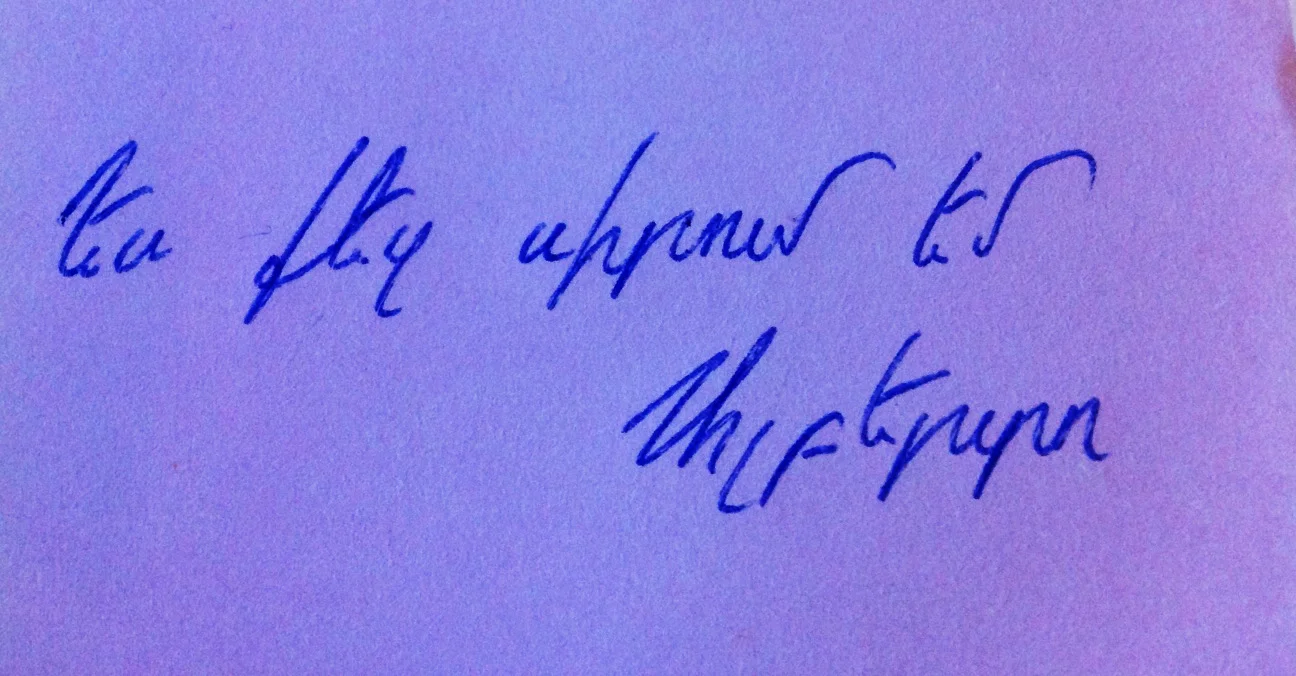
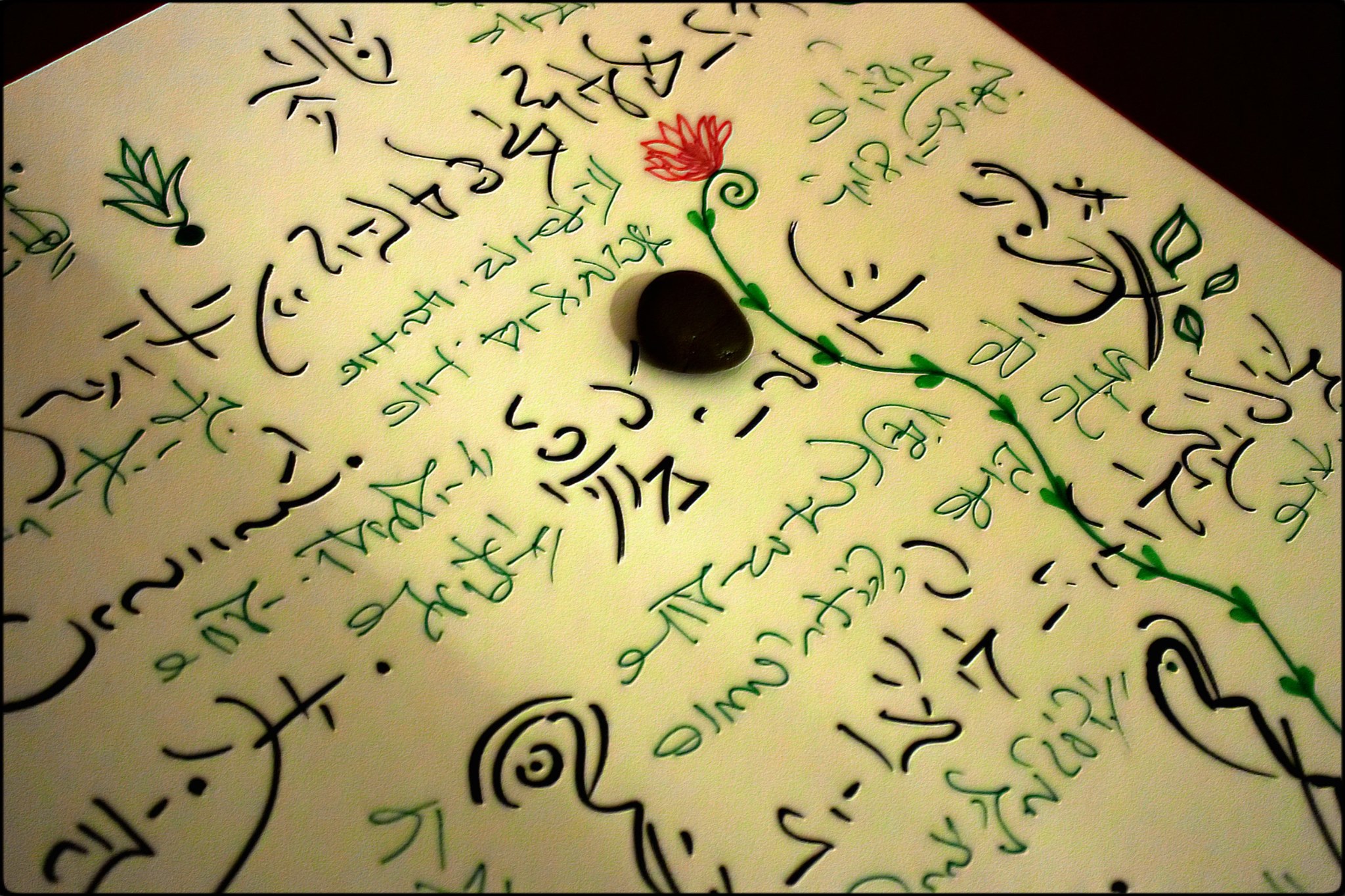
It'd odd how the simple coordination of individual strokes leads to the immediate recognition of meaning. But what happens when those strokes are combined new lines? Artist Tatiana Roumelioti has been exploring the bridge between art and words. You could say she's invented an alphabet, but that would be putting meaning where there is none. And so, we leave her words as they are, and their meaning up to you.

By Tatiana Roumelioti
Born on November 9th, 1988, in Athens, Greece,
I am a self taught artist,
and I am fascinated by both art and writing.
I love to bridge the two by using my imagination
to invent letters, glyphs, symbols, scripts.
I don't create with any intention of meaning about them,
so I cannot give
translation of my work.
However, it can speak by itself
on a personal level,
like any other form of Art.



Education Means to Me The Most Powerful Weapon • Rafeha Oyamuddin
* For information about this project, see our note at the bottom of the page *


Hello everyone!
I am a student in 12th grade at ZEC. I want to go to college because I make friends last year when I heard about college I started to dream about going to college. Education means to me the most powerful weapon wich we can use to change the world. With college degree I will always be marketable. By getting education I will have less problems and able to solve them. I teach other girls in my village. When I daughter I wish her to be educated like me and have a bright futur. Because if there is no struggle there is no progress. My greatest wishes to become a doctor and help my family and people. Thanks
Best wishes,
Rafeha Ogamuddin


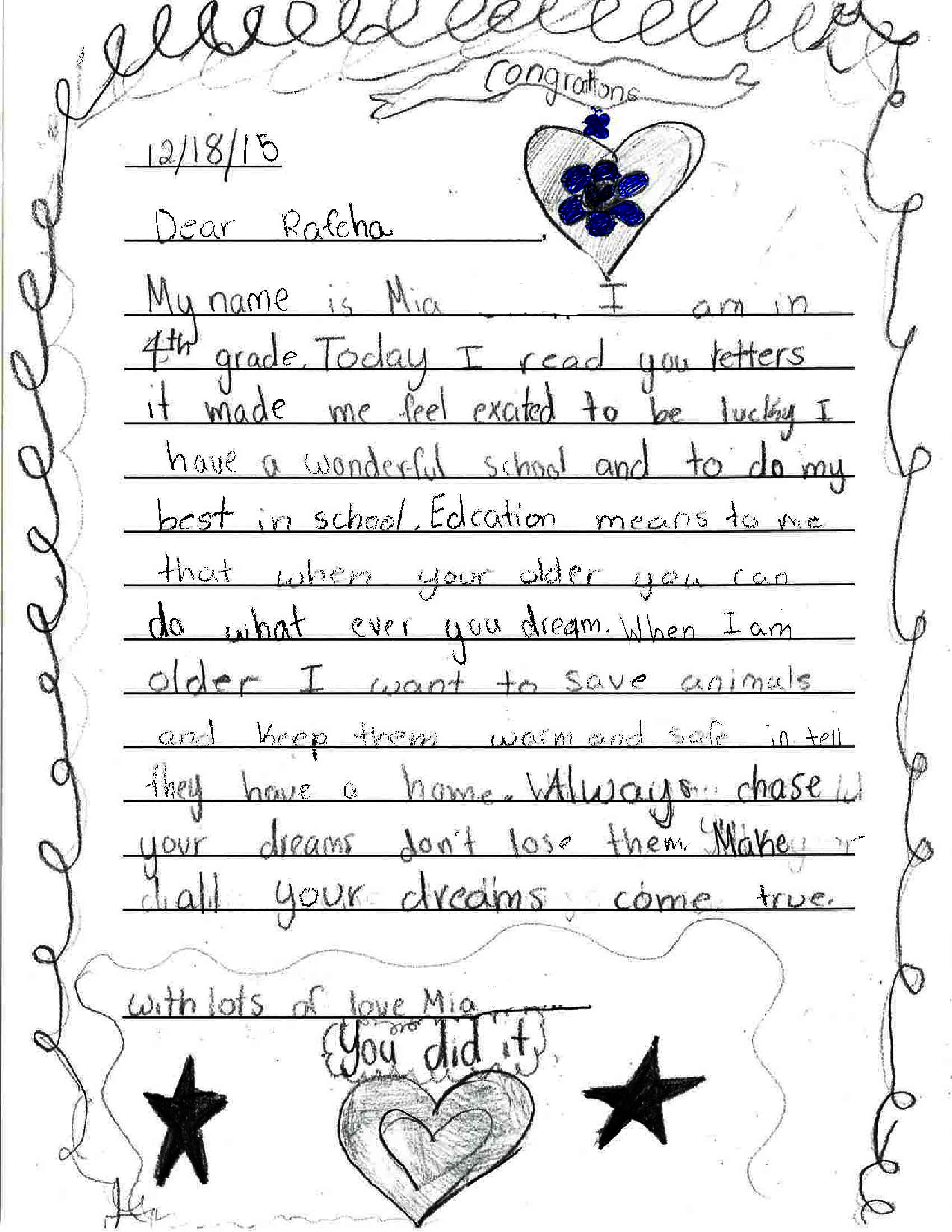


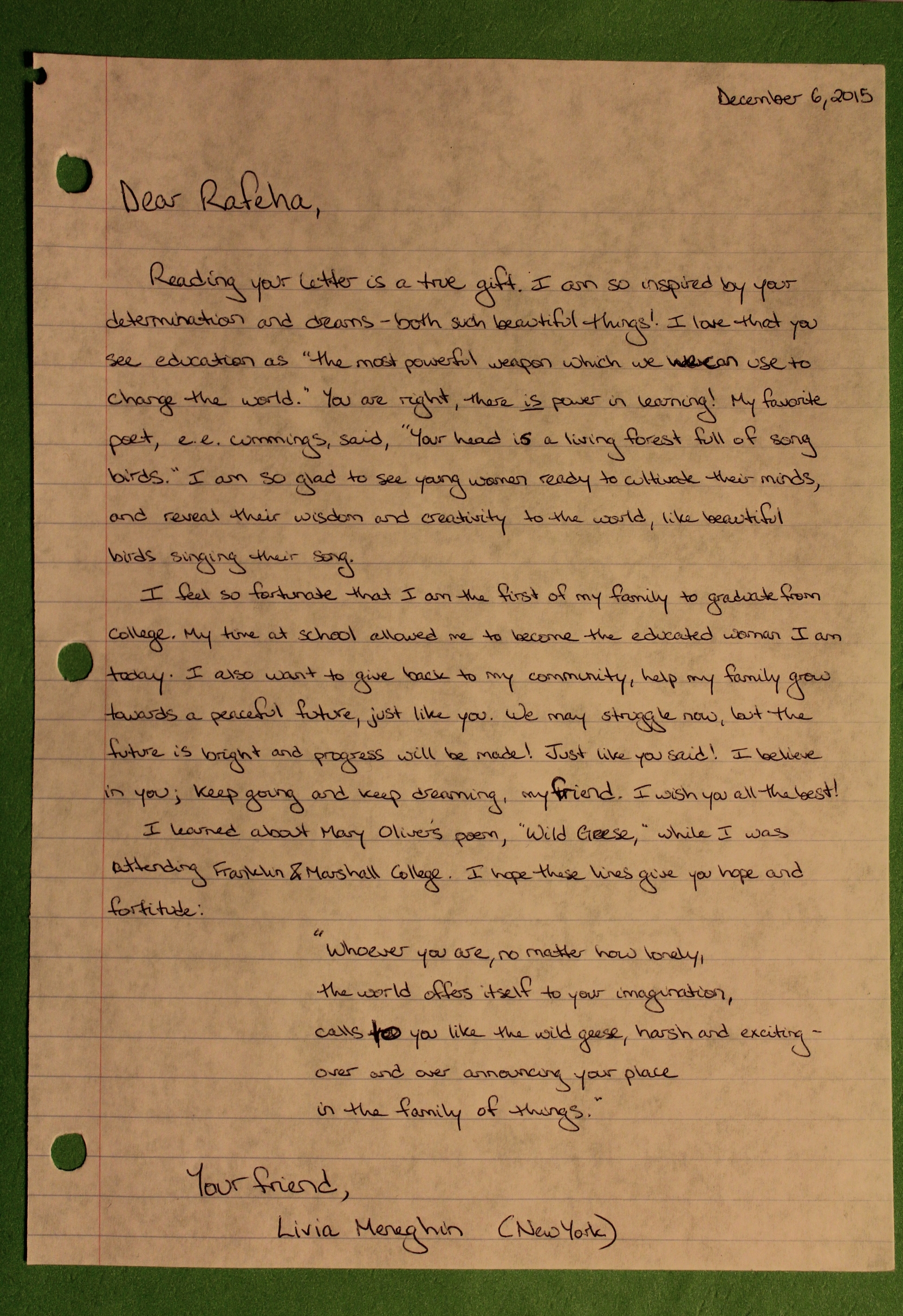

A Note from Handwritten (December 6, 2016): This comes from our exhibit, When I Know The Value of Knowledge, I Start To Dream. We brought the story and letters of seven students from Deh'Subz, Afghanistan into 4th grade classrooms in Brooklyn, because that is when the girls first started school. When they became the first to graduate from high school, they had no college to go to, so they hand-wrote personal statements to a school that didn't exist. Yet. Their letters created an impact campaign that raised $150,000, enough to build the first-ever free private college for women. When we told our 4th grade students about this story, the above, heart-melting letters were their replies.
Snappy Stories in Bed
A Get Well card from an antique shop that is dated 1955. A cute cat, thoughtful note, and throw-back to getting better, hurriedly so.

What was the cure for the common cold in 1955? A cute cat. So cute that nary an extra word is needed.


Have any gems hiding in your deep storage? Send them on over: info@handwrittenwork.com
Time is Our Wealth, Time is Our Slave • Nivedita Nivasini
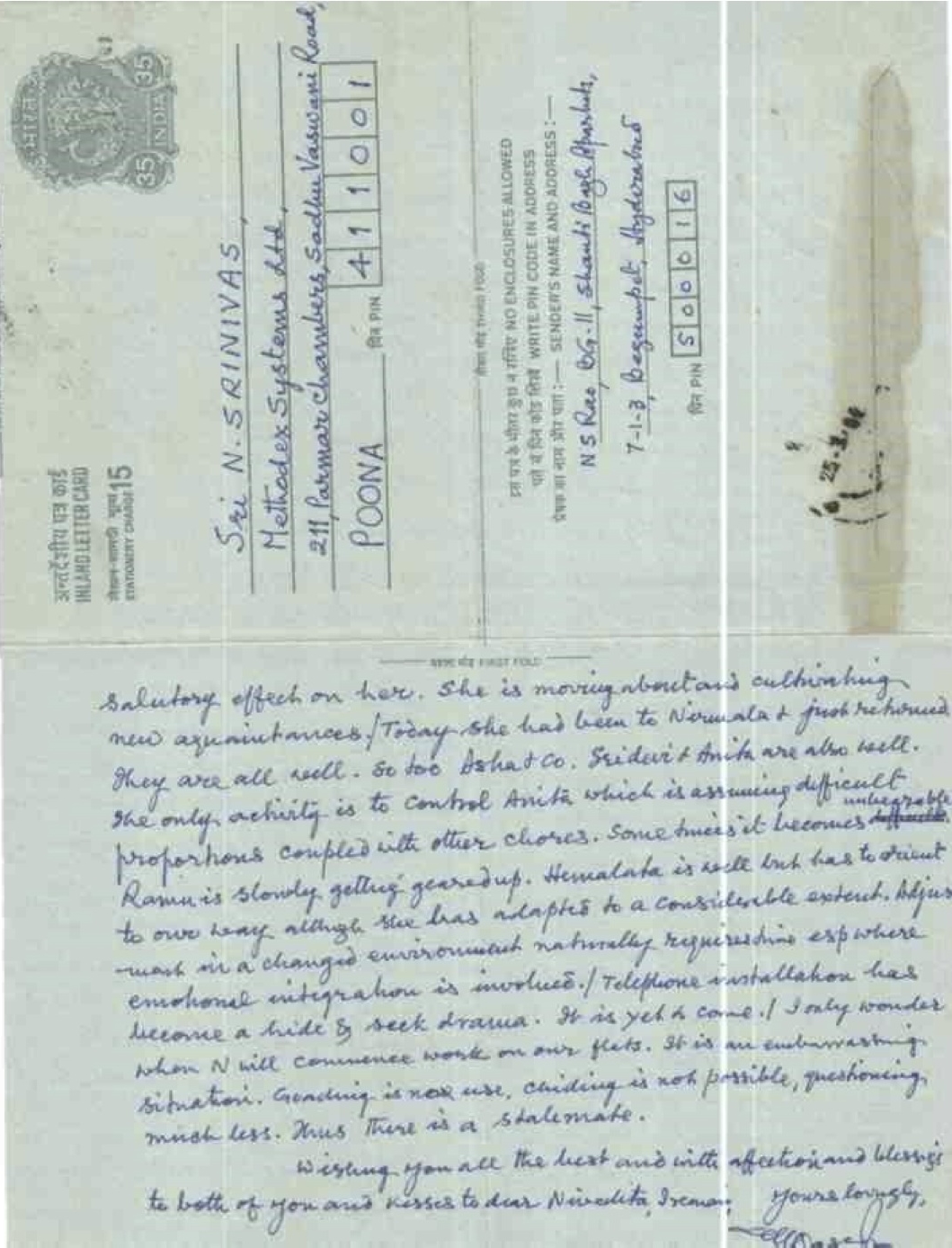
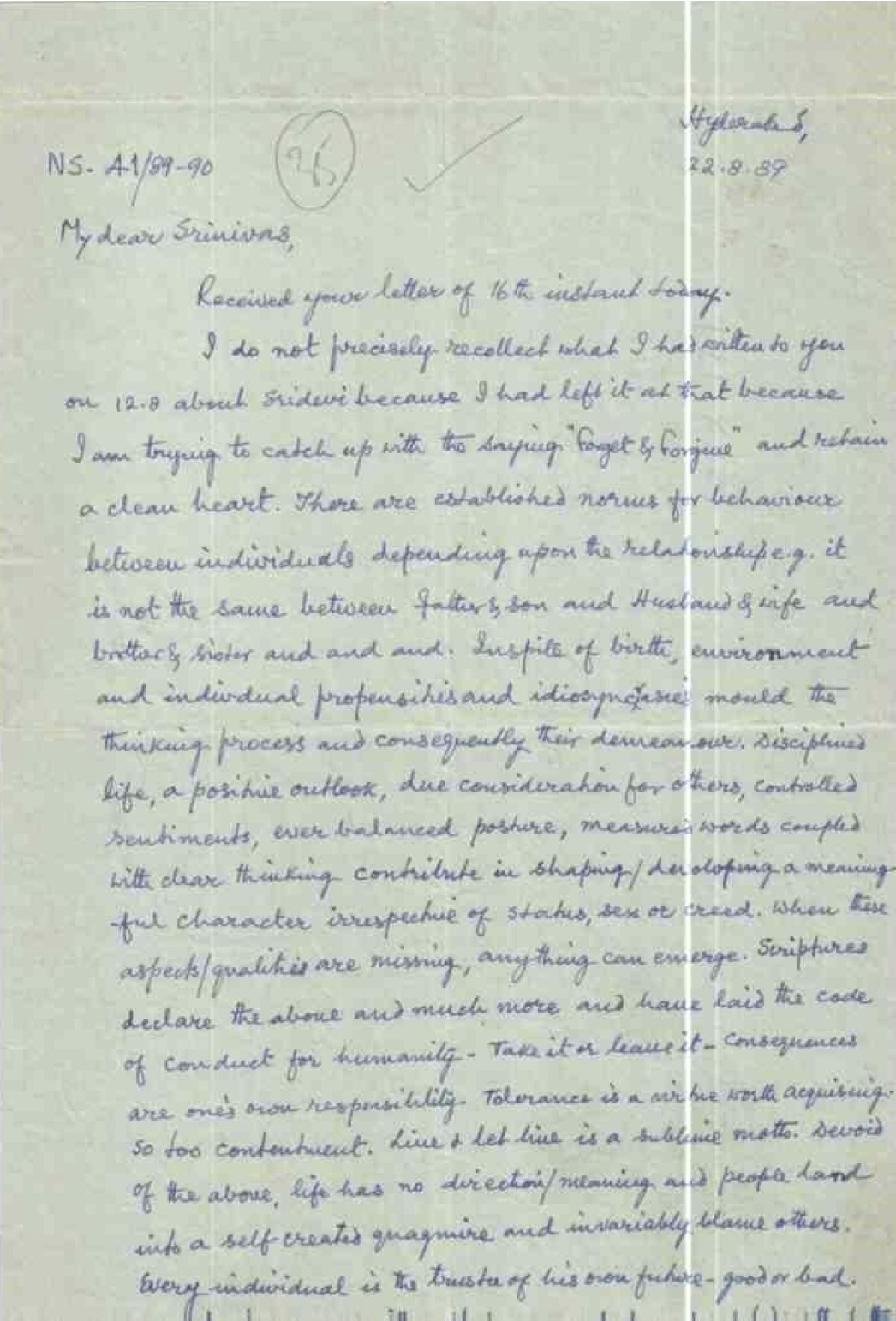
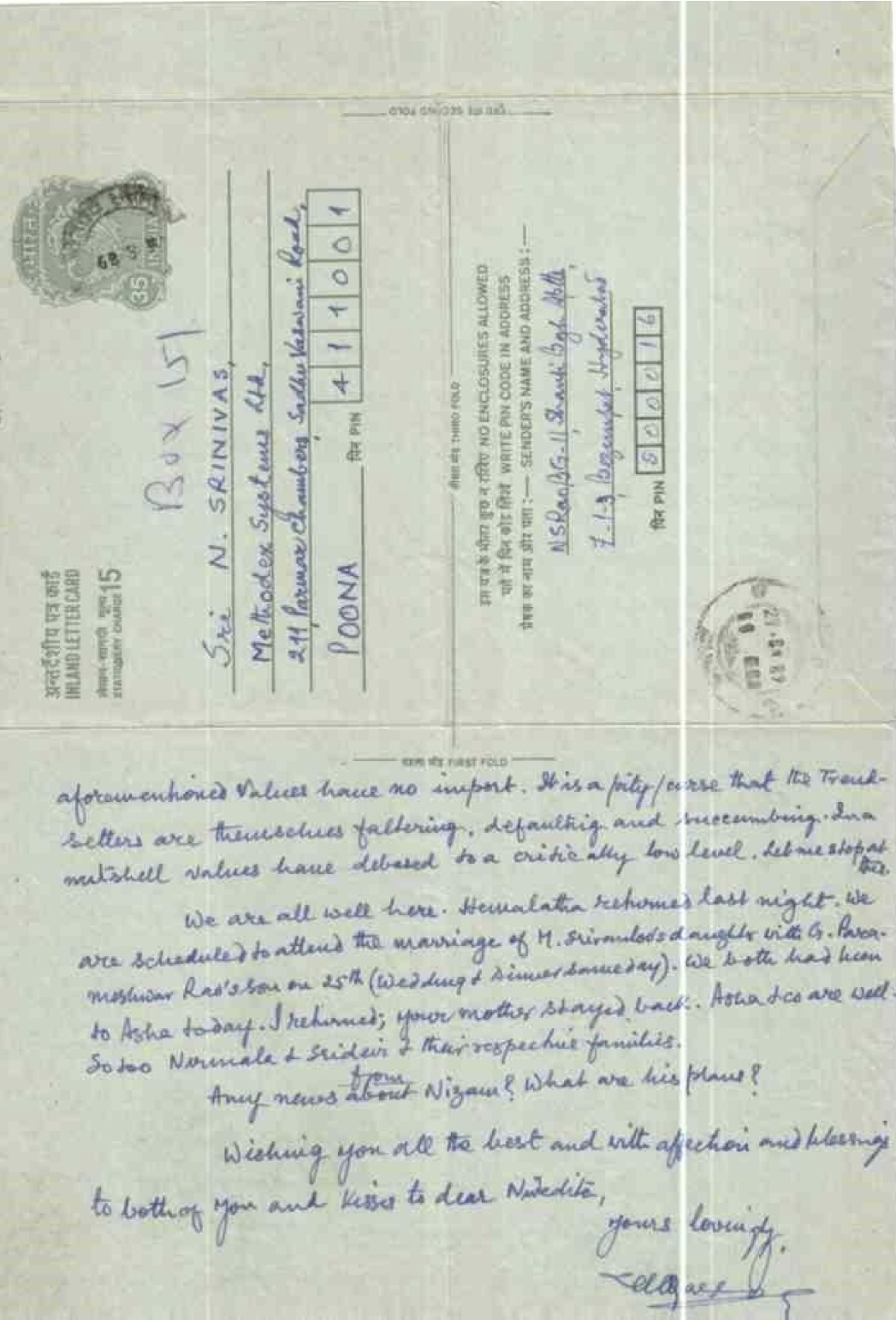
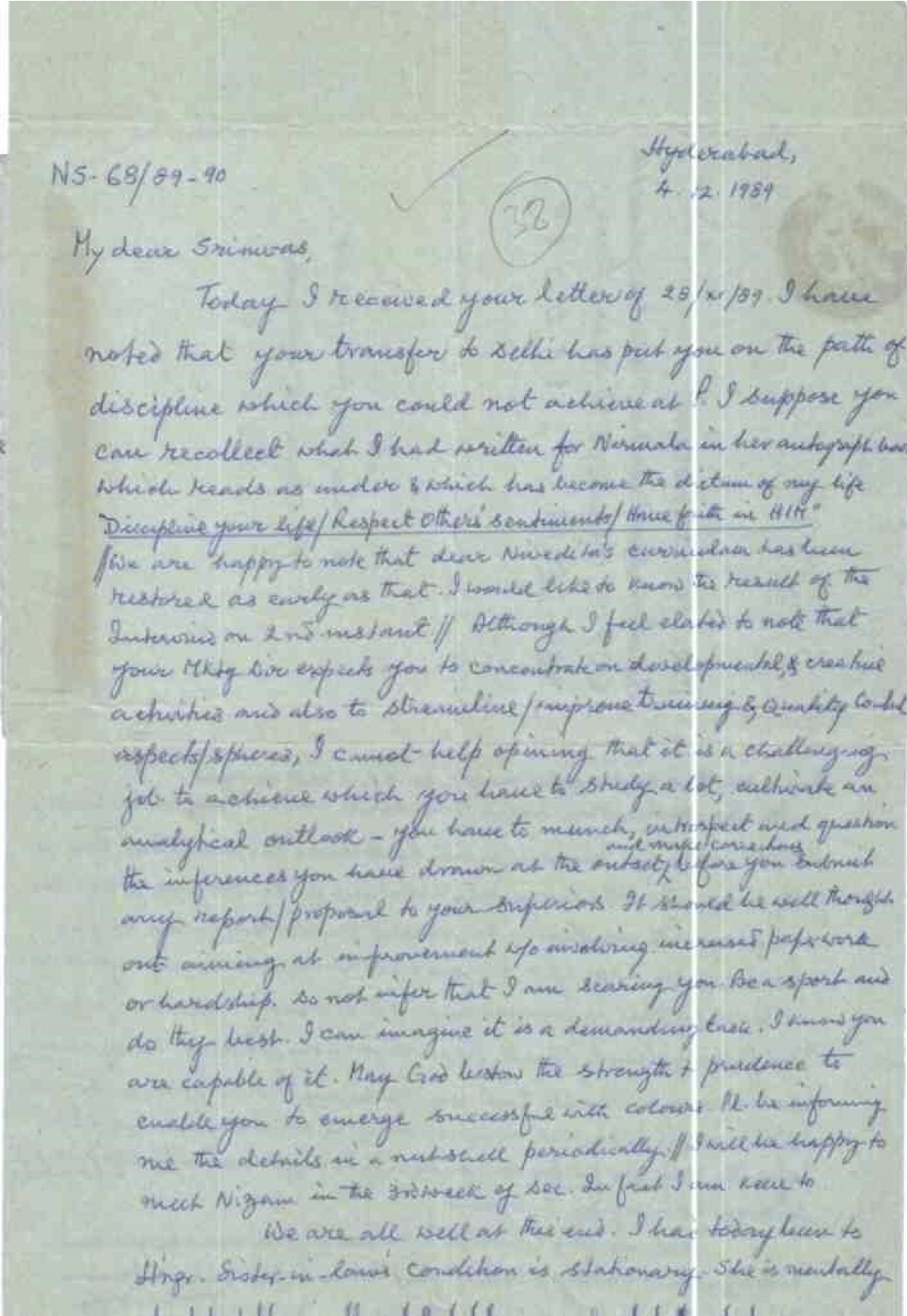
An inland letter that speaks of a generation when emotions, family values, morals and ethics were placed before the concept of individualism.

BY NIVEDITA NIVASINI
This letter, as dated, was written in the late 80s from my grandfather in Hyderabad to my father in Pune (India). In the late 80s, telephone connections took months to be installed, travel in the flights was still exorbitantly expensive and travel by train or a bus from one city to another took at least a day. The intercity telephone call or the STD phone call had to be planned when everybody was at home and the local telephone booth attendant had to be informed in advance to arrange for a telephone call. The arrangement would usually be done when every member of the joint family (i.e. at least two generations of the family living together in the same house) was present. The call would be only to ask about the well-being and each member would talk for 30 seconds to 1 minutes depending on their relation with the person.
As such, the emotions were lost in the technicalities of reaching to the members living out of the city or state or country. Hence, letters were the most comfortable option for a middle class person where he or she could pen their thoughts and emotions. The interesting aspect of writing a letter was patiently waiting for the reply of the letter. And, this letter is one such response.
Due to his profession’s demand, my father, along with me and my mother, left the city of Hyderabad to Pune. Having lived in a joint family, my father obviously missed his parents and the guidance that my grandfather provided. Since letters were the best way of communication, my grandfather and my father communicated often through the same.
My grandfather was (yes, he passed away in September, 2011) way ahead of his times. He believed in women empowerment, secularism, education, and most importantly, freedom of thought. He never bound any one with his chain of thoughts. He also played a pivotal role in my cousins’ and my life ensuring about our well-being and reprimanding us on our mistakes. His letters reflected his thoughts and responses to my father’s concerns while commencing a new life. He always ensured that the letters addressed everything that was asked. He thus carbon copied each letter. It was a practice he observed till the last letter he wrote in early 2011.
My grandfather wrote letters to most of my relatives who lived in other cities. When we collected the letters he wrote to my father and presented to each member of our extended family, they mentioned it to us how our grandfather was always concerned about their well-being too.
I think this inland letter speaks of a generation when emotions, family values, morals and ethics were placed before the concept of individualism. My grandfather always proudly spoke about his many brothers and sisters and the hard ships involved in completing his education. The letter is not only a reminder to us to keep the team or a family above an individualistic goal but also a biography of my grandfather’s generation.
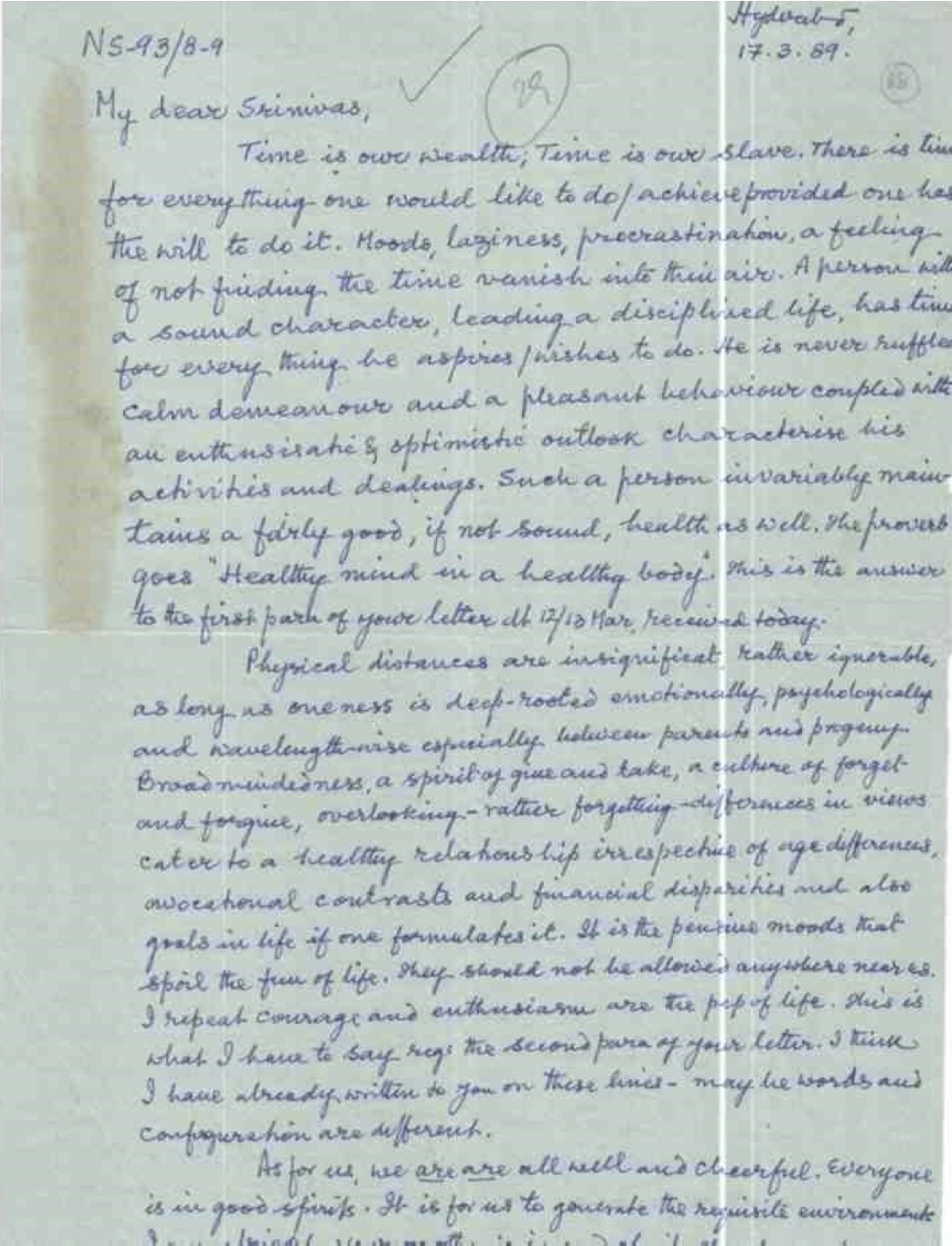
Hyderabad,
17-March-1989
My dear Srinivas,
Time is our wealth; Time is our slave. There is time for everything we would like to do/achieve provided one has the will to do it. Moods, laziness, procrastination, a feeling of not finding time vanish into thin air. A person with a sound character, leading a disciplined life has time for everything he aspired/wishes to do. He is never ruffled. Calm demeanor and a pleasant behaviour coupled with an enthusiastic and optimistic outlook characterise his activities and dealings. Such a person invariably maintains a fairly good, if not sound, health as well. The proverb, “Healthy mind is a healthy body.” This is the answer to the first part of your letter dated 12/13 March, received today.
Physical distances are insignificant, rather ignorable, as long as oneness is deep-rooted emotionally, psychologically, and wavelength-wise especially between parents and progeny. Broad mindedness, a spirit of give and take, a culture of forget and forgive, overlooking-rather forgetting — differences in views cater to a healthy relationship irrespective of age differences, avocational contrasts and financial disparities and also goals in life if one formulates it. It is the pensive moods that spoil the fun of life. They should not be allowed anywhere near us. I repeat courage and enthusiasm are the pep of life. This is what I have to say reg. the second para of your letter. I have already written to you on these lines – maybe the words and configuration are different.
All of us, we are are all well and cheerful. Everyone is in good spirits. It is for us to generate the requisite environments.
|
…. salutory effect on her. She is moving about and cultivating new acquaintances/Today she had been to Nirmala and just returned. They are all well. So too Asha & co. Sridevi & Amita are also well. The only activity is to control Amita which is assuming difficult portions couples with other chores. Sometimes it becomes unbearable. Ramu is slowly getting geared up. Hemalata is well but has to orient to our way although she has adapted to a considerable extent. Adjustment in a new environment naturally requires time esp. where emotional ingredient is involved/Telephone installation has become a hide & seek drama. It is yet to come/I only wonder when N will commence work on our flats. It is an embarrassing situation. Goading is no use, chiding is not possible, questioning much less. Thus there is a stalemate.
Wishing you all the best and wish affection and blessings to both of you and kisses to dear Nivedita.
Yours lovingly,
Satynarayana Rao (signed)
A Hyderabadi at heart, Nivedita N dwells in nostalgia. When not editing, reading or writing, she daydreams and watches the squirrels from the balcony of her house in Wisconsin and hopes to meet the rabbit imprisoned in the moon, someday.
You can find her work at Nivasini Publishers, follow her on twitter @DivenitaEr, and forthcoming is their new site, The Blue Stencil.
No Other Place Publishes Process • The Origins of Handwritten

In early Spring of 2015, Sarah Madges set out on a project surrounding the Handwritten word and recalled Brett mentioning a project he had recently begun. She reached out to ask if the project was still alive. It was, barely. The exchange served to reignite the project and has since turned into this site, which Sarah is also to thank for, as she since came on board as a central curator for the project. Below is their initial exchange about the idea for the site you are seeing today, which is constantly evolving.

SARAH MADGES: What inspired you to develop a publication/project surrounding the handwritten word? What is your own experience with handwriting?
BRETT RAWSON: I knew I wanted to start something last winter. I took a course at The New School that had us look at digital storytelling, and I found great calm mixed with wild energy in this embrace of and attitude toward technology - how can we use technology to promote our passions, digital or otherwise? On a morning in February, I was on the L train brainstorming for a separate project when the word Handwritten appeared from somewhere. I had my notebook in hand so I scribbled it down. I happened to be heading toward a workshop put on by PEN, so I wonder if that had something to do with the whole thought. At any rate, the word opened up the idea itself: a home for the handwritten word online.
There is no place that publishes things other than finished products. I wanted to promote process. There's a bunch of theories and thoughts about handwriting, penmanship, and personalities. I do think about them, and I care about them, but I am not specifically concerned about them. I don't really care much about their outcomes or conclusions. For example, I find it interesting what people think my handwriting says about me, but I care more about saying things with and through my handwriting. What comes of it in the end is not really something I can consider while I am doing it.
The idea is pretty simple—for people to express themselves with pen and paper, and be published for it. It's also to be a preserve of sorts—for letters written by those who have passed, for example. I am always writing by hand. I don't always write my stories by hand, though most things usually begin on paper—in a journal, on a napkin, or a legal pad. I do, however, write a lot of letters. It's how I ease myself into writing for the day. I can't jump into writing on the computer without starting by hand. I have to start somewhere free. In this sense, it's like stretching, doing yoga, starting out slow, or warming up.
MADGES: What is the project's mission statement?
RAWSON: A place in space for pen and paper. But I have been thinking about changing it to something a mentor of mine once said: writing is a physical activity.
MADGES: Are you concerned that handwriting / cursive lessons are being eclipsed by keyboard proficiency lessons in U.S. elementary schools?
RAWSON: I'm not so sure I am that worried about cursive. But that's probably because mine is horrific. In fact, my regular handwriting sort of looks cursive. Or maybe it looks like it is cursing. It's hard to tell. Someone once said my handwriting looks like a string of wasted wingding characters, which is offensive, but true. But handwriting altogether, what a horrific waste of natural talent. The hand is how we gain access to our inner self. I really don't think the computer can access that wild, raw energy inside each of us. When using a computer, I get an external feeling (usually in the form of mild swells of panic), whereas when I write by hand, the noise from everywhere really quiets down, and I can finally hear my own voice.
The people making these policies, or mistakes, probably don't write by hand much. I imagine they see it as a waste of time, or something of the past, that we should get with the times and technology. This measurement feels imprecise. And it isn't a matter of sentimentality. It also isn't about one or the other. I wonder when people will wake up and coexist - to stop living in some world of ones. I write on the computer all the time. I have four twitter accounts, a Facebook profile, page, and group, five Instagram accounts, one tumblr, and three websites. You know? It's not like I don't get the beauty and power in the computer, let alone its efficiency, insanity, and amusement. I am a user, and I love using it. But what a fucking mistake to not teach kids how to write by hand. So I guess I am concerned.
MADGES: Do you notice a difference in the kinds of things you write when you use pen/pencil as opposed to a computer / word processor? How do you think the writing tool affects content/style/etc? How do you think it affects the editing process?
RAWSON: Absolutely. The medium affects everything. The effect is also bilateral. The reader adjusts his or her expectations based on the medium. A letter is sort of like dining out—there is an experience to it. An email is more like take-out, delivery, or TV dinner - it is often more quick, requires less from me, and can be done while doing something else.
That being said, I don't see it as a matter of good or bad, better or worse. It is simply different. Writing by word processor is more about a product or outcome—a finished something—and so pieces composed there are usually toward that end. But with handwriting, it is more so a work of progress, or process. It is, inherently, more private and intimate. Computers are meant to connect, gather, and scatter. And the screen in between becomes a kind of reflection and projection, which can be a disorienting feeling that registers at a deeper level. Handwriting is about process on two levels -- one, it is about the process, but two, it is a way to process things. Not necessarily produce a product.
MADGES: Phenomenologists have argued that the self falls away when we are engaged in an intense activity, usually one that collapses the sense of the mind-body split by activating both elements. Do you think the writing implement of choice could act as a bodily extension, and that writing by hand helps combine subject and object in ways that promote intimacy with a text, whereas typing into a word document promotes separateness of subject and object?
RAWSON: Fascinating. I imagine this has to be. There is a oneness when it comes to things like painting, the piano, or even running, and so it would make sense that it carries over to hand-writers. It makes me think of meditation for some reason, only I don't really know why. There is intense freedom within limitation, which might be why the computer is such an energy vampire. It pokes so many holes in our concentration containers that after a short period of time, we feel totally drained. Whereas with the handwritten word, I think of a dam and what happens when everything flows through a single thing—it harnesses a new kind of energy. Because with handwriting, you aren't concerned really with what you're writing. There is something hypnotic about the way in which the hands moves.
MADGES: Anything else you would like to add?
RAWSON: Keep the beautiful pen busy!