All of Us, Once Angels, Who Finally Finished Falling • John Reed
Poet and playwright John Reed takes us inside his head, where his sonnets start, but also on a bus, where his sonnets form, and finally, where they end up, scribbled onto a napkin. It's how he escapes doubt, and discovers form.

BY JOHN REED
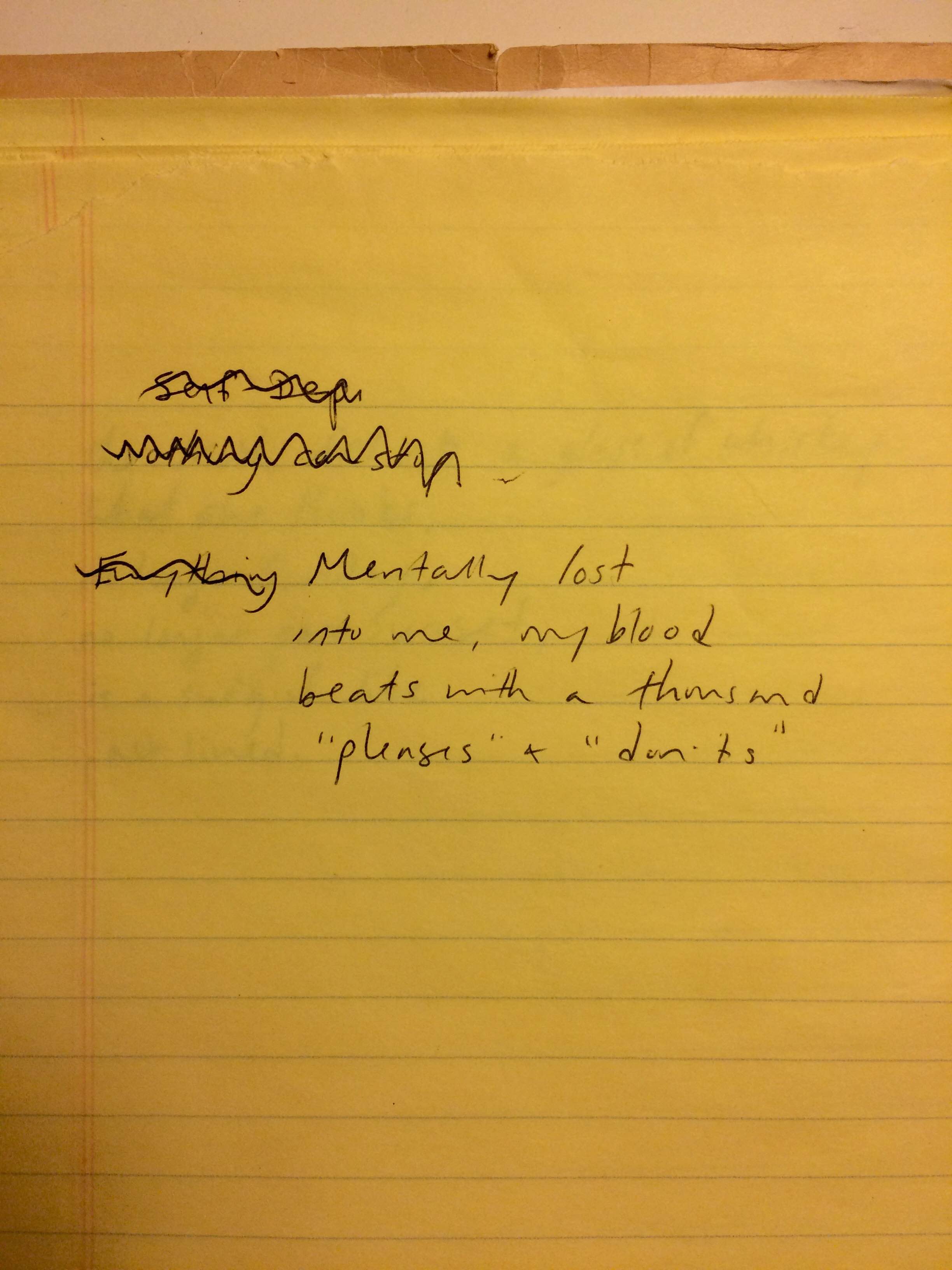
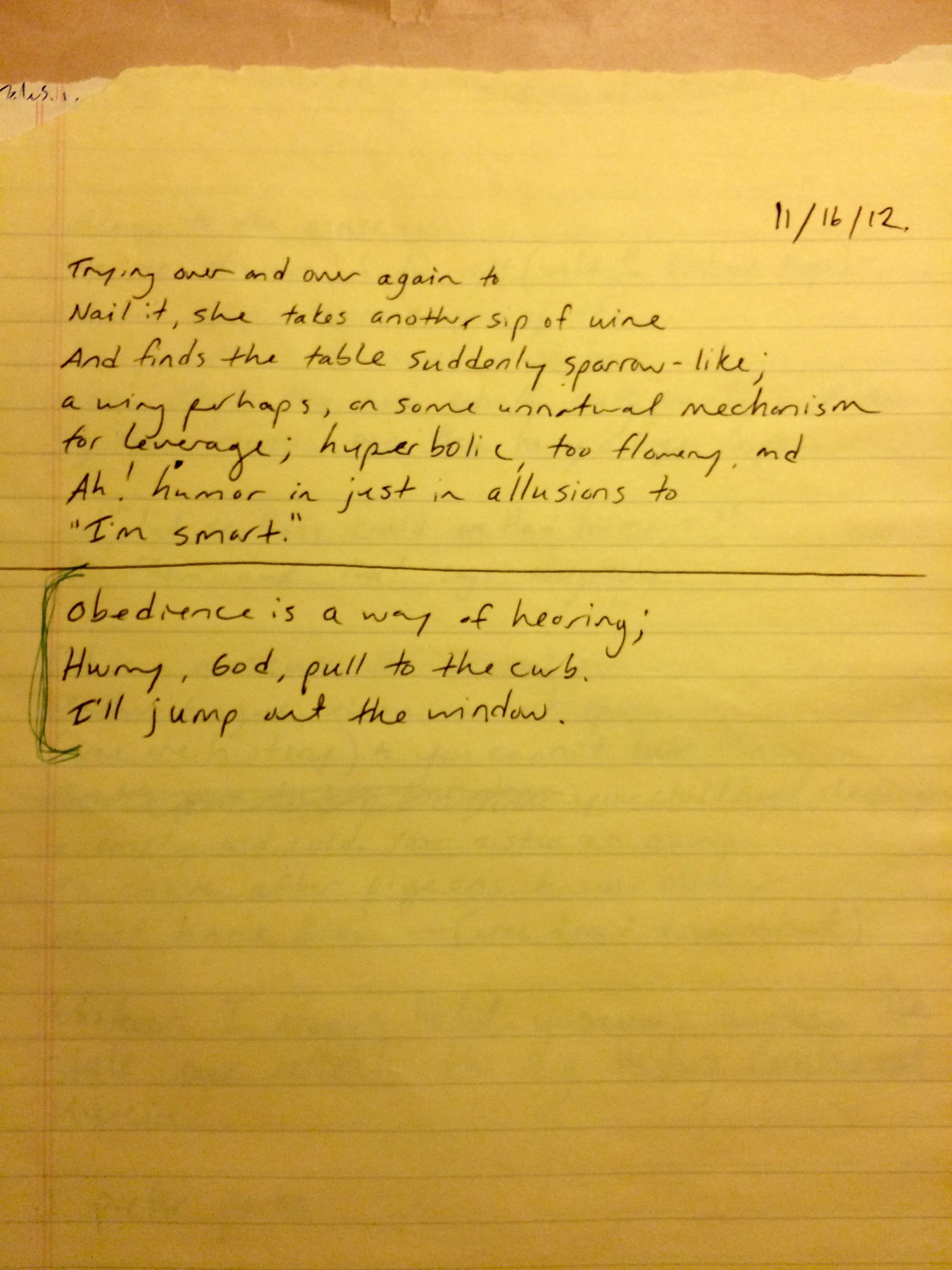
I usually work on sonnets for a long time in my head, then write them out by hand. Two out of three times I'm not feeling it, so I toss it, and think again for a while. I had to take a bus somewhere on a school trip, so I wrote this one down then. If I can get to the end without doubting, I usually am fairly satisfied.

Sonnet Typed Below:
80
I knew we'd be seeing each other again.
It looks like everyone else is here, too.
All of us, once angels, who finally finished falling.
We were so crazy about here and there,
when the little difference was "always,"
or the other eternity, "never."
Just listen to all of this childless laughter.
Now we are gone, and here we can stay,
you and I, who are you and I no more,
who tore apart our daughters for the bears,
who offered our sons to God, LOL,
who are, we know, we've forgotten who,
who are now outside of ourselves, without when.
You can read John Reed's bio on his website here, as well as praise for his sonnet-making abilities, which go something like this: "John Reed exploded my concept of a sonnet." Erika Anderson, Electric Literature.
I Won a Twenty Pound Bag of Detergent • Livia Meneghin

BY LIVIA MENEGHIN
A few years ago, I heard about a Brooklyn thrift store opportunity that I couldn't pass up: $25 for a large shopping bag of goodies. "If you can fit it, you can buy it!" said handwritten signs alongside the walls of the dilapidated building. When I saw their piles of books, I knew the clothing sections of the store would have to wait. My hands quickly skimmed across countless novels until finally halting on a book by Thomas A. Harris, called I'm OK—You're OK. I was taking a psychology class at the time, and interested in how mental health affected relationships, so I happily placed it in my bag. On the train home, I opened up the cover and found a note.


On New Year's Eve in 1973, a mother gave this book to her daughter (Sue). But why did Sue’s mother have the book? We know she read it, but what made her give it to Sue? Did she now hope it could provide answers for her daughter in the New Year?
I thought back to the times I’ve been gifted books. Just this past summer, a close friend gave me her childhood copy of The Little Prince by Antoine de Saint-Exupéry for my birthday. It was incredibly worn, probably providing her with years of adventure and happiness. Holding that book in my hands, with its broken spine and her favorite lines highlighted, made me feel like we were reading together. A book as a gift is so much more than something to read. Chosen with care and thoughtfulness, a book is an outstretched hand, welcoming another into a new world of new ideas.
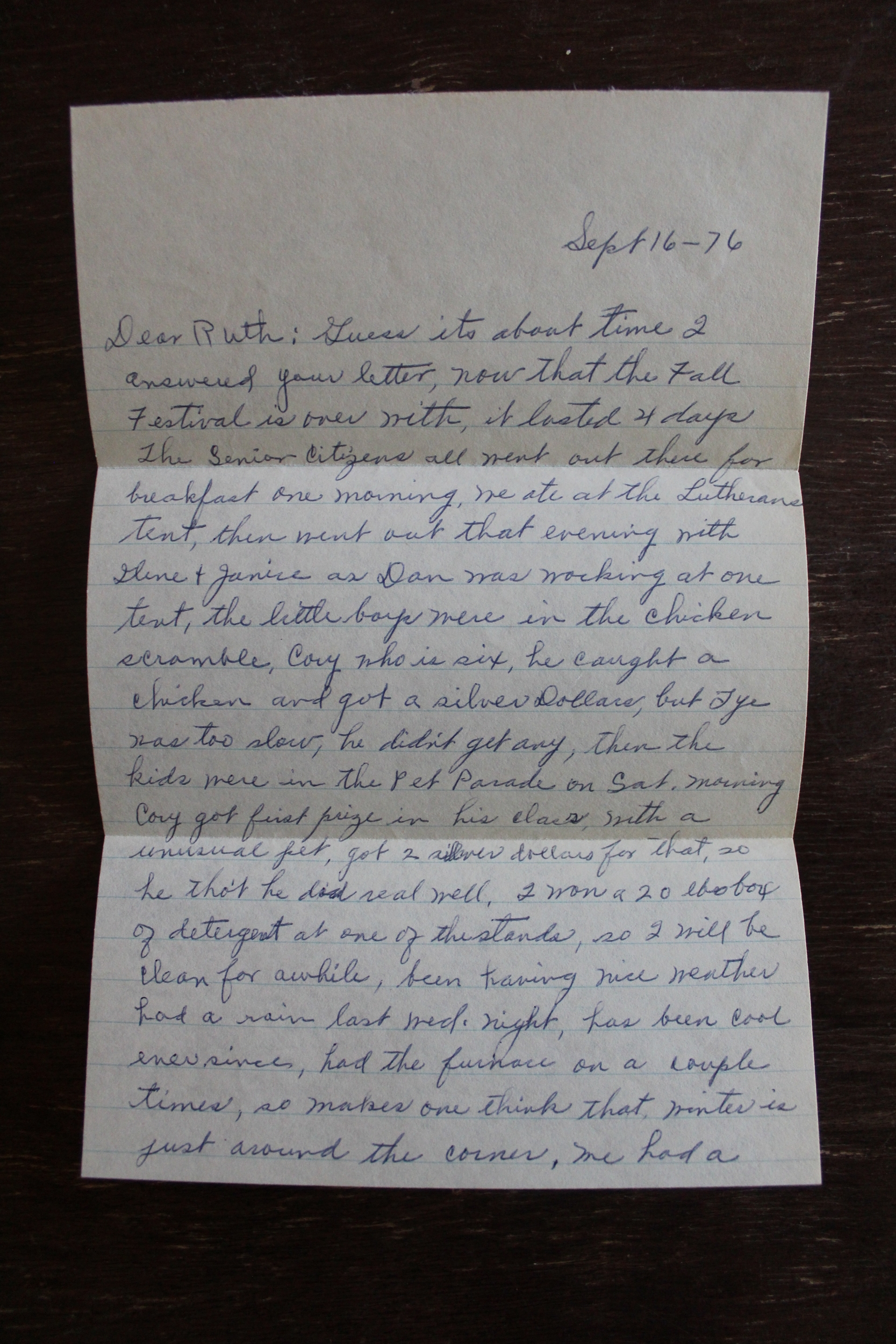
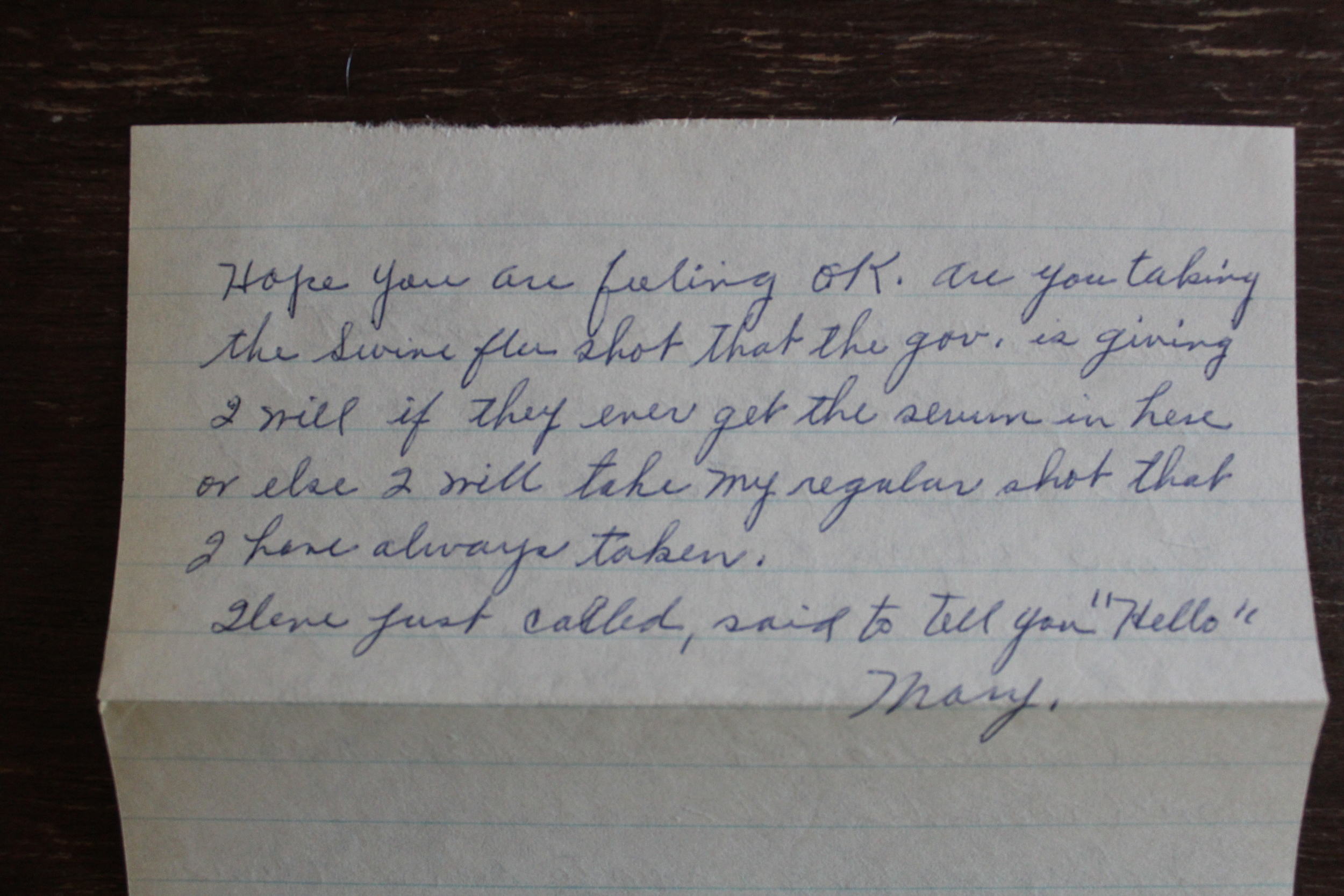
On the train ride home, I flipped through the tattered pages when I came across a lump. Sitting between pages 138 and 139 was an unsealed letter from Mrs. Mary Lehman from Monmouth, Illinois to Mrs. Ruth Robertson from Marion, Kansas, dated three years after the inscription (September 16, 1976). I wondered now about the four women. Did they all know each other? Did Sue gift it after reading? Mrs. Lehman's handwriting reminded me of my grandmother's—very elegant and careful. I could hear a humorous attitude with the first line, "Guess its about time I answered your letter." I felt like I knew them—had been given access into their personalities, their voices. This letter was not much different from the ones I write with my friends. We share daily news, things that seem unimportant, but it can mean wonders to someone far away when we ask if they are OK.

This leaves me wondering: what if I put a letter of my own into the book and donated it to a used bookstore, to keep the chain going? Whether intentionally placed or not, I picked up extra inspiration that day in Brooklyn, a mystery of sorts. I walked away with more than just a book, but possibilities for more stories. There's something incredibly human about imagining these women, especially through the same book they all shared. It makes the world feel smaller, more meaningful, even without actually knowing them or being in the same physical space. By continuing the chain, I can add to the story.
The letter is transcribed below.
Dear Ruth:
Sept 16, '76
Guess its about time I answer your letter, now that the Fall Festival is over with, it lasted 4 days. The senior citizens all went out there for breakfast one morning, we ate at the Lutheran tent, then went out that evening with Gene and Janice as Dan was working at one tent, the little boys were in the chicken scramble, Cory who is six, he caught a chicken and got a silver Dollar, but Tye was too slow, he didn’t get any, then the kids were in the Pet Parade on Sat. morning. Cory got first prize in his class, with a unusual [ ] got 2 silver dollars for that, so he thought he did real well, I won a 20 lb bag of detergent at one of the stands, so I will be clean for a while, been having nice weather, had a rain last wed night, has been cool ever since, had the furnace on a couple times, so makes one think that winter is just around the corner, we had a nice visit with Mary + Marvin, they were here for 3 days, seemed happy, hope everything turns out all right for them, they were on their way home. Ralph were here one evening, they had a letter from Lillian, they wanted me to read, sure too bad about Dick, hope he will soon be better.
Jacks are getting ready to pick seed corn, they hope to start next week, some of the fellows have all ready started. Just talked to Phyllis she was making pepper relish, she always makes a lot and gives most of it away, as her men don’t like it, she brought me some nice tomatoes yesterday and dozen eggs, her pullets are laying already.
I cleaned my garage yesterday, so today I am not doing much, made some bread pudding this morning, going to have goulash for dinner, have some hamburgers to use. Our Book Club went out for breakfast at the Restaurant yesterday morning.
Hope you are feeling OK. Are you taking the Divine flu shot that the gov is giving. I will if they ever get the serum in here or else I will take my regular shot that I have always taken.
Gene just called, said to tell you “Hello”
Mary

Livia Meneghin is a poet, non-fiction writer, and recent graduate from Franklin & Marshall College with a Bachelor’s Degree in Creative Writing. She was a contributing writer and photographer for F&M’s College Reporter, and earned the William Uhler Hensel Senior Prize in Research Writing for her essay, “Priest, Clerk, and Pitiable King: The Portrayal of Richard II in Recent Production History.” Her work is published in literary journals Dispatch and Plume. After a month-long poetry workshop in Greece, she is working on her first full-length collection and applying to MFA programs. You can follow her writing here: liviameneghin.wordpress.com.
Better Smut by Hand • Wednesday Black
Publishing under a nom de plume, this rising novelist reflects on how writing the first draft of her erotic novella by hand led to all kinds of unforgettable feelings.

BY WEDNESDAY BLACK
I wrote the smutty little novella, How to Train Your Virgin, in the fall of 2014. Badlands Unlimited, a publishing company founded by artist and activist Paul Chan, had put out a call for erotic fiction the spring before, and I took a chance and entered a chapter. I thought there might be a little money in anonymous smut-making. The result was a somewhat bittersweet novella of feminist, fabulist fiction — oh, yeah, and fucking.
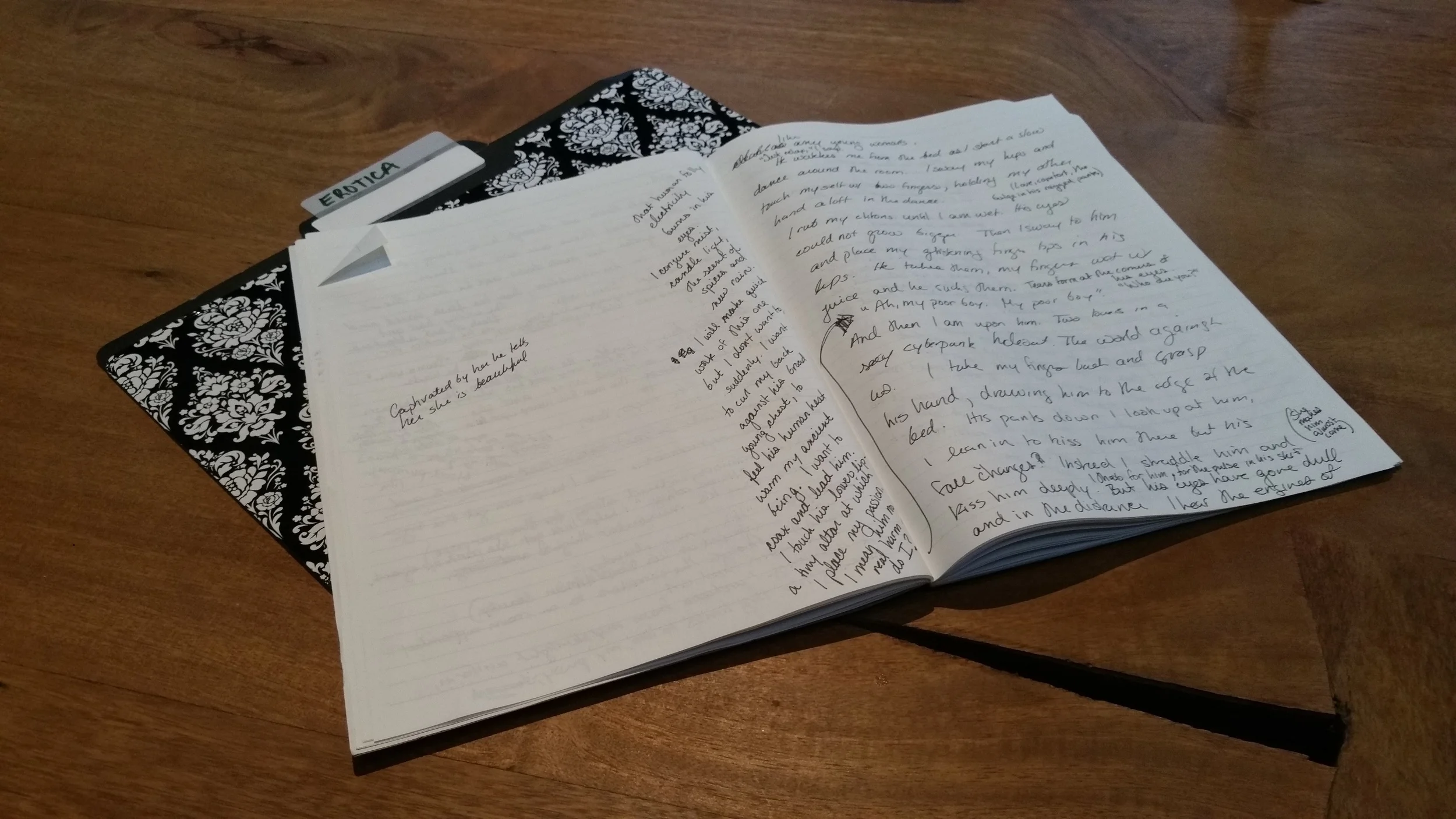
The real surprise for me was the enormous flow I experienced while writing it. I’d never written anything like it before, and it felt…good. It was as if my Inner Critic was so mortified she had no choice but to take a vacation. After all, I was working in cliché, striving to boost every scene over the top, and doing it all in a fantasy playground populated by evil bog women and clockwork sex carousels. Let’s not even get into the title! I mean, what could Inner Critic say that I didn’t know already? So I ran with the story — or maybe it ran with me.
I wrote most of HTTYV by hand — in bed, on the subway, hunched over in any number of coffee shops throughout Amagansett and Manhattan. I scrawled over multiple notebooks, post-its, scraps of napkin, the backs of receipts, and along the way I lost as much as I wrote.

Sometimes I like to imagine someone picking up one of those lost scraps of prose. What might they make of the scribbled words about Minotaur fellatio, great, tiered foundries for sexual smelting (okay, that one didn’t make into the book), or numbered directions for seducing hipsters? This is one of the dangers and pleasures of writing with pen and paper. Such words have a way of fluttering away on mysterious wings and leading lives independent of those we imagined for them.

Looking back at these first-draft jottings more than a year later, I can see a childish exuberance in my pen strokes and slashes. In many cases the finished product was very different, of course, and I’ve included examples here and there where it is relevant.
What is it about writing by hand? I like seeing what I scribbled out, having it still there even though I’ve consigned it to ballpoint obscurity. I love the act of scrawling ideas, scenes, shreds of dialogue — when I do, it seems to come from my hand and not my brain.
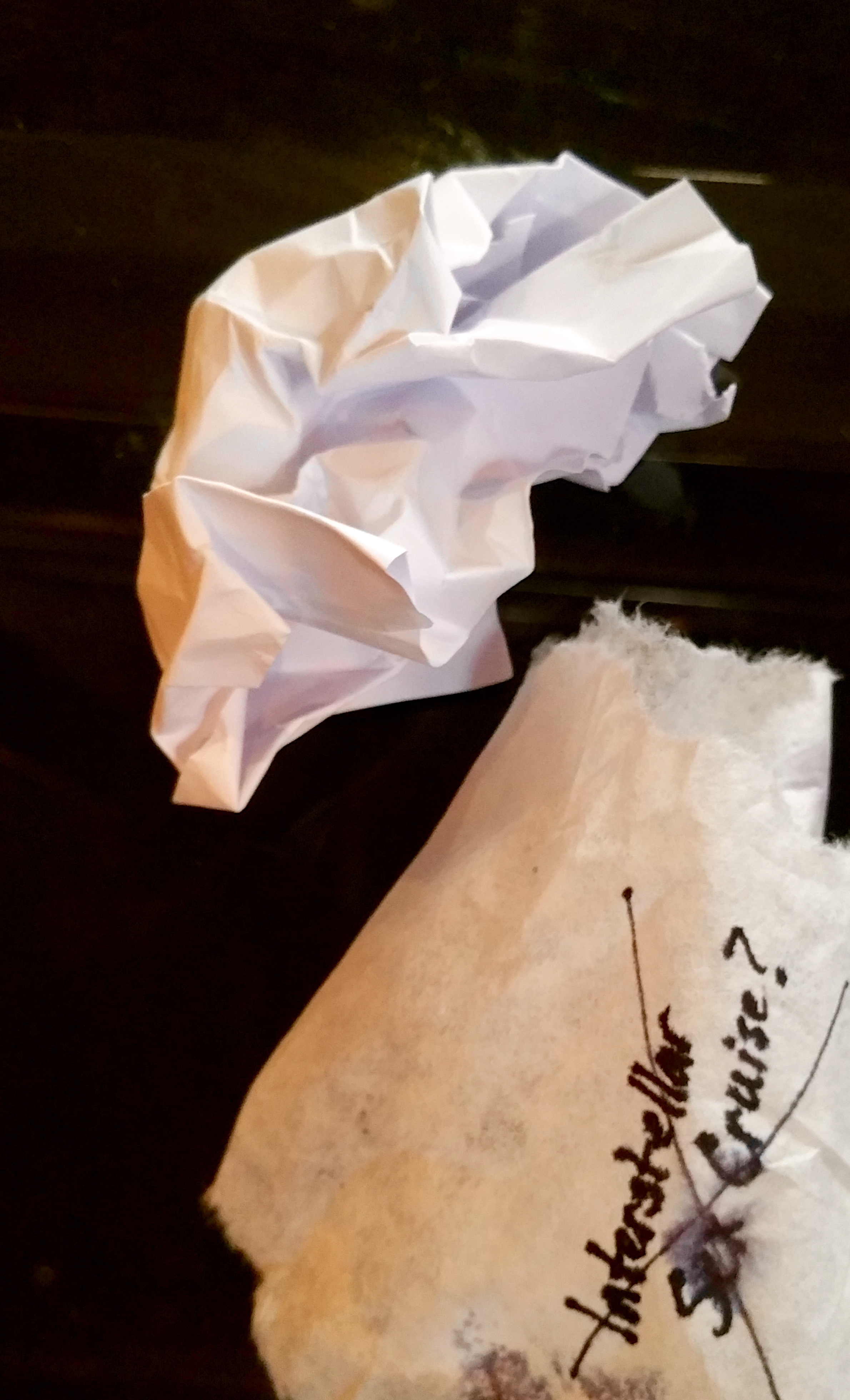

Looking at it now, I can see by the physical state of my writing how I was feeling then: frustrated, ashamed, enthusiastic, bored. I can relive my process as it developed, see where my creativity tripped and fell, and the moment it brushed itself off to allow the show to go on. Here is the raw version of The Ruin Carnival scene and the published version:


Sure, the paragraph that made it into the published novella is clearer, contains more — but would not have existed at all without the notes. One was the organic, physical product of handwriting. The raw material. The other was processed until it became more effective and organized. That it was processed and finished with the rather sterile act of tapping away on a plastic and metal contraption is significant. A keyboard and a screen have a disciplining effect. Remember my Inner Critic? She was allowed to come home again during this part. Another example:


Often I didn’t feel certain necessary content deserved to be written by hand—why waste the ink and finger joints? Instead, I wrote a note to my future self to get on with it as in this note. Love scene is a euphemism for SEXSEXSEX. In fact, I wrote most of the actual sex scenes on the prudent keys of my Mac.
As for the passion, the obsession, the pain and heartache—all of those things I found were best rendered by hand. There is something about writing these human intrigues that required, for me at least, a body-word collaboration best engaged by planting elbows on table and pressing down with pen.
In the end, after all that scribbling and wild fun, it was a trip to get the published version. Rigid margins, clearly printed large-type, a cover…wow. That’s classy smut, I thought. But the most human part, the communication between individuals — that was handwritten.


Leia Menlove is Wednesday Black is Leia Menlove. Her writing has been published in Monkey Bicycle, Joyland, Joyland Retro Volume 2, The Artificial Selection Project and more. Her novella, How to Train Your Virgin, was released by arts publisher Badlands Unlimited in March 2015, and was featured at the The Solomon R. Guggenheim Museum Series, "Conversations with Artists and Writers.” She is a graduate of The New School MFA program for creative writing, and splits her time living and working in New Orleans and New York City. If anyone finds a notebook containing scribbled notes for a dirty novel about women who are attracted to deconstructivist architecture, please email her immediately: mswednesdayblack@gmail.com.
Bernie Sanders, in a Mansion, with a Subaru Forrester • Trinity Tibe
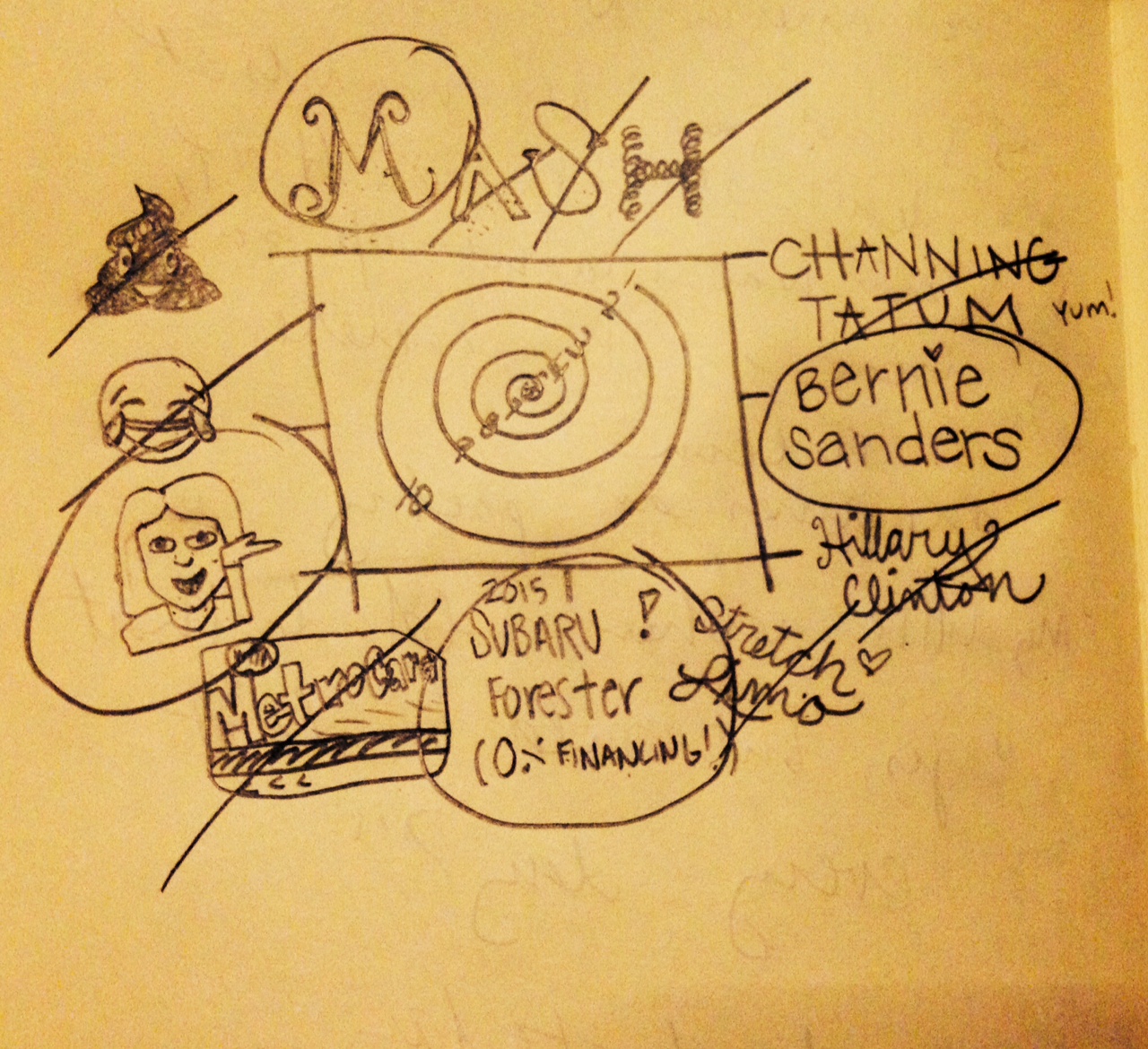
HANDWRITTEN BY TRINITY TIBE
My fifth grade year, I was addicted to the game of MASH. Every day before school and at lunchtime, my friends and I would huddle around our spiral notebooks, trying our hands at rudimentary divination. Who would we marry? How many children would we have? What car would we drive? Would we end up living in mansions or shacks?
Back then, I solidly believed in the institution of marriage, and probably wanted to marry Jonathan Taylor Thomas or Elijah Wood. I wanted 2 or 3 children, though I always left that third slot open for my friend to play a wild card. More than once it was predicted that I would have 1,000 children. Wow. I'm thirty, unmarried, and childless. Better get on it.
Oh, the MASH days, before I paid attention to gas prices or the idea of keeping my privilege in check. At first I wanted a simple convertible, but the game made me greedy. Soon I was writing "Hummer stretch limo with a hot tub and a personal chef" in tiny letters on the game board. Meanwhile a friend would write in "Clown Car" as my third option. Thank you, whoever you were, for keeping it real.
I loved drawing the game board, perfectly-shaped, filling in the spaces. I loved saying "Stop!" as my friend spiraled her pencil in the middle box, sealing my fate. Maybe what I loved most of all was that, no matter what the outcome was, there was always a chance to play again, to keep playing until the perfect future appeared.


Trinity Tibe is a co-founder of Say Yes Electric Collective, an art community in Prospect Heights, Brooklyn, that creates space for diverse artists and encourages collaboration. She is working on her MFA in Poetry at The New School, and she also loves to draw, paint, and puppeteer. Find her at TrinityTibe.com or @trinitytibe
Week 3: Before I Knew I Was a Writer, I Was a Reader


For Week Three, we have scooted away from Words for Wallpaper and asked Rehani about her own relationship, attitude, and experience with the art and act of writing by hand.

HANDWRITTEN: Tell us about the current state of your handwriting. Are you happy with your penmanship?
ANDREA REHANI: Majority if not all of my writing is initially written by hand. However my penmanship isn’t great. It resembles messy 4th grade handwriting. There are times I wish I wrote like my mother. Hers, elegant cursive strokes. Before I knew I was a writer, I was a reader. I used to copy my favorite sentences from books into my journal. I have been writing in a journal since I was in third grade.
HW: What word do you use, prefer, like, or dislike, when it comes your handwriting homes, and what kinds of things do you write by hand?
AR: Sometimes, I think certain words carry certain identities, stereotypes, gender, or images. For instance diary writing is often associated with women and feelings. I like to use the word journal – I find it to be mostly neutral and it conveys thinking. I handwrite everything first: outlines, essay drafts, poetry, and grocery lists. Although, I wish my grocery lists were like haikus.
HW: When you write, poetry or prose, where do you begin and where do you end? Do you start out by hand and finish by hand? Do you revise on a computer? What do you consider a finished product to be?
AR: I start my poetry, prose, prose poetry, my in-between stage, all by hand. My essays are usually written on color-coordinated and numbered note cards. Once I have the bones of what I am working on, I transfer it to a computer. My essays undergo several drafts and once they are on a computer, I print them, cross out words, handwrite words, and revise them on a computer. I don’t like to initially revise on a computer – I miss things. I need my writing physically in my hands. The words flow more organically when I handwrite them, too. Writing is never done because my perspectives are always changing. However, when I feel like I want to set one of my essays on fire or if I feel empty, then I consider them done for the time being.
HW: Do you write handwritten letters often?
AR: I have a pen pal in Michigan and we attempt to exchange every month or so. When I lived in New York, my mother and I exchanged letters. My mother has written me letters since I was young. I have a box filled with them. She, too, starts her day writing in her journal.
HW: Where do you like to write by hand? Is place important to you, or is it something else - vibe, music, the trip to that place, or otherwise?
AR: I like to write down conversations I overhear on the train. Sometimes, they make me laugh. Sometimes, they’re absurd. Sometimes, they are profound. I like to write down things I have to do. I like to write down unfamiliar words and their definitions. I like to write down sentences or graphs or stanzas or lines I’ve admired. I like to write in parks and coffee shops. I like to be surrounded by people as I immerse myself in my writing world. I need a little noise, but I don’t like to listen to music when I write unless it’s in a coffee shop. The music there is subdued with coffee and voices.
Week 2: Much of Art is Waiting, Much of Writing is Staring

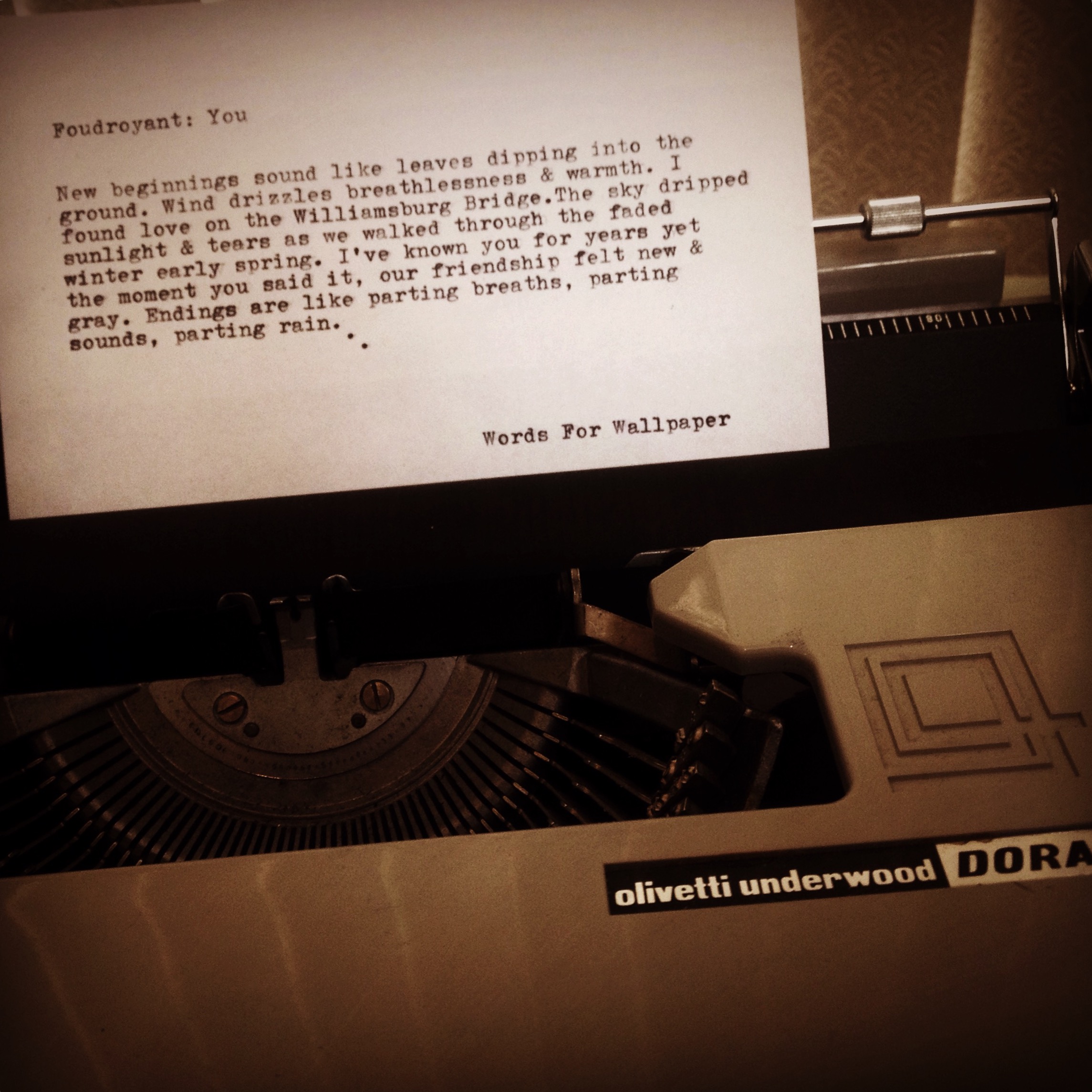


For Week Two, we sat down a thousand miles away from Andrea Rehani and asked her about the origin, spirit, and plans for Words for Wallpaper.

HANDWRITTEN: What is the origin story of Words for Wallpaper? How did it emerge, and what was its genesis? Or, if there was a WikiHow site on your project, how many steps would there be, and what were they?
ANDREA REHANI: Words for Wallpaper branched off of the concept behind Poems While You Wait. Before I became a member, I was an enthusiastic customer. I was in a coffee shop with my sister and we were brainstorming creative writing ideas. I remember saying something like, “I want poetry to be framed like photographs.” Then, my sister came up with the name. Like Poems While You Wait, people give me random topics and then I produce an original poem. Unlike Poems While You Wait, it’s not done on the spot. Sometimes, the poem takes a few days to make.
The project is to get people excited about poetry. I don’t think you have to be a poet to enjoy a poem. I also feel personalized poems are special. It’s pretty rad to see people excited about writing – especially poetry. There’s this notion that poetry is as scary as math word problems or it needs to be something that is impossible to understand. I remember one of my first poetry classes with Kathleen and she wrote on the board, “Poetry must be as well written as prose. –Ezra Pound” I believe in this statement. Kathleen has taught me how to analyze the dramatic situation of a poem. She taught me to consider: who is speaking, to whom, and under what circumstances?
When I compose a poem, I still use those questions. I also consider form and content to communicate an image, a thought, or a memory. Form is structure; it can mean language, style, patterns, or the actual form of a poem. Content is meaning; it can mean characters, emotions, ideas, or tone.
HW: Does your project have a mission statement, or guiding phrase that governs its spiritual space?
AR: I suppose my mission for W4W is to not only get people stoked about poetry, but also make it accessible for anyone. My mother and I exchange handwritten letters and I hate how many people don’t anymore. I love getting mail - especially thoughtful letters. I have had a pen pal for two years and we exchanged handwritten letters. The mission is also to make handmade art. My favorite type of poetry is prose poetry. The poems I produce are in this form. I love writing in a hybrid genre – it’s something that still is unexpected. Paragraphs seem familiar but are tweaked in prose poetry – they alter a familiar structure.
HW: Tell us a little bit about your experiences with the project. The topics you've received, the challenges you have encountered.
AR: I started W4W by asking friends for topics. I asked readers and artists. At first I was a little nervous because I wanted to create something perfect for my friends. Then I realized there is beauty in imperfections. Creating something perfect isn’t what Words For Wallpaper is about – it’s about experimenting, understanding, and building. Like all handmade items, I want to create something unusual and unique. It’s unique to frame poetry, an image, a picture told in words.
These topics serve as writing prompts or exercises for me. I’ve written poems on topics of love, anniversary, twinkle lights, teeth, doppelganger, cacti, being in the woods at dusk, and the unknown. The hardest topics for me were love and anniversary. I knew they were gifts and they had to be extra personal. I’ve noticed personalized poems attract people. Writing is a means of communication. To gift a poem has a thoughtful intention. I want my poems to be just as thoughtful. It’s interesting to see non-poets associate thoughtfulness with poetry.
HW: Say Words for Wallpaper is a car, and its night. It has its headlights on, and so you, and us, know where it's headed, but even high beams fade like quicksand in the night. Do you have a destination in mind for Words for Wallpaper? Where is the project heading? Or, what's the next turn? Or, are you not concerned with what is beyond the bend for now?
AR: I eventually want to hand-make my own frames. One ideas includes using the hard covers of books to make a frame. Another is creating a black-out poetry frame. This would entail taking any form of writing (such as an article, poem, piece of prose, etc) and blacking out certain words to create a revised and new poem. I like the idea of a poem within a poem.
HW: Tell us about the name and how it relates to the typewriter, frames, still-words, and motion-images. Basically, tell us about the intersection between mental and physical realms of poetry, people, and expression.
AR: Wallpaper, art, typewriters, quotes are all used as a means for decoration. But, I don’t want my art to be pretty or just decorative; I want it to make you think. I like typing on a typewriter because it makes me think harder. I can’t look something up on the Internet. I have to rely on myself. Much of art is waiting. Much of writing is staring. The name is meant for decoration but there’s a duality. Decoration is associated with identity, personality, and choice. I wanted my name to encompass all of these ideas.
HW: How can someone get Words on their Wallpaper?
AR: If you are interested in a poem, send me a poem topic at WordsForWallpaper@gmail.com. I will mail you the poem.

Week 1: The Images and The Inspiration
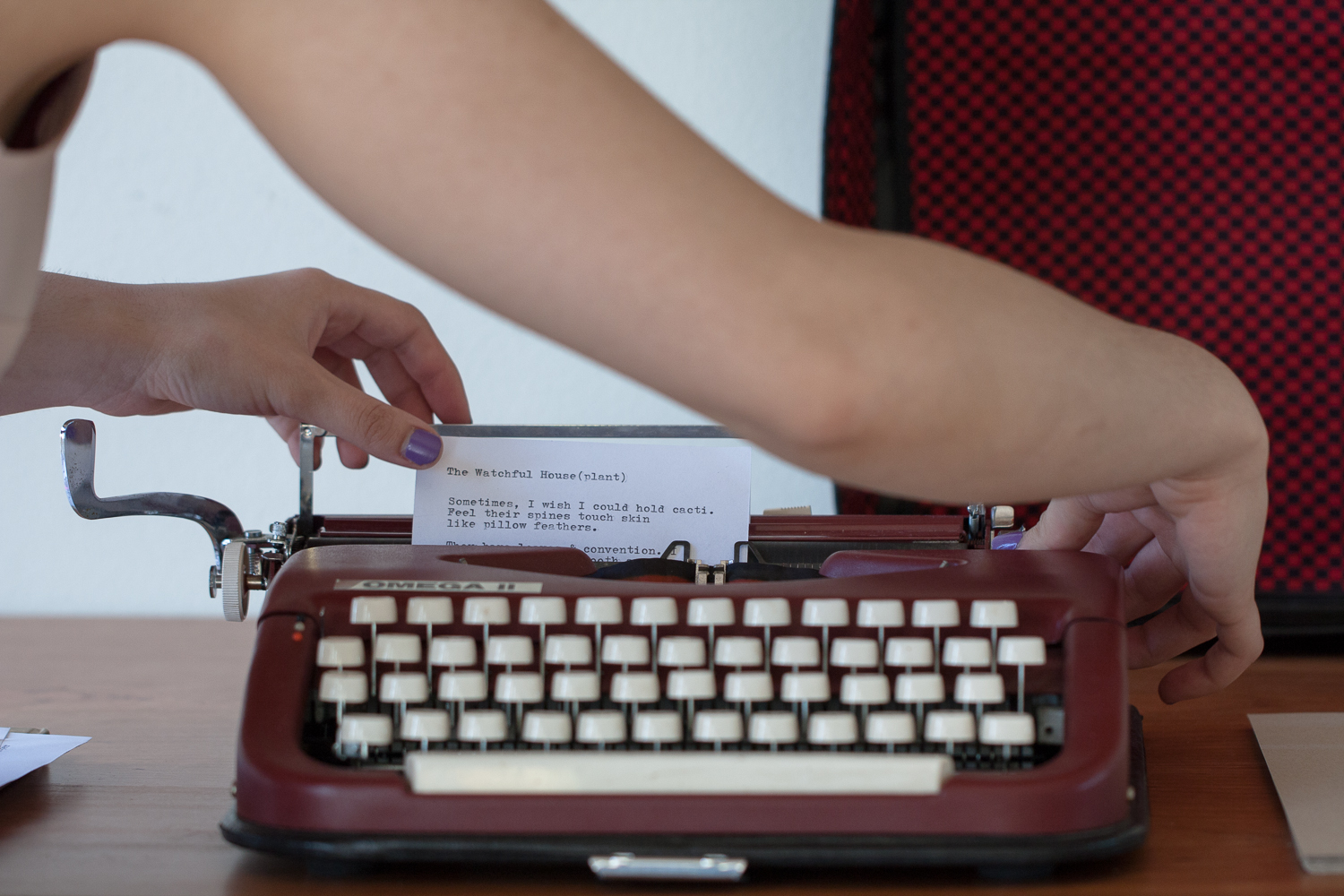
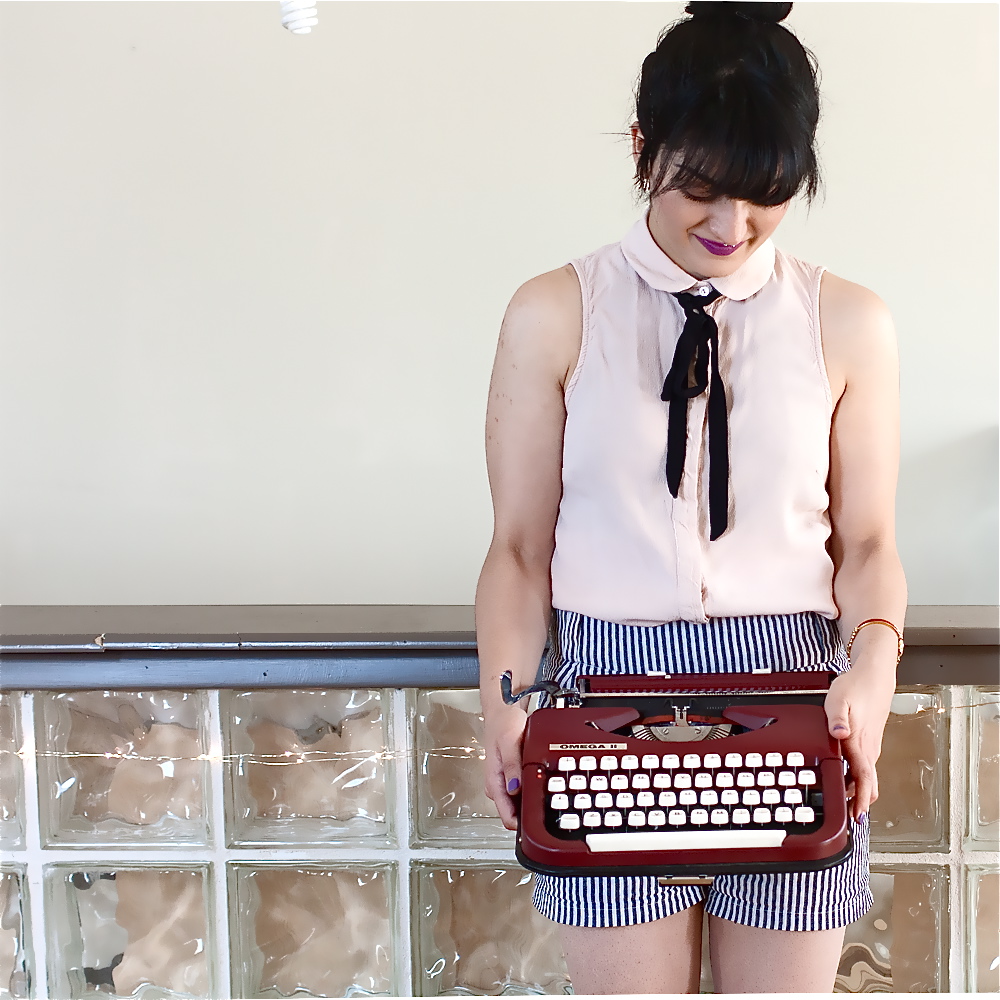
THE IMAGES.




AND THE INSPIRATION.
When we asked Rehani about the inspiration for Words for Wallpaper, she was quick to mention Poems While You Wait, which is a group of Chicago poets who write poetry on demand (think: The Haiku Guys in NYC, only, they're not stuck to seventeen syllables). Founded by Dave Landsberger and Kathleen Rooney, you can find the traveling poets at events, street festivals, weddings, parties, or random locations around the city. For those on the receiving end, there is little to it: you see them sitting somethere, you think, I wish someone would write me a poem today, so you approach them, engage in friendly fire, fork over $5, pick a topic, and whoever is up next (they rotate), they write you a poem within 15-20 blinks. Don't a lot of people do these kinds of things? You see some individuals doing this, but rare are established groups of published poets. How will I know if it's them? Says Rehani, "They are the ones with the vintage typewriters." And she is one of "the ones." Oh, and all the proceeds go to Rose Metal Press.
One obvious connection between Poems While You Wait and Rehani's Words for Wallpaper is the typwriter. "The approach to writing on typewriter is so different than a computer," Rehani said. "There isn’t a delete button. You need to have a certain kind of confidence when you use a typewriter." What about mistakes? They are everywhere. "Sometimes, I make mistakes and then I try to make the mistake part of the poem." And how could they not be? Standing before them is their reader, audience, and judge. When that kind of presence is present, it can increase the sound of time.
"It's interesting to see where writing can go in such a short time. We, writers and poets, manipulate memories and images, but it's a little challenging when put on time constraints. It's almost like time is manipulating the poem, too."
Words for Wallpaper - Poems While You Wait
READ WEEK 2
You Can Stop Cursing at Cursive Writing Now • A Handwritten Review

HANDLED BY HANDWRITTEN

Meet Linda Shrewsbury and Prisca LeCroy, the mother-daughter team who has changed the world of cursive writing. Literally and figuratively, they have reshaped the way children, and adults, learn cursive writing: not in alphabetical order, but by shape. And in less than one week, their second campaign comes to a close. Their first, a Kickstarter last year, was successfully funded and raised $33,000.
This helped bring CursiveLogic, the workbook you see below, into existence, and now, Shrewsbury and LeCroy are set on taking it into the classroom with their new campaign, Cursive2Class.
What exactly is CursiveLogic's method? It reorders the alphabet into four shape-groups (oval, loop, swing, and mound), color-codes them with visual and audio cues, and fits into a single workbook that has — prepare yourself for this — regular paper and dry erase worksheets. Heaven, we know. Whereas old models required students to sit in place and etch the alphabet in order and silence onto recycled and photocopied sheets of paper, this four-lesson workbook takes students through each similarly-shaped group of letters, while at the same time teaching how to write full-length words. This model, workbook, and business is the absolute example of how, coupled with new technologies, we are finding more effective ways of teaching children the fundamental skills and knowledge necessary for cognitive development.


This is the answer the core curriculum has been waiting for, not to mention Town Hall Meetings and online forums. Cursive writing has been disappearing from the classrooms, but that is because the way it was being taught had not changed with the ways in which students are learning, and expected to learn, in the twenty-first century. We are preparing students for jobs that don't exist yet because we are still inventing them. But the thing most people don't see is that when cursive handwriting goes, a lot of other things we cannot see or feel vanish with it as well, including reading comprehension, articulation, writing and sensory motor skills.
The old model wasn't working. We live in a technological world, and one that is constantly changing, which means we have to change with it. And CursiveLogic is not just keeping up, but it is ahead of the curve: they have side-stepped the political impasse and built their own business, a patent-pending approach, in fact, and instead of arguing back and forth with adults, they were sitting down with students and watching them work. Ever since their model surfaced, they have been gaining support from handwriting experts, educators, politicians, psychologists, and scientists around the country.
You might be thinking, this looks great, but not for me. We understand not everyone will want to relearn cursive writing, though we actually encourage you to do so (we have bought their workbooks and are going through it ourselves), but there is still something you can do: spread the word, sponsor a workbook, and help CursiveLogic make its way into the classroom. Join us and participate in their Indiegogo Campaign. We selected the "Get One and Give One" option, which we recommend, but if you want to Give Two, then do your thing.
The next time you hear someone up in arms about cursive writing, you can pat them on the shoulder, hold the cursive book you bring with you everywhere just in case you feel the urge to loop or swirl, and say, "You can stop cursing at cursive writing now."
Follow the links below to help support the remaining days of their campaign (Cursive2Class) and help a kid. Spread the love by liking them on Facebook, and check out their story in their words.
We Might be the Last Generation of Letter Writers • A Conversation with Sociologist Michelle Janning

Sociologist and Professor, Michelle Janning
I never really know why I do it, but there I will be on various afternoons throughout the year, sitting on the wooden floor in front of my closet, peeling tape off a slightly battered box. On the top flap of this box is two words in uppercase letters and permanent pen: DEEP STORAGE.
I've come across a lot of people who have the same — a box or ten of memories sitting on closet shelves — and people who do the same: thumb through this deep storage from time to time. The effects are not always the same, as the very reason for the impulse to sift through the past can vary, but there can often be a combination of emotions —nostalgia mixed with regret, or warmth mixed with emptiness. Albeit peripherally, I think it might have something to do with what Adam Phillips explores in Missing Out: In Praise of the Unlived Life, where there can be a strong sense of constant reflection: wondering what was, what could have been, and what could be. But I also think quickly to Joan Didion's "On Keeping a Notebook," which speaks to the importance of recording life and keeping a close proximity to the past.
One item that many seem to hold onto are letters of past love. But why do we keep a hold of these romantic reminders, especially of ones long gone? We found an inkling of an answer in an article recently, "Why Love Letters Matter, Even After You Break Up." It features words by sociologist Michelle Janning, who happens to be a professor at the college I attended, Whitman College. A lot of her research has looked at concepts of "betweenness," and romantic correspondence surely qualifies as that. But she has also looked at another intersection: the differences between digital vs. handwritten romantic correspondence. When asked why we hold onto these records of our romantic past, Janning replies: "They represent who we were, which is part of who we are. They become our relationship counselors, reminding us of what to avoid in future relationships and what to rekindle."
We recently spoke with Janning about her research and work, but also about her own experience and relationship to her deep storages and handwriting.

BRETT RAWSON: What led you to studying the divide between handwritten vs. digital correspondence in romantic relationships?
MICHELLE JANNING: I was cleaning out a closet and found the box of letters I'd stored from high school and college. After reading through them I talked with my husband, and we (college grads in the mid-90s just after email started and just before the internet) figured we might be the last generation of letter writers. Then lunch with friends of different generations (one who had a folder in her phone labeled "texts from cute boys") made me wonder further. Full story in the publication attached.
RAWSON: What did you find from your study that you didn't expect? Did anything surprise you, did new patterns emerge, did you find any contradictions between what people say and what they do? If you were to extend this research, what would be next?
JANNING: The most surprising thing I found was that, while women are more likely to save letters and mementos from relationships than men (and to save more of them), men tend to look at or "visit" their saved love letters more frequently than women. And men tend to store them in more accessible places (as opposed to closets, under the bed, or in storage).
Some of this may be because women tend to be tasked with household organization more, and spend more time than men on creating a storage location that is decorated or made special in some way. Right now I'm trying to figure out if it'd be worth studying the data to look at generational difference. The hard task here is that technologies change so fast that I'm not sure I can capture both age differences and technological change simultaneously (because change in one can falsely suggest change in the other).
My big project now is writing a book that uncovers how the objects and spaces in our homes tell us something about family relationships. Love letter storage will be part of the chapter on dating, sex, and paths to family formation.
RAWSON: Between-ness seems central to your focus. Aside from technology, what else comes in between us and handwriting?
JANNING: Good question. For me, between-ness is about internal conversation when I find myself unable to agree with polarized claims. Relating this to handwriting means that I am neither a huge fan nor critic of handwriting. I can see the importance of keeping it in order to foster all the good things that can stem from it (like the aesthetic, the handcrafted, the thoughtfulness, the non-reliance on non-human technologies).
But I also shy away from romanticizing anything that hearkens back to a fictitious past when our present (privileged) perception is that it was somehow better then than now. This is true when I think of gender roles, intergenerational relations, religion, or even medicine.
RAWSON: What is your own experience with handwriting?
JANNING: My dad had a brain tumor after college but before I was born that rendered him physically disabled such that he lost hearing in one ear, had partial paralysis in his face, and had to switch hands for writing. He had grown up ambidextrous. I have vivid memories of watching him sign his name with the most bizarre pen strokes, which took an inordinately long time, but which never seemed to make me feel impatient.
This matters because I am an impatient person. I also have looked at his musical compositions from college (he was a music major), which were all handwritten. Since the pre-tumor writing was different from what I saw him do, I always thought about his life as having two segments. Only now do I think that maybe the visual representation of his handwriting may have had something to do with that perception. Add to this the fact that my mother has handwriting that is like a flawless art piece, and no wonder I'm intrigued.
I learned calligraphy as a 10-year-old, and taught my son to do it when he was younger. I love examining how the aesthetic world can tell us something about human relations. I have always spent time shopping for interesting pens, inks, and papers, especially when we'd stay with cousins in Germany as a child. In high school and college, I would pride myself on the clever use of colored ink to help with anything from chemical compounds to calculus formulas, and from maps to poems. I recently was asked to write a book review for an academic journal, and I decided to hand-write both the notes and initial draft. I did this because I bought a new fountain pen in Germany this summer. The final draft (which was then crafted on the computer) went more quickly than anything I've ever written, and it was accepted without a single revision (complete with both a formal and informal note from the editors telling me how amazing it was).
RAWSON: Are you concerned that handwriting / cursive lessons are being eclipsed by keyboard proficiency lessons in the U.S. school system?
JANNING: Yes and no. I see the use of keyboarding as necessary for the work that my students do in college, and that it is most certainly an efficient way for me to do my own writing. (Again, I'm impatient). But because I find myself grateful that my son was on the cusp of cursive instruction (he received some in Denmark when we lived there, he did a little in 3rd grade just before the school moved to a greater focus on Chromebook instruction), I must think it's a good thing.
My bigger concern with the Chromebooks has more to do with the increase in standardized testing, which I presume may be exacerbated by virtue of the fact that students are getting quicker at keyboarding. This makes testing more efficient. What I liked about my son's teachers last year was that, especially in writing (Hooray for Mrs. Hartford!), the kids would draft things by hand, learn to navigate and edit on a computer, and be allowed lots of time for crafting stories. So, as far as the creative writing process goes, I think his teacher struck a good balance.
Other than the aesthetic coolness of nice handwriting, I am concerned that students will not be able to READ handwriting, which limits our ability to learn things from historical texts.
RAWSON: When you think of your own handwritten correspondences, what comes to mind?
JANNING: How little I do this. I am not a letter writer. I think of little notes to my son, or drafting my writing by hand. That's funny I suppose.
RAWSON: Phenomenologists have argued that the self falls away when we are engaged in an intense activity, usually one that collapses the sense of the mind-body split by activating both elements. Do you think the writing implement of choice could act as a bodily extension, and that writing by hand helps combine subject and object in ways that promote intimacy with a text, whereas typing into a word document promotes separateness of subject and object?
JANNING: I am not sure, because I have felt precisely this way while crafting my writing on a computer screen. For my aging body, the times when I am most likely to feel the mind-body split is when I am in pain. For typing, it's in my shoulder and my eyes. For handwriting, it's in my wrist.
So You Are Now an Invalid with Beautiful Nurses • Lauren Miller
A letter from mother to son during World War II illustrates the tense and tender sides of war, and long-distance correspondence.

BY LAUREN MILLER
I consider my grandfather the living Hemingway — he is tough, he has sought out adventures, and he prefers his alcohol to burn on the way down. So when we pulled out his box of WWII letters, I was hoping to discover another layer to this man who now stands at my own height. What I discovered was a voice from a teenager who was braver than hell and who referred to himself as Junie.
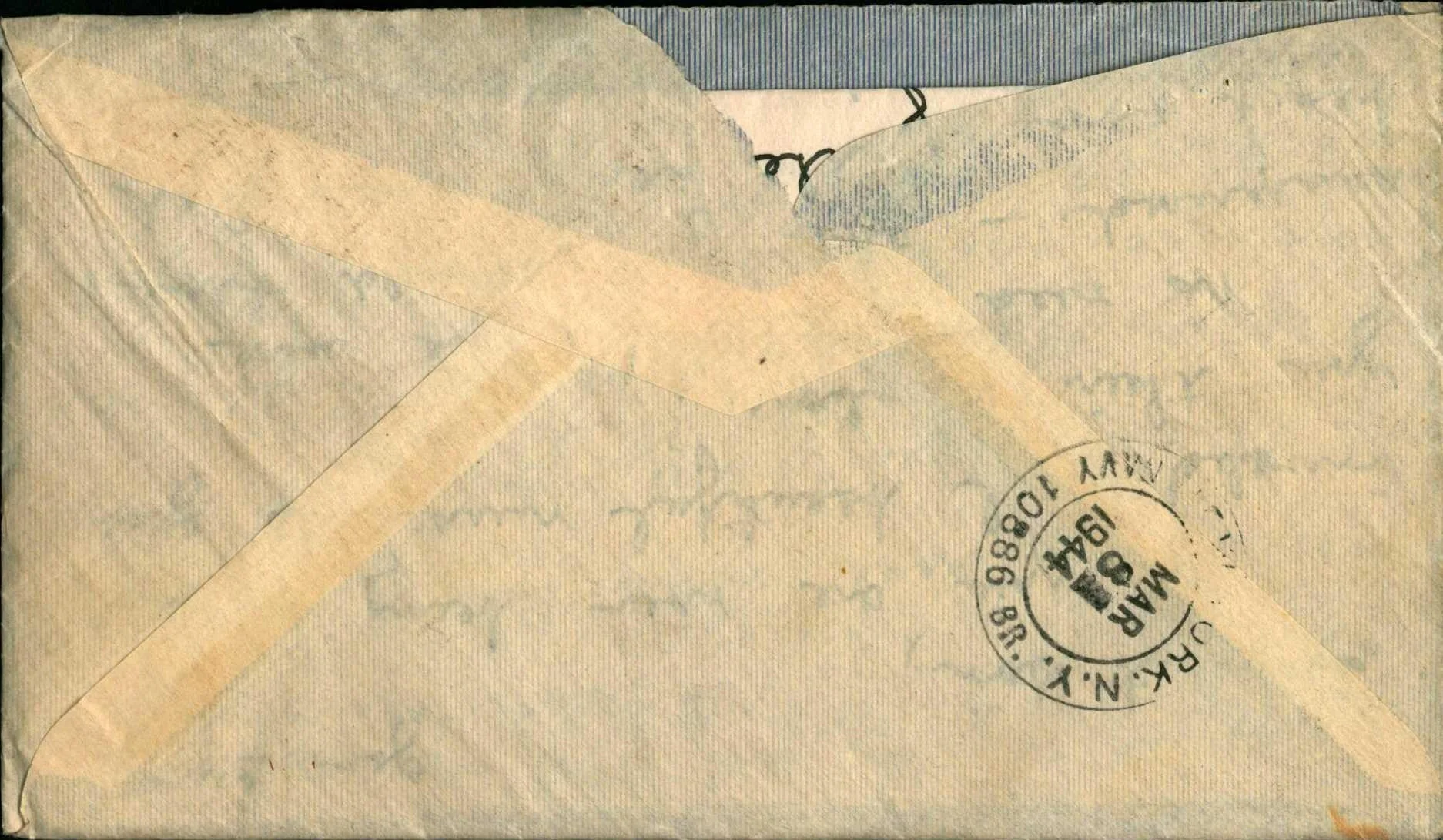
Herschel A. Cox Jr. wrote somewhere north of 75 letters to his mother and father while he was serving as a Marine in WWII. That afternoon, we read each letter out loud; skipping over the words we couldn't decipher and pausing for history lessons along the way. I had braced myself for tears, excitement, and laughter, but it wasn't until we read the one letter from his mother that I discovered the layer I was hoping for:
This letter was written to my grandfather from my great grandmother after she had learned her only son had been wounded. The envelope alone tells a story of how hard it was to locate him once the bullet entered and exited his arm. Her words portray her as a stoic, thoughtful, caring, and witty woman who I consider the bravest of them all. Holding that letter and seeing her handwriting was a heartfelt moment when I connected to the Marine who is my grandfather.
I must apologize in advance to my grandfather. This entry is not a historical representation of the months you spent serving. It is about how one letter encapsulates your experience as a Marine and reveals so many layers.


Lauren Miller is a handwriter in Seattle. True to her native roots, any goodness she hand writes usually starts after consuming a cup of coffee. Her first memory of writing was at her family cabin on Vashon Island. With legal pad placed squarely on her great grandfather's table and a number two pencil tightly gripped, she described the seagulls soaring above the Puget Sound. Today she enjoys the simple pleasures, her ability to follow her passion, and the musings of her nephews.
Paul Laudiero's Shit Rough Drafts • A Handwritten Review

BY HANDWRITTEN
We recently came across Shit Rough Drafts by comedian Paul Laudiero. After reading through it in one sitting, we spent the next few days losing our marbles. Laudiero's humor is magnetic, often departing as quickly as it arrived, leaving us to enjoy his imaginary musings on the greatest works, shows, and plays of our times.
Chances are, you have experienced several of the 135 books, movies, and TV shows that appear within Shit Rough Drafts. While that'll enhance the experience, it doesn't exclude entertainment. You don't need to have read Eat, Pray, Love to deeply enjoy Laudiero's title-twists.
Shit Rough Drafts exposes process, and in the process, pokes fun at finished products. How do these "must-reads" make their way into the world, and did they ever take a different shape? Are those who we hoist high out of reach just as messy, confused, and lost as we are?
We spoke with Laudiero one early morning while he was strolling alongside Central Park, coffee cup in hand. It was eight in the morning. He was alert and awake, while we were on a porch shielding our eyes from the early morning sun. We told him about Handwritten, and how we wanted to keep the humor in handwriting. He said that was good, because a site like ours would bore people to death. We totally agreed.
Shit Rough Drafts is a new wave of coffee table books. In that, it isn't idle. The book is impossible to not pick up, and difficult to put down. It's not easy then to pick our favorites, but since we had to, here are three that kept us laughing well into a deep sleep:
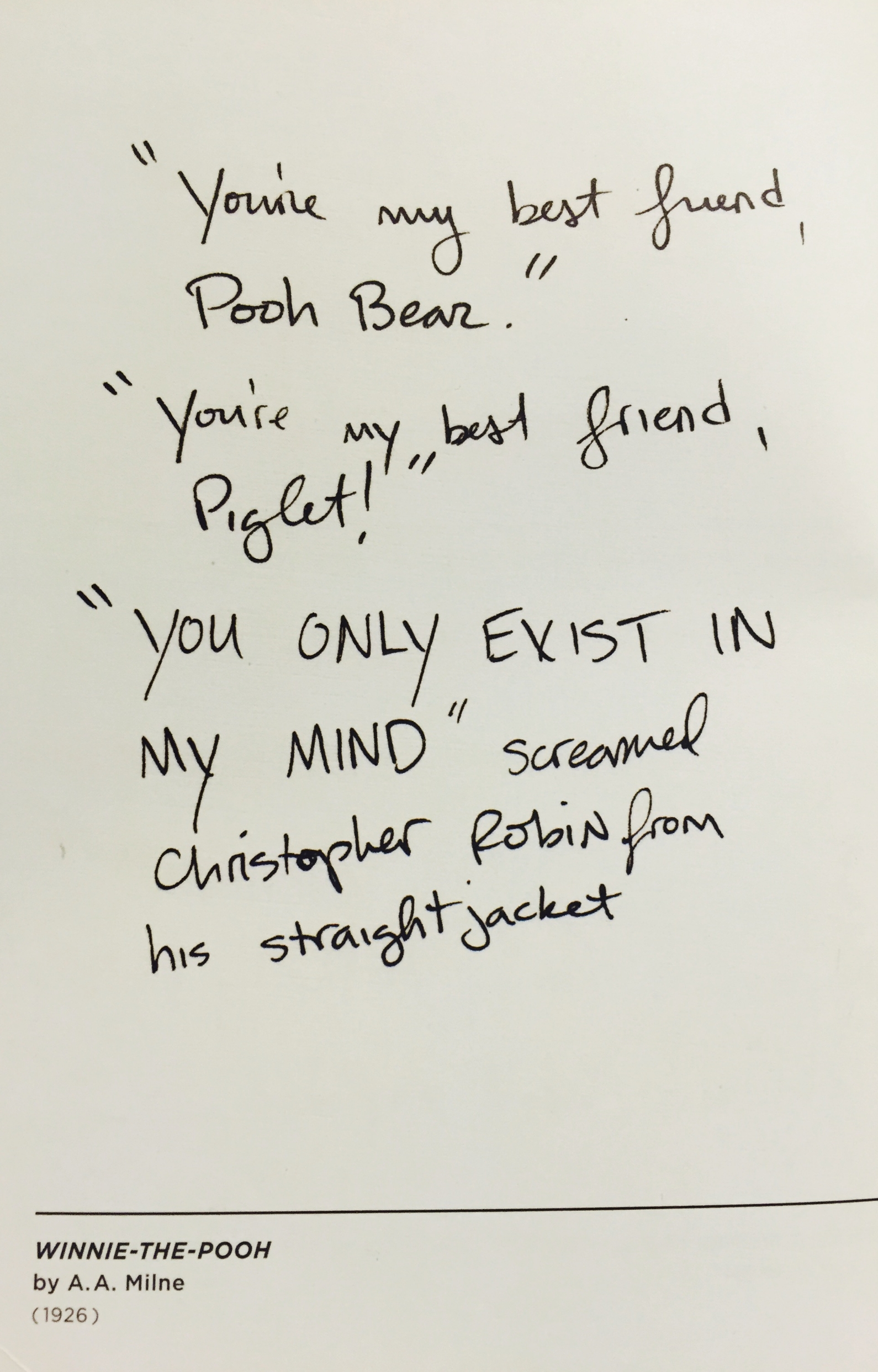
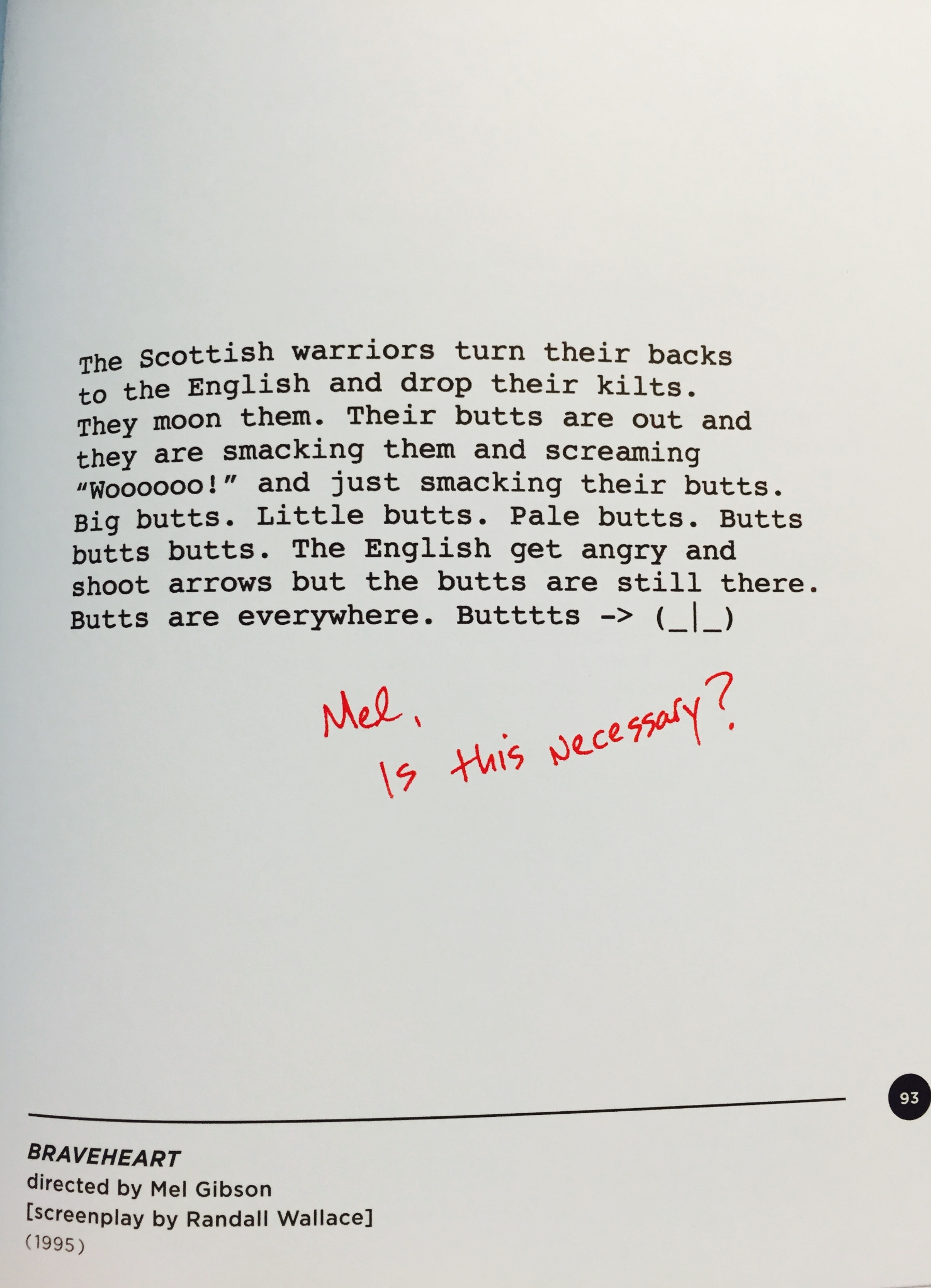
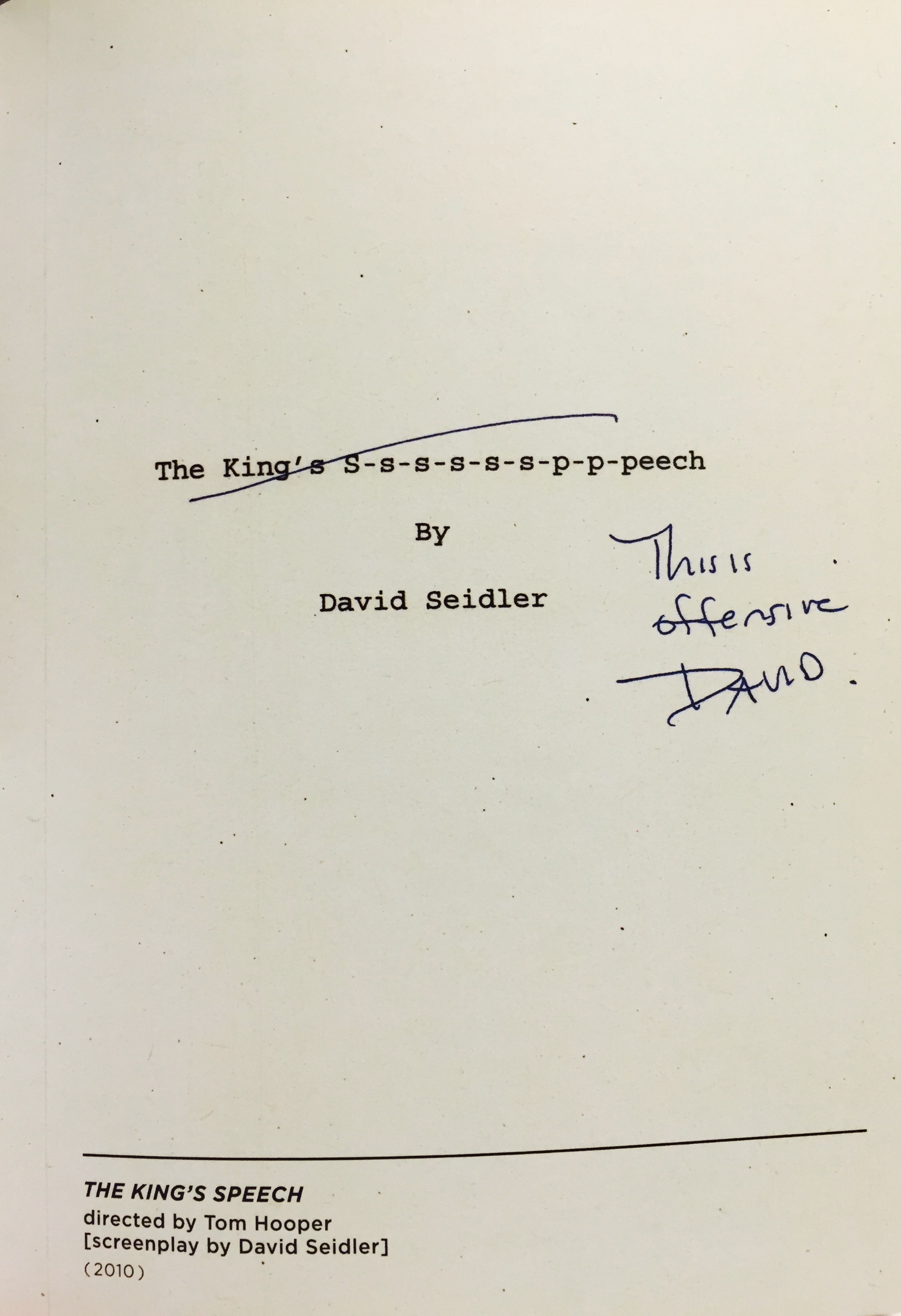
I Have Come to a Conclusion • Ali Osworth
In this micro-ritual, Ali Osworth lays out the key ingredients to safeguarding ink's elegance, and her daily quest for grace. For those of you looking to slow down your mornings, taking a look at what's on your desk is a good place to start.
BY ALI OSWORTH
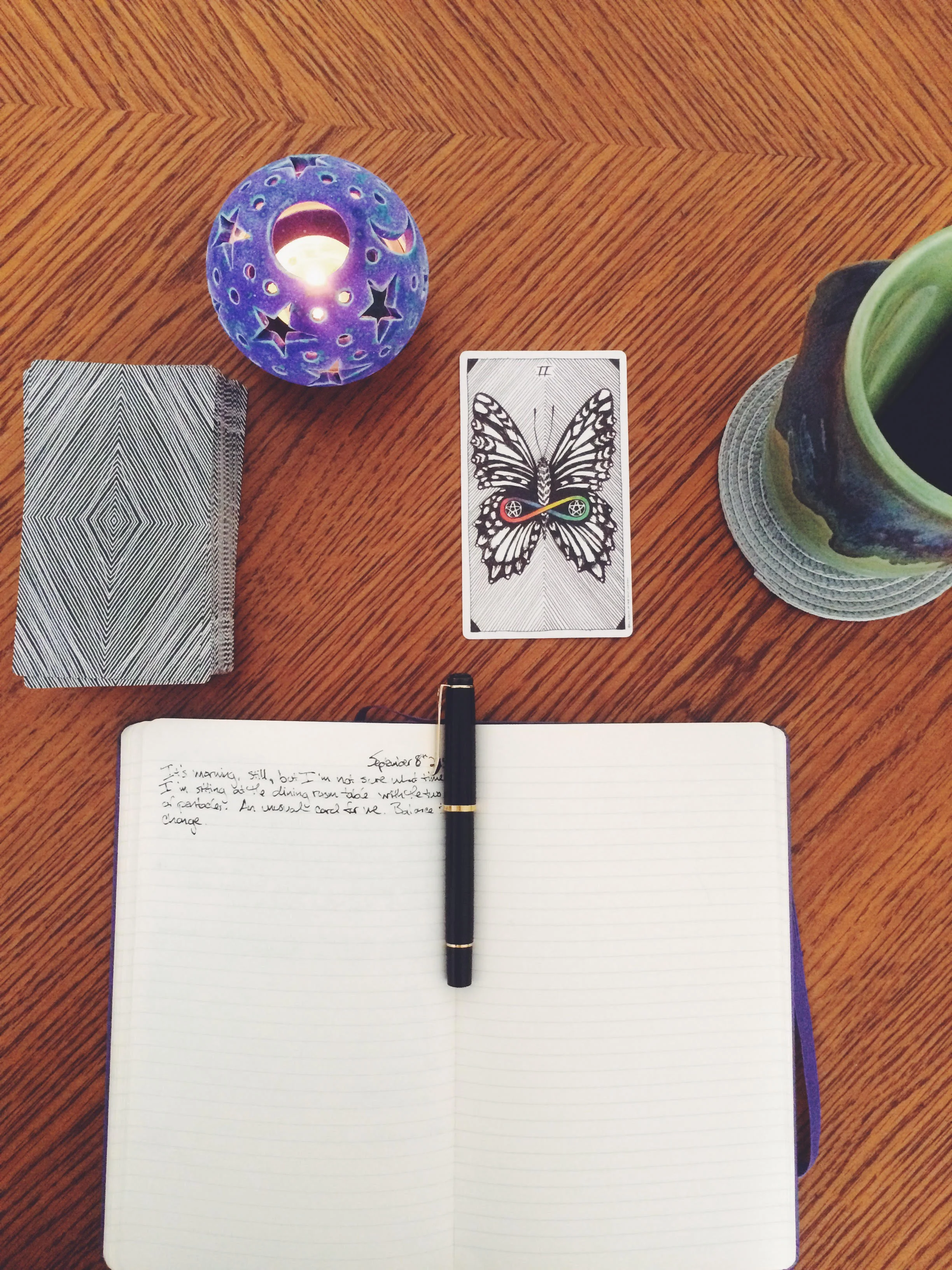
I have come to the conclusion that I'm a better, saner person when I slow down in the morning. I light a candle (the holder for which a dear friend gave me long ago), brew some tea (Lady Grey) and get out my tarot cards. The card in this photo is the two of pentacles — taking on new roles and balancing them, all with grace. It's the quest for grace that brings me to handwriting in my journal (most of the time, with a fountain pen that used to be my father's). Without the half-hour of journaling, of connecting my thoughts to my body as I use my fingers to move the pen across the page, I lose the grace. My movements become less refined. I lose ink's elegance. I become as fragmented as Tweets — 140 character, byte-sized.
Up and Back Again • Chad Frisk

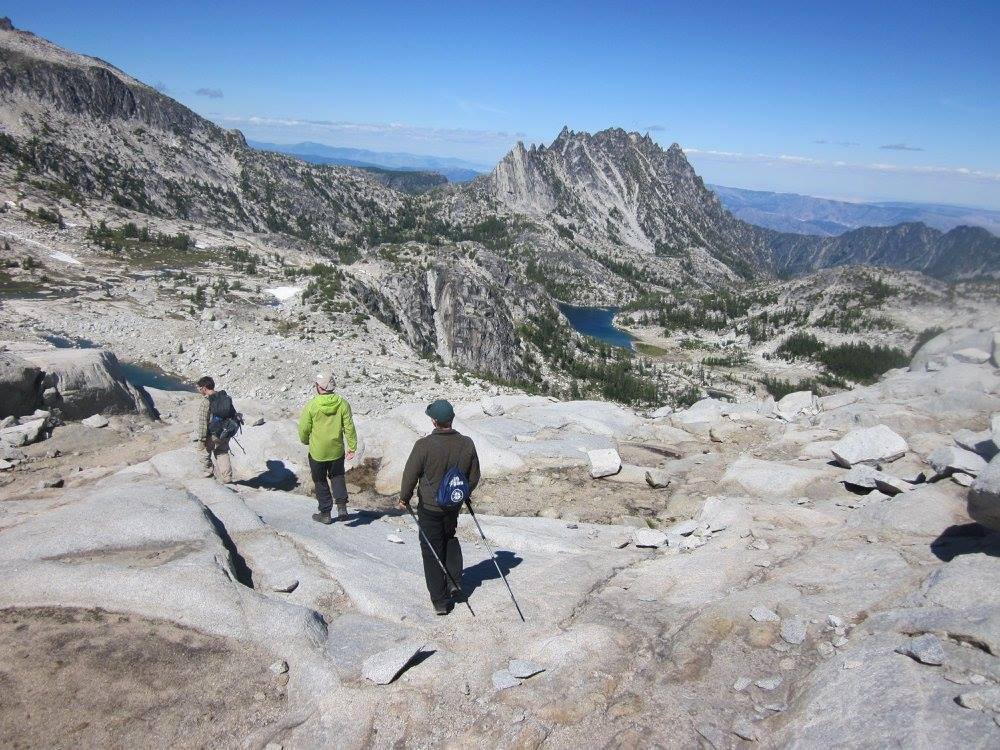
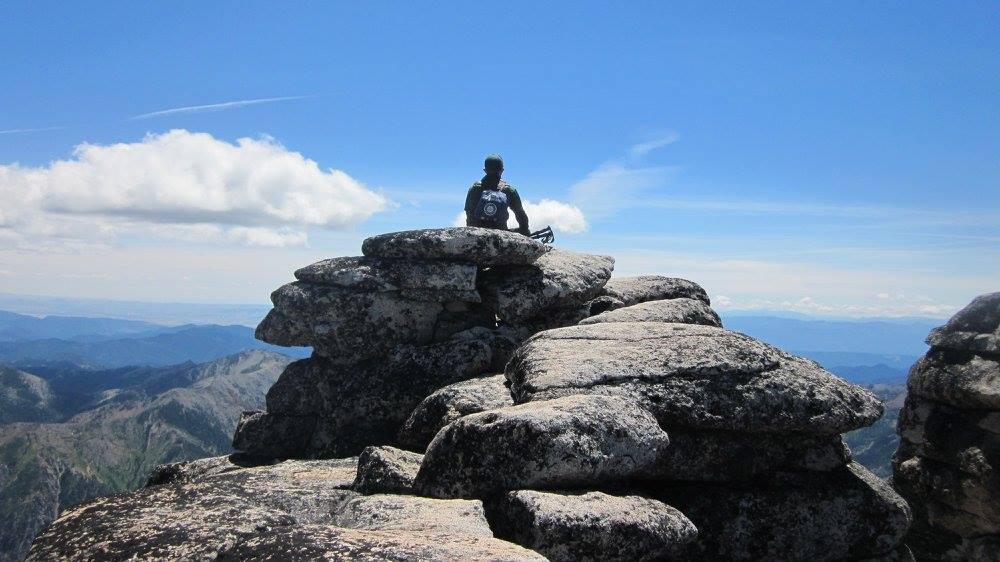
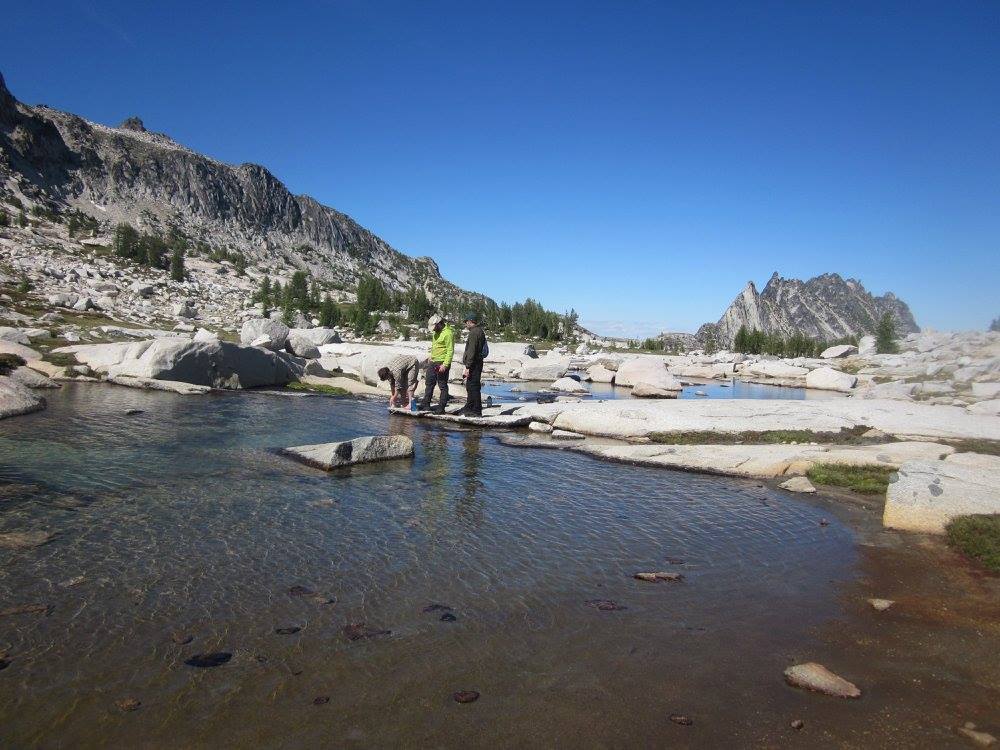
On the top of a mountain in the Pacific Northwest, author Chad Frisk came to a clearing. He didn't expect to write there, but he also didn't expect to be there, which is exactly why he wrote there. Below is the result in its original shape.

“The top wasn’t what we thought it would be. There were no signs telling us what to expect. You just stepped up and into a world that was entirely invisible from below.”
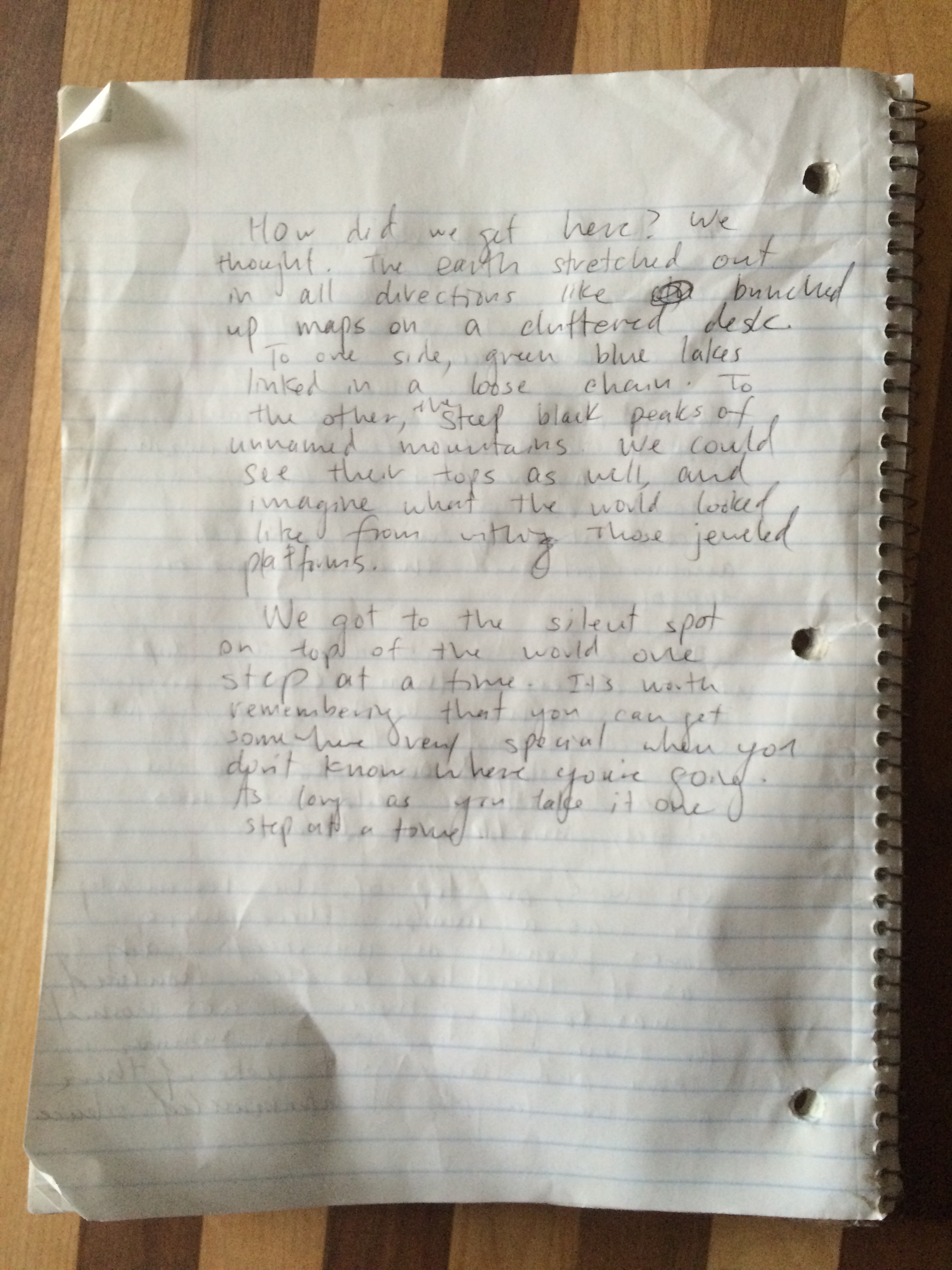
“How did we get here? we thought. The earth stretched out in all directions like bunched up maps on a cluttered desk. To one side, bright blue lakes linked in a loose chain. To the other, the steep black peaks of unnamed mountains.”
Once A Writer, Now A Handwriter • Demetri Raftopoulos
A writer reflects on his first experience with a journal, which happened to coincide with living away for the first time as well, at the age of 26.

BY DEMETRI RAFTOPOULOS
I forgot my notebook.
It’s 5:30 in the morning and most of Thassos is still sleeping. The sun is hidden behind a couple moon colored clouds, just like the rest of the writing cohort behind their closed bedroom doors at Archodissa. I walk back past the kitchen and up the stairs towards the courtyard where the basil and oregano that is sprinkled into our dishes grows. A group of off-white stray cats lay spread out next to the garden. Their eyes are closed too.
I walk up to the balcony and reach my room. Clothes hanging to dry snap softly on a line extending the length of the balcony. I barge in and retrieve the small beige felt journal resting on my nightstand. My feet crunch against the sand I drag in from the beach every day, and close the door behind me, now ready to open my notebook on a boat that will sail through the Aegean.
Spending a month in Greece, that same notebook was next to me as much as bread was with tzatziki. With me at all times like uncertainty throughout the Greek government. Simple chance brought us together. A good friend gave it to me before leaving and if it wasn’t for him, I would have never clicked down on a pen. I would have never built another relationship alongside all the others formed around me with the clanking of glasses that month.
The notebook became my traveling companion. In a new environment, with new people, I felt safe with it. But I was also in constant need to protect it. So much so that instead of spending my last morning in Thassos on the beach, I sat at the restaurant and transcribed everything I had filled it with onto my laptop, in case something unfortunate occurred. I needed to know where it was always, the few times it wasn’t tucked into my back pocket or open in my hands. It was a friend that always gave, no matter how much I took and took and took.
I wasn’t a hand-writer. But in Greece, I became one.

The water looks dark, like the tip of a sharpened pencil. I grip the blue siding of the boat the way I grip my notebook. We move slowly, a pattern of tiny ripples follow us to the fishing trap Stamatis set last night, but the boat still rocks with the unsteadiness of the water. Stamatis is a fisherman, captain of the Evanthoula, and owner of Archodissa. He stands behind me clutching onto a small metallic wheel that sticks out from above the compartment like his worn-out overalls do over his blue polo. Greek music plays from a speaker next to the wheel and we pick up speed.
“S’Agapo pou eisai oreia,” Stamatis shouts, adjusting a strap falling off his shoulder. “I love you because you’re beautiful,” I repeat to myself, taking a seat on the ledge in front of him.
I wonder if he is singing to the sea, I write in my notebook. The swaying of the boat darts my pen upward and downward. Or if he is singing to his wife, Eva. The word ‘singing’ comes out the sloppiest but I can still read it. I use my thigh as a desk and rest the notebook right above my knee AKIMBO. It’s chilly this morning and the Aegean breeze whispers across my exposed head. I pull my hood up and continue writing.
This is his life: setting traps at night to pick them up in the morning. Sleep irrelevant. And whatever the sea offers him this morning, he will still be singing. Whatever the headlines say about his home’s economy, he will still be fishing.
I flip back to earlier pages in my notebook and admire how much I have already written only into the second week of this month-long writing residency. The pages are filled with sloppily written words as if I wrote them descending King Da Ka at Six Flags but my words are there, nonetheless, engraved into each sheet.
Light begins to creep out from behind the mountain to our left, as if rising like beer poured slowly into a mug.

Stamatis is still singing. His words hit me like the morning wind but stay and land on my page instead.
The captain continues to serenade his home, his sea. He knows these waters better than the fish that swim in them. The boat moves with ease and the music blasts louder. Stamatis is Thassos’ alarm clock. The snake charmer for the sun. The dry entertainment above for those living below. He could be trying to mask the harsh sound of the Evanthoula’s engine. Provide the sea with comfort instead of impending potential capture. Or he could just love the music his favorite singers produce. It could be his constant cheery nature. That he wishes to celebrate his life instead of worry about it.
I click the end of the pen and place it in my notebook’s crease so I can stand for the sunrise. I leave the notebook closed on the ledge and face the mountain, watching it give birth to the sun. The curved arc appears first and the morning already begins to warm. I remove my hood and look back toward the notebook, tempted, but keep my eyes focused on the slowly rising sun.
This will sound a bit silly but my notebook isn’t demanding or needy. Yes, I may write in it constantly but the notebook has also allowed me to live my life separately, away from it’s pages and soft jacket cover. To admire what’s around me alone, and then share the moment with it afterward. To truly capture a moment before putting my head down. Don’t get me wrong, I enjoy sharing. But I enjoy being able to experience something on my own first and then sharing it with others. With my notebook.
The sun is halfway through its entrance and I return to my ledge. I watch the day brighten a little more before opening the notebook again.

“Ti graphis?” Stamatis asks loudly, touching the brim of his blue hat, and then resumes his song. "What are you writing?"
I turn to face him. “Kati yia sena,” I tell him. He smiles and his graying goatie does too. "Something about you."
An orange buoy appears, softly twirling in the water like the final spins of a quarter. The engine and speaker both soften and the boat inches towards its marker.
Stamatis’ beard resembles my father’s, as does his work ethic. I’ve been to Greece before but it’s been seven years since I’ve experienced that sunrise from the blue of the Aegean. With someone like Stamatis, a patriotic man, doing all he can to keep his business and world afloat. The water doesn’t have a rank smell attached to it, like the beaches on Long Island. If anything, it smells like promise. Greece is constantly on display, shackled in the courtyard of Europe for everyone to poke at. It isn’t hidden like that which swims beneath us. Hopefully Stamati will reveal some of his hard work when he pulls up the trap.
In the past, I don’t know how I would have recorded all this. With my phone? Hope to remember as much of it with my fleeting memory? Fleeting, like my presence in Greece. It’s impossible to remember every detail but with this notebook at my side, I’ve been attempting to. Whatever I don’t remember or don’t see, I’ll write into my notebook the next time I’m here. And whatever I forget will be kept alive.
The orange buoy is now at arms reach and the boat slows even more. A couple of seagulls are awake now too, circling the boat for whatever we throw back, if anything. The sun is now completely over the mountain and shines on the rest of the waking Thassos. This is when Stamati will begin to reel in his trap and wait to see what he has caught.
“Re Demetri,” Stamatis says, turning the wheel slightly, “pigene na to piasis para kalo pedaki mou.”
The captain asks me to go pick up the buoy. An honor. He is asking me for assistance, someone who is simply learning in the presence of a master. Stamatis could do all this with one hand covering his eyes and the other flicking worry beads over his fingers. My assistance isn’t paramount to his trip because surely he does this alone. However, he has entrusted me in carrying out a duty that affects the well-being of his family.
I’m still tempted to stay seated and write. To witness something invaluable I could never see elsewhere and fill more pages. Write this scene of him picking up the traps. Write with detail the way each fish looks, how they move, and sound. Describe the definition of Stamatis' aging yet tone muscles flexing with each pull of the trap. How his blue shirt matches the water he’s pulling fish out of. How the mechanized pulley reeling in the trap sounds alongside the rest of the emptiness we are surrounded by.
Instead, I leave the next page blank. I close my notebook, stand, walk to the front of the boat, and reach for the buoy.
Braiding Together Our Lives
A project that weaves together generations, experiences, and handwritten expressions.
BY SARAH MADGES
When my grandfather died a few years ago, I realized I didn't know how to process the loss because I hardly knew the person I was losing — I hadn't gotten to know him in his lifetime. With one remaining grandparent, I decided I needed to make sure I got to hear her story before I was forced to hear it from someone else. I wrote her a letter asking if she would share her life story with me, in as much detail, and whatever order she felt most comfortable with. I didn't expect her to respond so quickly, or at such length — even less did I expect her to keep sending letters once I stopped writing her back with specific prompts and encouragement.
As I gave her so few guidelines — tell me your story — it was interesting to see the way she segmented her life into chronological bits with titles corresponding to the content, like "Childhood Years," or "War Years." It was also fascinating the details she would include, recalling them in such vivid language — the white snakeskin tennis skirt she wore — while other sections she'd leap past, moving from her first date with her husband Clarence to marriage in a matter of paragraphs.
What's more, I was struck by her handwriting. As I read letter after letter, I came to see her in the handwriting — the bodily trace pointing to the human body, my grandmother, herself. I was reading Susan Howe's That This, whose cut-up quotes from manuscripts overlap to create beautiful excised art-meets-poetry, when I realized that's exactly how I wanted to preserve my grandmother's penmanship. I decided to create a visual art piece splicing her handwritten account of her life with my own handwritten account of my life. A life she knows as much about as I knew of hers before the letters. In one sitting, I wrote a truncated autobiography on a legal pad, demarcating sections the way my grandmother had but with alternate titles (there's no war for me to tell a personal account of). I scanned and printed everything, and began cutting out phrases, creating a redacted work in the spirit of blackout poetry that I then arranged and pasted onto card stock.
Braiding together our lives in this way brought me closer to her, and helped me contextualize my own life in its comparatively short run. As I keep working through our letters in sequence, the project grows in size and scope, and I can sense that the true subject will find itself in the process.
The Screen Test • Joyce Chen
Is the notebook half-empty or half-full? In this essay, Joyce Chen sets out to test and trust her hand, a routine tethered to time, with the hopes of avoiding the pitfalls of resolutions by resolving to reflect. Are you up for the screen test?
BY JOYCE CHEN
I’ve never been one for New Year’s resolutions.
Not because I don’t believe in the psychology behind them – God only knows how much I am an advocate for self-reflection and self-improvement – but because I’ve always had a sneaking suspicion that New Year’s resolutions are actually made to be broken. The way they’re worded and thought about almost always sets the resolution-maker up for failure: “This year, I resolve to work out more” (meaning, what? Buy a new pair of running shoes and use them thrice instead of once?); “This year, I resolve to be a better friend” (read: respond to emails in two months rather than four); “This year, I resolve to spend more time with family” (but more time with family doesn’t mean a thing if you’re still plugged into a device while sitting in the same room, right?).
This may sound a tad bitter, sure, but to be perfectly honest, I only feel okay making these jabs because I’ve made these resolutions before, and by that same token, I’ve also failed at these resolutions before. There’s something exciting about starting a new calendar year that nudges our inner navel gazers awake to notice our shortcomings and attempt to remedy them with a promise to “be better.” But what I’ve come to discover over the years is that while New Year’s resolutions are always well-intentioned, they are often more about finding a temporary, band-aid solution to problems than actually digging deeper to get to the core of the issue.
A desire to work out more, for instance, might stem from guilt over poor lifestyle choices (ie. late nights, fried foods, overindulgence of all kinds), not an actual desire to exercise more. The resolution is less about running and lifting, and perhaps more about thinking about and taking control over our daily routines.
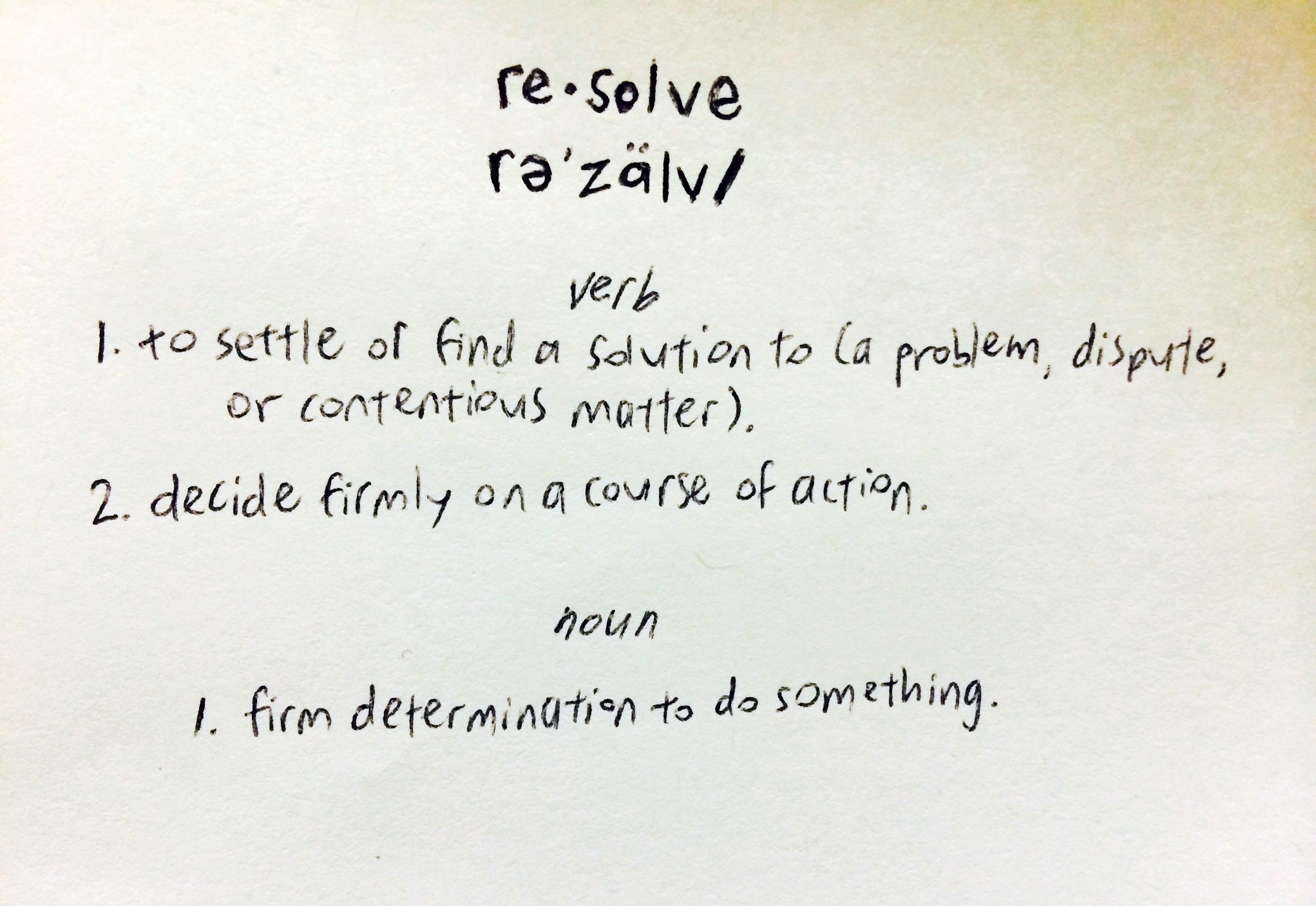
To that end, then, I would rather have resolve (n.) than to resolve (v.), because my goal isn’t to reach a conclusion right away; no, I want to understand my own process as it is unfolding. I would rather have the noun in my back pocket as a reminder than the verb in my front pocket, at the ready for a quick-fix solution. So this year, instead of a New Year’s resolution, I decided to have an anti-resolution. A plan to test my own willpower by opting not to do something that has become dangerously habitual to the point of dependency: stare at a screen all day.
I realize that as I am writing this, and as you are reading this, we are both staring at a screen – and that’s just fine. So to clarify, my decision to not stare at a screen is less a dramatic political statement and more a modified lifestyle choice, an experiment: Between the hours of 10:30 a.m. and 10:30 p.m., I allow myself to carry on as I always have – answering emails, scrolling through headlines, and laughing at silly GIFs. In those 12 hours, I feel connected to the greater community of the Interwebz, corresponding with friends halfway around the globe, pitching ideas to editors in other states, and engaging with a community beyond my immediate line of vision; I am in a digital portal and can free-float through both time and space.
And beyond the computer screen, I also allow myself to get lost in my iPhone, in the TV screen, in a number of other electronic means of communication; I express myself in words and emojis, and absorb new thoughts and ideas in the form of the news, news feeds, TV shows, Instagram, Facebook, Tumblr, Twitter. The sea of garbage, as a professor of mine once called this vast ocean of information, is alive and pulsing during those 12 hours.
This is what screens have given us, after all: a means to access other people, places, thoughts and head spaces, from wherever we happen to be at a given moment. And I am grateful for the distractions, as we all likely are, because that means that we can sometimes push aside the more immediate tasks at hand in favor of temporary escapes. But there is a threshold; there must be.
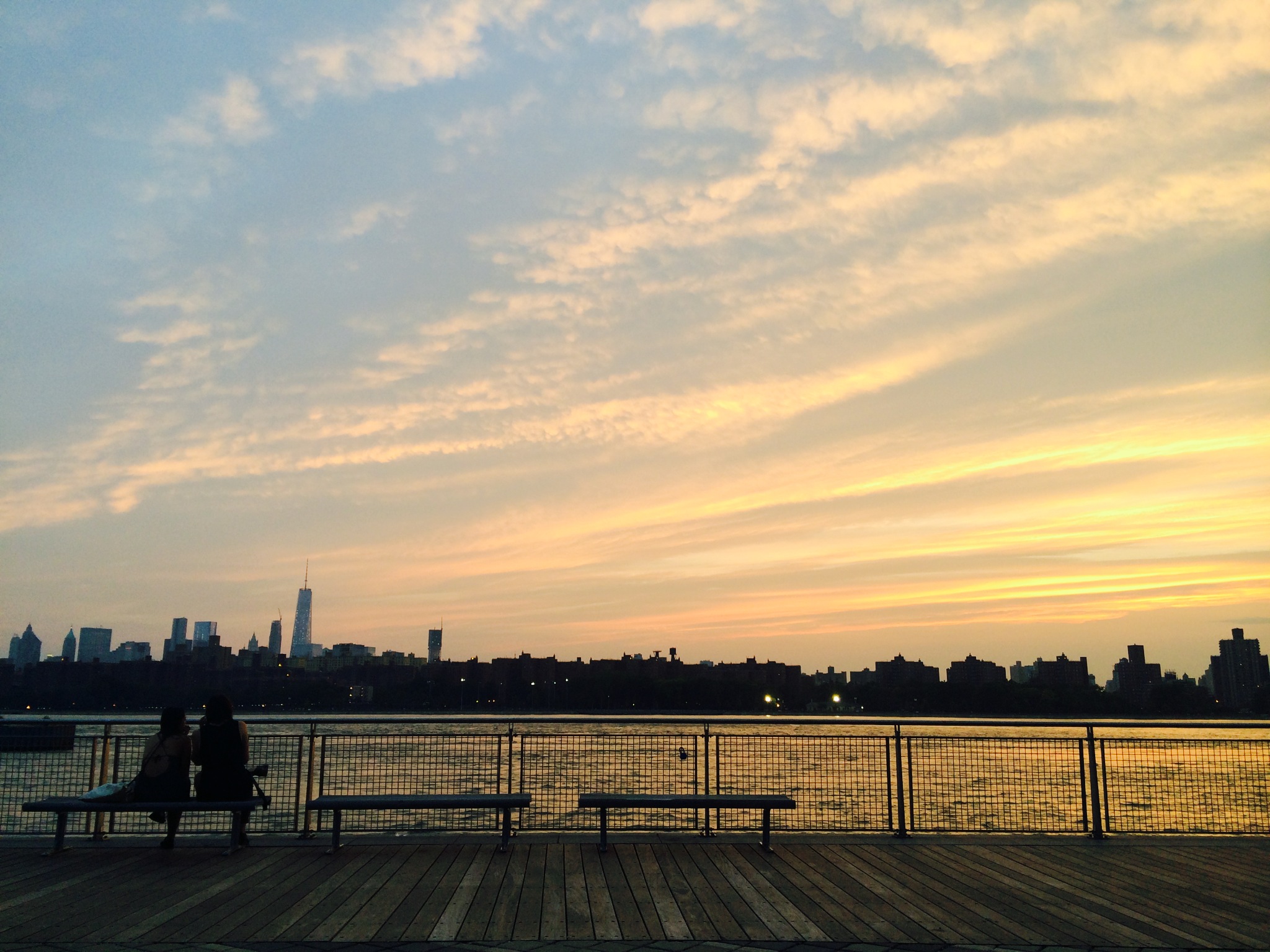
For me, that was last year, when I realized I was checking my email first thing in the morning and watching shows and films until I fell asleep at night. There was this feeling of dependency, of addiction, a light-bulb moment realization that I was literally spending all my waking hours as a slave to my many screens. I wasn’t getting good sleep, and I wondered sometimes if it was because my brain was going through withdrawal from not having a backlit device pointed straight at it during the hours I slept.
I realized that part of the problem with always being plugged into a device was that I was hop-scotching from distraction to distraction and was therefore not always quite here, the physical space I was occupying. And this meant, as a result, that hours and days and weeks and entire years were flying by without my ever having really experienced what was happening in the moment at the moment. I was living life in retrospect.
And that was a problem.
So though I still take part in the digital sphere between the hours of 10:30 a.m. and 10:30 p.m., these days, I’m opting to spend the hours prior to and after that off the grid a bit, focusing more on the who and the what of where I am during that time. Unplugging is the how. To experience life more vividly and fully is the why.
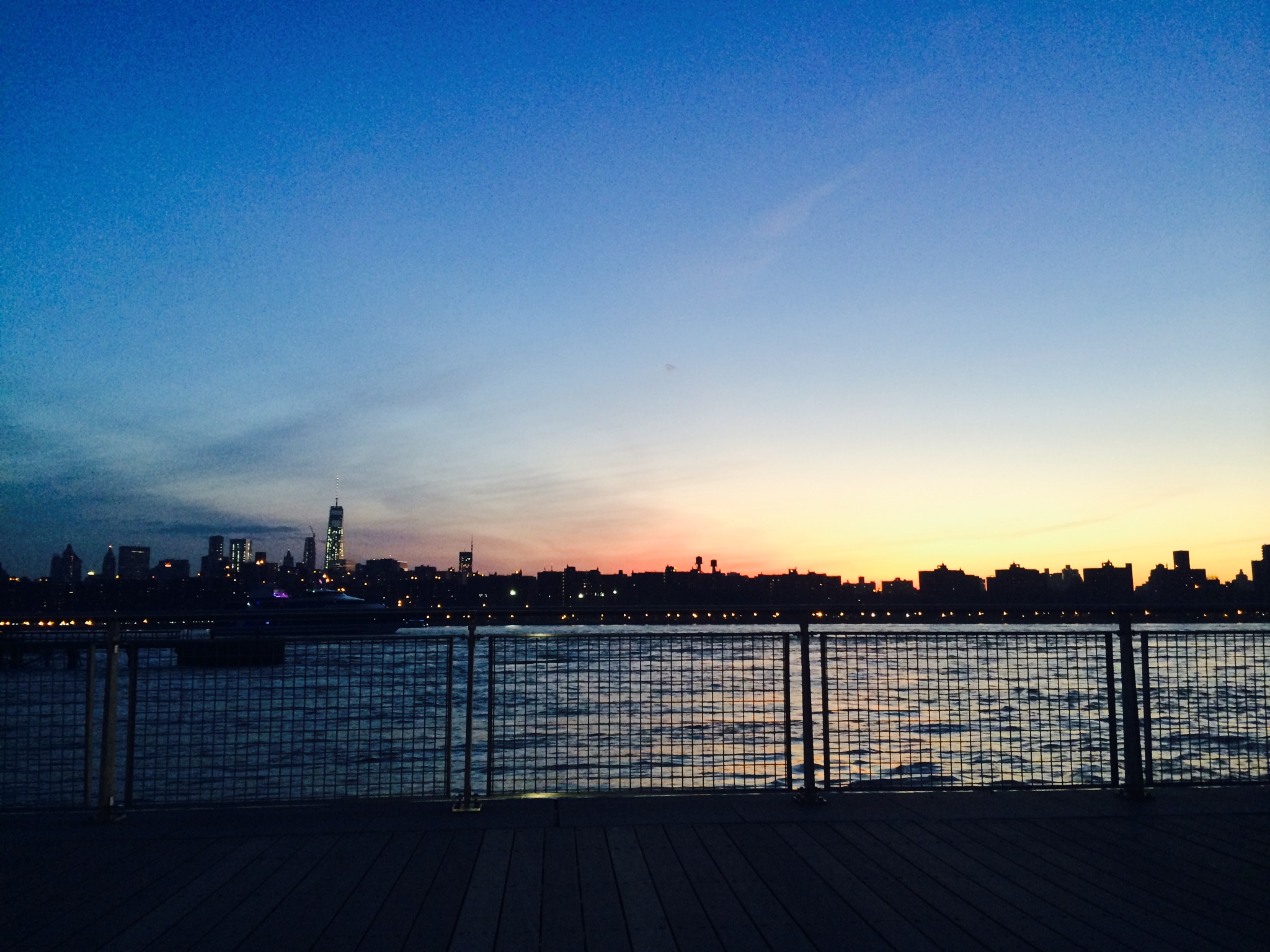
During those hours, I meditate and I think and I read and I write a lot (by hand, of course). There is a kind of stillness and peace I find in not being in front of or dictated by the influx of information found on a screen. It’s a feeling that I had long forgotten, and would most likely have continued to forget, if I hadn’t taken a step back and realized how my days had become inundated by thoughts and demands not my own. Being separate from the screen is giving me the luxury to do something I never thought I’d be able to do in this digital age: really hear myself think.
In the beginning, it was always tempting to cheat and take a quick peek through my phone in the morning just to see if there were any pressing emails or Facebook notifications or Instagram likes that took place overnight. But because I had given myself these rules and parameters, I felt a duty to keep myself in check, lest I disappoint myself with my own lack of willpower. I started to analyze that temptation, observe myself in third person during those morning handwriting sessions, and realized that much like Pavlov’s dogs, my instinct to check my inbox was more about the reward of attention (“so-and-so has replied to your email!”) and importance (“inbox: 52 from just one night? People really need to reach me”) than from an actual need to know information.
I am now finding that in those hours away from the screen, I am able to engage more fully not only with the present moment but also with myself, so that I know how to better navigate through the treacherous technological waters (and, to a certain extent, through social situations at large).

Now I write waterside, in cafes, in my room, in outdoor spaces that aren’t constrained by lack of wifi, outlets, or table-space. All I need is a pen, a notebook, and my fully focused mind. It is freeing.
Call it a reintroduction.
I feel more in touch with and honest with how I’m feeling because my thoughts are not as cloudy at the beginning and the end of each day, and I am starting to be able to translate some of that clarity into my daily living as well.
Call it a recalibration.
I sense myself being more selfish with my time and more careful in how and with whom I spend it.
Call it a reassessment.

The way I see it, we already segment our lives into so many distinct compartments based on how we spend our time anyway: family time, work time, free time, leisure time, personal time, social time, food time, sleep time, and on and on and on. So why not look for new ways to section off hours of the day, to break down previous habits and routines and build something new and perhaps, hopefully, more sustainable?
I’ve never been one for New Year’s resolutions because making them is, I think, a way to feel the thrill of a personal promise without any real commitment. Being more physically active, communicating more with loved ones, and reprioritizing our actions and activities are all noble pursuits, but what all three require above all else is a space and place to really explore the reasons why we want those things. And for me, I’ve found that space and place in my hard-won now, and I want to hold onto that feeling.
Every year, in place of a New Year’s resolution, I like to think of a single word to hold in my mind for those times throughout the year when I start to lose focus. In 2013, it was Create. In 2014, it was Trust. This year, 2015, I decided that my word would be neither verb nor noun, but a state of being.
In 2015, I have resolve: I am Awake

Joyce Chen is a handwriter in Brooklyn. She is also a journalist who thinks she spends too much of her time staring at screens - writing for print and the web, watching and reviewing films, and sending strings of emojis to family and friends. When she's not plugged into the World Wide Wonder, she can often be found out on unplanned runs throughout New York City, taking long walks along the waterside, or otherwise stretching her legs and getting out from the great indoors.
From Mess to Less • Chad Frisk

BY CHAD FRISK
I don’t know about you, but my mind is a disaster. Things are constantly whizzing through and then clogging it up. Things proliferate and congregate, ideally like constellations in the sky but typically like commuters during rush-hour. It’s a mess. Writing is, as I see it, the process of making that mess suitable for display. I learned the hard way that there is an appropriate tool for each step. I wrote the draft of my first novel by hand. I thought it would be cool. It was actually very dumb.
I filled fifteen notebooks. I went through a dozen erasers. Oftentimes I chose not to revise because it would be too much of a pain to cross things out and scribble in the margins. When I finished, I typed the whole thing into a Word document anyway, one indecipherable page at a time from tiny, gold-tooled notebooks that refused to stay open on their own.
I didn't know what it was about when I started writing. One day, I walked past an old, abandoned clock shop and thought it would be interesting to write a book about time travel. That was my only idea. I bought a notebook, scoured my apartment for a pencil, and started writing.
I was living in Japan at the time, working at a junior high school as an assistant teacher. That year, I didn't have anything to do. It was my job to go to four hours of class a day and read from a textbook. The other four hours were my own.
I decided to write a book. When it was finished, it had nothing to do with time travel. In fact, it had very little to do with anything. It was four or five stories posing unconvincingly as one, scrawled across 100 Yen notebooks I purchased at convenience stores.
There was a psychiatrist. He was frustrated by his patients' lack of progress, and decided to pursue alternative therapy - which included breaking and entering, kidnapping, stalking, and mild psychological assault. There was a burned-out business man. He was so deep in self-help that he had lost sight of how good he already was. There was a server at a nightclub for the uber rich. She was tired of getting hit on by three-piece suits, but was making so much money that she had convinced herself it didn't matter. There was a ten-year old boy. His grandpa had died, leaving a hole in his after-school routine that he didn't know how to fill.
There were others. There was a detective possessed by the ghost of Dick Tracy, an old illusionist whose understanding and lifelong exploitation of cognitive biases had poisoned his view of humanity, and a girl who lived in a castle with a mother and father who didn't pay attention to her. There was also a beanstalk, a ruined city, and a sleeping giant.
It needed an almost complete overhaul. To do that, I abandoned my pencil for a keyboard. Computers are amazing because they make editing incredibly easy. Point, click, drag, delete. Done. It’s infinitely easier to revise already written words on a computer than on a pad of paper.
It took me about eight months to handwrite the first draft. I spent nearly an additional year revising it. I cringed while rereading my notebooks. The story didn't make any sense. Who were the characters? What did they want? How were they connected? What was the point?
From the flurry of keystrokes, slowly, something that could be called a narrative emerged. I knew that it wasn't good enough, but I tried to get it published anyway. After a half dozen rejection letters (and at least as many unreturned emails) I gave up.
But I had something. It was all thanks to the computer. Revising the original text by hand would have been impossible.
But I'm glad I started with pencil and paper.
Handwriting is good because it can go all over the place. Impulse is where my writing starts, and it’s easier to transcribe impulse with a pen than a keyboard. I can scribble, doodle, draw lines, cross things out, and generally be very messy. Out of this mess emerges something coherent enough to take to a laptop.
The process of refining continues digitally, because that’s what bits are good for. I find that the first step in mining my mind, however, is often best performed by hand.

Chad Frisk is a graduate student at the University of Washington working towards a Masters in Teaching English to Students of Other Languages. His books include Direct Translation Impossible: Tales from the Land of the Rising Sun, which was published in October of 2014; a Japanese version of the same to be published in March of this year; and and he's working on his next book - this time entirely on a computer. His website is nobodyelsewillpublishme.com.
The Materials Matter
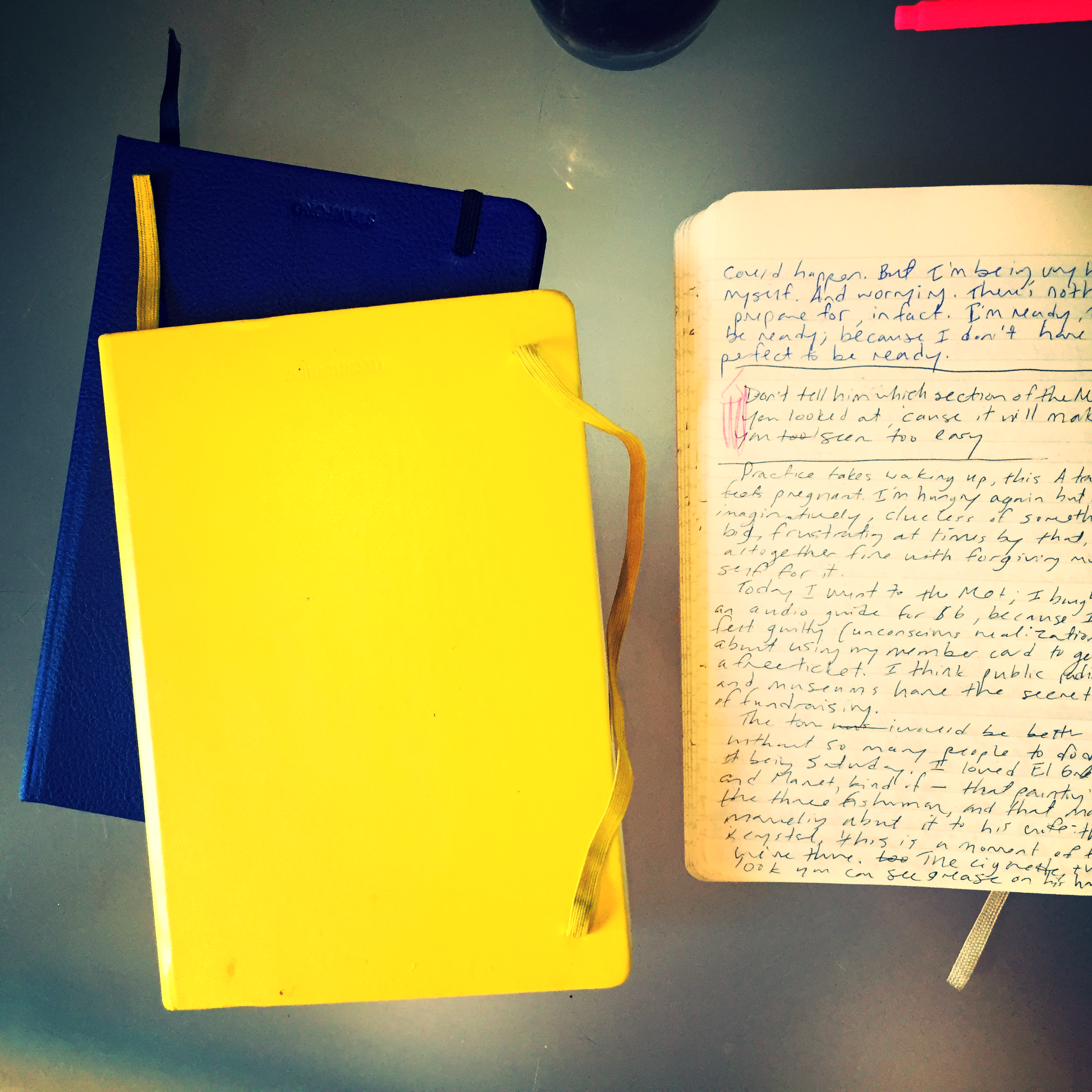
BY SARAH MADGES
I am often asked, “What are you going to do with all of those?” in regards to my ever-amassing collection of notebooks.
The tone people adopt when they ask me registers as an accusation, or a warning that they’re going to turn me in to the reality show Hoarders’ producers and stage a televised intervention. True, the amount of notebooks I’ve accumulated makes moving daunting (the journals, both blank and filled-in, take up at least four standard file boxes, and are heavy). But these bound batches of scribbles mean the world to me. Because it isn’t just the words that matter — the content ranging from teen angst to amateur poetry to higher ed revelations — but the format. The tangibility. The way the words look on the page. The way my handwriting sometimes forms tight serpentine ribbons or grows looser and larger when tipsy or tired or both.
The materials matter; even the notebook choice tells a story. Moving chronologically, my notebooks upgrade in quality from flimsy composition notebooks (Harriet the Spy-grade Meads) or one-subject college ruled notebooks I also used for high school Trig, to those ubiquitous ribboned moleskines, or Germany’s analogue, the Leuchtturm, or even the notebook in which I composed this draft—a Stamford Notebook Co. lizard embossed cobalt beauty handbound in England.
The medium change means a few things: 1) I moved up one ladder rung in the service industry and could afford nicer products, 2) I was starting to take myself seriously as a writer, and each double-digit-$ notebook was an investment in that continued pursuit 3) other people were taking me seriously as a writer, and gifting me nice notebooks for holidays 4) I realized the paper quality, brightness, and thickness, all contributed to the actual look of the text.
I began to appreciate the aesthetic of each individual journal entry, independent of the actual written content.
A Kaleidoscopic Force of Creative Decoration • Andrea Rehani

WORDS FOR WALLPAPER is a kaleidoscopic force of creative decoration by Chicago-based poet and creative, Andrea Rehani. It combines the beauty and brevity of poetic expression with an artistic and aesthetic simplicity that is at once reminiscent of the modern and the antique.
Beginning by hand, Rehani creates a poem based upon a particular color or theme and allows them to take horizontal and vertical shapes as she frames them for the wall, where they will eventually live. There is an odd distance of intimacy to Rehani's work. The poems themselves contain a layer that can feel like a memory, but zooming out, the object itself represents something of the "now here," not "nowhere;" in that, they carry with them the sense of place that surrounds them.
To see the exhibit, click here.
