I Have No Choice But to Revise • Keith Baldwin

WRITTEN BY KEITH BALDWIN
My handwriting is fucked. The penmanship is not as illegible as some, but in terms of how I physically write by hand, it’s all messed up. I hold a pen against my ring finger, like the wrong half of a pair of chopsticks, and form a lot of my letters from the bottom up, rather than the top down.
When I was eleven, my dad finally noticed the issue and approached it with all the vigor and care he’d applied to the insufficient knots in my shoes a few years earlier — just enough to make me feel shitty about it, without solving anything.
He spent a few frustrated hours with me at the kitchen table, correcting the way I formed a handful of letters and the number nine. There was no progress at all toward fixing my wonky grip, which was already too ingrained to be altered so easily.
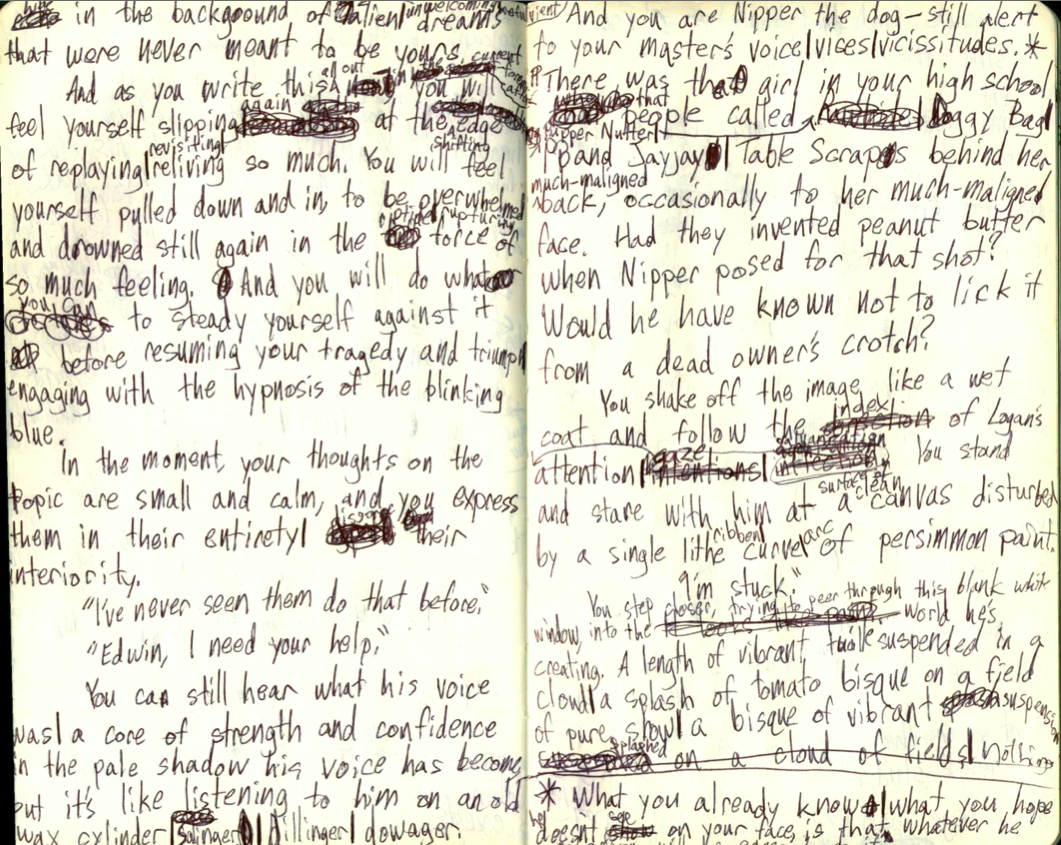
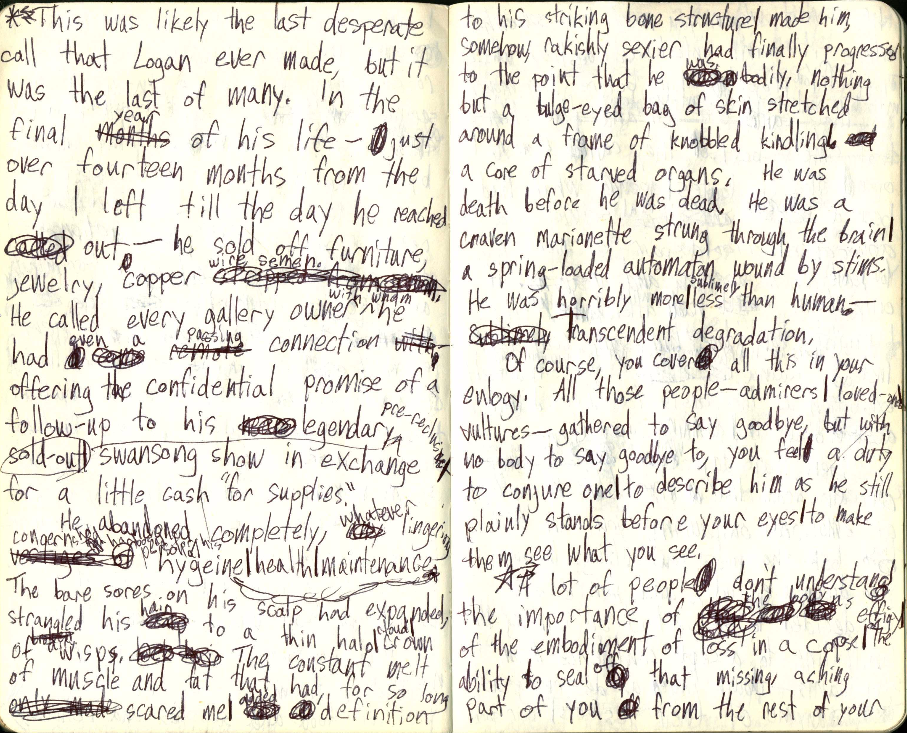
The upshot is that I don’t have the natural flow with a pen that other handwriting advocates rhapsodize. It’s always a slog for me. If I try to write too quickly, my hand and wrist start to cramp up, so my thoughts always remains three steps ahead of my pen. And while I work to close the gap, my mind is free to become distracted by flaws and omissions in what I’ve already written, leading to aggressive cross-outs and a morass of cramped footnotes that nest and crawl across margins — to be inserted in the main text later.


This would be enough to make a mess of my notebook, but on top of all that — rather than keeping everything in sequence — I have a bad habit of opening to a random blank page whenever I want to make a note, or a list, or play a game of hangman. In the middle of writing an extended scene of fiction, I will often turn the page to find story notes, shopping lists, and broken sentences for my ESL students to practice correcting. Typing up my work becomes a tedious chore of deciphering and reconstructing, tracking down where the story picks up when it’s suddenly interrupted by a sketch of my cat as an astronaut. It is almost as big a pain in the ass to work through it as it is for me to scrawl it out in the first place. So why do I even bother? Why do I keep returning to pen and ink whenever I’m writing something I care about? (You should see the rough draft of this essay…)


I know there are a lot of answers involving the way the brain works in different contexts, and how I formed these writing habits when all I could do on a keyboard was hunt and peck — and blah blah blah, a hundred other reasons why this website exists and longhand is the best. But I think the biggest factor for me is the same one that made me so much less anxious about sharing this mess of pages than I would have been about submitting something more polished. Because no one could ever confuse the contents of my notebook for a finished product — not even me.

On the one hand, this means that I can’t be held accountable for the contents, which frees me to be a little wilder in my first stab at a project. But it also means that I can’t avoid the work that still needs to be done. I have no choice but to revise.
My feelings about revision are pretty much the same as my feelings about flossing — I know I should do it, but it makes my gums bleed. And when my words are neatly typed and double-spaced, with numbered pages and no evidence of the disordered mind that composed them, I have to work to remind myself that it’s still a work in progress — that I can and should question every decision those collected words represent.

The process of transferring from the page to the screen forces me to consider every sentence with a critical eye while I retrace the whole erratic path. And I can’t even procrastinate for too long because, while a few days’ distance can bring fresh insights, a few weeks is liable to leave me incapable of piecing the whole mess together again. (It’s happened. It’s infuriating.)
I know that, for other people, writing by hand makes the whole process smoother. For me, it’s about making myself work harder, and getting better results for the effort.


Keith Baldwin is a writer and tutor living in subterranean Brooklyn while paying exorbitant tuition in Manhattan. He is sometimes worried that he might be one of those lizard people you hear about.
The Story Ribboned Forward, Inventing Itself • Karan Mahajan
For author Karan Mahajan, handwriting is a necessity, a fact almost. He writes every first draft by hand, and while he encourages everyone to as well, he doesn't care if you do. But we do, so read this interview and hear his fearless take on how handwriting cancels self-criticism, as well as helps you avoid getting needlessly attached to language and doubling backward into revision before a story is complete.

INTERVIEW BY DEMETRI RAFTOPOULOS
In eight sentences, Karan Mahajan had me silent. I had never read his words before, but there I was, re-reading a single paragraph over and over. It was a part of the series in Poets & Writers, where writers "recommend" a specific something. Later, I wondered how I even got there, but in the moment, I was captured by his voice, which was direct, almost demanding, but with elements of politeness and manners. A hard yet endearing shove into a specific direction: "Write first drafts by hand." He goes on:
This cancels self-criticism immediately; unless you have truly ugly, banged-up handwriting, everything you write will be visually and stylistically unified by ink. Better still, in an age of Internet-rehab apps like Freedom and SelfControl, nothing approaches the uncluttered nondigital quiet of a page. Take confidence in the fact that much of our canon was composed on paper. But mostly, when you achieve a flow, you're much less likely to break it on the page than on a screen—you'll be less tempted to double backwards into revision, checking e-mail, opening a tab. I found this to be true when I wrote the first complete draft of my second novel, The Association of Small Bombs. For years I'd been struggling to make progress, only to lapse back into revision. The minute I committed to paper, the story ribboned forward, inventing itself. I had never felt anything like it.”
This is something I have been contemplating deeply on my own. I was always a writer, but I recently began approaching projects by hand, often struggling to connect more with a blank screen than I was able to with a blank page. This past summer was the first time I ever wrote drafts by hand, let alone ever wrote in a journal. I uncovered something inside that journal that I haven't been able to express, but I see the feeling in Karan's words above. And so I set out to talk with Karan about the above, his process, the road bumps we often hit as writers, and how the handwritten words has shaped his craft.
* You can see his full bio at the bottom of this page, but Mahajan's second novel, The Association of Smalls Bombs (Vikings 2016), is forthcoming in March.

DEMETRI RAFTOPOULOS: You mention in Poets & Writers that you wrote one of your novels by hand. Do you always write first drafts by hand, or only certain kinds of things?
KARAN MAHAJAN: Increasingly, I write my first drafts of every kind of project by hand—fiction, non-fiction, reviews. Drafts are not a writing problem; they are an emotional problem. Usually, you haven’t broken through the material in the way you should have. When you type out first drafts, you get needlessly attached to the language you’ve used, and this keeps you from moving on.
Writing by hand also slows me down. I tend to write first drafts in a panic of excitement, and I’m calmed by the analogue action of handwriting.
DR: You said one reason you write first drafts by hand is specifically because it cancels self-criticism. Can you talk a little bit more about the idea of self-criticism, and how handwriting cancels that?
KM: Well, I’m experiencing this right now, as I type out the answer; my urge is to go back and correct a few words in the previous sentence. But, rather than fall into a loop of revision, I’d rather invest that energy forward.
DR: Do you think self-criticism, along with doubt and distraction, are forms of writer’s block?
KM: Yes—the main form of writer’s block. I was blocked in this way for about four years, but, because I was producing a ton of material and constantly revising—I have about 1,400 files in my “Association of Small Bombs” folder, most of them varying minutely from each other—I felt I was doing something. I wasn’t. Mailer says that writer’s block is a failure of the ego; I concur. And perfectionism can become a denial of your own humanity, of the languors, say, in a life or story.
DR: Has handwriting always been a large part of your life, or life as a writer?
KM: It hasn’t. I emigrated to the US in the Age of the Laptop. Coming to handwriting felt like a discovery—a holdover from journaling and note-taking.
DR: I'm curious about your process. At what point do you leave your drafts and begin typing? And how has your process of writing by hand -- drafts -- evolved over the years?
KM: It varies. If I feel confident that the story I’m writing is close to the final, I type it out as I go along—handwriting in the morning, typing in the afternoon. This keeps the work fresh in my memory when I attack it the next day. If I’m not yet confident the story’s going to unfurl to a conclusion, I’ll keep handwriting. If I reach some kind of end, I might type the whole thing out. But if the story dies midstream or I lose interest it’ll remain immured on paper.
DR: You mentioned that the minute you committed pen to paper in your second novel, The Association of Small Bombs, "the story ribboned forward and invented itself." What specifically came to you -- characters, plot, purpose?
KM: The plot of The Association of Small Bombs is entirely organic. I knew the downward direction the lives of the characters would take, and that Mansoor, one of the main characters, would come back from the US, but I didn’t know how any of the characters would connect, how their stories would play out in concert. It was the central challenge of writing a novel about terrorism. What do terrorists and victims really have to do with each other? The writing, which was instinctive, made these connections for me. When Ayub, my favorite character, appeared in the book, I was surprised. He allowed me to say, directly, many of the things I felt about terrorism without resorting to needless dramatization.
DR: You also said something else in Poets & Writers that stuck with me, “when you achieve a flow, you’re much less likely to break it on page than on a screen, you’ll be less tempted to double backwards into revision.” What was your revision process like then for The Association of Small Bombs. Did you find it to be easier? Less work?
KM: The key difficulty for me was to keep myself from destroying what I’d (hand)written. I tried once to rewrite the entire thing by hand, but simply didn’t have the drive or the interest; I’d said what I wanted to say. Then I tried rewriting almost every sentence on my computer. This was wasteful and idiotic, because each edit was only an elegant variation on what came before; it wasn’t improving the story or the scenes. The best editing advice I got—for the kind of writing I do—was to read it out loud. This sloughs off embarrassing and overwritten bits but doesn’t lead to a complete reworking of what you’ve offered the reader from your sub-conscious: which, in a way, is what the reader is after anyway.
DR: How did the experience of writing your second novel by hand compare to the experience of writing your first novel, Family Planning? Did you hand-write any of that novel?
KM: The storytelling in this novel is much better. Not much has been shifted around. Words and sentences remain where they first appeared in the flow of the story; the story is one giant thought. I’m proud of this. My main complaint about novels is that they lack unity; you get to the end and feel the writer forgot why he or she started. And almost no novel ends well; the project of getting to the end has defeated the novelist. Handwriting, zooming forward, allowed me to overcome this. And no, I didn’t handwrite any of Family Planning.
DR: The narrative, or at least parts, of both your novels is set in India, specifically New Delhi, where you grew up. How did your surroundings, or upbringing, impact the way in which you write? Obviously, it informed content, but what about form?
KM: It taught me to find my center, to achieve concentration, in the midst of a crowd.
DR: Do you have any handwriting rituals?
KM: I’ll sometimes warm myself up with journaling.
DR: When you look toward the future of handwriting, what do you see?
KM: A bleak future. And I’m fine with that. I’d rather keep this discovery to myself and let other writers be bewildered and broken by their fine machines.
Karan Mahajan was born in New Delhi. His second novel, The Association of Small Bombs, tells the story of two families in a world plagued by terrorism. Karan not only explores how terrorism shakes its victims, but how those responsible are affected as well. His debut novel, Family Planning, was published in nine different countries and won the Joseph Henry Jackson Award. His writing has also appeared in The New York Times, The Wall Street Journal, The New Yorker Online, Granta.com, and more. He resides in Austin, Texas, where he is currently diving into his third novel.
I Wanted to Build a Universe • Tonianne Bellomo
What happens when it's not just you, the writer, who struggles with the screen, but your characters? In this lyric essay, Tonianne Bellomo walks us through the negotiations she makes with her characters. What does she do to bring them to life? She builds them paper homes.

By Tonianne Bellomo
I wanted to build a universe.
I wanted to write stories like the ones that made me forget reality. I wanted to build worlds from letters. I wanted to draw in the margins and give readers a glimpse of the realms that rested behind my eyes.
I can’t do that on a computer, at least not at first. There’s no highlighting, scribbling, pasting, scratching out, ripping. There are just clean white backgrounds, perfect font, and the tapping of keys.

That is not world-building; that is a job.
The novel I’m editing is rough, probably in every sense of the word. It sometimes gets so dark that I forget which way is the way home, and I find myself suffocating.
It makes it hard to write.
The computer makes it worse. I feel like I’m cheating. My characters hate it, too. It’s like they refuse to be slighted, refuse to be clinically typed in perfect Times New Roman onto my computer rather than scrawled in a bastardization of Catholic school cursive. They’ll just stand at my mind’s door, arms crossed, heads turned away like I’ve insulted their mothers.
So, I give the characters what they want.
I give them paper homes.
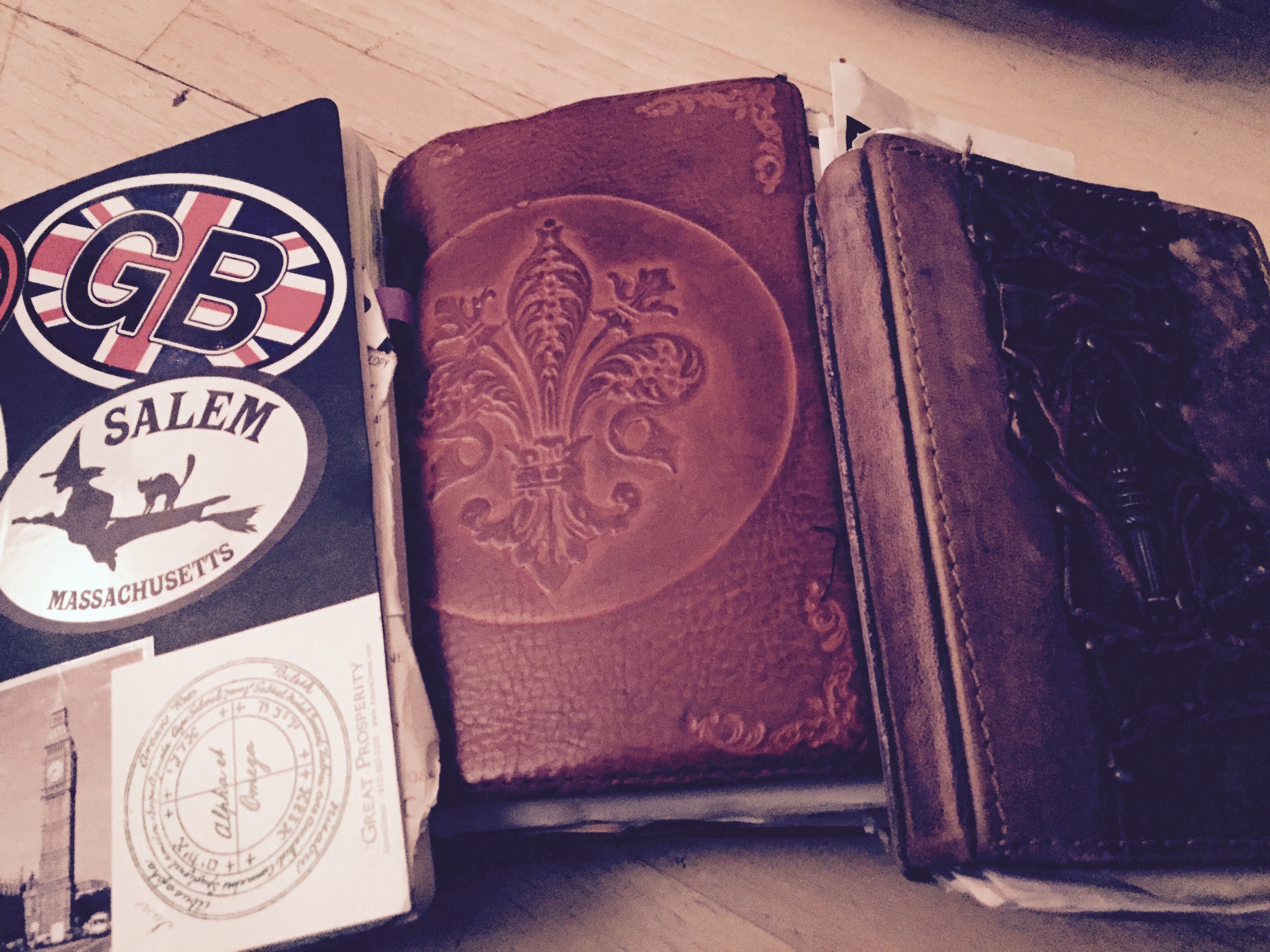
The characters grow in those spaces, whether I realize they’re characters or not. They are lines from a poem, a feeling evoked from a song, lyrics, ticket stubs, a Polaroid. The characters are a lot of things that would have never come together if I didn’t handwrite first.
Handwriting makes it feel like art.

I know by definition writing is an art. I just never feel like I’m making art. Handwriting my stories, though, and putting in all those extras makes me feel like I’m creating worlds for them, like the little girl with a dollhouse that she’s putting together.
Tristan, the protagonist of my novel, even has a journal that is featured on his blog. It originally just started out as a Tumblr blog, but I couldn’t “feel” him in that blue screen. I went out, bought a Moleskin (because he would totally have one) and started drawing and writing in his voice.
It made me feel like I could breathe again. Like the darkness wasn’t so suffocating because I could understand his thought process — I could follow his thoughts home.

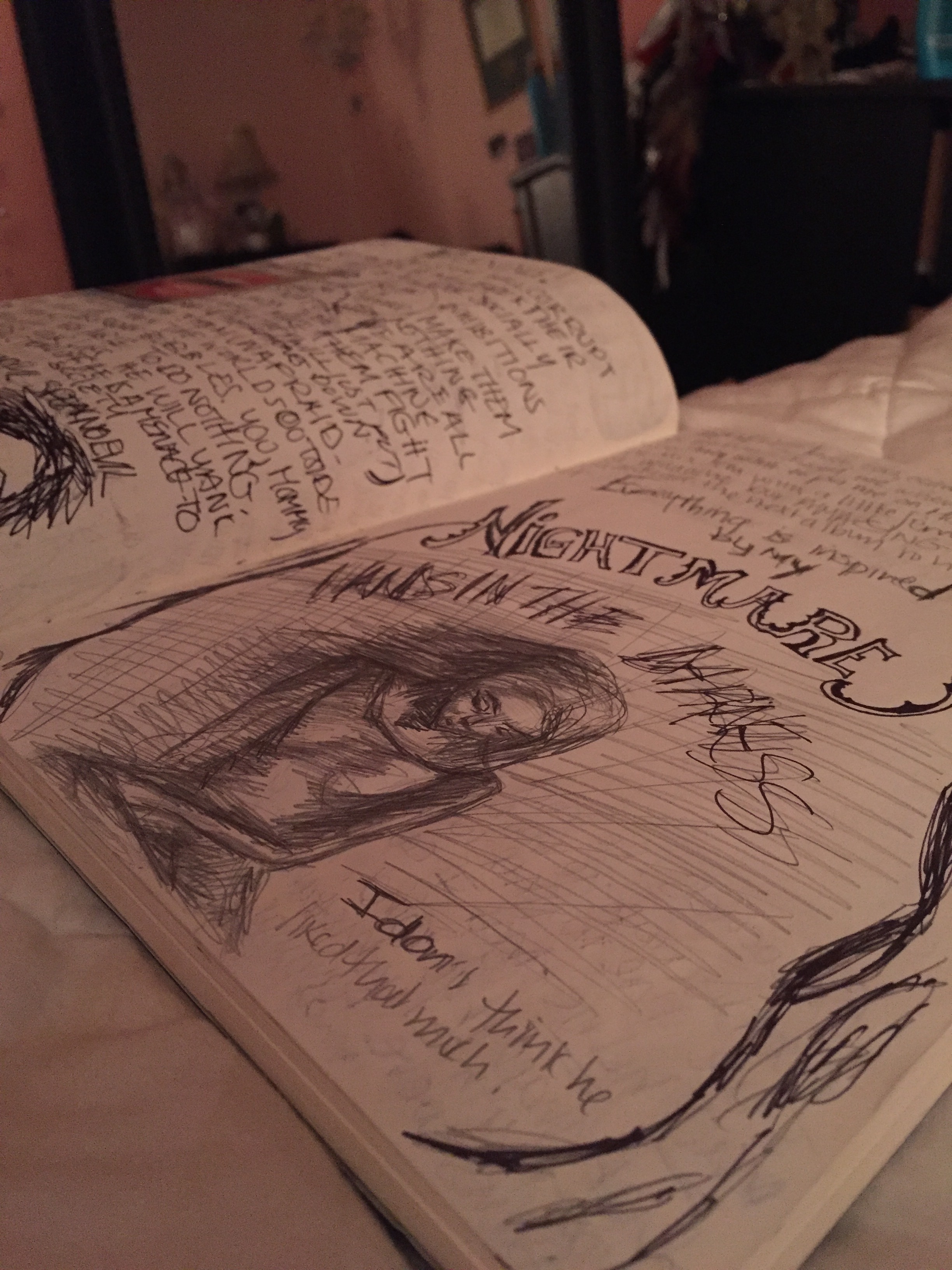
He’s real now. The moment I handwrote his first entry, he became real. The fourth wall broke, and he fell into reality. I can see him sitting in O Café sipping his Americano while sketching in his journal or pasting photos of Richey Edwards or Ian McCulloch onto the pages.
Handwriting and plotting my stories in my journal — it all helps me make worlds. It helps me create the universes that I want my readers to inhabit. And it helps me remember that before all the workshops and degrees and frustrations, there was just me, my journal, and the universes I wanted to build.


Tonianne Bellomo is a graduate of The New School MFA program and an adjunct lecturer at Baruch College where she teaches writing. She is currently editing a novel and blogging from her protagonist's POV at http://wax-and-wings.tumblr.com.
From Mess to Less • Chad Frisk

BY CHAD FRISK
I don’t know about you, but my mind is a disaster. Things are constantly whizzing through and then clogging it up. Things proliferate and congregate, ideally like constellations in the sky but typically like commuters during rush-hour. It’s a mess. Writing is, as I see it, the process of making that mess suitable for display. I learned the hard way that there is an appropriate tool for each step. I wrote the draft of my first novel by hand. I thought it would be cool. It was actually very dumb.
I filled fifteen notebooks. I went through a dozen erasers. Oftentimes I chose not to revise because it would be too much of a pain to cross things out and scribble in the margins. When I finished, I typed the whole thing into a Word document anyway, one indecipherable page at a time from tiny, gold-tooled notebooks that refused to stay open on their own.
I didn't know what it was about when I started writing. One day, I walked past an old, abandoned clock shop and thought it would be interesting to write a book about time travel. That was my only idea. I bought a notebook, scoured my apartment for a pencil, and started writing.
I was living in Japan at the time, working at a junior high school as an assistant teacher. That year, I didn't have anything to do. It was my job to go to four hours of class a day and read from a textbook. The other four hours were my own.
I decided to write a book. When it was finished, it had nothing to do with time travel. In fact, it had very little to do with anything. It was four or five stories posing unconvincingly as one, scrawled across 100 Yen notebooks I purchased at convenience stores.
There was a psychiatrist. He was frustrated by his patients' lack of progress, and decided to pursue alternative therapy - which included breaking and entering, kidnapping, stalking, and mild psychological assault. There was a burned-out business man. He was so deep in self-help that he had lost sight of how good he already was. There was a server at a nightclub for the uber rich. She was tired of getting hit on by three-piece suits, but was making so much money that she had convinced herself it didn't matter. There was a ten-year old boy. His grandpa had died, leaving a hole in his after-school routine that he didn't know how to fill.
There were others. There was a detective possessed by the ghost of Dick Tracy, an old illusionist whose understanding and lifelong exploitation of cognitive biases had poisoned his view of humanity, and a girl who lived in a castle with a mother and father who didn't pay attention to her. There was also a beanstalk, a ruined city, and a sleeping giant.
It needed an almost complete overhaul. To do that, I abandoned my pencil for a keyboard. Computers are amazing because they make editing incredibly easy. Point, click, drag, delete. Done. It’s infinitely easier to revise already written words on a computer than on a pad of paper.
It took me about eight months to handwrite the first draft. I spent nearly an additional year revising it. I cringed while rereading my notebooks. The story didn't make any sense. Who were the characters? What did they want? How were they connected? What was the point?
From the flurry of keystrokes, slowly, something that could be called a narrative emerged. I knew that it wasn't good enough, but I tried to get it published anyway. After a half dozen rejection letters (and at least as many unreturned emails) I gave up.
But I had something. It was all thanks to the computer. Revising the original text by hand would have been impossible.
But I'm glad I started with pencil and paper.
Handwriting is good because it can go all over the place. Impulse is where my writing starts, and it’s easier to transcribe impulse with a pen than a keyboard. I can scribble, doodle, draw lines, cross things out, and generally be very messy. Out of this mess emerges something coherent enough to take to a laptop.
The process of refining continues digitally, because that’s what bits are good for. I find that the first step in mining my mind, however, is often best performed by hand.

Chad Frisk is a graduate student at the University of Washington working towards a Masters in Teaching English to Students of Other Languages. His books include Direct Translation Impossible: Tales from the Land of the Rising Sun, which was published in October of 2014; a Japanese version of the same to be published in March of this year; and and he's working on his next book - this time entirely on a computer. His website is nobodyelsewillpublishme.com.
Behind "The Bone Transfer" • Zachary Lutz
BY ZACHARY LUTZ
The sketch for “The Bone Transfer” was written in a subway car. Probably the B or the Q, headed to Manhattan. I keep a smaller notebook, pocket-sized, with a white cover. It helps that the surface area is more compact, as well the writing is compacted to fit. Tempts less spectators. In this particular type of free-writing, being surrounded by people comes in handy: there’s no contract for details on the subway. I’ll start with some image that’s been consistent and strange, some reoccurring thought. I’m generally writing narrative work, think non-autobiographical, so I’m not always drawing from experience. Easy to steal from something happening next to me on the train and makeup the rest.
The day I’m taking notes that will eventually turn into “The Bone Transfer,” I’m thinking about cartoon physics, TV tropes. For a few days, I’d been scanning this website/catalog of TV tropes, stumbling through entries. ‘Toon physics got me hooked. The page for the trope made note of “Who Framed Roger Rabbit?” as being a good example of the crossover between the “natural laws” of the human world versus that of the cartoon, and thus a good reference point for demarcation. I wanted to write something where character(s) experienced cartoon physics in the human world, but maintained their very human portentousness. I had been thinking for some time about how cartoons experience electrocution.
In addition, I’d received a phone call from a BBQ restaurant earlier that day assuring me that if I were to return to the location any time in the near future, I’d have a free meal voucher waiting for me. It was a wrong number call, but stuck with me. The writing I’m doing in my notebook is really just a way to process details. I try work with specificity as often as possible, and to link those details that might at the start appear un-linkable. (A rerun of an episode of “Shark Tank” introduced me to the Uro Club, which is referenced here alongside another sex organ-themed gift. It all returns to the body.)

When I transpose from my notebook to my computer, I’ll edit as I go. I’ll cut whole sections out, rearrange syntax. I change names or pump up the ambiguity. I want always for the mood of the piece to overshadow the context. Writing or thinking through a piece by hand provides me a necessary freedom which I make freer by movement—a faulty retractable leash that keeps threading out, a series of handkerchiefs from the sleeve of an encouraging magician. I recognize themes in handwriting, leave structure for the word processor. The shearing that results from the unmerciful typing-up of handwritten notes helps manage a pace, become more economical, say more heavily.

Zachary Lutz is a handwriter in Brooklyn. He holds an MFA in poetry from The New School and received an honorable mention for the Paul Violi Poetry Prize. His work has appeared in Luna Negra Magazine. To the left is his handprint.