
I Have No Choice But to Revise • Keith Baldwin

WRITTEN BY KEITH BALDWIN
My handwriting is fucked. The penmanship is not as illegible as some, but in terms of how I physically write by hand, it’s all messed up. I hold a pen against my ring finger, like the wrong half of a pair of chopsticks, and form a lot of my letters from the bottom up, rather than the top down.
When I was eleven, my dad finally noticed the issue and approached it with all the vigor and care he’d applied to the insufficient knots in my shoes a few years earlier — just enough to make me feel shitty about it, without solving anything.
He spent a few frustrated hours with me at the kitchen table, correcting the way I formed a handful of letters and the number nine. There was no progress at all toward fixing my wonky grip, which was already too ingrained to be altered so easily.
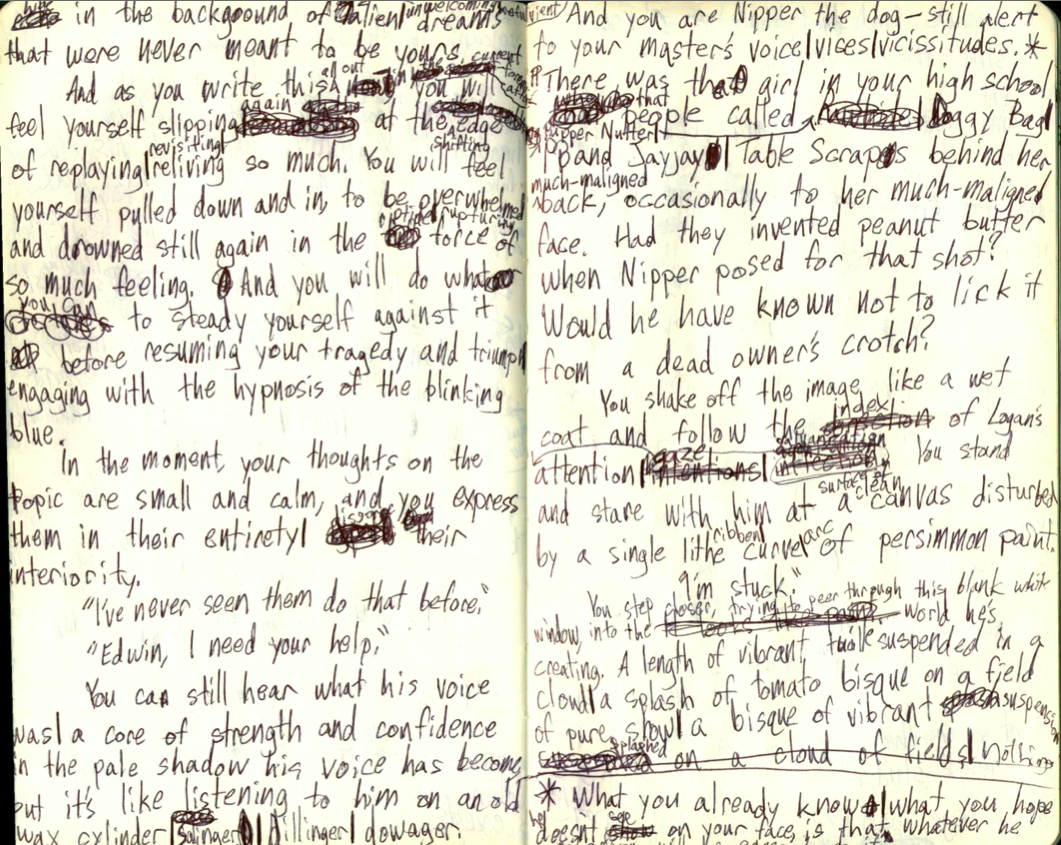
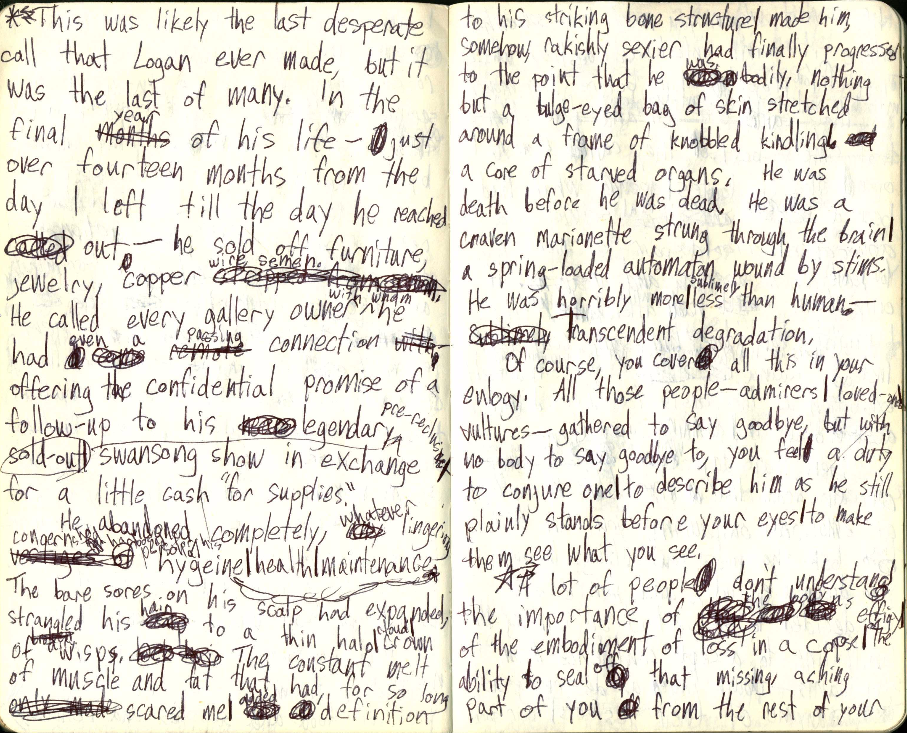
The upshot is that I don’t have the natural flow with a pen that other handwriting advocates rhapsodize. It’s always a slog for me. If I try to write too quickly, my hand and wrist start to cramp up, so my thoughts always remains three steps ahead of my pen. And while I work to close the gap, my mind is free to become distracted by flaws and omissions in what I’ve already written, leading to aggressive cross-outs and a morass of cramped footnotes that nest and crawl across margins — to be inserted in the main text later.


This would be enough to make a mess of my notebook, but on top of all that — rather than keeping everything in sequence — I have a bad habit of opening to a random blank page whenever I want to make a note, or a list, or play a game of hangman. In the middle of writing an extended scene of fiction, I will often turn the page to find story notes, shopping lists, and broken sentences for my ESL students to practice correcting. Typing up my work becomes a tedious chore of deciphering and reconstructing, tracking down where the story picks up when it’s suddenly interrupted by a sketch of my cat as an astronaut. It is almost as big a pain in the ass to work through it as it is for me to scrawl it out in the first place. So why do I even bother? Why do I keep returning to pen and ink whenever I’m writing something I care about? (You should see the rough draft of this essay…)


I know there are a lot of answers involving the way the brain works in different contexts, and how I formed these writing habits when all I could do on a keyboard was hunt and peck — and blah blah blah, a hundred other reasons why this website exists and longhand is the best. But I think the biggest factor for me is the same one that made me so much less anxious about sharing this mess of pages than I would have been about submitting something more polished. Because no one could ever confuse the contents of my notebook for a finished product — not even me.

On the one hand, this means that I can’t be held accountable for the contents, which frees me to be a little wilder in my first stab at a project. But it also means that I can’t avoid the work that still needs to be done. I have no choice but to revise.
My feelings about revision are pretty much the same as my feelings about flossing — I know I should do it, but it makes my gums bleed. And when my words are neatly typed and double-spaced, with numbered pages and no evidence of the disordered mind that composed them, I have to work to remind myself that it’s still a work in progress — that I can and should question every decision those collected words represent.

The process of transferring from the page to the screen forces me to consider every sentence with a critical eye while I retrace the whole erratic path. And I can’t even procrastinate for too long because, while a few days’ distance can bring fresh insights, a few weeks is liable to leave me incapable of piecing the whole mess together again. (It’s happened. It’s infuriating.)
I know that, for other people, writing by hand makes the whole process smoother. For me, it’s about making myself work harder, and getting better results for the effort.


Keith Baldwin is a writer and tutor living in subterranean Brooklyn while paying exorbitant tuition in Manhattan. He is sometimes worried that he might be one of those lizard people you hear about.
The Distance Between our Public and Private Selves • Aine Greaney
In this essay on deleted pasts and new beginnings, Aine Greaney takes us around the world in an old composition notebook: the only one she brought with her when she emigrated to America. With the start of the new year just behind us, we find this piece more timely than ever, as we revisit filled pages from the past, and look toward the blank ones of the future.

BY AINE GREANEY
December 21, 2015
This morning, I ate some oatmeal, drank some coffee and penned the last page of my personal journal. I flip back to the first page: June 30, 2015. Inside this bound book are almost eight months' worth of thoughts, uncertainties, musings and arguments.

I don't write in my journal every day, but on those weekday mornings when I do, when I set the alarm to get up extra early, reflective writing makes the rest of my working day happier. On the weekends, journaling acts as my transition from working me to creative me—and believe me when I tell you that the latter is the more authentic version. In fact, journaling has taught me this: The shorter the distance between our public and private selves, the happier we are. Stephen King may have been referring to an entirely different type or genre of writing, but he was really on to something when he declared that writing is about “getting happy.”
I started keeping a journal in my teenage years while I was attending a small-town convent day school in my native Ireland. Some days, I can still shut my eyes and see myself back there, still dressed in my navy-blue school uniform, sitting inside my bedroom window, my geography and math texts pushed aside as I scribbled in an old composition notebook.
We were the first generation to benefit from a 1967 law that granted free, secondary-level (high school) education to every child in the Irish nation. So I was supposed to be grateful for that school uniform and those textbooks that had been denied my mother and my grandmother. I was grateful. Still, I recall those school days and nights as being full of square-peg-round-hole malaise and anxiety. In public, I sang with the choir in the school assembly room. In private, I wanted, desperately, to raise my own, individual voice. Journaling was the only place where this was possible.
However, when I emigrated to America at age twenty-four, I abandoned all but one of those notebooks. I think I believed that, in my bright, new country, in a nation founded on the notion of deleted pasts and new beginnings, that that melancholy, soul-searching me was best left behind, left where it belonged.
I did bring one hard-cover notebook into which I had transcribed some of those writings from my late teens and early 20s. In the flyleaf of this little red notebook, I grandly wrote, “Collected poems, rhymes and thoughts.” Now, when I re-read those hand-written pages, I see just how wrong I was to believe that our past has ever really passed. I am shocked at how well those “assorted rhymes” still describe the middle-aged me.
For example, here’s one of those entries that I remember writing as I sat propped against the pillows in my twin bed in my parents' house:
My books stand orderly on the shelf
Masks for that hidden self
Hoping they can quench the flame
Of numberless passions with no name.
I talk and talk; I make my stance
‘You’re such good company,’ he said.
But what would he say if, perchance
He saw me sobbing in my bed?
I find it comforting to read this unchanged part of me, this struggle between the private and public self. I like that we have certain personality traits that are in-born or immutable, and that there is, at all of our cores, a perpetual and lifelong mystery.

In the basement of my house in Massachusetts, I keep boxes of my completed journals, each one chronicling six to twelve months over the course of my twenty-nine years living here. My arrival day at JFK Airport, New York. That hot, AugustSunday when my American husband and I said, “I do” before a town judge. The day an editor wrote to say she was going to publish my first short story. I remember these. But, if it weren't for those journals, many or most of the less auspicious occasions, the ordinary mornings or afternoons, would be gone from memory recall. For example, in the journal I just completed, on August 18, 2015, I wrote that “I am here alone, finally, and the internet has made me vain and distracted, and these two things (vain and distracted) are very connected.” I cannot remember feeling that—not without re-reading my own handwriting on that page.
Without all of these hand-written journal pages, how much of the past two seasons would I actually remember? How well could I evoke the sounds or feelings or atmosphere of one ordinary hour or afternoon in July or August or September? What summertime walks did I take? When did the cherry blossoms drop their pink? When did the marsh grasses near my house turn dry and brown with summer heat? Now that our garden is under snow, I find it hard to close my eyes and re-see that garden when it was lush and colorful with summer perennials.
Some days, I feel as if I am on a Japanese bullet train ride through a fast-disappearing landscape, where, by the time I sit up and look out the window, everything is already gliding out of eye view.
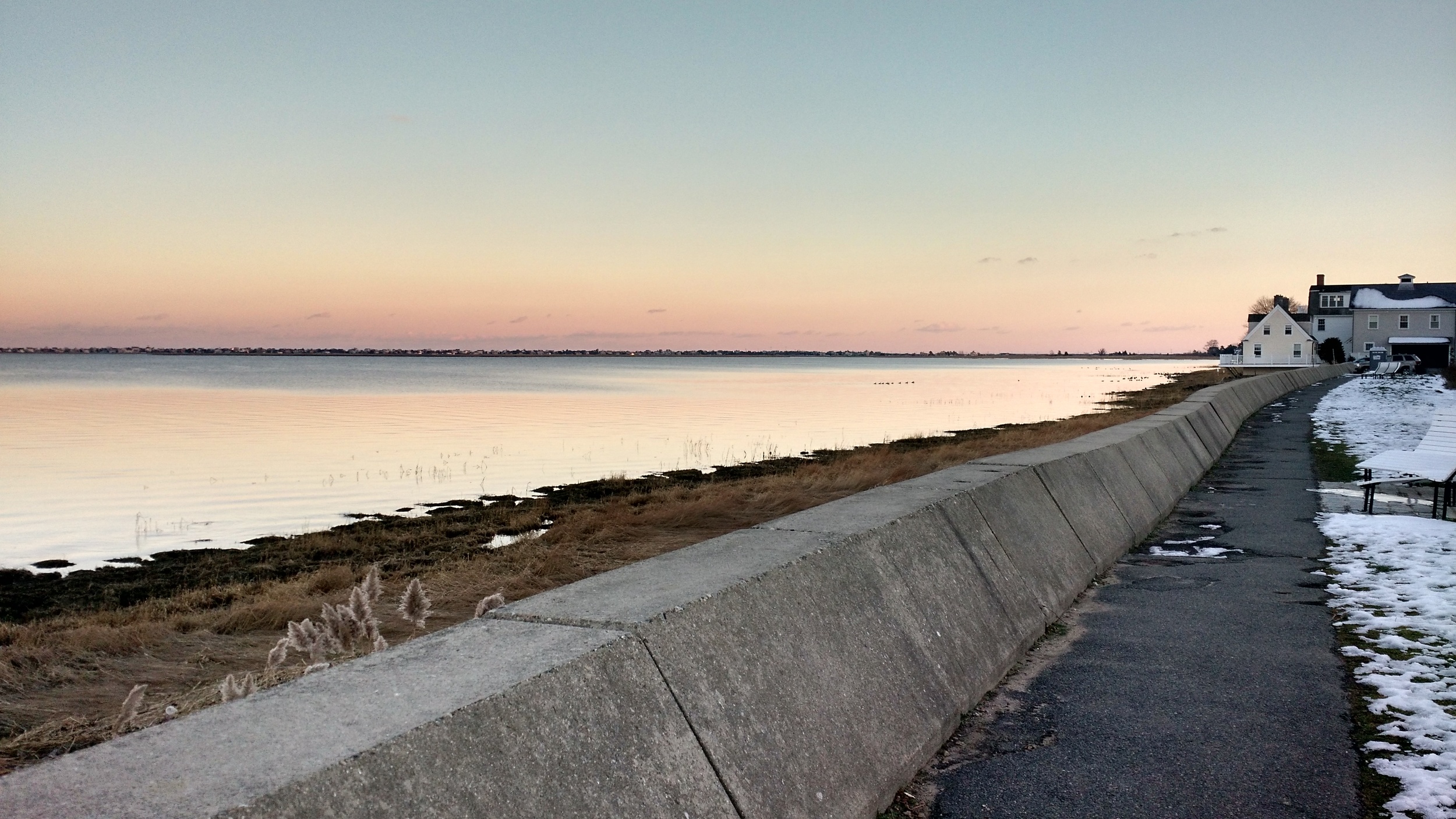
Then there are those days when I’m driving home from work, my head still buzzing with deadlines or with snippets of workplace conversations, and I look out my car windshield at the roadside pine trees, a flock of geese flying south through the paling sky and I think, This evening, this moment in time will never come again. So I’d better shush my mind to look---really look--around me. How many of these afternoons are left in my life? I don’t know. None of us do. Morbid? I don’t think so. These moments of mindfulness are how we hit the pause button, how we behold our own joy. When we write down those moments, when we record them in a journal, we are creating the narrative—the only half-way reliable narrative—of our precious and finite days.
Henry David Thoreau said that he traded his comfortable town home for a rustic woodland cabin because he wished to live deliberately.

At least in the abstract, some of us covet this concept of unplugging and retreating from our hectic and digitized lives. Who wouldn't like to slow down time so we can feel the heft and length of each passing hour?
But nowadays, how many of us would adapt this as a permanent and year-round lifestyle choice? The woodland WiFi and cell phone connections would be spotty at best. And, as someone who grew up in a thatch-roof farmhouse without indoor plumbing or central heating, the discomforts and inconveniences of that bare-bones cabin life would, sooner or later, override the joy or mindfulness.
So in my cozy and well-heated writing studio I keep a set of ballpoint pens and write in my notebooks to record the ephemera of my life. Without these journals, without this writing, most of the past seven months would be gone.
This morning I closed my completed journal and crossed to my studio bookshelves to stash it there until, during one of my sudden and always overdue clean-outs, it will end up with all the others in those basement boxes.
I know there will come a future day when I will go to the basement to search through the shelves for an old photo or a lost gadget and the journal box will call to me, as it has before. I will open today’s completed journal at a random page and sit there under the basement’s Florescent strip light in the company of my previous self, reliving a day from 2015. In all my past journals, I see recurring themes: the yearning for solitude; the immigrant’s search for an existential home; and my almost lifelong struggle and vacillation between my public and private personae (as in the 1983 piece above).
When I read them, I’m also struck by how prophetic some of my past writings turn out to be. It seems, in retrospect, that the writing knew much more than I did. Too often, I see that I should have listened to or acted upon my own observations.
Today, I select a new book to set on my desk underneath the east-facing window of my writer’s studio. The new blank journal sits here, empty and waiting for tomorrow.

It Starts to Look Like a Timeline, Not a Journal • A Conversation with Angela Flournoy

BY SARAH MADGES
Angela Flournoy and her debut novel, The Turner House, are igniting the literary scene with their unassuming eloquence and nuanced commentary on the deleterious effects of the 2008 housing bubble and the black American diaspora, whose interrelated history subsumes the 13 members of the Turner family as they navigate a crumbling Detroit.
Garnering significant attention and accolades for a debut novelist, Flournoy is a finalist for the National Book Awards in Fiction, and was named a “5 under 35” writer, designations that left Flournoy nearly tweetless, only able to write “whaaaat” in response. Despite this rapid success, when we saw her during an intimate conversation hosted by CLMP at the New School, there was an easygoing magnetism to her speech, posture, and perspective. Although Flournoy is the first to admit her excitement for the book’s positive reception, watching her speak, it seemed clear that we are in the presence of a person who has remained rooted at the center of the spinning wheel.
So when we found out that Flournoy wrote the entire first draft of The Turner House by hand, we went wild with theories — perhaps the handwritten word explains why she is so grounded, or has enabled her to access memories of her father’s Detroit childhood, etc. Thankfully, Sarah Madges from Handwritten spoke with Angela about writing The Turner House by hand, thereby recusing us of the need to go on any longer. We wish Angela the very best this week, and hope everyone who reads this here will read her book, and then handwrite their own.

SARAH MADGES: So I wanted to talk to you about your process, how handwriting figures into it, and how you came to incorporate it into your process:
ANGELA FLOURNOY: Handwriting has always been a part of my process. I got my first journal when I was eight years old — I don’t have them with me or I’d check, they are at my mother’s house. I’ve always worked out ideas or feelings through handwriting.
For most of my academic life I was writing papers on the computer and generally typing things, and it didn’t seem like the most natural way to work on something that was not like a term paper. When I was first writing short stories in undergrad most were written on a computer first, but when I got to Iowa, one thing that was an issue for me was procrastination. I didn’t have the smartest of phones, I was always a couple generations behind — now that’s an issue — but I figured if I left the house I’d focus more. So I would sit in the coffee shop and sit on my laptop hanging around on the Internet instead of writing, even after downloading Self Control, because you could still override it.
So I returned to handwriting to focus — there were not as many distractions. Especially when you’re working on something historical, you want to look everything up on Google, which is useful in revision, but it gets in the way of writing when you stop and end up in a Wikipedia rabbit hole. Writing longhand made me focus, and slow down.
MADGES: Has your writing always been historical in the way The Turner House is, or written about, for example, a city you never lived in, but know about?
FLOURNOY: History is always a part of the way that I envision stories. This novel, especially, but I had written 70 pages of another novel based in a city I never lived in and it was a similar process.
MADGES: How would you get yourself to push through the writing instead of succumbing to the kneejerk reaction to look things up — would you leave notes like “look up later” and just keep going?
FLOURNOY: Well I would put an asterisk next to what I wasn’t sure was right. The thing about literary fiction is that it’s not one of those things — I’m not writing a civil war period piece that heavily relies on research and that people are so into it and will feel betrayed if they feel it’s inaccurately portrayed, like, “That’s not what happened at Gettysburg!” That’s not the burden of the kind of fiction I write. You just need to have a foundation with reality. I would just write in the margin: Look this up!
MADGES: You said you started writing in a journal when you were around eight years old. Did someone encourage you to do that, or did you sort of come to that naturally?
FLOURNOY: Well, it was a Christmas present from an aunt of mine and so then it was just, there. And I’ve always been a person who, as soon as I learned how to read, read a lot, so it was like of course I would do this thing. No one was telling me I have to do it, and there wasn’t much else to do. Now, we live in a time of distraction, so it might be different. People talk about wanting to pick it up as a practice.
MADGES: Did you always prefer to write by hand? Have you found greater success this way, or did you notice yourself writing/editing differently with a word processor?
FLOURNOY: I feel like I’m a lot less apt to take risks when I’m typing out a story because it’s so easy to delete things; whereas, when you’re writing by hand you have to get to a certain critical mass before you “x” something out. It’s too easy to reread every sentence, go backwards rather than forward.
The editing process should be the editing process. You handicap yourself when you keep cutting down your own ideas. One on its own might not be great, but they might all make sense in concert with themselves. When there’s that blinking cursor encouraging you to cut them down, you might lose what the idea was really supposed to be.
MADGES: Right! And once you delete them there’s no evidence of those ideas, at least in a notebook you can usually still read the words you crossed out. So how does handwriting figure into your writing process? What role did it play in writing the Turner House?
FLOURNOY: One benefit of writing longhand, I’m more gentle with myself on first drafts. It hurts to scratch out all the pages you wrote in the day.
I usually write the first draft longhand with notes in the margins and sometimes rudimentary edits as they fit on the page. For this novel, I wrote maybe a couple chapters at a time, then I would go and type them into this master novel document. That’s already two editing processes: on the page in the margins, and then of course I’m not going to transcribe something that is terrible, so again when I type. And because I’m not rereading everything in the document, that document lives separately, it ends up getting sort of built up and I’m able to look at what’s there, what’s working and what’s not, and change it later. It allows me to have a base, and provides some time between writing something and wanting to jump into revising it and moving, structurally, whole chapters around. Once I finished a notebook I would assess: where are we actually in the larger narrative? Some of the notebooks are half writing prose, half notes. It took about seven college ruled Moleskine notebooks.
MADGES: How long would it take you? Did you find yourself having to stop because you couldn’t physically write anymore, or…?
FLOURNOY: No, I’m not a fast writer. On some days, it might have been more staring and thinking and I maybe only wrote five actual pages in my notebook. On other days, I could very easily look up and there’d be 15 pages in front of me. And even though handwriting is larger, those 15 pages would end up being 20 pages because I would think of things to add or subtract when transcribing. I don’t really remember my hand cramping. I wish I was one of those people who could really get a lot out of writing for three hours every day. For me, I have “writing seasons” and I have “thinking about writing seasons,” and when I am in the writing season, I just hunker down. I wake up early. If I don’t have a block of four hours, I feel like the time is already gone. I am not a fast writer. I was working at a D.C. public library, and I would have a shift from 5-9pm. So I would get to the coffee shop at noon and I would try to finish, or start a chapter.
MADGES: Do you keep a journal, or carry a notebook and pen around with you?
FLOURNOY: I have a journal but I don’t write in it much. When I was writing short stories, I would sometimes journal, but when I was writing this novel, I think the last thing I wanted to do was pick up another book and write in that book, too. I have slowed down journaling for myself. Now, I use it more for marking moments, or milestones.
MADGES: How do you feel about the fact that cursive is no longer required teaching in U.S. elementary schools?
FLOURNOY: I am terrible at cursive — I have terrible handwriting — but I can read cursive. But say, how can you even read archival documents if you can’t read cursive? You have to trust someone else’s transcription of it. It’s as if you’ve lost a language if you can’t read it for yourself and that is dangerous because people can say that any document says anything. It’s bad enough I only know one language fluently — I can at least read and write in Spanish — but it’s bad enough that most people in the U.S. don’t even have reading proficiency in a second language. But to not even have that proficiency in the language you were raised with? We’re not even going to be a monolingual culture anymore — we’re going to be whatever half of monolingual is.
MADGES: Well, you had a very successful debut! How do you feel about being shortlisted for the National Book Award? Were you surprised?
FLOURNOY: Yes, I was surprised. A sort of big moment for me was being on the long list, because who thinks that’s going to happen? I was in my apartment and I had sorted out my clothes and was going to take them to the laundromat and my phone started vibrating. This is stuff your younger writer self doesn’t dare fantasize about. I never really fantasized about publishing my book in general. It’s been great — it’s opened up all these different opportunities. I’m going to be teaching at The New School in the spring, which is exciting.
MADGES: Did you write about that in your journal?
FLOURNOY: [laughs] Yes, the last thing I wrote was in, like, August, and then: “I got on the shortlist!” It starts to look like a timeline, not a journal. Baby steps. I’ll get there.


From her site: ANGELA FLOURNOY is the author of The Turner House, which is a finalist for the National Book Award and the Center for Fiction First Novel Prize, a Summer 2015 Barnes & Noble Discover Great New Writers selection, and a New York Times Sunday Book Review Editors' Choice. She is a National Book Foundation "5 Under 35" Honoree for 2015. Her fiction has appeared in The Paris Review, and she has written for The New York Times, The New Republic and The Los Angeles Times.
A graduate of the Iowa Writers' Workshop, Flournoy received her undergraduate degree from the University of Southern California. She has taught at the University of Iowa and The Writer's Foundry at St. Joseph's College in Brooklyn. She is joining the faculty at Southern New Hampshire University's low-residency MFA program in Spring 2016.
I Don’t Keep a Journal the Way Most Journal Artists Do • A Conversation with Brian Singer of 1000 Journals Projects
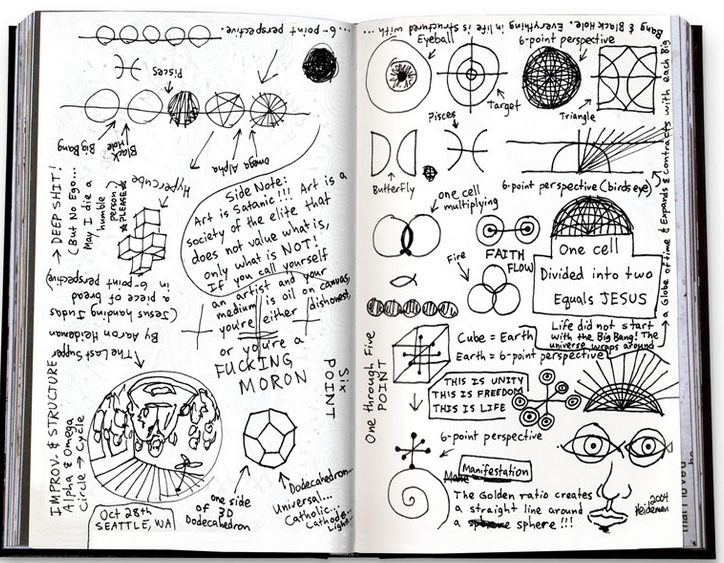
Brian Singer is a San Francisco-based fine artist whose sobriquet “Someguy” downplays the enormously unique body of work he has produced in the last decade or so. I first discovered his work at age 15, when I stumbled across the 1000 Journals Project book in my sister’s bedroom.
An ongoing collaborative experiment, The 1000 Journals Project attempts to track 1000 originally empty journals through their travels across the globe, accumulating stories, sketches, and photographs as they pass between friends’ and strangers’ hands. In addition to larger scale projects such as this, he creates visual art pieces that explore the layers of signification of the printed word, crossing out and redacting text in a process of mixed media décollage.

SARAH MADGES: The extensive, anonymous shared artifact network you created with The 1000 Journals Project speaks volumes about individuals' desires to be creative, without fear of criticism. Did you expect to find so many untapped talents waiting to give expression to their thoughts? Did you initially conceive of this project as a way to make collaborative art or did it just kind of happen?
BRIAN "SOMEGUY" SINGER: I think everyone is creative, but society tends to have a narrow definition of the word. Some people are creative when they cook, or garden, others make art. In the book Orbiting the Giant Hairball, Gordon MacKenzie talks about creativity—I’m paraphrasing here—he says that if you ask a room full of kindergarteners how many of them are artists, they’ll all raise their hands. Ask the same question of a bunch of 6th graders, and a few will raise their hands. Ask high school students, and you’ll be lucky to get a couple to raise their hands. So, what happens to us growing up? We begin to fear criticism and judgment of society.

When the project was conceived, it was based on what people write on bathroom walls. Not quite collaborative art, but more like public conversations. That said, I love the works of Dan Eldon, and sort of imagined what would happened if people just layered and layered their contributions until you got a density similar to his journals.
MADGES: In an increasingly tech- and text-based world, handwriting has lost some of its former relevance and ubiquity—cursive is no longer even required in U.S. school curricula and thousands of people have never written or received a letter in their entire life. How important is the handwritten aspect of these journal entries to you? How important is the written word to you as an artist?
SOMEGUY: The hand-crafted element is crucial to the journals. It’s almost like a signature, or hint of a person’s personality, beyond the words written. As an artist, for whatever reason, it has a little less meaning to me. Strange, now that I think about it. Perhaps because it’s so accessible and anyone can do it, it feels less precious or unique. Or maybe because I don’t incorporate handwriting into my art work — I’ve never really liked the look of my own handwriting. It’s more like chicken-scratch, which I blame my dad for.
MADGES: Do you keep a journal?
SOMEGUY: No. Yes. Sort of. I don’t keep a journal the way most journal artists do. When I was younger, I kept a journal which was more like a diary of sorts. Now, I have sketchbooks, which I use mostly for notes and ideas. Not really for freeform writing, or artwork, just lists and notes and sketches.
MADGES: As far as I can tell, the 1000 Journals Project was last on exhibition in Scottsdale in 2013. Where is it now? What are your plans for the project? Do you consider yourself its curator anymore?
SOMEGUY: There aren’t any exhibition plans for 1000J right now. A couple years back, I approached a few venues, and while there’s some interest, nothing panned out. As for plans, again, I don’t have any current plans. This is mostly due to time constraints, it takes a lot of energy to keep things going. I do consider myself the curator of the project, but am mostly playing a waiting game.. waiting for journals that have been out in the world for almost 15 years to be rediscovered and sent home. I imagine most are sitting on bookshelves, forgotten over the years.

MADGES: What do you think is the relationship between visual arts and creative writing? Do you think of yourself as a poet or writer when you create your cross-out and printed word pieces?
SOMEGUY: That’s a great question, because I haven’t given it much thought. I tend to gravitate towards certain types of works. These can be strictly visual in nature, or strictly written. I think the ability to combine the two opens up the best of both worlds when done well. They can live in harmony, or in contrast, and add value to each other, or amplify the artist’s intent. When I create my redacted works, I mostly consider myself an editor. I’m stripping away information and creating new meaning. I’d hesitate to call myself a poet or writer, which might be an insult to poets and writers, but there are some similarities in our goals to shape language and message.
MADGES: What have you been working on lately?
SOMEGUY: Lately, I’ve been working on building bodies of work around themes. So not really participatory, or journal based projects. One recent explorations was around visualizing number patterns (connect the dots) in unexpected ways. And the current exploration (no photos online yet), are process based works where I put a shape on every page of a book (imagine a circle or letter), and then cut the book up and reassemble the shape using the edges of the paper.
Behind "The Bone Transfer" • Zachary Lutz
BY ZACHARY LUTZ
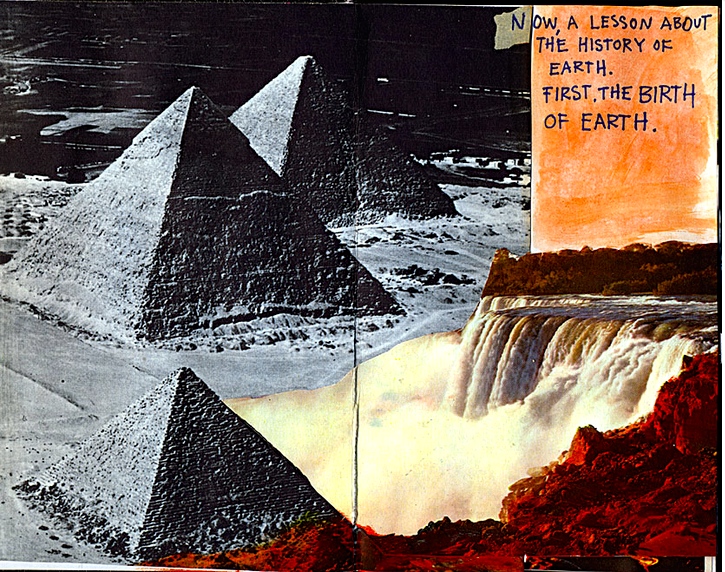
The sketch for “The Bone Transfer” was written in a subway car. Probably the B or the Q, headed to Manhattan. I keep a smaller notebook, pocket-sized, with a white cover. It helps that the surface area is more compact, as well the writing is compacted to fit. Tempts less spectators. In this particular type of free-writing, being surrounded by people comes in handy: there’s no contract for details on the subway. I’ll start with some image that’s been consistent and strange, some reoccurring thought. I’m generally writing narrative work, think non-autobiographical, so I’m not always drawing from experience. Easy to steal from something happening next to me on the train and makeup the rest.
The day I’m taking notes that will eventually turn into “The Bone Transfer,” I’m thinking about cartoon physics, TV tropes. For a few days, I’d been scanning this website/catalog of TV tropes, stumbling through entries. ‘Toon physics got me hooked. The page for the trope made note of “Who Framed Roger Rabbit?” as being a good example of the crossover between the “natural laws” of the human world versus that of the cartoon, and thus a good reference point for demarcation. I wanted to write something where character(s) experienced cartoon physics in the human world, but maintained their very human portentousness. I had been thinking for some time about how cartoons experience electrocution.
In addition, I’d received a phone call from a BBQ restaurant earlier that day assuring me that if I were to return to the location any time in the near future, I’d have a free meal voucher waiting for me. It was a wrong number call, but stuck with me. The writing I’m doing in my notebook is really just a way to process details. I try work with specificity as often as possible, and to link those details that might at the start appear un-linkable. (A rerun of an episode of “Shark Tank” introduced me to the Uro Club, which is referenced here alongside another sex organ-themed gift. It all returns to the body.)

When I transpose from my notebook to my computer, I’ll edit as I go. I’ll cut whole sections out, rearrange syntax. I change names or pump up the ambiguity. I want always for the mood of the piece to overshadow the context. Writing or thinking through a piece by hand provides me a necessary freedom which I make freer by movement—a faulty retractable leash that keeps threading out, a series of handkerchiefs from the sleeve of an encouraging magician. I recognize themes in handwriting, leave structure for the word processor. The shearing that results from the unmerciful typing-up of handwritten notes helps manage a pace, become more economical, say more heavily.

Zachary Lutz is a handwriter in Brooklyn. He holds an MFA in poetry from The New School and received an honorable mention for the Paul Violi Poetry Prize. His work has appeared in Luna Negra Magazine. To the left is his handprint.