Butter Tart • Kari Macknight Dearborn
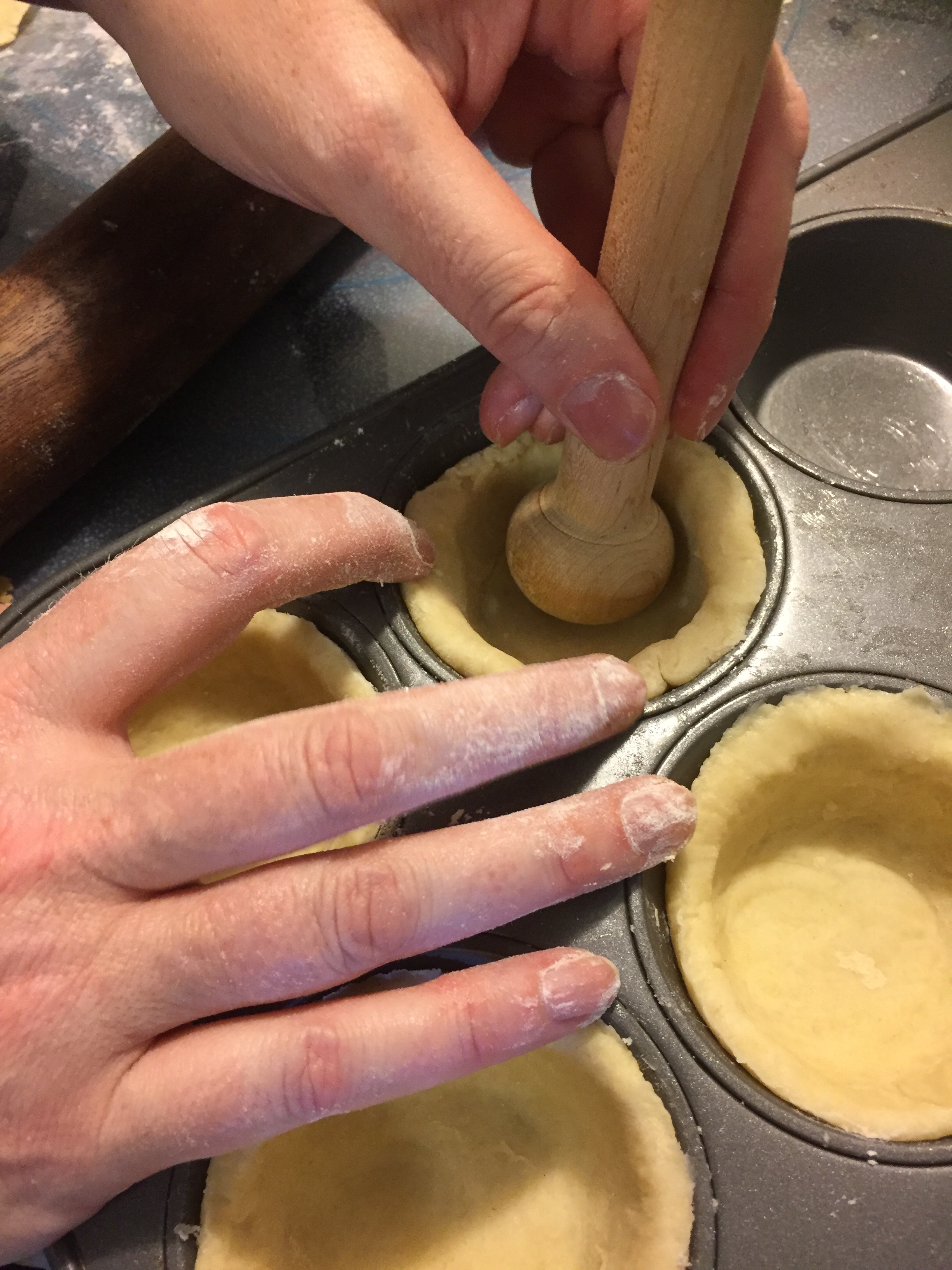
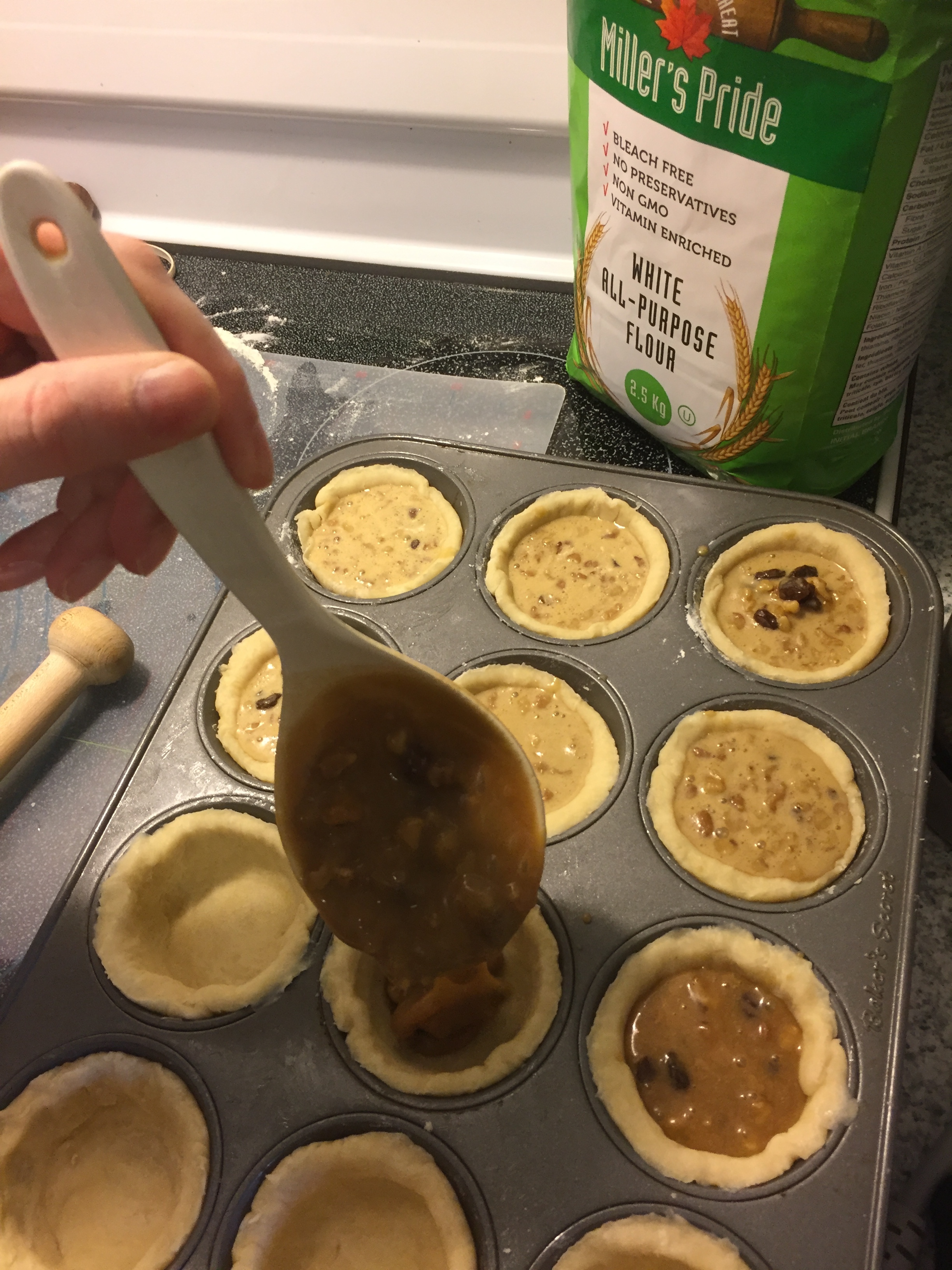
A Note from Curator Rozanne Gold: This fascinating article by Kari Macknight Dearborn comes just in time for Canada’s huge 150th birthday party celebration on July 1st. Canada Day festivities take place throughout the country and wherever Canadians live abroad. Here, Kari shares her own glorious family history, and that of Canada’s edible icon. Her step-by-step photos for making the country's beloved butter tarts are at once mouthwatering and instructive. Kari, a senior producer at the Toronto advertising firm, Zulu Alpha Kilo, Inc., is a board member of Slow Food Canada and is currently studying for her WSET Diploma. She lives in Ontario with her husband, Paul, and two Hungarian Puli dogs, Luna and Tisza. Many thanks to Allison Radecki for securing Kari’s memories for us...and just in time for the party! Happy Birthday, Canada.

Click to enlarge
BUTTER TARTS BY KARI MACKNIGHT DEARBORN
As so many of my fellow Canucks count down to July 1st, and to what probably will be the largest national party of my lifetime — Canada’s sesquicentennial celebration of Confederation — we are daily bombarded, and in every conceivable medium, with Canadiana.
This fervor has never been seen in our land of quiet pride and polite patriotism, and it’s odd and awesome at the same time. Images of beavers and moose, maple leaves, hockey, and all other symbols of my native land, are everywhere this year. The entire country is red, white, and bleeding nostalgia.
Canada officially came into being July 1, 1867, in case you were wondering what the fuss is about, by being granted a confusing level of freedom from the British Empire. It’s complicated. Americans went about it slightly differently, I know. Canada’s separation from Britain was a lot less bloody, and our connection to the ‘Empire’ is still strong today as a result.
We remain a country with very British and French influences because these countries created Canada. We have two official languages and we’ve raised a bunch of the funny and talented famous people you love. But my story is not exactly meant to be a lesson in Canadian history.
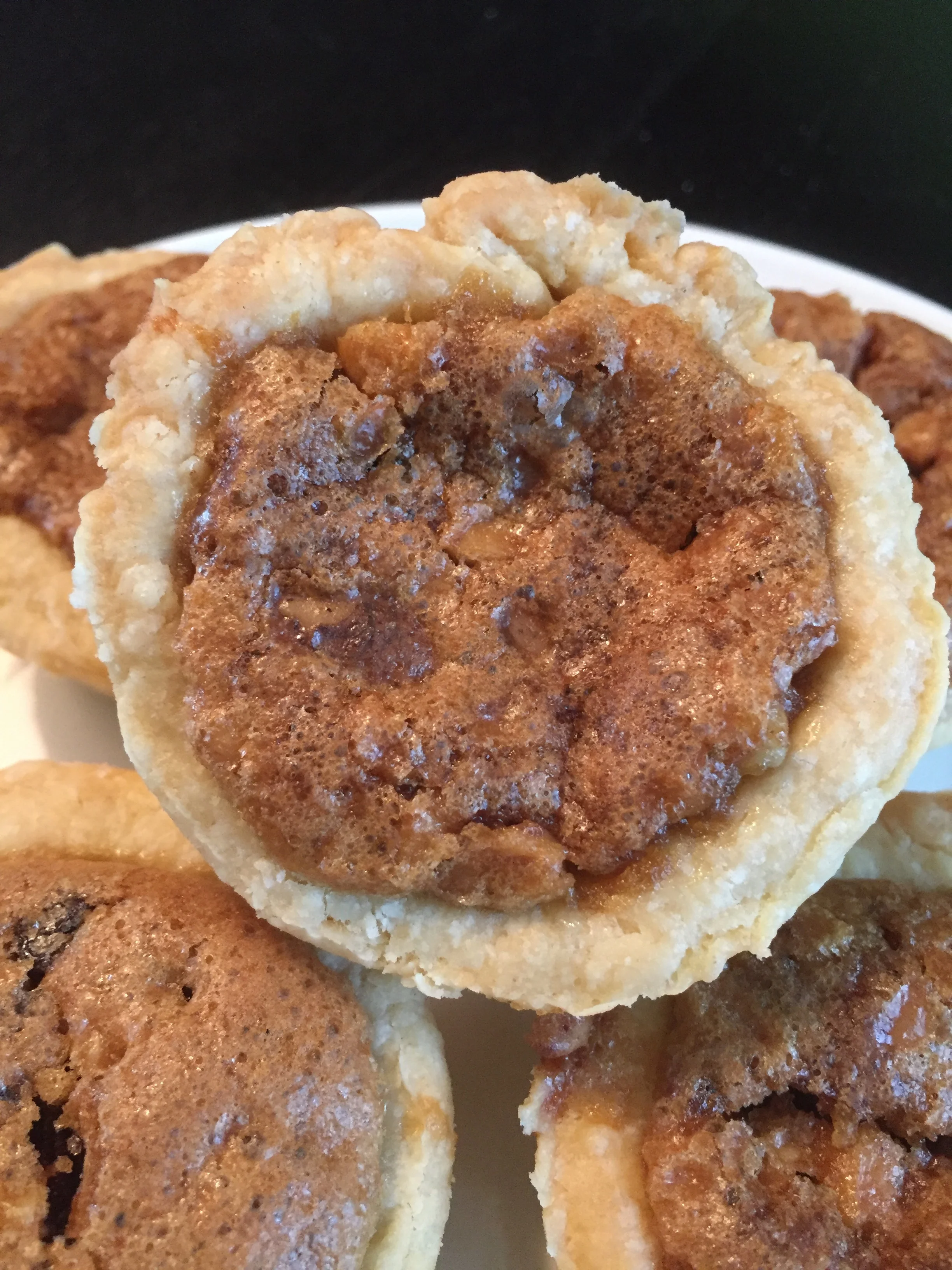
Instead it is a story about a singular confection; a quintessential Canadian dessert, made with basic pantry staples — the butter tart. How it came to be such a part of Canada’s cultural identity, and my own, is at the heart of my handwritten recipe.
I was raised in Northern Ontario on the North Shore of Lake Huron, as a consequence of my father’s employ in the mining industry. My grandmother was an English war bride who married my Canadian soldier grandfather and came to Canada shortly after the end of the Second World War. They settled very close to what would become my hometown of Elliot Lake.
My mother comes from hard-working Scottish Hebridean farmers of the Presbyterian persuasion, many of whom were displaced by the Highland Clearances. They ultimately settled in the rich agricultural areas north of Toronto that resemble, topographically at least, their ancestral homeland, minus the blasting winds from the North Atlantic.
It was in these enclaves of fellow immigrant Scots, and other erstwhile Brits, where these folks baked for weddings, picnics, and church events with the humble ingredients they could most easily procure.
Canadian food historians claim the butter tart’s certain influences from the Scottish Ecclefechan tart and early Québecois pie recipes made with maple syrup and maple sugar, as well as Southern recipes for pecan pie. These reasons all make sense given our country’s history and the oral tradition of sharing recipes. The main difference with the butter tart seems to be the individual serving size. Additionally, butter tarts are runnier than pecan pie given the lack of cornstarch.
The earliest published recipe for the butter tart is from Barrie, Ontario, from 1900 in the Women’s Auxiliary of the Royal Victoria Hospital Cookbook, attributed to one Mrs. Malcolm (Mary) MacLeod. Since my mother’s Aunt Marion was part of the auxiliary in Barrie in the post-war era, the written recipe here, in my mother’s hand, naturally resembles it.
These tarts were a precious part of my childhood at family gatherings but contained many (to me) vile raisins that I would meticulously remove one by one, wiping my hands on my clothes. For my wedding in 2008, since I am not fond of cake and my husband adores my mother’s version, I asked my mother to make dozens of mini butter tarts for my guests. Some of the tarts were even made sans raisins just for me, making it easier to keep my dress free of the gooey filling. My stance on raisins has since softened. And if the trend of butter tart wedding cakes ever takes off, you know where it began.
This recipe is classic, unfussy, and consistent but with a slightly loopy script. It’s sweet, and it has that nothing-extraneous Scottishness about it that I rely on. It’s my mum in pastry form.
My mum, a retired nurse, mailed me the original recipe to use for this piece, but I also have the email she sent me years ago when she transcribed it. Her recipe for the pastry dough (pate brisee) isn’t written down because it’s burned into her memory, and is also used for her amazing apple pies and much-beloved tourtière.
Butter tarts have become big tourist draws. We have a Butter Tart Tour in the Kawarthas area near where my mum grew up, and a Butter Tart Trail near the city of Guelph. Ontario’s Best Butter Tart Festival and Contest is held in Midland, Ontario, annually. Whether you add raisins or not, walnuts or pecans, nobody can really agree. Maple bacon versions and some containing coconut are popular variations on the traditional. Since I am a purist, I prefer mine with walnuts since pecans are not native to Canada, and would not have been cheap or easy to find here 100 years ago.
Happy Canada Day!
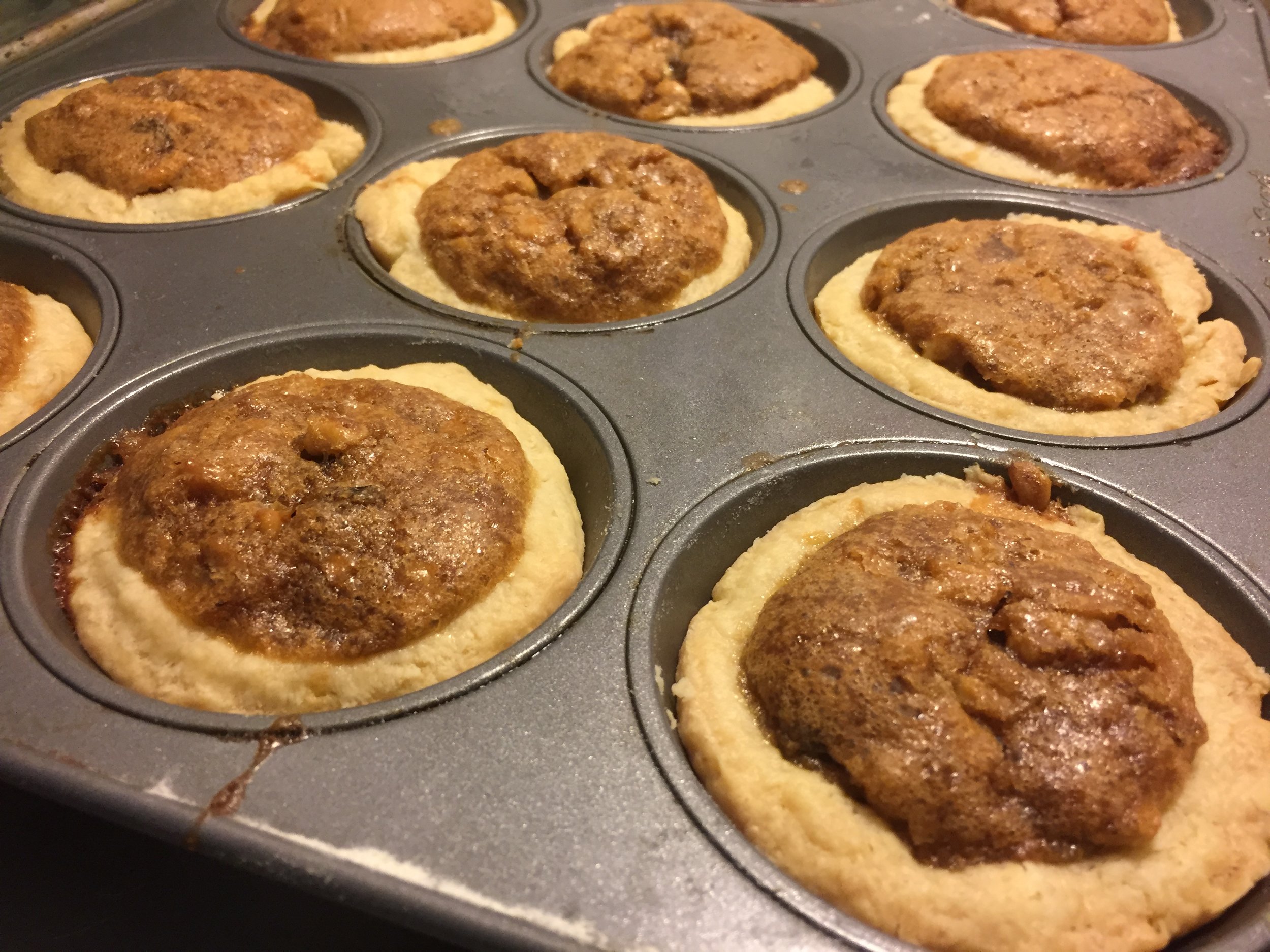
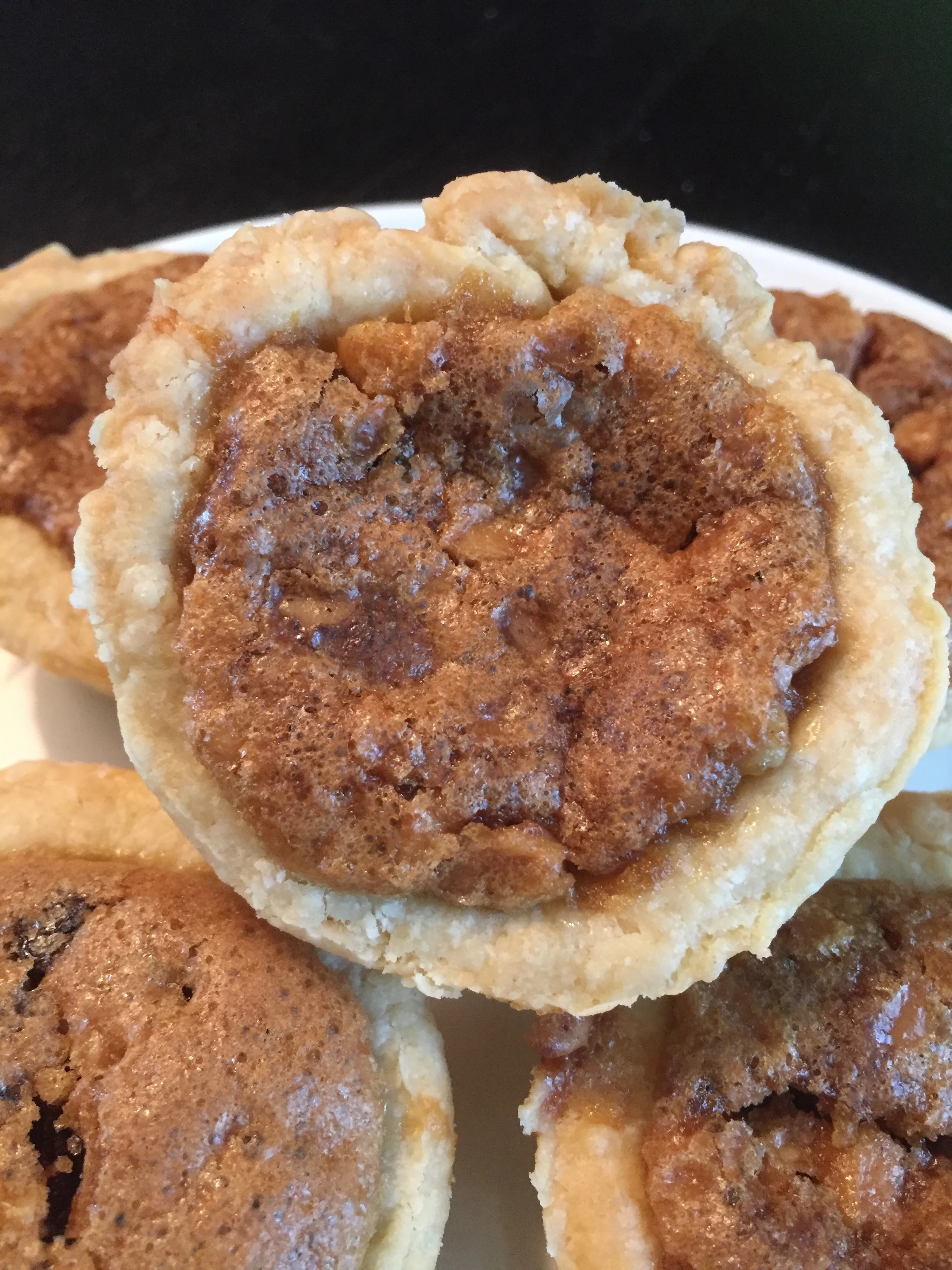
Butter Tarts (yields 12 tarts)
Note: You can use your own pastry dough recipe or purchase pie crusts.
Ingredients
Pastry for 2 pie crusts
2 eggs
1 cup packed brown sugar
1 tsp vanilla
1 Tbsp white vinegar
½ cup melted butter
¾ cup raisins
¾ cup chopped walnuts
Directions
1. Set oven to 400 degrees F.
2. Grease 12 – 3” pie pans (muffin tins)
3. Roll pastry and place in pans
4. In a large bowl, beat eggs. Beat in brown sugar. Stir in vanilla and vinegar. Mix well and stir in melted butter. Fold in raisins and walnuts.
5. Spoon mixture into pans. Place pan on cookie sheet.
6. Bake for 10 minutes then reduce to 350 and bake for another 25-30 minutes. Let cool.
A Fortress of Order Within Chaos • Ingrina Shieh
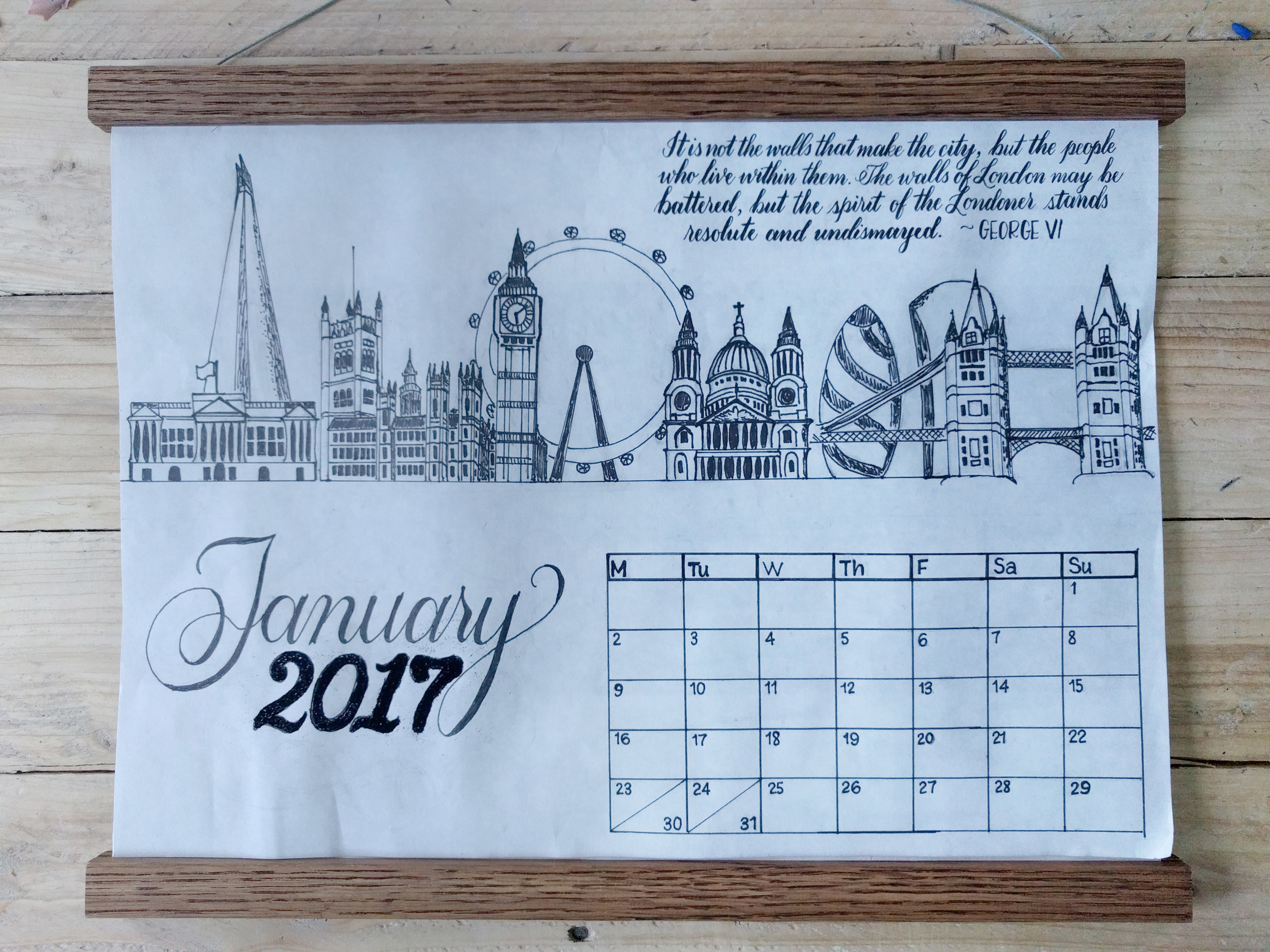
BY INGRINA SHIEH
Urban landscapes have always enticed to me. I love how lines intersect with other lines and the way shapes within, through, on top of other shapes create the towering skyscrapers we recognise so well. At a distance, city skylines emanate a beautiful stillness and unflinching majesty while within them pulses the movement and sounds of millions of lives. People, machines, and people on machines, darting around at a frenetic pace; opportunities opening and shutting before me. It exhausts and excites me. And though I’m constantly surrounded by people, I can sometimes feel the loneliest I’ve ever felt. Such contrasts hold me captive between repulsion and absolute adoration, so I‘ve come to simply accept the city as it is: a fortress of order within chaos.
It thus seemed fitting that I design my first hand drawn 2017 calendar based on cities of the world. I don’t know what possessed me to draw it rather than design it with software, but once I got the idea, it stuck. I also thought working with cityscapes by hand might help me learn the basics of design and drawing: how to put lines and shapes together and how light hits objects at certain angles.
Naturally, I started off with the city I call home — London — though I had already done practise sketches with Venice and Boston. This sketch took a good deal longer and involved more ruler-ing and erasing than I’d anticipated, but two days before 1 January 2017, my shaky hands committed the sketch to ink, and I even embossed ‘2017’ for the hell of it.
As a tribute to Londoners, I added a quote by George VI: It’s not the walls that make the city, but the people who live within them. The walls of London may be battered, but the spirit of the Londoner stands resolute and undismayed. The end result is not completely what I had envisioned — a little flat, lacking in character and depth, a little boxy — and I realise that I need to upgrade my drawing pens. But this first step has provided a foundation for the coming months’ designs and further ideas to zoom into cities on a micro level.
I’m excited about interacting differently with the iconic buildings I see so regularly in person and online. In drawing London, an unexpected intimacy came from having to examine details — ornate and simple — and deciding how to transfer them to paper. When I passed Big Ben and the Palace of Westminster during my early morning run, I noticed how many elements I missed or couldn’t fit onto the page. But, by studying it as I had, I was able to appreciate its grandeur and craftsmanship more deeply and to admire the fact that, long ago, this icon was borne out of someone’s careful etchings on paper.


Ingrina Shieh lives and works in London, where she is learning design and lettering in her small loft. When her hands are hurting, she takes her legs out to run, walk, or cycle around London's windy streets. Or she goes to buy more paper and pens.
Sweetly Unadorned Bits of Proof • Lexi Wangler

BY LEXI WANGLER
“What are you writing?”
Sadie, my best friend’s fifteen-year-old sister, paused on the porch. On her way to the hair salon, she surveyed me over her sunglasses, the bridge slipping down her nose.
“The ceremony,” I told her, and ripped another page out of my notebook.
“Oh, God.” Underneath the layers of heavy-handed wedding makeup, she paled in horror. “I’ll, uh, let you finish then.”
I could have called after her, defended myself and explained to her the nonlinear experience of expectation, the impossibly rapid speed of time devoured by just existing, let alone creative expression. But with forty-five, no, forty-four minutes to go, I just decided to keep writing.

Last September, my best friend asked me to officiate his wedding. He’s been my best friend for going on seven years now, and at first, I thought it was a sop for not asking me to be his best (wo)man. I remember asking him, clearly, repeatedly, “Are you sure?”
But he and his fiancée were. They didn’t find it surprising when the wheels of my plane touched down in the city I used to call home without a single ceremonial word written. Well, to be fair, I filled out the paperwork, joined the American Ministers of Marriage, and mailed the affidavit to the court house. I took a risk and didn’t buy the officiating kit with an embossed certificate, but I did buy a dress — floor-length, fire-engine red with mesh cut-outs. That’s as far as I went until about forty-eight hours before the ceremony. Between cocktails at the rehearsal dinner, I typed out the first half of the ceremony on my phone, riding that familiar edge between writerly hubris and an absolute terror of failure. This was before I realized I probably shouldn’t be reading from an iPhone screen at the wedding.

I borrowed a bit from the Corinthians, and a little from a speech that Roxane Gay gave at St. Louis University about Catholicism and feminism — ironically, since the happy couple asked me, the atheist, the fallen Catholic with a vengeance, to presumably perform a secular ceremony at a refurbished airport decimated during Hurricane Katrina.
The word “millennial” gets tossed around a lot to describe our generation, commonly linked with, jeopardy-style, “What is the worst?” Sometimes our elders have problems processing how we can ever mature, how we can contribute, how we can function, having been raised not only attached to increasingly smaller screens, but in a world that keeps getting increasingly darker: politically, environmentally, globally. The answer, of course, is hope. By coming here today, you have shown incredibly deep reservoirs of hope, in each other and in the joint future you began to build the day you met. You show the world the difference between growing up, and growing older.
*
Before and after the wedding, I explained several times that no, I do not do this all the time, that I am not a minister, but simply a girl who happens to be friends with the groom, a friend who has been known to occasionally write things down.
*
“Love suffers long and is kind. It is not proud. It bears all things, believes all things. Hopes all things, endures all things. Love never fails. [After all else], these three remain: faith, hope and love. But the greatest of these is love.” (1 Corinthians, 13:4)
*
I’m told it’s a rising trend nowadays, having a friend do for free what you used to have to pay a churchman to do. For a millennial couple with no particular religious leanings, it was a cost-effective choice, though vastly more personal and intimate. In the South, however, it still raised a couple of eyebrows. Despite mandatory compliments and platitudes from attendants following the ceremony, I wasn’t actually sure how it went. I cried through most of it, the maid of honor patiently passing me tissue after tissue. I only cry when I’m happy — weddings and other moments of intense joy are something of an emotional minefield for me. More so when you watch friend after friend find what looks like incalculable joy in the arms of someone new, someone you haven’t grown up with, but someone you nevertheless would like to know. It’s a joy tinged with fear, envy, sadness, wondering, sure, but it’s still the kind of joy that leaks out of you.
*
You met by chance. You fell in love by chance. You are here today because you are making a choice. You have chosen hope. You have chosen faith. You have chosen each other. By being here, you promise to both provide the best version of yourself and to also accept nothing less than the best version of each other. These promises are ones you intend to keep. You vow to take care of each other, to stand up for one another, to find happiness in the other. Each vow shares the same, simple premise; you promise to experience, to share, to be there. You promise.
*
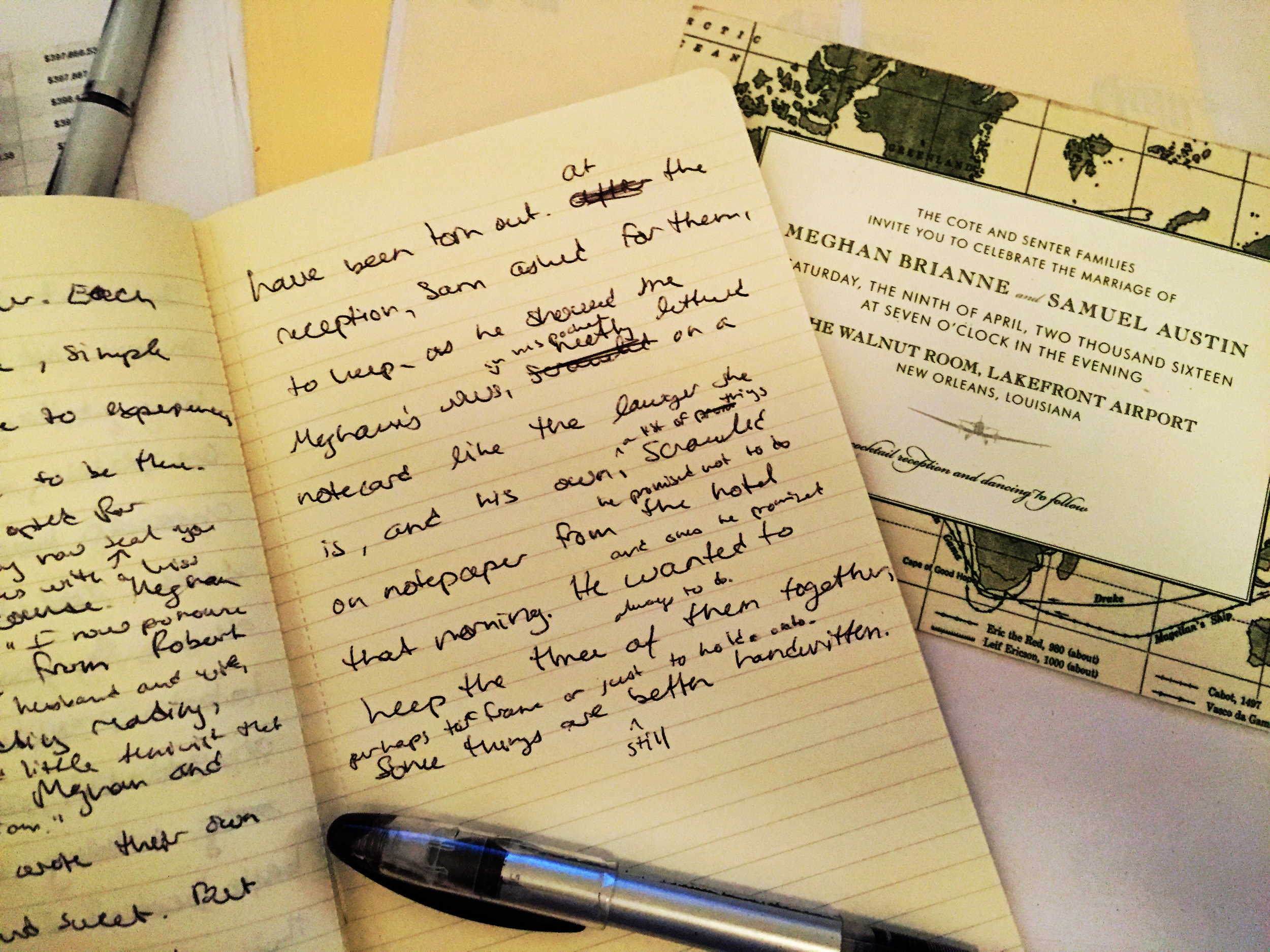
There is more, of course. I opted at the end for “You may now seal your vows with a kiss,” as opposed to “You may now kiss the bride,” and I switched out “I now pronounce you man and wife,” for “I now pronounce you husband and wife,” fervent little feminist that I am. They wrote their own vows, sweetly unadorned bits of proof. But these are not mine to share. Writing down my speech for the ceremony, my hand cramped over the teeth of the pages that have been torn out of my notebook. At the reception, Sam asked for them to keep. He showed me Meghan’s vows in his pocket, lettered neatly, firmly on a notecard like the lawyer she is, and his own, scrawled on notepaper with the letterhead from the hotel that morning, a list of things he promises never to do, followed by a list of promises he’ll always try to keep.
He wanted the three of them together, maybe to frame, or maybe just to hold onto. In this moment, I am glad to have something tangible, firmer than memory, to give them. Something handwritten.

Lexi Wangler holds an MFA from The New School in Fiction, soon to be joined by a dual concentration in Writing for Children. She works as an assistant at a literary agency and has so many books she has begun stacking them in her kitchen.
I Have No Choice But to Revise • Keith Baldwin

WRITTEN BY KEITH BALDWIN
My handwriting is fucked. The penmanship is not as illegible as some, but in terms of how I physically write by hand, it’s all messed up. I hold a pen against my ring finger, like the wrong half of a pair of chopsticks, and form a lot of my letters from the bottom up, rather than the top down.
When I was eleven, my dad finally noticed the issue and approached it with all the vigor and care he’d applied to the insufficient knots in my shoes a few years earlier — just enough to make me feel shitty about it, without solving anything.
He spent a few frustrated hours with me at the kitchen table, correcting the way I formed a handful of letters and the number nine. There was no progress at all toward fixing my wonky grip, which was already too ingrained to be altered so easily.
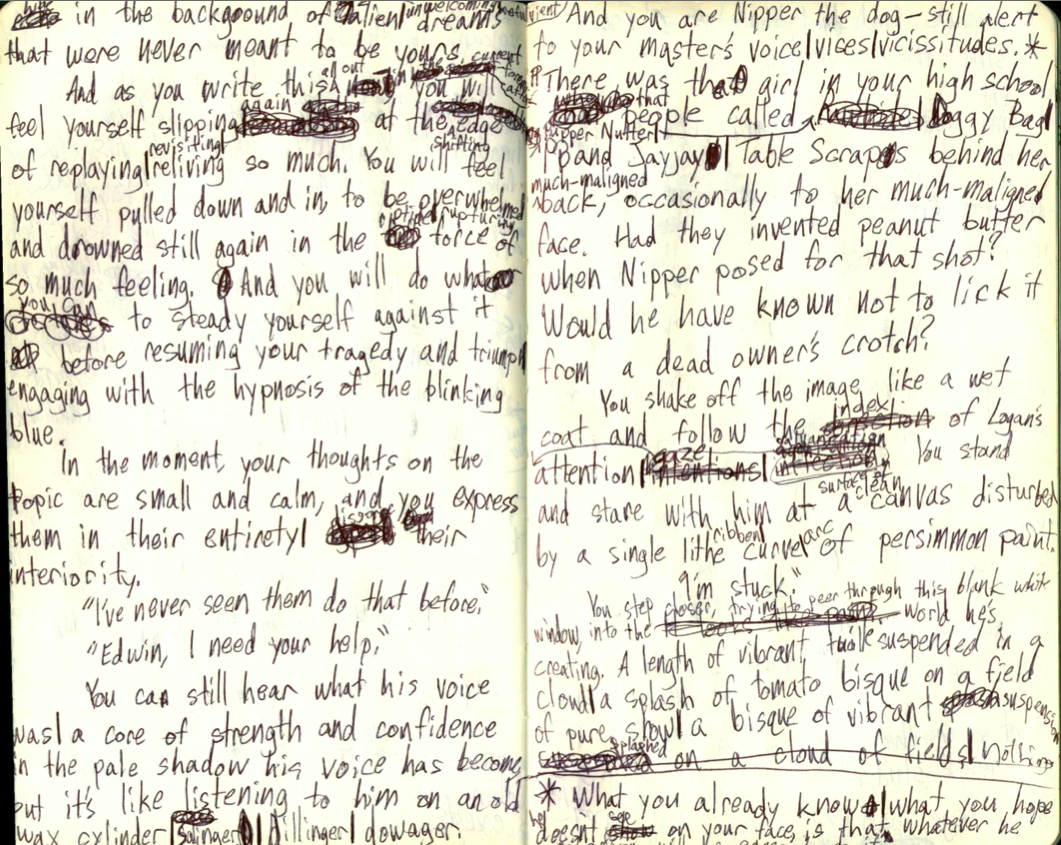
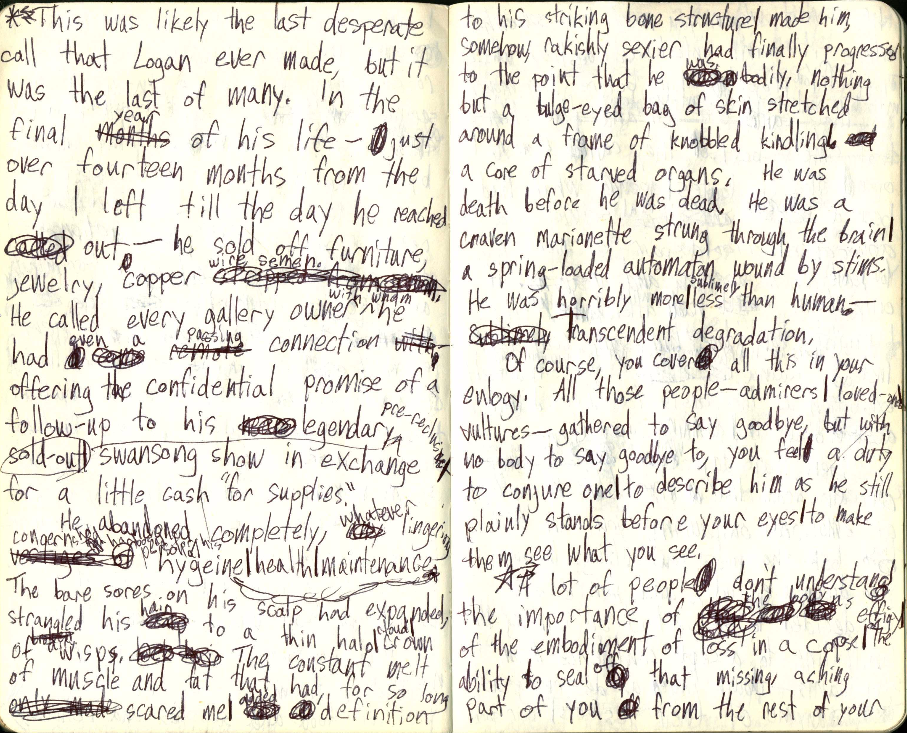
The upshot is that I don’t have the natural flow with a pen that other handwriting advocates rhapsodize. It’s always a slog for me. If I try to write too quickly, my hand and wrist start to cramp up, so my thoughts always remains three steps ahead of my pen. And while I work to close the gap, my mind is free to become distracted by flaws and omissions in what I’ve already written, leading to aggressive cross-outs and a morass of cramped footnotes that nest and crawl across margins — to be inserted in the main text later.


This would be enough to make a mess of my notebook, but on top of all that — rather than keeping everything in sequence — I have a bad habit of opening to a random blank page whenever I want to make a note, or a list, or play a game of hangman. In the middle of writing an extended scene of fiction, I will often turn the page to find story notes, shopping lists, and broken sentences for my ESL students to practice correcting. Typing up my work becomes a tedious chore of deciphering and reconstructing, tracking down where the story picks up when it’s suddenly interrupted by a sketch of my cat as an astronaut. It is almost as big a pain in the ass to work through it as it is for me to scrawl it out in the first place. So why do I even bother? Why do I keep returning to pen and ink whenever I’m writing something I care about? (You should see the rough draft of this essay…)


I know there are a lot of answers involving the way the brain works in different contexts, and how I formed these writing habits when all I could do on a keyboard was hunt and peck — and blah blah blah, a hundred other reasons why this website exists and longhand is the best. But I think the biggest factor for me is the same one that made me so much less anxious about sharing this mess of pages than I would have been about submitting something more polished. Because no one could ever confuse the contents of my notebook for a finished product — not even me.

On the one hand, this means that I can’t be held accountable for the contents, which frees me to be a little wilder in my first stab at a project. But it also means that I can’t avoid the work that still needs to be done. I have no choice but to revise.
My feelings about revision are pretty much the same as my feelings about flossing — I know I should do it, but it makes my gums bleed. And when my words are neatly typed and double-spaced, with numbered pages and no evidence of the disordered mind that composed them, I have to work to remind myself that it’s still a work in progress — that I can and should question every decision those collected words represent.

The process of transferring from the page to the screen forces me to consider every sentence with a critical eye while I retrace the whole erratic path. And I can’t even procrastinate for too long because, while a few days’ distance can bring fresh insights, a few weeks is liable to leave me incapable of piecing the whole mess together again. (It’s happened. It’s infuriating.)
I know that, for other people, writing by hand makes the whole process smoother. For me, it’s about making myself work harder, and getting better results for the effort.


Keith Baldwin is a writer and tutor living in subterranean Brooklyn while paying exorbitant tuition in Manhattan. He is sometimes worried that he might be one of those lizard people you hear about.
Connie Love’s Irish Soda Bread • Allison Radecki

Note from curator Rozanne Gold: I adore Irish Soda Bread and don’t eat it often enough. That will certainly change now that I have this fabulous recipe from Connie Love. Not only is her version filled with love and lore, but is lovingly written by Allison Radecki, who interviewed Connie for this story. It’s “Handwritten” doing what it does best. The recipe is written in Connie’s hand on thin, yellowed paper which she keeps protected, slipped into a small plastic sleeve. It is marked with lines and revisions. Many thanks to Connie, Allison, and her mother, Joanna.

Connie Love's Irish Soda Break by Allison Radecki
There are some homes where everything you see has a story attached to it; a place where life is lived in the company of objects that keep the memories of loved ones alive and where the spirit of a bygone era is still gloriously vibrant.
Such is the home of Connie Love, a close family friend with whom I have been lucky enough to share friendship, much kindness, and lots of laughter in both easy days and tough times over the years. A lover of recipes and a wonderful cook, Connie is the type of friend who will call you to say that there is an extra jar of homemade minestrone with your name on it, waiting for you on her front stoop. “Just remember to stop by and pick it up.”
My mother, Joanna, worked alongside Connie for many years as a realtor in Montclair, New Jersey, and benefited from many such surprises that emerged from Connie’s generous kitchen. Since Connie’s retirement, the two of them still manage to share adventures, whether it is an impromptu movie night or a game of Pickleball, the fantastically named hybrid of tennis and ping-pong, at the local YMCA.
In celebration of various holidays, Connie’s baked goods would appear in our home and soon be reduced to a plate of crumbs. This is how I first encountered her Irish soda bread, which often accompanied the first days of Spring and the Saint Patrick’s day season.
One afternoon this March, my mother and I sat down in Connie’s meticulous kitchen to talk about her soda bread recipe and found ourselves engaged in a whirlwind of memories, photographs, and stories. The recipe for her soda bread came from her mother, Amelia Malanga Ianucci (known as Minnie). Minnie, one of 14 children, was born in Newark, NJ, in 1895. She received this recipe as 17-year old bride from Mrs. Pollack, an Irish neighbor whose apartment shared a door to the same fire escape in a Newark tenement building. The recipe was said to be ‘the poor man’s soda bread’ since it did not use eggs or butter.
“My mother and Mrs. Pollack socialized on the balcony. Their apartments were side-by-side. The basement was filled with crocks with pickles and peppers. They kept the coal in the basements for the coal stoves.” Connie (Columbia Ianucci) and her twin sister, Betty (Elizabeth) were born in the midst of The Great Depression on Clifton Avenue in Newark, not far from The Cathedral Basilica of the Sacred Heart. “No one had a cookbook. No one had measurements. They just knew,” said Connie. “My mother knew the dough for knots. She knew the sweet crusts for Easter pies. My sister said, ‘we didn’t make an effort to know, so we didn’t know.’” Because of this, Connie, herself a young bride, had her mother dictate her soda bread process as she committed the steps to paper. Connie figures that she wrote the recipe down in the 1950s when she was already married and running her own house.
“The tenements smelled, not of garlic and food, but of bleach. The women would bleach the wooden floors until they were almost white.” Bleach was delivered to the women in the tenements by the bleach salesman. “These women didn’t have cars. They didn’t go to the stores.” She remembers the Jewish peddlers who sold linens, which her mother would buy — a tablecloth here, a sheet there — slowly stocking the Hope Chest for her and her sister. “The Stanley guys sold brooms, house products…brushes. The insurance guy came by to collect the insurance premiums — ten cents, twenty cents.”
A network of other relatives lived close by. Connie’s Grandmother’s tenement was on Stone Street. Aunt Tilly lived downstairs. Uncle Arthur and Aunt Ella lived in different tenements in the area. Connie’s father, Stephen Ianucci, was born in Italy in 1890. Connie remembers that at night, her father would read the paper out-loud and her mother would correct him, in an effort to erase his Italian accent. Dinner was always served at 5:30 p.m.
Connie reminisced some more. How she and her sister would harmonize with their mother as they washed the dishes -- “we had no tv and the radio was on top of the fridge. The Green Hornet, music, all sorts of shows.” And she remembered the big black stove with the chrome piece which she would have to polish when her grandmother said “Vieni qua."
Sadly, it was time for us to go. But I’ve got Connie’s recipe and an invitation to come back again. There would be more stories to tell.


Connie Love’s Irish Soda Bread
8 cups flour
3/4 cup of sugar
4 tsp. baking soda
2 tsp. baking powder
2 tsp. salt
2 cups of raisins
1 tsp. caraway seeds
About 4 cups of sour milk
(buttermilk or whole milk with one
tablespoon of lemon juice mixed in)
1. Sift dry ingredients together. Add 2 cups of raisins and caraway seeds, if desired. Add 4 to 5 cups of buttermilk (or whole milk with lemon juice). Mix to hold together.
2. Knead for 1 minute or just mix (not too soft, although never fails, whatever the texture).
3. Bake at 375 for 40 minutes until golden brown (loaf pans or a cake pan).
This recipe makes 3 loaves, which freeze well and are delicious when toasted.

You Show Me Hard Work Like No One Else • Andres, 4th Grader

When we brought the story and letters from Deh'Subz, Afghanistan into 4th grade classrooms in Brooklyn, a magnetic chamber of energy opened, and we walked away that day thinking this: perhaps we should all be a little bit more child-like, and less child-ish. These 4th grade students are role models for the future, making us here at Handwritten think that perhaps we should be leading letter-writing sessions for the politicians.
Below are forty-one of the letters written, which we will be showcased at Pen + Brush on Saturday, March 5th, for our Handwriting Gala.


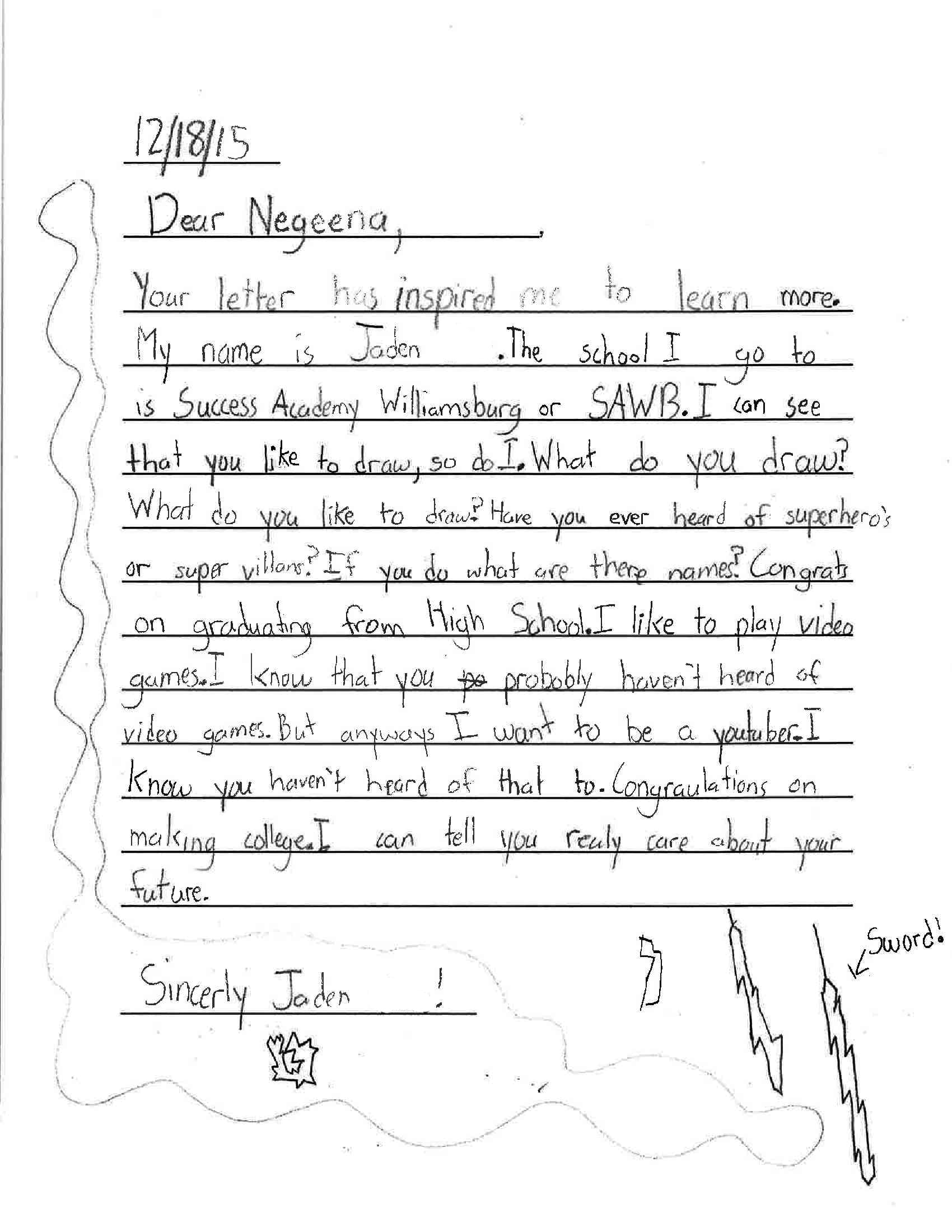
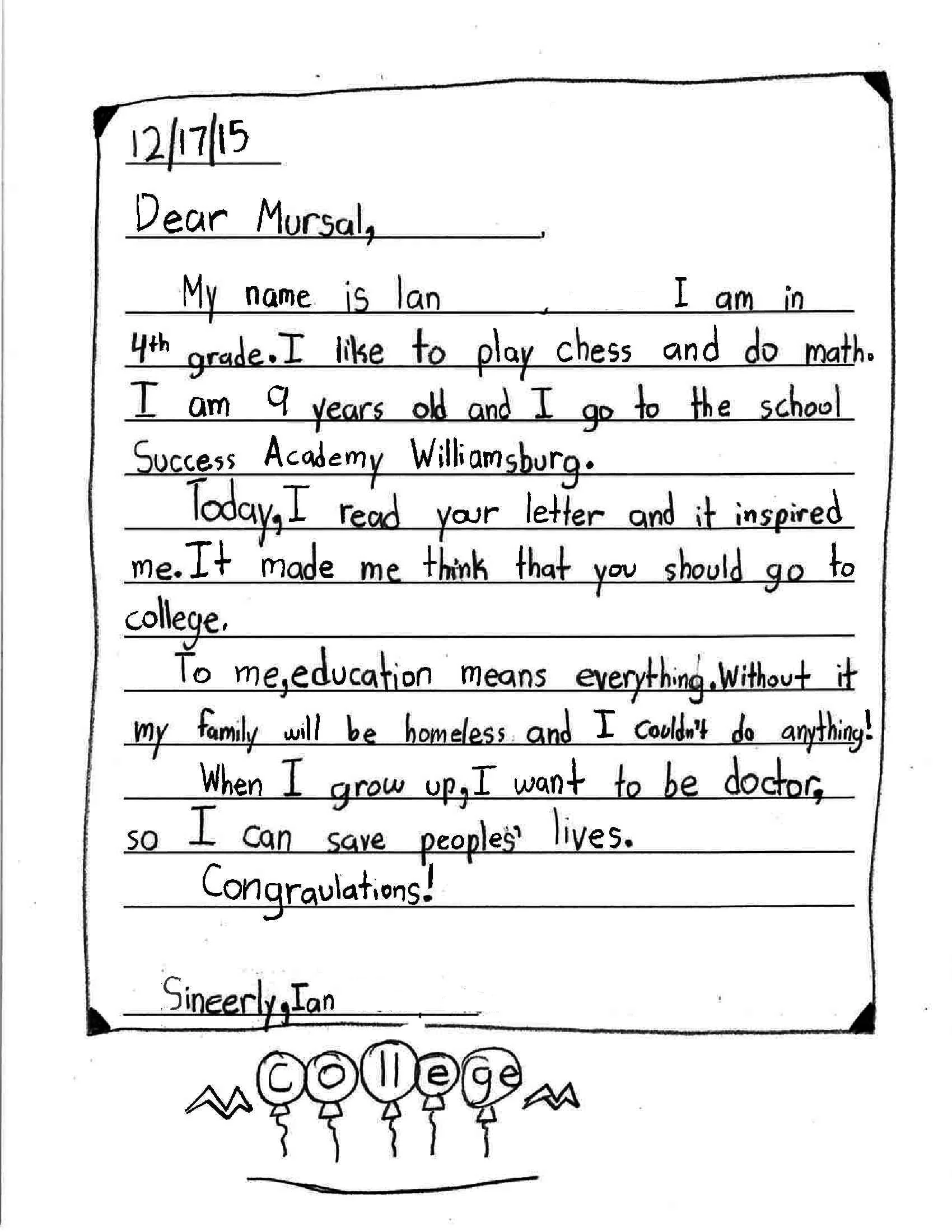


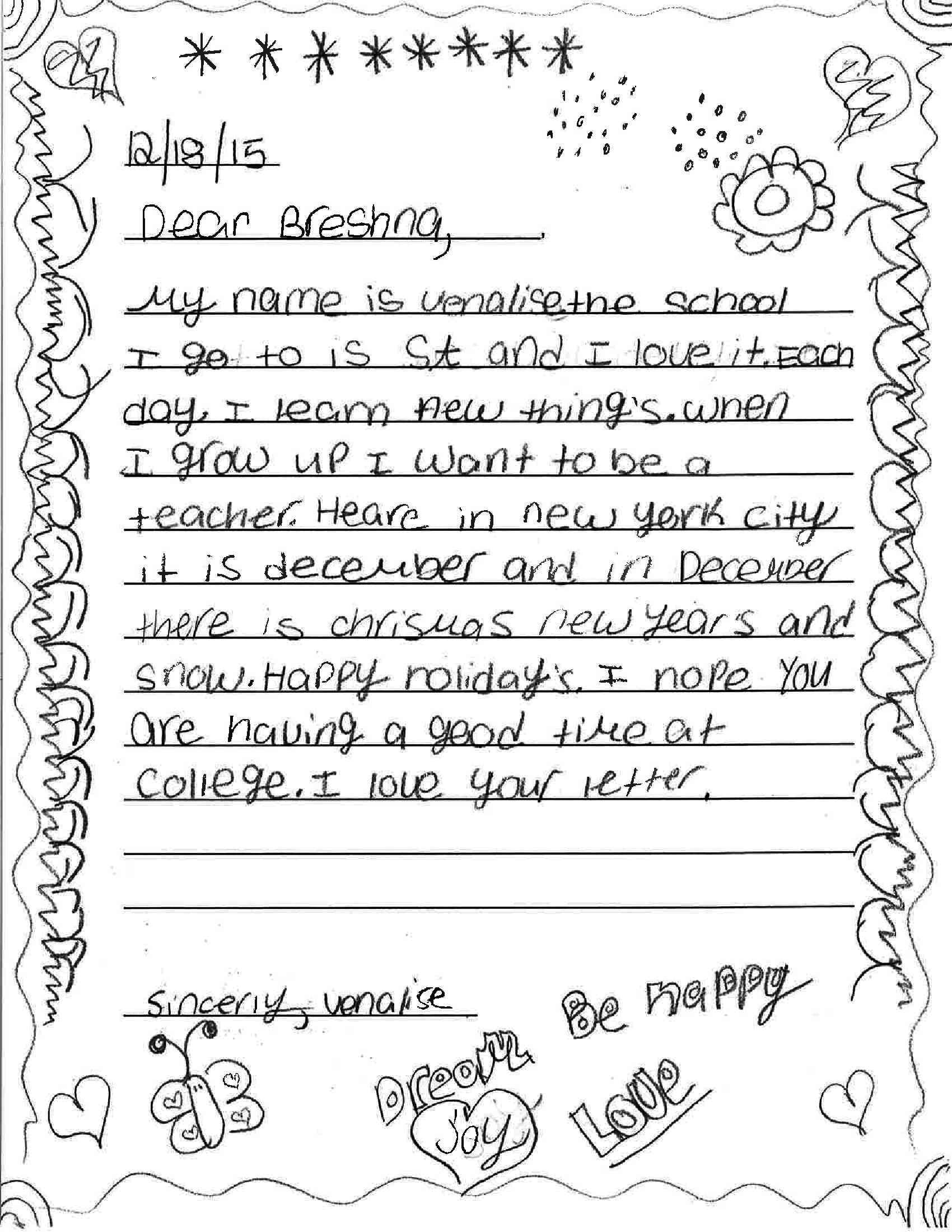

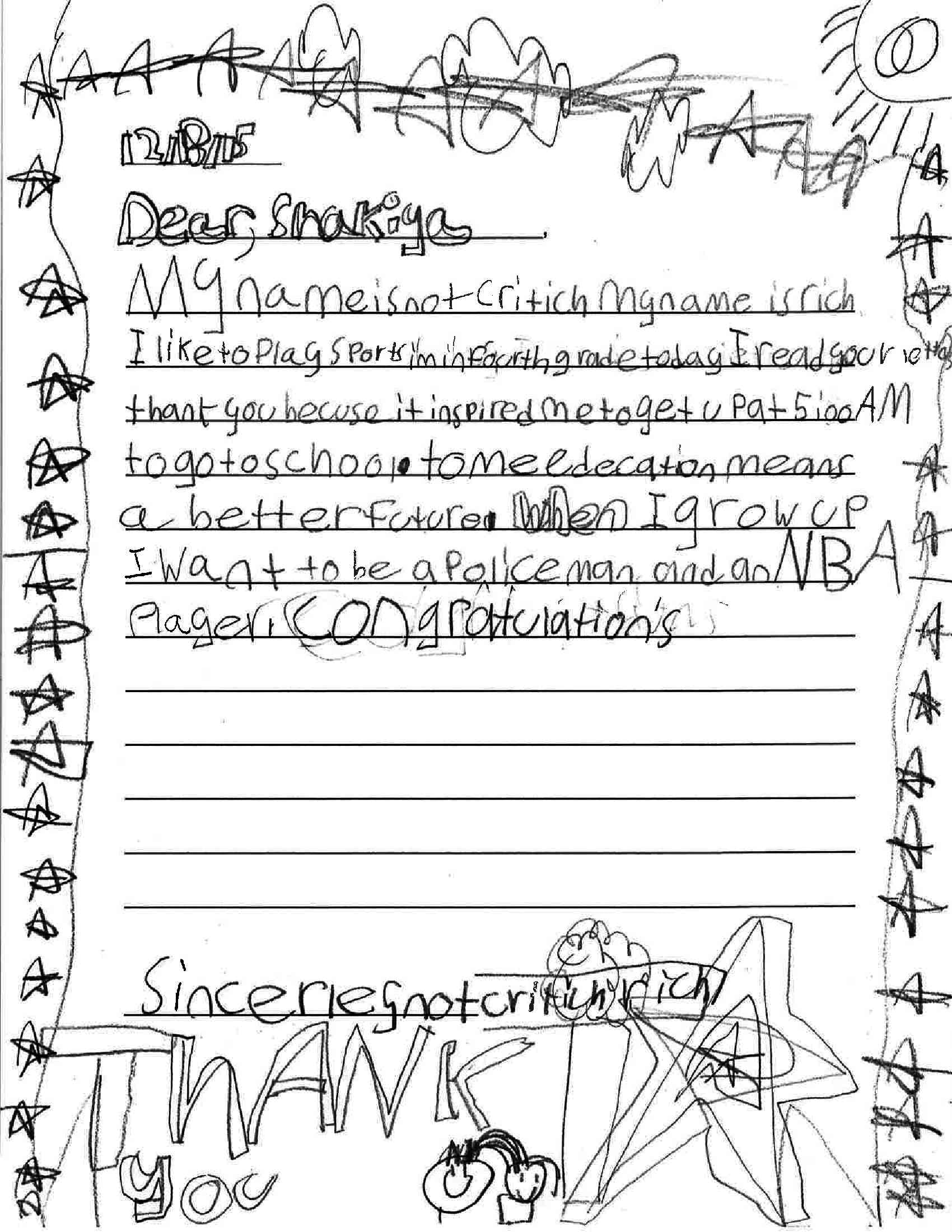


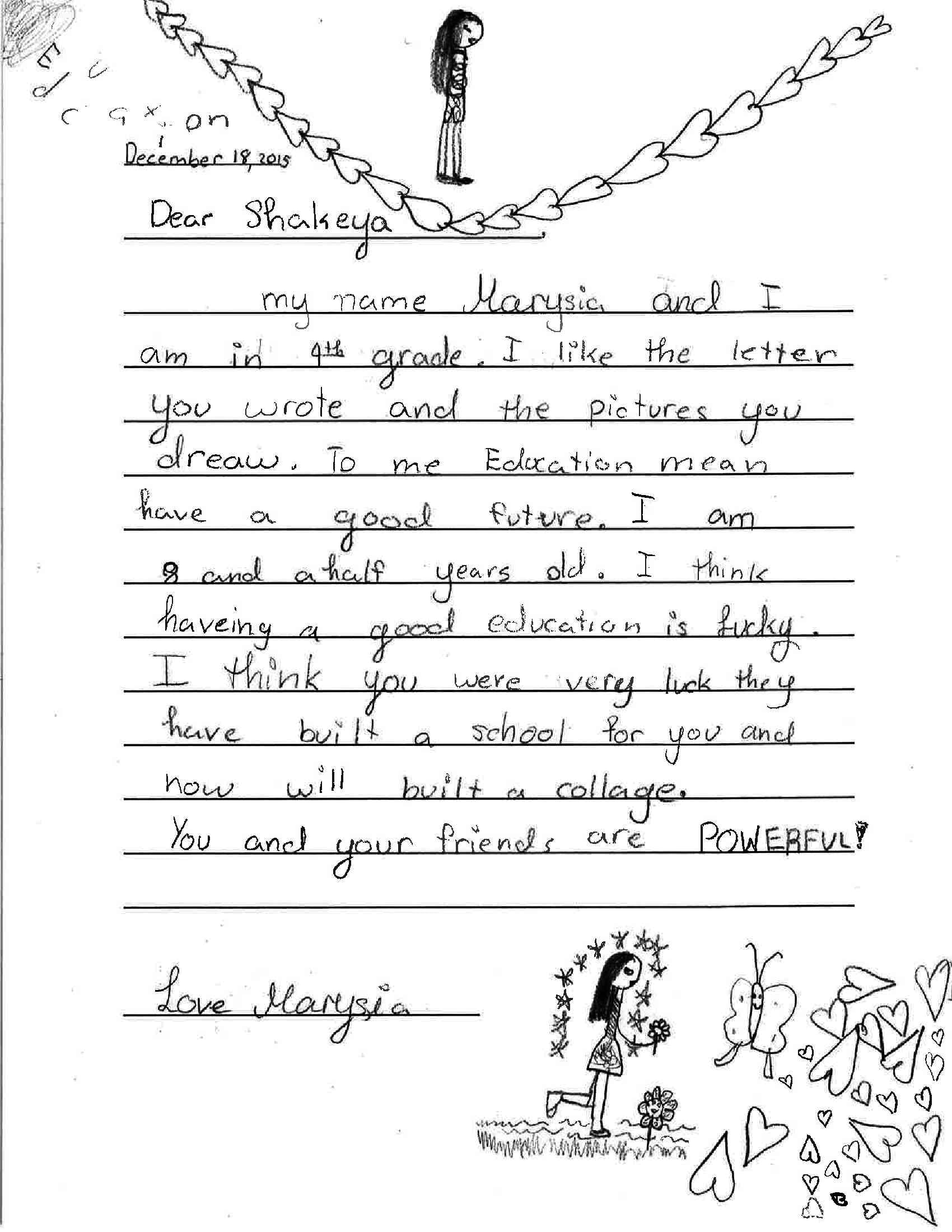
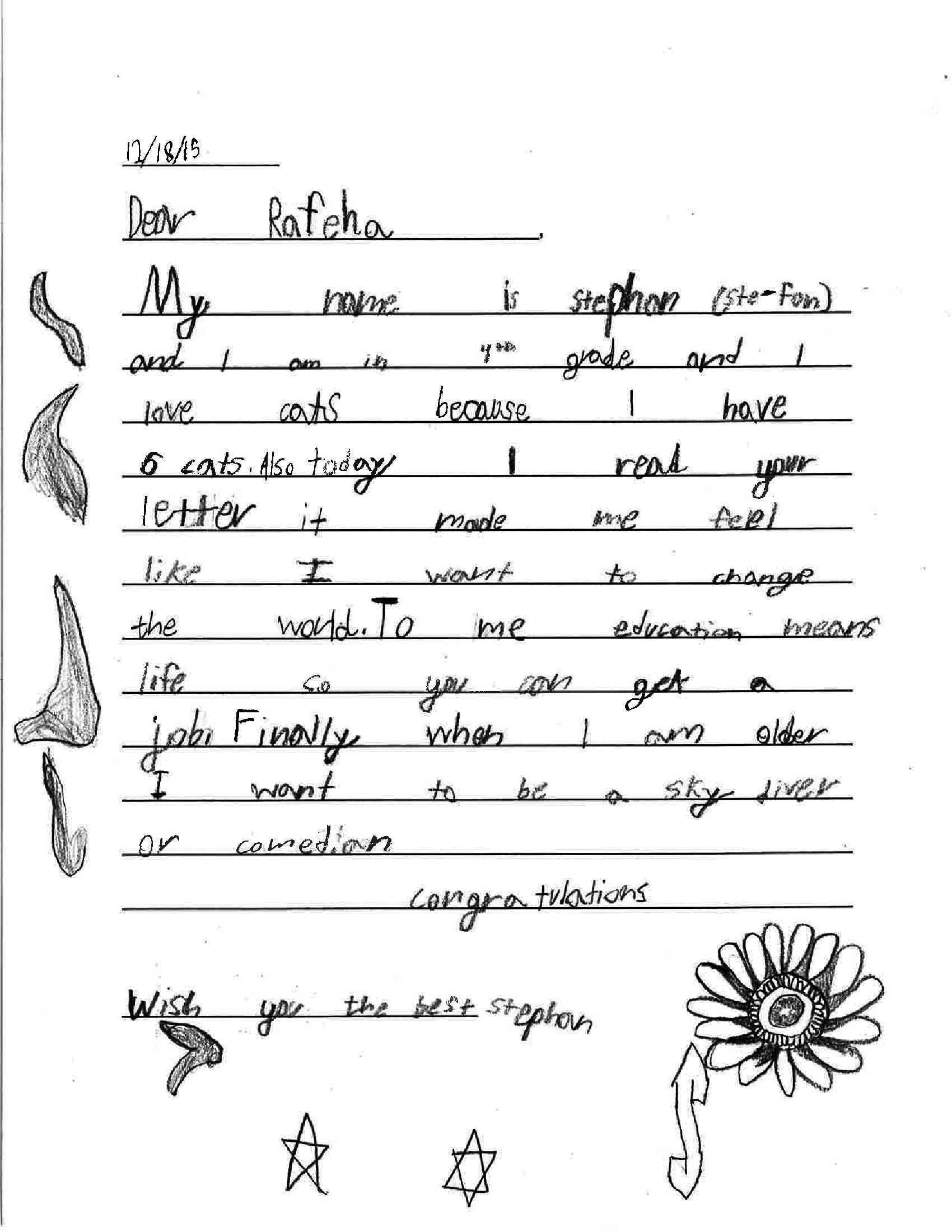


Do you want us to come visit your classroom and teach a letter-writing lesson? Get in touch. We customize the curriculum to your needs. Email us at info@handwrittenwork.com.
A Warrior for the Chaos of the Wild • Rags Edward

àite còmhnaidh (Dwelling Place)
I am from paper, ink, words, images and spidery handwriting, from Canon, Nideggen, burnt sienna and red ochre, coptic and codex. I am from lands of green, with dark, worked soil, from the adoration of constellations and the heavy scent of woodsmoke in the autumn air.

I am from the eagle tree and coyote fire-song, hay meadows full of wild roses and rooms pressed into the grasses, from a hiding place in the dark thicket of laurel branches, and the cool pocket by the lake.

I am from deer and dog, coyote and wolf, knight and Indian, books and stories. I am from home baked bread, handmade ice cream, banks strewn with Virginia Bluebells and restful sensitive spirits, from hateful battles full of terror and fright, from the ancient stillness of Simon, Mable, Alice and Fanny and the agonies of Jeanne and Ken. I am from homespun cloth of linen and the simplicity of field and pasture, from the bogey man in the basement who will stand you on your head, deep dreams of bears in dens and the legends of Jesus and King Arthur.

I am from worship of the earth and the hypocrisy of tongues - the comfort of the trees and the punishment of the Rock of Ages, from early devotion to Artemis, Diana, Luna. I’m from Lancaster and York, the lands of Merlin, from Donegal and the cities of red and white roses, from garden snapped peas, blackberries with beetles bitten in half, summer-cut roses and strawberry shortcake.

From the wicked aunt who stole identities and thieved the past and three gentle women who cradled my spirit as I grew, from long country walks on Sunday and the green walled cemeteries of Donegal. I am from paper, ink, words, images and the lovely hand of graceful fate.

From Rags: This is a poetry exercise that I wrote with guidance from a poem by George Ella Lyon called "Where I'm From." The exercise is great fun, and well worth a try! I’d love to see your results if you try it! Details for how to do it can be found here at Fred First's website.

Rags Edward:
hand bookbinder.
poet.
aspiring banjo player.
painter.
photographer.
warrior/advocate
for the chaos of
the wild!
The Distance Between our Public and Private Selves • Aine Greaney
In this essay on deleted pasts and new beginnings, Aine Greaney takes us around the world in an old composition notebook: the only one she brought with her when she emigrated to America. With the start of the new year just behind us, we find this piece more timely than ever, as we revisit filled pages from the past, and look toward the blank ones of the future.

BY AINE GREANEY
December 21, 2015
This morning, I ate some oatmeal, drank some coffee and penned the last page of my personal journal. I flip back to the first page: June 30, 2015. Inside this bound book are almost eight months' worth of thoughts, uncertainties, musings and arguments.

I don't write in my journal every day, but on those weekday mornings when I do, when I set the alarm to get up extra early, reflective writing makes the rest of my working day happier. On the weekends, journaling acts as my transition from working me to creative me—and believe me when I tell you that the latter is the more authentic version. In fact, journaling has taught me this: The shorter the distance between our public and private selves, the happier we are. Stephen King may have been referring to an entirely different type or genre of writing, but he was really on to something when he declared that writing is about “getting happy.”
I started keeping a journal in my teenage years while I was attending a small-town convent day school in my native Ireland. Some days, I can still shut my eyes and see myself back there, still dressed in my navy-blue school uniform, sitting inside my bedroom window, my geography and math texts pushed aside as I scribbled in an old composition notebook.
We were the first generation to benefit from a 1967 law that granted free, secondary-level (high school) education to every child in the Irish nation. So I was supposed to be grateful for that school uniform and those textbooks that had been denied my mother and my grandmother. I was grateful. Still, I recall those school days and nights as being full of square-peg-round-hole malaise and anxiety. In public, I sang with the choir in the school assembly room. In private, I wanted, desperately, to raise my own, individual voice. Journaling was the only place where this was possible.
However, when I emigrated to America at age twenty-four, I abandoned all but one of those notebooks. I think I believed that, in my bright, new country, in a nation founded on the notion of deleted pasts and new beginnings, that that melancholy, soul-searching me was best left behind, left where it belonged.
I did bring one hard-cover notebook into which I had transcribed some of those writings from my late teens and early 20s. In the flyleaf of this little red notebook, I grandly wrote, “Collected poems, rhymes and thoughts.” Now, when I re-read those hand-written pages, I see just how wrong I was to believe that our past has ever really passed. I am shocked at how well those “assorted rhymes” still describe the middle-aged me.
For example, here’s one of those entries that I remember writing as I sat propped against the pillows in my twin bed in my parents' house:
My books stand orderly on the shelf
Masks for that hidden self
Hoping they can quench the flame
Of numberless passions with no name.
I talk and talk; I make my stance
‘You’re such good company,’ he said.
But what would he say if, perchance
He saw me sobbing in my bed?
I find it comforting to read this unchanged part of me, this struggle between the private and public self. I like that we have certain personality traits that are in-born or immutable, and that there is, at all of our cores, a perpetual and lifelong mystery.

In the basement of my house in Massachusetts, I keep boxes of my completed journals, each one chronicling six to twelve months over the course of my twenty-nine years living here. My arrival day at JFK Airport, New York. That hot, AugustSunday when my American husband and I said, “I do” before a town judge. The day an editor wrote to say she was going to publish my first short story. I remember these. But, if it weren't for those journals, many or most of the less auspicious occasions, the ordinary mornings or afternoons, would be gone from memory recall. For example, in the journal I just completed, on August 18, 2015, I wrote that “I am here alone, finally, and the internet has made me vain and distracted, and these two things (vain and distracted) are very connected.” I cannot remember feeling that—not without re-reading my own handwriting on that page.
Without all of these hand-written journal pages, how much of the past two seasons would I actually remember? How well could I evoke the sounds or feelings or atmosphere of one ordinary hour or afternoon in July or August or September? What summertime walks did I take? When did the cherry blossoms drop their pink? When did the marsh grasses near my house turn dry and brown with summer heat? Now that our garden is under snow, I find it hard to close my eyes and re-see that garden when it was lush and colorful with summer perennials.
Some days, I feel as if I am on a Japanese bullet train ride through a fast-disappearing landscape, where, by the time I sit up and look out the window, everything is already gliding out of eye view.
Then there are those days when I’m driving home from work, my head still buzzing with deadlines or with snippets of workplace conversations, and I look out my car windshield at the roadside pine trees, a flock of geese flying south through the paling sky and I think, This evening, this moment in time will never come again. So I’d better shush my mind to look---really look--around me. How many of these afternoons are left in my life? I don’t know. None of us do. Morbid? I don’t think so. These moments of mindfulness are how we hit the pause button, how we behold our own joy. When we write down those moments, when we record them in a journal, we are creating the narrative—the only half-way reliable narrative—of our precious and finite days.
Henry David Thoreau said that he traded his comfortable town home for a rustic woodland cabin because he wished to live deliberately.

At least in the abstract, some of us covet this concept of unplugging and retreating from our hectic and digitized lives. Who wouldn't like to slow down time so we can feel the heft and length of each passing hour?
But nowadays, how many of us would adapt this as a permanent and year-round lifestyle choice? The woodland WiFi and cell phone connections would be spotty at best. And, as someone who grew up in a thatch-roof farmhouse without indoor plumbing or central heating, the discomforts and inconveniences of that bare-bones cabin life would, sooner or later, override the joy or mindfulness.
So in my cozy and well-heated writing studio I keep a set of ballpoint pens and write in my notebooks to record the ephemera of my life. Without these journals, without this writing, most of the past seven months would be gone.
This morning I closed my completed journal and crossed to my studio bookshelves to stash it there until, during one of my sudden and always overdue clean-outs, it will end up with all the others in those basement boxes.
I know there will come a future day when I will go to the basement to search through the shelves for an old photo or a lost gadget and the journal box will call to me, as it has before. I will open today’s completed journal at a random page and sit there under the basement’s Florescent strip light in the company of my previous self, reliving a day from 2015. In all my past journals, I see recurring themes: the yearning for solitude; the immigrant’s search for an existential home; and my almost lifelong struggle and vacillation between my public and private personae (as in the 1983 piece above).
When I read them, I’m also struck by how prophetic some of my past writings turn out to be. It seems, in retrospect, that the writing knew much more than I did. Too often, I see that I should have listened to or acted upon my own observations.
Today, I select a new book to set on my desk underneath the east-facing window of my writer’s studio. The new blank journal sits here, empty and waiting for tomorrow.
Some People Live a Whole Lifetime, and They Never Learn to Love the Rain • Adrienne Pieroth

BY ADRIENNE PIEROTH
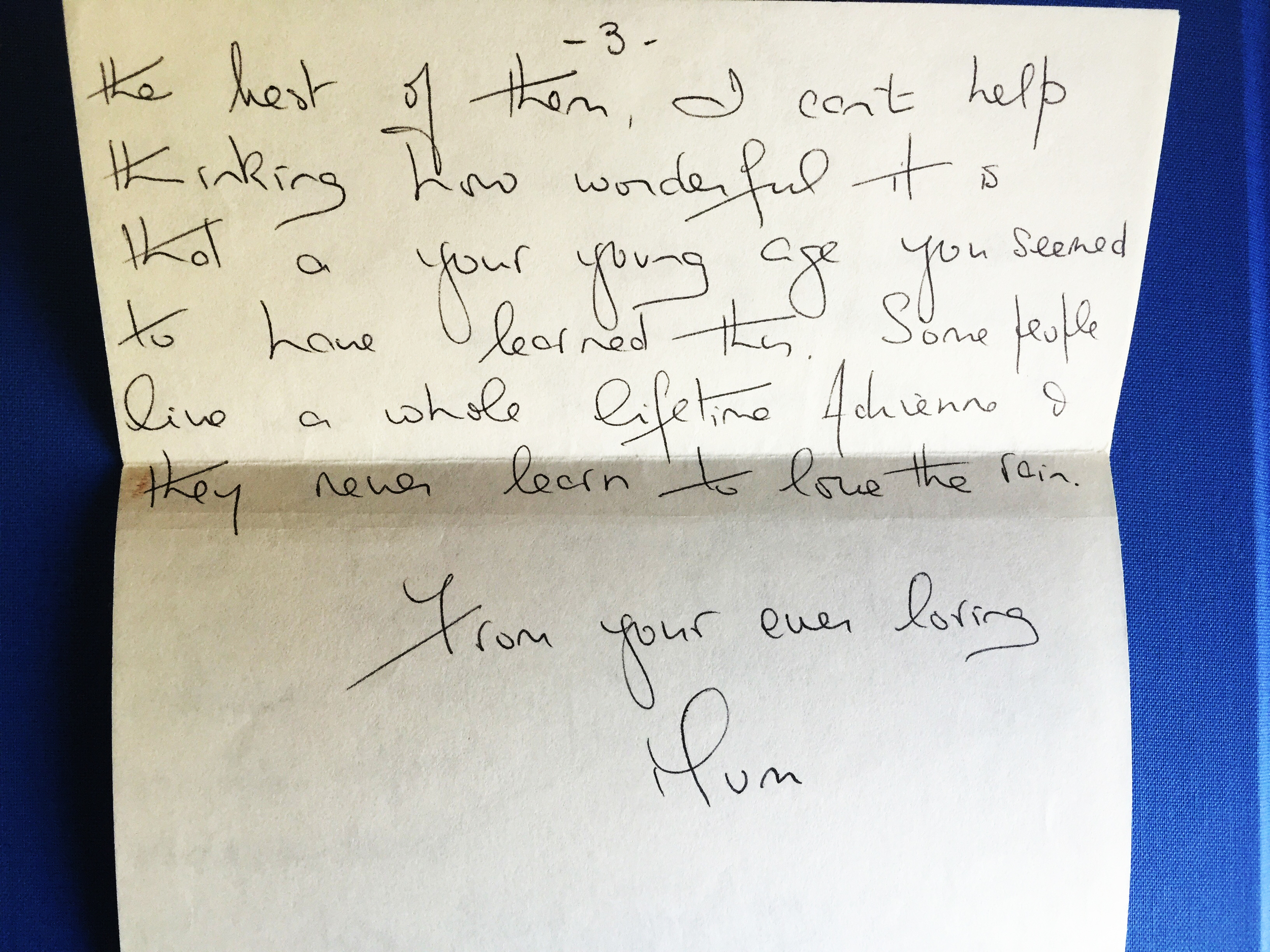
I received this letter towards the end of my freshman year in college. I was away from my hometown of Denver, Colorado, attending Drake University in Des Moines, Iowa. It had been a year of adjustments for me — some good, some challenging — like most 18 year-olds spending their first long period of time away from home. My mother had always been the center of my life, the touchstone I would return to over and over again for comfort, love, a hug, a laugh, or a cup of tea and a much-needed chat. My mother was British and had me late in life the at 39 years old.
Perhaps it was her older, wiser years that made her such a solid and grounded figure in my life. If you asked me what defined the word “home” for me, I would say without hesitation, my Mum. While being away from the comforting home and life she had created for me was difficult at first — her care packages and letters she sent each week made all the difference. Most of the letters were about daily stuff — what was happening at home, with my Dad, or how the cats were doing. But towards the end of the year, this letter arrived. I knew it was special from the minute I opened it. I had no way of knowing that less than five years later, I would be sharing the words in this letter as part of the eulogy I gave at her funeral.
Throughout my high school years my mother battled a rare form of cancer. During those years, I lost track of the number of surgeries, and the radiation and chemotherapy treatments. But all the while, I never once remember her complaining, or asking “why me?” Perhaps the fact that my mother grew up in England during World War II, where nights spent in bomb shelters, rations and stories of sacrifice and bravery defined her youth. All I knew was that my mother had incredible strength, optimism, and not for one minute did she ever believe she wouldn’t survive her battle with cancer.
When I first read it, the part of the letter that struck me most was that she was proud of me. My mother always told me she loved me and how proud she was of me, but it was something different to see it in words, written on a page, in her beautiful handwriting — handwriting, by the way, I couldn’t read until I was nearly ten. My mother had been a secretary and knew shorthand, so her writing was a combination of cursive and shorthand in a style all it’s own.
Years later, at her funeral, it was her last words that spoke to me most, and the ones I shared with family and friends gathered to say goodbye. They were:
...we have to have some grey days in our lives in order to appreciate the bright sunny ones, and we have to make the best of them. I can’t help thinking how wonderful it is that at your young age you seemed to have learned this. Some people live a whole lifetime, Adrienne, and they never learn to love the rain.
If I learned to love the rain, I learned from my mother’s example. Looking back, I wonder which of her grey days she was remembering as she wrote those words. The day I read those words as part of her eulogy was the greyest day of my life to date, even 26 years later, but the brightness of her love and the memories of my time with her outshine the rain. Whenever I want to remember this, I need only to open the envelope that contains my mother’s beautiful words of love and support to be reminded.


April 29th, 1985
My Dear Adrienne,
I am looking forward so much to having you home for the summer. To hear the front door open & to hear you say, “Hi it’s me.” Your dad & I have missed your very much since you went off to college but we know this is the first stage of our daughter’s independence. We love you very much & we are so very proud of you. We know you have worked long & hard in all of your classes & it’s been a struggle, so many times wanting to go out & have fun, or go to a party, but knowing that you have homework to do and that the studies come first.
You have always been able to appreciate the small things in life, Adrienne – a diamond ring – a new 28oz – a trip around the world! So just kidding, I really mean the small & important things in life. When we talked on the phone last week I remember your comment on the weather. It was raining & you said when you were passing a couple of students they were complaining about the rain; how wet & miserable it was. You told me you were smiling inside because it brought back memories of England back to you & the air smelt so sweet & fresh.
Life is a little like that – we have to have some grey days in our lives in order to appreciate the bright sunny ones, & we have to make the best of them. I can’t help thinking how wonderful it is that at your young age you seemed to have learned that. Some people live a whole lifetime Adrienne & they never learn to love the rain.
From your ever loving,
Mum
A photo of Adrienne and Mum
Neat, Cursive, Normal, Lefty • Chelsea Florio
BY CHELSEA FLORIO
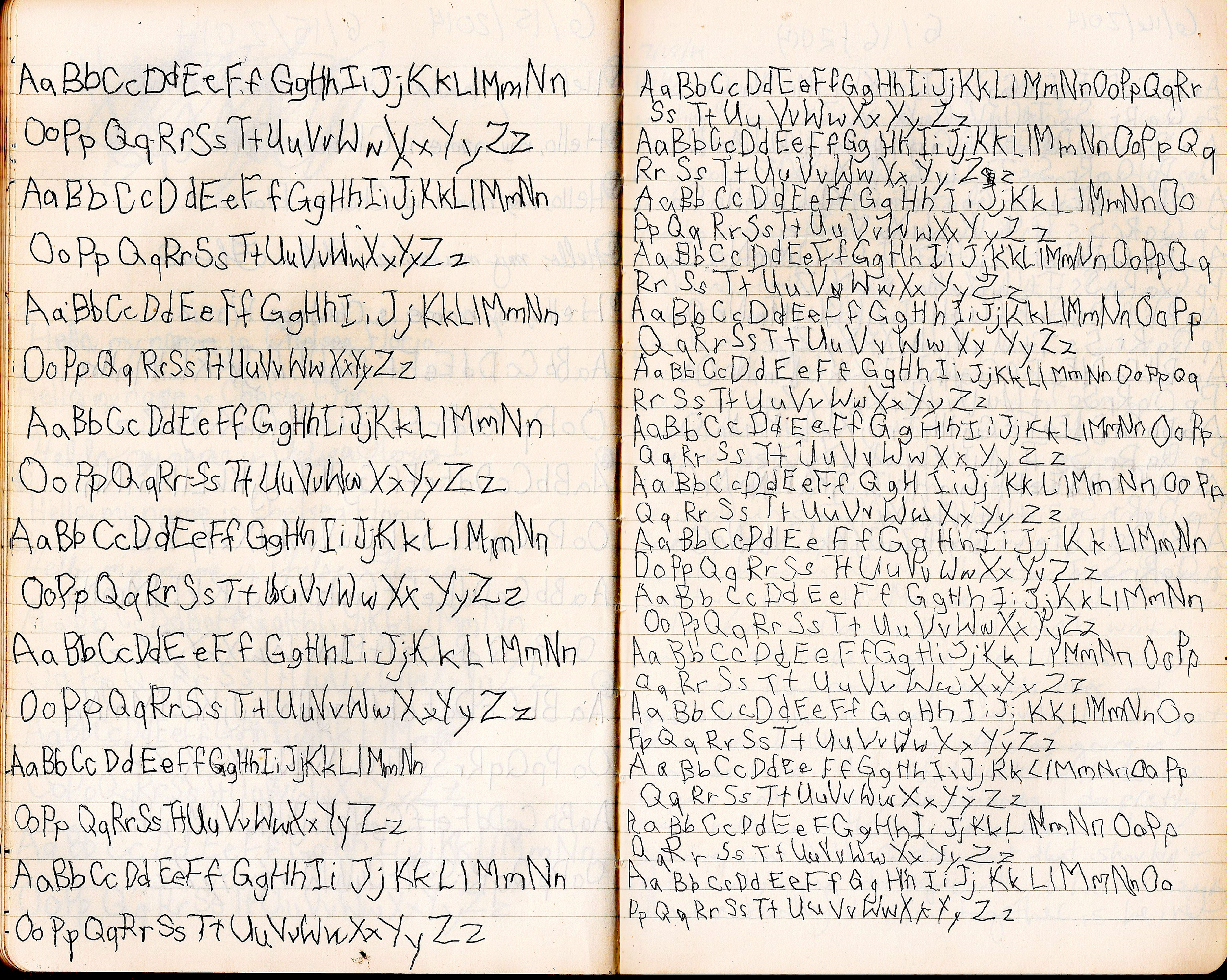
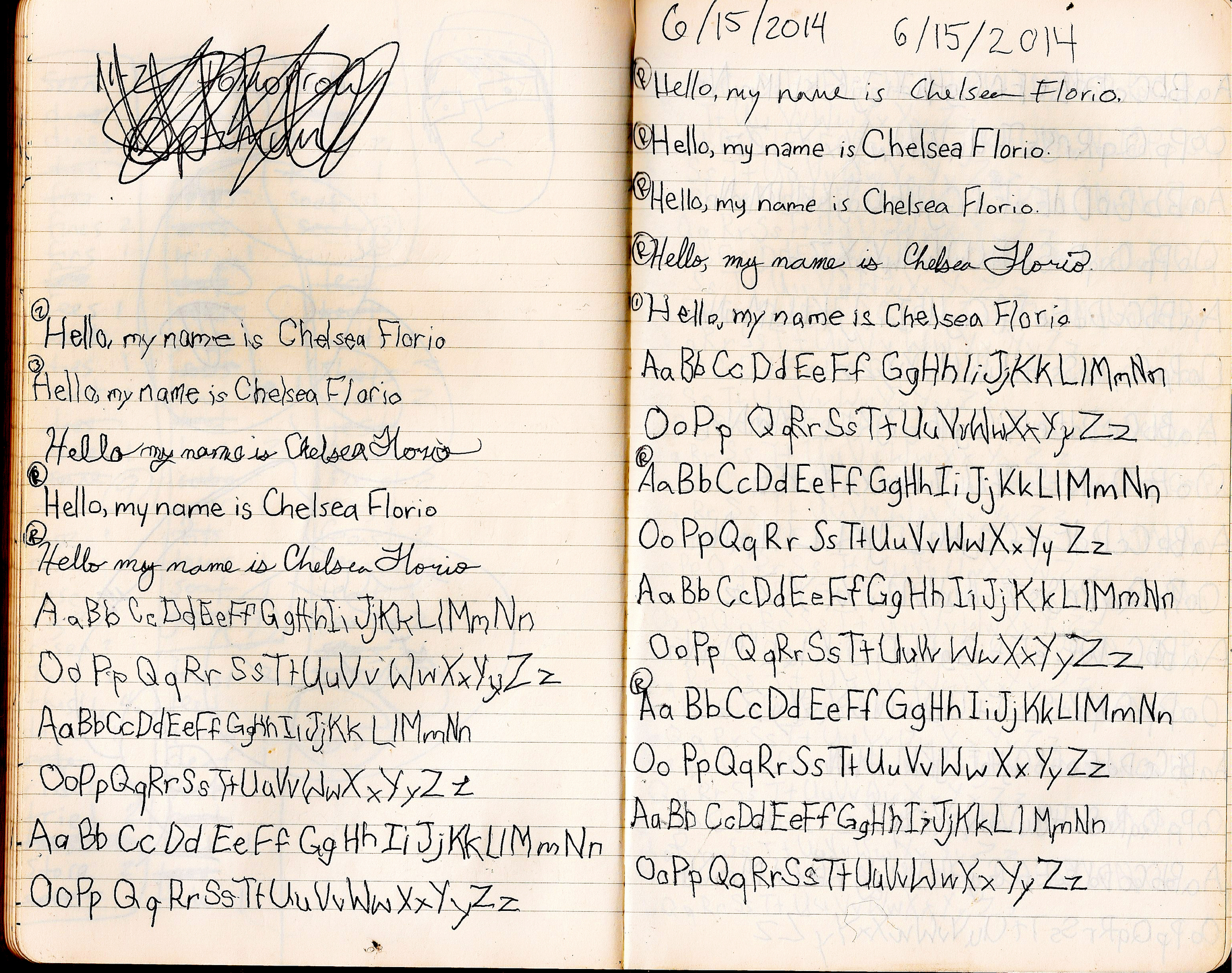
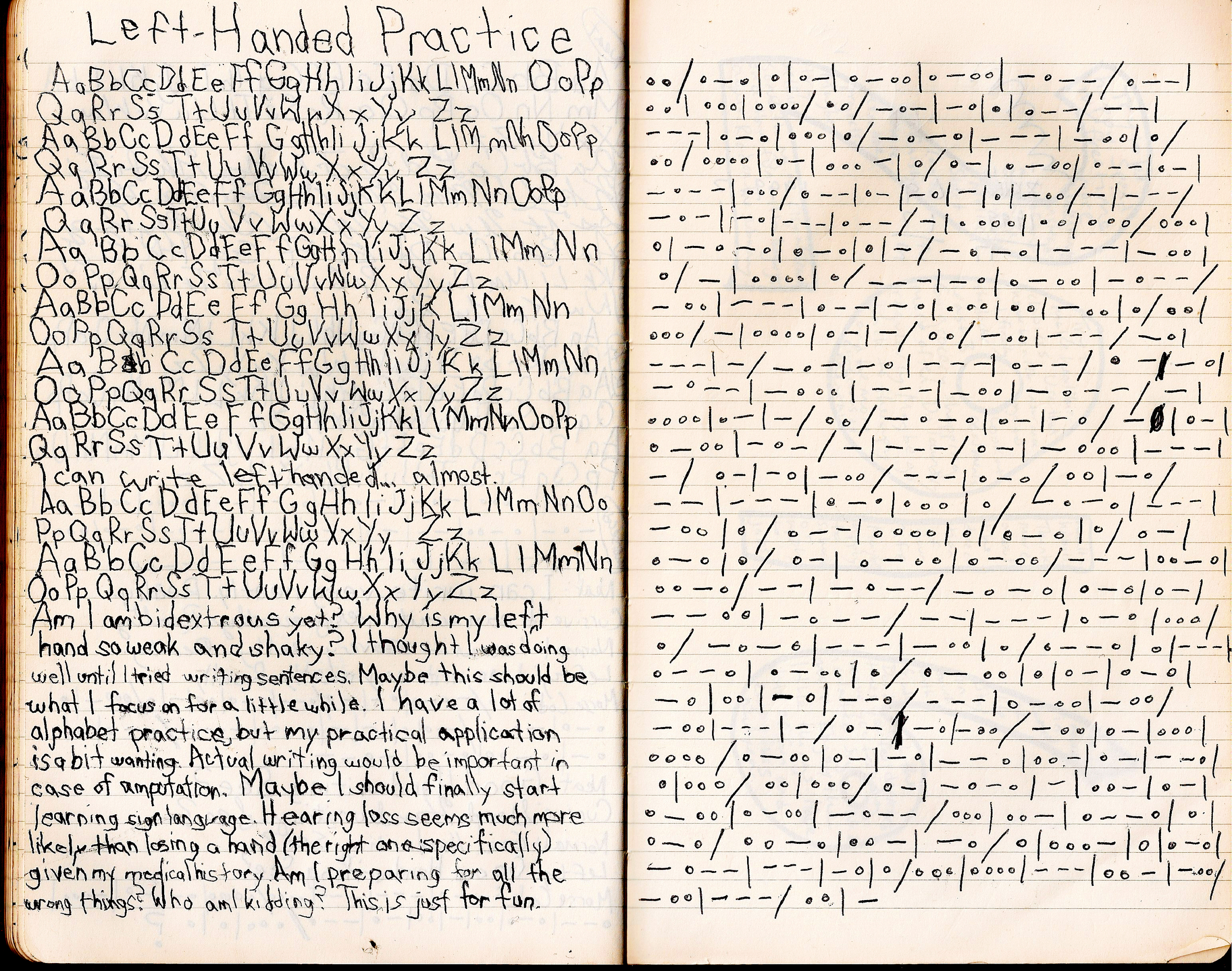
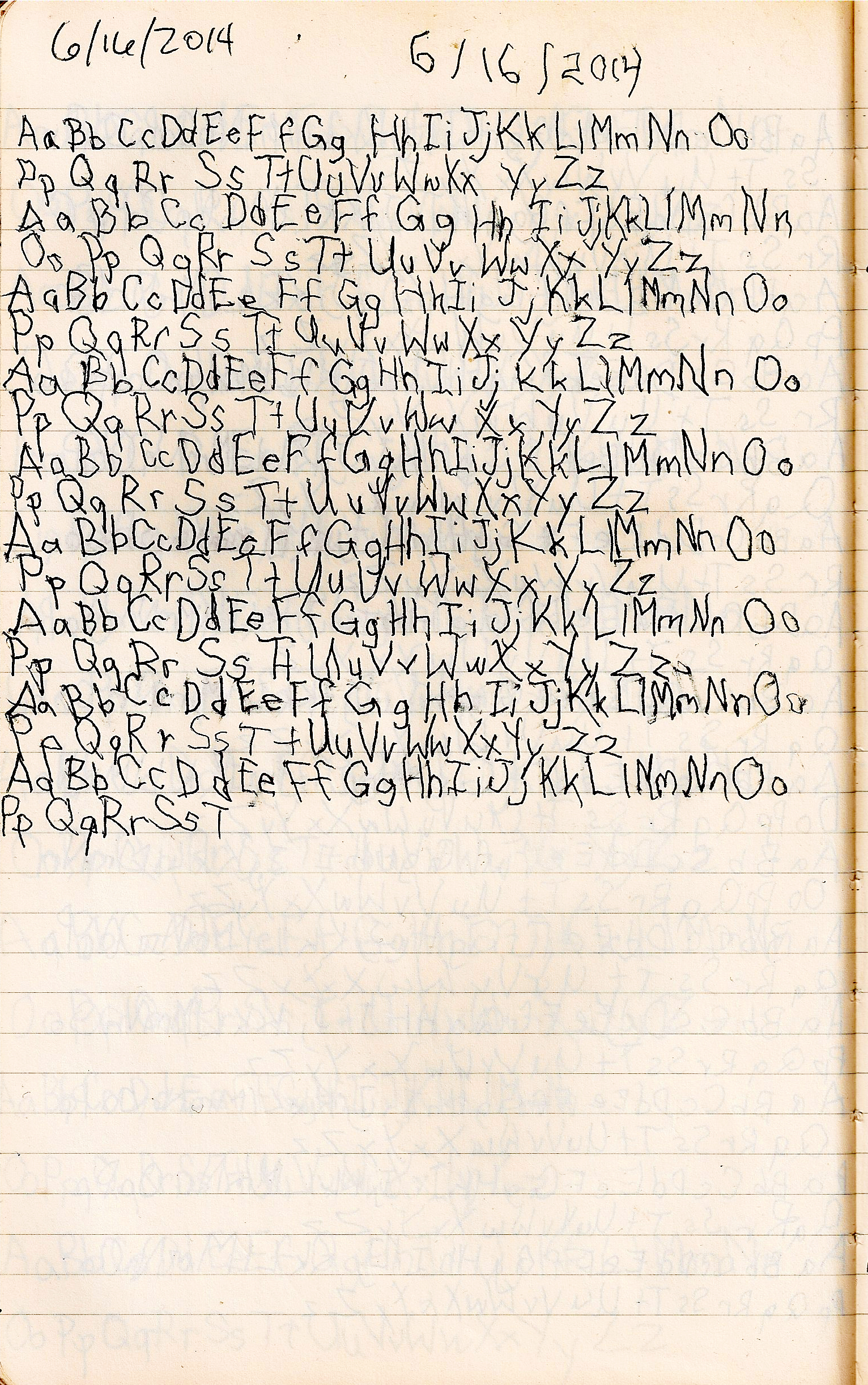
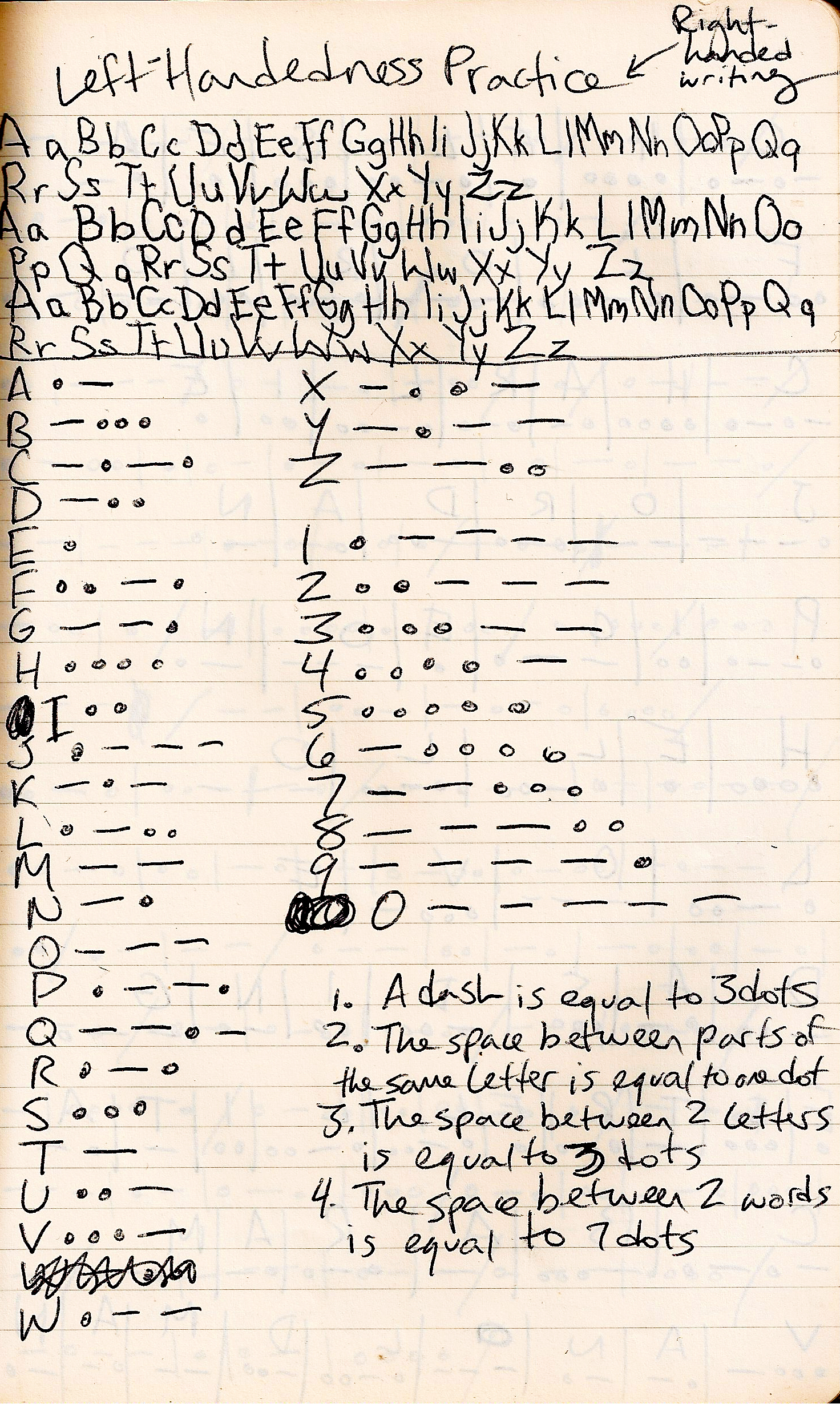
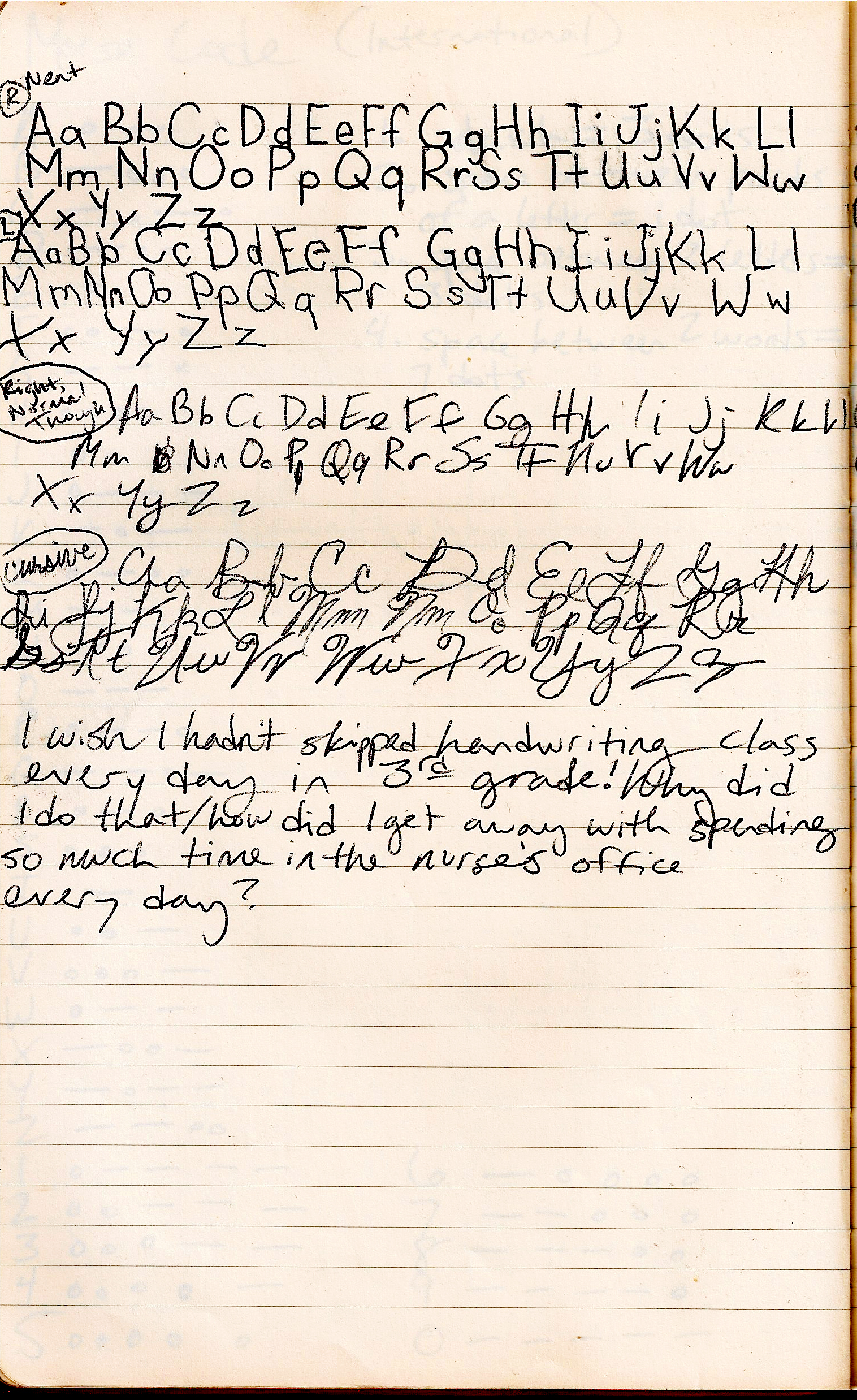
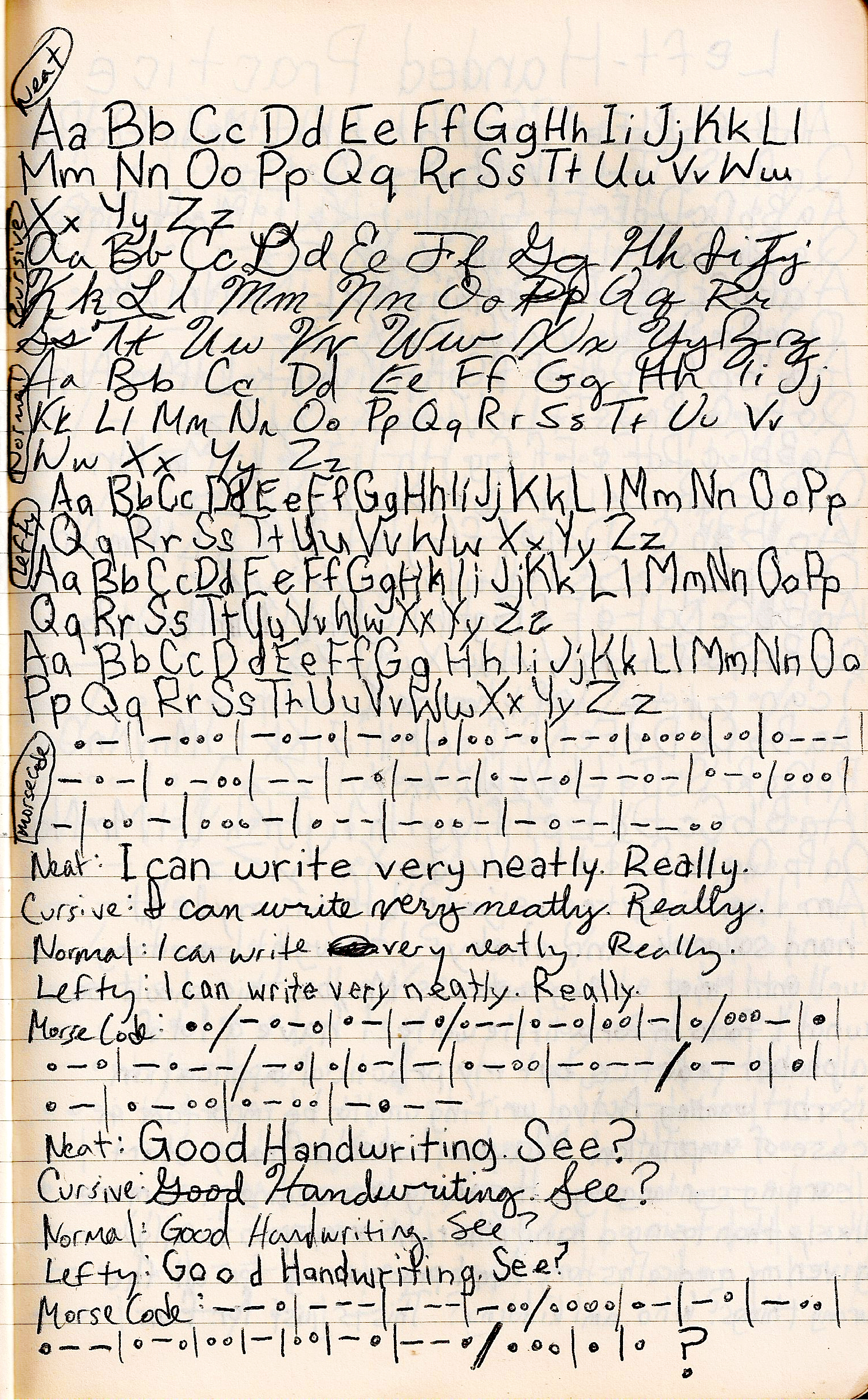
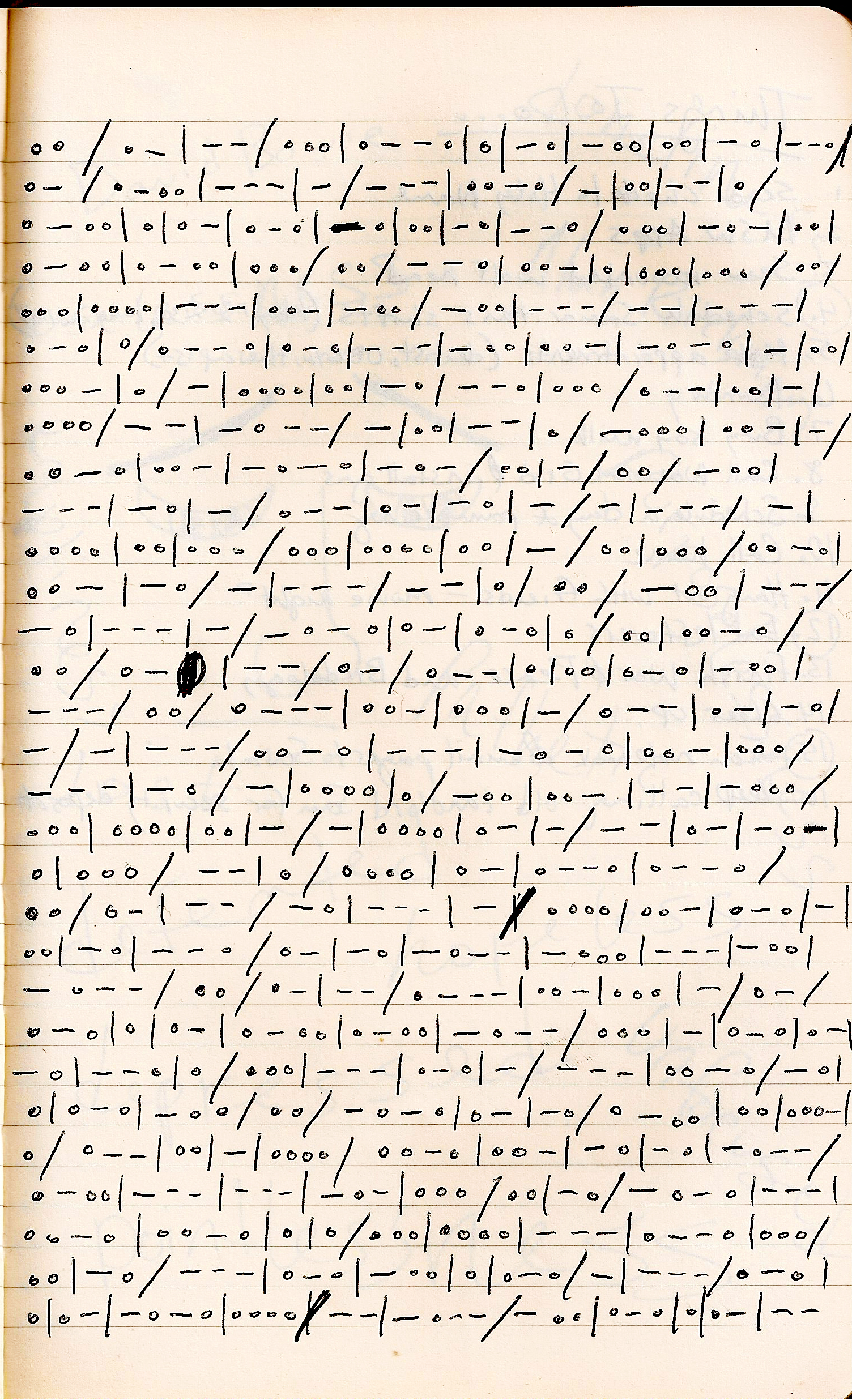
For as long as I can remember, I have loved language. Whether it's studying foreign languages (from Arabic to Elvish) or learning the rules of my native tongue (English) and playfully finding new ways to break them, I am completely enthralled with learning about the ways people communicate.
Above and below are journal entries spanning the last several years in which I played around with writing in new ways. Many of them are my attempts to learn how to write left-handed because I've always seen ambidexterity as one of the neatest skills on the planet. Interspersed are my attempts at learning Morse code, which I find to be a delightfully mysterious and pretty much forgotten form of clandestine communication. Neither of the skills I've been trying to acquire when very bored are really that practical, but it's a fun way to pass the time.

The Story Ribboned Forward, Inventing Itself • Karan Mahajan
For author Karan Mahajan, handwriting is a necessity, a fact almost. He writes every first draft by hand, and while he encourages everyone to as well, he doesn't care if you do. But we do, so read this interview and hear his fearless take on how handwriting cancels self-criticism, as well as helps you avoid getting needlessly attached to language and doubling backward into revision before a story is complete.

INTERVIEW BY DEMETRI RAFTOPOULOS
In eight sentences, Karan Mahajan had me silent. I had never read his words before, but there I was, re-reading a single paragraph over and over. It was a part of the series in Poets & Writers, where writers "recommend" a specific something. Later, I wondered how I even got there, but in the moment, I was captured by his voice, which was direct, almost demanding, but with elements of politeness and manners. A hard yet endearing shove into a specific direction: "Write first drafts by hand." He goes on:
This cancels self-criticism immediately; unless you have truly ugly, banged-up handwriting, everything you write will be visually and stylistically unified by ink. Better still, in an age of Internet-rehab apps like Freedom and SelfControl, nothing approaches the uncluttered nondigital quiet of a page. Take confidence in the fact that much of our canon was composed on paper. But mostly, when you achieve a flow, you're much less likely to break it on the page than on a screen—you'll be less tempted to double backwards into revision, checking e-mail, opening a tab. I found this to be true when I wrote the first complete draft of my second novel, The Association of Small Bombs. For years I'd been struggling to make progress, only to lapse back into revision. The minute I committed to paper, the story ribboned forward, inventing itself. I had never felt anything like it.”
This is something I have been contemplating deeply on my own. I was always a writer, but I recently began approaching projects by hand, often struggling to connect more with a blank screen than I was able to with a blank page. This past summer was the first time I ever wrote drafts by hand, let alone ever wrote in a journal. I uncovered something inside that journal that I haven't been able to express, but I see the feeling in Karan's words above. And so I set out to talk with Karan about the above, his process, the road bumps we often hit as writers, and how the handwritten words has shaped his craft.
* You can see his full bio at the bottom of this page, but Mahajan's second novel, The Association of Smalls Bombs (Vikings 2016), is forthcoming in March.

DEMETRI RAFTOPOULOS: You mention in Poets & Writers that you wrote one of your novels by hand. Do you always write first drafts by hand, or only certain kinds of things?
KARAN MAHAJAN: Increasingly, I write my first drafts of every kind of project by hand—fiction, non-fiction, reviews. Drafts are not a writing problem; they are an emotional problem. Usually, you haven’t broken through the material in the way you should have. When you type out first drafts, you get needlessly attached to the language you’ve used, and this keeps you from moving on.
Writing by hand also slows me down. I tend to write first drafts in a panic of excitement, and I’m calmed by the analogue action of handwriting.
DR: You said one reason you write first drafts by hand is specifically because it cancels self-criticism. Can you talk a little bit more about the idea of self-criticism, and how handwriting cancels that?
KM: Well, I’m experiencing this right now, as I type out the answer; my urge is to go back and correct a few words in the previous sentence. But, rather than fall into a loop of revision, I’d rather invest that energy forward.
DR: Do you think self-criticism, along with doubt and distraction, are forms of writer’s block?
KM: Yes—the main form of writer’s block. I was blocked in this way for about four years, but, because I was producing a ton of material and constantly revising—I have about 1,400 files in my “Association of Small Bombs” folder, most of them varying minutely from each other—I felt I was doing something. I wasn’t. Mailer says that writer’s block is a failure of the ego; I concur. And perfectionism can become a denial of your own humanity, of the languors, say, in a life or story.
DR: Has handwriting always been a large part of your life, or life as a writer?
KM: It hasn’t. I emigrated to the US in the Age of the Laptop. Coming to handwriting felt like a discovery—a holdover from journaling and note-taking.
DR: I'm curious about your process. At what point do you leave your drafts and begin typing? And how has your process of writing by hand -- drafts -- evolved over the years?
KM: It varies. If I feel confident that the story I’m writing is close to the final, I type it out as I go along—handwriting in the morning, typing in the afternoon. This keeps the work fresh in my memory when I attack it the next day. If I’m not yet confident the story’s going to unfurl to a conclusion, I’ll keep handwriting. If I reach some kind of end, I might type the whole thing out. But if the story dies midstream or I lose interest it’ll remain immured on paper.
DR: You mentioned that the minute you committed pen to paper in your second novel, The Association of Small Bombs, "the story ribboned forward and invented itself." What specifically came to you -- characters, plot, purpose?
KM: The plot of The Association of Small Bombs is entirely organic. I knew the downward direction the lives of the characters would take, and that Mansoor, one of the main characters, would come back from the US, but I didn’t know how any of the characters would connect, how their stories would play out in concert. It was the central challenge of writing a novel about terrorism. What do terrorists and victims really have to do with each other? The writing, which was instinctive, made these connections for me. When Ayub, my favorite character, appeared in the book, I was surprised. He allowed me to say, directly, many of the things I felt about terrorism without resorting to needless dramatization.
DR: You also said something else in Poets & Writers that stuck with me, “when you achieve a flow, you’re much less likely to break it on page than on a screen, you’ll be less tempted to double backwards into revision.” What was your revision process like then for The Association of Small Bombs. Did you find it to be easier? Less work?
KM: The key difficulty for me was to keep myself from destroying what I’d (hand)written. I tried once to rewrite the entire thing by hand, but simply didn’t have the drive or the interest; I’d said what I wanted to say. Then I tried rewriting almost every sentence on my computer. This was wasteful and idiotic, because each edit was only an elegant variation on what came before; it wasn’t improving the story or the scenes. The best editing advice I got—for the kind of writing I do—was to read it out loud. This sloughs off embarrassing and overwritten bits but doesn’t lead to a complete reworking of what you’ve offered the reader from your sub-conscious: which, in a way, is what the reader is after anyway.
DR: How did the experience of writing your second novel by hand compare to the experience of writing your first novel, Family Planning? Did you hand-write any of that novel?
KM: The storytelling in this novel is much better. Not much has been shifted around. Words and sentences remain where they first appeared in the flow of the story; the story is one giant thought. I’m proud of this. My main complaint about novels is that they lack unity; you get to the end and feel the writer forgot why he or she started. And almost no novel ends well; the project of getting to the end has defeated the novelist. Handwriting, zooming forward, allowed me to overcome this. And no, I didn’t handwrite any of Family Planning.
DR: The narrative, or at least parts, of both your novels is set in India, specifically New Delhi, where you grew up. How did your surroundings, or upbringing, impact the way in which you write? Obviously, it informed content, but what about form?
KM: It taught me to find my center, to achieve concentration, in the midst of a crowd.
DR: Do you have any handwriting rituals?
KM: I’ll sometimes warm myself up with journaling.
DR: When you look toward the future of handwriting, what do you see?
KM: A bleak future. And I’m fine with that. I’d rather keep this discovery to myself and let other writers be bewildered and broken by their fine machines.
Karan Mahajan was born in New Delhi. His second novel, The Association of Small Bombs, tells the story of two families in a world plagued by terrorism. Karan not only explores how terrorism shakes its victims, but how those responsible are affected as well. His debut novel, Family Planning, was published in nine different countries and won the Joseph Henry Jackson Award. His writing has also appeared in The New York Times, The Wall Street Journal, The New Yorker Online, Granta.com, and more. He resides in Austin, Texas, where he is currently diving into his third novel.

2 Composers Separated by 68 Years and 2 Drawings • Graydon Hanson

When 12-year old aspiring composer, Graydon, was tasked with following in the footsteps of a composer, he chose Estonian composer Arvo Part, who happened to draw significantly by hand. Above and below are two images from Graydon's presentation, illustrating his journey through the past and toward the future.

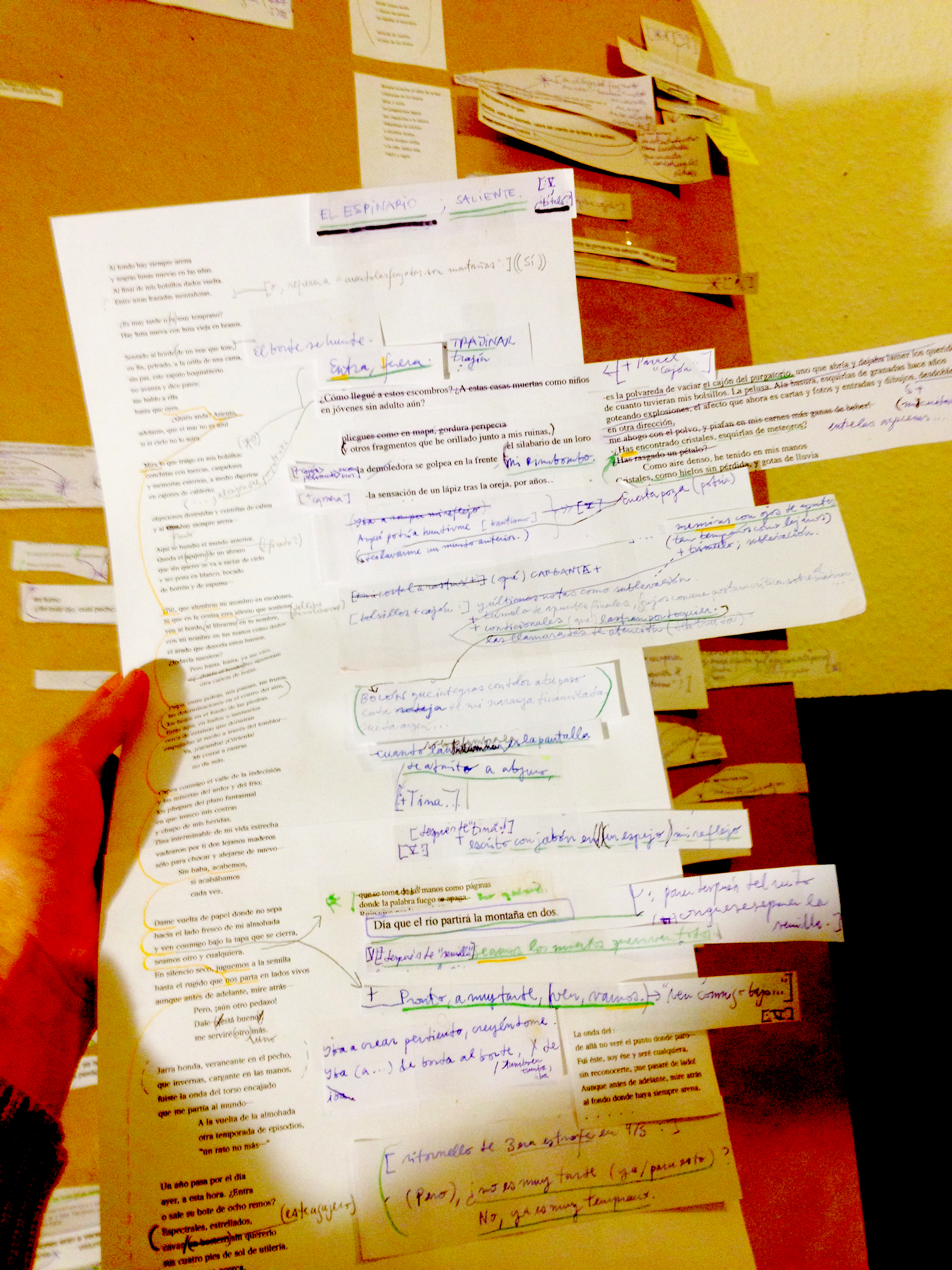
The Script Inside a Manuscript • Tomas Cohen
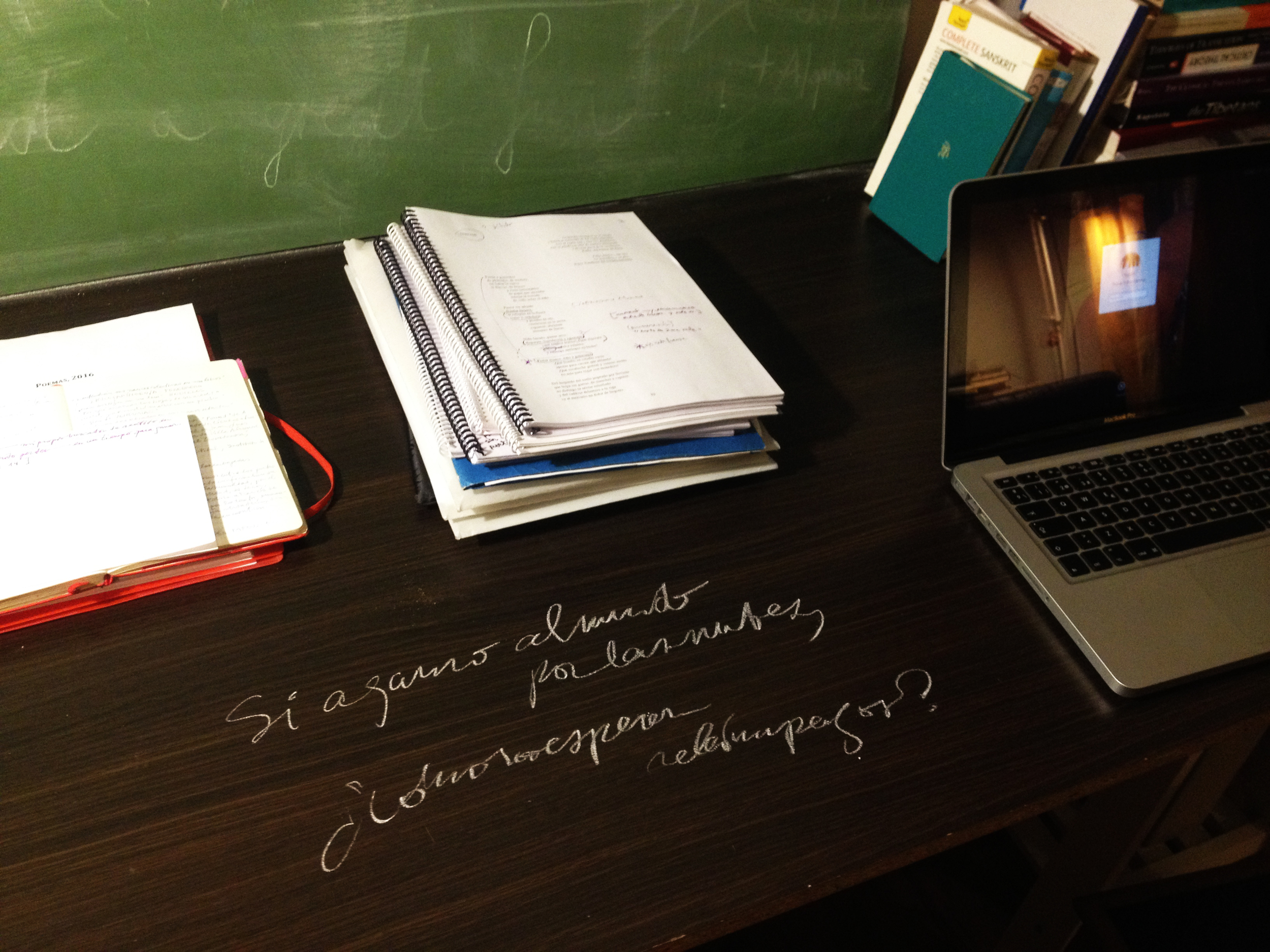
With best wishes from a Chilean poet in Berlin,
Tomas | www.tomascohen.com

The Best Work is Work You Don’t Understand Fully • A Conversation with Special Forces Medic & Poet Graham Barnhart

BY DEMETRI RAFTOPOULOS
Graham Barnhart is from Titusville, Pennsylvania, the birthplace of the oil industry. He is an 18D, Special Forces medical sergeant, and has been deployed twice: once in Iraq for nine months, and the other for seven months in Afghanistan. I didn’t know all this when I met him at Hotel El Greco in Thessaloniki. All I knew was that Graham Barnhart was a poet and my roommate for the summer. We were the only two men taking part in Writing Workshops in Greece on the island of Thassos. It being my first time living away from home and having a roommate other than my parents, there were a lot of question marks in my eyes.
The day we were to meet, I went for a long walk along the port to the White Tower and other landmarks drenched in Greek history. In between monuments, I wondered if Graham and I were searching for the same thing; if we would be capable of having a good time with a beer in one hand and a pen in the other; and if we could mix the sentimental with the comical, the work and the play. A few hours later when I returned to our hotel and skipped up the flights of stairs, I was stopped by an unfamiliar, familiar face. I wasn’t sure what Graham looked like—his Facebook profile picture was a black and white image of a random old bearded fisherman—but something told me this was him.
“You’re Graham,” I said, almost accusatory.
“That’s me,” he replied.
I would learn this to be his normal, quiet, calm exterior. I would also learn that he wildly records his surroundings, almost instantly rendering them into lines of expression. One of our first nights, we sat in the restaurant beneath our rooms, watching locals throw napkins over the others dancing to the live music. When Graham asked why they did this, I told him it was a sign of respect, to the musicians and to the dancers. During the first student reading, Graham read a poem about his time in the military and in Greece that centered around the image of the napkins.. He had this uncanny ability to live in the moment, to inhale all that was around him and let it all sink onto a page, and a poem, as he exhaled.
Throughout our time together, I learned something else about Graham — he handwrites wherever he goes. This makes sense, as he is always on the move in the military, but I wondered how he balances the two worlds — the military and literary. We caught up recently and talked about this: his time overseas, balancing the military world and the literary world, and his thoughts on the handwritten word.

DEMETRI RAFTOPOULOS: In Thassos, you carried around your notebook everywhere, especially on our excursions to other towns. What kinds of things were you writing?
GRAHAM BARNHART: I write down a mixture of notes and poems, usually more notes and lines than full ideas for a piece. I try to pursue an idea as far as I can in that first jotting, to get everything out as it occurs to me. I try not to list off ideas for what the poem will be about. That feels like a shying away from the sometimes (often) daunting moment of inspiration. That moment when you can feel but not yet articulate all the potential of the idea that has struck you. It’s too easy to try to categorize or outline that idea than put it aside. That avoids all the hard work and limits the creative potential to what you already understand or can conceive of.
The best work is work you don’t understand fully until you’ve written it. It’s better for me to have the image or handful of lines so that I can come back to them, hopefully experiencing again whatever it was that made me want to write them in the first place. A good idea or plan for a poem can sometimes turn into a trap.
RAFTOPOULOS: Yeah, I don’t think I ever fully follow through with an “idea” the way I thought I would when it first hits me. Always lands on the page differently than it does in my head. What’s your process like?
BARNHART: I tend to start by hand though I don’t usually think of my handwritten work as a first draft until it hits a computer. On paper I might complete a poem but keep marking it up, fussing with it really, until I get motivated enough to actually type it up. That’s when I know I have a draft rising up out of all the daily notes and scribbles that I really want to pursue.
Handwritten work feels more in-progress to me, like I haven’t quite found the right configuration of ideas and images to call it a poem. Once those components are present I do most of the finer tuning on a screen. That’s when I start thinking about outlining or diagraming the piece and when I add notes for further revision. The handwritten phase is not always a requirement, but it serves as a permanent record and a well of all the ideas and lines that might otherwise be forgotten. I love to flip through my current and older notebooks as a way to warm up to writing. I don’t always ending up working on the piece I sat down to revise but something usually happens. That’s all I can ask for sometimes.
RAFTOPOULOS: Absolutely. Do you always use the same notebook, or do you have different ones for different purposes?
BARNHART: I’ve always kept some sort of a notebook, though kept might mean that it sat in my room or desk for weeks without being used. I have a bad habit of writing down ideas in whatever paper is handy rather than using my designated writing notebooks. So I end up with notes and drafts scattered through everything else.
Having a pen and paper handy is a big deal in the military. There is always information being put out, whether it’s the time of the next formation, how many rounds of ammunition you’re drawing for the range, or a casualty description for a medevac request. It’s considered unprofessional to show up for a briefing or class without something to write with and on. That comes in handy when trying to take poetry notes. No one really questions what I’m doing. Not that writing poetry would be a problem, but explaining my writing to a soldier would be about as long and complicated a conversation as explaining what I do in the military to a civilian. It’s just easier most days for everyone to think I’m noting the effect range of a 60mm mortar.
RAFTOPOULOS: And one notebook specifically that you described to me as a “writeintherain” notebook.
BARNHART: Yes. Recently — the last 15 years maybe — little flipbooks kept in zip lock bags have been replaced with waterproof notebooks made by a company called “Rite in the Rain.” They have thick, waxy pages and only work with regular, old ballpoint pens, rather than the fine tip pilot pens I really like. In fact the notebooks even come with an “all weather pen” which is just a short, steel ballpoint.
RAFTOPOULOS: How about your handwriting — does it change from notebook to notebook? I imagine writing in the rain could “weather” your penmanship.
BARNHART: I don’t make the handwriting look different on purpose, but because of the materials used it just does. It actually feels harder to write on the all weather paper, kind of like the notebook is resisting anything not specifically military. Though of course it’s also a pain to write military stuff. That material tends to be short notes and lists rather than lines and stanzas.
I mentioned not being very good at keeping my writing consolidated. So on top of half filled moleskins lying around I also have a bunch of waterproof notebooks filled with operation orders, mortar targeting grids and the occasional poetry stanza. I don’t try to keep these things separate in the notebooks though. I like the juxtaposition.
RAFTOPOULOS: You have experience teaching and I know you want to teach in the future. Do you think you’ll assign writing prompts in class, just so your students are forced to write by hand as you sometimes are?
BARNHART: I think in class writing prompts are fantastic, especially when they’re handwritten. That format forces a sense of urgency but also of care. You have to physically create each letter, but you may only have 5 minutes, or 10. For me this frees me from my normal analytical and self-editing process. I just get something out there that follows whatever external guidelines the prompt demands. Some people don’t like prompts feeling they stifle their own creative process. I rather think that prompts free your creative process from you, if you are diligent and faithful to the restrictions. So in short, yes, I will absolutely assign handwritten prompts.
RAFTOPOULOS: How did you decide on pursuing an MFA?
BARNHART: I decided on the MFA in undergrad and actually started the application process before I decided to enlist. It seemed like the best way to pursue a writing career and avoid student loans for as long as possible. I knew I wanted to write and didn't much care what sort of real life job I ended up with so an MFA seemed like the right way to go.
RAFTOPOULOS: What was it like writing or attempting to write in places like Iraq and Afghanistan?
BARNHART: I wrote very little digitally during deployments. In fact I didn’t write much at all. I took sporadic handwritten notes when an image caught my attention, sometimes even a full poem but I didn’t spend much time actually working. I regret that now of course, I wish I had at least kept better daily logs.
On both trips I did have my own room with a desk, a bed and some books. I wouldn’t take my laptop out on patrols or missions of course but it was around. I always had a notebook in my pocket though. Actually it was in a pouch on my body armor. I kept pen and paper, some caffeine pills and a little iPod shuffle that was plugged into my ballistic hearing protection. The pouch was intended to hold shotgun shells so it had little elastic loops sewn all over the inside.
RAFTOPOULOS: How were you able to balance both of these worlds — military and literary?
BARNHART: Most days if I ended up with some notes or lines, I felt like that was a success. It was a sufficient sign that I hadn’t given up or lost writing which was a big concern for me post undergrad. I went from learning to write in an environment structured to support that to one structured to support a very different goal. I was also learning and studying in the military, but of course none of it was directly poetry related. It helped to think of it, especially the miserable stuff, as material.
RAFTOPOULOS: Were you ever worried that you would stop writing completely?
BARNHART: There was a point during the medical training when I actually thought I would. That course was intensive. We did physical training from 6:30-8:00, and then we were in class from 9:00-5:00. Afterwards, we spent three to four hours studying. There were written and practical tests every week. Learning that much medicine that fast pushed everything else out of my head. I completely forgot all of the Arabic I had spent the last six month learning. I didn’t feel like I had the capacity for any other kind of thinking.
RAFTOPOULOS: I can imagine. I’m happy you haven’t stopped writing. How much of your poetry is inspired by your time overseas?
BARNHART: Much of my writing is loosely inspired by my deployments, mainly Afghanistan because it was more combat-oriented and also more recent. Many of my poems are set there, though I prefer to rely on an ambiguity that implies the setting alludes to it. I think of the war and my military time in general as a useful context for exploring ideas in poetry but I don’t think many of them as “about” the war, or at least, the ones I find more interesting to write are not.
Then again, my time in the military is relatively short compared to most of the guys I worked with. Some of them have been to Afghanistan more than ten times, though some of those trips were as contractors. I’m hesitant to talk about what the war is like because I only know about my brief experience, leaving out the long history of this conflict, not to mention that largely silent or unheard voices of the people who actually live there. I never want to say this is what Afghanistan is like. I can only say this is what I saw in Afghanistan while I was there as an American soldier.

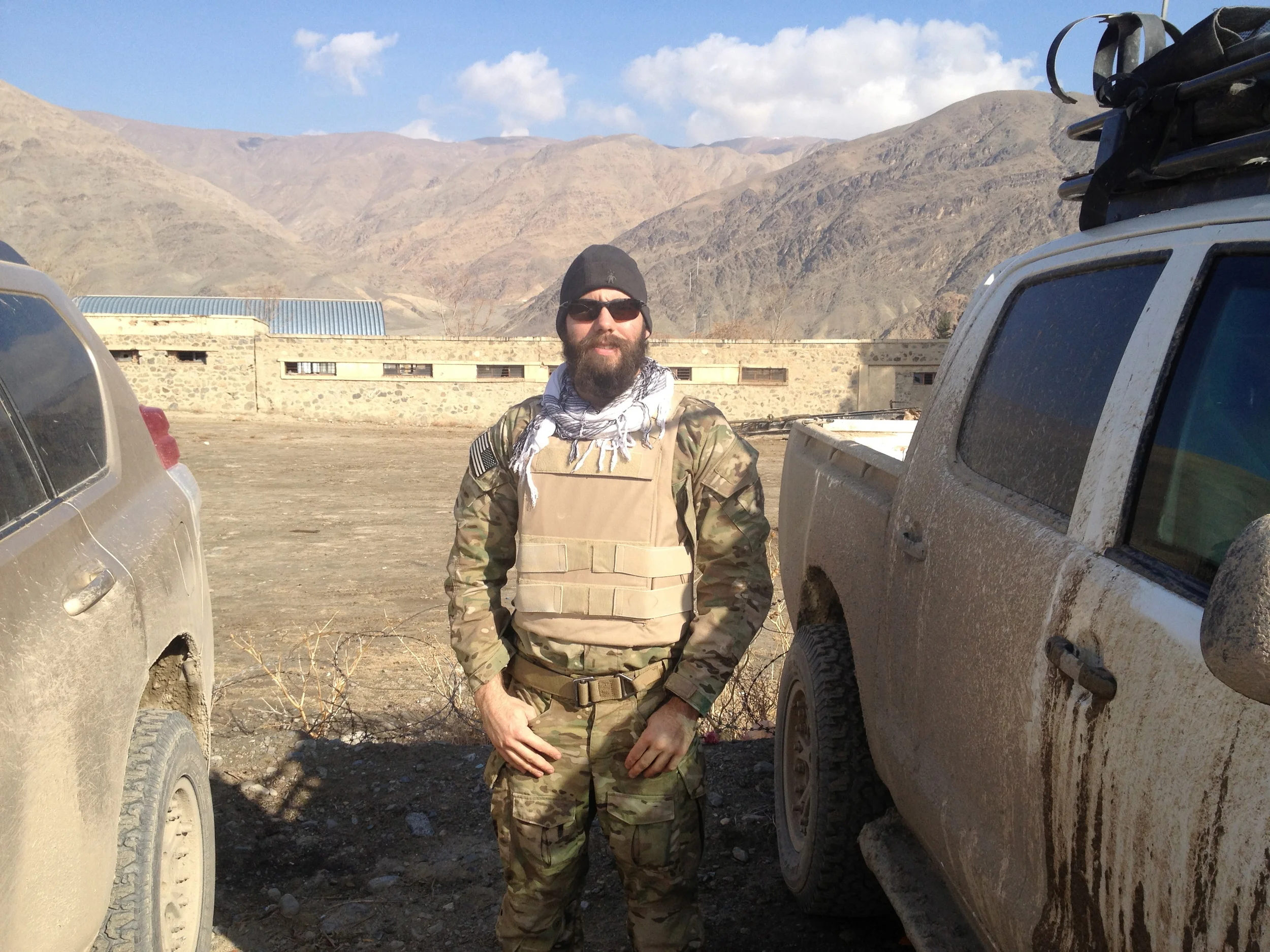
Graham Barnhart is an 18D, Special Forces medical sergeant, and is an MFA in Creative Writing candidate at The Ohio State University. His writing has appeared in the Beloit Poetry Journal, the Sycamore Review where he was a finalist for their 2014 Wabash prize, Subtropics, The Gettysburg Review, and Sewanee Review. He is also a finalist for the Indiana Review's poetry prize and the Iowa Review's Jeff Scharlett Memorial award for veterans. And is hoping to be back in Greece next summer so Demetri can continue drinking tsipouro with him and translating Greek for him.
The Best Investment of Time and Money • A Conversation with Calligrapher Kathy Orf

BY SARAH MADGES
Kathy Orf is a calligrapher living and creating in St. Louis, MO. She has been practicing a “morning writing” ritual in which she sits down and draws in calligraphy without any prior planning for just a few minutes each day, a 365 project that allows her to continually approach her work in fresh ways. I had the chance to talk to her about what exactly calligraphy is, how it relates to handwriting, and how she became so invested in the art.

SARAH MADGES: How and when did you first become interested in calligraphy? How did you come to make a career out of it?
KATHY ORF: I had a “decorative arts” class in high school that included calligraphy and — I’m really dating myself here — macramé! Then in college, I majored in graphic design and had a whole semester of calligraphy, which was really rare. After graduation, I worked in graphic design until my second son (Alex) was born and then decided I should stay home and do calligraphy part time. I had started trying to sell my work at arts and crafts shows just 3 months after my first son was born and thought I would continue that. I’m not sure I would call it a “career,” maybe more of a passion or a creative outlet…It is really hard to support yourself doing calligraphy and luckily I never had to. That said, I’ve been doing calligraphy for 30 years.
MADGES: When people hear the word calligraphy, they tend to think “beautifully ornate handwriting” or “wedding invitations.” How do you characterize calligraphy — is it an art form, a process of symbol arrangement, pimped-out handwriting? What are calligraphy’s essential elements? What makes it different from handwriting?
ORF: I think calligraphy can be different things depending on how it is used. It can definitely be an art form…something which has been a struggle to achieve in other’s eyes. But it can be very utilitarian when it is used to address envelopes or fill in names on pre-printed certificates. I do not consider calligraphy to be hand-writing in any sense of the word. It takes years of practice and good instruction and some talent to reach a certain skill level. Calligraphy is not fast in learning it or its execution. The letters may look like they’ve been written quickly, but many times it is more deliberate than you might think. And the funny thing is, one important part of hand-lettering is consistency, but whenever I look at printed lettering, I look to see if the letters are identical to determine whether it is hand-done or a typeface. So, even though you strive for consistency, you also want it to look organic, like it came from someone’s hand and not a machine.


MADGES: Does your handwriting resemble your calligraphy? Have you always had good handwriting?
ORF: My handwriting is the worst…just ask my husband. But I think it is because I am always in a hurry when I am writing something and using a ballpoint pen. Put a calligraphy nib in my hand and it’s a different story. It’s almost like my hand knows what to do at that point.
MADGES: Do you have one main mode of calligraphy, or are you always inventing and adapting the letters and symbols to their specific purpose and environment?
ORF: I know many different hands…italic, uncial, blackletter, foundational, romans, copperplate…and variations of them all. But I tend to get in ruts and use the same personalized style all of the time. I guess you could call this style my “calligraphic handwriting” because that is what I use to write with most of the time. My tool of choice to create this lettering is a pointed pen…Brause EF66. It is very flexible and can be used to write very tiny or even letters up to an inch tall. Every morning, I pick up my Brause, a piece of paper that I had already painted and just write a saying using this “handwriting,” although it does not resemble my actual handwriting at all. But, when I sit down to do a finished piece, I might think more about what I want it to look like, and what style I should use, and even use a chiseled nib, like a Mitchell.
MADGES: What are your most common assignments — and what kind of clients do you attract? How long do you spend working on individual pieces?
ORF: Most of my work of late is just doing sayings for friends. I don’t advertise, except through word of mouth. I have some certificate work for Washington University in the spring and fall, and will do a wedding or two a year, but usually just for friends, as I’ve never really enjoyed the rote nature of the work. I also create pieces to sell at fairs using my photographs of things that look like letters that I combine with my calligraphy. I can usually do a simple lettering job in a couple of hours. If I am creating a background and lettering a larger piece, it takes maybe 6 to 8 hours — it really depends on so many variables.
MADGES: What do you think about the diminishment of handwriting and cursive lessons in U.S. schools? Have you noticed any change in the demand for and reception of calligraphy as handwriting diminishes in use and popularity?
ORF: I think it is terrible that they are trying to stop teaching handwriting in schools. I think it is one of those things that they will later decide was detrimental to cognitive development. I’m not sure diminished use of handwriting has affected the popularity of calligraphy as much as the increase in fonts that look like it!
MADGES: What are some of your favorite examples of calligraphy in general — historical, global, etc.?
ORF: I just went to see the Book of Kells this summer at Trinity College in Dublin and it was amazing. I also love the work that Donald Jackson did on the St. John’s Bible that he just completed a couple of years ago for St. John’s Abbey and University in Minnesota. But I am mostly drawn to and excited by contemporary calligraphy.
MADGES: Why do people respond to it? Do you think there will always be a demand or desire for calligraphy?
ORF: I think people respond to calligraphic work because it so often interprets words in a way that touches them. Sometimes it’s because it is something they “wouldn’t have the patience for” — I hear this very often. And sometimes just because it is beautiful! I think there will always be a desire to do calligraphy as art, maybe not as much of a demand for invitations and such, although the whole retro movement may help, like it has for letterpress printing! But to survive, I think it will have to grow more into the realm of art and it has been doing that for a while now.
MADGES: Any advice for calligraphy enthusiasts out there?
ORF: Join your local calligraphy guild. Learn from good teachers and don’t just take a class and never do it again…practice or do homework if it is assigned. The best thing I ever did was to take a year-long class taught by a calligrapher named Reggie Ezell. He travels to four different cities for one weekend of every month of the year teaching almost everything you need to know. The great thing is that there was homework each month, and I DID THE HOMEWORK…and that made all of the difference! Unfortunately, Reggie is retiring after next year. But that was the best investment of time and money I ever spent.

Education Means to Me The Most Powerful Weapon • Rafeha Oyamuddin
* For information about this project, see our note at the bottom of the page *


Hello everyone!
I am a student in 12th grade at ZEC. I want to go to college because I make friends last year when I heard about college I started to dream about going to college. Education means to me the most powerful weapon wich we can use to change the world. With college degree I will always be marketable. By getting education I will have less problems and able to solve them. I teach other girls in my village. When I daughter I wish her to be educated like me and have a bright futur. Because if there is no struggle there is no progress. My greatest wishes to become a doctor and help my family and people. Thanks
Best wishes,
Rafeha Ogamuddin


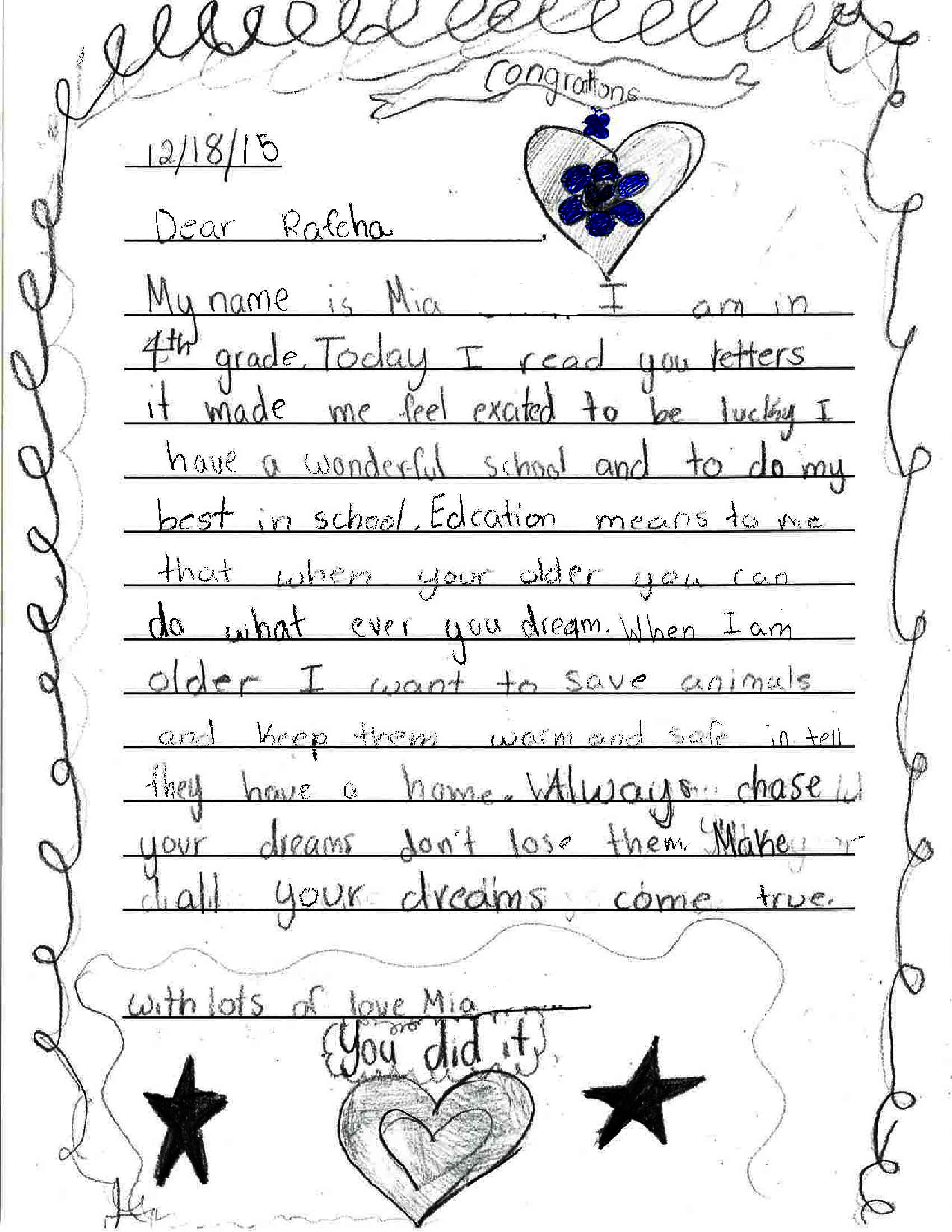


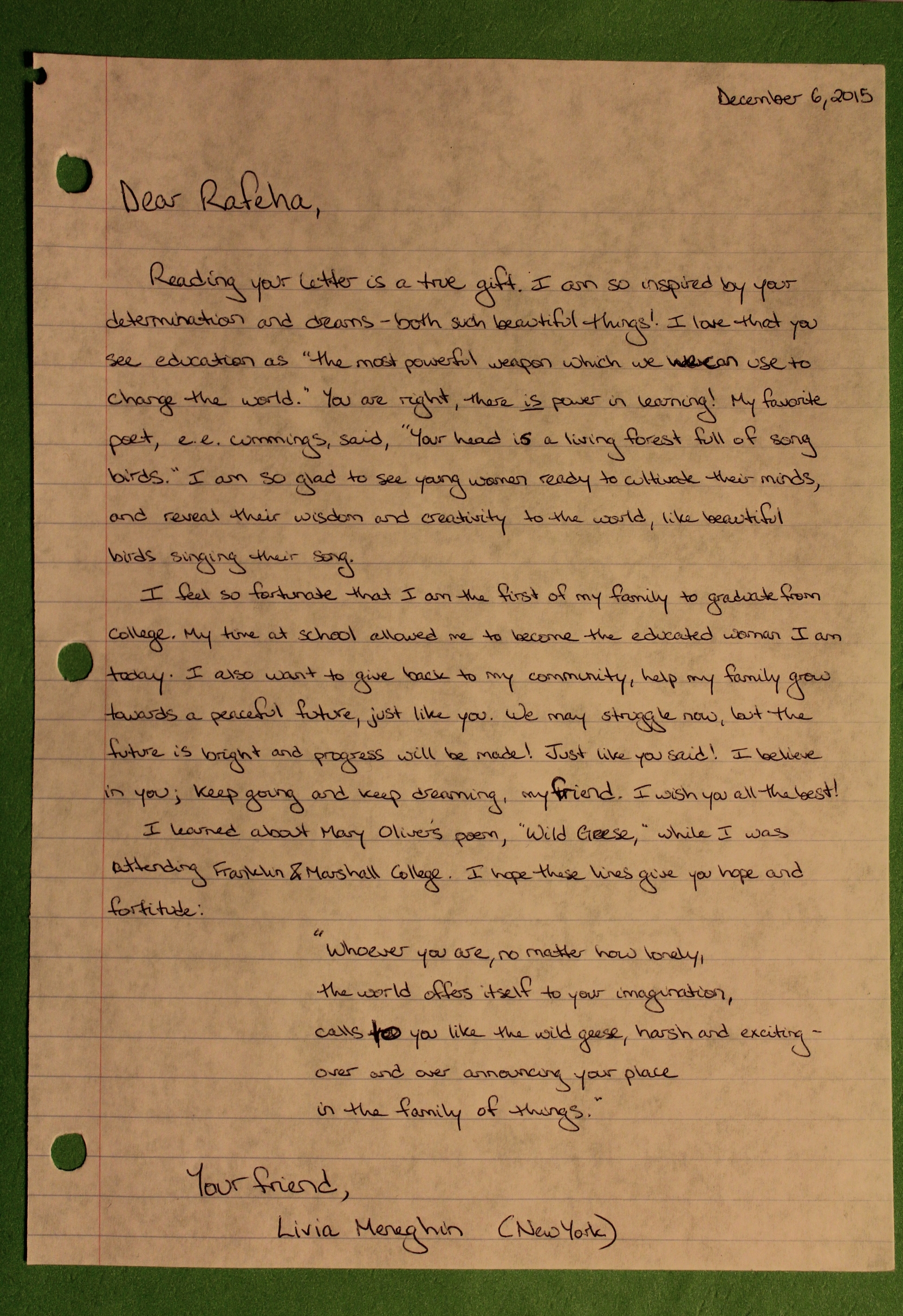

A Note from Handwritten (December 6, 2016): This comes from our exhibit, When I Know The Value of Knowledge, I Start To Dream. We brought the story and letters of seven students from Deh'Subz, Afghanistan into 4th grade classrooms in Brooklyn, because that is when the girls first started school. When they became the first to graduate from high school, they had no college to go to, so they hand-wrote personal statements to a school that didn't exist. Yet. Their letters created an impact campaign that raised $150,000, enough to build the first-ever free private college for women. When we told our 4th grade students about this story, the above, heart-melting letters were their replies.
It Starts to Look Like a Timeline, Not a Journal • A Conversation with Angela Flournoy

BY SARAH MADGES
Angela Flournoy and her debut novel, The Turner House, are igniting the literary scene with their unassuming eloquence and nuanced commentary on the deleterious effects of the 2008 housing bubble and the black American diaspora, whose interrelated history subsumes the 13 members of the Turner family as they navigate a crumbling Detroit.
Garnering significant attention and accolades for a debut novelist, Flournoy is a finalist for the National Book Awards in Fiction, and was named a “5 under 35” writer, designations that left Flournoy nearly tweetless, only able to write “whaaaat” in response. Despite this rapid success, when we saw her during an intimate conversation hosted by CLMP at the New School, there was an easygoing magnetism to her speech, posture, and perspective. Although Flournoy is the first to admit her excitement for the book’s positive reception, watching her speak, it seemed clear that we are in the presence of a person who has remained rooted at the center of the spinning wheel.
So when we found out that Flournoy wrote the entire first draft of The Turner House by hand, we went wild with theories — perhaps the handwritten word explains why she is so grounded, or has enabled her to access memories of her father’s Detroit childhood, etc. Thankfully, Sarah Madges from Handwritten spoke with Angela about writing The Turner House by hand, thereby recusing us of the need to go on any longer. We wish Angela the very best this week, and hope everyone who reads this here will read her book, and then handwrite their own.

SARAH MADGES: So I wanted to talk to you about your process, how handwriting figures into it, and how you came to incorporate it into your process:
ANGELA FLOURNOY: Handwriting has always been a part of my process. I got my first journal when I was eight years old — I don’t have them with me or I’d check, they are at my mother’s house. I’ve always worked out ideas or feelings through handwriting.
For most of my academic life I was writing papers on the computer and generally typing things, and it didn’t seem like the most natural way to work on something that was not like a term paper. When I was first writing short stories in undergrad most were written on a computer first, but when I got to Iowa, one thing that was an issue for me was procrastination. I didn’t have the smartest of phones, I was always a couple generations behind — now that’s an issue — but I figured if I left the house I’d focus more. So I would sit in the coffee shop and sit on my laptop hanging around on the Internet instead of writing, even after downloading Self Control, because you could still override it.
So I returned to handwriting to focus — there were not as many distractions. Especially when you’re working on something historical, you want to look everything up on Google, which is useful in revision, but it gets in the way of writing when you stop and end up in a Wikipedia rabbit hole. Writing longhand made me focus, and slow down.
MADGES: Has your writing always been historical in the way The Turner House is, or written about, for example, a city you never lived in, but know about?
FLOURNOY: History is always a part of the way that I envision stories. This novel, especially, but I had written 70 pages of another novel based in a city I never lived in and it was a similar process.
MADGES: How would you get yourself to push through the writing instead of succumbing to the kneejerk reaction to look things up — would you leave notes like “look up later” and just keep going?
FLOURNOY: Well I would put an asterisk next to what I wasn’t sure was right. The thing about literary fiction is that it’s not one of those things — I’m not writing a civil war period piece that heavily relies on research and that people are so into it and will feel betrayed if they feel it’s inaccurately portrayed, like, “That’s not what happened at Gettysburg!” That’s not the burden of the kind of fiction I write. You just need to have a foundation with reality. I would just write in the margin: Look this up!
MADGES: You said you started writing in a journal when you were around eight years old. Did someone encourage you to do that, or did you sort of come to that naturally?
FLOURNOY: Well, it was a Christmas present from an aunt of mine and so then it was just, there. And I’ve always been a person who, as soon as I learned how to read, read a lot, so it was like of course I would do this thing. No one was telling me I have to do it, and there wasn’t much else to do. Now, we live in a time of distraction, so it might be different. People talk about wanting to pick it up as a practice.
MADGES: Did you always prefer to write by hand? Have you found greater success this way, or did you notice yourself writing/editing differently with a word processor?
FLOURNOY: I feel like I’m a lot less apt to take risks when I’m typing out a story because it’s so easy to delete things; whereas, when you’re writing by hand you have to get to a certain critical mass before you “x” something out. It’s too easy to reread every sentence, go backwards rather than forward.
The editing process should be the editing process. You handicap yourself when you keep cutting down your own ideas. One on its own might not be great, but they might all make sense in concert with themselves. When there’s that blinking cursor encouraging you to cut them down, you might lose what the idea was really supposed to be.
MADGES: Right! And once you delete them there’s no evidence of those ideas, at least in a notebook you can usually still read the words you crossed out. So how does handwriting figure into your writing process? What role did it play in writing the Turner House?
FLOURNOY: One benefit of writing longhand, I’m more gentle with myself on first drafts. It hurts to scratch out all the pages you wrote in the day.
I usually write the first draft longhand with notes in the margins and sometimes rudimentary edits as they fit on the page. For this novel, I wrote maybe a couple chapters at a time, then I would go and type them into this master novel document. That’s already two editing processes: on the page in the margins, and then of course I’m not going to transcribe something that is terrible, so again when I type. And because I’m not rereading everything in the document, that document lives separately, it ends up getting sort of built up and I’m able to look at what’s there, what’s working and what’s not, and change it later. It allows me to have a base, and provides some time between writing something and wanting to jump into revising it and moving, structurally, whole chapters around. Once I finished a notebook I would assess: where are we actually in the larger narrative? Some of the notebooks are half writing prose, half notes. It took about seven college ruled Moleskine notebooks.
MADGES: How long would it take you? Did you find yourself having to stop because you couldn’t physically write anymore, or…?
FLOURNOY: No, I’m not a fast writer. On some days, it might have been more staring and thinking and I maybe only wrote five actual pages in my notebook. On other days, I could very easily look up and there’d be 15 pages in front of me. And even though handwriting is larger, those 15 pages would end up being 20 pages because I would think of things to add or subtract when transcribing. I don’t really remember my hand cramping. I wish I was one of those people who could really get a lot out of writing for three hours every day. For me, I have “writing seasons” and I have “thinking about writing seasons,” and when I am in the writing season, I just hunker down. I wake up early. If I don’t have a block of four hours, I feel like the time is already gone. I am not a fast writer. I was working at a D.C. public library, and I would have a shift from 5-9pm. So I would get to the coffee shop at noon and I would try to finish, or start a chapter.
MADGES: Do you keep a journal, or carry a notebook and pen around with you?
FLOURNOY: I have a journal but I don’t write in it much. When I was writing short stories, I would sometimes journal, but when I was writing this novel, I think the last thing I wanted to do was pick up another book and write in that book, too. I have slowed down journaling for myself. Now, I use it more for marking moments, or milestones.
MADGES: How do you feel about the fact that cursive is no longer required teaching in U.S. elementary schools?
FLOURNOY: I am terrible at cursive — I have terrible handwriting — but I can read cursive. But say, how can you even read archival documents if you can’t read cursive? You have to trust someone else’s transcription of it. It’s as if you’ve lost a language if you can’t read it for yourself and that is dangerous because people can say that any document says anything. It’s bad enough I only know one language fluently — I can at least read and write in Spanish — but it’s bad enough that most people in the U.S. don’t even have reading proficiency in a second language. But to not even have that proficiency in the language you were raised with? We’re not even going to be a monolingual culture anymore — we’re going to be whatever half of monolingual is.
MADGES: Well, you had a very successful debut! How do you feel about being shortlisted for the National Book Award? Were you surprised?
FLOURNOY: Yes, I was surprised. A sort of big moment for me was being on the long list, because who thinks that’s going to happen? I was in my apartment and I had sorted out my clothes and was going to take them to the laundromat and my phone started vibrating. This is stuff your younger writer self doesn’t dare fantasize about. I never really fantasized about publishing my book in general. It’s been great — it’s opened up all these different opportunities. I’m going to be teaching at The New School in the spring, which is exciting.
MADGES: Did you write about that in your journal?
FLOURNOY: [laughs] Yes, the last thing I wrote was in, like, August, and then: “I got on the shortlist!” It starts to look like a timeline, not a journal. Baby steps. I’ll get there.


From her site: ANGELA FLOURNOY is the author of The Turner House, which is a finalist for the National Book Award and the Center for Fiction First Novel Prize, a Summer 2015 Barnes & Noble Discover Great New Writers selection, and a New York Times Sunday Book Review Editors' Choice. She is a National Book Foundation "5 Under 35" Honoree for 2015. Her fiction has appeared in The Paris Review, and she has written for The New York Times, The New Republic and The Los Angeles Times.
A graduate of the Iowa Writers' Workshop, Flournoy received her undergraduate degree from the University of Southern California. She has taught at the University of Iowa and The Writer's Foundry at St. Joseph's College in Brooklyn. She is joining the faculty at Southern New Hampshire University's low-residency MFA program in Spring 2016.
It's So Un-Special, It's Special • A Conversation with the Bill Keaggy on Artfulness, Sloppiness, and Interestingness

St. Louis-based Bill Keaggy is king of “generating content.” A wildly prolific artist and collector, he was an erstwhile magazine designer and photo editor at the St. Louis Dispatch before launching his self-proclaimed purposeless website of “visual indiscretions,” the eponymous www.keaggy.com.
His goal is to make things interesting by helping people appreciate what’s right in front of them—which he more than accomplished with projects such as Milk Eggs Vodka, a tome of anonymous and abandoned grocery lists he first uploaded to his site as a simple photo collection entitled “Grocery Lists,” before piquing a publisher’s interest and organizing them into snarky categories such as “Eating Wrong,” or “Bad Spellrs.”
By compiling such miscellaneous marginalia, Keaggy imbues the ephemeral both with an otherwise lost fixity, and a sort of imaginative narrative history. As he put it, “I considered my work to be ‘art’ in the lowercase form of the term. It’s so un-special, it’s special.” These special un-special projects have been featured in places like the New York Times, The L.A. Times, Chicago Tribune, The Guardian, HOW Magazine, and even Jimmy Kimmel Live. Should you want a more concise and chronologically organized autobiography, his documentary impulse has produced a timeline of his entire life, including everything from his first sip of PBR in 1972 to his NY Times Magazine interview in 2004, here: http://keaggy.com/about-me/.

SARAH MADGES: Have you always been a collector, of marginalia or otherwise?
BILL KEAGGY: I think so. Not in a hoarder kind of way, but yes, I think I’ve always had an interest in collections of things. When I was 10 or so I had a pretty big key chain collection, although now I’m not sure why, but I soon realized that it was far more interesting to collect things that were never meant to be collected. Things that other people had lost interest in or saw as useless.
MADGES: This project must have required incredible patience and dedication. At any point did you consider quitting? What convinced you to keep going, and to eventually get the collection published in a book?
KEAGGY: The grocery list collection started small and stayed small for a very long time. But I never approached it in a “Must. Add. Lists. Every. Day!” kind of way. I’m not naturally a patient person, but in this case I just let it grow naturally, adding a list every few weeks or so. Then around 2000 I put it online, and back then being a novelty online actually was novel, so it got linked around a lot and people started to ask how they could contribute. Since then, the collection has been fueled 99% by friends and strangers sending me lists. It sort of has a life of its own now and I update the site a few times a year at most. So, no, I never considered quitting because it was difficult. The collection has grown big in the same way people grow old — suddenly you’re not young anymore and you look back and wonder how the hell that happened.
I’d thought about how I might turn it into a book but never acted on it. The truth is that I had the luxury of the publisher contacting me to see if I wanted to make a book. Of course I did. It was a good way to breathe new life into the project, to think about the collection in a different way and give it depth, and help other people think about the lists in different ways.


MADGES: In an increasingly tech- and text-based world, handwriting has lost some of its former relevance and ubiquity — cursive is no longer even required in U.S. school curricula, and thousands of people have never written or received a letter in their entire life. How important is the handwritten aspect of these grocery lists to you? Do you still write by hand?
KEAGGY: The handwritten lists usually are the best — they have more character, personality, quirks, artfulness, sloppiness, and interestingness to them. Not just because of the handwriting but also because of the writing material — you can’t run weird, repurposed scraps of paper or cardboard or magazine through a printer but you can tear a piece off of something and write on it. And I’m a designer so I have this innate interest in letterforms and layout and organization, and everyone brings their own approach to these things in handwritten lists.
That said, I obviously get more and more typed lists now, but fewer lists overall because so many people do keep their lists on their phones. I do, because like everyone else I always have my phone with me. I only occasionally write a grocery list out by hand but the truth is I don’t feel too nostalgic over this change. I still do a lot of writing, sketching, and designing on paper, so it’s still part of my daily life.
MADGES: Many people, editorial reviewers and regular folks (ie, Amazon.com customers) alike, have commented on Milk Egg Vodka's humor, which comes in part from the original content of the various grocery lists collected, but mostly from your insightful and playfully snarky commentary. There's also the obvious fact that the Library of Congress designated it as a "Humor" book. When you started collecting these lists, were you mostly compelled by the comic opportunities they provided? Or was it more about the voyeuristic element of finding discarded personal notes, the various examples of penmanship and spelling, their value as art objects, something you couldn't quite name? A more concise question: was humor the intended goal, or a natural and happy accident?
KEAGGY: Yes, the funny lists were what made the collection really interesting to me, and I think to most people. Aside from the fact that they’re an anonymous, unguarded peek into other people’s lives, and, truthfully, are mostly normal and boring, it was when you’d find that needle in the haystack — that weird, WTF list with odd combinations of items or really poor spelling or funny notes. It was those moments that made the project worthwhile and I realized early on that I should highlight them for people, so I made Top 10 lists, which became the backbone of the book. Finding funny lists wasn’t the original goal — I just thought it was interesting to pick up something someone else had thrown away — but the humor aspect was a funny bonus that only became apparent after sticking at it for a while. I don’t know which of the lists was the very first one I found, but I do know it wasn’t funny. It was typical.
The funny ones are few and far between, but do make it all worthwhile are are probably the main reason people find the collection weird and interesting.


MADGES: Separate, but related question: how do you characterize your work? What are you hoping people will notice or take away from it?
KEAGGY: I don’t think I have a good answer to this question. I very purposely don’t tell people how to feel or what they should get out of looking at my various projects. I might explain how *I* feel about them, or why I did something, but I just put things out there and hope that they take *anything* away from it. I want their reactions to be legitimate and pure, whether it’s “Wow, I never thought about waste that way” or “This guy is an idiot." Telling people how to feel about these projects and art in general is like saying, “Get it? It’s funny because…” at the end of a joke. In the past I’ve characterized my work as being about “the life behind the things we leave behind,” and I think that’s enough for people to go on.
MADGES: After MEV, you published a similarly-minded book in 2008 called 50 Sad Chairs, which critiqued and poked fun at consumer culture while artfully cataloguing a bunch of forlorn furniture. What have you been up to since then? What projects are driving you right now, and how have your previous works prepared you for or led you to them?
KEAGGY: After “50 SAD CHAIRS” I did a lot of other “collecting with photography” projects. I’d stumble on a theme and make dozens or hundreds or thousands of photos that catalogued a particular idea. Trees growing out of old abandoned buildings. Basketball hoops in alleys. Rust stains. Curse words. Lots of decay porn, which has become a genre unto itself. Recently in my photo collections I’ve been leaning more toward seeing everyday things in other everyday things. In February I challenged myself to find the shapes of all 50 U.S. states in the world around me and in June I collected the letters of the alphabet from dead worms on the sidewalk. People really liked the states project and were really grossed out by the worms. But what I do more and more of now is actually *make* things from other things—working with found and repurposed objects instead of simply collecting them. After so many years of working digitally I really felt the need to go analog. But the idea of appreciating—or at least considering—and/or re-using “junk” and little, broken, forgotten, ugly, ignored things is what ties most of my projects together.

Bernie Sanders, in a Mansion, with a Subaru Forrester • Trinity Tibe
HANDWRITTEN BY TRINITY TIBE
My fifth grade year, I was addicted to the game of MASH. Every day before school and at lunchtime, my friends and I would huddle around our spiral notebooks, trying our hands at rudimentary divination. Who would we marry? How many children would we have? What car would we drive? Would we end up living in mansions or shacks?
Back then, I solidly believed in the institution of marriage, and probably wanted to marry Jonathan Taylor Thomas or Elijah Wood. I wanted 2 or 3 children, though I always left that third slot open for my friend to play a wild card. More than once it was predicted that I would have 1,000 children. Wow. I'm thirty, unmarried, and childless. Better get on it.
Oh, the MASH days, before I paid attention to gas prices or the idea of keeping my privilege in check. At first I wanted a simple convertible, but the game made me greedy. Soon I was writing "Hummer stretch limo with a hot tub and a personal chef" in tiny letters on the game board. Meanwhile a friend would write in "Clown Car" as my third option. Thank you, whoever you were, for keeping it real.
I loved drawing the game board, perfectly-shaped, filling in the spaces. I loved saying "Stop!" as my friend spiraled her pencil in the middle box, sealing my fate. Maybe what I loved most of all was that, no matter what the outcome was, there was always a chance to play again, to keep playing until the perfect future appeared.


Trinity Tibe is a co-founder of Say Yes Electric Collective, an art community in Prospect Heights, Brooklyn, that creates space for diverse artists and encourages collaboration. She is working on her MFA in Poetry at The New School, and she also loves to draw, paint, and puppeteer. Find her at TrinityTibe.com or @trinitytibe