The Distance Between our Public and Private Selves • Aine Greaney
In this essay on deleted pasts and new beginnings, Aine Greaney takes us around the world in an old composition notebook: the only one she brought with her when she emigrated to America. With the start of the new year just behind us, we find this piece more timely than ever, as we revisit filled pages from the past, and look toward the blank ones of the future.

BY AINE GREANEY
December 21, 2015
This morning, I ate some oatmeal, drank some coffee and penned the last page of my personal journal. I flip back to the first page: June 30, 2015. Inside this bound book are almost eight months' worth of thoughts, uncertainties, musings and arguments.

I don't write in my journal every day, but on those weekday mornings when I do, when I set the alarm to get up extra early, reflective writing makes the rest of my working day happier. On the weekends, journaling acts as my transition from working me to creative me—and believe me when I tell you that the latter is the more authentic version. In fact, journaling has taught me this: The shorter the distance between our public and private selves, the happier we are. Stephen King may have been referring to an entirely different type or genre of writing, but he was really on to something when he declared that writing is about “getting happy.”
I started keeping a journal in my teenage years while I was attending a small-town convent day school in my native Ireland. Some days, I can still shut my eyes and see myself back there, still dressed in my navy-blue school uniform, sitting inside my bedroom window, my geography and math texts pushed aside as I scribbled in an old composition notebook.
We were the first generation to benefit from a 1967 law that granted free, secondary-level (high school) education to every child in the Irish nation. So I was supposed to be grateful for that school uniform and those textbooks that had been denied my mother and my grandmother. I was grateful. Still, I recall those school days and nights as being full of square-peg-round-hole malaise and anxiety. In public, I sang with the choir in the school assembly room. In private, I wanted, desperately, to raise my own, individual voice. Journaling was the only place where this was possible.
However, when I emigrated to America at age twenty-four, I abandoned all but one of those notebooks. I think I believed that, in my bright, new country, in a nation founded on the notion of deleted pasts and new beginnings, that that melancholy, soul-searching me was best left behind, left where it belonged.
I did bring one hard-cover notebook into which I had transcribed some of those writings from my late teens and early 20s. In the flyleaf of this little red notebook, I grandly wrote, “Collected poems, rhymes and thoughts.” Now, when I re-read those hand-written pages, I see just how wrong I was to believe that our past has ever really passed. I am shocked at how well those “assorted rhymes” still describe the middle-aged me.
For example, here’s one of those entries that I remember writing as I sat propped against the pillows in my twin bed in my parents' house:
My books stand orderly on the shelf
Masks for that hidden self
Hoping they can quench the flame
Of numberless passions with no name.
I talk and talk; I make my stance
‘You’re such good company,’ he said.
But what would he say if, perchance
He saw me sobbing in my bed?
I find it comforting to read this unchanged part of me, this struggle between the private and public self. I like that we have certain personality traits that are in-born or immutable, and that there is, at all of our cores, a perpetual and lifelong mystery.

In the basement of my house in Massachusetts, I keep boxes of my completed journals, each one chronicling six to twelve months over the course of my twenty-nine years living here. My arrival day at JFK Airport, New York. That hot, AugustSunday when my American husband and I said, “I do” before a town judge. The day an editor wrote to say she was going to publish my first short story. I remember these. But, if it weren't for those journals, many or most of the less auspicious occasions, the ordinary mornings or afternoons, would be gone from memory recall. For example, in the journal I just completed, on August 18, 2015, I wrote that “I am here alone, finally, and the internet has made me vain and distracted, and these two things (vain and distracted) are very connected.” I cannot remember feeling that—not without re-reading my own handwriting on that page.
Without all of these hand-written journal pages, how much of the past two seasons would I actually remember? How well could I evoke the sounds or feelings or atmosphere of one ordinary hour or afternoon in July or August or September? What summertime walks did I take? When did the cherry blossoms drop their pink? When did the marsh grasses near my house turn dry and brown with summer heat? Now that our garden is under snow, I find it hard to close my eyes and re-see that garden when it was lush and colorful with summer perennials.
Some days, I feel as if I am on a Japanese bullet train ride through a fast-disappearing landscape, where, by the time I sit up and look out the window, everything is already gliding out of eye view.
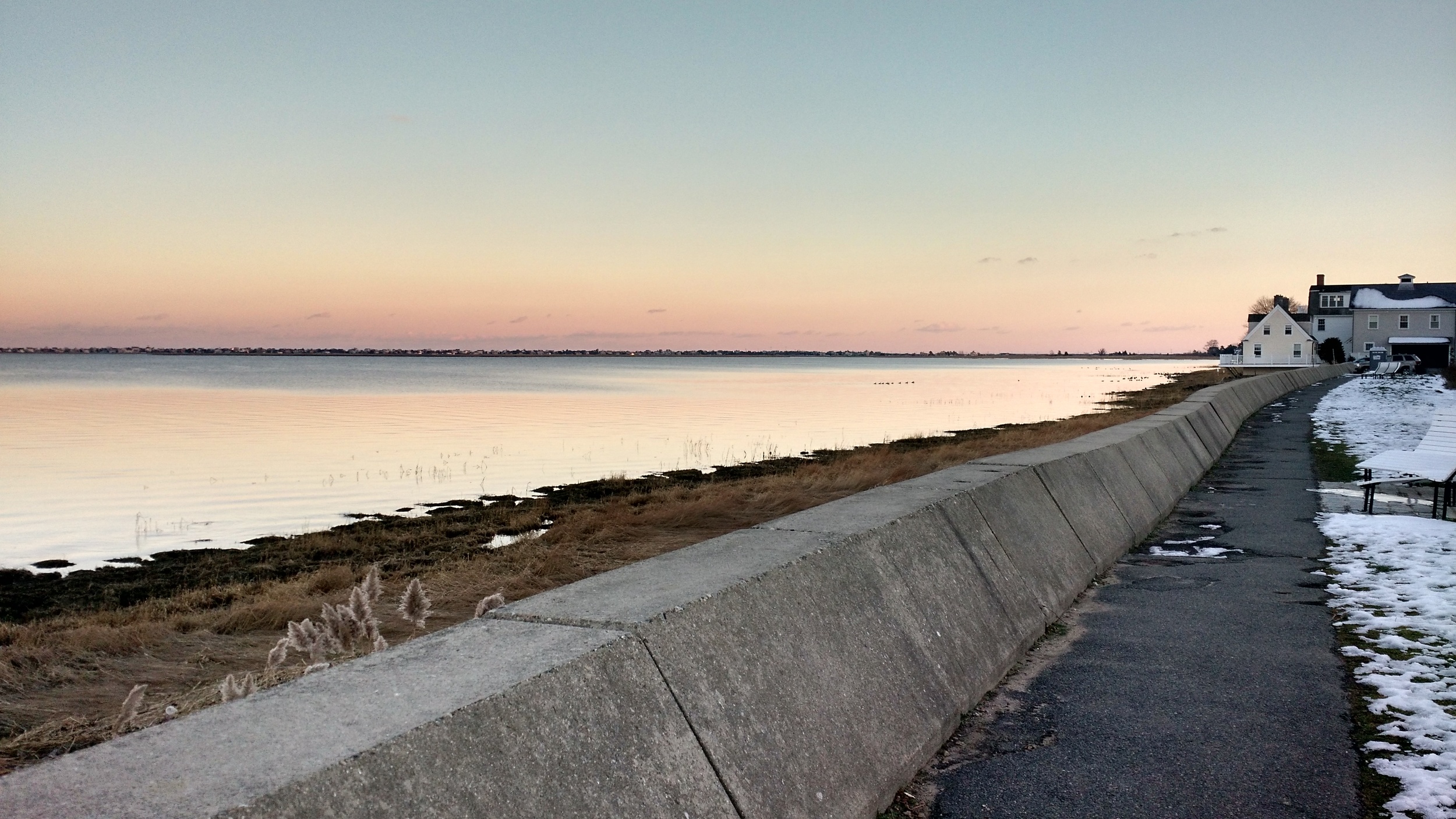
Then there are those days when I’m driving home from work, my head still buzzing with deadlines or with snippets of workplace conversations, and I look out my car windshield at the roadside pine trees, a flock of geese flying south through the paling sky and I think, This evening, this moment in time will never come again. So I’d better shush my mind to look---really look--around me. How many of these afternoons are left in my life? I don’t know. None of us do. Morbid? I don’t think so. These moments of mindfulness are how we hit the pause button, how we behold our own joy. When we write down those moments, when we record them in a journal, we are creating the narrative—the only half-way reliable narrative—of our precious and finite days.
Henry David Thoreau said that he traded his comfortable town home for a rustic woodland cabin because he wished to live deliberately.

At least in the abstract, some of us covet this concept of unplugging and retreating from our hectic and digitized lives. Who wouldn't like to slow down time so we can feel the heft and length of each passing hour?
But nowadays, how many of us would adapt this as a permanent and year-round lifestyle choice? The woodland WiFi and cell phone connections would be spotty at best. And, as someone who grew up in a thatch-roof farmhouse without indoor plumbing or central heating, the discomforts and inconveniences of that bare-bones cabin life would, sooner or later, override the joy or mindfulness.
So in my cozy and well-heated writing studio I keep a set of ballpoint pens and write in my notebooks to record the ephemera of my life. Without these journals, without this writing, most of the past seven months would be gone.
This morning I closed my completed journal and crossed to my studio bookshelves to stash it there until, during one of my sudden and always overdue clean-outs, it will end up with all the others in those basement boxes.
I know there will come a future day when I will go to the basement to search through the shelves for an old photo or a lost gadget and the journal box will call to me, as it has before. I will open today’s completed journal at a random page and sit there under the basement’s Florescent strip light in the company of my previous self, reliving a day from 2015. In all my past journals, I see recurring themes: the yearning for solitude; the immigrant’s search for an existential home; and my almost lifelong struggle and vacillation between my public and private personae (as in the 1983 piece above).
When I read them, I’m also struck by how prophetic some of my past writings turn out to be. It seems, in retrospect, that the writing knew much more than I did. Too often, I see that I should have listened to or acted upon my own observations.
Today, I select a new book to set on my desk underneath the east-facing window of my writer’s studio. The new blank journal sits here, empty and waiting for tomorrow.
We Might be the Last Generation of Letter Writers • A Conversation with Sociologist Michelle Janning

Sociologist and Professor, Michelle Janning
I never really know why I do it, but there I will be on various afternoons throughout the year, sitting on the wooden floor in front of my closet, peeling tape off a slightly battered box. On the top flap of this box is two words in uppercase letters and permanent pen: DEEP STORAGE.
I've come across a lot of people who have the same — a box or ten of memories sitting on closet shelves — and people who do the same: thumb through this deep storage from time to time. The effects are not always the same, as the very reason for the impulse to sift through the past can vary, but there can often be a combination of emotions —nostalgia mixed with regret, or warmth mixed with emptiness. Albeit peripherally, I think it might have something to do with what Adam Phillips explores in Missing Out: In Praise of the Unlived Life, where there can be a strong sense of constant reflection: wondering what was, what could have been, and what could be. But I also think quickly to Joan Didion's "On Keeping a Notebook," which speaks to the importance of recording life and keeping a close proximity to the past.
One item that many seem to hold onto are letters of past love. But why do we keep a hold of these romantic reminders, especially of ones long gone? We found an inkling of an answer in an article recently, "Why Love Letters Matter, Even After You Break Up." It features words by sociologist Michelle Janning, who happens to be a professor at the college I attended, Whitman College. A lot of her research has looked at concepts of "betweenness," and romantic correspondence surely qualifies as that. But she has also looked at another intersection: the differences between digital vs. handwritten romantic correspondence. When asked why we hold onto these records of our romantic past, Janning replies: "They represent who we were, which is part of who we are. They become our relationship counselors, reminding us of what to avoid in future relationships and what to rekindle."
We recently spoke with Janning about her research and work, but also about her own experience and relationship to her deep storages and handwriting.

BRETT RAWSON: What led you to studying the divide between handwritten vs. digital correspondence in romantic relationships?
MICHELLE JANNING: I was cleaning out a closet and found the box of letters I'd stored from high school and college. After reading through them I talked with my husband, and we (college grads in the mid-90s just after email started and just before the internet) figured we might be the last generation of letter writers. Then lunch with friends of different generations (one who had a folder in her phone labeled "texts from cute boys") made me wonder further. Full story in the publication attached.
RAWSON: What did you find from your study that you didn't expect? Did anything surprise you, did new patterns emerge, did you find any contradictions between what people say and what they do? If you were to extend this research, what would be next?
JANNING: The most surprising thing I found was that, while women are more likely to save letters and mementos from relationships than men (and to save more of them), men tend to look at or "visit" their saved love letters more frequently than women. And men tend to store them in more accessible places (as opposed to closets, under the bed, or in storage).
Some of this may be because women tend to be tasked with household organization more, and spend more time than men on creating a storage location that is decorated or made special in some way. Right now I'm trying to figure out if it'd be worth studying the data to look at generational difference. The hard task here is that technologies change so fast that I'm not sure I can capture both age differences and technological change simultaneously (because change in one can falsely suggest change in the other).
My big project now is writing a book that uncovers how the objects and spaces in our homes tell us something about family relationships. Love letter storage will be part of the chapter on dating, sex, and paths to family formation.
RAWSON: Between-ness seems central to your focus. Aside from technology, what else comes in between us and handwriting?
JANNING: Good question. For me, between-ness is about internal conversation when I find myself unable to agree with polarized claims. Relating this to handwriting means that I am neither a huge fan nor critic of handwriting. I can see the importance of keeping it in order to foster all the good things that can stem from it (like the aesthetic, the handcrafted, the thoughtfulness, the non-reliance on non-human technologies).
But I also shy away from romanticizing anything that hearkens back to a fictitious past when our present (privileged) perception is that it was somehow better then than now. This is true when I think of gender roles, intergenerational relations, religion, or even medicine.
RAWSON: What is your own experience with handwriting?
JANNING: My dad had a brain tumor after college but before I was born that rendered him physically disabled such that he lost hearing in one ear, had partial paralysis in his face, and had to switch hands for writing. He had grown up ambidextrous. I have vivid memories of watching him sign his name with the most bizarre pen strokes, which took an inordinately long time, but which never seemed to make me feel impatient.
This matters because I am an impatient person. I also have looked at his musical compositions from college (he was a music major), which were all handwritten. Since the pre-tumor writing was different from what I saw him do, I always thought about his life as having two segments. Only now do I think that maybe the visual representation of his handwriting may have had something to do with that perception. Add to this the fact that my mother has handwriting that is like a flawless art piece, and no wonder I'm intrigued.
I learned calligraphy as a 10-year-old, and taught my son to do it when he was younger. I love examining how the aesthetic world can tell us something about human relations. I have always spent time shopping for interesting pens, inks, and papers, especially when we'd stay with cousins in Germany as a child. In high school and college, I would pride myself on the clever use of colored ink to help with anything from chemical compounds to calculus formulas, and from maps to poems. I recently was asked to write a book review for an academic journal, and I decided to hand-write both the notes and initial draft. I did this because I bought a new fountain pen in Germany this summer. The final draft (which was then crafted on the computer) went more quickly than anything I've ever written, and it was accepted without a single revision (complete with both a formal and informal note from the editors telling me how amazing it was).
RAWSON: Are you concerned that handwriting / cursive lessons are being eclipsed by keyboard proficiency lessons in the U.S. school system?
JANNING: Yes and no. I see the use of keyboarding as necessary for the work that my students do in college, and that it is most certainly an efficient way for me to do my own writing. (Again, I'm impatient). But because I find myself grateful that my son was on the cusp of cursive instruction (he received some in Denmark when we lived there, he did a little in 3rd grade just before the school moved to a greater focus on Chromebook instruction), I must think it's a good thing.
My bigger concern with the Chromebooks has more to do with the increase in standardized testing, which I presume may be exacerbated by virtue of the fact that students are getting quicker at keyboarding. This makes testing more efficient. What I liked about my son's teachers last year was that, especially in writing (Hooray for Mrs. Hartford!), the kids would draft things by hand, learn to navigate and edit on a computer, and be allowed lots of time for crafting stories. So, as far as the creative writing process goes, I think his teacher struck a good balance.
Other than the aesthetic coolness of nice handwriting, I am concerned that students will not be able to READ handwriting, which limits our ability to learn things from historical texts.
RAWSON: When you think of your own handwritten correspondences, what comes to mind?
JANNING: How little I do this. I am not a letter writer. I think of little notes to my son, or drafting my writing by hand. That's funny I suppose.
RAWSON: Phenomenologists have argued that the self falls away when we are engaged in an intense activity, usually one that collapses the sense of the mind-body split by activating both elements. Do you think the writing implement of choice could act as a bodily extension, and that writing by hand helps combine subject and object in ways that promote intimacy with a text, whereas typing into a word document promotes separateness of subject and object?
JANNING: I am not sure, because I have felt precisely this way while crafting my writing on a computer screen. For my aging body, the times when I am most likely to feel the mind-body split is when I am in pain. For typing, it's in my shoulder and my eyes. For handwriting, it's in my wrist.