Winter Call for Submissions
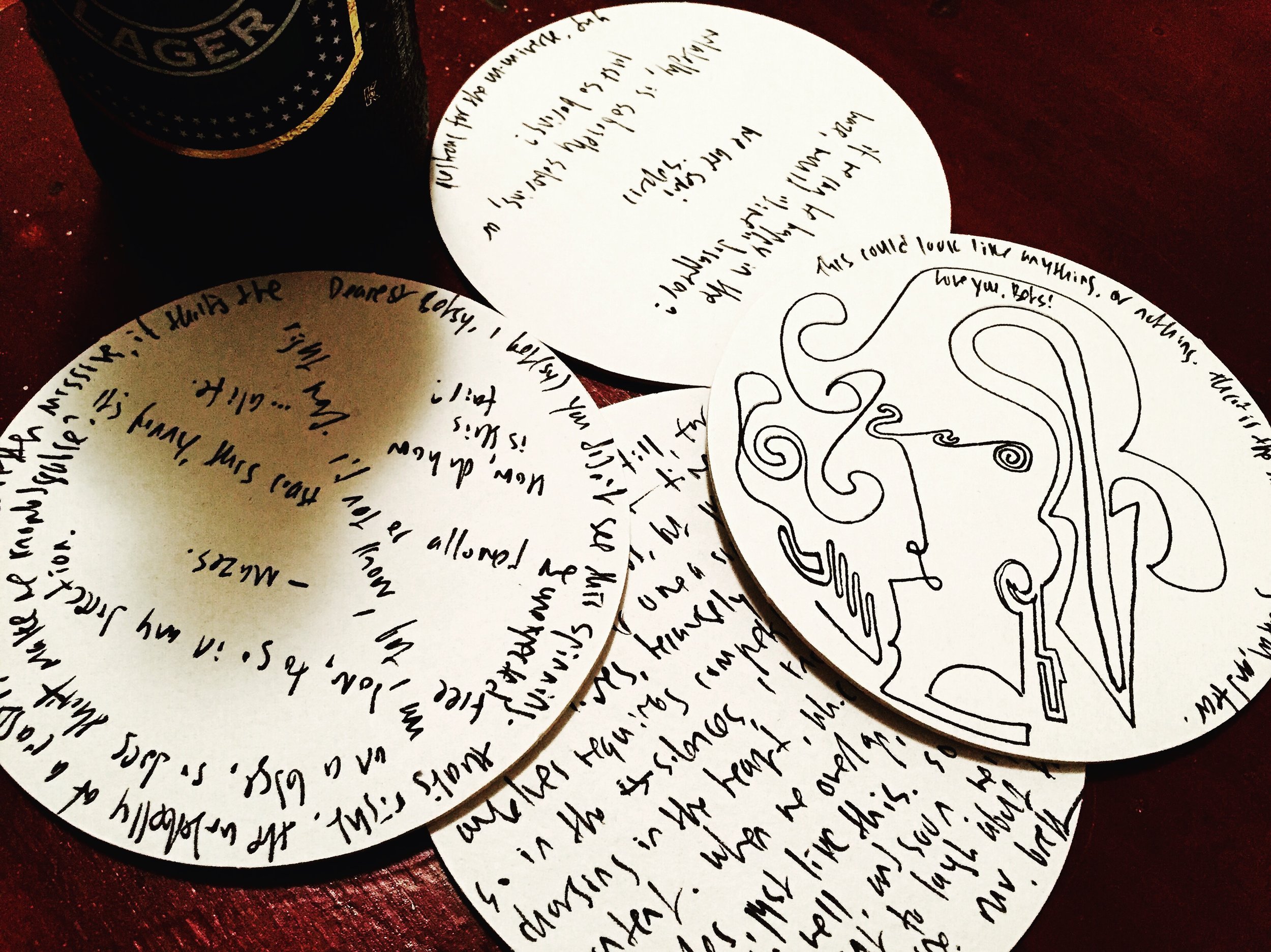
Handwriting is always changing, and so are we. While you can submit anything to us at anytime, you can also submit some things to us at some times. This winter, we're looking to hear and see how handwriting is surfacing in the below ways:

1. Elections. The election left a chaotic dent in the world. No matter how or if you voted, its impact is everywhere — online, in the streets, on walls. We've seen it surface in handwriting in various ways: from kids writing letters to Donald Trump about kindness to the Post-It Note Wall in Union Square Subway Station (below). Handwriting has its own political past, and can be, as we're seeing, a form of protest. The pen is, after all, the formal declaration of war. But handwriting also plays an important role in how we process impactful moments. In stories, drawings, images, or drafts, send us your observations, experiences, and understandings.

"This Is How You Build a Wall:" A picture of the thousands of Post-It Notes in Union Square Subway Station, calling for No Hate,
2. Snow Write. See what we did there? Lame, we know. Anyway, it's winter outside. This means we might get snowed in sometime soon! No better time to cozy up next to the log fire, or broken radiator, and write. Last year, we published a touching tradition (below), I Saw In My Mind a Sparkling Vision of Them, in which a mother hand-wrote messages on each present to her children. How do you experience the handwritten holidays?

"I Saw In My Mind a Sparkling Vision of Them," Adrienne Harvitz, published on Handwritten (Winter 2015)
3. Anaba. When we need a little bit of social silence, we go to our favorite tavern: the one below street level, all wood, with the Chuckanut Pilsner. We order two beers while writing letters or thoughts in our journals. There is a word in Japanese for these kinds of private places in public: anaba. Tell us about the spots, spaces, and places you go when you need to a little more room to write in.

The Pub @ Third Place, Ravenna, Seattle, WA
Missing Letters • Torin Curtin Savala, Fifth Grade
INTRO BY HANDWRITTEN
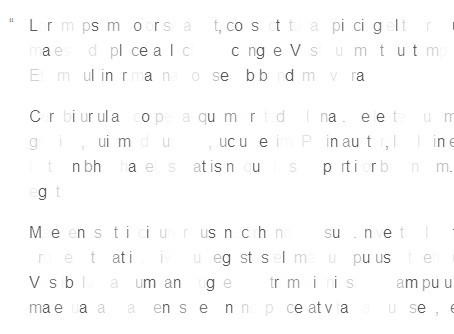
We wish more people would be child-like (not to be confused with childish). Our very tools of expression can sometimes be our steepest limitations, which is why the poem below by Torin Curtin Savala, a fifth grader from California, struck us right in the heart. Torin takes to the keyboard to express the difficulty he experiences on paper. Gripping a pen and forming letters does not come easily. But Torin meets this challenge with creativity and courage. Unable to read what he wrote? Highlight each line and see for yourself the invisible letters he faces every day.

Missing words,
Oh no, words are missing.
Disappearing.
Gone
Ahhhh.
Tiny blank spots nowhere to be seen.
Where did they go?
Not here, not there.
Maybe in your hair?
Missing words are everywhere.
So clear and near.
But to us they are nowhere to be seen.
Maybe they are hiding in beans.
But to us they can not be seen.
Torin Curtin Savala
My Mom’s Bread Pudding • Rosie Nelson

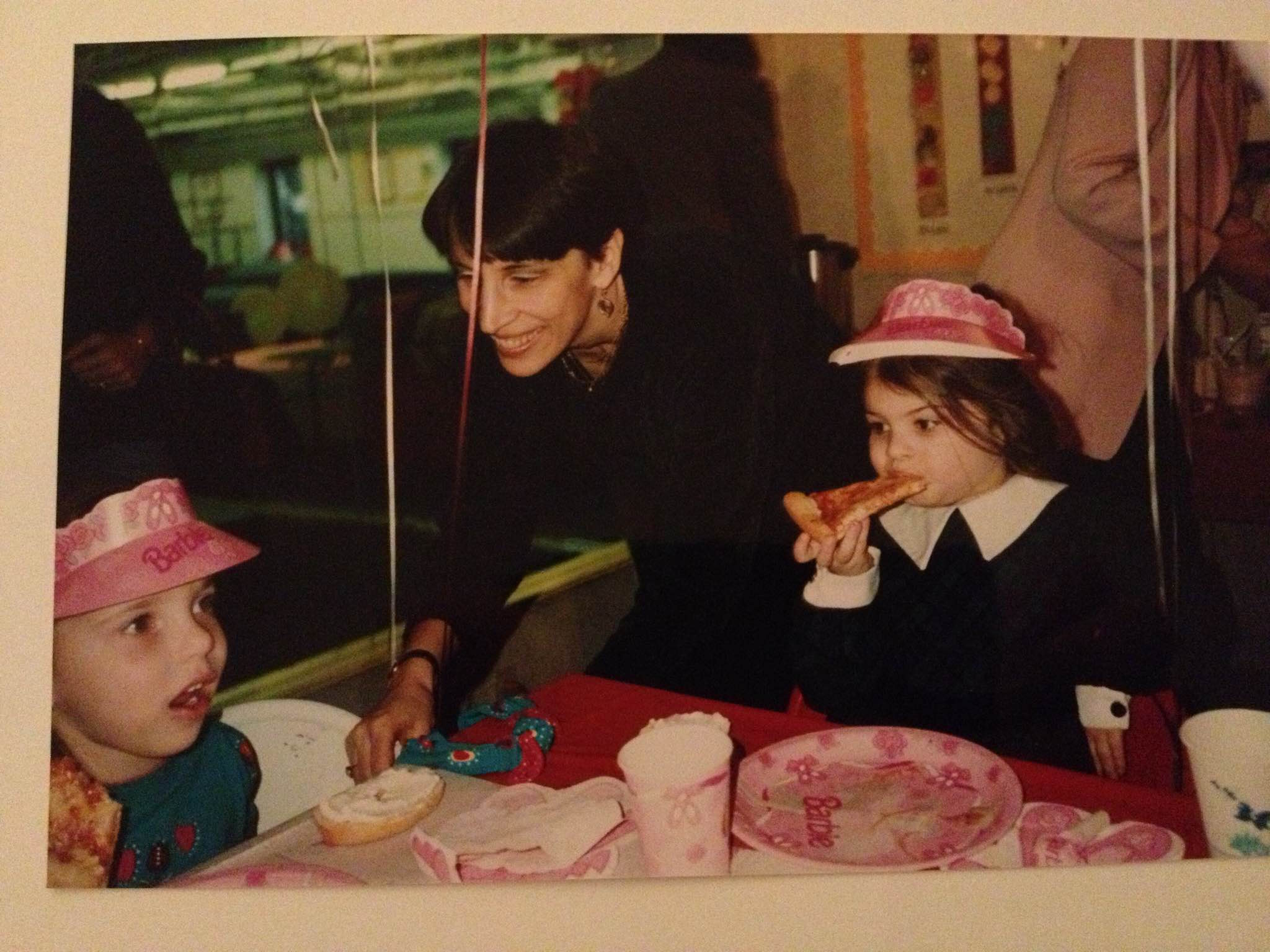
Note from curator Rozanne Gold: What a charming story from Rosie Nelson, who shares with us not only a delicious recipe, but a delightful, warm, and unexpected peek into a family holiday. And what a family it is. Her mother, Dr. Judy Nelson is Chief of Palliative Care at Memorial Sloan-Kettering in NY, her dad Eric is a crackerjack lawyer, and Rosie, a recent college grad, is an advertising exec, with an exuberant passion for food and…bread pudding. You’ll find out why, here. Thank you, Rosie. (p.s. Rosie was one of the teen sous-chefs who helped test recipes and had a starring role in my book “Eat Fresh Food: Awesome Recipes for Teen Chefs, Bloomsbury, 2009.)

My Mom's Bread Pudding by Rosie Nelson
I was about ten years old, I came home the day before Passover (a holiday where one eats matzoh) only to find a gigantic homemade bread pudding sitting in the kitchen.
Having a few years of Hebrew school under my belt, if I had learned anything about Judaism, it was that we do not eat leavened bread during the eight day-period that Passover is celebrated. Why then had my mom, who had spent many more Passovers than my ten, listening to her father (my grandpa) retell the story of the Jews’ hasty exodus from Egypt, put together this soon-to-be forbidden pudding that we would no longer be able to enjoy?
My mother, a renowned doctor, had a logical response: She didn't want the three loaves of bread remaining in the kitchen to go to waste. So she made bread pudding; and the three of us enjoyed a warm delicious dessert that night. Naturally, the majority of the pudding was left in the dish, staring at me every time I walked into the kitchen. What could I do but take another bite? Was that a bit of Grand Marnier, I tasted? The texture was so creamy. The raisins were so plump and sweet. The holiday had begun, the pudding now off-limits, and I remained taunted by my mother’s great baking skills. Restraint is not one of my virtues. How sad to have that gorgeous pudding go to waste. But as the bread pudding sat-in-state as the holiday progressed, the only choice was to throw it away! My mom's seemingly logical plan to avoid being wasteful no longer seemed as logical — now that along with the bread, the milk, spices, sugar, eggs, and raisins now also had to be trashed, not to mention the hour of work she spent making it.
As a ten-year-old, little did I know that bread pudding would create lifelong memories of holidays past, family gatherings, thrifty meals and, unpredictably, of Buenos Aires, where I spent six months studying during a semester of college. To say that food and cuisine were central aspects of Argentine culture is an understatement. My wonderful host mother, Monica, made countless memorable meals over which we discussed everything — from politics to art to cooking. I loved the experience so much that, one year later, I returned with my friend Shanen and stayed for a month.
On our first night, Shanen and I walked the local streets to a steakhouse, where we found ourselves five more times during our stay. After a huge meal, the panqueques con dulce de leche (crepes filled with dulce de leche) caught Shanen’s eye while the Budín (bread pudding), caught mine. We polished off all of it, only to find out that the bread pudding was a portion meant for four! But we ordered it again, and again.
I think of bread pudding every Spring, the time of year when Jews all over the world share a traditional Seder meal. But I think of my mother every time I see bread pudding on a restaurant menu. It is now fifteen years since the Passover bread pudding story began but I know the memory of the forbidden dessert will make the holiday seem a little bit sweeter next year.
The recipe is written in my mother’s handwriting. Sometimes we make it with fresh blueberries, and sometimes we make it with chocolate chips. And sometimes we bake it as is (and not in a water bath).


My Mom’s Bread Pudding
Serves 8
Butter for greasing pan
4 - 5 cups stale white bread cubes
¾ cup raisins
4 large eggs
¾ cup sugar
1 teaspoon vanilla
1 teaspoon Grand Marnier
1 teaspoon ground cinnamon
½ teaspoon freshly-grated nutmeg
½ teaspoon salt
3 cups milk
Preheat oven to 350 degrees.
1. Spread the bread cubes in a buttered 2-quart baking dish. Scatter raisins (or blueberries or chocolate chips) over the bread.
2. Thoroughly whisk together: eggs, sugar, vanilla, Grand Marnier, cinnamon, nutmeg and salt. Whisk in milk.
3. Pour the liquid mxture over the bread and let stand 30 minutes, periodically pressing bread down with spatula for absorption. Please dish in a water bath (fill pan about ½ up sides of the dish – use scalding hot tap water.) Bake until puffy and firm in the center – about 1-1/4 hours. Serve warm, room temperature or cold.
Note by RG: Although Rosie’s story is related to Passover, the bread pudding recipe is wonderful all year long. Top with fresh blueberries or peaches in summer; ripe pears in the fall, or bittersweet chocolate, any time.

"OUT LOUD" is Back at Flatiron Plaza (7/28)

BY HANDWRITTEN
On June 30th, Handwritten held OUT LOUD, an afternoon of bearing witness through writing, for the first time. We set up a microphone in one of the most iconic, and busiest, intersections in New York City and began reading from letters, journals, and deep storage. We're happy to be invited back by the Flatiron/23rd Street Partnership's Summer Series and, in partnership with Pen + Brush Gallery, bring the private once against into the public. Details are:
Public Plaza
Broadway, 5th Avenuve, And 23rd St
12-2pm, Thursday, July 28, 2016
"OUT LOUD" is about bringing our private lives to the public. It is about smudging the borders between ourselves and others that keep us from sharing who we are and learning more about those around us. We invite people to share those thoughts formerly kept to themselves, whether written in diaries or letters, in the open. Because, to adjust an Adrienne Rich quote, when one person tells the truth, it creates the possibility for more truth around them.
In a city of 8.5 million of people, it's easy to feel anonymous, alone, and apart. Authentic intimacy can seem difficult to come by. We find that writing down our thoughts and reflections whether in journal entries or letters to friends and family is a helpful way to process what it is to be alive today. At "Out Loud," we want you to share these confessions, meditations, and reflections with the larger public.
You can read excerpts of things you've written or things someone else has written to you. And for those of you who can't make the event or want to partake but not speak, you can still participate: send us your excerpt and allow it to be read by those in the audience, or our roster of performers.
Email us at info@handwrittenwork.com to let us know how you'd like to partake.
Hilde’s “Overdue” Carrot Soup • Ruth Zamoyta

Note from curator Rozanne Gold: This recipe, rumored to induce labor, was lovingly shared with me by Ruth Zamoyta who is the Development & Communications Director at New Jersey Theatre Alliance, a published poet and playwright. The recipe was written by Ruth’s South African friend, Hildegarde Webber. Hilde and Ruth’s husbands were both students at Yale’s School of Management in New Haven, Connecticut in the early 1990s. Ruth keeps this piece of handwritten history in a recipe box that her mom, Carolyn Zamoyta, gave her – “a box overflowing with ingredients scribbled on index cards, cut from newspapers, magazines, mayonnaise jar labels, and sugar boxes.” I made the soup; it is delicious.

Hilde’s “Overdue” Carrot Soup by Ruth Zamoyta
My baby was due December 7th, 1994. I had planned ahead. All the Christmas presents had been bought, wrapped, and placed under the tree by November 30th, in case he arrived early.
Ha.
By December 15th, I was dragging my 40-pound-overweight body around downtown New Haven, Connecticut, trying the old wives’ remedy for over-dueness: walking. In the Yale bookstore I ran into my friend Woody who was studying midwifery. I told her that I was trying to induce labor by walking.
“It’s actually the opposite,” she said. “Your uterus needs to relax and store up some energy. Go home and take a nap.” So, I retraced my steps back home to graduate family housing — one whole mile — and collapsed in my bed. I woke up around three o’clock. No contractions. That’s when my friend Hilde called. She sighed and said, “You need the soup.” I asked her to explain.
Hilde said that when she was overdue with her son, a friend had given her a special carrot soup recipe known to induce labor instantly in the most wretched and piteous of overdue mothers. I told her I was desperate and would try anything, so she drove over and gave me this recipe, transcribed in pencil, on an 8 ½ x 11 sheet of paper. Note the bottom line: "If all else fails, try castor oil!"
The ingredients were pretty standard, except for the heavy cream, so I had my husband run out and get that. As I sliced the carrots, I instinctively knew that this would work. I threw everything in the pot and stirred occasionally, envisioning holding a baby in my arms the next morning. I glanced at the front door of the apartment, to make sure my overnight bag was at its side, ready to grab and go. I looked in the freezer and made sure the pre-made dinners were still there. I glanced at the tree, twinkling in the living room.
Soon the soup was ready. I filled a bowl for myself (my husband wouldn’t touch it) and ate the last spoonful. It was time to go to the hospital.
It was a fairytale birth, a long but happy pain, and the biggest surprise was when I was on the delivery table, waiting for the next urge to push, and I pushed, and the baby crested, and the nurse down below exclaimed, “He has red hair!” My husband (brown hair) and I (a blonde) looked at each other incredulously. Minutes later, when I held my little son to my chest, I looked down and saw that it was true: I had given birth to a carrot top.
There are some other interesting phenomena surrounding my son, Colm O’Toole’s, birth and hair. When we heard that red hair must come from both sides of the family, my husband and I had to do some investigating. It turns out that my grandfather's mother had red hair, and on Sean's side, his grandmother had had red hair, though it was already white by the time Sean was born, so he hadn't known.
It just so happens that Colm was born on December 17th, Sean's grandmother's birthday — the granny with the red hair. Also, if you count back 9 months from December 17th, you get March 17th — St Patrick's day. Colm is now 21, and my other children Róisín O'Toole, 24, and Liadain O’Toole, 12. No soup was required.


Hilde’s “Overdue” Carrot Soup by Ruth Zamoyta
Serves 6
Hilde’s “Overdue” Carrot Soup
4 tablespoons butter (unsalted)
1 onion, chopped (5 oz. onion)
4 carrots, peeled and sliced (about 10 oz.)
1 stalk celery with leaves, chopped
2 medium potatoes, peeled & diced (about 10 oz.)
2 sprigs parsley
5 cups chicken stock (or canned broth)
1 cup heavy cream
Salt & freshly ground black pepper
Melt the butter in a large pot, add the onion, carrots, and celery and cook for 10 to 15 minutes, stirring from time to time. Add the potatoes and parsley and stir two minutes.
Stir in the stock and cook, partially covered, until potatoes are tender, about 20 minutes. Put through a strainer or vegetable mill or puree in a blend or food processor.
Return to the pot, stir in the cream, add salt and pepper to taste and reheat without boiling. Serve hot or cold (Can also add paprika and other spices to taste.) (If all else fails, try castor oil!!!)
** Note from Rozanne: I added a large pinch of garam masala and used fresh thyme from my window box, instead of parsley.

The Busy Land of Human Beings • A Young Man in 1974
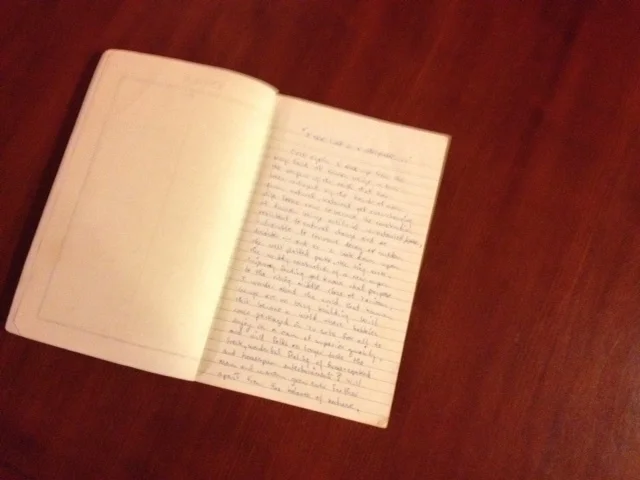


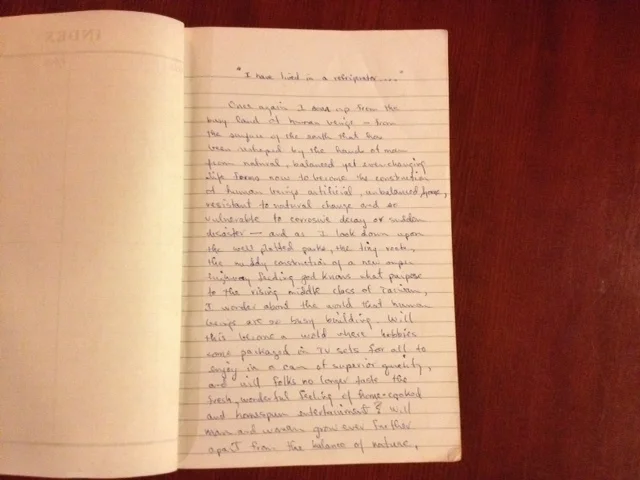
This journal excerpt comes from the online exhibition, "Out Loud." To see the full exhibit, click here.

This is Where I Battle My Writing Demons • Sheila Lamb

BY SHEILA LAMB
The first draft always begins on paper with ink. Sometimes, the first handwritten words are a line, a sentence, a phrase. Sometimes, a scene. Usually, these words will not be in the final story. But they mark the magical moment where the story began.
I find ideas flow better from paper to pen. When I handwrite, I write fast. Inspiration can be elusive and I want to get the words on paper without disruption. There is a smooth connection from pen to hand, something that, for me, pencils don’t give. Computers certainly don’t. The pen is, literally, a fluid implement. I favor gel pens (a Pilot G-2). It’s part of the whole flow of words, from thought to paper. I’ll use pencils in a pinch, but graphite tends to smudge and fade. There’s also a rub as the pencil hits the page, a dryness, a physical sensation, that gives me the shivers – like fingernails on the chalkboard. Occasionally, there is the issue of broken lead and the search for a pencil sharpener. Pencils, despite their simplicity, have too many complications and they are not my utensil of choice.
Ballpoint pens are another option. They are easy to find, ten to a pack. However, they are my second choice. Words don’t glide from a ballpoint as they do from a gel pen. Like the pencil, the ballpoint ink to paper has a palpable feel that is off-putting to me. Ballpoint ink can be thick and gloopy, and sometimes leaves thick globules at the end of sentences. Although ballpoints are certainly preferable to computer keyboards, they don’t have the smoothness of a gel pen.
*
Writing by hand is second nature to me. Perhaps because I’ve handwritten stories since elementary school, when they gave us green penmanship paper with fat, chunky pencils. I’ve kept paper and pen journals since high school. It’s easier for me to reach for pen and paper than trudge to the laptop, wait for it to start, find the folder, open the file, and pray the program doesn’t freeze or mysteriously return me to last week’s temp file draft. All those layers of technology slow the inspiration, that spark of a new story or pivot within a plot.
For short stories, I write the entire first draft — or what I think is the entire draft at the time — on paper. Most of it begins in my bedside journals. My recent story, “Hunger, Not Tame,” began after a camping trip to Assateague. I journaled about our trip and the feral horses. I was infuriated with the tourists, who petted and fed potato chips to the horses on the beach.
That incident was the scene that stuck, and the one that gave way to story. I began to play on paper, shifting from my journal to a spiral notebook — last-day-of-school perks of the teaching trade — expanding the scene into a story, in longhand. I witnessed Kate, the main character, grow from this exploration: a park employee who confronted the people tossing Doritos at the horses. I write until I come to what feels like a stopping point — the end of a scene or section of dialogue. If I’m lucky, I’ll discover the final sentence here. Something in the shape of the words lets me know that this is it — this phrase where the story will end.
*
In writing by hand, I’ve discovered that this is where I battle my writing demons. For me, past defines the present, so as a writer, I struggle with back-story. Actually, I revel in it. I spend a lot of time figuring out how my character made her way to the start of the story. I tend to develop psychology before I develop plot. Why is the character there? What makes her do what she is doing? Writing those back-story details by hand is necessary for me to create the character. I’m fine knowing many of those initial, raw words won’t make it into the next draft. The process paints a picture, so I know who I’m dealing with as I place her in situations she’d rather not be in. The potato-chip tourists barely made it into the final draft. Even though they were the beginning, in the end, they were a brief, two-sentence presence. They were simply a starting point for Kate to explain why she was at Assateague and what motivated her work. The longhand process, I’ve discovered, is a sort of third-person, in-character, journaling.
*
My conflicts with electronic writing are three fold: First, my creative energy, that burst that inspires a new story, vanishes when I start writing on an electric document. All of the green and red warnings that highlight misspellings and incorrect punctuation are like blaring sirens, taking me out of the story. Instead of writing, I go back and correct. That delete key is dangerous. It can very quickly disappear a phrase that might not fit in that sentence, but a phrase I may want to use later. Second, as I develop and revise the story, I prefer the kinesthetic, hands-on process of physically writing (educational researchers are looking at the correlations between student success and handwriting but I’ll save that tangent for another time). Instead of scrolling through track changes, highlights, and text colors, I make side notes on paper with the pen, underline an idea I want to develop, remind myself to go back and find a synonym, with a circle and the abbreviation: syn. The handwritten notes make the ideas and revisions stick. Finally, I’m incredibly distracted by the Internet. Turn off the Wi-Fi, a lot of people say. Yet the Internet is a necessary evil because many stories require research. I researched the feral — not wild — horses of Assateague, their history, and the park regulations, but the pull of social media is powerful. It is so easy to go from the National Park Service site to Facebook, to Twitter, and pass another hour without actually finding anything of substance, just scrolling from one site to the next.
Eventually, the story needs to go electronic. For me, this is where revision takes place. I find digital typing is great for the editing phase. I transcribe the paper page word for word into Scrivener. Then, I’ll take a look at chronology, scenes, and plot development. I love the way I can add a new text page or section, and stay organized as I work. With this, I’m able to move scenes around and bridge the story together. In “Hunger, Not Tame,” I played a lot with Kate’s past and how much to include in the story, the back-story burden. It took several revisions to refine the central scene, where her past and present collide.
But after the digital jump, I’m back to paper and pen. I print out the revised draft and I read through the story on paper. I edit, make notes, read it aloud. I mark it up. There, it develops shape and structure. Those changes are made again on the typed draft. Then, there is another printed version for a final read-through. Last minute changes are made, with pen on the paper, and corrected again on the laptop.
Handwritten work takes time. My electronically-inclined friends claim I’m doubling my time on a story. You could have been done by now. But good storytelling shouldn’t be fast or easy, no matter the method. Writing stories is, for me, a hands-on process, an artistic process of creating a world, of creating a person, of creating a story. Writing by hand allows my creative magic to have its space.

Nana's Cookies • Marie Simmons

Note from curator Rozanne Gold: Marie Simmons, a star in the culinary galaxy, shares reminiscences and recipes so vivid that we decided to feature her story in two parts. Part I includes a beautiful essay about her Italian family at the turn of last century and illustrates a cherished view of life – one that included hard work, strong familial ties and values, great meals, and a slew of handwritten recipes dictated by Marie’s grandmother and penned by her mother. The culmination of this is Marie’s love of cooking and her status in the food world. She is an award-winning author of numerous cookbooks and a beloved cooking teacher. Originally from New York, Marie now lives in Eugene, Oregon, a place she considers “paradise.” She bicycles everywhere and is smitten with the vast amount of culture that Eugene provides. The timing for our connection is fortuitous. Marie’s newest cookbook, Whole World Vegetarian (Houghton Mifflin Harcourt), is just out this week. Never mind that Nana’s addictive pepper cookies (known as taralli) are made with lard! Thank you, Marie, and congratulations on the publication of another wonderful cookbook.

Nana's Cookies by Marie Simmons
Antonette Abbruzzese, my grandmother, (I was named Marie Antonette for Nana) was born on the lower East Side of Manhattan on December 19, 1890. Her husband, my Grandpa, was a gentle, sweet man who was very proud of being able to read the daily English newspaper. He was born on January 20, 1880 in the village of Forenza in the remote region of Basilicata — the area of Southern Italy often referred to as the boot. His father died when Grandpa was a small boy and he eventually moved to live near relatives in New York City with his older brother Michael and his mother. Grandpa became a barber for a military installation on Long Island.
Nana and Grandpa maintained a small backyard farm where Grandpa sold produce, honey, fruit, fresh eggs, and beautifully grown vegetables. It was in a small Italian immigrant community in the Hudson Valley village of Milton, New York.
Nana enjoyed cooking healthful meals for her extended family of 9: She had 8 children: Marie Louise, (Tessie) Maria Theresa (Tessie taught school and never married), Grace, Rita, Joseph, Emmaline, and an adopted daughter Maggie, orphaned at the age of 9 and raised by Nana and Grandpa. Their home was always open to family and friends and many of the recipes in my cookbooks describe the hearty meals prepared there. I especially loved the big platter called Aunt Milie’s Cannellini Beans and Rice that made its way into my book, Rice the Amazing Grain. (page 132). It makes me hungry today even thinking about it.
My grandfather was remarkable in that he firmly believed in educating his daughters. (His son Joseph was in the Marines in the Pacific during the war.) Grandpa’s three oldest daughters all went to school and became teachers. But Aunt Rita, evidently extremely bright, obtained a scholarship to Cornell University when she was only 16 years old. Marie and Tessie borrowed money to help pay for books (they were teachers by now) and got Rita settled into her school year at Cornell. What I find amazing about this saga is how open minded my grandfather was. I remember a family saying: You give your children your love and the love of God and you give them wings. You let them fly. And, that is what they did.
My mother, Marie Louise, was a retired school teacher and a “super” organizer! She, along with Aunt Tess and Aunt Rita, ran a tight ship. Our family gatherings were always punctuated by “You, sit here; you, sit there.” No one sat on their own volition — You just waited to be told where!
Now to the handwritten recipes: Most of the recipes were printed by Mom as they were dictated by Nana. I retested many for accuracy. After all, Nana measured her ingredients with a large chipped ceramic mug. She would dip deep down into a big vat of flour and skimmed off the excess with the back of her hand. Not the most accurate measuring, I’d say, but the most immediate. I’d worked most of my life in the magazine test kitchen at Woman’s Day magazine and so I had precision and accuracy pounded into my head. After Woman’s Day I moved on to be Food Editor at Cuisine magazine and then cookbook author, so I thought I knew a little about recipe testing, and accuracy.
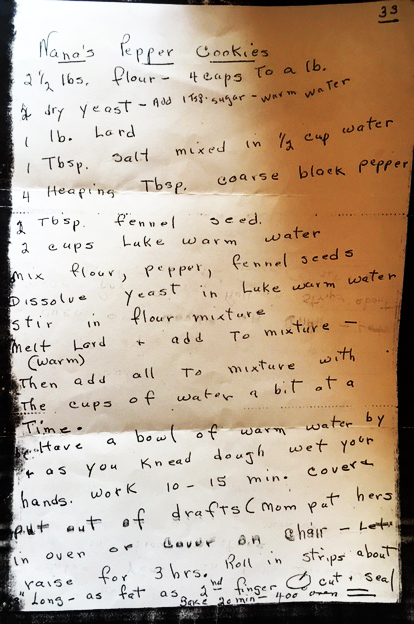
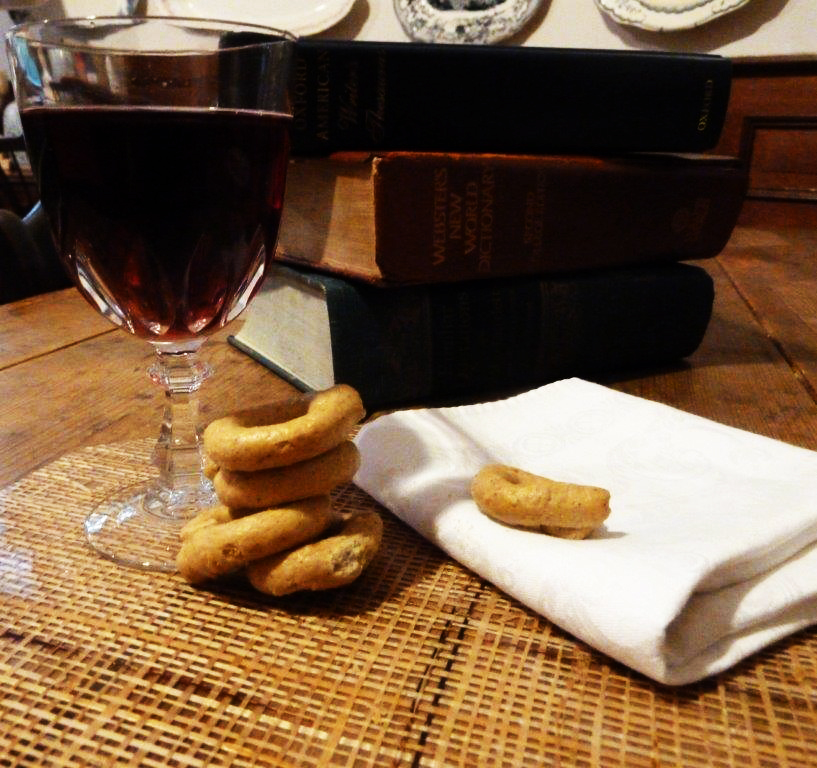
Now where to begin in the saga of Mom and Nana’s recipes? Nana’s Pepper Cookies are tiny savory rings made with yeast and lard and studded with coarse ground black pepper and fennel seeds. I discovered, later in life, how delicious they are with a glass of red wine. I have retested it, but here it is in its original form as written by Nana.
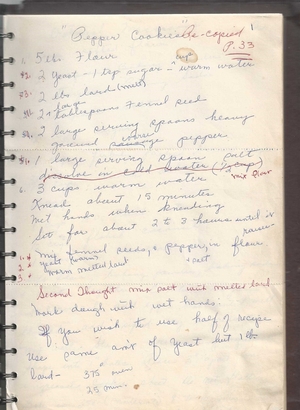
Ingredients
Nana's Pepper Cookies (as edited by Marie)
2-1/2 lbs. flour
2 tsp. dry yeast (add 1 tsp. sugar and warm water)
1 lb. lard
1 tbsp. salt mixed in 1/2 cup water
4 heaping tbsp. coarse black pepper
1 tbsp. fennel seed
2 cups lukewarm water
Directions
Mix flour, pepper, fennel seeds. Dissolve yeast (and sugar) in lukewarm water. Stir in flour mixture. Melt lard (warm) and add to mixture — then add all to mixture with the cups of water a bit at a time. have a bowl of warm water nearby and as you knead dough wet your hands. Work 10-15 minutes. Cover and put out of drafts (Mom put hers in oven or covered on a chair.) Let rise for 3 hours. Roll in strip about 8" inches and as fat as 2nd finger. Cut into small rings. Seal. Bake 20 minutes in a 400 degree oven.

Gina's Aunt's Rice Pudding • Stacey Harwood-Lehman


Note from curator Rozanne Gold: Gina’s Aunt’s Rice Pudding recipe comes to us by way of New York’s Poet Laureate of the Greenmarkets, Stacey Harwood-Lehman. I’m certain Stacey would love to garnish the rice pudding each season—perhaps a strawberry-rhubarb-ginger compote right now at the height of Spring? Poached pears and star anise in Fall? Either way, hers is a lovely story with a quixotic recipe scribbled in her own handwriting on a hotel pad of paper. I love it because it’s real…with a missing word or two, the very shorthand that makes cooking mysterious and sometimes serendipitous. Gina’s Aunt’s recipe is very sweet and could use a little scraping of fresh vanilla bean. It could feed your whole block. I messed around with a simple version of my own (see below), inspired by Stacey’s love of rice pudding!

Gina's Aunt's Rice Pudding By Stacey Harwood-Lehman
Gina and I had been working together for several years when she started dating Tony, a new employee in our agency’s IT department. Soon after Tony joined the staff, I noticed that the usually tech-savvy Gina seemed to be having an uncharacteristically difficult time mastering the new computer system and that Tony was making many visits to our floor to help her. Within a couple of months she announced their engagement. I was among the lucky few of her colleagues to be invited to the wedding.
At the time I was working in Albany, NY, as a policy analyst for the government agency that regulates gas, electric, water, and telephone utilities. I grew up in a suburb of New York City and had relocated to Albany to attend the state university. It wasn’t my intention to remain in Albany after college but there was a boyfriend and a job, so I stayed.
Gina’s work-station was situated near mine and we became friends even though when she joined the department she was only 19 — quite a bit younger than I was — and right out of secretarial school. She had a terrific fashion sense along with a lively sense of humor and an easy laugh. I was flattered that she liked to take a seat in my work cubicle to dish about office romances and such.
Gina liked to listen to the radio while she worked and I could hear her singing along, softly and slightly out of key, with the hits. A local rock station played the same two songs every Friday to usher in the weekend: Todd Rundgren’s “Bang on the Drum” (“I don’t wanna work; I wanna bang on the drum all day”) and Four in Legion’s “Party in My Pants,” the lyrics of which Gina heard as “There’s a party at my parents’, and you’re invited,” the perfect mondegreen to reveal her youthful innocence.
My proximity to Gina made me privy to her wedding plans. But before there was a wedding, there was a wedding shower to be held at the Italian Fraternal Club in Green Island, a small town roughly eight miles north of the state capitol. I was seated at a table of strangers, all of whom seemed to have known each other for decades. My attempts to enter the conversation mostly failed, until I learned that Gina’s aunt, who was seated across from me, had owned a small restaurant that she had recently closed in order to retire. The menu was red-sauce Italian and among her specialties was her rice pudding. I love rice pudding. Would she share her recipe?
Gina’s aunt was no-nonsense, someone you could imagine at the helm of a busy kitchen where everything was made from scratch and where the menu was likely the same from the day it opened until the day it closed. She explained that the recipe would feed a crowd, a large crowd, so unless I was planning to throw a big party, I shouldn’t bother with it. Never mind, I said. I want to give it try.
Something in her manner as she spoke, communicated doubt; doubt that I would be able to make a success of it. It was her rice pudding, after all. She dictated the recipe as I scribbled on a pad that I’d picked up from a hotel where I’d stayed during a recent trip.
That was decades ago. Gina had two children and divorced Tony. The recipe has been with me through several moves and life changes, stashed in an envelope stuffed with other recipes, some torn from magazines, others written hastily on scraps of paper.
When I ran into Gina’s aunt at the wedding, she asked if I had tried her recipe. I hadn’t. I was waiting for the right occasion. I’m still waiting.


Gina’s Aunt’s Rice Pudding
2 lbs. rice
½ gallon milk
5 cups sugar
18 eggs
½ box of raisins
1 stick butter
Cook rice 15 minutes. Drain in colander. Rinse. Beat eggs. Stir eggs over rice. Stir. Add sugar, stir, milk, stir. Put in stick of butter. Stir. Put in oven @350 covered with Reynolds wrap for 1 hour. Remove cover. Stir. Top w/nutmeg. Put back in oven until solid.
Creamy Rice Pudding
(without eggs)
1 quart 2%, or whole, milk
6 tablespoons sugar
¼ teaspoon salt
1 teaspoon vanilla extract (or scraping of vanilla bean)
2/3 cup long or medium-grain rice
1/3 cup raisins
Grated nutmeg and/or cinnamon
Put milk in a 3-quart saucepan. Add sugar, salt, vanilla, and rice. Bring to a boil; lower heat to medium and boil, stirring 3 minutes. Lower heat to simmer (tiny bubbles steady on top). Cook 20 to 25 minutes, stirring frequently. Add raisins and cook several minutes until rice is very soft and mixture is thick but still soupy. Will firm upon cooling. Pour into a deep dish. Sprinkle with nutmeg and/or cinnamon. Cover and chill. Serves 4 to 6

Externally Obvious, Internally Mysterious • Minakshi Choudhary

BY MINAKSHI CHOUDHARY
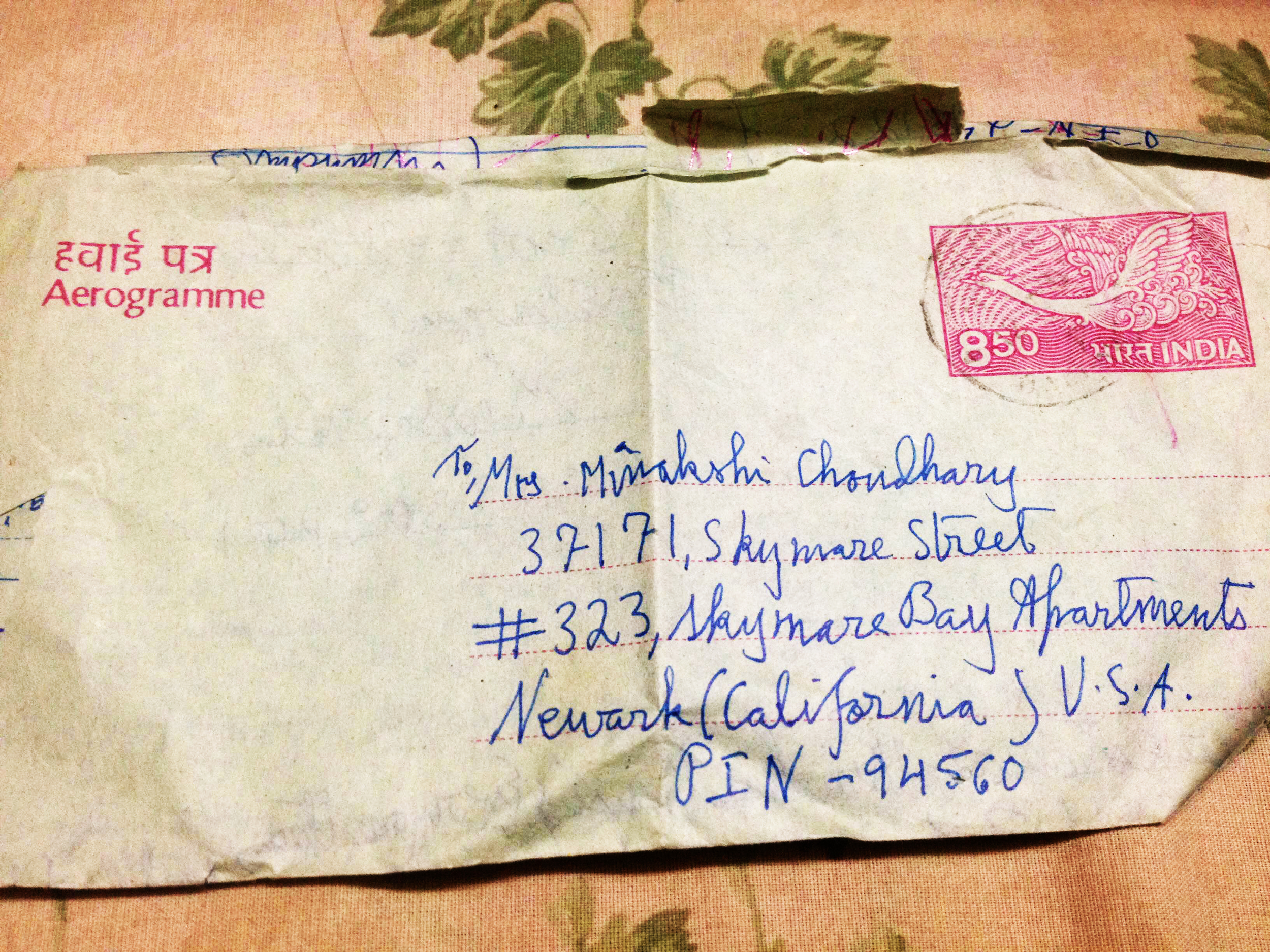
When my phone rang and I heard the voice of my community manager on the other side, I was shocked. There was an inland letter waiting to be received by me: that three-fold piece of paper, externally obvious, internally mysterious.
While I dressed up and on the way to post office, all the neurons of my brain were ringing bells to deafen me with thoughts pouring in and pouring out. Mostly thinking, what might have provoked someone to write a letter to me in this world of emails and phones? Turning the form section of that envelope made me more nervous. My hands were frozen with sweat, unable to unglue the piece of paper.
The letter was from my nephew studying in fourth grade in a fully residential school. Between reading the from address and ungluing the letter, I came to know how fast our brain processes and how far it can travel within seconds.
As soon as I opened it, I was all tears seeing this sweet little sender just wanting me to know his address as he left to boarding school. He was under impression that I hadn't written to him because I didn't know his address. This innocence touched me to the core, and at that moment, I wished to hug my sweet little nephew and tell him how we elders are so busy solving the pain of ourselves created by ourselves.
Now, when that sweet little boy is grown up and busy finishing his degrees, I believe he might have forgotten about this episode of his life. We all fall into this trap of forgetting, though our best friend in the form of black and white text always makes our lives colourful with varied emotion rewinded and reversed on timelines.


He Just Smiled, Said Hello, and Went On His Way • Lora Ackermann

BY LORA ACKERMANN
While searching for any of the many examples of handwritten cards and notes from my family, I came across a journal of mine. This is an incredibly special journal, entirely handwritten, spanning from my first of what would eventually be four ovarian surgeries (over the course of many years) in August of 1992, through the death of my maternal grandmother in March of 1995, her husband, my grandfather in May of 1995, and ending with my soon-to-be wedding in October of 1995. These pages hold such a roller coaster of euphoria and pain. So many entries that touch my heart, soul, and spirit, drawing memories from places long forgotten to the routines of daily life. So many memories bringing new pains of loss and journeyed paths now closed.
There truly is something to say about the handwritten page. There’s a certain comfort, a warmth, as though the lines are reaching forward, surrounding me in a hug, and drawing me in. As I re-read some of these entries, I can detect, in the formation of the letters, the slant of the words, the stains on the pages, changes in mood, emotion, stress level, time management, and so many other delicate strands that make up these layered memories; delicacies that would be but lost in simplified print. The handwriting, like the musical score of a movie, tells its very own story; separate from the worded memories they so eagerly record.


Even after reading these pieces of my life from those years, pieces that now seem centuries away from reality, the entry on those first pages still strikes me the most. I had only been home from my first major surgery at age 20 for a day or two. Having received the good news that what was thought to be ovarian cancer wasn’t, I was free to heal and live my life in gratitude. I had a renewed sense of awe and appreciation for the little things life tended to toss haphazardly in my path and it showed in this entry.
August 29, 1992
…..I just returned from a walk around the block—oh what memories lie in some of the houses around here—not just my own. I can look at Elizabeth’s house, or Suzy’s house, or LouAnne’s, and still see inside, 12-13 years ago….’youngins’ they’d call us. I see Liz and myself in her room, making stickers w/ double-sided tape—we made them out of just about anything—wrapping paper, pictures, things we’d colored, etc.
I see Suzy and I in her room—so pink—pink carpet, bedspread, walls, bright pink, light pink—if ever there was a pink room it was Suzy’s. I see the laundry chute and the poster of ‘Frank Poncherello’ from the TV show, “CHIPS” above her bed. (We had a crush on him, though I liked his partner better.) I see Suzy & I sitting on the floor in her ‘play room’ eating Fruitloops from the box and watching “Emergency 911” (or something like that)—she always said that one of the men was her daddy—They did look alike and for a while I believed her, too!
I see LouAnne & I in her room playing w/Barbie dolls—she had a loft bed with a yellow carpet underneath.
I also see inside another house down the street; a brown house next to the Woolsey’s and an elderly woman who used to live there alone. Unfortunately, I don’t remember her name—I wish I did. She used to read to me and she helped teach me to read so that when I was old enough—so to speak, I often read books to her. She was a very kind woman. I wonder how she faired after she moved. I was too young to remember why she moved—family reasons I suppose. I missed her for quite some time. I think sometimes I still do. Perhaps.
I find that at times I even miss ‘Joe.’ ‘Joe’ was a man who ever since I could remember walked every day. Twice a day he passed our house. ‘Joe’ wasn’t his real name. I don’t know what it is actually. ‘Joe’ was a friendly man who always had a wonderful smile to give any passerby—anyone at all. I think he had a stroke or heart attack. I think he may still be alive, but he doesn’t walk around here anymore. Perhaps he moved; perhaps he just doesn’t walk anymore. ‘Joe’ never corrected us in regard to his name—he just smiled, said hello, & went on his way—leaving smiles on our faces for a long time after. I really did think his name was ‘Joe’ until I was about 15 or 16 when Mom told us differently. She told us his real name, but I still call him ‘Joe.’ Perhaps it’s ‘Joe’ that I owe, in part, my smiling fetish to. Perhaps.
Even typing up these words—such layered memories; memories of people who touched my life, beneath memories of writing the entry itself, beneath those of healing, speaking volumes in the spaces between the letters, the lines between the lines; you know the ones—the ones that speak to our hearts, pulling in our soul’s deepest comforts, the ones that can dry a dampened spirit or bring light to the darkest corners. Yes, so many layers that can only be fully appreciated to the depths they desire in their original, handwritten form.
Today, I journal, too. Sometimes I type. Other times I dictate. But many a time, I pick up my pen, one of the many paper journals my amazing friends have gifted me recently, find a quiet space all my own, and, even for just a few blessed moments, I disappear into the notes of the score, the layers of the letters, the spaces between the words and lines, and the hidden pleasures and soul-soothing rhythms found only when pen, from hand to page, journeys forth.


The Everyday Mind • Chad Frisk
BY CHAD FRISK
I’d never before considered handwriting to be an art form.
For me, handwriting was always a tool. I used it to build thoughts on a page, or just to fill out forms. It was slow. It was blunt. It was annoying. That’s how I had always thought of handwriting in English, and for a long time I thought of handwriting in Japanese in the same way. That is, until I met Takemoto Sensei.
“Make sure you use an extra soft pencil,” Takemoto said.
I went to the college bookstore and bought one. Slouching in a hard wooden chair, I pressed the gray tip to the off-white page of the worksheet he had given me. I could hear his voice. "Trace the lines," he said. It came with a smile that was mildly irritating.
The work was both boring and a little bit humiliating. I had written those characters for four years as a high school student, but there I was, tracing lines like a fourth-grader. The connection was appropriate, however, because I actually spent the first week of fourth grade crying over my handwriting. Ms. Ramcke had given me back a writing assignment covered with red pen. “This isn’t fourth grade writing,” the comment read. My letters still used the kindergarten stencil, filling three lines. Ms. Ramcke wanted me to shrink them down to fourth-grade size. That night I told my mom I didn't want to go to school anymore. I was curled into a lump in the corner of my bed. She did what most parents would do. She said she was sorry and rubbed my back. But then she did something else. "Maybe Ms. Ramcke is right," she said. And before I could wipe my nose, she was poking me in the back with a notebook. "Let's practice."
*
English letters aren’t very complicated. There are twenty-six of them (a few more if you include capitals). They don’t require you to make very many strokes. You don’t even have to take your pencil off the paper most of the time.
Japanese letters aren’t like that. There are three writing systems: hiragana, katakana, and kanji. Two of them – hiragana and katakana - are relatively compact, with about 46 characters each. There are thousands of kanji characters, however. And neither hiragana, katakana, nor kanji are easy to write – at least, not if you want to write them well. In high school, I didn’t stand a chance. But in college, Takemoto gave me one.
I heard voices as I tried to control my soft pencil: "Trace the lines," Takemoto said. "Let's practice," my mom added.
I sighed and continued to trace. Slowly, something strange started to happen. As I sat there, moving the pencil from top to bottom and right to left across the page, I found myself enjoying it. I stopped to look at my handiwork.
“That’s not bad,” I thought.
I kept writing. Before long, all of my notebooks were covered with Japanese. Hiragana, katakana, progressively less misshaped kanji. I was hooked.
*
Takemoto Sensei's approach to handwriting was totally new to me. For me, handwriting had always been an annoyance; for him, it was a craft. There were ways to apply pressure to the pencil. There were proper paths to follow, angles to be aware of, particular compositions that looked better than others. I came to love writing because there were ways to do it better.
That was almost ten years ago. Since those days, I’ve occasionally exchanged the pencil for a brush. The game changes entirely. Kanji are fun to write with a pencil. Writing them with ink, however, is a trial. If you stop the brush, you will end up with blobs. If you press too softly, your lines will be weak. If you press too hard, your lines will blend into black mush. If art is about degree of difficulty, then the brush is the tool of a master.
I am not a master. In a normal calligraphy session, I write the same kanji character fifteen to twenty times before I feel satisfied. It’s hard! With a brush, every mistake compounds. One small mistake gets me thinking about what I’ll do better the next time which causes me to make another mistake which causes me to drown the rice-paper in ink.
For me, it’s about maintaining focus from the beginning of the first stroke to the end of the last one. If I do fifteen to twenty attempts, I’m usually able to maintain that level of focus one time. I used to think that there was nothing I could do about it. But now I’m not so sure. Obsessive reading in cognitive science and a semi-regular meditation routine have made me think that focus is something I can train. I thought maybe I could use kanji to do so.
So I decided to try an experiment. I chose to write one kanji compound every morning, selecting a word that I thought would put me in a constructive frame of mind for the day. Furthermore, I only gave myself one shot.

Fumei, Uncertainty
Sitting at the table, the stars still shining in a dark, winter sky, I stared at the blank piece of paper. I tried to map the coming kanji onto it. 不明. Fumei. “Uncertainty.” I looked at the brush, sitting in the black inkwell. “You only get one shot,” I thought. Then I picked up the brush and started to write.
Ideally, the lines would have flowed out of me. Ideally, the brush would have regulated itself, increasing and decreasing pressure on its own, flicking between strokes, pausing, trailing away as I held it. Unfortunately, that’s not what happened. I caught myself thinking of something else when I would have liked to be thinking of nothing but the tip of the brush. “Too bad,” I told myself, and, after scribbling some English in the margins, went to the sink to clean out the inkwell.
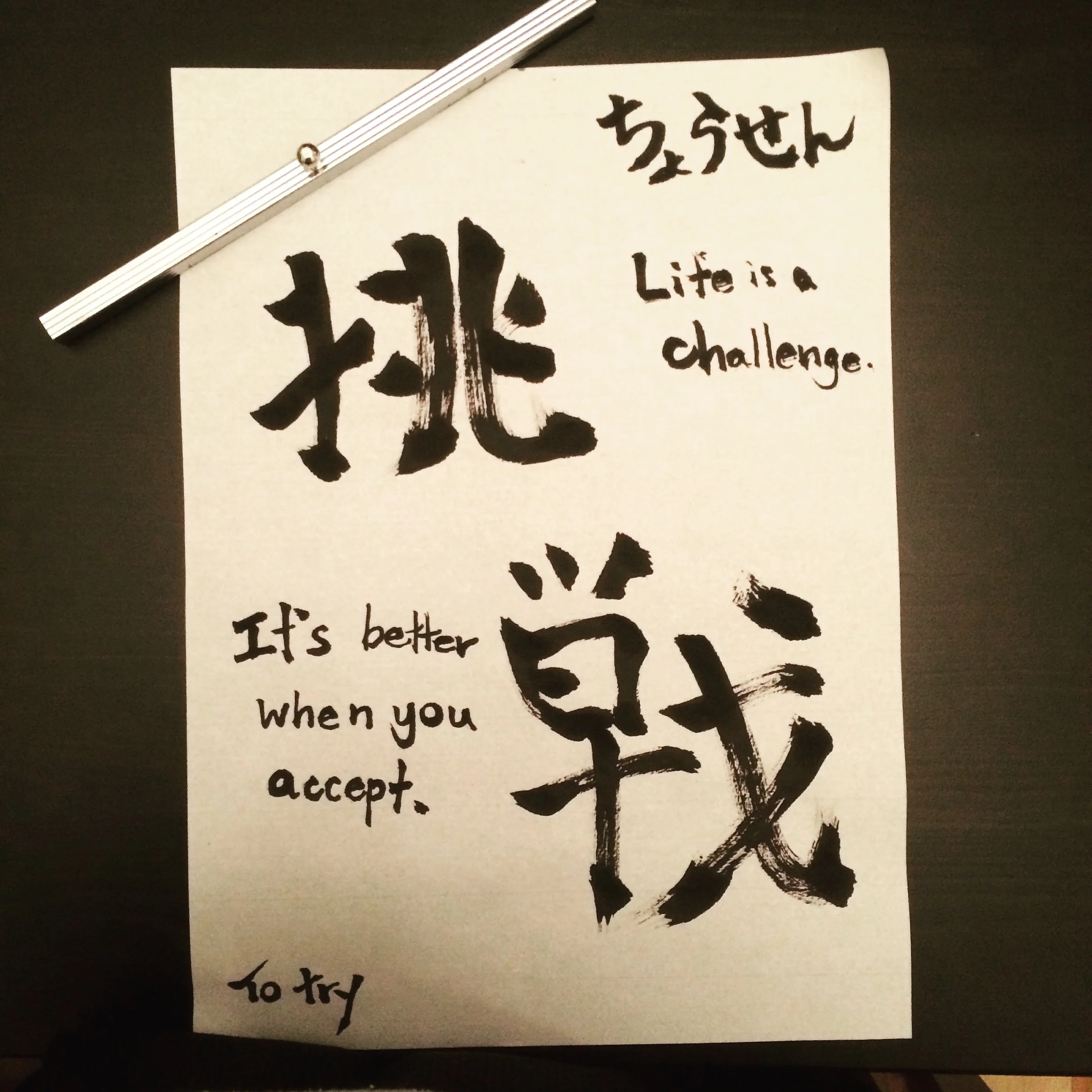
I came back the next day. “What word do I want today?” I asked myself, and waited for a response. I didn’t have to wait for long. 挑戦. Chōsen. A hard word to translate, but one that is often rendered as “to try”, or “to challenge”. I wrote it quickly, hoping that speed would equal elegance. It turned out alright.
Again, the white space at the corners of the page caught my eye. “Life is a challenge,” I felt myself writing. “It’s better when you accept.”

The word echoed in my mind throughout the morning. Chōsen. Did it make me act differently than I otherwise would have? It’s hard to say for sure. But even months later, the word still pops into my mind. I think it gives me a jolt of strength.
The next day I chose – again – the first thing that came to mind. Kansha. “Gratitude”. I felt a little bit nervous because I had been posting the calligraphy to Instagram. “Will people think I’m posting this just to look good?” I worried. The next thought was even more worrisome: “Am I actually posting this just to look good?”
I thought about it for a second. "Maybe not just to look good,” I reasoned. Then I paused. “But at least a little."
Then I posted it.
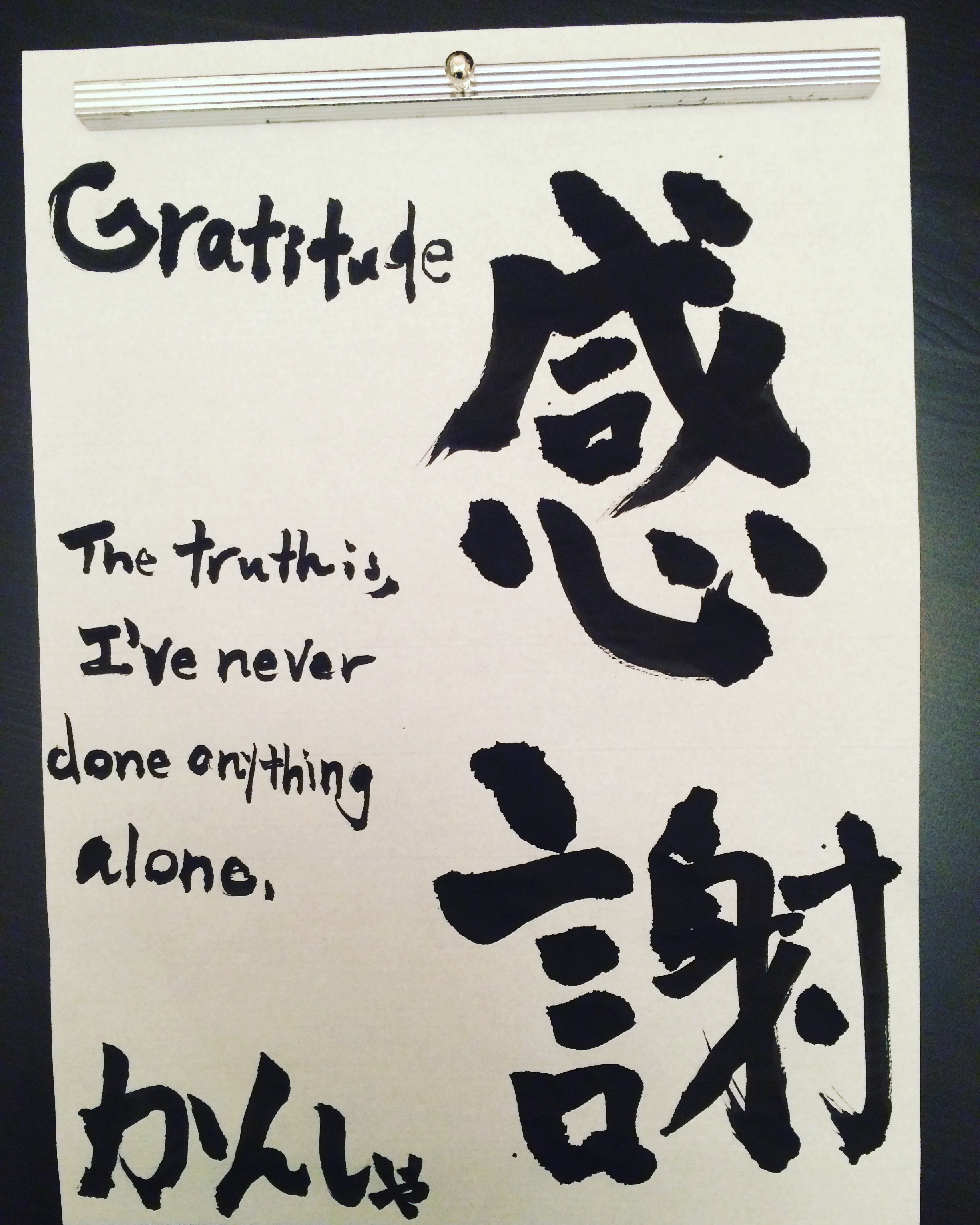
For three weeks, I didn’t run out of words. I found that every day I had something in my life to work on, and I was eventually able to find a word to express it. Here are some of the words that came to mind as I thought about what I wanted to bring to the day.
Nobiru. To grow. I’ve found that holding the intention to grow is enough to transform what would otherwise be the meaningless detritus of the everyday into (what at least feel like) important lessons.

Shuchu. Focus. Sometimes focus happens naturally, but usually I have to maintain it in the face of distraction. Intending to do so (and continually reaffirming that intention) is the first step.

Junan: flexible. Hansei: reflection. Norikiru: to get by.
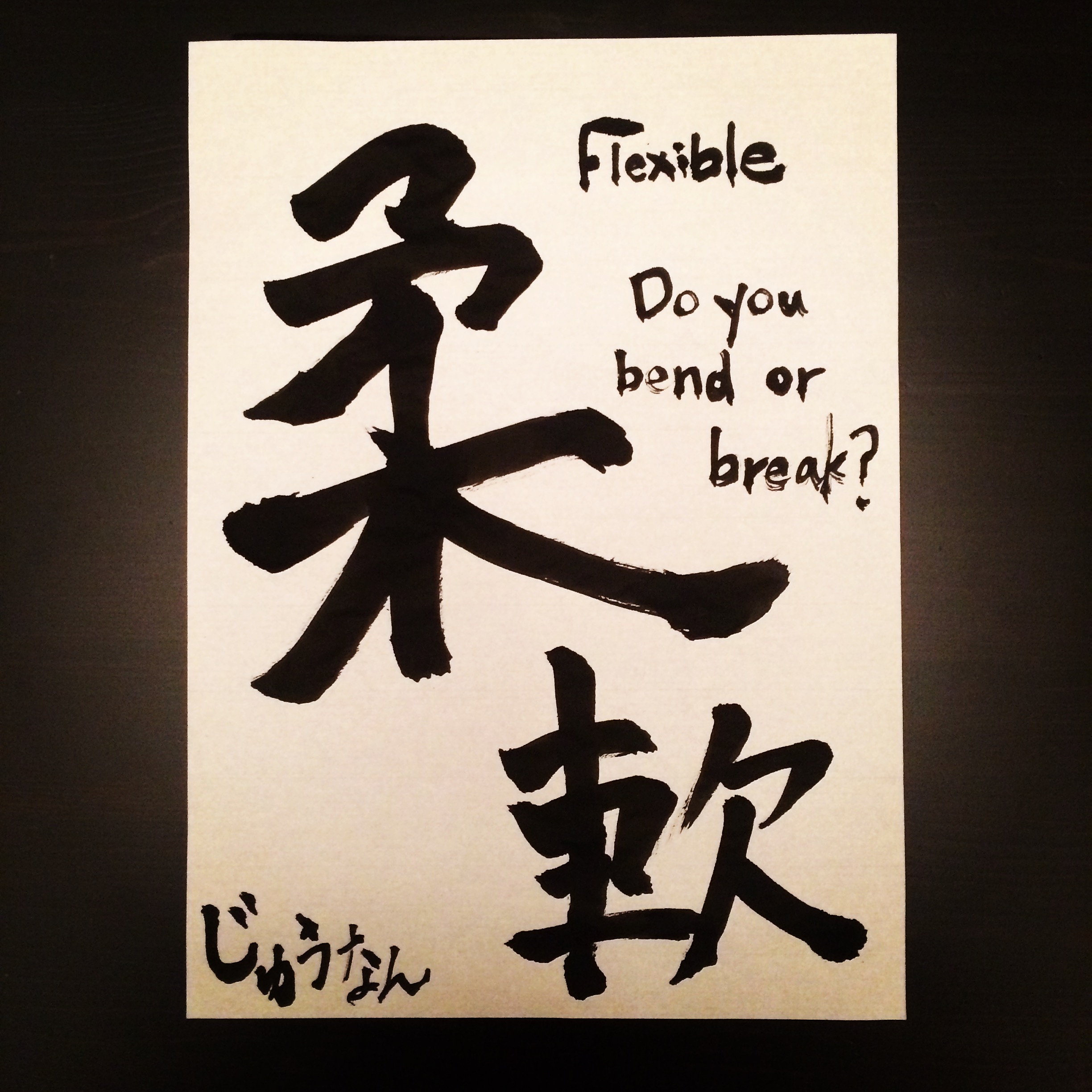
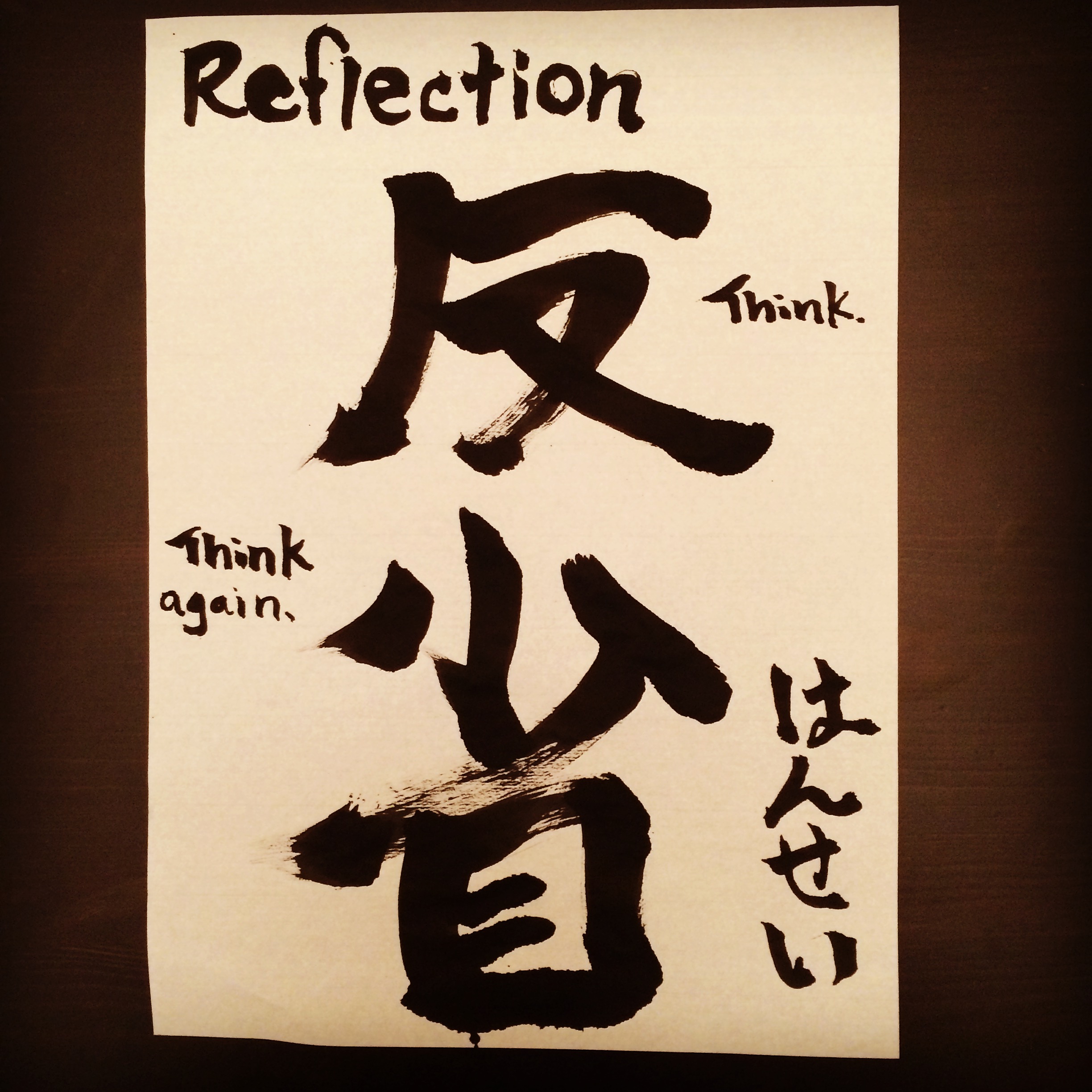
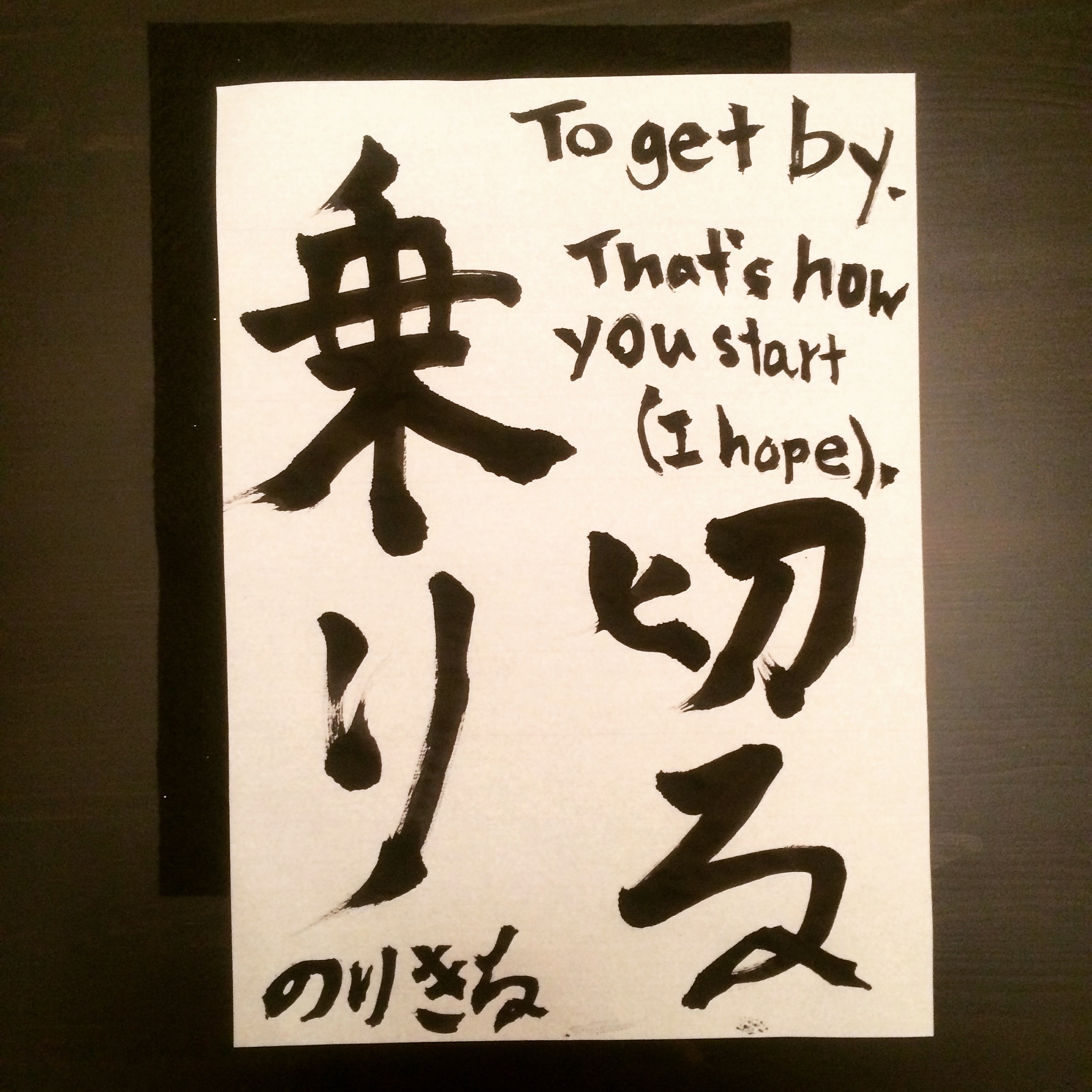
It was an interesting experiment. It lasted three weeks. It changed from a morning ritual to an evening one. It ended not because I ran out ink, but eventually, the drive. I also ran out of words. Once or twice, my first attempt was so bad that I had to allow myself a second. But more often than not I waited out the impulse.
What made one day better than another? What conditions allowed the brush take over one day, and prevented it from doing so on another? It’s hard to say. Sleep quality, maybe. My mood, definitely. To tell the truth, there were some, or maybe many, days that I really didn’t want to write anything.
“Let’s skip it today,” a voice often said. "Do you really want to take all that gear out just to write on kanji?"
“I know,” I always forced myself to reply. “It’s kind of annoying.
“But we’re doing it anyway.”
*
Handwriting has taught me that I don’t always want to do what is good for me. It started in fourth-grade. I didn't want to shrink my letters to fit in one line. My letters fit perfectly fine into three lines. But I needed to grow up; I would be in trouble today if my letters were still six-inches high. Ten years later, I didn’t want to change my Japanese handwriting either; however, if I hadn’t, I would have missed out on a chance to participate in what I now consider to be a very meaningful art form.
The lesson I took from the calligraphy experiment is the same: writing the characters took effort. I had to expend the energy to set up the equipment; I had to think of a word, either to jump-start my day or to encapsulate it; I had to submit myself to the pressure of having only one shot; and I had to live with whatever I came up with, though sometimes I failed at that.
But the effort was worth it. Takemoto gave me a seemingly remedial homework assignment that lead to a craft. In a lot of ways, life is also a craft – one that I’d like to master. Sadly, without conscious effort I tend to produce a scrawl, both in handwriting and life.
Happily, I think I know what to do about that. Now the challenge is to actually do it.
Some People Live a Whole Lifetime, and They Never Learn to Love the Rain • Adrienne Pieroth

BY ADRIENNE PIEROTH
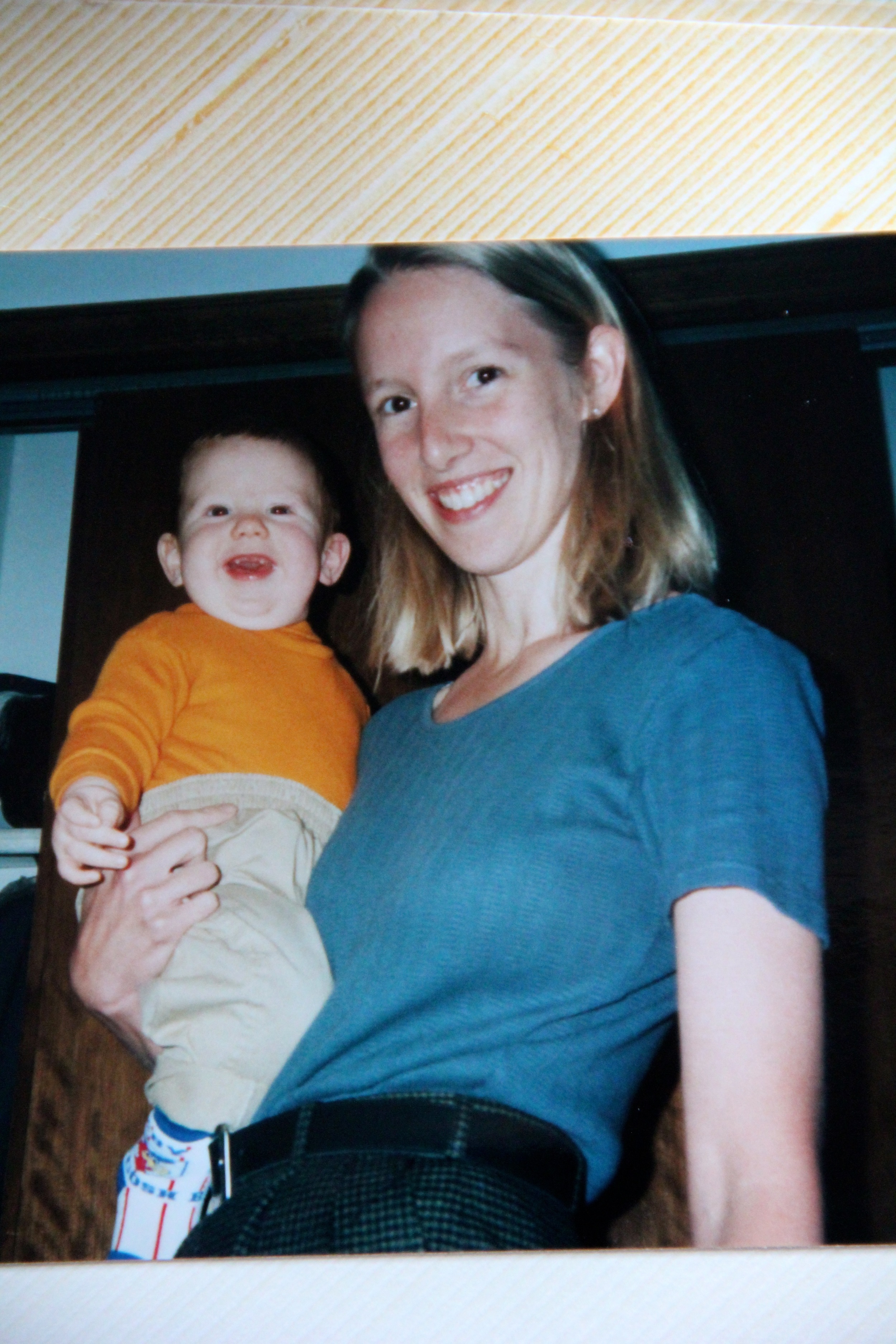
I received this letter towards the end of my freshman year in college. I was away from my hometown of Denver, Colorado, attending Drake University in Des Moines, Iowa. It had been a year of adjustments for me — some good, some challenging — like most 18 year-olds spending their first long period of time away from home. My mother had always been the center of my life, the touchstone I would return to over and over again for comfort, love, a hug, a laugh, or a cup of tea and a much-needed chat. My mother was British and had me late in life the at 39 years old.
Perhaps it was her older, wiser years that made her such a solid and grounded figure in my life. If you asked me what defined the word “home” for me, I would say without hesitation, my Mum. While being away from the comforting home and life she had created for me was difficult at first — her care packages and letters she sent each week made all the difference. Most of the letters were about daily stuff — what was happening at home, with my Dad, or how the cats were doing. But towards the end of the year, this letter arrived. I knew it was special from the minute I opened it. I had no way of knowing that less than five years later, I would be sharing the words in this letter as part of the eulogy I gave at her funeral.
Throughout my high school years my mother battled a rare form of cancer. During those years, I lost track of the number of surgeries, and the radiation and chemotherapy treatments. But all the while, I never once remember her complaining, or asking “why me?” Perhaps the fact that my mother grew up in England during World War II, where nights spent in bomb shelters, rations and stories of sacrifice and bravery defined her youth. All I knew was that my mother had incredible strength, optimism, and not for one minute did she ever believe she wouldn’t survive her battle with cancer.
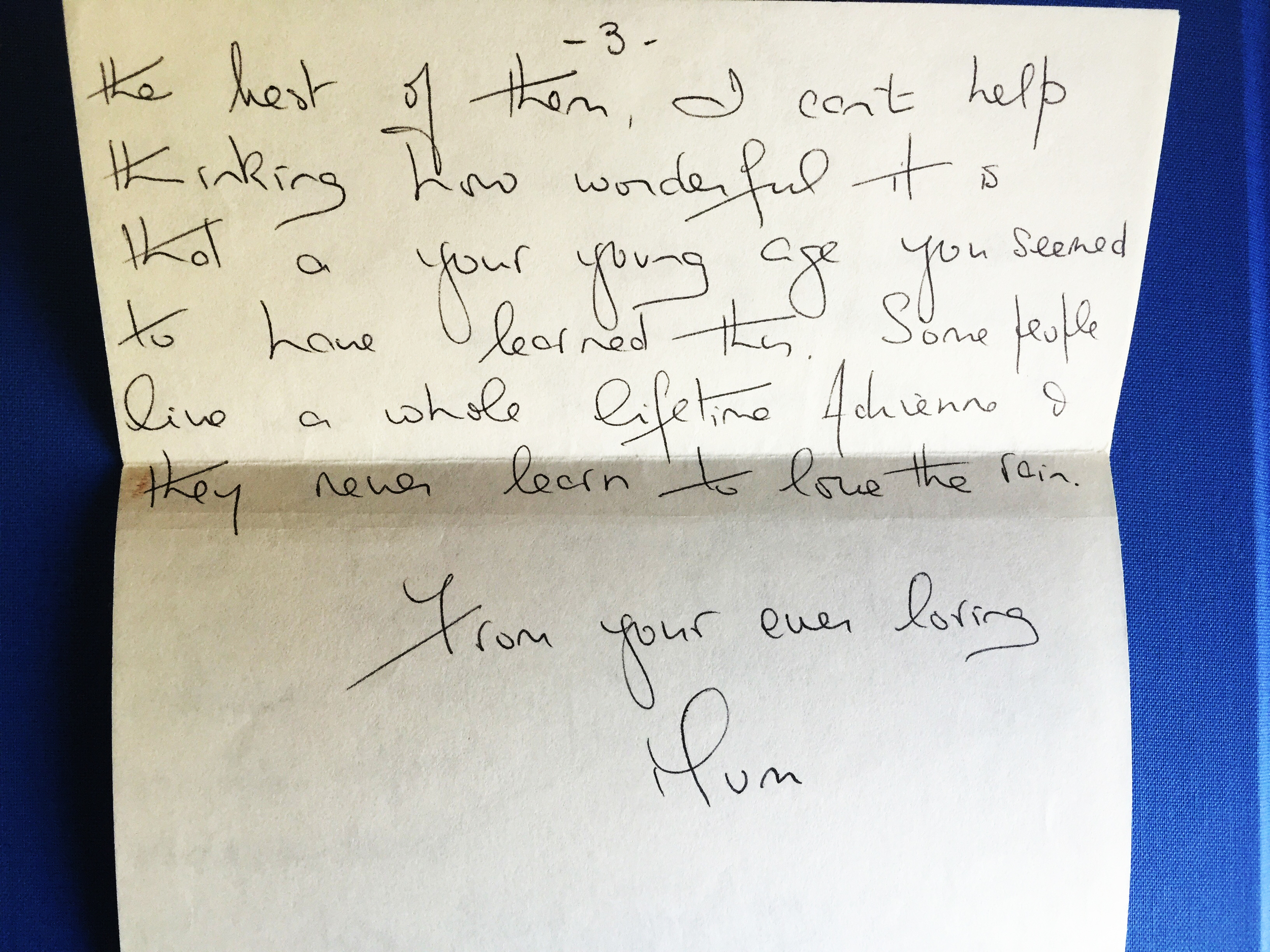
When I first read it, the part of the letter that struck me most was that she was proud of me. My mother always told me she loved me and how proud she was of me, but it was something different to see it in words, written on a page, in her beautiful handwriting — handwriting, by the way, I couldn’t read until I was nearly ten. My mother had been a secretary and knew shorthand, so her writing was a combination of cursive and shorthand in a style all it’s own.
Years later, at her funeral, it was her last words that spoke to me most, and the ones I shared with family and friends gathered to say goodbye. They were:
...we have to have some grey days in our lives in order to appreciate the bright sunny ones, and we have to make the best of them. I can’t help thinking how wonderful it is that at your young age you seemed to have learned this. Some people live a whole lifetime, Adrienne, and they never learn to love the rain.
If I learned to love the rain, I learned from my mother’s example. Looking back, I wonder which of her grey days she was remembering as she wrote those words. The day I read those words as part of her eulogy was the greyest day of my life to date, even 26 years later, but the brightness of her love and the memories of my time with her outshine the rain. Whenever I want to remember this, I need only to open the envelope that contains my mother’s beautiful words of love and support to be reminded.


April 29th, 1985
My Dear Adrienne,
I am looking forward so much to having you home for the summer. To hear the front door open & to hear you say, “Hi it’s me.” Your dad & I have missed your very much since you went off to college but we know this is the first stage of our daughter’s independence. We love you very much & we are so very proud of you. We know you have worked long & hard in all of your classes & it’s been a struggle, so many times wanting to go out & have fun, or go to a party, but knowing that you have homework to do and that the studies come first.
You have always been able to appreciate the small things in life, Adrienne – a diamond ring – a new 28oz – a trip around the world! So just kidding, I really mean the small & important things in life. When we talked on the phone last week I remember your comment on the weather. It was raining & you said when you were passing a couple of students they were complaining about the rain; how wet & miserable it was. You told me you were smiling inside because it brought back memories of England back to you & the air smelt so sweet & fresh.
Life is a little like that – we have to have some grey days in our lives in order to appreciate the bright sunny ones, & we have to make the best of them. I can’t help thinking how wonderful it is that at your young age you seemed to have learned that. Some people live a whole lifetime Adrienne & they never learn to love the rain.
From your ever loving,
Mum
A photo of Adrienne and Mum
Artistic Expression is as Essential as Breathing • Mary Fratesi
In this micro-reflection, Mary Fratesi finds delicate words for the most difficult of experiences: watching a loved one in pain. While this piece began as a pairing of two images, which has a fluency of its own, Mary takes us beneath the tree, and between the lines.
BY MARY FRATESI
Expressing my own thoughts pushes me outside my comfort zone. This is a good thing. Looking at these two pictures, you might understand something of the essence, but the context would be necessary to connect the thread for the lived experience.
The building is Northwestern Memorial Hospital, where my daughter is in ICU. I have watched epilepsy nearly rob her of her entire life. The emotions are raw and consuming. I have difficulty pulling cohesive thought together and onto paper.
But I was drawn to their togetherness—the image and these words—as I love the act of writing, for lack of better words. These words are my normal every day writing. I studied calligraphy when in High School. I tremendously enjoyed it and practiced daily for hours. I am often told I am a good writer and seem to produce written bodies of work that often surprise myself. Without question, and speaking for myself, writing and photography are a passion through which I share myself. I tend to keep everything inside, preferring to focus on the needs of others, to help others realize their own gifts and to be their best.
When it comes to expressing the great deal of sadness I have come to accept, I'm flooded with so many thoughts, that I find it tremendously difficult to find the words, in any semblance of cohesiveness. Artistic expression is as essential as breathing.

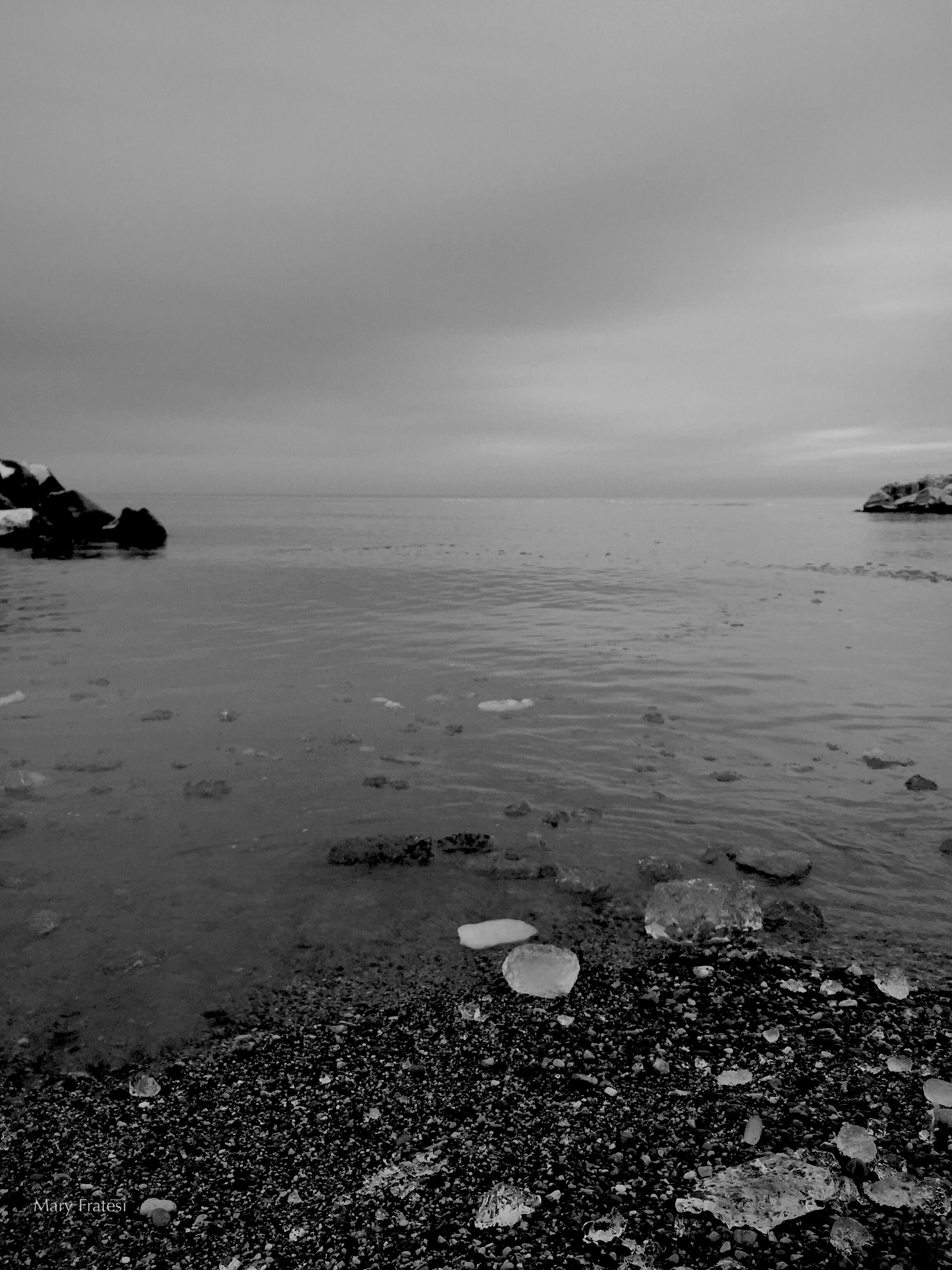

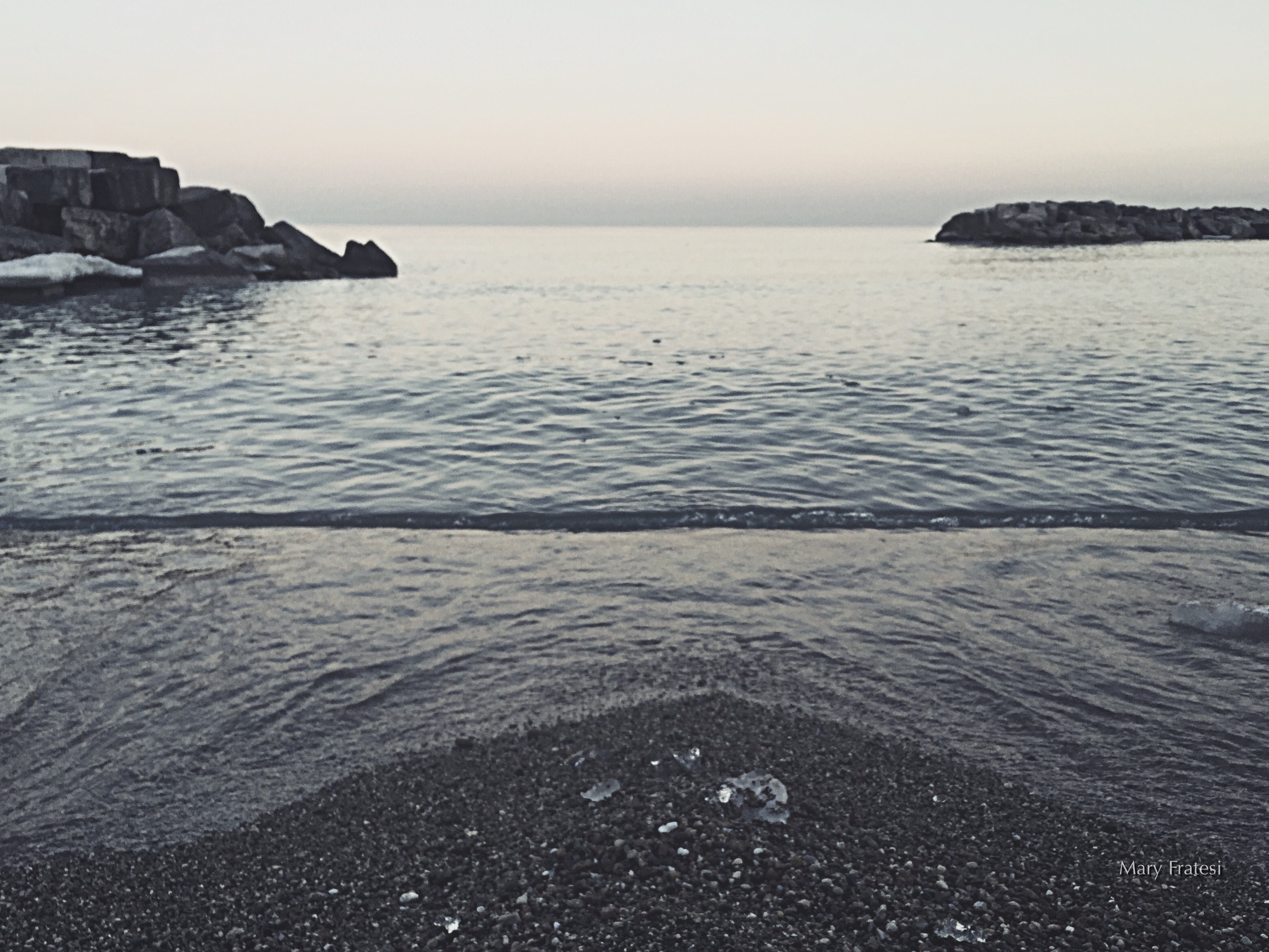


Mary Fratesi recently uncovered this photograph the other day, which is a picture of her practicing calligraphy when she was near 15-16 years of age. In the image, she is in her high school art classroom.
This Diary is Worth So Much More than the Paper it is Written On • Melissa Dundas-Paine

BY MELISSA DUNDAS-PAINE
Our mom was diagnosed with colon cancer in 1989. It was a highly emotional time for our family, as Papa (our Dad's Dad) had just passed in a tragic car crash. Our Mom had surgery and underwent treatment shortly after the diagnosis, but being so close to our Papa, I can only imagine she immediately felt faced with her own mortality. I remember her saying that Papa visited her in a dream and told her it wasn't her time to go yet. She decided sometime between then and her death five years later that she needed to write down the story of how she met our dad, Papa's son, as well as when and why they decided to have children.
But we didn't know this back then. Our dad gave us this handwritten story after her passing. She had also taken the time to type it out, but as you can imagine, the handwritten account tugs so much more at our heartstrings. There is just something special about seeing our mother's penmanship. It evokes so many sweet memories.
She passed while we were all young, before any of us had started dating. But to have this account written by her of how she met our father and how she felt upon becoming pregnant with each of us and about the days we were born is just priceless. These are her thoughts and feelings written for us by her hand. What she must have been thinking as she penned this is just unfathomable. I'm sure she hoped we would be older and that the journal would have been full of more stories, but tragically, it sits less than a quarter full of her handwriting, as her life was cut short at the age of thirty-nine.
This diary, or mini memoir, is a treasure to my sisters and myself, and is worth so much more than the paper it is written on.

Chris & I got engaged on June 10th, 1975. He was so romantic. We went parking by the lake, he asked me if I would be his wife and then slid the ring on my finger. (What a love). One time, maybe a year before this, we were at a hockey game (Flyers). Chris asked me “why do you want to marry me?” I said, “because I want you in my life forever.” He said, “well if I marry you it will be forever.

I remember the night Chris said to me, “I’d like to start to try having a baby, what about you?” I was so excited I couldn’t sleep. It was in March. It took 3 months it seemed like forever. Chris enjoyed the pregnancy so much. We would lay on the couch at night and wait for the baby to kick. All my babies were very lazy, maybe 10-15 kicks a day.
Seventy Years Ago Today

By Carly Butler
It was while moving my grandfather into a retirement home that we stumbled upon 110 love letters written from my grandmother to my grandfather just after WWII. They were dated January to July of 1946, and they were tucked away in the back of a cupboard next to a slew of VHS tapes of recorded British sitcoms. My Grama had been gone for over 10 years at this point. She died when I was 13.
When we first found the letters, they were simply a precious family memento — an heirloom that we’d keep in a drawer the few years that followed their discovery. It wasn’t until 2012 that I found myself in front of the RMS Queen Mary docked in Long Beach, California, the ship that my Grama sailed on in 1946 towards her new life, that an idea started to form. I would move to England from January to July of 2013 to retrace my Grama's steps. I would knock on the door of the house she wrote the letters from, I would visit the places she visited and I would write home to my love, just as she did.
The journey of retracing my Grama’s letters 67 years later changed my life. It has led me to this exact moment, drafting up my first entry for this column on Handwritten. If someone were to have told me that a bundle of love letters would change the course of my life, bring incredible people into my path, be the foundation of a love that I have with the perfect man for me, and create a connection to my Grama, someone who left this world almost 20 years ago, I’m not sure I would have believed it.
What I've come to realize is that my gratitude for having these letters is far beyond the grand gesture or epic journey. The most meaningful part of having found my Grama’s letters is that they give me a window into a life-story of an incredible woman who walked before me. Her handwritten words allow me to get to know her as a 26 year-old women embarking on a major life decision, leaving behind everything she knew, putting her faith in love and living life the way it’s meant to be lived. Her words bring me strength when I feel weak, courage when I feel scared, belief when I am in doubt, and chutzpah to live the life of my dream, seventy years later.
Her first letter, shared below for the first time, is dated January 17, 1946, just over seventy years ago today.

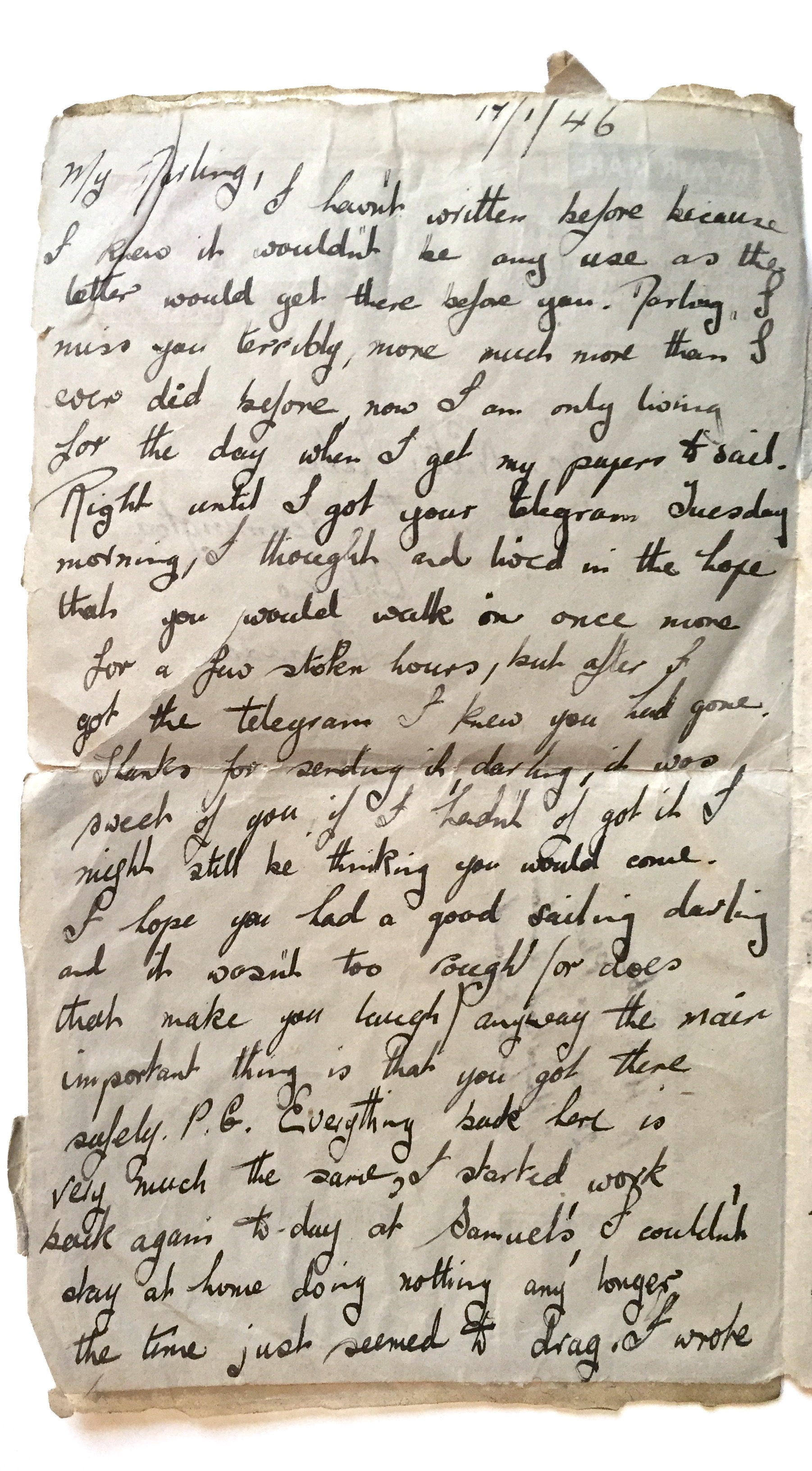
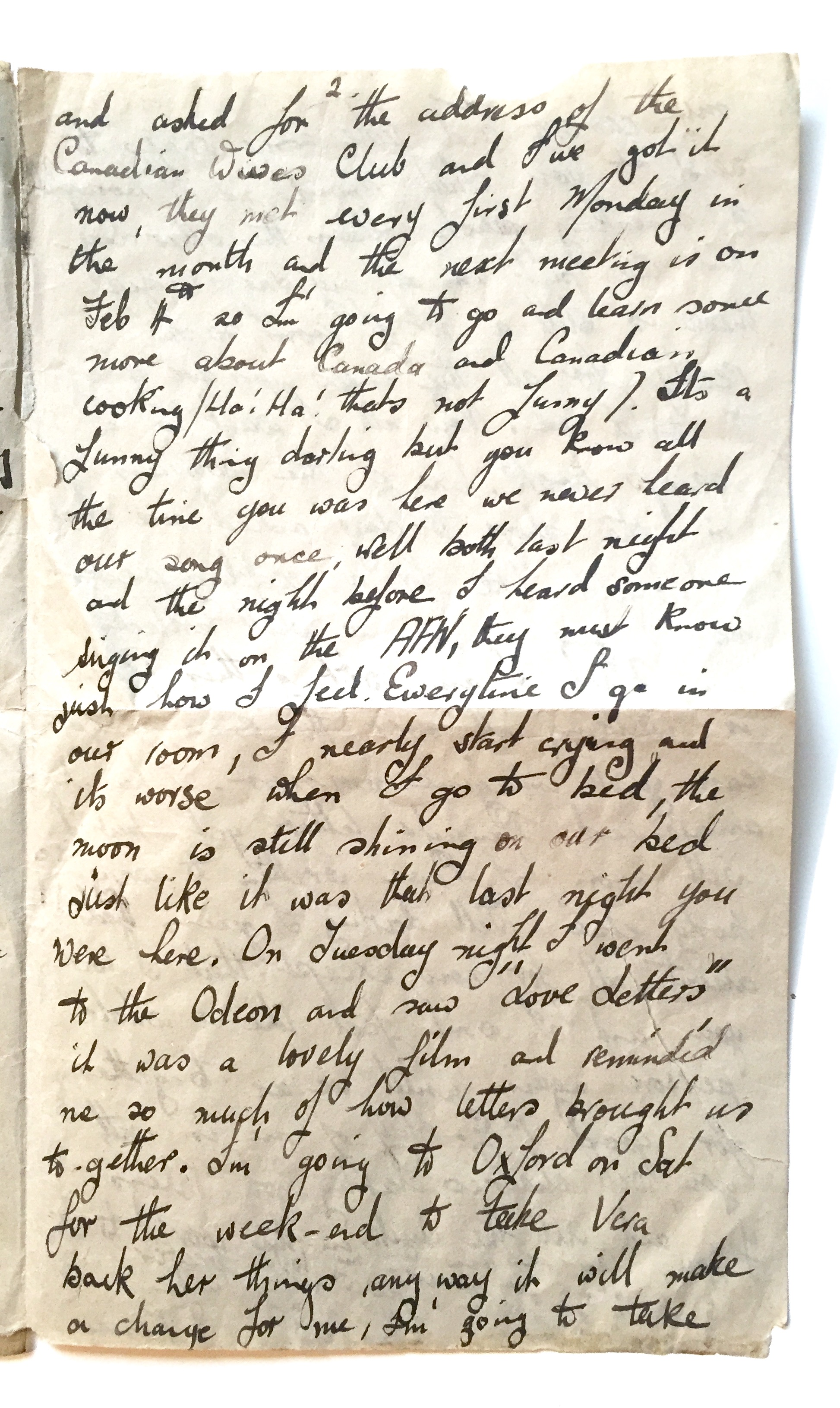
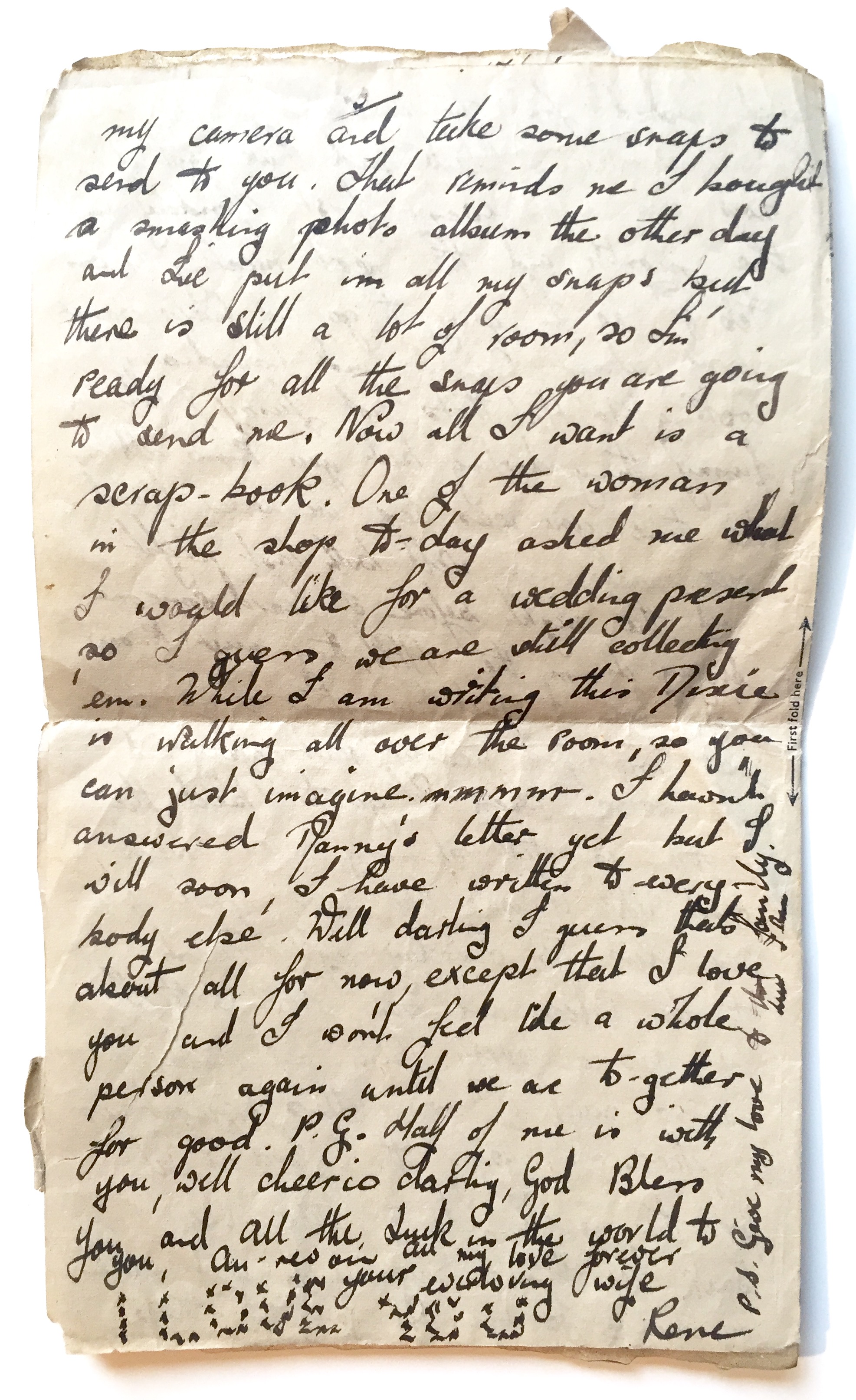
TRANSCRIPTION:
January 17, 1946
My Darling,
I haven't written before because I knew it wouldn't be any use as the letter would get there before you. Darling, I miss you terribly, much more than I ever did before, now I am only living for the day when I get my papers to sail. Right until I got your telegram Tuesday morning, I thought and lived in the hope that you would walk in once more for a few stolen hours, but after I got the telegram I knew you had gone. Thanks for sending it, darling, it was sweet of you, if I hadn't of got it I might still be thinking you would come.
I hope you had a good sailing darling and it wasn't too rough (or does that make you laugh) anyway the main important thing is that you got there safely. P.G. Everything back here is very much the same, I started work back again today at Samuel’s, I couldn't stay at home doing nothing any longer the time just seem to drag.
I wrote and asked for the address of the Canadian wives club and I've got it now, they meet every first Monday in the month and the next meeting is on Feb 4th so I'm going to go and learn some more about Canada and Canadian cooking (Ha! Ha! That's not funny).
It's a funny thing darling but you know all the time you were here we never heard our song once, well both last night and the night before I heard someone singing it on the AFN, they must know just how I feel. Every time I go in our room, I nearly start crying and it's worse when I go to bed, the moon is still shining on our bed just like it was that last night you were here.
On Tuesday night I went to the Odeon and saw "Love Letters" it was a lovely film and reminded me so much of how letters brought us together. I'm going to Oxford on Saturday for the weekend to take Vera back her things, anyway it will make a change for me, I'm going to take my camera and take some snaps to send to you. That reminds me I bought a smashing photo album the other day and I've put in all my snaps but there is still a lot of room, so I'm ready for all the snaps you are going to send me. Now all I want is a scrapbook.
One of the women in the shop today asked me what I would like for a wedding present so I guess we are still collecting 'em. While I am writing this Dixie is walking all over the room, so you can just imagine. mmmm. I have an answer Danny's letter yet but I will soon, I have written to everybody else. Well darling I guess that's about all for now except that I love you and I won't feel like a whole person again until we are together for good. P.G.
Half of me is with you, well cheerio darling, God Bless You and All the Luck in the world to you, Au revoir. All my love forever your ever loving wife,
Rene
I love you – in x’s
P.S. Give my love to the family. Love Rene.
Once A Writer, Now A Handwriter • Demetri Raftopoulos
A writer reflects on his first experience with a journal, which happened to coincide with living away for the first time as well, at the age of 26.

BY DEMETRI RAFTOPOULOS
I forgot my notebook.
It’s 5:30 in the morning and most of Thassos is still sleeping. The sun is hidden behind a couple moon colored clouds, just like the rest of the writing cohort behind their closed bedroom doors at Archodissa. I walk back past the kitchen and up the stairs towards the courtyard where the basil and oregano that is sprinkled into our dishes grows. A group of off-white stray cats lay spread out next to the garden. Their eyes are closed too.
I walk up to the balcony and reach my room. Clothes hanging to dry snap softly on a line extending the length of the balcony. I barge in and retrieve the small beige felt journal resting on my nightstand. My feet crunch against the sand I drag in from the beach every day, and close the door behind me, now ready to open my notebook on a boat that will sail through the Aegean.
Spending a month in Greece, that same notebook was next to me as much as bread was with tzatziki. With me at all times like uncertainty throughout the Greek government. Simple chance brought us together. A good friend gave it to me before leaving and if it wasn’t for him, I would have never clicked down on a pen. I would have never built another relationship alongside all the others formed around me with the clanking of glasses that month.
The notebook became my traveling companion. In a new environment, with new people, I felt safe with it. But I was also in constant need to protect it. So much so that instead of spending my last morning in Thassos on the beach, I sat at the restaurant and transcribed everything I had filled it with onto my laptop, in case something unfortunate occurred. I needed to know where it was always, the few times it wasn’t tucked into my back pocket or open in my hands. It was a friend that always gave, no matter how much I took and took and took.
I wasn’t a hand-writer. But in Greece, I became one.

The water looks dark, like the tip of a sharpened pencil. I grip the blue siding of the boat the way I grip my notebook. We move slowly, a pattern of tiny ripples follow us to the fishing trap Stamatis set last night, but the boat still rocks with the unsteadiness of the water. Stamatis is a fisherman, captain of the Evanthoula, and owner of Archodissa. He stands behind me clutching onto a small metallic wheel that sticks out from above the compartment like his worn-out overalls do over his blue polo. Greek music plays from a speaker next to the wheel and we pick up speed.
“S’Agapo pou eisai oreia,” Stamatis shouts, adjusting a strap falling off his shoulder. “I love you because you’re beautiful,” I repeat to myself, taking a seat on the ledge in front of him.
I wonder if he is singing to the sea, I write in my notebook. The swaying of the boat darts my pen upward and downward. Or if he is singing to his wife, Eva. The word ‘singing’ comes out the sloppiest but I can still read it. I use my thigh as a desk and rest the notebook right above my knee AKIMBO. It’s chilly this morning and the Aegean breeze whispers across my exposed head. I pull my hood up and continue writing.
This is his life: setting traps at night to pick them up in the morning. Sleep irrelevant. And whatever the sea offers him this morning, he will still be singing. Whatever the headlines say about his home’s economy, he will still be fishing.
I flip back to earlier pages in my notebook and admire how much I have already written only into the second week of this month-long writing residency. The pages are filled with sloppily written words as if I wrote them descending King Da Ka at Six Flags but my words are there, nonetheless, engraved into each sheet.
Light begins to creep out from behind the mountain to our left, as if rising like beer poured slowly into a mug.

Stamatis is still singing. His words hit me like the morning wind but stay and land on my page instead.
The captain continues to serenade his home, his sea. He knows these waters better than the fish that swim in them. The boat moves with ease and the music blasts louder. Stamatis is Thassos’ alarm clock. The snake charmer for the sun. The dry entertainment above for those living below. He could be trying to mask the harsh sound of the Evanthoula’s engine. Provide the sea with comfort instead of impending potential capture. Or he could just love the music his favorite singers produce. It could be his constant cheery nature. That he wishes to celebrate his life instead of worry about it.
I click the end of the pen and place it in my notebook’s crease so I can stand for the sunrise. I leave the notebook closed on the ledge and face the mountain, watching it give birth to the sun. The curved arc appears first and the morning already begins to warm. I remove my hood and look back toward the notebook, tempted, but keep my eyes focused on the slowly rising sun.
This will sound a bit silly but my notebook isn’t demanding or needy. Yes, I may write in it constantly but the notebook has also allowed me to live my life separately, away from it’s pages and soft jacket cover. To admire what’s around me alone, and then share the moment with it afterward. To truly capture a moment before putting my head down. Don’t get me wrong, I enjoy sharing. But I enjoy being able to experience something on my own first and then sharing it with others. With my notebook.
The sun is halfway through its entrance and I return to my ledge. I watch the day brighten a little more before opening the notebook again.

“Ti graphis?” Stamatis asks loudly, touching the brim of his blue hat, and then resumes his song. "What are you writing?"
I turn to face him. “Kati yia sena,” I tell him. He smiles and his graying goatie does too. "Something about you."
An orange buoy appears, softly twirling in the water like the final spins of a quarter. The engine and speaker both soften and the boat inches towards its marker.
Stamatis’ beard resembles my father’s, as does his work ethic. I’ve been to Greece before but it’s been seven years since I’ve experienced that sunrise from the blue of the Aegean. With someone like Stamatis, a patriotic man, doing all he can to keep his business and world afloat. The water doesn’t have a rank smell attached to it, like the beaches on Long Island. If anything, it smells like promise. Greece is constantly on display, shackled in the courtyard of Europe for everyone to poke at. It isn’t hidden like that which swims beneath us. Hopefully Stamati will reveal some of his hard work when he pulls up the trap.
In the past, I don’t know how I would have recorded all this. With my phone? Hope to remember as much of it with my fleeting memory? Fleeting, like my presence in Greece. It’s impossible to remember every detail but with this notebook at my side, I’ve been attempting to. Whatever I don’t remember or don’t see, I’ll write into my notebook the next time I’m here. And whatever I forget will be kept alive.
The orange buoy is now at arms reach and the boat slows even more. A couple of seagulls are awake now too, circling the boat for whatever we throw back, if anything. The sun is now completely over the mountain and shines on the rest of the waking Thassos. This is when Stamati will begin to reel in his trap and wait to see what he has caught.
“Re Demetri,” Stamatis says, turning the wheel slightly, “pigene na to piasis para kalo pedaki mou.”
The captain asks me to go pick up the buoy. An honor. He is asking me for assistance, someone who is simply learning in the presence of a master. Stamatis could do all this with one hand covering his eyes and the other flicking worry beads over his fingers. My assistance isn’t paramount to his trip because surely he does this alone. However, he has entrusted me in carrying out a duty that affects the well-being of his family.
I’m still tempted to stay seated and write. To witness something invaluable I could never see elsewhere and fill more pages. Write this scene of him picking up the traps. Write with detail the way each fish looks, how they move, and sound. Describe the definition of Stamatis' aging yet tone muscles flexing with each pull of the trap. How his blue shirt matches the water he’s pulling fish out of. How the mechanized pulley reeling in the trap sounds alongside the rest of the emptiness we are surrounded by.
Instead, I leave the next page blank. I close my notebook, stand, walk to the front of the boat, and reach for the buoy.
Braiding Together Our Lives
A project that weaves together generations, experiences, and handwritten expressions.
BY SARAH MADGES
When my grandfather died a few years ago, I realized I didn't know how to process the loss because I hardly knew the person I was losing — I hadn't gotten to know him in his lifetime. With one remaining grandparent, I decided I needed to make sure I got to hear her story before I was forced to hear it from someone else. I wrote her a letter asking if she would share her life story with me, in as much detail, and whatever order she felt most comfortable with. I didn't expect her to respond so quickly, or at such length — even less did I expect her to keep sending letters once I stopped writing her back with specific prompts and encouragement.
As I gave her so few guidelines — tell me your story — it was interesting to see the way she segmented her life into chronological bits with titles corresponding to the content, like "Childhood Years," or "War Years." It was also fascinating the details she would include, recalling them in such vivid language — the white snakeskin tennis skirt she wore — while other sections she'd leap past, moving from her first date with her husband Clarence to marriage in a matter of paragraphs.
What's more, I was struck by her handwriting. As I read letter after letter, I came to see her in the handwriting — the bodily trace pointing to the human body, my grandmother, herself. I was reading Susan Howe's That This, whose cut-up quotes from manuscripts overlap to create beautiful excised art-meets-poetry, when I realized that's exactly how I wanted to preserve my grandmother's penmanship. I decided to create a visual art piece splicing her handwritten account of her life with my own handwritten account of my life. A life she knows as much about as I knew of hers before the letters. In one sitting, I wrote a truncated autobiography on a legal pad, demarcating sections the way my grandmother had but with alternate titles (there's no war for me to tell a personal account of). I scanned and printed everything, and began cutting out phrases, creating a redacted work in the spirit of blackout poetry that I then arranged and pasted onto card stock.
Braiding together our lives in this way brought me closer to her, and helped me contextualize my own life in its comparatively short run. As I keep working through our letters in sequence, the project grows in size and scope, and I can sense that the true subject will find itself in the process.
The Screen Test • Joyce Chen
Is the notebook half-empty or half-full? In this essay, Joyce Chen sets out to test and trust her hand, a routine tethered to time, with the hopes of avoiding the pitfalls of resolutions by resolving to reflect. Are you up for the screen test?
BY JOYCE CHEN
I’ve never been one for New Year’s resolutions.
Not because I don’t believe in the psychology behind them – God only knows how much I am an advocate for self-reflection and self-improvement – but because I’ve always had a sneaking suspicion that New Year’s resolutions are actually made to be broken. The way they’re worded and thought about almost always sets the resolution-maker up for failure: “This year, I resolve to work out more” (meaning, what? Buy a new pair of running shoes and use them thrice instead of once?); “This year, I resolve to be a better friend” (read: respond to emails in two months rather than four); “This year, I resolve to spend more time with family” (but more time with family doesn’t mean a thing if you’re still plugged into a device while sitting in the same room, right?).
This may sound a tad bitter, sure, but to be perfectly honest, I only feel okay making these jabs because I’ve made these resolutions before, and by that same token, I’ve also failed at these resolutions before. There’s something exciting about starting a new calendar year that nudges our inner navel gazers awake to notice our shortcomings and attempt to remedy them with a promise to “be better.” But what I’ve come to discover over the years is that while New Year’s resolutions are always well-intentioned, they are often more about finding a temporary, band-aid solution to problems than actually digging deeper to get to the core of the issue.
A desire to work out more, for instance, might stem from guilt over poor lifestyle choices (ie. late nights, fried foods, overindulgence of all kinds), not an actual desire to exercise more. The resolution is less about running and lifting, and perhaps more about thinking about and taking control over our daily routines.
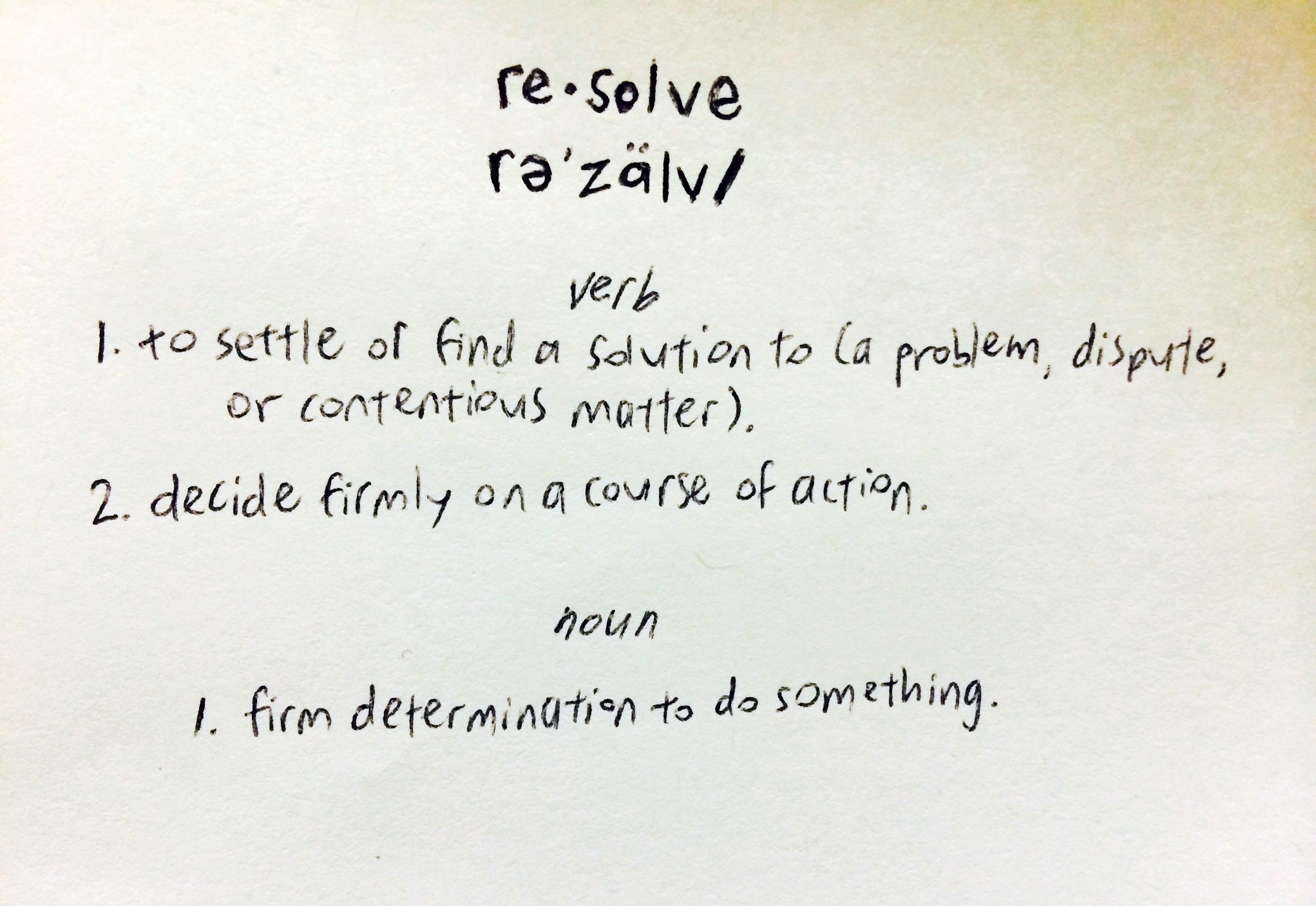
To that end, then, I would rather have resolve (n.) than to resolve (v.), because my goal isn’t to reach a conclusion right away; no, I want to understand my own process as it is unfolding. I would rather have the noun in my back pocket as a reminder than the verb in my front pocket, at the ready for a quick-fix solution. So this year, instead of a New Year’s resolution, I decided to have an anti-resolution. A plan to test my own willpower by opting not to do something that has become dangerously habitual to the point of dependency: stare at a screen all day.
I realize that as I am writing this, and as you are reading this, we are both staring at a screen – and that’s just fine. So to clarify, my decision to not stare at a screen is less a dramatic political statement and more a modified lifestyle choice, an experiment: Between the hours of 10:30 a.m. and 10:30 p.m., I allow myself to carry on as I always have – answering emails, scrolling through headlines, and laughing at silly GIFs. In those 12 hours, I feel connected to the greater community of the Interwebz, corresponding with friends halfway around the globe, pitching ideas to editors in other states, and engaging with a community beyond my immediate line of vision; I am in a digital portal and can free-float through both time and space.
And beyond the computer screen, I also allow myself to get lost in my iPhone, in the TV screen, in a number of other electronic means of communication; I express myself in words and emojis, and absorb new thoughts and ideas in the form of the news, news feeds, TV shows, Instagram, Facebook, Tumblr, Twitter. The sea of garbage, as a professor of mine once called this vast ocean of information, is alive and pulsing during those 12 hours.
This is what screens have given us, after all: a means to access other people, places, thoughts and head spaces, from wherever we happen to be at a given moment. And I am grateful for the distractions, as we all likely are, because that means that we can sometimes push aside the more immediate tasks at hand in favor of temporary escapes. But there is a threshold; there must be.

For me, that was last year, when I realized I was checking my email first thing in the morning and watching shows and films until I fell asleep at night. There was this feeling of dependency, of addiction, a light-bulb moment realization that I was literally spending all my waking hours as a slave to my many screens. I wasn’t getting good sleep, and I wondered sometimes if it was because my brain was going through withdrawal from not having a backlit device pointed straight at it during the hours I slept.
I realized that part of the problem with always being plugged into a device was that I was hop-scotching from distraction to distraction and was therefore not always quite here, the physical space I was occupying. And this meant, as a result, that hours and days and weeks and entire years were flying by without my ever having really experienced what was happening in the moment at the moment. I was living life in retrospect.
And that was a problem.
So though I still take part in the digital sphere between the hours of 10:30 a.m. and 10:30 p.m., these days, I’m opting to spend the hours prior to and after that off the grid a bit, focusing more on the who and the what of where I am during that time. Unplugging is the how. To experience life more vividly and fully is the why.
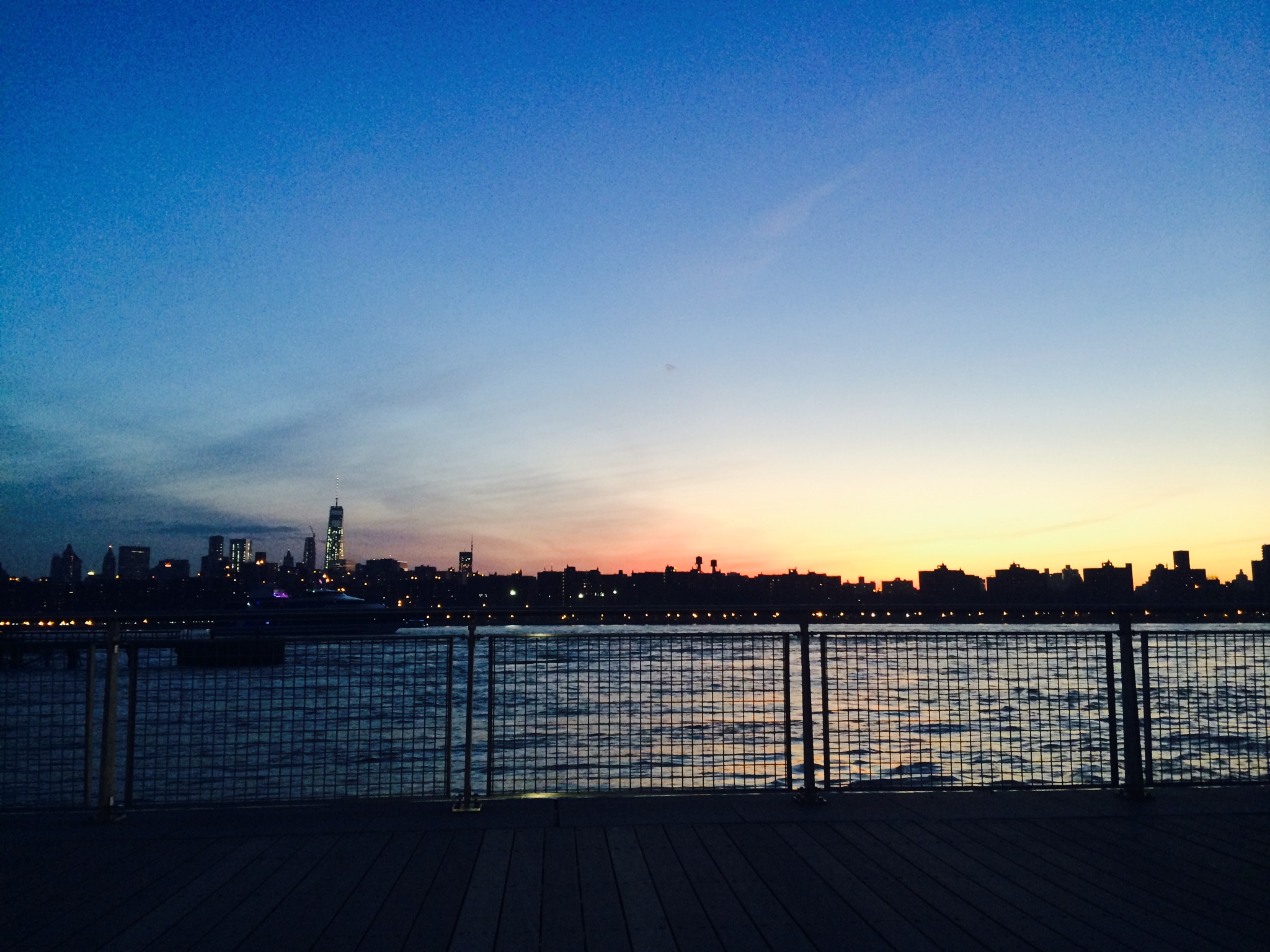
During those hours, I meditate and I think and I read and I write a lot (by hand, of course). There is a kind of stillness and peace I find in not being in front of or dictated by the influx of information found on a screen. It’s a feeling that I had long forgotten, and would most likely have continued to forget, if I hadn’t taken a step back and realized how my days had become inundated by thoughts and demands not my own. Being separate from the screen is giving me the luxury to do something I never thought I’d be able to do in this digital age: really hear myself think.
In the beginning, it was always tempting to cheat and take a quick peek through my phone in the morning just to see if there were any pressing emails or Facebook notifications or Instagram likes that took place overnight. But because I had given myself these rules and parameters, I felt a duty to keep myself in check, lest I disappoint myself with my own lack of willpower. I started to analyze that temptation, observe myself in third person during those morning handwriting sessions, and realized that much like Pavlov’s dogs, my instinct to check my inbox was more about the reward of attention (“so-and-so has replied to your email!”) and importance (“inbox: 52 from just one night? People really need to reach me”) than from an actual need to know information.
I am now finding that in those hours away from the screen, I am able to engage more fully not only with the present moment but also with myself, so that I know how to better navigate through the treacherous technological waters (and, to a certain extent, through social situations at large).

Now I write waterside, in cafes, in my room, in outdoor spaces that aren’t constrained by lack of wifi, outlets, or table-space. All I need is a pen, a notebook, and my fully focused mind. It is freeing.
Call it a reintroduction.
I feel more in touch with and honest with how I’m feeling because my thoughts are not as cloudy at the beginning and the end of each day, and I am starting to be able to translate some of that clarity into my daily living as well.
Call it a recalibration.
I sense myself being more selfish with my time and more careful in how and with whom I spend it.
Call it a reassessment.

The way I see it, we already segment our lives into so many distinct compartments based on how we spend our time anyway: family time, work time, free time, leisure time, personal time, social time, food time, sleep time, and on and on and on. So why not look for new ways to section off hours of the day, to break down previous habits and routines and build something new and perhaps, hopefully, more sustainable?
I’ve never been one for New Year’s resolutions because making them is, I think, a way to feel the thrill of a personal promise without any real commitment. Being more physically active, communicating more with loved ones, and reprioritizing our actions and activities are all noble pursuits, but what all three require above all else is a space and place to really explore the reasons why we want those things. And for me, I’ve found that space and place in my hard-won now, and I want to hold onto that feeling.
Every year, in place of a New Year’s resolution, I like to think of a single word to hold in my mind for those times throughout the year when I start to lose focus. In 2013, it was Create. In 2014, it was Trust. This year, 2015, I decided that my word would be neither verb nor noun, but a state of being.
In 2015, I have resolve: I am Awake
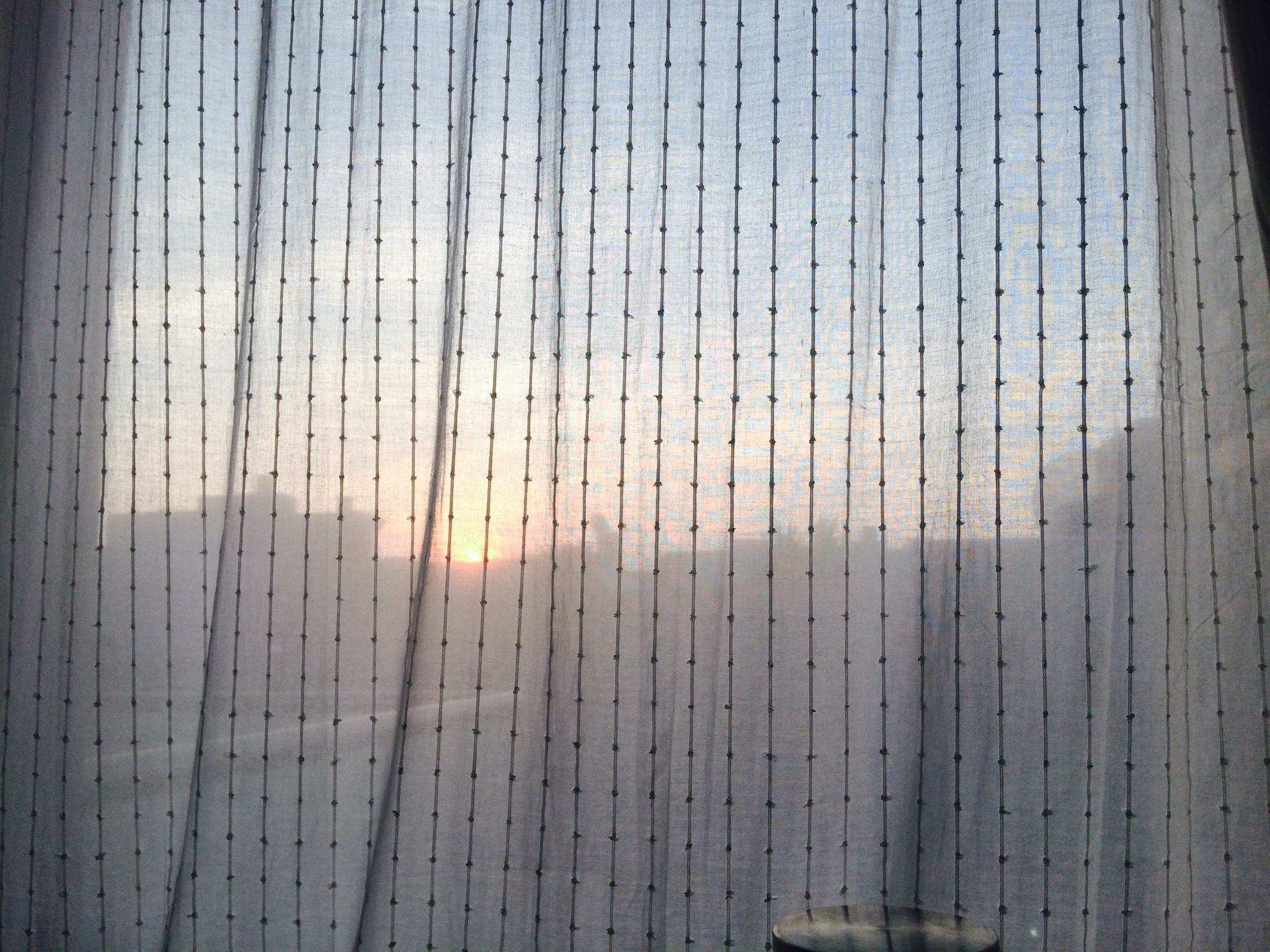

Joyce Chen is a handwriter in Brooklyn. She is also a journalist who thinks she spends too much of her time staring at screens - writing for print and the web, watching and reviewing films, and sending strings of emojis to family and friends. When she's not plugged into the World Wide Wonder, she can often be found out on unplanned runs throughout New York City, taking long walks along the waterside, or otherwise stretching her legs and getting out from the great indoors.