
The Best Investment of Time and Money • A Conversation with Calligrapher Kathy Orf

BY SARAH MADGES
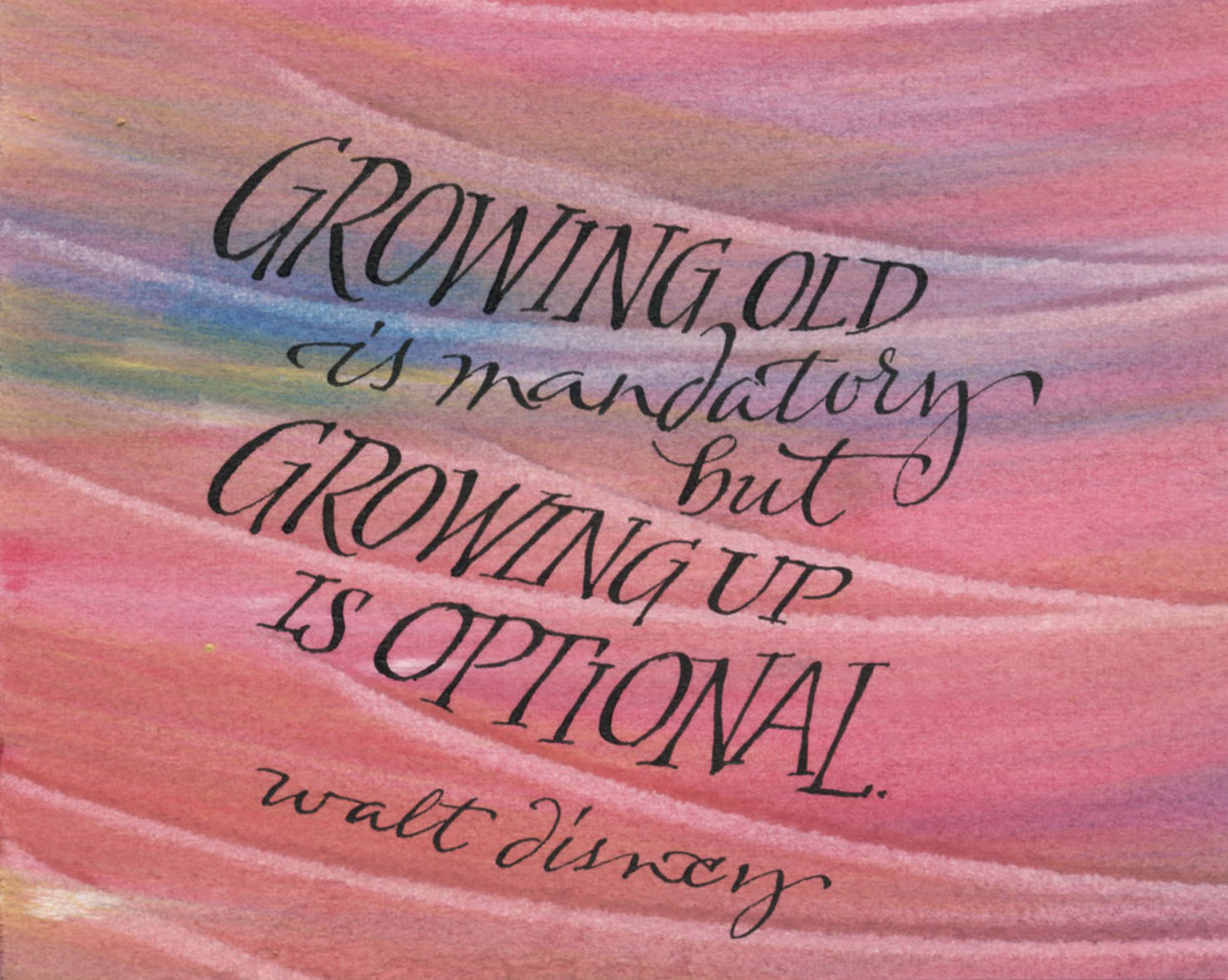
Kathy Orf is a calligrapher living and creating in St. Louis, MO. She has been practicing a “morning writing” ritual in which she sits down and draws in calligraphy without any prior planning for just a few minutes each day, a 365 project that allows her to continually approach her work in fresh ways. I had the chance to talk to her about what exactly calligraphy is, how it relates to handwriting, and how she became so invested in the art.

SARAH MADGES: How and when did you first become interested in calligraphy? How did you come to make a career out of it?
KATHY ORF: I had a “decorative arts” class in high school that included calligraphy and — I’m really dating myself here — macramé! Then in college, I majored in graphic design and had a whole semester of calligraphy, which was really rare. After graduation, I worked in graphic design until my second son (Alex) was born and then decided I should stay home and do calligraphy part time. I had started trying to sell my work at arts and crafts shows just 3 months after my first son was born and thought I would continue that. I’m not sure I would call it a “career,” maybe more of a passion or a creative outlet…It is really hard to support yourself doing calligraphy and luckily I never had to. That said, I’ve been doing calligraphy for 30 years.
MADGES: When people hear the word calligraphy, they tend to think “beautifully ornate handwriting” or “wedding invitations.” How do you characterize calligraphy — is it an art form, a process of symbol arrangement, pimped-out handwriting? What are calligraphy’s essential elements? What makes it different from handwriting?
ORF: I think calligraphy can be different things depending on how it is used. It can definitely be an art form…something which has been a struggle to achieve in other’s eyes. But it can be very utilitarian when it is used to address envelopes or fill in names on pre-printed certificates. I do not consider calligraphy to be hand-writing in any sense of the word. It takes years of practice and good instruction and some talent to reach a certain skill level. Calligraphy is not fast in learning it or its execution. The letters may look like they’ve been written quickly, but many times it is more deliberate than you might think. And the funny thing is, one important part of hand-lettering is consistency, but whenever I look at printed lettering, I look to see if the letters are identical to determine whether it is hand-done or a typeface. So, even though you strive for consistency, you also want it to look organic, like it came from someone’s hand and not a machine.


MADGES: Does your handwriting resemble your calligraphy? Have you always had good handwriting?
ORF: My handwriting is the worst…just ask my husband. But I think it is because I am always in a hurry when I am writing something and using a ballpoint pen. Put a calligraphy nib in my hand and it’s a different story. It’s almost like my hand knows what to do at that point.
MADGES: Do you have one main mode of calligraphy, or are you always inventing and adapting the letters and symbols to their specific purpose and environment?
ORF: I know many different hands…italic, uncial, blackletter, foundational, romans, copperplate…and variations of them all. But I tend to get in ruts and use the same personalized style all of the time. I guess you could call this style my “calligraphic handwriting” because that is what I use to write with most of the time. My tool of choice to create this lettering is a pointed pen…Brause EF66. It is very flexible and can be used to write very tiny or even letters up to an inch tall. Every morning, I pick up my Brause, a piece of paper that I had already painted and just write a saying using this “handwriting,” although it does not resemble my actual handwriting at all. But, when I sit down to do a finished piece, I might think more about what I want it to look like, and what style I should use, and even use a chiseled nib, like a Mitchell.
MADGES: What are your most common assignments — and what kind of clients do you attract? How long do you spend working on individual pieces?
ORF: Most of my work of late is just doing sayings for friends. I don’t advertise, except through word of mouth. I have some certificate work for Washington University in the spring and fall, and will do a wedding or two a year, but usually just for friends, as I’ve never really enjoyed the rote nature of the work. I also create pieces to sell at fairs using my photographs of things that look like letters that I combine with my calligraphy. I can usually do a simple lettering job in a couple of hours. If I am creating a background and lettering a larger piece, it takes maybe 6 to 8 hours — it really depends on so many variables.
MADGES: What do you think about the diminishment of handwriting and cursive lessons in U.S. schools? Have you noticed any change in the demand for and reception of calligraphy as handwriting diminishes in use and popularity?
ORF: I think it is terrible that they are trying to stop teaching handwriting in schools. I think it is one of those things that they will later decide was detrimental to cognitive development. I’m not sure diminished use of handwriting has affected the popularity of calligraphy as much as the increase in fonts that look like it!
MADGES: What are some of your favorite examples of calligraphy in general — historical, global, etc.?
ORF: I just went to see the Book of Kells this summer at Trinity College in Dublin and it was amazing. I also love the work that Donald Jackson did on the St. John’s Bible that he just completed a couple of years ago for St. John’s Abbey and University in Minnesota. But I am mostly drawn to and excited by contemporary calligraphy.
MADGES: Why do people respond to it? Do you think there will always be a demand or desire for calligraphy?
ORF: I think people respond to calligraphic work because it so often interprets words in a way that touches them. Sometimes it’s because it is something they “wouldn’t have the patience for” — I hear this very often. And sometimes just because it is beautiful! I think there will always be a desire to do calligraphy as art, maybe not as much of a demand for invitations and such, although the whole retro movement may help, like it has for letterpress printing! But to survive, I think it will have to grow more into the realm of art and it has been doing that for a while now.
MADGES: Any advice for calligraphy enthusiasts out there?
ORF: Join your local calligraphy guild. Learn from good teachers and don’t just take a class and never do it again…practice or do homework if it is assigned. The best thing I ever did was to take a year-long class taught by a calligrapher named Reggie Ezell. He travels to four different cities for one weekend of every month of the year teaching almost everything you need to know. The great thing is that there was homework each month, and I DID THE HOMEWORK…and that made all of the difference! Unfortunately, Reggie is retiring after next year. But that was the best investment of time and money I ever spent.

Time is Our Wealth, Time is Our Slave • Nivedita Nivasini
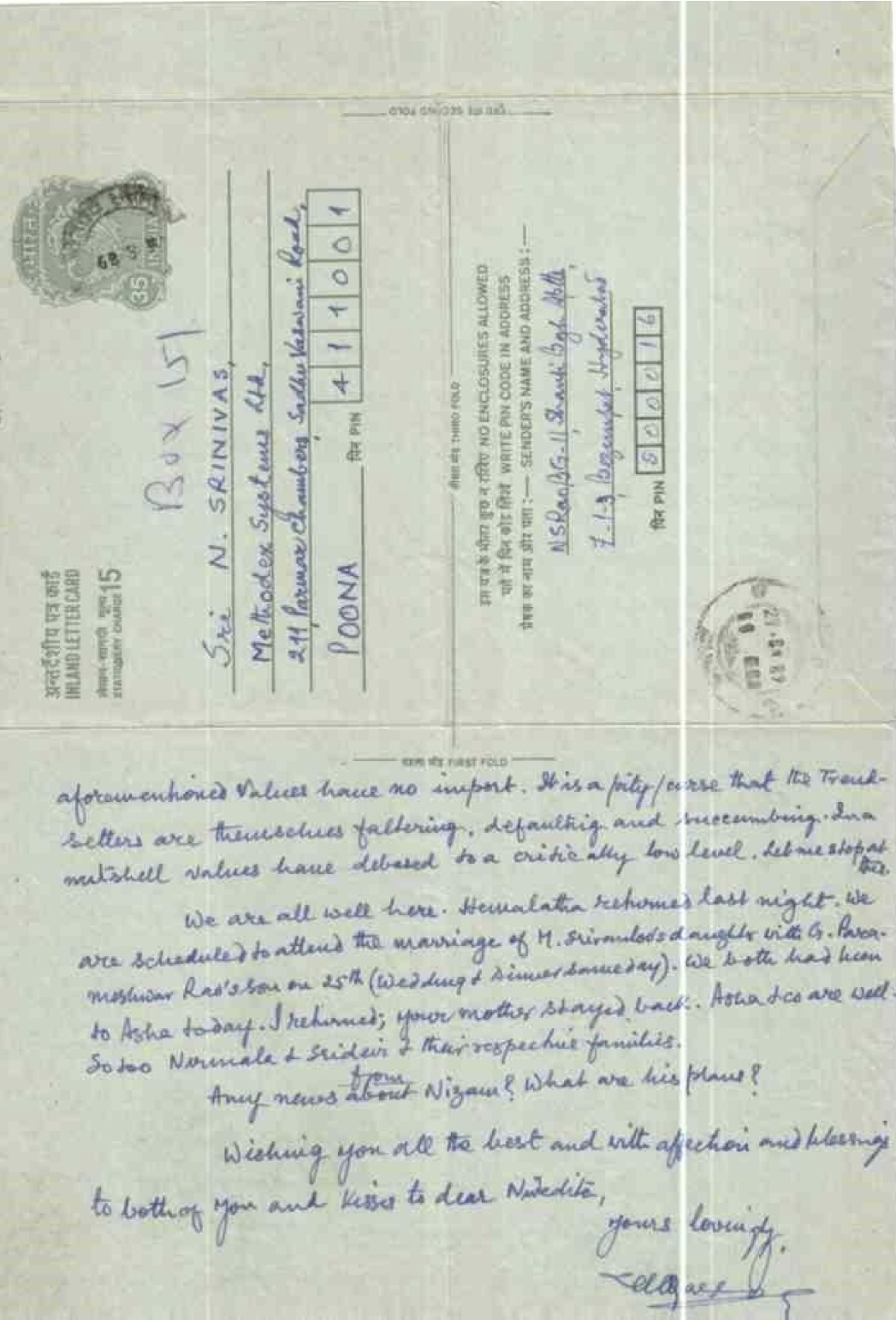
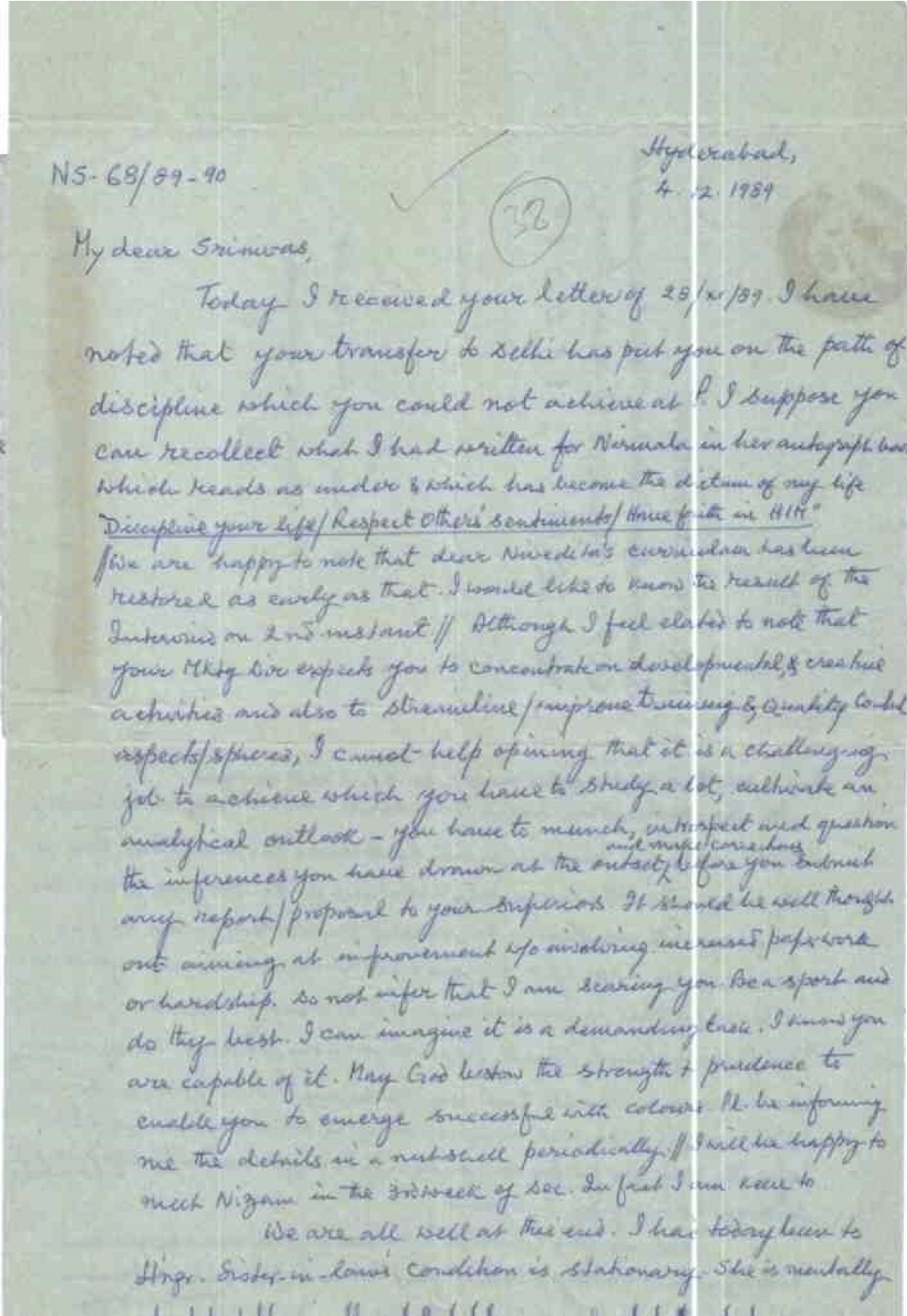
An inland letter that speaks of a generation when emotions, family values, morals and ethics were placed before the concept of individualism.

BY NIVEDITA NIVASINI
This letter, as dated, was written in the late 80s from my grandfather in Hyderabad to my father in Pune (India). In the late 80s, telephone connections took months to be installed, travel in the flights was still exorbitantly expensive and travel by train or a bus from one city to another took at least a day. The intercity telephone call or the STD phone call had to be planned when everybody was at home and the local telephone booth attendant had to be informed in advance to arrange for a telephone call. The arrangement would usually be done when every member of the joint family (i.e. at least two generations of the family living together in the same house) was present. The call would be only to ask about the well-being and each member would talk for 30 seconds to 1 minutes depending on their relation with the person.
As such, the emotions were lost in the technicalities of reaching to the members living out of the city or state or country. Hence, letters were the most comfortable option for a middle class person where he or she could pen their thoughts and emotions. The interesting aspect of writing a letter was patiently waiting for the reply of the letter. And, this letter is one such response.
Due to his profession’s demand, my father, along with me and my mother, left the city of Hyderabad to Pune. Having lived in a joint family, my father obviously missed his parents and the guidance that my grandfather provided. Since letters were the best way of communication, my grandfather and my father communicated often through the same.
My grandfather was (yes, he passed away in September, 2011) way ahead of his times. He believed in women empowerment, secularism, education, and most importantly, freedom of thought. He never bound any one with his chain of thoughts. He also played a pivotal role in my cousins’ and my life ensuring about our well-being and reprimanding us on our mistakes. His letters reflected his thoughts and responses to my father’s concerns while commencing a new life. He always ensured that the letters addressed everything that was asked. He thus carbon copied each letter. It was a practice he observed till the last letter he wrote in early 2011.
My grandfather wrote letters to most of my relatives who lived in other cities. When we collected the letters he wrote to my father and presented to each member of our extended family, they mentioned it to us how our grandfather was always concerned about their well-being too.
I think this inland letter speaks of a generation when emotions, family values, morals and ethics were placed before the concept of individualism. My grandfather always proudly spoke about his many brothers and sisters and the hard ships involved in completing his education. The letter is not only a reminder to us to keep the team or a family above an individualistic goal but also a biography of my grandfather’s generation.
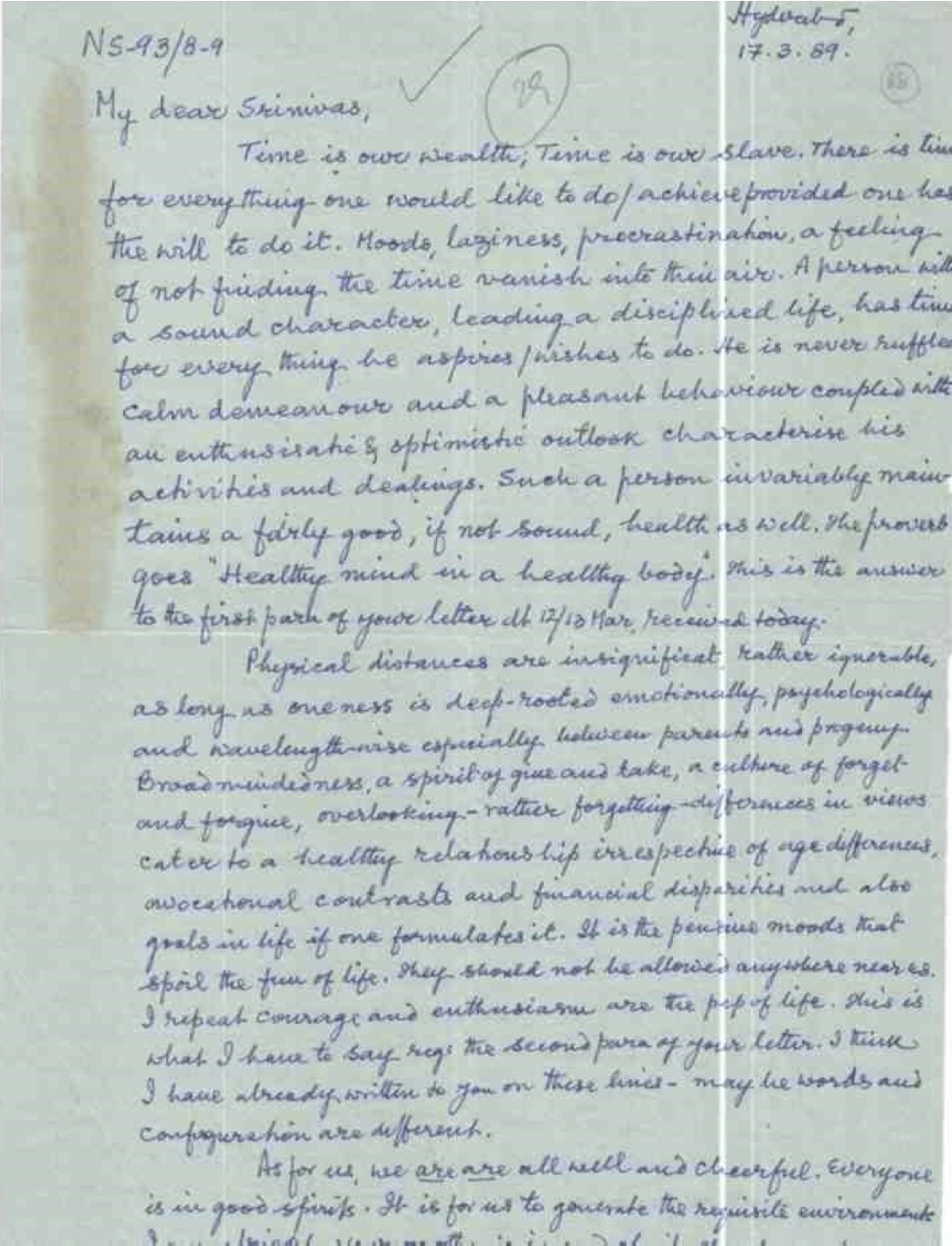
Hyderabad,
17-March-1989
My dear Srinivas,
Time is our wealth; Time is our slave. There is time for everything we would like to do/achieve provided one has the will to do it. Moods, laziness, procrastination, a feeling of not finding time vanish into thin air. A person with a sound character, leading a disciplined life has time for everything he aspired/wishes to do. He is never ruffled. Calm demeanor and a pleasant behaviour coupled with an enthusiastic and optimistic outlook characterise his activities and dealings. Such a person invariably maintains a fairly good, if not sound, health as well. The proverb, “Healthy mind is a healthy body.” This is the answer to the first part of your letter dated 12/13 March, received today.
Physical distances are insignificant, rather ignorable, as long as oneness is deep-rooted emotionally, psychologically, and wavelength-wise especially between parents and progeny. Broad mindedness, a spirit of give and take, a culture of forget and forgive, overlooking-rather forgetting — differences in views cater to a healthy relationship irrespective of age differences, avocational contrasts and financial disparities and also goals in life if one formulates it. It is the pensive moods that spoil the fun of life. They should not be allowed anywhere near us. I repeat courage and enthusiasm are the pep of life. This is what I have to say reg. the second para of your letter. I have already written to you on these lines – maybe the words and configuration are different.
All of us, we are are all well and cheerful. Everyone is in good spirits. It is for us to generate the requisite environments.
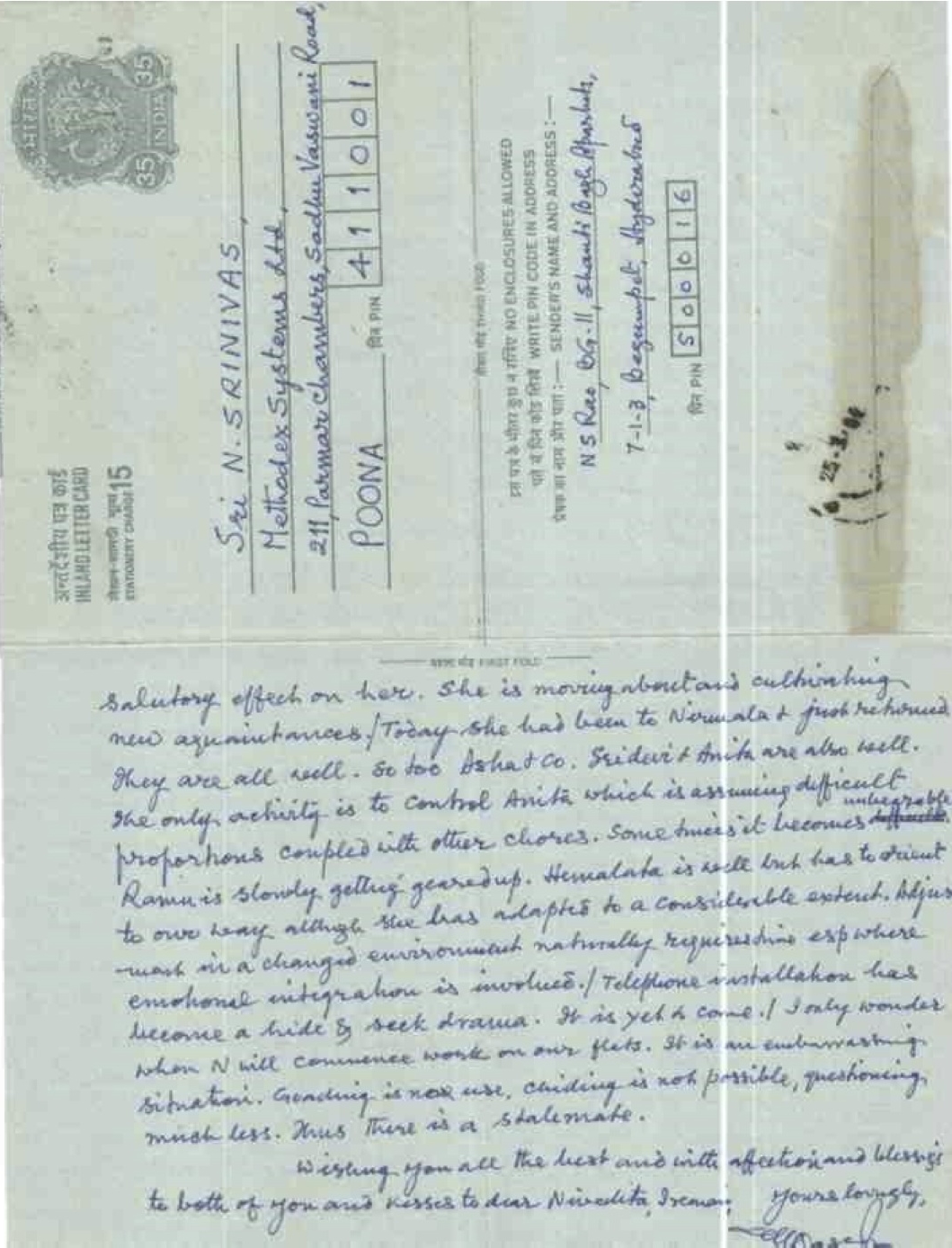
|
…. salutory effect on her. She is moving about and cultivating new acquaintances/Today she had been to Nirmala and just returned. They are all well. So too Asha & co. Sridevi & Amita are also well. The only activity is to control Amita which is assuming difficult portions couples with other chores. Sometimes it becomes unbearable. Ramu is slowly getting geared up. Hemalata is well but has to orient to our way although she has adapted to a considerable extent. Adjustment in a new environment naturally requires time esp. where emotional ingredient is involved/Telephone installation has become a hide & seek drama. It is yet to come/I only wonder when N will commence work on our flats. It is an embarrassing situation. Goading is no use, chiding is not possible, questioning much less. Thus there is a stalemate.
Wishing you all the best and wish affection and blessings to both of you and kisses to dear Nivedita.
Yours lovingly,
Satynarayana Rao (signed)
A Hyderabadi at heart, Nivedita N dwells in nostalgia. When not editing, reading or writing, she daydreams and watches the squirrels from the balcony of her house in Wisconsin and hopes to meet the rabbit imprisoned in the moon, someday.
You can find her work at Nivasini Publishers, follow her on twitter @DivenitaEr, and forthcoming is their new site, The Blue Stencil.