In Person Bretty Rawson In Person Bretty Rawson

Handwritten Recipes and A Taste of the Past • A Radio Interview with Linda Pelaccio of Heritage Radio Network
BY HANDWRITTEN

"When was the last time you cooked
from a recipe from a handwritten card or paper?"

On February 2nd, we were invited to Linda Pelaccio's radio show, A Taste of the Past, which is a weekly journey through culinary history. It's housed in the back of Robertas, a true palace of pizza, and is the permanent home to Heritage Radio Network, which hosts over 35 weekly shows from their little wooden den. 

Linda caught wind of Rozanne Gold's column, Handwritten Recipes, which does something similar to her radio show: exploring the connections between food and language. For forty-five minutes, we chopped it up about handwriting, recipes, and secret ingredients. To date, Rozanne has curated 28 of these Handwritten Recipes, and we have no intentions of slowing down. This living cookbook has a life of its own.

To hear the podcast, click here. You can also see the podcast on iTunes. We hope you enjoy hearing more about the column, the origins of this site, and where we're headed.

Read More
Pen to Paper, In Person, Reviews Bretty Rawson Pen to Paper, In Person, Reviews Bretty Rawson

Pen to Paper: Artists' Handwritten Letters • A Review by Sarah Madges

"Designed by Princeton Architectural Press, the book operates much like a gallery exhibition, privileging the visual over the verbal so that we may take in the high quality images as art objects before reading the accompanying “wall text” that complements and situates them."

BY SARAH MADGES

Borne from an offhand observation between Smithsonian’s Archives of American Art colleagues about the instant recognizability of minimalist painter A.D. Reinhardt’s handwriting, Pen to Paper: Artists’ Handwritten Letters, inspires reverential curiosity. In this carefully considered book, Curator of Manuscripts Mary Savig regards letter-writing as an art, paying special attention to how each artist addresses formal properties of line and space, as well as what we can infer from these decisions about their creative processes and everyday lives.

Proceeding alphabetically from Bernice Abbott through Grant Wood, and spanning the decades from the 1830s to the 1970s, this thoughtful compendium tells the history of art in America in the words of the artists who shaped it: through correspondences both professional and personal, from negotiations with art collectors and curators to revelations about their art and attendant aspirations.

For this project, Savig sought out curators, professors, historians, artists, and archivists alike to read not just between the lines, but to read into each line, inviting 56 different minds to investigate the interplay between language and art in short essays included alongside each letter. As she explained in an interview with us: the goal was to get the writers (many of whom had previously pored over these manuscripts for citations in art catalogs and dissertations) “to step back from the content and instead approach the letter as if it’s a painting or a sculpture. What might the curves, dashes, and density of line tell us about the artist?”

She hoped that providing examples and interpretations of artists’ handwriting would offer new frameworks for understanding their work — and she was right. “What emerged from this project,” Savig summarized, “is that primary sources, and handwritten letters in particular, remain relevant and poised for interpretation.”

Designed by Princeton Architectural Press, the book operates much like a gallery exhibition, privileging the visual over the verbal so that we may take in the high quality images as art objects before reading the accompanying “wall text” that complements and situates them. While each entry deserves thoughtful consideration, their enigmatic, artistic value may be grasped in a glance, making the collection ripe for paging through at any pace and in any order. Full verbatim transcriptions are included in the back of the book so that readers may experience each letter’s gestalt before delving into character-based, historical, or cultural analysis.

In order to demonstrate just how closely intertwined the written word is with visual art, Savig selected a wide range of artists and traditions. Artists’ idiosyncrasies impress themselves on the page, leaving a tangible trace from which we may draw parallels between artist’s pen, personality, and practice. We see how, in a letter from Howard Finster, sketches of Mount Rushmore-ish busts of important figures punctuate the otherwise breathless string of blocky san serifs, recalling his emphatic speech as a Baptist preacher as well as what he termed his “sermons in paint.” Senior Curator at Smithsonian American Art Museum Eleanor Harvey notes how Frederic Edwin Church’s calligraphic pen strokes echo his brushwork, “in which the rapid back and forth of his brush delineates the contour of a landscape with lyrical flair.”

Seemingly trivial details such as the consistency of letterforms and their organization on the page, or the evident ease or burden with which each letter was composed communicate a surprising amount of personal information as well.

As Savig notes in the book’s introduction: “Artists often code their feelings through handwriting.” We can learn a great deal about the level of affection and familiarity between the letter writer and recipient, the writer’s emotional or professional investment in the contents, and even their current mood. Henry Ossawa Tanner’s anger radiates in his 1914 letter to Eunice Tietjens that responds to an article presuming Tanner’s racial identity and relating it to his success. “Now am I a Negro?” Tanner demands in determined script after a paragraph of underlined phrases, crossouts, and emphasized quotations that undermine that claim. In drafts of a condolence letter written between October 8 and 9, 1968 to Teeny Duchamp just one week after Marcel Duchamp’s death, Joseph Cornell’s handwriting chokes up with ineffable grief. Entire paragraphs are violently slashed out with vertical ink bars, and his script stutters through the recounting of a dream that marks the last time Cornell “saw” Marcel.

Pen to Paper's letters run the gamut from personal chronicles and affectionate notes to philosophical treatises and meditations on the intersection between race, gender, and class in the art world. Some comments are profound, such as Marcel Duchamp’s first utterance of “readymade” to explain his transformation of everyday objects into art to his sister, and others are more banal — “sending this by carrier moose,” Ivan Albright teasingly signs off a letter to Earle Ludgin. In some cases, the letters bear ignorance of their future significance.

When Grant Wood squiggled a frame around an ebullient, red-penciled “Hurray!” at the top of a letter to Zenobia Ness, he couldn’t have known he should be celebrating his imminent fame in addition to the fact that the Art Institute of Chicago decided to hang two of his paintings, including the iconic American Gothic. The parenthetical postscript “(How are you Jackson?)” in Lee Krasner’s aerogram to Jackson Pollock during their trial separation carries chillingly prophetic weight when considering it was likely their last communication before he died in a drunken car crash a few weeks later.

From the whimsical floral doodles surrounding the word “darling” in Rockwell Kent’s letter to his wife Sally to the Asian calligraphy-inspired characters of A.D. Reinhardt, these missives offer extensive proof of the expressive and aesthetic capabilities of handwriting, while engendering a unique familiarity with figures who previously loomed larger than life in our consciousnesses.

By preserving and presenting these ephemera, the book emphasizes process over product, with redactions and insertions of text betraying an artist working through ideas—evidence no longer available in a world dominated by digital modes of communication in which individuality is often obscured by the opacity of typed text. Additionally, the book’s smattering of penmanship styles reflect trends in handwriting, as the ornamental cursive of Thomas Eakins (above), son of a 19th century handwriting instructor, is replaced by the uniform efficiency of the Palmer Method, as seen in Andy Warhol’s comically curt biography offered to the managing editor of Harper’s. 

This quiet collection poses a direct challenge to anyone who associates archival materials with must, dust, and irrelevance. The unmistakably human element of handwritten letters elevates what today may be merely cursory communication — an email or text message — to a kind of art that evokes the presence of the person who penned them, and leaves behind a physical relic of the relationship between letter writer, recipient, and the world at large. Appropriately in the book’s introduction, Savig encourages us not to ring the death knell of handwriting. Instead she invites us to “celebrate how imaginative correspondence now exists in material and digital forms,” providing new access and ways of thinking. Pen to Paper is a distillation of that celebration.

Read More
In Person Bretty Rawson In Person Bretty Rawson

Carly Butler to be Letters Editor at Handwritten • A Handwritten Announcement

BY HANDWRITTEN

Eight months ago, we welcomed Carly Butler to the Handwritten Team as curator of a new column, Life's Letters. It was inspired by a discovery that led to a journey: after finding 110 love letters written from her grandmother to her grandfather, Carly packed her bags and went to the address of the first letter: London, England.

The only catch is: she had just fallen in love. So while she spent months retracing her grandmother's steps and reliving her letters day-by-day, she, too, was embarking on her own love and life through long-distant letters. All the while revisiting the past and dreaming of the future, Carly encountered scores of people who all had stories of their own, and finally, someone to share them with: Carly. This is the very reason Carly wanted to start the column: to showcase other peoples' stories as contained and ignited by the handwritten letter. Each story she curated detonated silently in the heart, from An Informal Memoir Joselyn Smith-Greene to The Keepers by Sharon Huget. And it's been such a wild joy to watch the stories unfold and get shared around the world. 

You won't see Life's Letters as a column, but the spirit lives on: as Letters Editor, Carly will be editing and curating all things letter-related, but she'll also be more involved with Handwritten's exhibitions, social media, events, and even the digital curriculum we're currently creating in collaboration with Karen Benke. To have her more involved brings us tremendous joy, as she is a trilateral power base of kindness, laughter, and great ideas.

We can't wait to see what the next 8 months bring! 

Ink Responsibly,
Handwritten

Read More
In Person Bretty Rawson In Person Bretty Rawson

Outside the Box • A Handwritten Review

BY BRETT RAWSON

I have my preferences and loyalties, but when it comes to certain moods or weather, the sirens of style can call like the crow's caw. Most often, this happens when I am rushing to a dinner party and have been tasked with "bring wine," a beverage I only know in passing. Pacing up and down the aisle in a panic, I curse my small wine-brain, and am left with no other option than to choose the bottle that speaks to me the most: meaning, the one with the best label, or name, or both for the win.

Though it plays an important role in my purchasing decisions, it is not something I had thought about at calm length. But some weeks back, I came across an object that contains enough energy for the imagination to implode: Outside the Box: Hand-Drawn Packaging from Around the World by New York-based designer, writer, and educator Gail Anderson. And for some unknown amount of time, I flipped through continents of creatives, as Anderson hand-picked forty individuals who sit in the front-seats of this growing industry of home-grown, artistic designs.

While this collection showcases a diverse portfolio of people, typography, and expressions, it simultaneously illuminates Anderson's own vast depth and eye for creative representation, as she weaves together interviews, images, brand origins, and routines of forty of our most prolific hand-artists today. Outside the Box peels back the label, uncovering what has gone into some of the most well-known brands. I'm not often one for book summaries, but this one leaves the door ajar:

In an age of slick, computer-generated type and Photoshopped perfection, hand-drawn packing is enjoying a global resurgence. As shorthand for something more authentic, homegrown, handmade, or crafted, hand-drawn packaging is found on everything from supermarket eggs to Chipotle drink cups. In this exhaustive and lavishly illustrated survey, organized by four types—DIY, art, craft, and artisanal—Gail Anderson pulls back the curtain on the working processes and inspirations of forty letterers, illustrators, and designers from all around the world through insightful interviews, process sketches, and her infectious love of the medium.

And since this site and platform is dedicated to process, let's promote the people responsible for publishing the beautiful pages: Princeton Architectural Press, who have eyes, hands, and hearts on this visual culture of ours. So, just what is inside Outside the Box? Below is a splash of the beauty in between these covers (click on the images to see them in full and then hover over the full-sized images to get a description of what they're about):

The next time you're scanning the aisle, either in eagerness or ease, take a look at the difference between those items handwritten and otherwise. You'll see an air of energy around the handwritten and hand-drawn designs. Sure, it's the inside that you're going for, but don't forget to enjoy the outside. 

Purchase Outside the Box here

Read More
In Person Bretty Rawson In Person Bretty Rawson

You Can Stop Cursing at Cursive Writing Now • A Handwritten Review

HANDLED BY HANDWRITTEN

Meet Linda Shrewsbury and Prisca LeCroy, the mother-daughter team who has changed the world of cursive writing. Literally and figuratively, they have reshaped the way children, and adults, learn cursive writing: not in alphabetical order, but by shape. And in less than one week, their second campaign comes to a close. Their first, a Kickstarter last year, was successfully funded and raised $33,000.

This helped bring CursiveLogic, the workbook you see below, into existence, and now, Shrewsbury and LeCroy are set on taking it into the classroom with their new campaign, Cursive2Class. 

What exactly is CursiveLogic's method? It reorders the alphabet into four shape-groups (oval, loop, swing, and mound), color-codes them with visual and audio cues, and fits into a single workbook that has — prepare yourself for this — regular paper and dry erase worksheets. Heaven, we know. Whereas old models required students to sit in place and etch the alphabet in order and silence onto recycled and photocopied sheets of paper, this four-lesson workbook takes students through each similarly-shaped group of letters, while at the same time teaching how to write full-length words. This model, workbook, and business is the absolute example of how, coupled with new technologies, we are finding more effective ways of teaching children the fundamental skills and knowledge necessary for cognitive development.

This is the answer the core curriculum has been waiting for, not to mention Town Hall Meetings and online forums. Cursive writing has been disappearing from the classrooms, but that is because the way it was being taught had not changed with the ways in which students are learning, and expected to learn, in the twenty-first century. We are preparing students for jobs that don't exist yet because we are still inventing them. But the thing most people don't see is that when cursive handwriting goes, a lot of other things we cannot see or feel vanish with it as well, including reading comprehension, articulation, writing and sensory motor skills. 

The old model wasn't working. We live in a technological world, and one that is constantly changing, which means we have to change with it. And CursiveLogic is not just keeping up, but it is ahead of the curve: they have side-stepped the political impasse and built their own business, a patent-pending approach, in fact, and instead of arguing back and forth with adults, they were sitting down with students and watching them work. Ever since their model surfaced, they have been gaining support from handwriting experts, educators, politicians, psychologists, and scientists around the country. 

You might be thinking, this looks great, but not for me. We understand not everyone will want to relearn cursive writing, though we actually encourage you to do so (we have bought their workbooks and are going through it ourselves), but there is still something you can do: spread the word, sponsor a workbook, and help CursiveLogic make its way into the classroom. Join us and participate in their Indiegogo Campaign. We selected the "Get One and Give One" option, which we recommend, but if you want to Give Two, then do your thing.
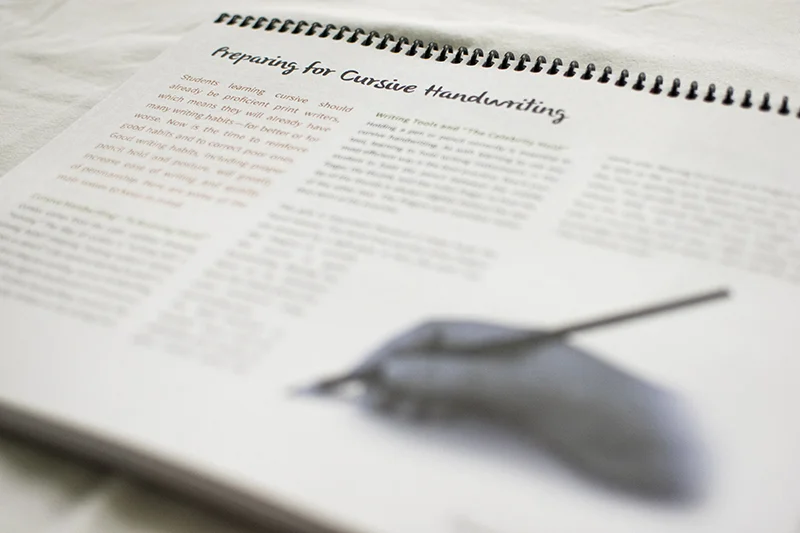
The next time you hear someone up in arms about cursive writing, you can pat them on the shoulder, hold the cursive book you bring with you everywhere just in case you feel the urge to loop or swirl, and say, "You can stop cursing at cursive writing now." 

Follow the links below to help support the remaining days of their campaign (Cursive2Class) and help a kid. Spread the love by liking them on Facebook, and check out their story in their words.

Cursive2Class Campaign.

Facebook | CursiveLogic | Cursive2Class

Read More
In Person Bretty Rawson In Person Bretty Rawson

Paul Laudiero's Shit Rough Drafts • A Handwritten Review

BY HANDWRITTEN

We recently came across Shit Rough Drafts by comedian Paul Laudiero. After reading through it in one sitting, we spent the next few days losing our marbles. Laudiero's humor is magnetic, often departing as quickly as it arrived, leaving us to enjoy his imaginary musings on the greatest works, shows, and plays of our times.

Chances are, you have experienced several of the 135 books, movies, and TV shows that appear within Shit Rough Drafts. While that'll enhance the experience, it doesn't exclude entertainment. You don't need to have read Eat, Pray, Love to deeply enjoy Laudiero's title-twists.

Shit Rough Drafts exposes process, and in the process, pokes fun at finished products. How do these "must-reads" make their way into the world, and did they ever take a different shape? Are those who we hoist high out of reach just as messy, confused, and lost as we are?

We spoke with Laudiero one early morning while he was strolling alongside Central Park, coffee cup in hand. It was eight in the morning. He was alert and awake, while we were on a porch shielding our eyes from the early morning sun. We told him about Handwritten, and how we wanted to keep the humor in handwriting. He said that was good, because a site like ours would bore people to death. We totally agreed.

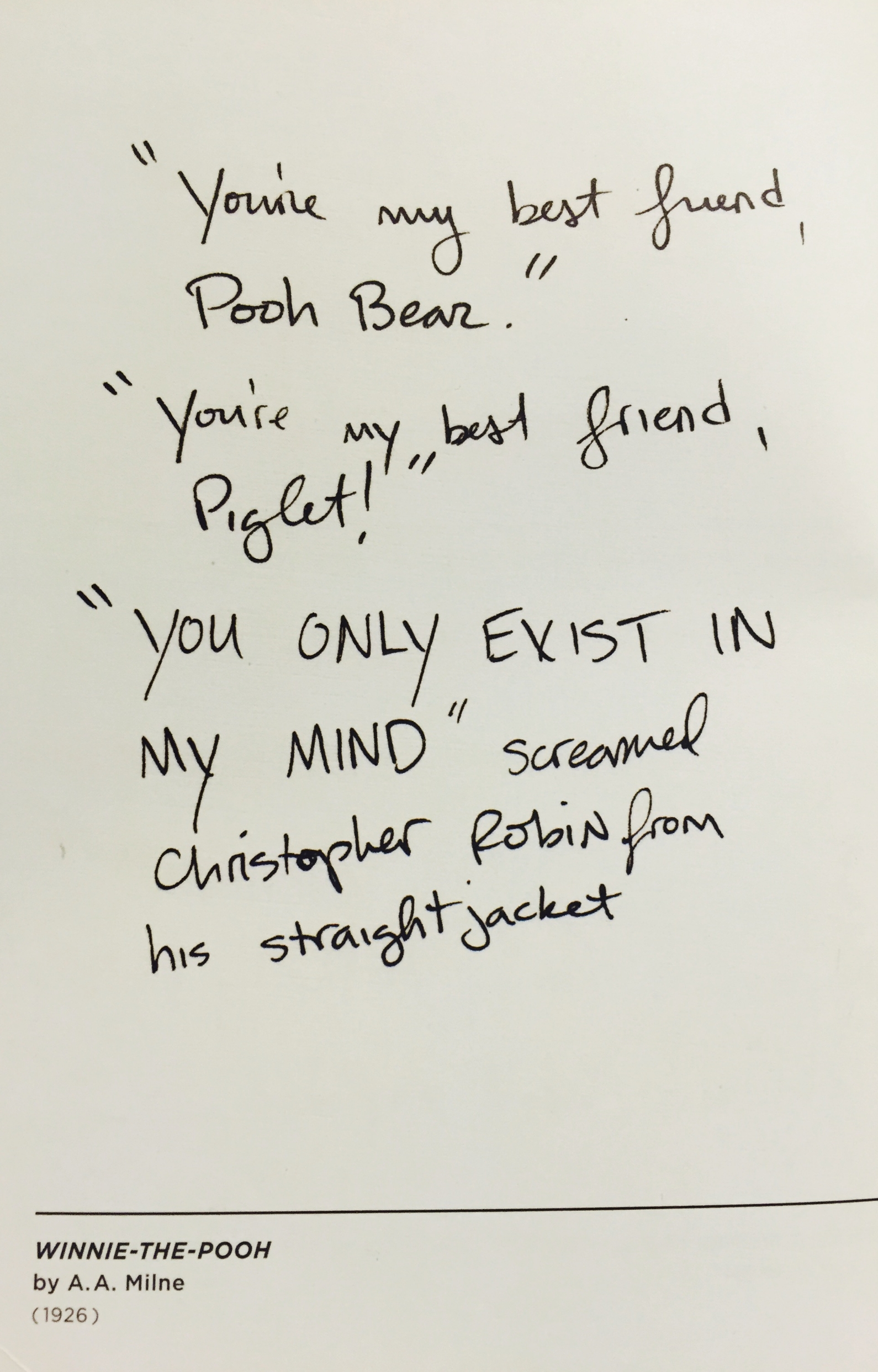
Shit Rough Drafts is a new wave of coffee table books. In that, it isn't idle. The book is impossible to not pick up, and difficult to put down. It's not easy then to pick our favorites, but since we had to, here are three that kept us laughing well into a deep sleep:
Read More