Notes from My Soul in the Morning • Kate Hoyle
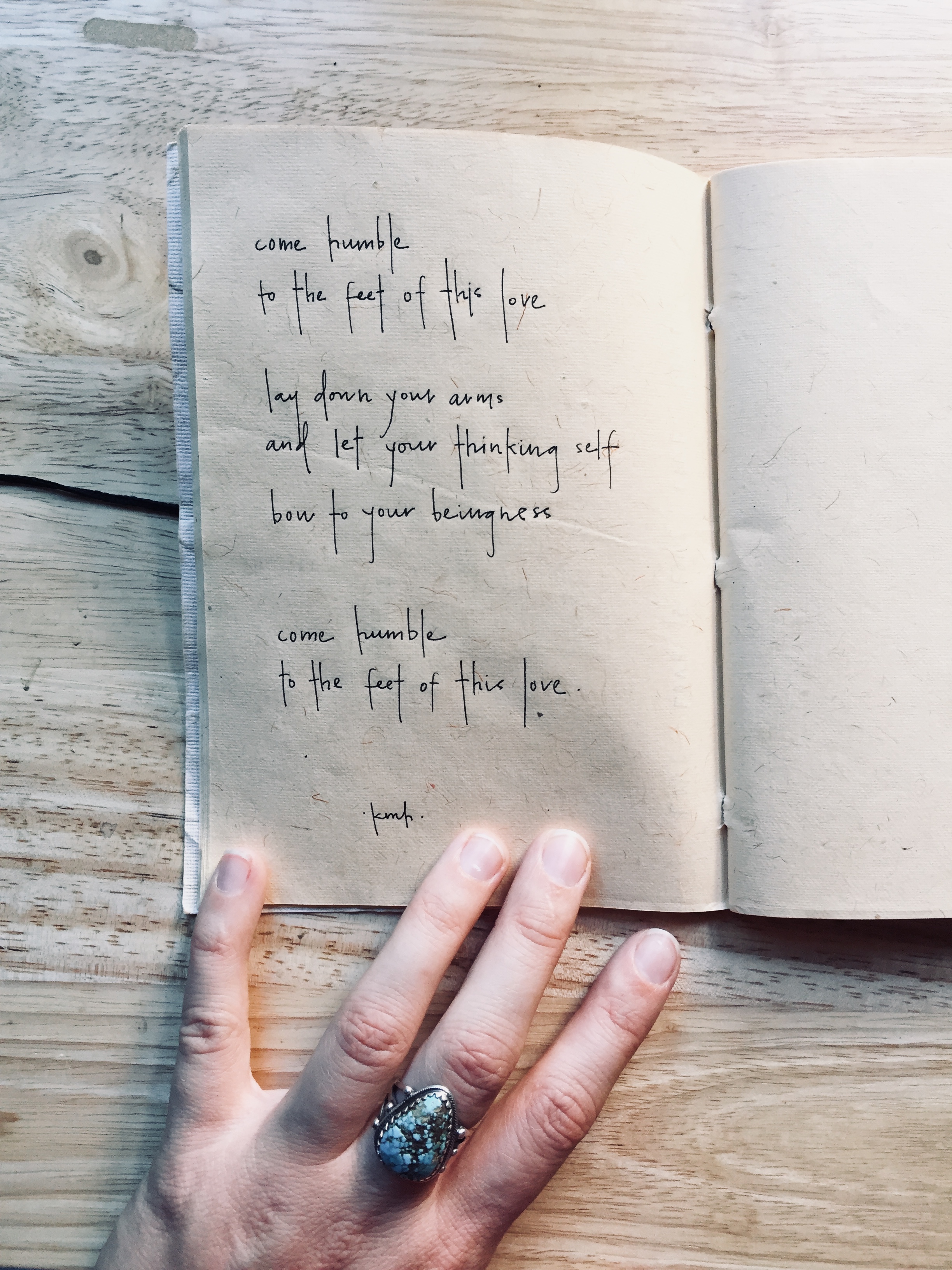


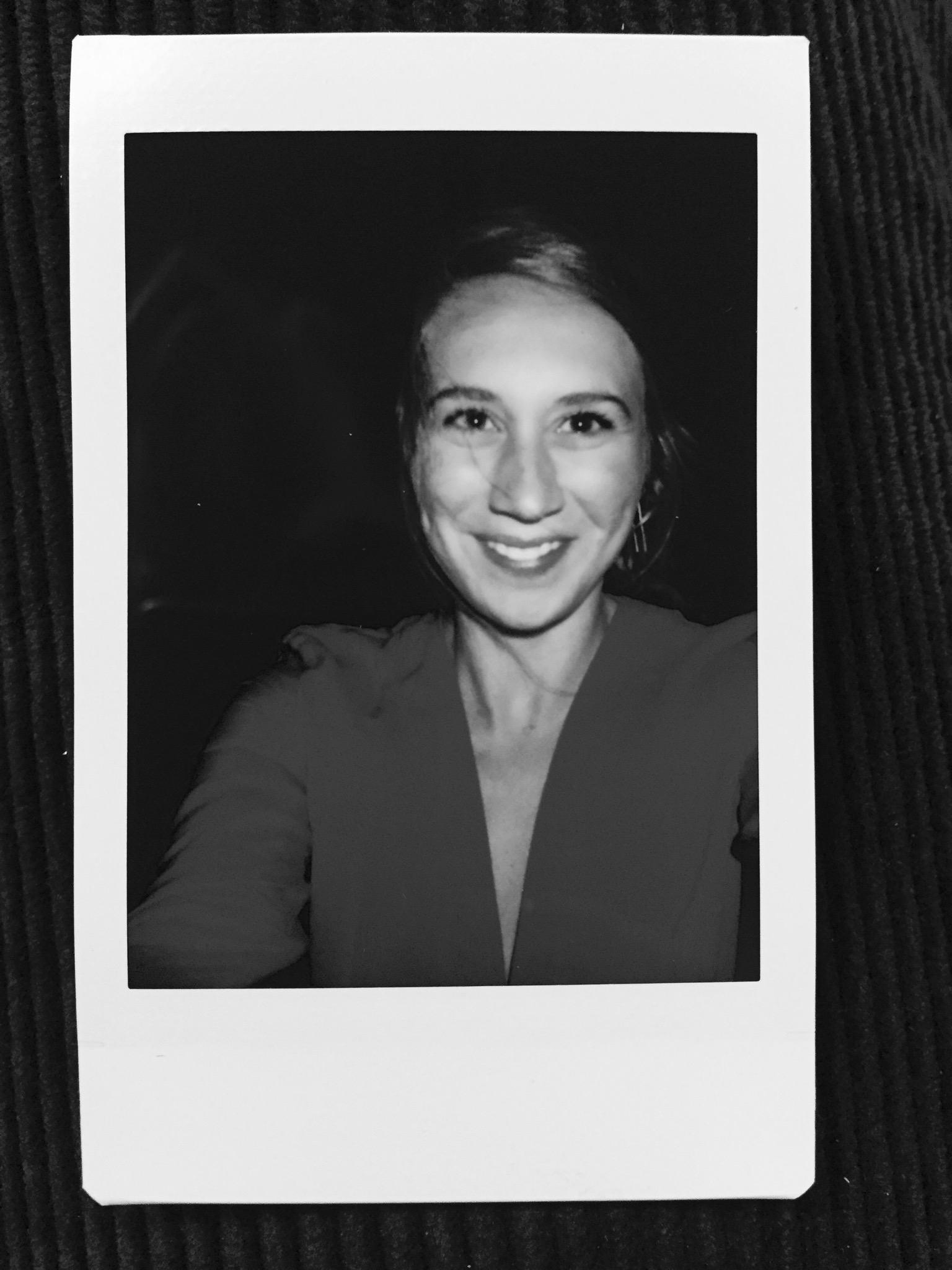
Kate Hoyle is a poet and visual artist from Moraga, California. Her work has been published in Tupelo Press 30/30 Project, The AUDACITY and Smokelong Quarterly. Her five poem series, On America, is currently touring the US and South America on exhibit in U2’s Joshua Tree World Tour. You can see more of her work at katehoyle.com
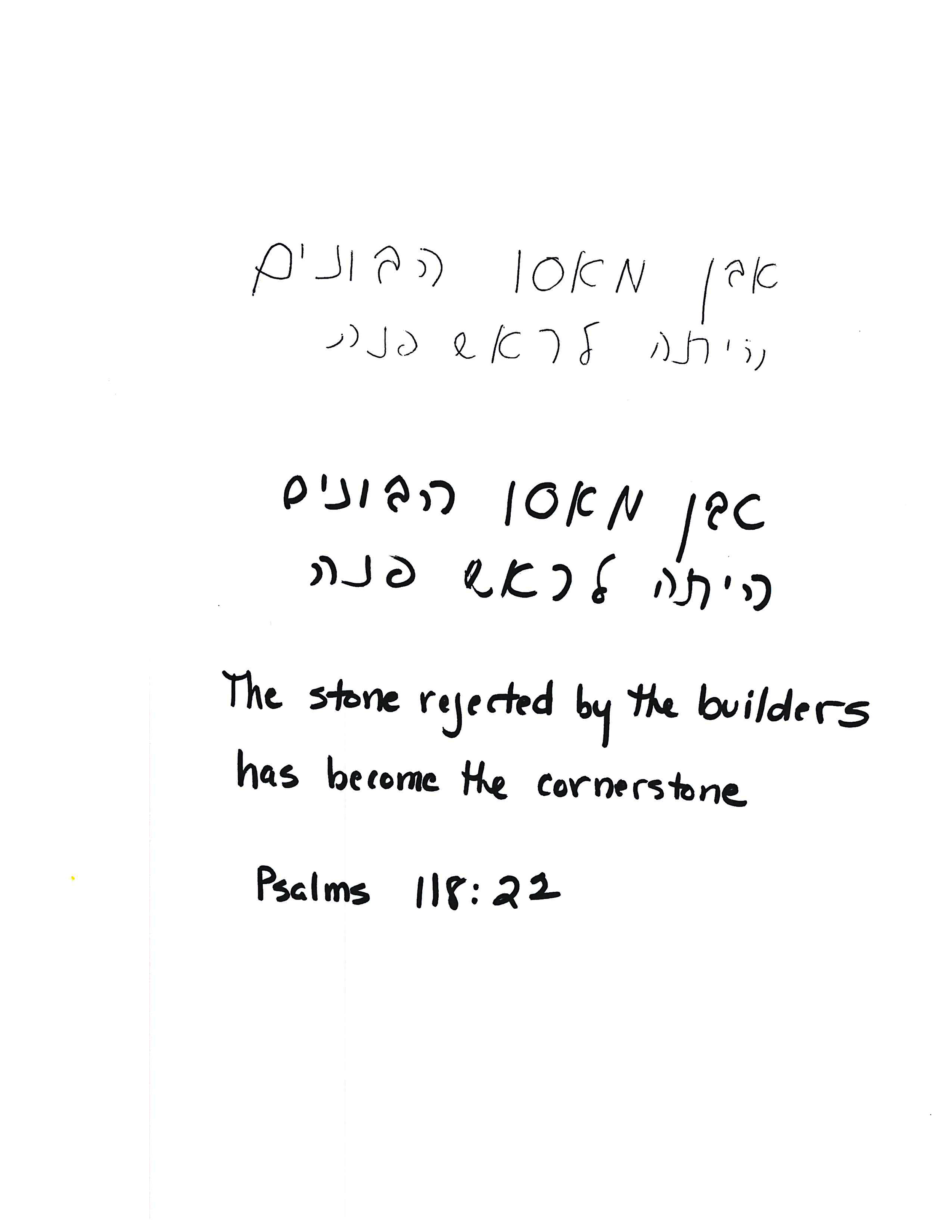
A Warrior for the Chaos of the Wild • Rags Edward

àite còmhnaidh (Dwelling Place)
I am from paper, ink, words, images and spidery handwriting, from Canon, Nideggen, burnt sienna and red ochre, coptic and codex. I am from lands of green, with dark, worked soil, from the adoration of constellations and the heavy scent of woodsmoke in the autumn air.

I am from the eagle tree and coyote fire-song, hay meadows full of wild roses and rooms pressed into the grasses, from a hiding place in the dark thicket of laurel branches, and the cool pocket by the lake.

I am from deer and dog, coyote and wolf, knight and Indian, books and stories. I am from home baked bread, handmade ice cream, banks strewn with Virginia Bluebells and restful sensitive spirits, from hateful battles full of terror and fright, from the ancient stillness of Simon, Mable, Alice and Fanny and the agonies of Jeanne and Ken. I am from homespun cloth of linen and the simplicity of field and pasture, from the bogey man in the basement who will stand you on your head, deep dreams of bears in dens and the legends of Jesus and King Arthur.

I am from worship of the earth and the hypocrisy of tongues - the comfort of the trees and the punishment of the Rock of Ages, from early devotion to Artemis, Diana, Luna. I’m from Lancaster and York, the lands of Merlin, from Donegal and the cities of red and white roses, from garden snapped peas, blackberries with beetles bitten in half, summer-cut roses and strawberry shortcake.

From the wicked aunt who stole identities and thieved the past and three gentle women who cradled my spirit as I grew, from long country walks on Sunday and the green walled cemeteries of Donegal. I am from paper, ink, words, images and the lovely hand of graceful fate.

From Rags: This is a poetry exercise that I wrote with guidance from a poem by George Ella Lyon called "Where I'm From." The exercise is great fun, and well worth a try! I’d love to see your results if you try it! Details for how to do it can be found here at Fred First's website.

Rags Edward:
hand bookbinder.
poet.
aspiring banjo player.
painter.
photographer.
warrior/advocate
for the chaos of
the wild!
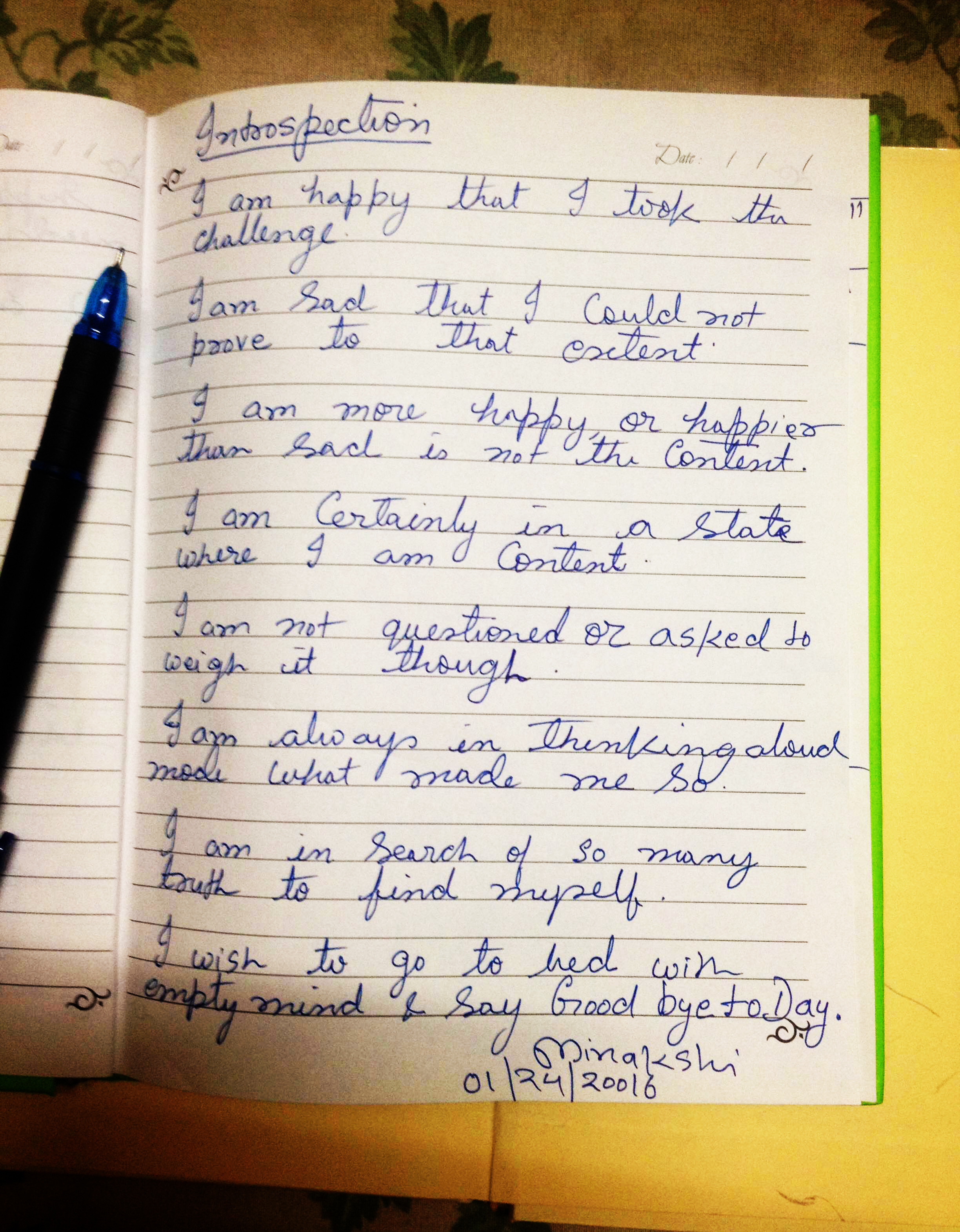
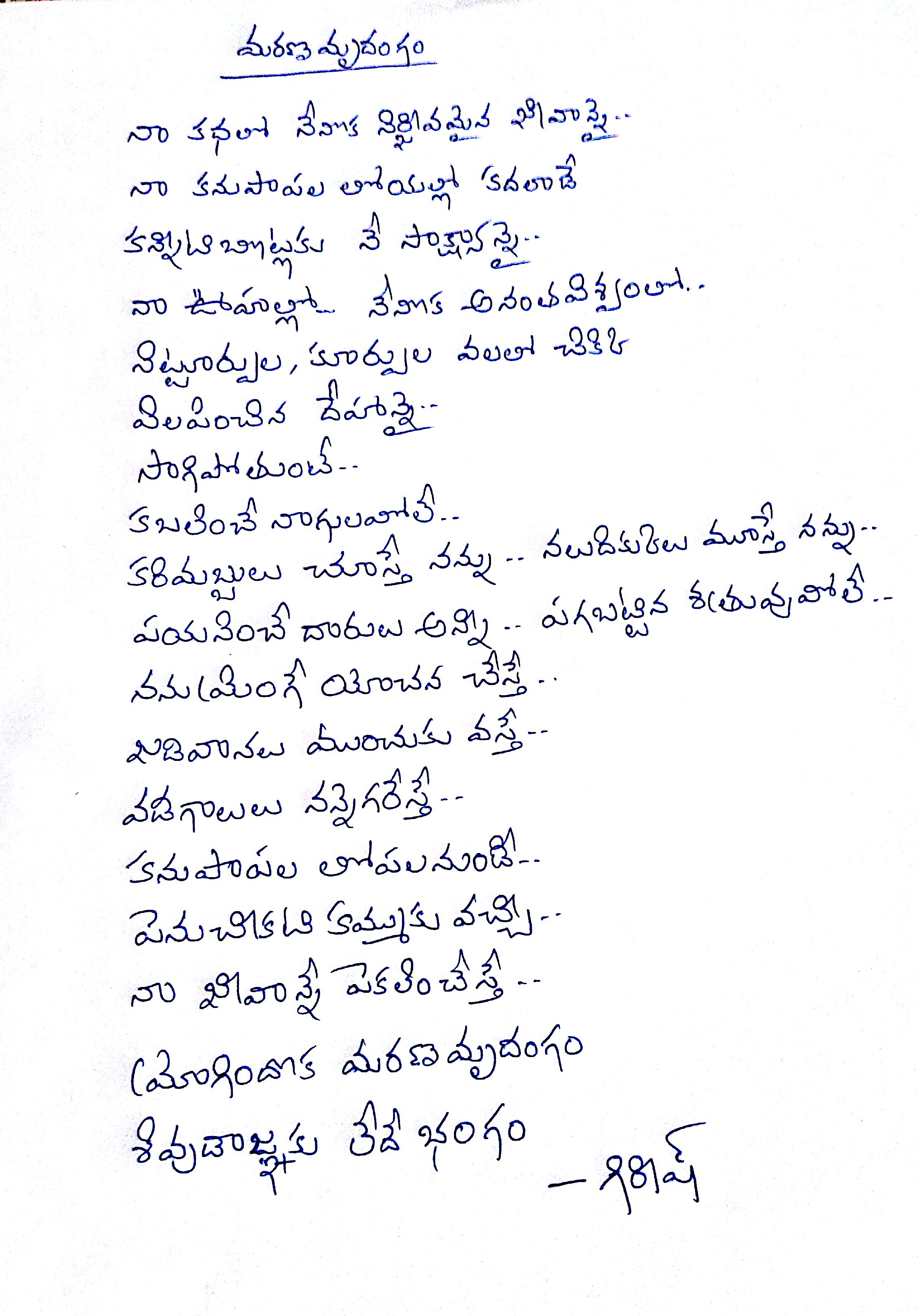
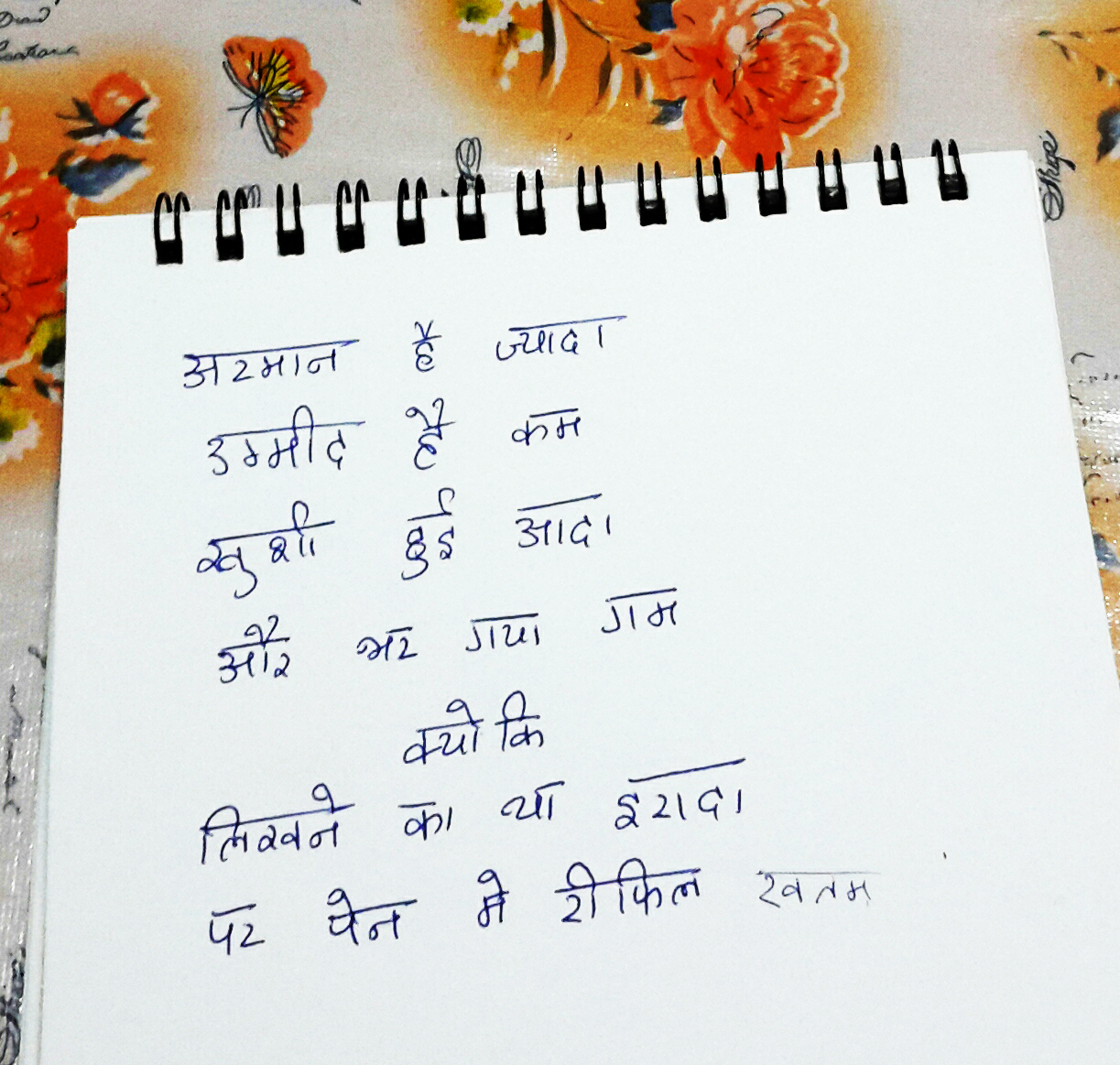
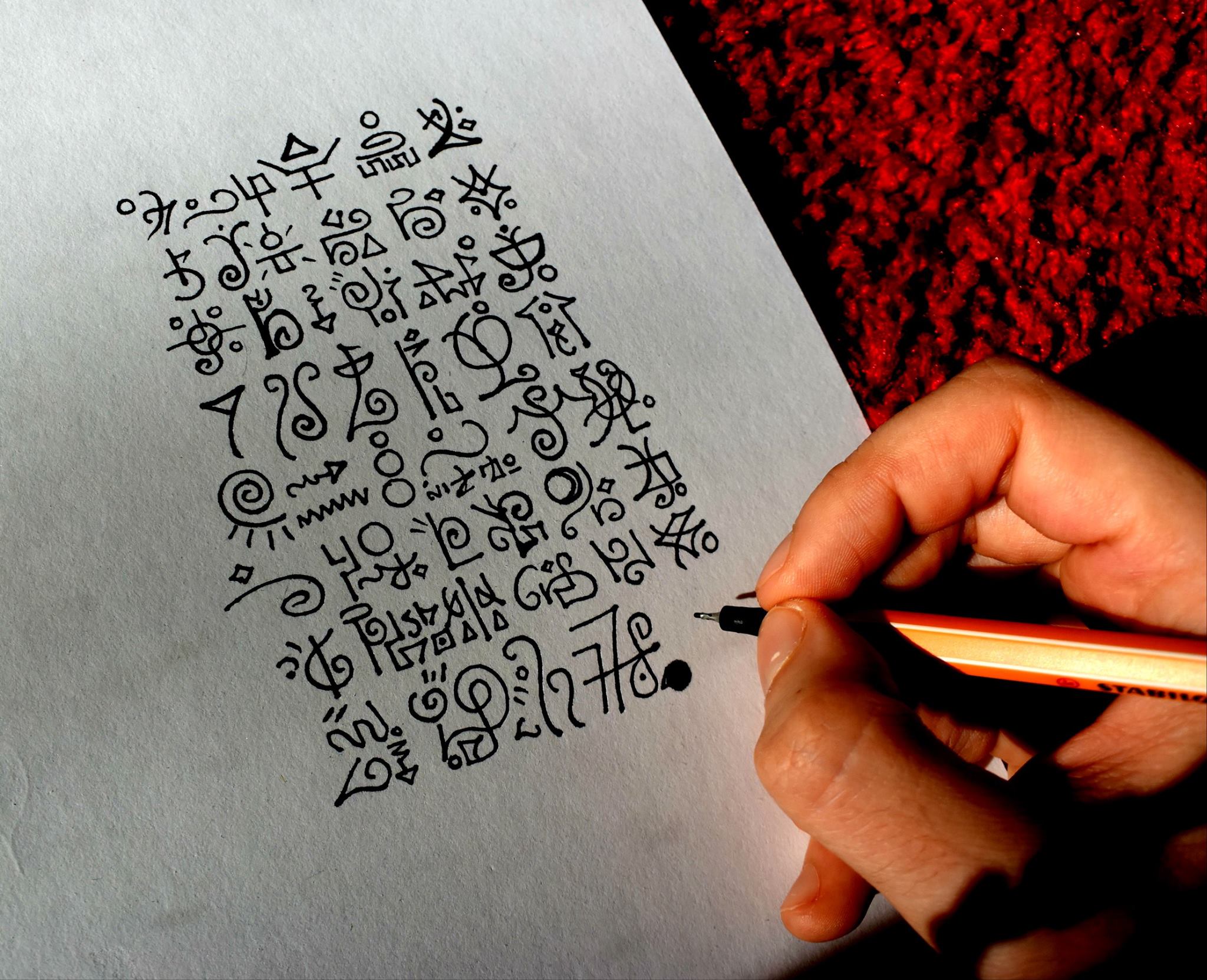
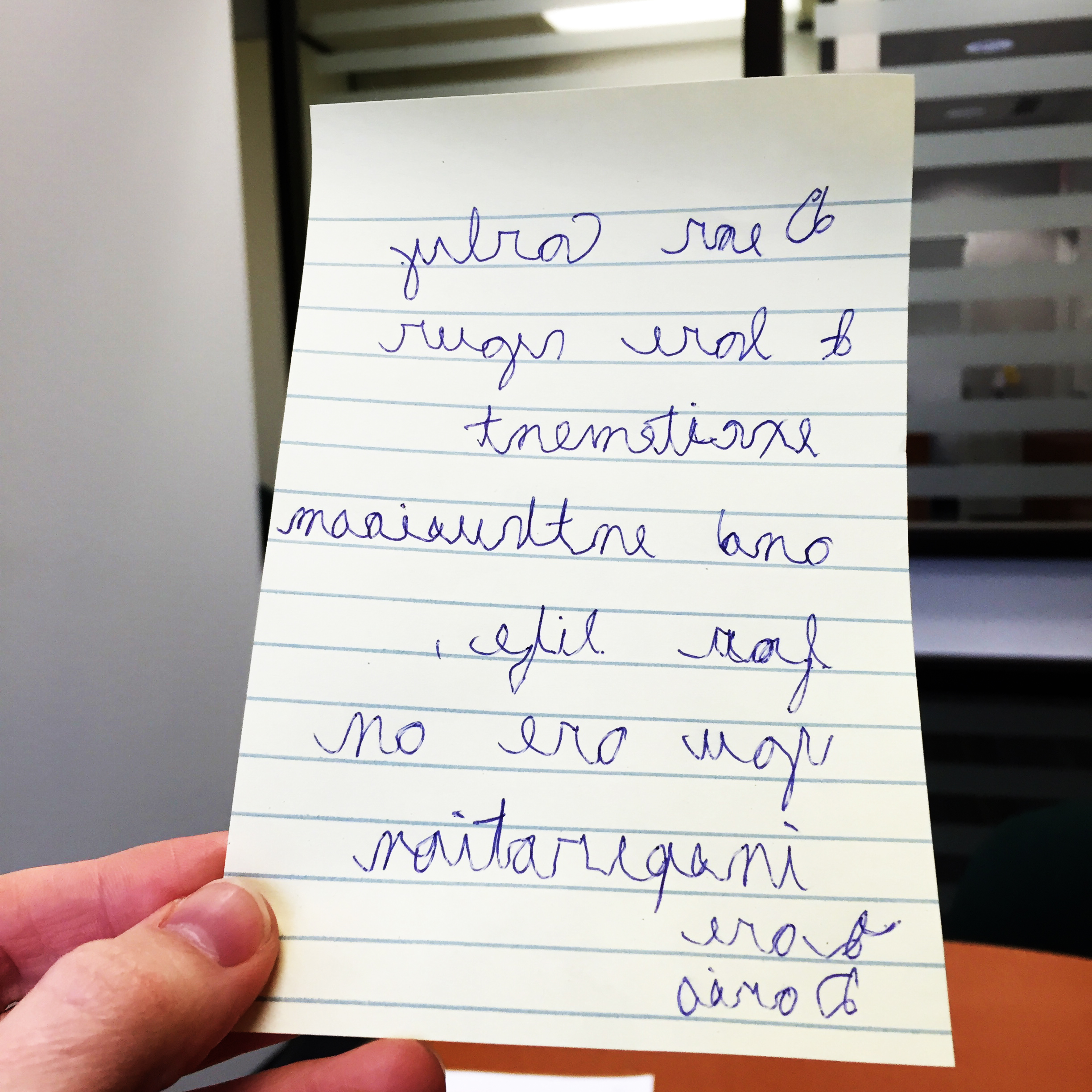
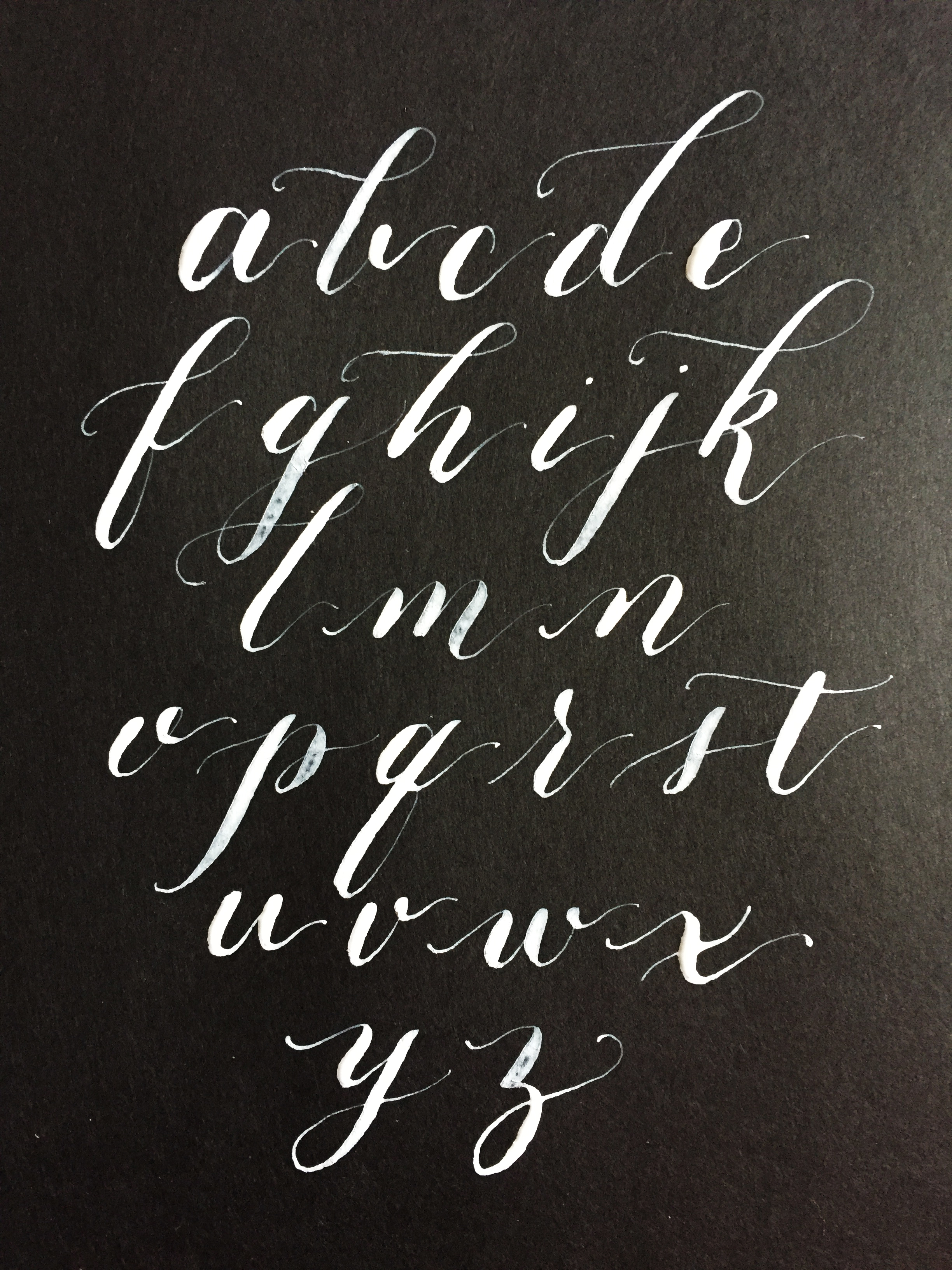
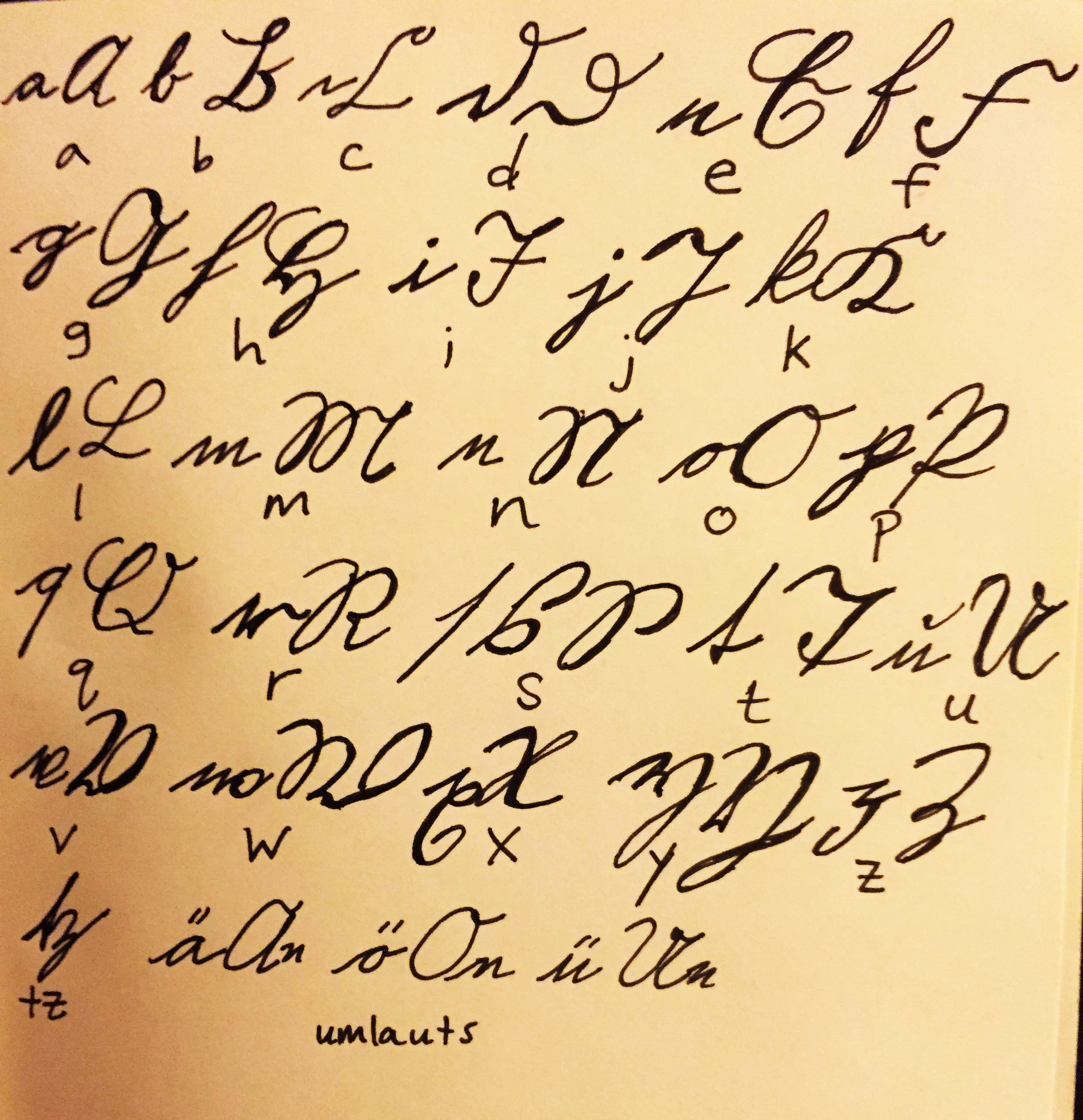
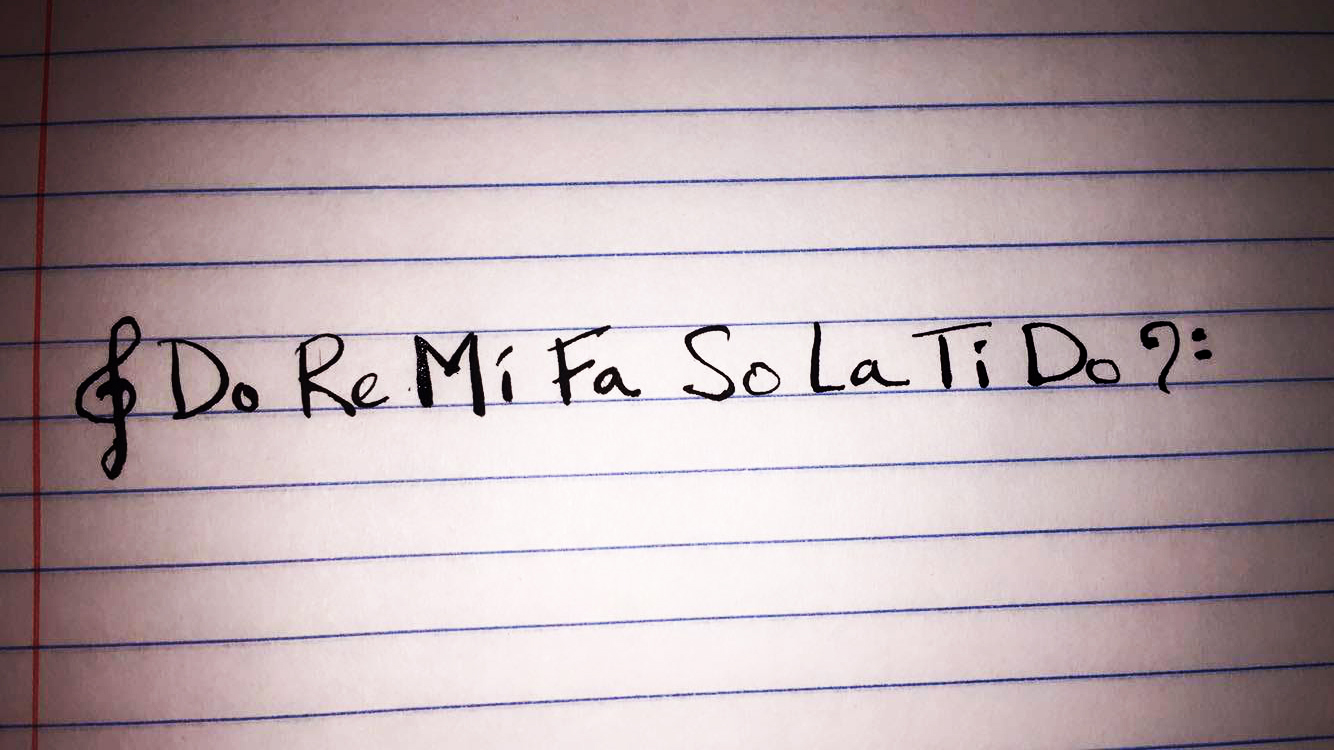
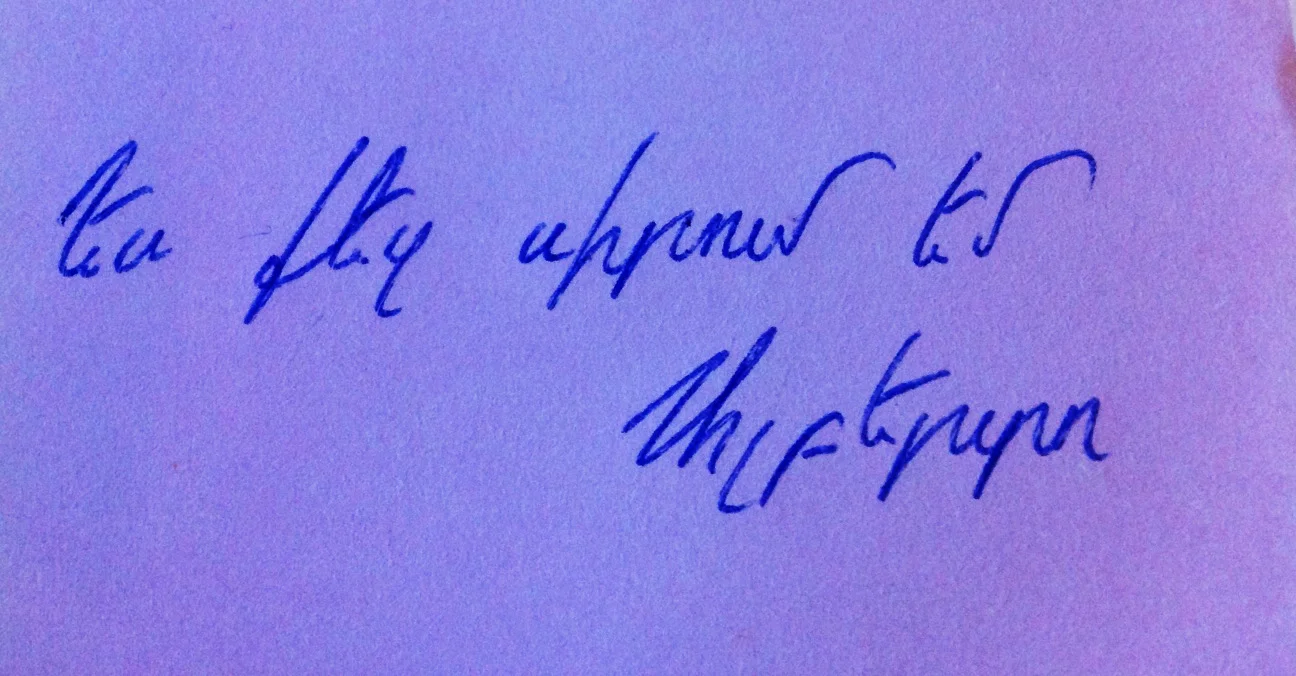
I Share My Unbeing With You • Rajesh Kumar
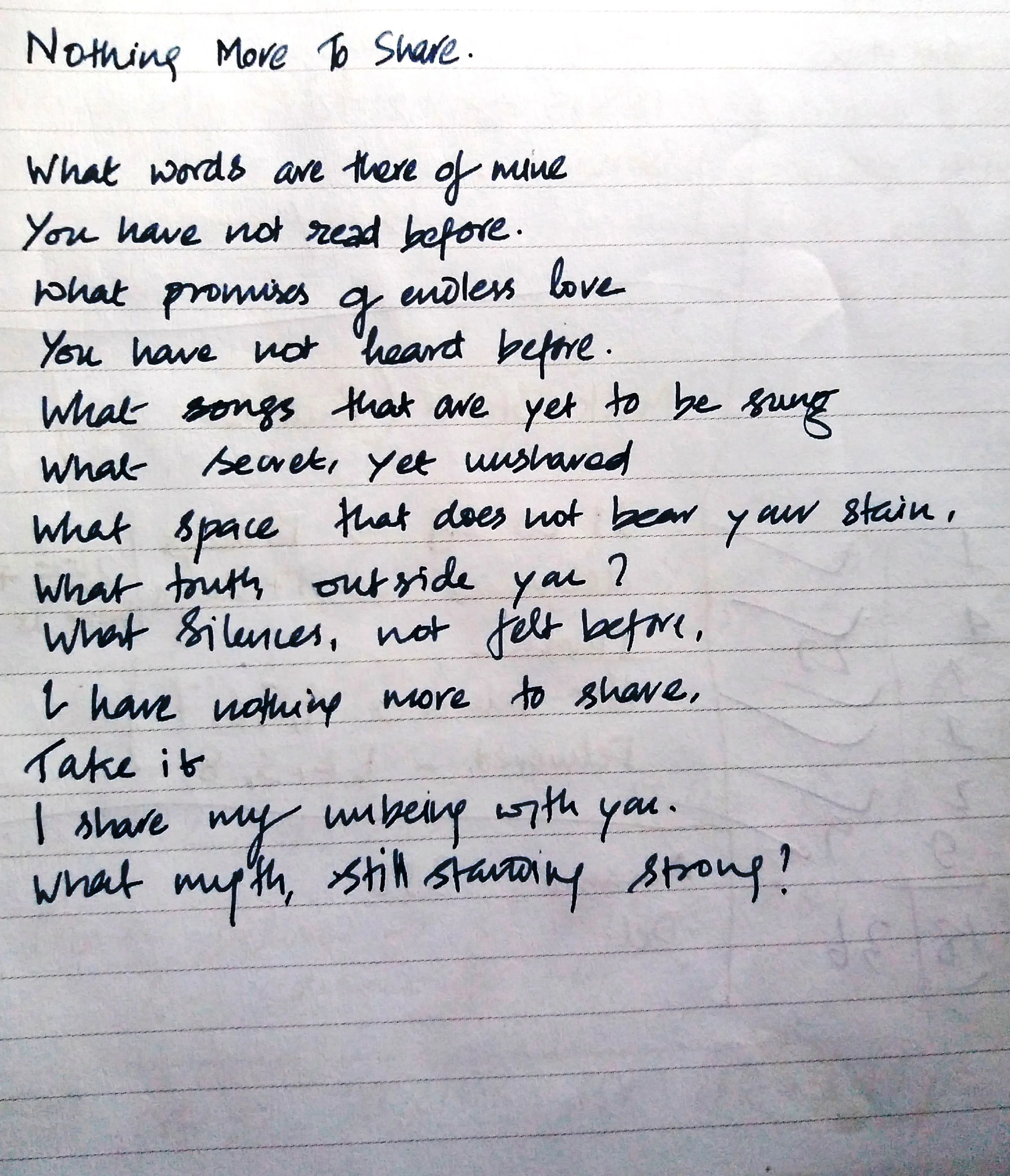

Rajesh Kumar is the co-founder of the Twin City Poets Meetup Group in Hyderabad, India, which consists of 380 poets. He is an HR professional, avid blogger, poet, and dabbler of prose. He loves the handwritten word and keeps its grace alive through a big collection of fountain pens





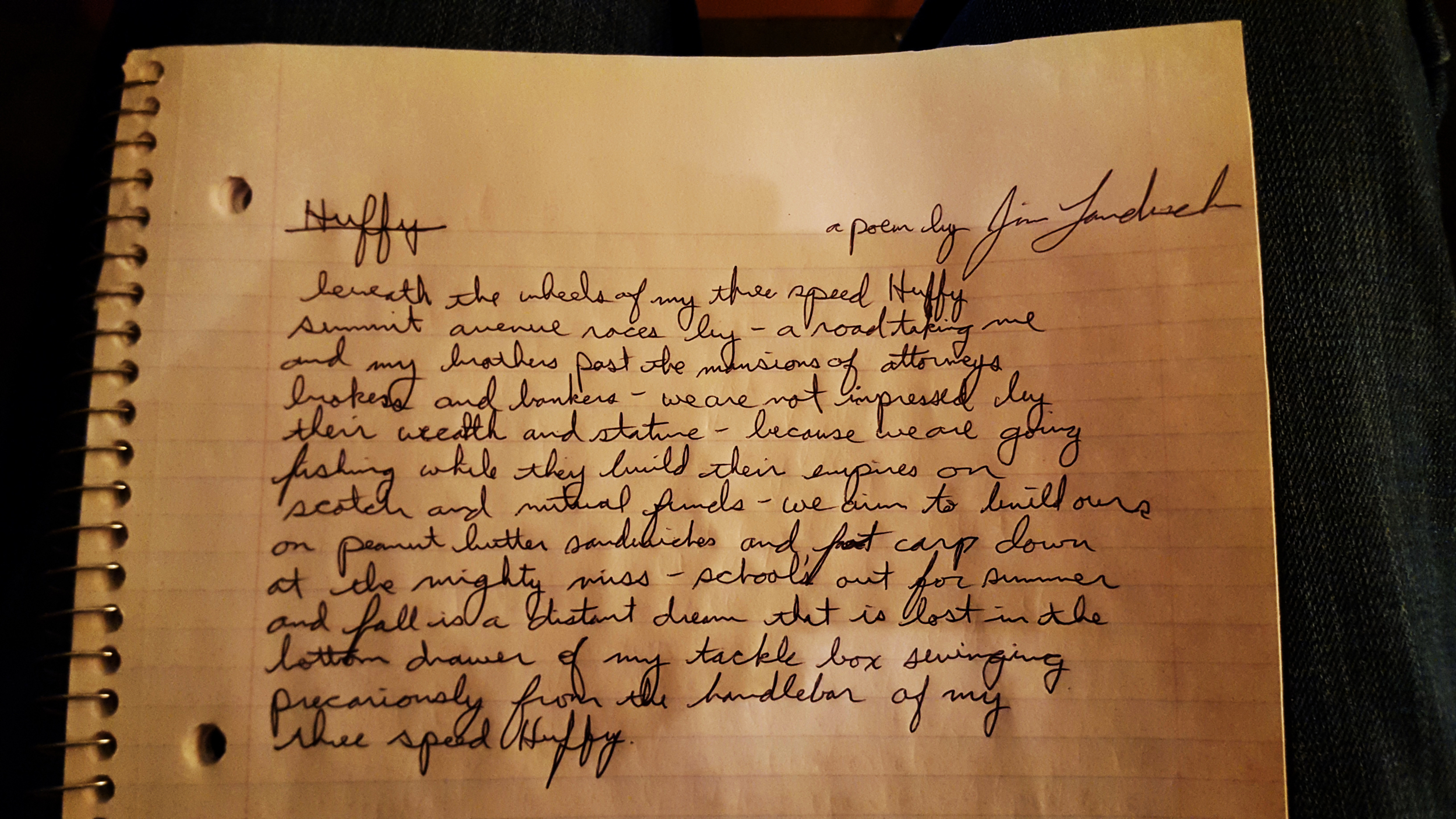
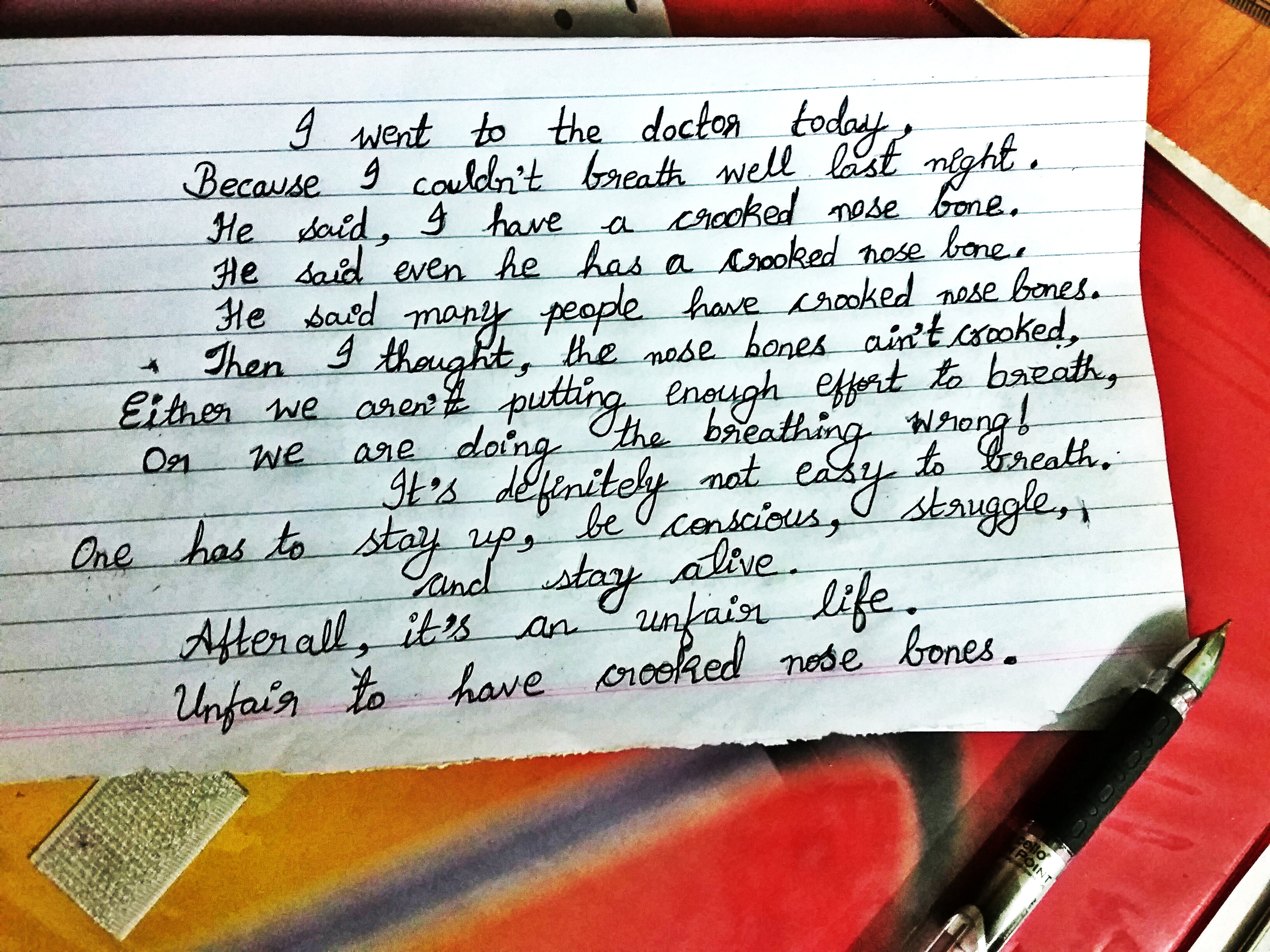
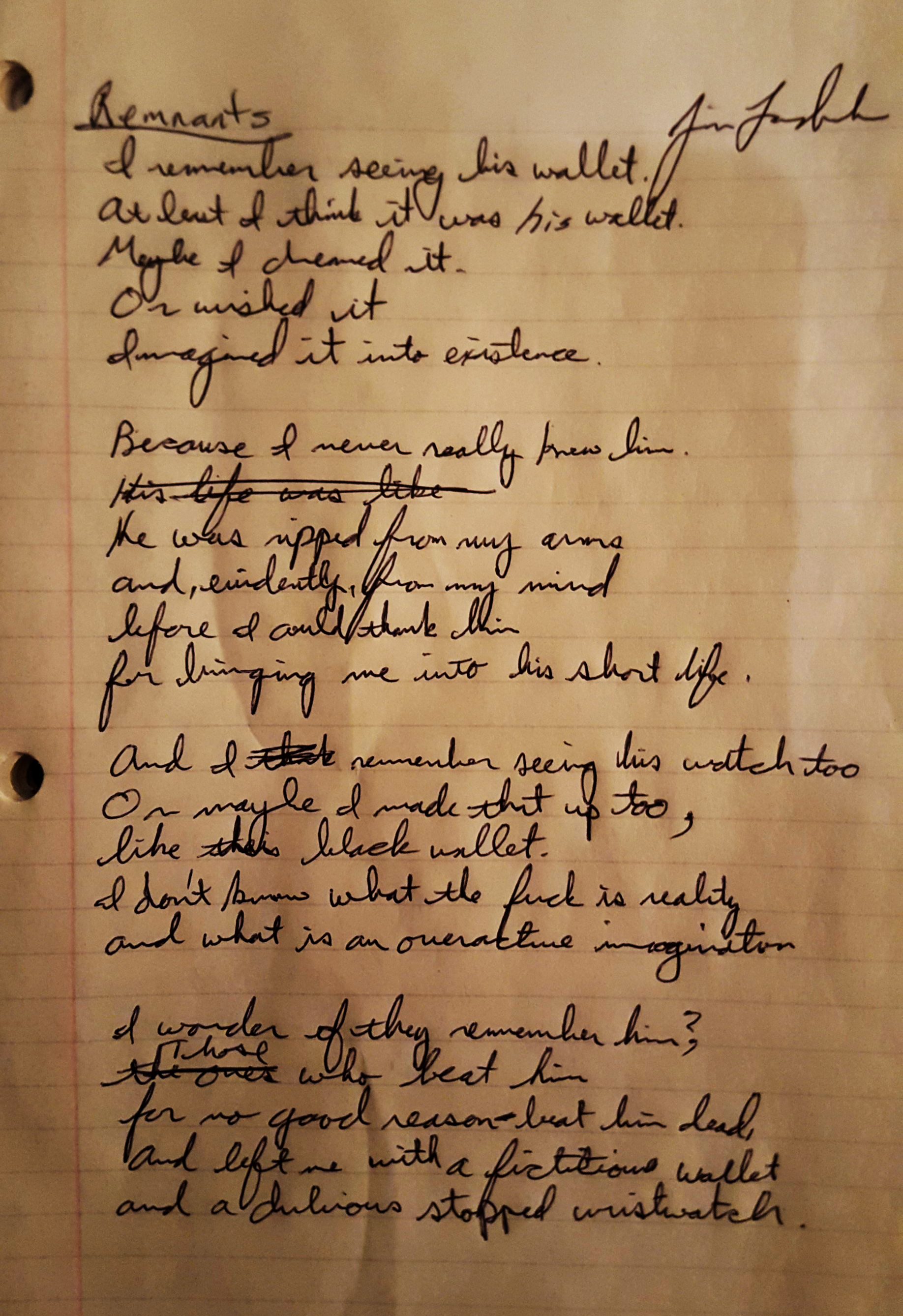
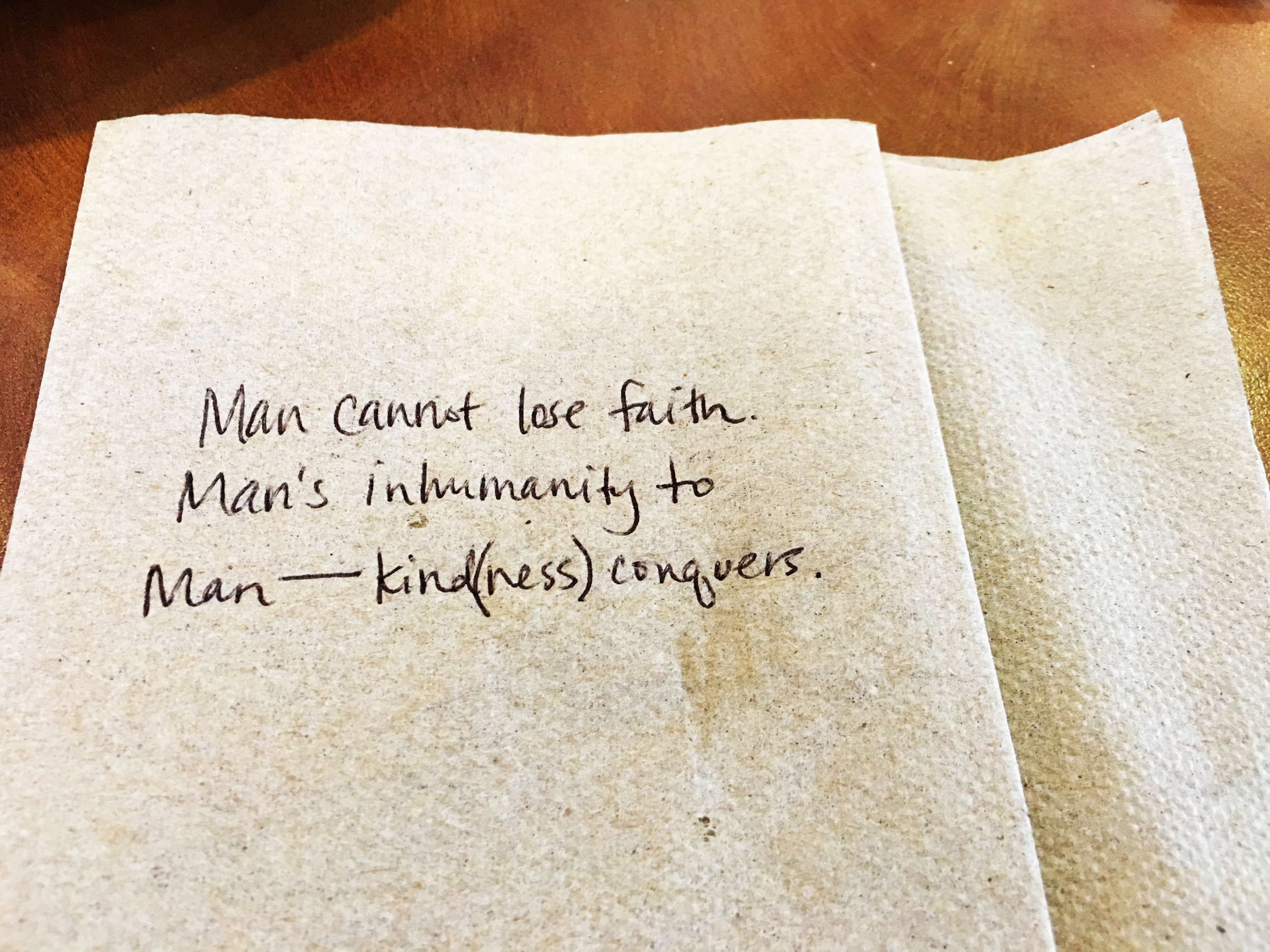
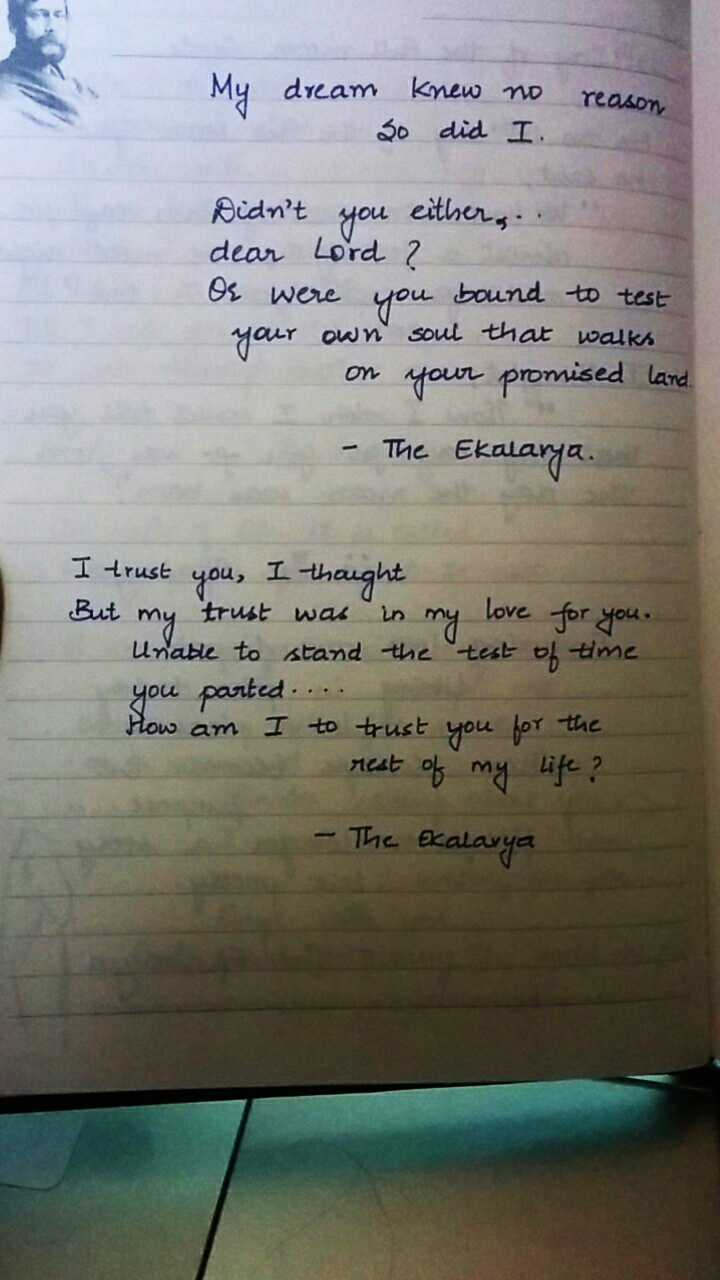
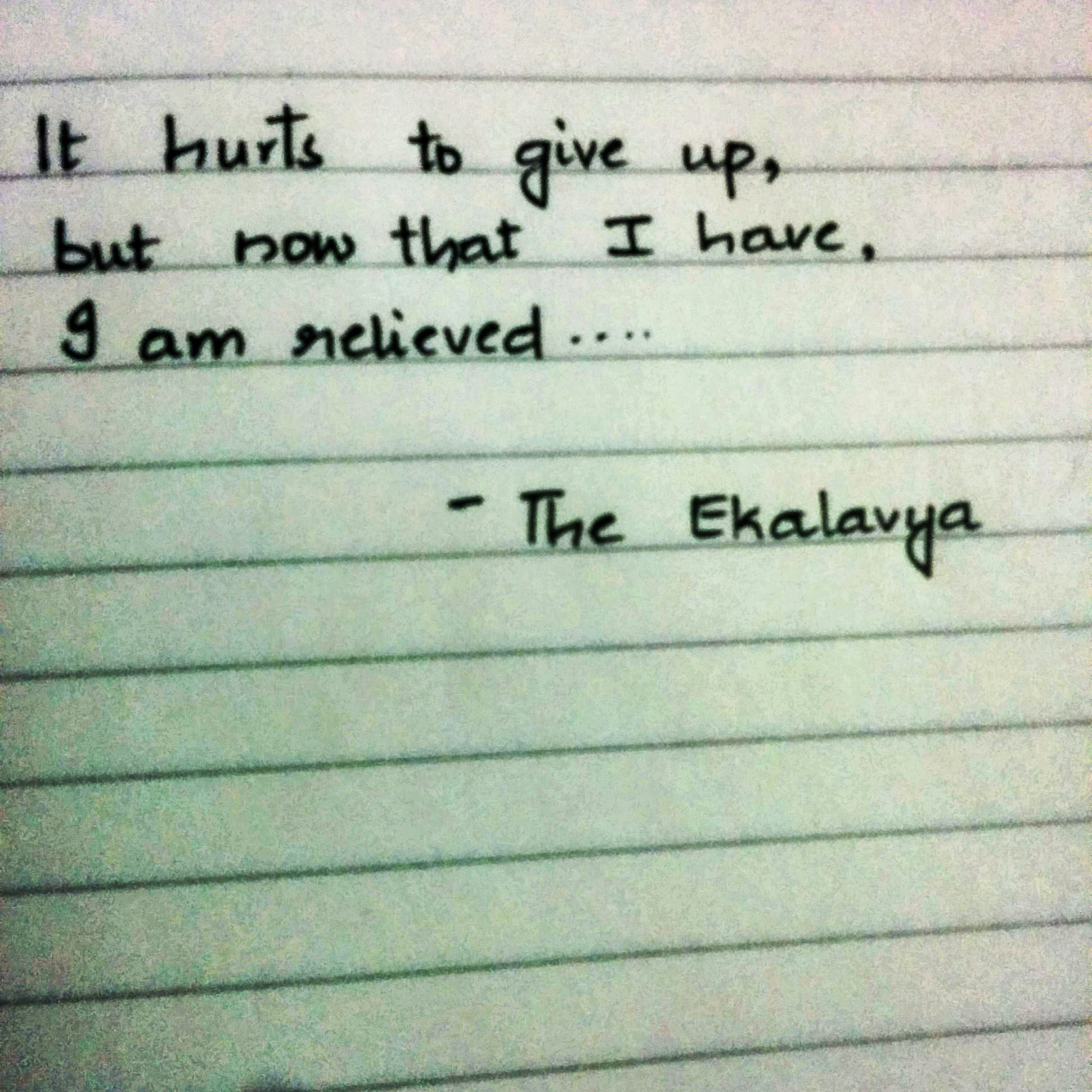
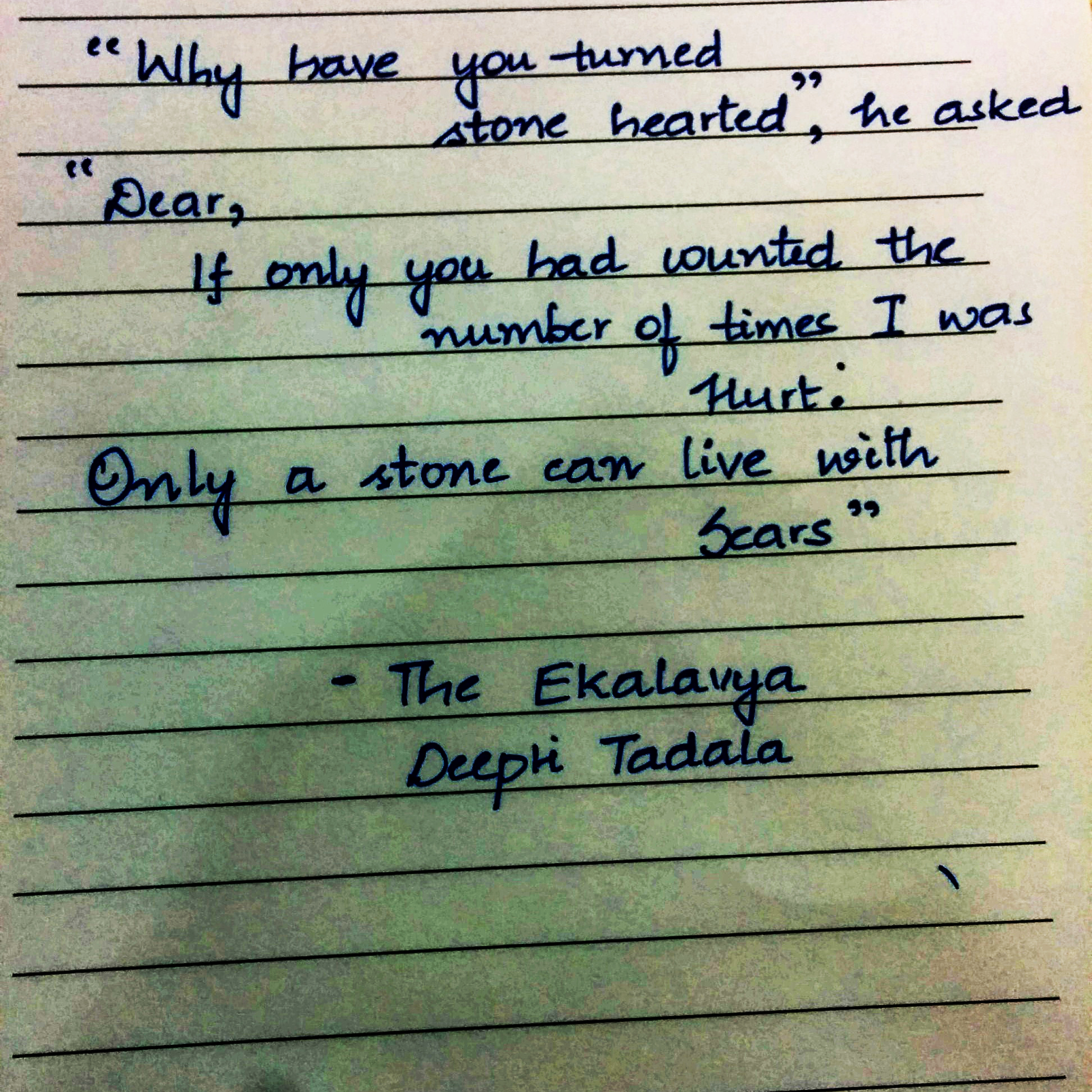

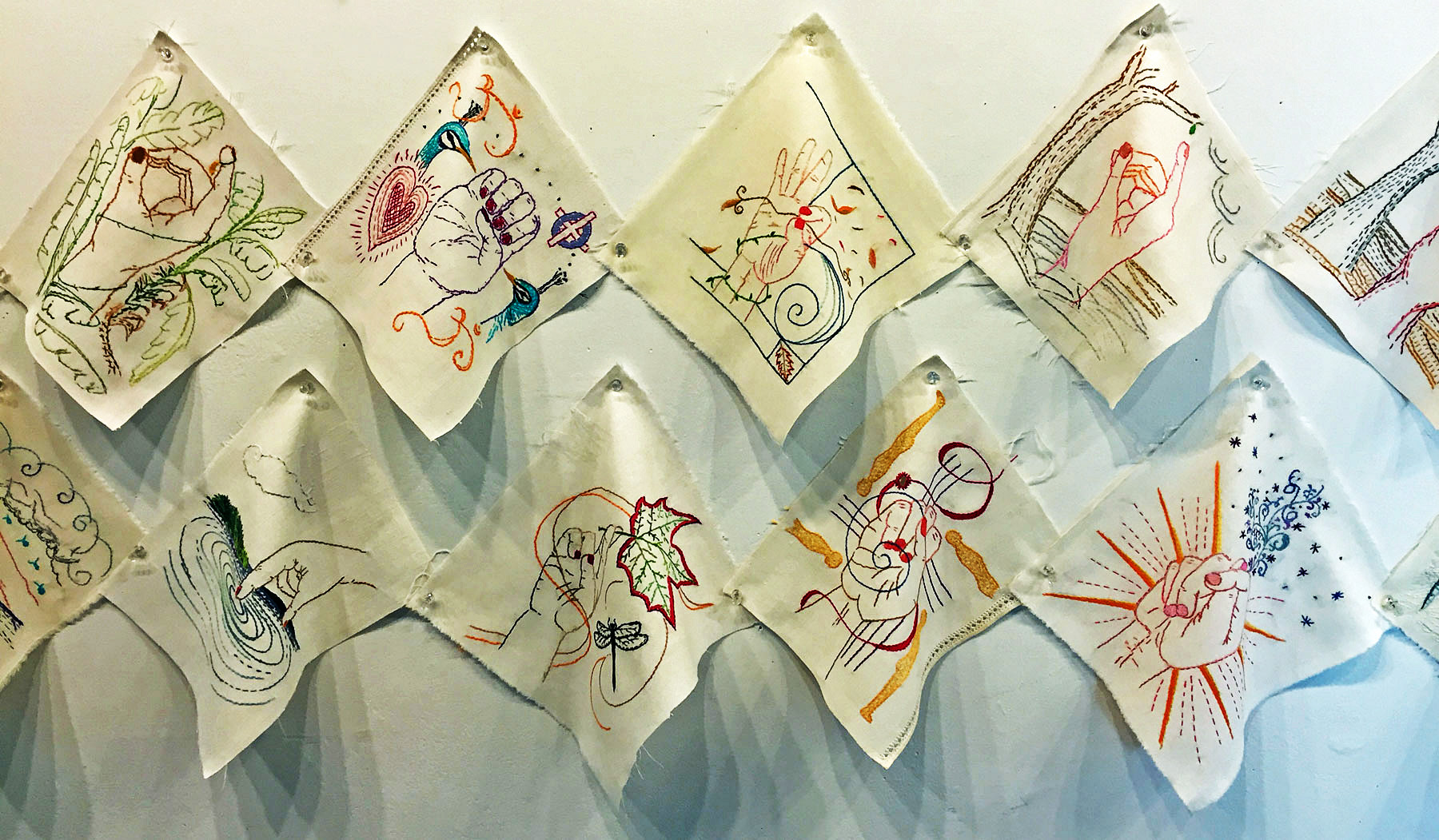




The Tears We Refuse Touch Bone • Four Poems by Karen Benke

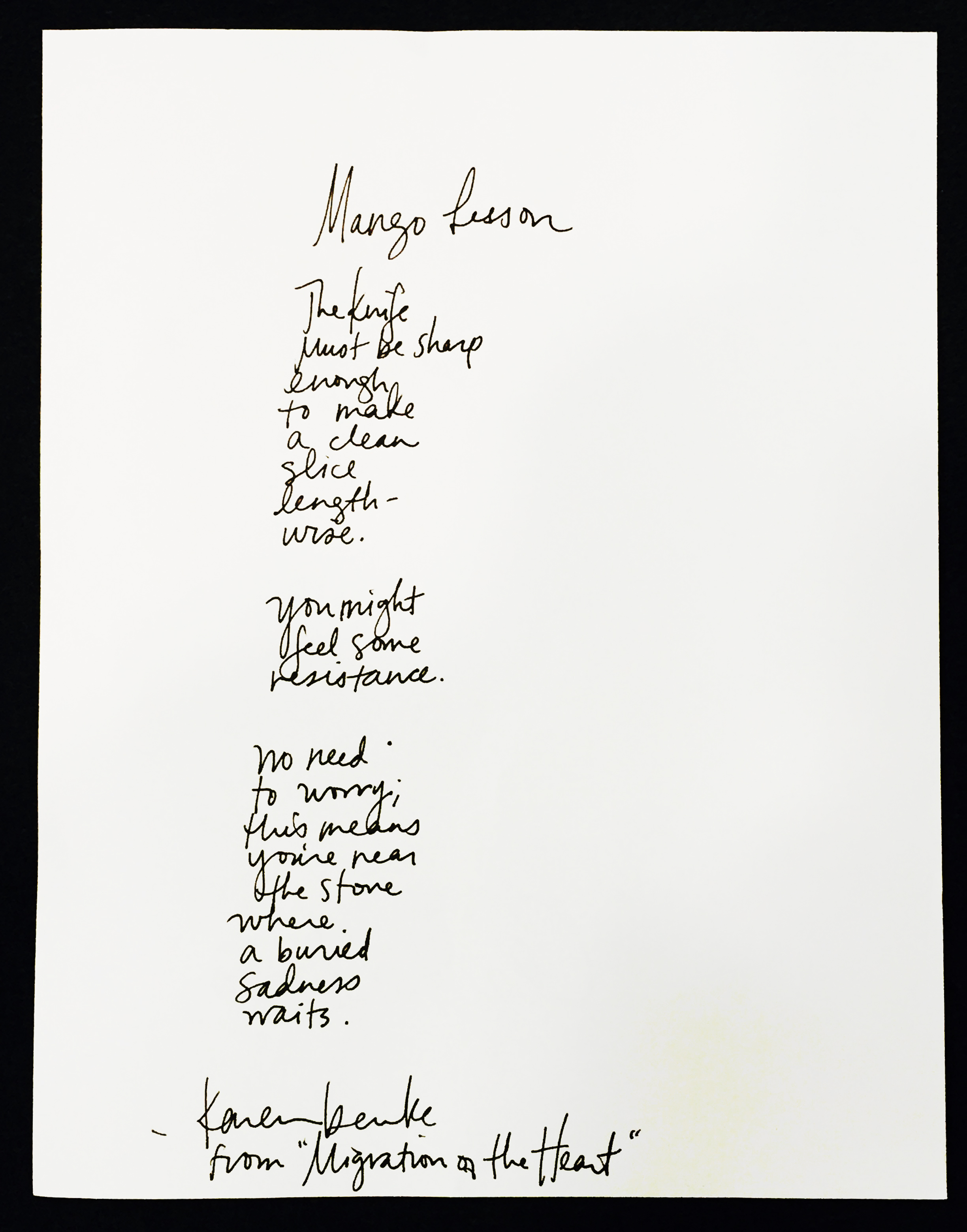


Karen Benke is a creative writer, adventurer of pen and paper, and long time poem-maker. She is the author of the chapbook, Sister (Conflux Press, 2014), and three popular books on playing on the page, Rip the Page! (Roost Books/Shambhala, 2010); Leap Write In! (Roost Books/Shambhala, 2013); and Write Back Soon! Adventures in Letter Writing (Roost Books/Shambhala, 2015). She lives north of the Golden Gate Bridge with her teenage son, a magic cat, and a rescue dog. Though she prefers receiving letters via snail mail, she can be reached via her website: www.karenbenke.com.
It's So Un-Special, It's Special • A Conversation with the Bill Keaggy on Artfulness, Sloppiness, and Interestingness

St. Louis-based Bill Keaggy is king of “generating content.” A wildly prolific artist and collector, he was an erstwhile magazine designer and photo editor at the St. Louis Dispatch before launching his self-proclaimed purposeless website of “visual indiscretions,” the eponymous www.keaggy.com.
His goal is to make things interesting by helping people appreciate what’s right in front of them—which he more than accomplished with projects such as Milk Eggs Vodka, a tome of anonymous and abandoned grocery lists he first uploaded to his site as a simple photo collection entitled “Grocery Lists,” before piquing a publisher’s interest and organizing them into snarky categories such as “Eating Wrong,” or “Bad Spellrs.”
By compiling such miscellaneous marginalia, Keaggy imbues the ephemeral both with an otherwise lost fixity, and a sort of imaginative narrative history. As he put it, “I considered my work to be ‘art’ in the lowercase form of the term. It’s so un-special, it’s special.” These special un-special projects have been featured in places like the New York Times, The L.A. Times, Chicago Tribune, The Guardian, HOW Magazine, and even Jimmy Kimmel Live. Should you want a more concise and chronologically organized autobiography, his documentary impulse has produced a timeline of his entire life, including everything from his first sip of PBR in 1972 to his NY Times Magazine interview in 2004, here: http://keaggy.com/about-me/.

SARAH MADGES: Have you always been a collector, of marginalia or otherwise?
BILL KEAGGY: I think so. Not in a hoarder kind of way, but yes, I think I’ve always had an interest in collections of things. When I was 10 or so I had a pretty big key chain collection, although now I’m not sure why, but I soon realized that it was far more interesting to collect things that were never meant to be collected. Things that other people had lost interest in or saw as useless.
MADGES: This project must have required incredible patience and dedication. At any point did you consider quitting? What convinced you to keep going, and to eventually get the collection published in a book?
KEAGGY: The grocery list collection started small and stayed small for a very long time. But I never approached it in a “Must. Add. Lists. Every. Day!” kind of way. I’m not naturally a patient person, but in this case I just let it grow naturally, adding a list every few weeks or so. Then around 2000 I put it online, and back then being a novelty online actually was novel, so it got linked around a lot and people started to ask how they could contribute. Since then, the collection has been fueled 99% by friends and strangers sending me lists. It sort of has a life of its own now and I update the site a few times a year at most. So, no, I never considered quitting because it was difficult. The collection has grown big in the same way people grow old — suddenly you’re not young anymore and you look back and wonder how the hell that happened.
I’d thought about how I might turn it into a book but never acted on it. The truth is that I had the luxury of the publisher contacting me to see if I wanted to make a book. Of course I did. It was a good way to breathe new life into the project, to think about the collection in a different way and give it depth, and help other people think about the lists in different ways.


MADGES: In an increasingly tech- and text-based world, handwriting has lost some of its former relevance and ubiquity — cursive is no longer even required in U.S. school curricula, and thousands of people have never written or received a letter in their entire life. How important is the handwritten aspect of these grocery lists to you? Do you still write by hand?
KEAGGY: The handwritten lists usually are the best — they have more character, personality, quirks, artfulness, sloppiness, and interestingness to them. Not just because of the handwriting but also because of the writing material — you can’t run weird, repurposed scraps of paper or cardboard or magazine through a printer but you can tear a piece off of something and write on it. And I’m a designer so I have this innate interest in letterforms and layout and organization, and everyone brings their own approach to these things in handwritten lists.
That said, I obviously get more and more typed lists now, but fewer lists overall because so many people do keep their lists on their phones. I do, because like everyone else I always have my phone with me. I only occasionally write a grocery list out by hand but the truth is I don’t feel too nostalgic over this change. I still do a lot of writing, sketching, and designing on paper, so it’s still part of my daily life.
MADGES: Many people, editorial reviewers and regular folks (ie, Amazon.com customers) alike, have commented on Milk Egg Vodka's humor, which comes in part from the original content of the various grocery lists collected, but mostly from your insightful and playfully snarky commentary. There's also the obvious fact that the Library of Congress designated it as a "Humor" book. When you started collecting these lists, were you mostly compelled by the comic opportunities they provided? Or was it more about the voyeuristic element of finding discarded personal notes, the various examples of penmanship and spelling, their value as art objects, something you couldn't quite name? A more concise question: was humor the intended goal, or a natural and happy accident?
KEAGGY: Yes, the funny lists were what made the collection really interesting to me, and I think to most people. Aside from the fact that they’re an anonymous, unguarded peek into other people’s lives, and, truthfully, are mostly normal and boring, it was when you’d find that needle in the haystack — that weird, WTF list with odd combinations of items or really poor spelling or funny notes. It was those moments that made the project worthwhile and I realized early on that I should highlight them for people, so I made Top 10 lists, which became the backbone of the book. Finding funny lists wasn’t the original goal — I just thought it was interesting to pick up something someone else had thrown away — but the humor aspect was a funny bonus that only became apparent after sticking at it for a while. I don’t know which of the lists was the very first one I found, but I do know it wasn’t funny. It was typical.
The funny ones are few and far between, but do make it all worthwhile are are probably the main reason people find the collection weird and interesting.


MADGES: Separate, but related question: how do you characterize your work? What are you hoping people will notice or take away from it?
KEAGGY: I don’t think I have a good answer to this question. I very purposely don’t tell people how to feel or what they should get out of looking at my various projects. I might explain how *I* feel about them, or why I did something, but I just put things out there and hope that they take *anything* away from it. I want their reactions to be legitimate and pure, whether it’s “Wow, I never thought about waste that way” or “This guy is an idiot." Telling people how to feel about these projects and art in general is like saying, “Get it? It’s funny because…” at the end of a joke. In the past I’ve characterized my work as being about “the life behind the things we leave behind,” and I think that’s enough for people to go on.
MADGES: After MEV, you published a similarly-minded book in 2008 called 50 Sad Chairs, which critiqued and poked fun at consumer culture while artfully cataloguing a bunch of forlorn furniture. What have you been up to since then? What projects are driving you right now, and how have your previous works prepared you for or led you to them?
KEAGGY: After “50 SAD CHAIRS” I did a lot of other “collecting with photography” projects. I’d stumble on a theme and make dozens or hundreds or thousands of photos that catalogued a particular idea. Trees growing out of old abandoned buildings. Basketball hoops in alleys. Rust stains. Curse words. Lots of decay porn, which has become a genre unto itself. Recently in my photo collections I’ve been leaning more toward seeing everyday things in other everyday things. In February I challenged myself to find the shapes of all 50 U.S. states in the world around me and in June I collected the letters of the alphabet from dead worms on the sidewalk. People really liked the states project and were really grossed out by the worms. But what I do more and more of now is actually *make* things from other things—working with found and repurposed objects instead of simply collecting them. After so many years of working digitally I really felt the need to go analog. But the idea of appreciating—or at least considering—and/or re-using “junk” and little, broken, forgotten, ugly, ignored things is what ties most of my projects together.

All of Us, Once Angels, Who Finally Finished Falling • John Reed
Poet and playwright John Reed takes us inside his head, where his sonnets start, but also on a bus, where his sonnets form, and finally, where they end up, scribbled onto a napkin. It's how he escapes doubt, and discovers form.

BY JOHN REED
I usually work on sonnets for a long time in my head, then write them out by hand. Two out of three times I'm not feeling it, so I toss it, and think again for a while. I had to take a bus somewhere on a school trip, so I wrote this one down then. If I can get to the end without doubting, I usually am fairly satisfied.

Sonnet Typed Below:
80
I knew we'd be seeing each other again.
It looks like everyone else is here, too.
All of us, once angels, who finally finished falling.
We were so crazy about here and there,
when the little difference was "always,"
or the other eternity, "never."
Just listen to all of this childless laughter.
Now we are gone, and here we can stay,
you and I, who are you and I no more,
who tore apart our daughters for the bears,
who offered our sons to God, LOL,
who are, we know, we've forgotten who,
who are now outside of ourselves, without when.
You can read John Reed's bio on his website here, as well as praise for his sonnet-making abilities, which go something like this: "John Reed exploded my concept of a sonnet." Erika Anderson, Electric Literature.
A Kaleidoscopic Force of Creative Decoration • Andrea Rehani

WORDS FOR WALLPAPER is a kaleidoscopic force of creative decoration by Chicago-based poet and creative, Andrea Rehani. It combines the beauty and brevity of poetic expression with an artistic and aesthetic simplicity that is at once reminiscent of the modern and the antique.
Beginning by hand, Rehani creates a poem based upon a particular color or theme and allows them to take horizontal and vertical shapes as she frames them for the wall, where they will eventually live. There is an odd distance of intimacy to Rehani's work. The poems themselves contain a layer that can feel like a memory, but zooming out, the object itself represents something of the "now here," not "nowhere;" in that, they carry with them the sense of place that surrounds them.
To see the exhibit, click here.

Indian Summer Evenings • Nivedita Nivi
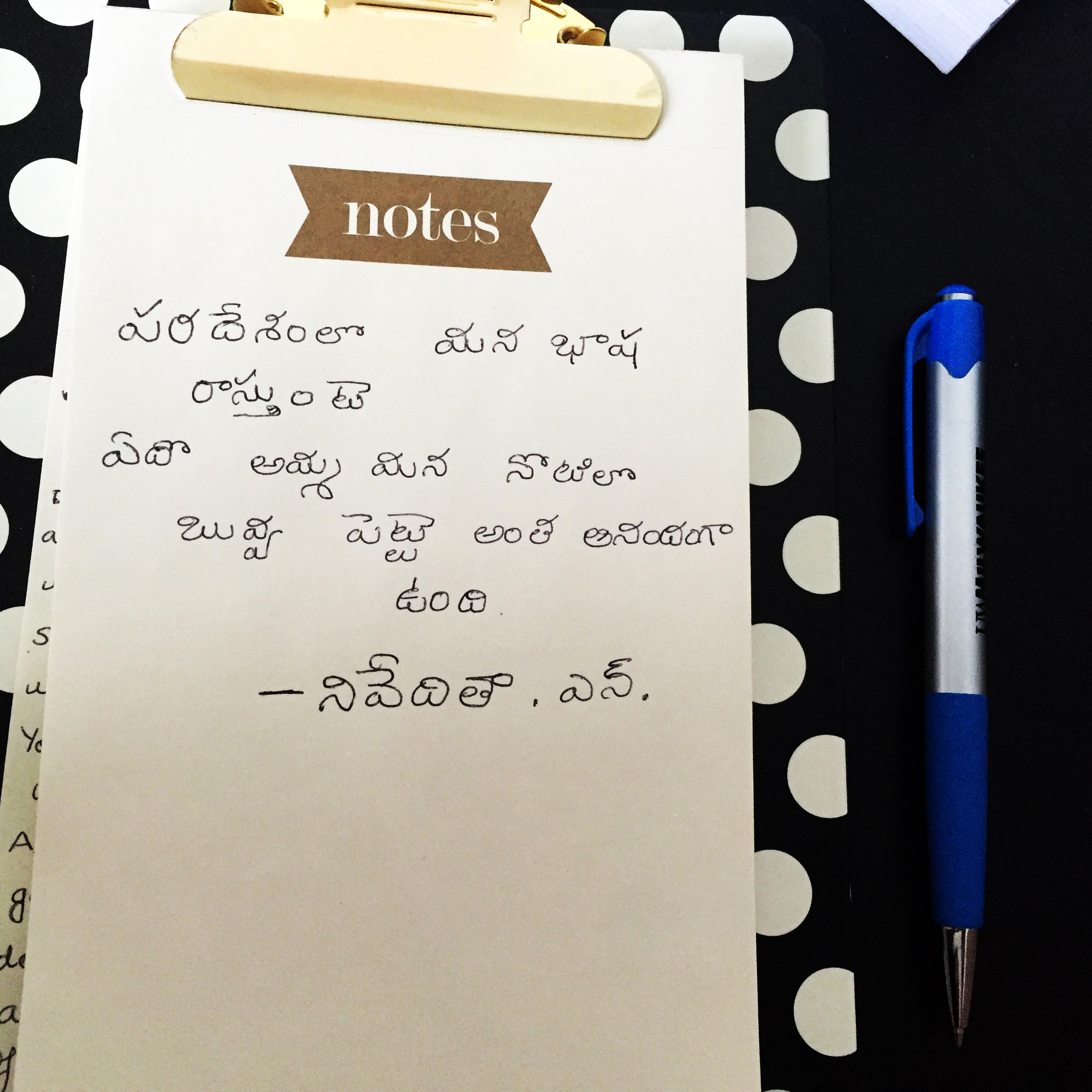
While some use their journals to capture the everyday experience, Nivi uses them as a space and place for her poetry to roam.


A Hyderabadi at heart, Nivedita Nivi dwells in nostalgia. When not editing, reading or writing, she daydreams and watches the squirrels from the balcony of her house in Wisconsin and hopes to meet the rabbit imprisoned in the moon, someday.
Clean


Sarah Madges is a handwriter living in Brooklyn. Her handwriting has appeared in numerous composition notebooks, a handful of three-subject college ruled notebooks, and a whole host of moleskines. She also works with typed words, which have appeared in places like the Village Voice, Killing the Angel, and various abandoned blog platforms.
300 Mg
Wellbutrin blues dose high dose low so close. closet blues
keep shoes rubber made walking. white round scribbles. Avoid
avoids. Walk away stomp shoes bouncing soles black.
colorful hyphen split open particles purged beads of feel
betters scattering scattered. Extend the release of. You might
experience. May include. Talk to your doctor.
Peristaltic magic make me whole soul bouncing.
Internal tremors shake off just wellbutrin blues.
Swallow swallows swallowed shallow breathing blue-
Ing. Better better better better. Walk out old life
matinee movie — much brighter than you
remembered. Glittering goldly sweetly scrim of
saccharine. Put it on peristaltic. Old life moth balls
closet blues forget forgot. Swallowing a white room
quiet white noise machine drown out therapy
drown out but what about tell me about talk
about I. Scratch pad for scars give coat for bag
rattling. Bouncing in bag walking out old life.
Ticking rattler reminder not quite not quite. Quit.


Sarah Madges is a handwriter living in Brooklyn. Her handwriting has appeared in numerous composition notebooks, a handful of three-subject college ruled notebooks, and a whole host of moleskines. She also works with typed words, which have appeared in places like the Village Voice, Killing the Angel, and various abandoned blog platforms.