
On Handwriting Guest User On Handwriting Guest User

Collecting Words • A Reflection on Lenore Tawney by Kathleen Mangan

Kathleen Mangan, the Executive Director of the Lenore G. Tawney Foundation discusses the role of handwriting in Lenore Tawney’s daily life and in her artistic practice. Tawney was a regular correspondent and diarist who filled dozens of tiny journals with fine script, but she also incorporated  handwriting in collages and constructions. Fine, thread-like script was superimposed upon lines of text from old manuscripts; written lines were piled atop one another so they could not be deciphered; and at other times delicate lines on translucent paper were turned upside-down. Tawney’s goal was to make “visionary” experiences “visible.”

Lenore Tawney (141), postcard to Maryette Charlton, February 15, 1969

Lenore Tawney (141), postcard to Maryette Charlton, February 15, 1969

This essay was originally a part of collaboration with The Smithsonian's Archives of American Art, Pen to Panel.

BY KATHLEEN MANGAN

The handwritten word played an important role in Lenore Tawney’s daily life and in her artistic practice.  Tawney was a regular correspondent and diarist who filled dozens of tiny journals with fine script.  These writings only rarely referenced her artwork or reflected events in her life.  More typically, Tawney ‘s notebooks were filled with quotations from her extensive readings.  “Collecting” passages in this way provided the opportunity for meditation on their deeper meanings.

Lenore Tawney (142-3), letter to Maryette Charlton, Jan. 27, 1970 [cont'd below]

Lenore Tawney (142-3), letter to Maryette Charlton, Jan. 27, 1970 [cont'd below]

In 1964, she began sending postcards to friends.  In her own words, “the postcards came from wishing to communicate…but not knowing what to say.  You know—you don’t want to say anything but you want to be a friend.  So I began making these postcards with messages that looked like writing but they were just signs.  There was a message but it was [an] invisible, unreadable message.”

Almost immediately, she began to incorporate her handwriting in collages and constructions.  The meaning of these written words was also fugitive, intended to communicate, but in a mysterious, elusive way.  Fine, thread-like script was superimposed upon lines of text from old manuscripts; written lines were piled atop one another so they could not be deciphered; and at other times delicate lines on translucent paper were turned upside-down.  Tawney’s goal was to make “visionary” experiences “visible.”

In this 1970 letter to Maryette Charlton, Tawney alludes to a deep, unconscious form of communication.  She describes a visit with Nanrei Kobori, the chief abbot of Ryoko-in in Kyoto, a Zen master and a highly regarded calligrapher.   Reflecting on Kobori’s teaching, Tawney notes that “When we are drawing a line, it is a part of our being.”  And as such, she believed in the power of art to convey “unreadable messages” from deep within.

Back to the Exhibit

Kathleen Nugent Mangan is the Executive Director of the Lenore G. Tawney Foundation.  A former curator at the American Craft Museum, Mangan was guest curator of the Museum’s 1990 traveling exhibition, Lenore Tawney: A Retrospective.  Following the retrospective, she continued to work with Tawney on numerous exhibitions and projects.  Mangan joined the board of the Lenore G. Tawney Foundation in 1995 and became its director following the artist’s death in 2007.

Read More
On Handwriting Guest User On Handwriting Guest User

Jackson Pollock's Calligraphy in Composition • A Reflection by Helen A. Harrison

Helen A. Harrison, the Eugene V. and Clare E. Thaw Director of the Pollock-Krasner House and Study Center weighs in on the intersection between Jackson Pollock's art and handwriting, such as his "use of calligraphic imagery as an integral compositional element" in some of his drawings that contradicts the awkward, halting script used outside of his artwork for personal and professional correspondence.

Jackson Pollock, 1928 / unidentified photographer. Jackson Pollock and Lee Krasner papers, circa 1905-1984. Archives of American Art, Smithsonian Institution.

Starting in the early 1940s, Jackson Pollock’s abstract compositions include forms that look like letters and numbers. Paintings such as Male and Female (1942-43), Guardians of the Secret (1943), and especially Stenographic Figure (1942) contain many such elements. Less explicitly, in Pollock’s poured paintings the free-flowing linear shapes suggest cursive calligraphy. If we accept his assertion that “technique is just a means of arriving at a statement,” it’s not too far-fetched to imagine his art as a kind of communication akin to written language. Yet his actual handwriting—whether fragmentary jottings and drafts, which would naturally be informally written, or more carefully penned examples—bears no resemblance to the writing in his paintings.

Jackson Pollock and Lee Krasner papers, circa 1905-1984. Archives of American Art, Smithsonian Institution.

Examples of Pollock’s handwriting are in his papers at the Archives of American Art. The script is halting, often with crossed-out passages, dashes, and other hesitations. His awkward penmanship contrasts sharply with the graceful rhythmic flow of his classic paintings. Indeed, he seems to have had more control over sweeping spontaneous gestures than over the intimate and deliberate motions of handwriting.
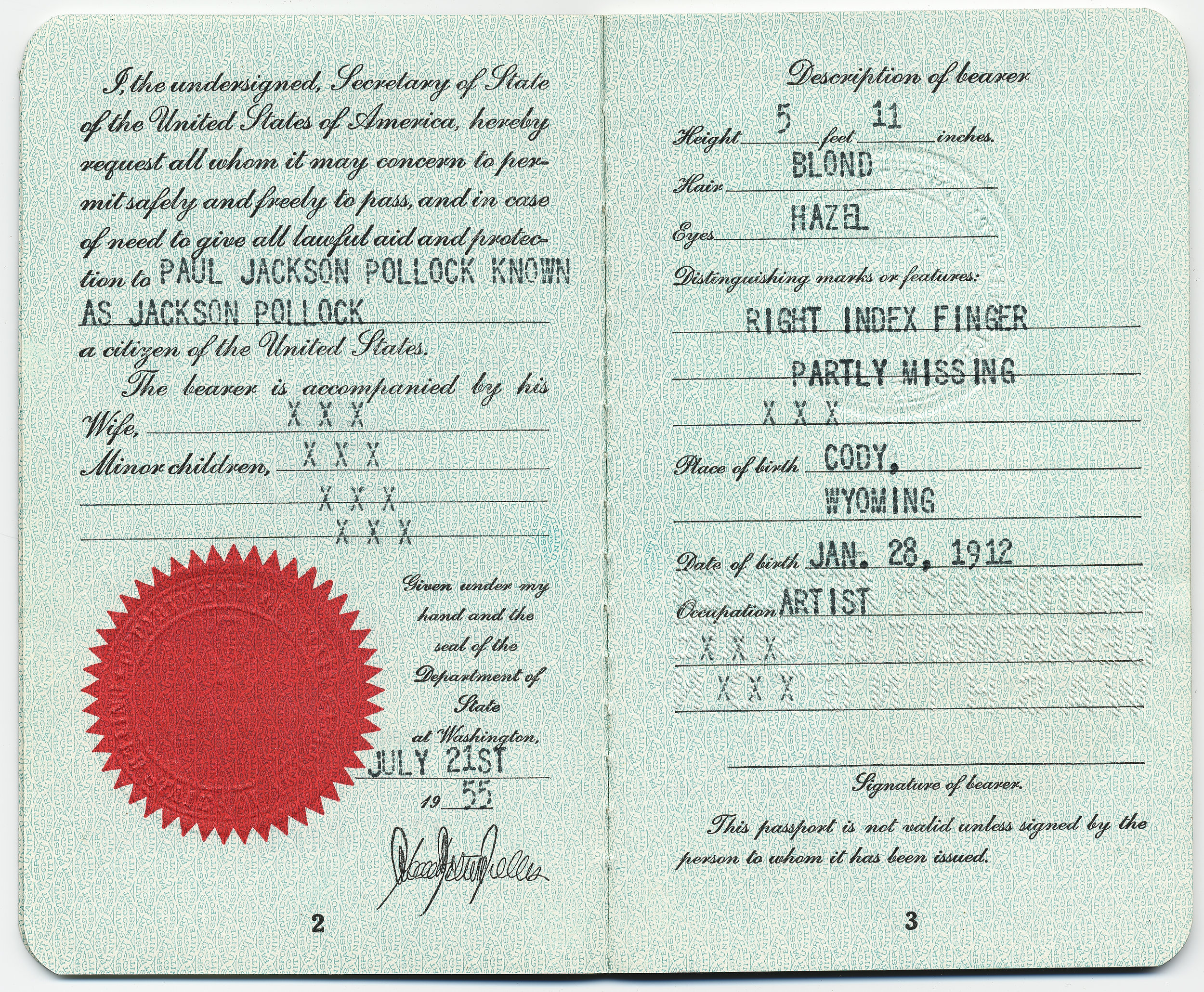
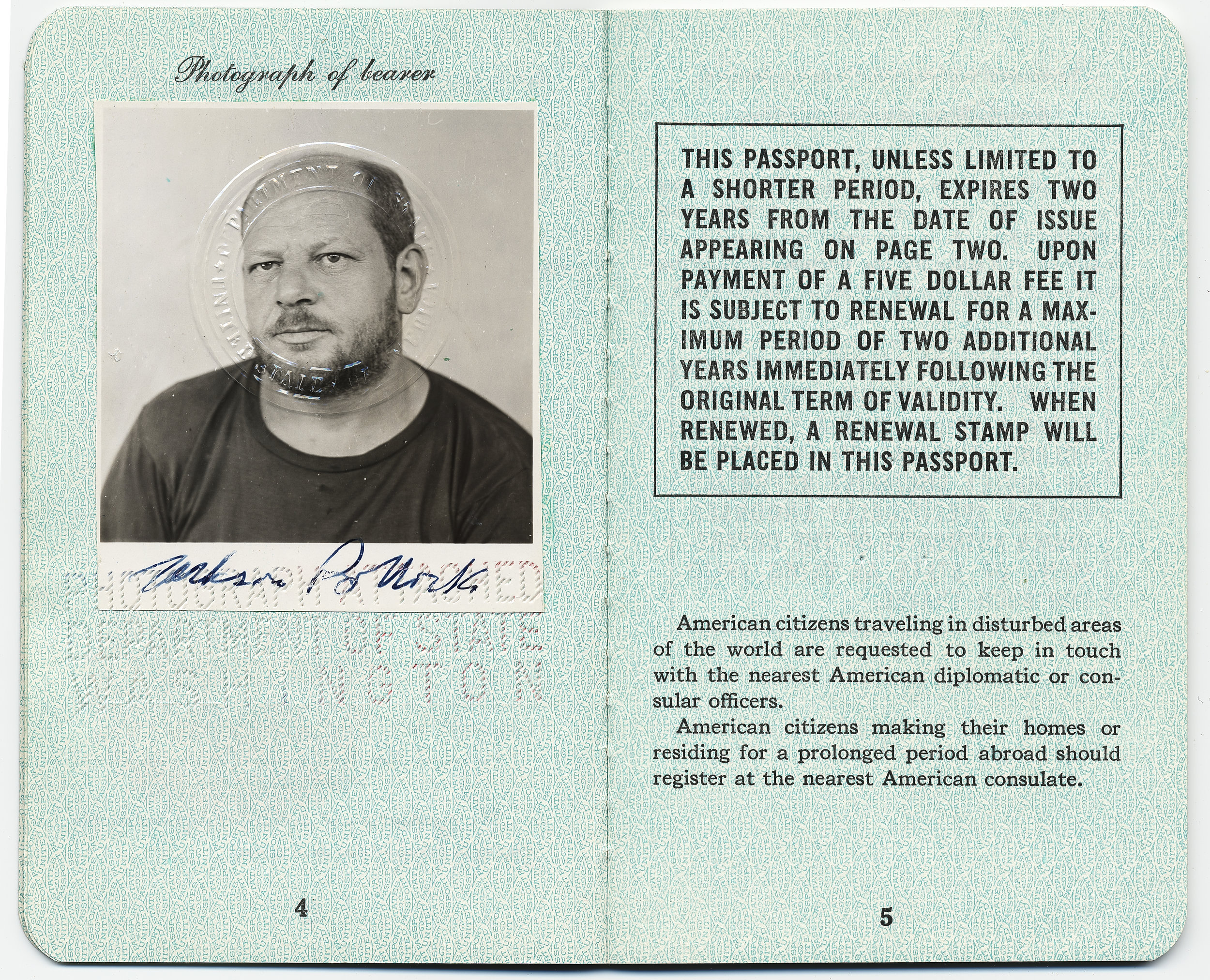
Jackson Pollock's passport, 1955 July 21. Jackson Pollock and Lee Krasner papers, circa 1905-1984. Archives of American Art, Smithsonian Institution.

But that impression is contradicted by many of his drawings, especially those of the mid 1940s, in which complex graphic patterns were created by finely calibrated marks. They show him to have been capable of handling a pen, pencil or crayon with great finesse. And in an untitled 1951 drawing that he gave to Clement Greenberg, the word “kiss” is repeated as a linear motif—another intriguing example of Pollock’s use of calligraphic imagery as an integral compositional element.

Back to Exhibit


Helen A. Harrison, the Eugene V. and Clare E. Thaw Director of the Pollock-Krasner House and Study Center in East Hampton, New York, is an art historian, curator and journalist specializing in modern American Art. Her most recent books are a monograph on Jackson Pollock and a mystery novel, An Exquisite Corpse: Death in Surrealist New York.

Read More
Events Bretty Rawson Events Bretty Rawson

Pen to Panel • An Evening of Archives, Conversation, and Lagers

This Saturday is our culminating event, Pen to Panel, with the Smithsonian's Archives of American Art. We'll be joined by five wildly creative minds for an hour of conversation about the past, present, and future of handwriting. We are thrilled to be hosting the event at The Sketchbook Project's newly-renovated home, which houses thousands of sketchbooks from around the globe. Below are the brief bios of our panelists, as well as a few links so that you can get a little lost, and find much more. But if you're in town, come see and hear from them in person. Did we mention the beer is on us?

The power in the pen is people, which is why we hosted Pen to Panel. It was our third of three events with The Smithsonian's Archives of American Art. Curator of Manuscripts Mary Savig doesn't believe handwriting is a dying art, and we agree, which is how we bonded, and it is which is why we have bonded, and for two months, banded together to help celebrate the launch of their latest anthology, Pen to Paper. We were thrilled to host this culminating event at The Sketchbook Project's newly-renovated home, which is the permanent home of the Brooklyn Art Library and houses thousands of sketchbooks from around the globe. We're in the midst of creating a short film from the event, as we recorded the conversation, but in the meantime, we hope you'll enjoy some of the images from the night, as well as info on the five wild minds that joined us to talk shop.  

Info on our Five Panelists:

Mary Savig, Curator of Manuscripts, Smithsonian Archives of American Art

Mary Savig, Curator of Manuscripts, Smithsonian Archives of American Art

Mary Savig brings to the table years of experience in one of the largest archives today: The Smithsonian's Archives of American Art. We first bonded during a snowstorm. It happened to be National Handwriting Day, which is not only the best time to get snowed in, but the best time to write by hand. She doesn't believe that handwriting is a dying art, and we agree, which is why we bonded in the first place, but then banded together to create this collaboration and conversation. She talked about the issues archives face, how they keep the past present, and what steps The Smithsonian is taking to embrace the technologies of the future.  


Luis Jaramillo, Author and Director of the MFA in Creative Writing at The New School

Luis Jaramillo, Author and Director of the MFA in Creative Writing at The New School

Luis Jaramillo is the author of The Doctor’s Wife, winner of the Dzanc Books Short Story Collection Contest, an Oprah Book of the Week, and one of NPR’s Best Books of 2012. Plot twist: he writes his drafts by hand. Luis talked about this particular experience, but also the role handwriting plays, in general, in the creative writing process. While this is one of the main reasons we were excited to have Luis on the panel, he also happens to be a part of Handwritten's origin story: the platform was first imagined during a course he co-taught called Writing & Publishing Lab at The New School's MFA Creative Writing Program, where he is currently the director.


Linda Shrewsbury, Creator of CrusiveLogic

Linda Shrewsbury, Creator of CrusiveLogic

We were thrilled to be joined by Founder of CursiveLogic Linda Shrewsbury. They have been one of our "Partners in the Pen" since the beginning. Whenever people say cursive writing is dead or dying, we say no it's not. And then we explain to them CursiveLogic: the patent-pending method for teaching cursive that has literally and figuratively reshaped the way students learn cursive in the classroom. Only two years in, CursiveLogic's future is bright, which is one of the things Linda talked about: the future, and reinvention, of cursive writing in the classroom. In addition to homeschooling her own three children, Linda has been privileged to work as a teacher and a college professor in both private and public institutions. Linda received her undergraduate degree from Harvard University and her Masters from Oklahoma State University.


Tullis Johnson, Author and Curator of Archives at Burchfield Penney Art Center

Tullis Johnson, Author and Curator of Archives at Burchfield Penney Art Center

Tullis Johnson is the curator and manager of archives at the Burchfield Penney Art Center. He is what we would call a historical surgeon on Burchfield, but what others would call an emerging Burchfield Scholar. Tullis has organized multiple exhibitions of contemporary and historical significance, including the nationally touring exhibition, Charles Burchfield: Weather Event, which received the Award of Commendation at Museums in Conversation from the Museum Association of New York. You can see his exhibition Blistering Vision: Charles E. Burchfield’s Sublime American Landscapes, which is currently on view at the Burchfield Penney Art Center in Buffalo, NY. Using Burchfield as a portal, Tullis spoke about the necessity of zooming out when we look at the state of handwriting.


Barbara Bash, Calligrapher, Author, Illustrator, Performance Artist, and Teacher

Barbara Bash, Calligrapher, Author, Illustrator, Performance Artist, and Teacher

Barbara Bash quintuples as a calligrapher, author, illustrator, performance artist and teacher of the creative process. Her love of the alphabet has taken her back to the study of their early origins in the nature: the writing of the world. She has written and illustrated a number of children’s book about trees, bats, urban birds and most recently, True Nature: An Illustrated Journal of Four Seasons in Solitude, which was completely handwritten except for the bar code. The embodied act of handwriting is one of her core practices for self connection. She is currently creating a book (working title, Leaping Letters) that explores why handwriting still matters. You can understand why we could not contain our wild happiness to have had Barbara on the panel. 

Read More
In Person, Pen to Paper Bretty Rawson In Person, Pen to Paper Bretty Rawson

Handwriting Continues to Prove Its Nimble Nature • A Conversation with Curator of Manuscripts at Mary Savig

"Technologies of communication, from telegrams to texting, have long threatened the written word. And yet, handwriting continues to prove its nimble nature. The craft of handwriting has flourished online, especially on social media. Artists, thinkers, and makers alike are experimenting with penmanship in innovative ways. Along these lines, the Archives continues to digitize and make our vast handwritten records available online for new generations to discover."

This conversation was a part of our collaboration with The Smithsonian's Archives of American Art, Pen to Panel. Here, we talk with Curator of Manuscripts Mary Savig about the creation of their latest anthology, which was the root of our collaboration, Pen to Paper.

SARAH MADGES: I read in the review on the Smithsonian website that the idea for the exhibition and eventually this book came from a discussion amongst colleagues about how easily recognizable A.D. Reinhardt's handwriting is. Are there some other artists whose handwriting you can spot from across the room? Georgia O'Keefe's handwriting is so distinctive!

MARY SAVIG: Yes, Georgia O’Keeffe’s lyrical, bold handwriting shouts for attention and is impossible to forget. Hans Hofmann and Maxfield Parrish also boast distinct penmanship: Hofmann’s handwriting is twiggy but deliberate, and there is no confusing it for another artist’s hand. Parrish’s graceful penmanship doesn’t jump off the page like the others, but its inimitable elegance is as recognizable as his paintings. 

SARAH: What factored into your decision about which artists, and their letters, to feature?

MARY: The artist’s handwriting had to intrigue me. It was also important to represent the broad scope and scale of American art, from the nineteenth century through the present, as well as artists from different geographical regions who worked in various media, like sculpture, photography, graphic arts, abstract painting, landscape painting, and crafts. The book includes outsider artists and conceptual artists, feminists and immigrants, and more. As a whole, this selection reflects the depth of resources at the Archives of American Art. 

SARAH: In your introduction to the book you talk a lot about the historical development of handwriting in the U.S. Obviously you've researched this topic quite a bit — what was the most surprising or interesting thing you learned?

MARY: Much ink has been spilled on handwriting’s tenuous relationship with technology. “Once upon a time, before there were electronic typewriters, or tape records, or Xerox machines, boys and girls had to write by hand,” began a New York Times article lamenting the current state of penmanship in 1967.  Technologies of communication, from telegrams to texting, have long threatened the written word. And yet, handwriting continues to prove its nimble nature. The craft of handwriting has flourished online, especially on social media. Artists, thinkers, and makers alike are experimenting with penmanship in innovative ways. Along these lines, the Archives continues to digitize and make our vast handwritten records available online for new generations to discover. 

SARAH: What's your favorite letter in the book?

MARY: Don’t make me choose! My answer really depends on the day and since it’s a sunny Friday morning, I’m thinking of a charming letter by the Reverend Howard Finster. Liza Kirwin, deputy director at the Archives of American Art, writes, “Reverend Howard Finster was a consummate entertainer and an old-timey Bible-belt evangelist. His handwriting, most often in block capitals, was like his preaching — purposeful, emphatic, and an integral part of his art, his “sermons in paint.” This description encapsulates the spirit of the book. 

SARAH: Who transcribed all of these letters? The book cites Transcription Center volunteers. How did people tackle the less legible ones? 

MARY: Transcription Center volunteers helped with the bulk of transcriptions (a few of the letters had been previously transcribed). The volunteers are especially amazing at deciphering difficult hands. Many of them have compared translation to solving a puzzle: you have to be able to discern whether the faintest line might indicate a dash, a period, or a dotted i, while keeping in mind the bigger picture of the letter because it holds so many context clues. 

SARAH: You note that for this book the writers focused on visual content over verbal. Why was it important that they do that? What were you hoping would emerge in the contributors' essays as a result?

MARY: Many of the writers had spent months, often years, in the Archives of American Art scouring these letters for details like the locations of artworks, sale records, notable collaborations, and the like. The goal of this project was to get the writers to step back from the content and instead approach the letter as if it’s a painting or a sculpture. What might the curves, dashes, and density of line tell us about the artist? I was always fascinated and often surprised by the diversity of responses. What emerged from this project is that primary sources, and handwritten letters in particular, remain relevant and poised for interpretation. I hope this book prompts others to look at our materials with a fresh perspective. 

Read More
Pen to Paper, In Person, Reviews Bretty Rawson Pen to Paper, In Person, Reviews Bretty Rawson

Pen to Paper: Artists' Handwritten Letters • A Review by Sarah Madges

"Designed by Princeton Architectural Press, the book operates much like a gallery exhibition, privileging the visual over the verbal so that we may take in the high quality images as art objects before reading the accompanying “wall text” that complements and situates them."

BY SARAH MADGES

Borne from an offhand observation between Smithsonian’s Archives of American Art colleagues about the instant recognizability of minimalist painter A.D. Reinhardt’s handwriting, Pen to Paper: Artists’ Handwritten Letters, inspires reverential curiosity. In this carefully considered book, Curator of Manuscripts Mary Savig regards letter-writing as an art, paying special attention to how each artist addresses formal properties of line and space, as well as what we can infer from these decisions about their creative processes and everyday lives.

Proceeding alphabetically from Bernice Abbott through Grant Wood, and spanning the decades from the 1830s to the 1970s, this thoughtful compendium tells the history of art in America in the words of the artists who shaped it: through correspondences both professional and personal, from negotiations with art collectors and curators to revelations about their art and attendant aspirations.

For this project, Savig sought out curators, professors, historians, artists, and archivists alike to read not just between the lines, but to read into each line, inviting 56 different minds to investigate the interplay between language and art in short essays included alongside each letter. As she explained in an interview with us: the goal was to get the writers (many of whom had previously pored over these manuscripts for citations in art catalogs and dissertations) “to step back from the content and instead approach the letter as if it’s a painting or a sculpture. What might the curves, dashes, and density of line tell us about the artist?”

She hoped that providing examples and interpretations of artists’ handwriting would offer new frameworks for understanding their work — and she was right. “What emerged from this project,” Savig summarized, “is that primary sources, and handwritten letters in particular, remain relevant and poised for interpretation.”

Designed by Princeton Architectural Press, the book operates much like a gallery exhibition, privileging the visual over the verbal so that we may take in the high quality images as art objects before reading the accompanying “wall text” that complements and situates them. While each entry deserves thoughtful consideration, their enigmatic, artistic value may be grasped in a glance, making the collection ripe for paging through at any pace and in any order. Full verbatim transcriptions are included in the back of the book so that readers may experience each letter’s gestalt before delving into character-based, historical, or cultural analysis.

In order to demonstrate just how closely intertwined the written word is with visual art, Savig selected a wide range of artists and traditions. Artists’ idiosyncrasies impress themselves on the page, leaving a tangible trace from which we may draw parallels between artist’s pen, personality, and practice. We see how, in a letter from Howard Finster, sketches of Mount Rushmore-ish busts of important figures punctuate the otherwise breathless string of blocky san serifs, recalling his emphatic speech as a Baptist preacher as well as what he termed his “sermons in paint.” Senior Curator at Smithsonian American Art Museum Eleanor Harvey notes how Frederic Edwin Church’s calligraphic pen strokes echo his brushwork, “in which the rapid back and forth of his brush delineates the contour of a landscape with lyrical flair.”

Seemingly trivial details such as the consistency of letterforms and their organization on the page, or the evident ease or burden with which each letter was composed communicate a surprising amount of personal information as well.

As Savig notes in the book’s introduction: “Artists often code their feelings through handwriting.” We can learn a great deal about the level of affection and familiarity between the letter writer and recipient, the writer’s emotional or professional investment in the contents, and even their current mood. Henry Ossawa Tanner’s anger radiates in his 1914 letter to Eunice Tietjens that responds to an article presuming Tanner’s racial identity and relating it to his success. “Now am I a Negro?” Tanner demands in determined script after a paragraph of underlined phrases, crossouts, and emphasized quotations that undermine that claim. In drafts of a condolence letter written between October 8 and 9, 1968 to Teeny Duchamp just one week after Marcel Duchamp’s death, Joseph Cornell’s handwriting chokes up with ineffable grief. Entire paragraphs are violently slashed out with vertical ink bars, and his script stutters through the recounting of a dream that marks the last time Cornell “saw” Marcel.

Pen to Paper's letters run the gamut from personal chronicles and affectionate notes to philosophical treatises and meditations on the intersection between race, gender, and class in the art world. Some comments are profound, such as Marcel Duchamp’s first utterance of “readymade” to explain his transformation of everyday objects into art to his sister, and others are more banal — “sending this by carrier moose,” Ivan Albright teasingly signs off a letter to Earle Ludgin. In some cases, the letters bear ignorance of their future significance.

When Grant Wood squiggled a frame around an ebullient, red-penciled “Hurray!” at the top of a letter to Zenobia Ness, he couldn’t have known he should be celebrating his imminent fame in addition to the fact that the Art Institute of Chicago decided to hang two of his paintings, including the iconic American Gothic. The parenthetical postscript “(How are you Jackson?)” in Lee Krasner’s aerogram to Jackson Pollock during their trial separation carries chillingly prophetic weight when considering it was likely their last communication before he died in a drunken car crash a few weeks later.

From the whimsical floral doodles surrounding the word “darling” in Rockwell Kent’s letter to his wife Sally to the Asian calligraphy-inspired characters of A.D. Reinhardt, these missives offer extensive proof of the expressive and aesthetic capabilities of handwriting, while engendering a unique familiarity with figures who previously loomed larger than life in our consciousnesses.

By preserving and presenting these ephemera, the book emphasizes process over product, with redactions and insertions of text betraying an artist working through ideas—evidence no longer available in a world dominated by digital modes of communication in which individuality is often obscured by the opacity of typed text. Additionally, the book’s smattering of penmanship styles reflect trends in handwriting, as the ornamental cursive of Thomas Eakins (above), son of a 19th century handwriting instructor, is replaced by the uniform efficiency of the Palmer Method, as seen in Andy Warhol’s comically curt biography offered to the managing editor of Harper’s. 

This quiet collection poses a direct challenge to anyone who associates archival materials with must, dust, and irrelevance. The unmistakably human element of handwritten letters elevates what today may be merely cursory communication — an email or text message — to a kind of art that evokes the presence of the person who penned them, and leaves behind a physical relic of the relationship between letter writer, recipient, and the world at large. Appropriately in the book’s introduction, Savig encourages us not to ring the death knell of handwriting. Instead she invites us to “celebrate how imaginative correspondence now exists in material and digital forms,” providing new access and ways of thinking. Pen to Paper is a distillation of that celebration.

Read More
In Person, Pen to Panel Bretty Rawson In Person, Pen to Panel Bretty Rawson

Let the Mind Rule the Eye • A Conversation with Tullis Johnson about Charles Burchfield

Working on Pen to Paper was interesting for me because it brought Burchfield’s handwriting into a larger context. While some artists took time and care in crafting letters to friends, Burchfield had little concern for the elegance and precision of the written word. 

AH_Burchfield2.jpg

SARAH MADGES: How did working on this project inform or change the way you think about handwriting?

TULLIS JOHNSON: Charles E. Burchfield wrote prolifically. He kept a journal for more than fifty years, which by the end of his life totaled more than ten thousand pages. He also wrote notes on his sketches for paintings and on loose sheets of paper that were kept in his studio. The letters he wrote to his friends and colleagues constitute a small fraction of the writing that he did throughout his life, and reveal only a small part of what we can learn by examining his handwriting.

Working on Pen to Paper was interesting for me because it brought Burchfield’s handwriting into a larger context. While some artists took time and care in crafting letters to friends, Burchfield had little concern for the elegance and precision of the written word. On August 19, 1914 he wrote in his journal about his feelings on the subject:

 
Let the mind rule the writing not the eye! The mind should be so intent upon what it is saying, that it forgets the means of transferring it to paper. The artist does not see his brush. Be sure if what you are saying is worthwhile, someone will decipher your hieroglyphics. I do not mean that a man should adopt a crude handwriting to affect eccentricity. A man’s handwriting should be spontaneous. If we all wrote perfectly, there would be less variance of character. Of what avail is it, if a man perfect his handwriting, and [finds] that he has not perfected what he has to say? His only calling must be that of copyist.
— Charles E. Burchfield, Journals, Vol. 19, pg. 35-36, August 19, 1914
 

Burchfield was more interested in the content of his work, than on the methods of applying his medium. Reflecting on his experiences teaching, in 1959, he told interviewer John D. Morse at the Archives of American Art, “I couldn’t possibly tell anybody how to paint in watercolor….I told them: ‘Don’t think about the medium. What you’re trying to say is much more important than what you’re saying it with. And if you’re thinking about what you are trying to express, you may use watercolor like nobody else ever used it.”

SARAH: Why do you think these letters are so important, and how did you choose which one to discuss? What were the other fan letter responses like?

TULLIS: The letters written by Burchfield, in the collection of the Archive of American Art, are important because they reveal much about the character of the man at various times in his career. The earliest letter, written to Paul Travis (1891-1975) in 1930, is more a letter to a friend than a response to a fan. Travis was a close friend to Burchfield during and after his time at the Cleveland School of Art, who would later accompany him on sketching trips along with other friends from his time in Cleveland. 

Burchfield’s letters to Lawrence Fleischman (1925-1997) are even more revealing. Correspondences between these two men, in the collection of the Archives of American Art, span between the years of 1954 and 1964. 1954 was the same year that the Archives were founded, by Fleischman and others. In January and February of 1956, the Whitney Museum of American Art held a retrospective of Burchfield’s work. The letter I chose was written in March of the same year. The friendship that developed over those years, was an important one. Fleischman became an avid collector of Burchfield’s work, and eventually owned more than thirty of his paintings. Fleischman’s Kennedy Galleries would later represent Burchfield’s estate after the artist’s death.

SARAH: Have you always suspected a link between an artist's handwriting and their art? If so, when did you first notice or consider this connection?

TULLIS: On October 8, 1913 Burchfield wrote in his journal:

 
I often wonder what I am naturalist or artist, for the pursuit of one hinders the other - I seem always to be deciding which it shall be - Of course it must be an artist, for I must live, but I am hoping for a day when I can give myself entirely up to Nature.
 

Burchfield’s handwriting has always been an important part of the study of his work. In an interview conducted at his home in 1959, John D. Morse inquired about whether the journals might eventually end up at the Archives of American Art. Burchfield declined, suggesting that they would end up with his estate. In 2000, more than ten thousands pages were donated, by the foundation set up in the artist’s name, to the Burchfield Penney Art Center in Buffalo, New York.

In 2006 an even larger collection of over 25,000 objects from the artist’s studio was donated as well. I took part in the inventory of a large part of that collection. Included are sketches and studies for paintings, but there are also a large number of notes, written in the artists hand on loose sheets of paper. The sketches themselves also include notes on changes that should be made to the final paintings.

Even Burchfield’s doodles contain handwriting, often revealing critical insights into the artist and his work. Some contain simple things, like a score for a card game played with his wife. One doodle includes the title of the book The Sense of Wonder by Rachel Carson. There has always been a link between Charles Burchfield’s handwriting and his art. He was aware of it early in his life, and scholars that study his work, during and after his lifetime, have been aware of it as well.

SARAH: What do you think we can learn about Charles Burchfield from studying these letters that we couldn't from mere biographical record?

TULLIS: You can learn a lot about an artist by studying their writing, but different kinds of documents can reveal different things. Studio notes and notations on sketches are written as notes to one’s self. Journals and diaries are written with no particular audience in mind. They contain memories and musings on the activities of the day. They also present a great deal of autobiographical information about the writer. Correspondence however, are always written with a particular audience in mind, and each letter reveals something different about the character of the man.

SARAH: You included Burchfield's quote about letting "the mind rule the writing, not the eye" in your essay in Pen to Paper, and again here. What do you think he meant by referring to his writing as "hieroglyphics"? Do you consider handwriting, in the sense that it is a drawn character system, to be visual art?  

TULLIS: Handwriting surely can be visual art, and with certain artists it definitely is. In Charles Burchfield’s case, handwriting is a part of his art. It is most dramatically so with his monogram“CEB” which he used to sign his works starting in the 1920s. Handwriting is also an important part of many of his sketches, although the ideas that are communicated are more important than the handwriting itself. He wrote “Of what avail is it, if a man perfect his handwriting, and [finds] that he has not perfected what he has to say?” For Burchfield himself, handwriting itself was not visual art, but rather a means for communicating ideas. Viewers today however, often find his handwriting to be quite exciting and worthy of examination. In 2013 the Burchfield Penney Art Center commissioned Richard Kegler, co-founder of Buffalo based P22 Type Foundry to create a Burchfield font to honor the artist. Today the font is often used in exhibitions, to highlight many of the dramatic statements that Burchfield made in his journals, sketches or notes.

SARAH: Where do you think we could find qualitatively similar information and insight about an artist and their work today now that people use snail mail for personal correspondence less frequently? Do you think there's a comparable medium or mode of communication in use?

TULLIS: Today the personal letter is quite rare, and the bulk of communication is done by digital means. This being the case, the best place to find qualitatively similar information on an artist and their ambitions is through social media. Many artists use Twitter and Instagram to share their work. In 2012 at the Burchfield Penney Art Center we launched a program on our website called “In His Own Words” where each day an entry from Burchfield’s journals is posted with an image of one of his paintings or drawings. In this way we are using contemporary communication tools to reach thousands and give them access to this otherwise inaccessible information from the past.

Tullis Johnson, curator and manager of archives at the Burchfield Penney Art Center, has organized multiple exhibitions of contemporary and historical significance, including the nationally touring exhibition, Charles Burchfield : Weather Event, which received the Award of Commendation at Museums in Conversation from the Museum Association of New York. Through his writing on Charles Burchfield, he is an emerging Burchfield Scholar. Respected for placing the work of Burchfield into a contemporary context, Johnson’s scholarship continues to break new ground in the understanding of the artist. His exhibition Blistering Vision: Charles E. Burchfield’s Sublime American Landscapes is currently on view at the Burchfield Penney Art Center in Buffalo, New York. Johnson received his B.F.A. from the Visual Studies Department at the University at Buffalo earning the Eugene Gaier Award for Excellence in Print Making.

Read More
In Person, Pen to Panel Bretty Rawson In Person, Pen to Panel Bretty Rawson

James McNeill Whistler and Work-Effacing Work • A Conversation With Lee Glazer

This project reminded me of the actual, physical connection between writing, writer, and words. It’s especially telling in the context of someone like Whistler, who was such a clever writer and for whom words were his weapon of choice in his battles against the (to his mind, at least) unappreciative British public.

James McNeill Whistler (153) letter to Charles Bowen Bigelow, October 5, 1891

James McNeill Whistler (153) letter to Charles Bowen Bigelow, October 5, 1891

BY SARAH MADGES

American Impressionist and portraitist ex-pat James McNeill Whistler espoused that art should be "an effortless expression of aesthetic principles," and his loose scrawl seems to echo that claim. Lee Glazer, Associate Curator of American Art at the Freer Gallery of Art and Arthur M. Sackler Gallery, however, counters in Pen to Paper that these letters indicate a more controlling figure. Written in the early 1890s, the documents on display here formed part of Whistler's anti-piracy campaign that intended both to protect and promote his art and art criticism in The Gentle Art of Making Enemies.

This conversation was a part of our collaboration with The Smithsonian's Archives of American Art, Pen to Panel, which celebrated the launch of their latest anthology, Pen to Paper.

SARAH MADGES: How did working on this project inform or change the way you think about handwriting?

LEE GLAZER: The entire Whistler correspondence—some 9000 documents—has been digitized, edited, and transcribed by the Whistler scholars at the University of Glasgow. I rely on that digital edition—so easy to search, to skim, to search! I rely on it in my day-to-day work as a curator of a collection (the Freer Gallery of Art) dominated by Whistler’s work. But this project reminded me of the actual, physical connection between writing, writer, and words. It’s especially telling in the context of someone like Whistler, who was such a clever writer and for whom words were his weapon of choice in his battles against the (to his mind, at least) unappreciative British public. His handwriting has this insouciant, off-the-cuff look that belies the careful thought and intense labor that preceded the final draft. Very similar, in fact, to his art, where, as he said, “work effaces work.”

MADGES: Why do you think these letters are so important, and how did you choose which to discuss?

GLAZER: These letters aren’t necessarily the most important in the Whistler corpus. They were more or less chosen for me, based on the holdings of the Archives of American Art. But, they are quite telling: written in the early 1890s, they were part of a concerted campaign that Whistler mounted to retain control over the publication and distribution of The Gentle Art of Making Enemies, a compendium of some of his pronouncements on art and art critics.

MADGES: What did you learn or what do you think others could learn about James McNeill Whistler from studying these letters that you couldn't from mere biographical record?

GLAZER: The handwriting in the letters is light and dashing, but beneath the surface is a determination to exert total control. They demonstrate Whistler’s idea that art should appear effortless, betraying no struggle or obvious strain of labor.

MADGES: Do you consider handwriting as visual art, writing, some combination, or something else entirely?

GLAZER: I don’t consider it visual art--but there is certainly a level or art and/or artifice about handwriting that makes it distinct from printed words. When we’re looking at printed words on a page, content and form exist as more or less at the conceptual level. The words themselves, as physical marks or presences recede--unless a lot of attention is paid to graphic design or there is a deliberately emotive use of typography. Handwriting certainly isn’t an unmediated form of personal expression – it conforms to certain conventions that change over time, it can be manipulated for effect, but I do think that it can tell us something about the writer that goes beyond the words themselves.

MADGES: Where do you think we could find qualitatively similar information and insight about an artist and their work today now that people use snail mail for personal correspondence less frequently? Do you think there's a comparable medium or mode of communication in use?

GLAZER: I think that we need look no farther than email and social media: the hand is absent, but there are lots of stylistic tics in “autograph” digital messages. Looking at patterns in these kinds of messages may well become the 21 st-century version of handwriting analysis.

Lee Glazer is curator of American art at the Smithsonian’s Freer Gallery of Art and Arthur M. Sackler Gallery where she has organized numerous exhibitions including, most recently, Chinamania and Peacock Room REMIX: Darren Waterston’s Filthy Lucre. She is the author of A Perfect Harmony: The American Collection in the Smithsonian’s Freer Gallery of Art and co-editor of James McNeill Whistler in Context, East West Interchanges in American Art, and Palaces of Art: Whistler and the Art Worlds of Aestheticism.


Read More
In Person, Pen to Panel Bretty Rawson In Person, Pen to Panel Bretty Rawson

Dan Flavin's Art & Life • A Conversation with Tiffany Bell

"It’s concerning that kids growing up today might not be able to read letters, read these manuscripts. Flavin’s early text is so difficult to read, you almost feel shut out. He has all these flourishes, especially the way he ends a word. It’s very sad when this kind of information becomes inaccessible."

SARAH MADGES: How did you get involved with this project?

TIFFANY BELL: I got a call from Mary [Savig] because she noticed my work on the Dan Flavin catalogue raisonné. I make use of the archives on a regular basis and so she asked if I would write about one of Flavin's letters that they had because his writing is so unique.

MADGES: How did you decide which letter to talk about?

BELL: She [Savig] asked me to choose one and I was already familiar with this one because it was available online. I was also interested in it because the content of the letter reflected his handwriting. It describes his interest in 19th century drawings and landscape art, and Ellen [Ellen Johnson, the letter's recipient] had a collection of these John Frederick Kensett drawings.

His handwriting is quite formal considering how innovative his art is. It was interesting to me that it looked so perfect, exactly the way it had been taught to him.

I also knew the artist and knew he took writing seriously; he took serious care...I think he had some idea his letters would be studied at some point. He was interested in the collected writings of Cezanne and would use some of them in lectures. He was very interested in traditional writing like that, capturing the artist's life, and so I thought this letter projected that aspect of his personality.

MADGES: Why do you think archives should be public access? Why are these letters, these archival documents, important?

BELL: It’s invaluable for the kind of research I do. I think archives should absolutely be public access--and there is so much online now, which is so exciting. Even the postmarks on letters tell you where the artist was on a certain date. It’s invaluable for putting together someone’s biography.

But now, with all of these emails exchanged instead--I don't know if or how they will be saved. The quantity of material might be overwhelming to sift through. A lot was done through phone calls, so a lot has been lost there too. My work on Agnes Martin — although not entirely relevant to this conversation — her letters in the Archives of American Art are completely essential as far as learning who people in her circle were, what she thought about her art, and where she would show it. There's no other way to find this information out because she didn't keep a record of anything. Flavin kept his stuff as a record, knowing; he was prepared for people to access his writing.

MADGES: You noted in your essay that Flavin’s art resisted associations with the handmade, and yet he took such care with his penmanship. What were his journal entries like compared to his letters? You said that his letters were copied from what he wrote in his journal--did you notice any edits made between first and second draft?

BELL: His final page has no crossouts, and his letters were often typed. There are more crossouts and edits in his journals. You can really see him working through a thought.

MADGES: A kind of related question here, but what did you learn or what do you think others could learn about Dan Flavin from studying his letters that you couldn’t from biographical record?

BELL: Access to letters gives access and insight into thinking. You get to see how he presents himself to people.

MADGES: Did he write for the duration of his career?

BELL: He started in the 60s--the journals begin in 1961 or ‘62 and he kept them going through the 80s. As a young artist he was very interested in recording what he was doing as an artist. Early letters reach out to people who might be interested in buying or showing his work. I think he already knew Ellen Johnson when he wrote to her--when Flavin made his fluorescent light works they were always untitled, but were often dedicated to people. One of them was dedicated to Ellen Johnson.

MADGES: How do you feel about the fact that the U.S. Core Curriculum no longer requires handwriting instruction?

BELL: I was shocked. I even feel sorrow because I type so much now and I very much miss the way writing by hand connects you to your thought in a different way. When you actually write something down it enhances your ability to think through the idea. The fact that handwriting is slower means you stay with the thought longer.

It’s concerning that kids growing up today might not be able to read letters, read these manuscripts. Flavin’s early text is so difficult to read, you almost feel shut out. He has all these flourishes, especially the way he ends a word. It’s very sad when this kind of information becomes inaccessible. 

MADGES: How did working on this project inform or change how you think about handwriting?

BELL: Well first of all, the book is really beautiful. I’m very pleased to be a part of it. It didn’t change how I think, but maybe it reinforced the idea of how wonderful handwritten letters are. Dan Flavin himself understood the beauty and great capacity of what you could convey in a handwritten letter. It’s interesting to look closely at them; you get more sense of personality, occasionally some humor. You can observe how he puts the date and place in each entry and fills the whole page, leaving no margins. He has this very meticulous handwriting that looks angular, even stylized, and always on unlined paper.

MADGES: Do you consider handwriting visual art, writing, or some combination?

BELL: For Flavin, I think it’s a lot like his drawings in some way. He used to carry a notebook around with him all the time and he would use the same pen to sketch. He collected drawings, like he mentioned in the letter: Kensett pieces. Kensett also did ink drawings on paper, often with little notes about where they were drawn and when. Flavin kind of took after him--he recorded the date and time. You can sense the connection to his past art, its influence on him.

Read More
Project Bretty Rawson Project Bretty Rawson

What stories will your handwriting tell?

Is handwriting really a lost art? Mary Savig, Curator of Manuscripts at The Smithsonian's Archives of American Art, says no. And we agree, which is why we have bonded, and for two months, banded together to help celebrate the launch of their latest anthology, Pen to Paper. Edited by Savig, this art object brings together worlds of insight on handwriting: the personal with the professional, and the past as translated by the present. Published by the one and only Princeton Architectural Press, Pen to Paper showcases letters written between American artists, their intimates, and colleagues. In this online exhibition, you will find interviews and reflections from contributors expanding on their essays in the book alongside a selection of letters from the Archives. 

"And yet, handwriting continues to prove its fluidity. The craft of handwriting had flourished online, especially on social media. Artists, thinkers, and makers alike are experimenting with penmanship in innovative ways. Demonstrations of calligraphy can be found on YouTube and hand-scribed cards flourish on Etsy. In the past few years, curator Hans-Ulrich Obrist has rebooted autograph collecting by posting handwritten notes--usually jotted down on Post-It Notes--by contemporary artists on Instagram, where anyone is welcome to add comments. With this in mind, let's not mourn handwriting as a lost at, or even as a dying art. As snail mail fades from contemporary culture as a primary mode of communication. the vast array of handwritten letters in the Archives of American Art remains relevant and ready for new generations to discover. Let's celebrate how imaginative correspondence now exists in material and digital forms, posing new ways of thinking about art, history, and culture. In the spirit of this book, pick up your pen and write a letter today. What stories will your handwriting tell?"

- Mary Savig, Introduction, Pen to Paper (page 23)

Read More