On Handwriting Bretty Rawson On Handwriting Bretty Rawson

The Pen Thing • A.E. Osworth

sharpie.jpg

BY A.E. OSWORTH

The Pen Thing started with my mother. She kept a small yellow notepad in the kitchen, and she would write on it with a blue felt tip pen—the edges of it smooth and round, curving a u-shape up to the tip. It had metallic flecks in it—the barrel of the pen, not the ink. She had other colors—red, green, and black—all kept in the junk drawer, scattered around with twine, two rulers with marker all over them, and my father’s construction-strength tape measure. She made lists and wrote notes to my brother and I with these pens, always only these pens. She’d start her letter B from the bottom, way below the soft straight line when she wrote her name, Berit. The first letter almost looked like a heart. 

When I sought out one of her pens, standing on my tip-toes to reach into the junk drawer, my mother would warn me: don’t grab the permanent ones. Back then, I thought it was because if you wrote on your skin with permanent marker, it would never come off. I was convinced that’s how my grandfather got his Navy tattoo. And so I used Crayola for longer than was reasonable. But now I know: she didn't want anyone else using Her Pen. 

The first sign of The Pen Thing came in college when I bought a pack of three extra-fine-tipped Sharpies. After first use, I ignored every other writing utensil I possessed. I think I was looking to make an indelible mark upon the world. They resembled my mother’s pens — the felt tip ones — but differed from them just enough that I felt like I was individuating. I kept long lists of verbs I could use in my acting training — “You can’t just feel — you have to get on stage and do.” — all written in Sharpie. I wrote on my scripts in Sharpie. After college, I started keeping a journal and I wrote that in Sharpie, too. It didn’t matter that it bled to the other pages. Sharpie was the most permanent, and I feared death. Sharpie was the most consistent, and I feared change. 

Someone borrowed one of My Sharpies once and wrote on the rubber sole of their sneaker with it like a heathen — the tip was no longer the sleek, immortal ink delivery service that attracted me so to the Sharpie. It was frayed. I began to carry around My Sharpies and other Sharpies — a whole box that I could give away when someone asked if I could lend them a pen. "Keep it. Don't worry about it, I have a whole box." I won't want it after you've used it, were the words I did my best to keep to myself.

The Sharpie era lasted a good long time. My journals are proof: the smudges and spidery bleeds are telltale. It was my father who broke the spell. I was in South Carolina for Christmas, about to finish a journal and start a fresh one. Oh, what a holiday! New Journal Day! I usually had at least two of My Sharpies in my backpack, the one with all the patches from Europe. I scoured it and couldn’t find either one of them, nor the backup unchristened third Sharpie, which I swore I’d left in the front pocket in the same place as emergency tampons.

On that day, my father lent me a pen. It was the one he used to write with in his Franklin Covey planner before he retired — ink black with gold fountain tip and clip, a small Pelikan pelican embossed on it if you look closely. He led me into his library and showed me how to load ink into it. “You can keep it, if you like,” he said. "I'd never steal your pen," I replied. "But I will borrow it."

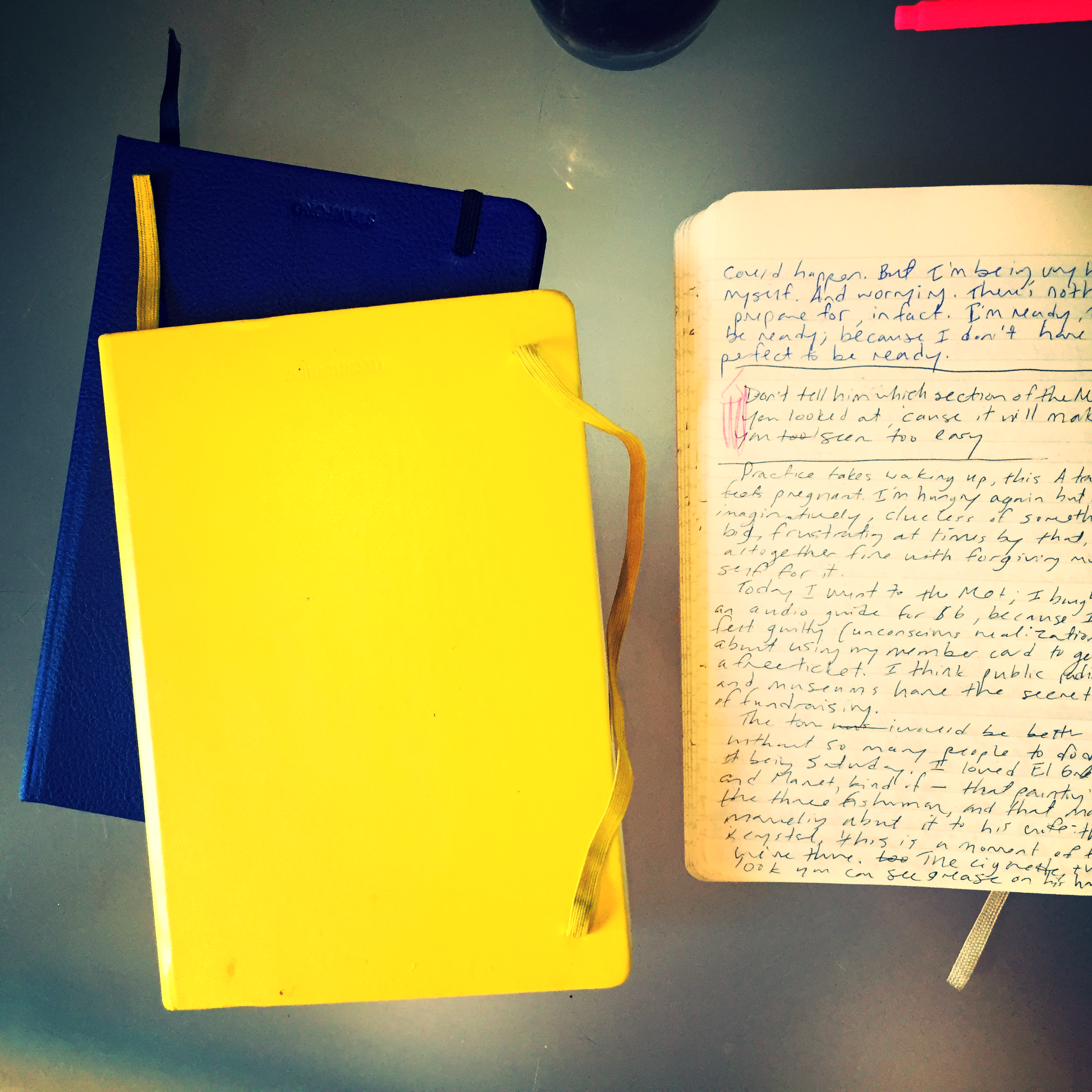
I took it to the table and wrote an entry in my journal: it wrote like a dream. I filled the yellow journal and sitting nearby was a new red one, and I saw an opportunity to be a continuous person for an entire Moleskin. I walked over to my father. He was watching television with my mother. I asked him if I could steal his pen, and he laughed — he put one hand on his chest and threw his head back like he always does. He never did replace his pen. Perhaps I should feel sad and return his pen. I will not return his pen.

Fountain nibs mold to a person’s hand, you know, just like felt tips. But they are so much more permanent. When a felt tip pen comes to the end of its life, it goes in the garbage. A fountain pen is like having a pet that knows your voice and lives forever. I thought there was something special in that — that the nib on that pen had gotten used to my father and was then getting used to me. Part of me feels like I betrayed my mother in this moment — I did not steal her pens. 

I wrote with my father’s pen for seven months. During that time, I lived in the attic of the house my father and grandfather built in 1954. I made it through the whole red journal with that pen. Once, I thought I lost it. I started hyperventilating and my fiancée made me check all the closets. One of our cats pushed it through a crack under a door that looked like it was made for a gnome — it lead to the eaves. When I retrieved it from the dust and the cotton candy insulation, I remember crying a little. But I can’t find the journal entry to prove it.

That’s when I decided that not losing the pen was more important than being a continuous person. So I bought a ballpoint seven-year pen from the bookstore on the corner. It’s called a seven-year pen because it’s supposed to have enough ink to write meters and meters per day for seven years. That’s a lot of years for me to get attached to a pen! But ballpoint — what am I, a madwoman? I chose the one with a bicycle on the clip because I aspire to be a better person than I currently am, transportation- and fitness-wise. I took it with me on a trip to the Grand Canyon and Joshua Tree National Park; research for a novel I imagine I will resurrect someday. I wrote fast, drunk with ballpoint power, on the edge of a desert staring into the great bowl of the sky.

seven-year-pen.jpg

It broke recently, that pen. I could sense it happening. The clip came loose and I knew it would crack. It still writes, but it is no longer My Pen. Other people can use it now, if they want to use a broken, imperfect, mortal pen. Sensing it was about to break, I bought a set of Staedtlers triplus fineliners. There are ten of them, each a different color, and I tote them around in the clear case they came in. They’re called “porous point pens.” That means “felt tip pens,” in pen addict speak. My friend asked to borrow one recently, and I looked her in the face and said, “No.” Even though there are ten of them, they are all Mine — the “porous tips” have now bonded with me and I’m keeping them. She has since purchased her own set. 

pen-set.jpg

I tried to use the pens evenly so they wore out at the same rate. My journal, the one I just finished, is a veritable rainbow inside. And the clear, easel-prop storage case began to break. I devised a plan that consists of attractive Washi tape and ignoring the death of things.

Since beginning my latest journal, I am using only the black pen in the Staedtler set. It may seem like I’ve thrown caution to the wind, pentropy be damned. But no — it’s because I can get a million more black fineliners. When these pens break and break my heart, the black one, at least, can be replaced. The barrel is a metallic silver; it is triangular, but the corners are round. Smooth. That I am marching ever toward being my mother is not lost on me. Sometimes I write with the fountain pen in the safety of my own apartment, when I need to channel my father. My need to individuate is gone. I could do with a bit of permanence, a bit of history. I could stand to write with the pens and the preoccupations that got used to my family’s hands.

Read More
In Handwriting, Poetry Bretty Rawson In Handwriting, Poetry Bretty Rawson

Notes from My Soul in the Morning • Kate Hoyle
IMG_2092.jpg
blot.png
IMG_2093.jpg
blot.png
IMG_2101.jpg
blot.png
IMG_3214.jpg
blot.png
IMG_2188.jpg

image1.jpeg

Kate Hoyle is a poet and visual artist from Moraga, California. Her work has been published in Tupelo Press 30/30 Project, The AUDACITY and Smokelong Quarterly. Her five poem series, On America, is currently touring the US and South America on exhibit in U2’s Joshua Tree World Tour. You can see more of her work at katehoyle.com

Read More
In Handwriting Bretty Rawson In Handwriting Bretty Rawson

I Gess That You Havft to Try Things Befor Your Scared of Them • Laura Buccieri at 8 Years Old

BY LAURA BUCCIERI

When I got braces and told my journal all about it.

Read More
In Person, Pen to Panel Bretty Rawson In Person, Pen to Panel Bretty Rawson

Let the Mind Rule the Eye • A Conversation with Tullis Johnson about Charles Burchfield

Working on Pen to Paper was interesting for me because it brought Burchfield’s handwriting into a larger context. While some artists took time and care in crafting letters to friends, Burchfield had little concern for the elegance and precision of the written word. 

AH_Burchfield2.jpg

SARAH MADGES: How did working on this project inform or change the way you think about handwriting?

TULLIS JOHNSON: Charles E. Burchfield wrote prolifically. He kept a journal for more than fifty years, which by the end of his life totaled more than ten thousand pages. He also wrote notes on his sketches for paintings and on loose sheets of paper that were kept in his studio. The letters he wrote to his friends and colleagues constitute a small fraction of the writing that he did throughout his life, and reveal only a small part of what we can learn by examining his handwriting.

Working on Pen to Paper was interesting for me because it brought Burchfield’s handwriting into a larger context. While some artists took time and care in crafting letters to friends, Burchfield had little concern for the elegance and precision of the written word. On August 19, 1914 he wrote in his journal about his feelings on the subject:

 
Let the mind rule the writing not the eye! The mind should be so intent upon what it is saying, that it forgets the means of transferring it to paper. The artist does not see his brush. Be sure if what you are saying is worthwhile, someone will decipher your hieroglyphics. I do not mean that a man should adopt a crude handwriting to affect eccentricity. A man’s handwriting should be spontaneous. If we all wrote perfectly, there would be less variance of character. Of what avail is it, if a man perfect his handwriting, and [finds] that he has not perfected what he has to say? His only calling must be that of copyist.
— Charles E. Burchfield, Journals, Vol. 19, pg. 35-36, August 19, 1914
 

Burchfield was more interested in the content of his work, than on the methods of applying his medium. Reflecting on his experiences teaching, in 1959, he told interviewer John D. Morse at the Archives of American Art, “I couldn’t possibly tell anybody how to paint in watercolor….I told them: ‘Don’t think about the medium. What you’re trying to say is much more important than what you’re saying it with. And if you’re thinking about what you are trying to express, you may use watercolor like nobody else ever used it.”

SARAH: Why do you think these letters are so important, and how did you choose which one to discuss? What were the other fan letter responses like?

TULLIS: The letters written by Burchfield, in the collection of the Archive of American Art, are important because they reveal much about the character of the man at various times in his career. The earliest letter, written to Paul Travis (1891-1975) in 1930, is more a letter to a friend than a response to a fan. Travis was a close friend to Burchfield during and after his time at the Cleveland School of Art, who would later accompany him on sketching trips along with other friends from his time in Cleveland. 

Burchfield’s letters to Lawrence Fleischman (1925-1997) are even more revealing. Correspondences between these two men, in the collection of the Archives of American Art, span between the years of 1954 and 1964. 1954 was the same year that the Archives were founded, by Fleischman and others. In January and February of 1956, the Whitney Museum of American Art held a retrospective of Burchfield’s work. The letter I chose was written in March of the same year. The friendship that developed over those years, was an important one. Fleischman became an avid collector of Burchfield’s work, and eventually owned more than thirty of his paintings. Fleischman’s Kennedy Galleries would later represent Burchfield’s estate after the artist’s death.

SARAH: Have you always suspected a link between an artist's handwriting and their art? If so, when did you first notice or consider this connection?

TULLIS: On October 8, 1913 Burchfield wrote in his journal:

 
I often wonder what I am naturalist or artist, for the pursuit of one hinders the other - I seem always to be deciding which it shall be - Of course it must be an artist, for I must live, but I am hoping for a day when I can give myself entirely up to Nature.
 

Burchfield’s handwriting has always been an important part of the study of his work. In an interview conducted at his home in 1959, John D. Morse inquired about whether the journals might eventually end up at the Archives of American Art. Burchfield declined, suggesting that they would end up with his estate. In 2000, more than ten thousands pages were donated, by the foundation set up in the artist’s name, to the Burchfield Penney Art Center in Buffalo, New York.

In 2006 an even larger collection of over 25,000 objects from the artist’s studio was donated as well. I took part in the inventory of a large part of that collection. Included are sketches and studies for paintings, but there are also a large number of notes, written in the artists hand on loose sheets of paper. The sketches themselves also include notes on changes that should be made to the final paintings.

Even Burchfield’s doodles contain handwriting, often revealing critical insights into the artist and his work. Some contain simple things, like a score for a card game played with his wife. One doodle includes the title of the book The Sense of Wonder by Rachel Carson. There has always been a link between Charles Burchfield’s handwriting and his art. He was aware of it early in his life, and scholars that study his work, during and after his lifetime, have been aware of it as well.

SARAH: What do you think we can learn about Charles Burchfield from studying these letters that we couldn't from mere biographical record?

TULLIS: You can learn a lot about an artist by studying their writing, but different kinds of documents can reveal different things. Studio notes and notations on sketches are written as notes to one’s self. Journals and diaries are written with no particular audience in mind. They contain memories and musings on the activities of the day. They also present a great deal of autobiographical information about the writer. Correspondence however, are always written with a particular audience in mind, and each letter reveals something different about the character of the man.

SARAH: You included Burchfield's quote about letting "the mind rule the writing, not the eye" in your essay in Pen to Paper, and again here. What do you think he meant by referring to his writing as "hieroglyphics"? Do you consider handwriting, in the sense that it is a drawn character system, to be visual art?  

TULLIS: Handwriting surely can be visual art, and with certain artists it definitely is. In Charles Burchfield’s case, handwriting is a part of his art. It is most dramatically so with his monogram“CEB” which he used to sign his works starting in the 1920s. Handwriting is also an important part of many of his sketches, although the ideas that are communicated are more important than the handwriting itself. He wrote “Of what avail is it, if a man perfect his handwriting, and [finds] that he has not perfected what he has to say?” For Burchfield himself, handwriting itself was not visual art, but rather a means for communicating ideas. Viewers today however, often find his handwriting to be quite exciting and worthy of examination. In 2013 the Burchfield Penney Art Center commissioned Richard Kegler, co-founder of Buffalo based P22 Type Foundry to create a Burchfield font to honor the artist. Today the font is often used in exhibitions, to highlight many of the dramatic statements that Burchfield made in his journals, sketches or notes.

SARAH: Where do you think we could find qualitatively similar information and insight about an artist and their work today now that people use snail mail for personal correspondence less frequently? Do you think there's a comparable medium or mode of communication in use?

TULLIS: Today the personal letter is quite rare, and the bulk of communication is done by digital means. This being the case, the best place to find qualitatively similar information on an artist and their ambitions is through social media. Many artists use Twitter and Instagram to share their work. In 2012 at the Burchfield Penney Art Center we launched a program on our website called “In His Own Words” where each day an entry from Burchfield’s journals is posted with an image of one of his paintings or drawings. In this way we are using contemporary communication tools to reach thousands and give them access to this otherwise inaccessible information from the past.

Tullis Johnson, curator and manager of archives at the Burchfield Penney Art Center, has organized multiple exhibitions of contemporary and historical significance, including the nationally touring exhibition, Charles Burchfield : Weather Event, which received the Award of Commendation at Museums in Conversation from the Museum Association of New York. Through his writing on Charles Burchfield, he is an emerging Burchfield Scholar. Respected for placing the work of Burchfield into a contemporary context, Johnson’s scholarship continues to break new ground in the understanding of the artist. His exhibition Blistering Vision: Charles E. Burchfield’s Sublime American Landscapes is currently on view at the Burchfield Penney Art Center in Buffalo, New York. Johnson received his B.F.A. from the Visual Studies Department at the University at Buffalo earning the Eugene Gaier Award for Excellence in Print Making.

Read More
In Handwriting Bretty Rawson In Handwriting Bretty Rawson

They Are Folded Into Gatherings • Rags Edwards

HB P1.jpg

BY RAGS EDWARD

Papers are selected, painted and torn down.  Then they are folded into gatherings for pages.

HB P2.jpg

Harmonious hand-painted materials are selected for applying to the cover boards, inside and out.

HB P3.jpg

Bees wax for the sewing thread, leather straps cut and a hand drawn binding map for guidance.

HB P4.jpg

A luscious bloom of watercolor to illuminate your handwriting.

HB P5.jpg

A stack of my hand bound half sized journals with inset photographs and hand painted paste paper covers.

HB P6.jpg

A stack of my full-sized hand bound journals with leather straps and hand painted paste paper covers.

HB P7.jpg

From hand to bound, pages to contain my every thought.
 

Read More
Winter 2016, On Handwriting Bretty Rawson Winter 2016, On Handwriting Bretty Rawson

The Distance Between our Public and Private Selves • Aine Greaney

In this essay on deleted pasts and new beginnings, Aine Greaney takes us around the world in an old composition notebook: the only one she brought with her when she emigrated to America. With the start of the new year just behind us, we find this piece more timely than ever, as we revisit filled pages from the past, and look toward the blank ones of the future.

BY AINE GREANEY

December 21, 2015
 
This morning, I ate some oatmeal, drank some coffee and penned the last page of my personal journal. I flip back to the first page: June 30,  2015. Inside this bound book are almost eight months' worth of thoughts, uncertainties, musings and arguments.

I don't write in my journal every day, but on those weekday mornings when I do, when I set the alarm to get up extra early, reflective writing makes the rest of my working day happier. On the weekends, journaling acts as my transition from working me to creative me—and believe me when I tell you that the latter is the more authentic version. In fact, journaling has taught me this: The shorter the distance between our public and private selves, the happier we are. Stephen King may have been referring to an entirely different type or genre of writing, but he was really on to something when he declared that writing is about “getting happy.”  

I started keeping a journal in my teenage years while I was attending a small-town convent day school in my native Ireland. Some days, I can still shut my eyes and see myself back there, still dressed in my navy-blue school uniform, sitting inside my bedroom window, my geography and math texts pushed aside as I scribbled in an old composition notebook.

We were the first generation to benefit from a 1967 law that granted free, secondary-level (high school) education to every child in the Irish nation. So I was supposed to be grateful for that school uniform and those textbooks that had been denied my mother and my grandmother. I was grateful. Still, I recall those school days and nights as being full of square-peg-round-hole malaise and anxiety. In public, I sang with the choir in the school assembly room. In private, I wanted, desperately, to raise my own, individual voice. Journaling was the only place where this was possible. 

However, when I emigrated to America at age twenty-four, I abandoned all but one of those notebooks. I think I believed that, in my bright, new country, in a nation founded on the notion of deleted pasts and new beginnings, that that melancholy, soul-searching me was best left behind, left where it belonged.

I did bring one hard-cover notebook into which I had transcribed some of those writings from my late teens and early 20s. In the flyleaf of this little red notebook, I grandly wrote,  “Collected poems, rhymes and thoughts.” Now, when I re-read those hand-written pages, I see just how wrong I was to believe that our past has ever really passed. I am shocked at how well those “assorted rhymes” still describe the middle-aged me.

For example, here’s one of those entries that I remember writing as I sat propped against the pillows in my twin bed in my parents' house:

My books stand orderly on the shelf
Masks for that hidden self
Hoping they can quench the flame
Of numberless passions with no name.
 
I talk and talk; I make my stance
‘You’re such good company,’ he said.
But what would he say if, perchance
He saw me sobbing in my bed?

I find it comforting to read this unchanged part of me, this struggle between the private and public self. I like that we have certain personality traits that are in-born or immutable, and that there is, at all of our cores, a perpetual and lifelong mystery.

In the basement of my house in Massachusetts, I keep boxes of my completed journals, each one chronicling six to twelve months over the course of my twenty-nine years living here. My arrival day at JFK Airport, New York. That hot, AugustSunday when my American husband and I said, “I do” before a town judge. The day an editor wrote to say she was going to publish my first short story. I remember these. But, if it weren't for those journals,  many or most of the less auspicious occasions, the ordinary mornings or afternoons, would be gone from memory recall. For example, in the journal I just completed, on August 18, 2015, I wrote that “I am here alone, finally, and the internet has made me vain and distracted, and these two things (vain and distracted) are very connected.” I cannot remember feeling that—not without re-reading my own handwriting on that page.

Without all of these hand-written journal pages, how much of the past two seasons would I actually remember? How well could I evoke the sounds or feelings or atmosphere of one ordinary hour or afternoon in July or August or September? What summertime walks did I take? When did the cherry blossoms drop their pink? When did the marsh grasses near my house turn dry and brown with summer heat?   Now that our garden is under snow, I find it hard to close my eyes and re-see that garden when it was lush and colorful with summer perennials.

Some days, I feel as if I am on a Japanese bullet train ride through a fast-disappearing landscape, where, by the time I sit up and look out the window, everything is already gliding out of eye view.  
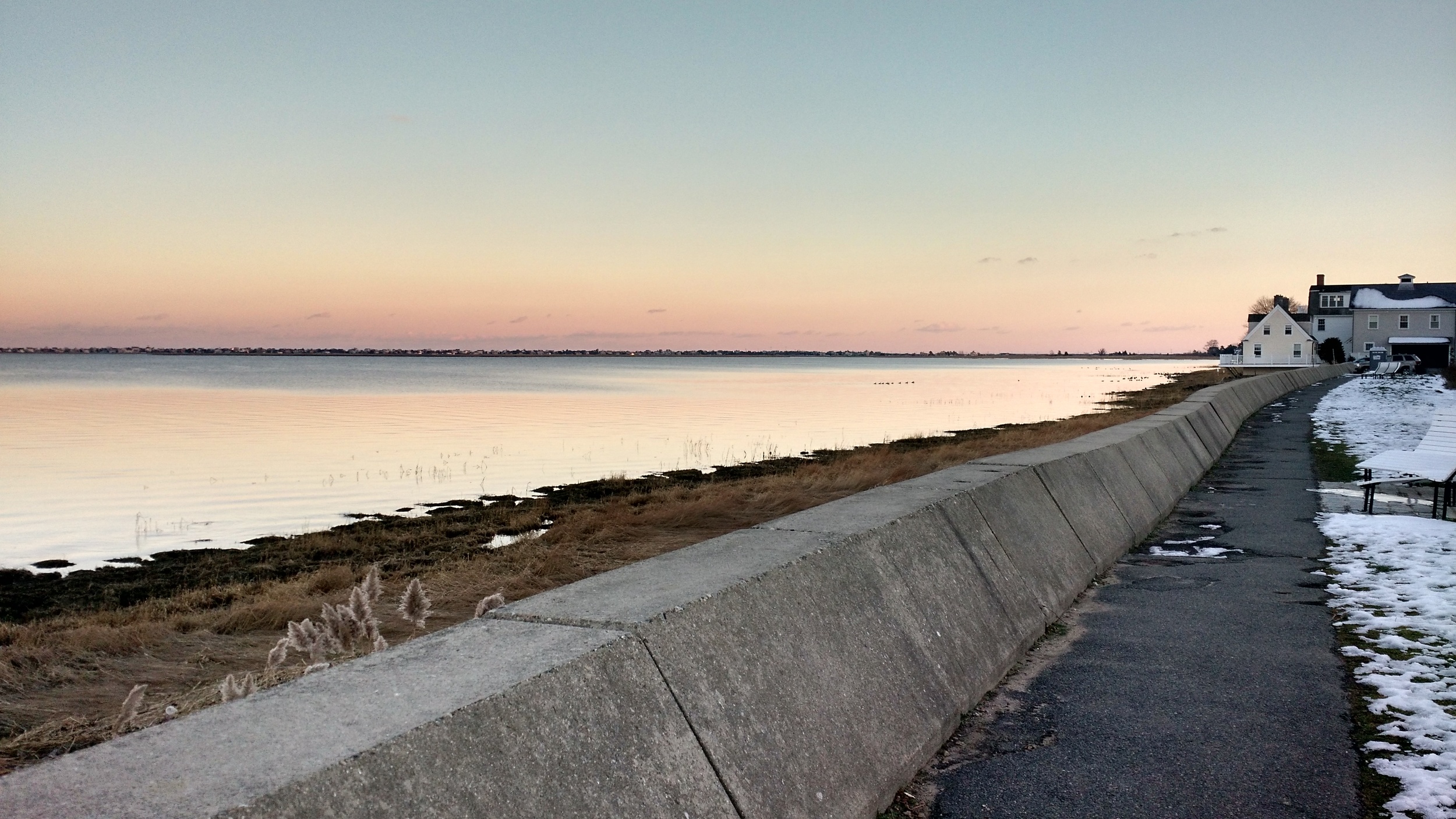
Then there are those days when I’m driving home from work, my head still buzzing with deadlines or with snippets of workplace conversations, and I look out my car windshield at the roadside pine trees, a flock of geese flying south through the paling sky and I think, This evening, this moment in time will never come again. So I’d better shush my mind to look---really look--around me.  How many of these afternoons are left in my life? I don’t know. None of us do.  Morbid?   I don’t think so.  These moments of mindfulness are how we hit the pause button, how we behold our own joy. When we write down those moments, when we record them in a journal, we are creating the narrative—the only half-way reliable narrative—of our precious and finite days.

Henry David Thoreau said that he traded his comfortable town home for a rustic woodland cabin because he wished to live deliberately.

At least in the abstract, some of us covet this concept of unplugging and retreating from our hectic and digitized lives. Who wouldn't like to slow down time so we can feel the heft and length of each passing hour?

But nowadays, how many of us would adapt this as a permanent and year-round lifestyle choice?  The woodland WiFi and cell phone connections would be spotty at best. And, as someone who grew up in a thatch-roof farmhouse without indoor plumbing or central heating, the discomforts and inconveniences of that bare-bones cabin life would, sooner or later, override the joy or mindfulness.

So in my cozy and well-heated writing studio I keep a set of ballpoint pens and write in my notebooks to record the ephemera of my life. Without these journals, without this writing, most of the past seven months would be gone.

This morning I closed my completed journal and crossed to my studio bookshelves to stash it there until, during one of my sudden and always overdue clean-outs, it will end up with all the others in those basement boxes. 

I know there will come a future day when I will go to the basement to search through the shelves for an old photo or a lost gadget and the journal box will call to me, as it has before.  I will open today’s completed journal at a random page and sit there under the basement’s Florescent strip light in the company of my previous self, reliving a day from 2015.  In all my past journals, I see recurring themes: the yearning for solitude;  the immigrant’s search for an existential home; and my almost lifelong struggle and vacillation between my public and private personae (as in the 1983 piece above).

When I read them, I’m also struck by how prophetic some of my past writings turn out to be.  It seems, in retrospect, that the writing knew much more than I did.  Too often, I see that I should have listened to or acted upon my own observations.

Today, I select a new book to set on my desk underneath the east-facing window of my writer’s studio.  The new blank journal sits here, empty and waiting for tomorrow.

Read More
In Handwriting, On Handwriting Bretty Rawson In Handwriting, On Handwriting Bretty Rawson

Neat, Cursive, Normal, Lefty • Chelsea Florio
BY CHELSEA FLORIO

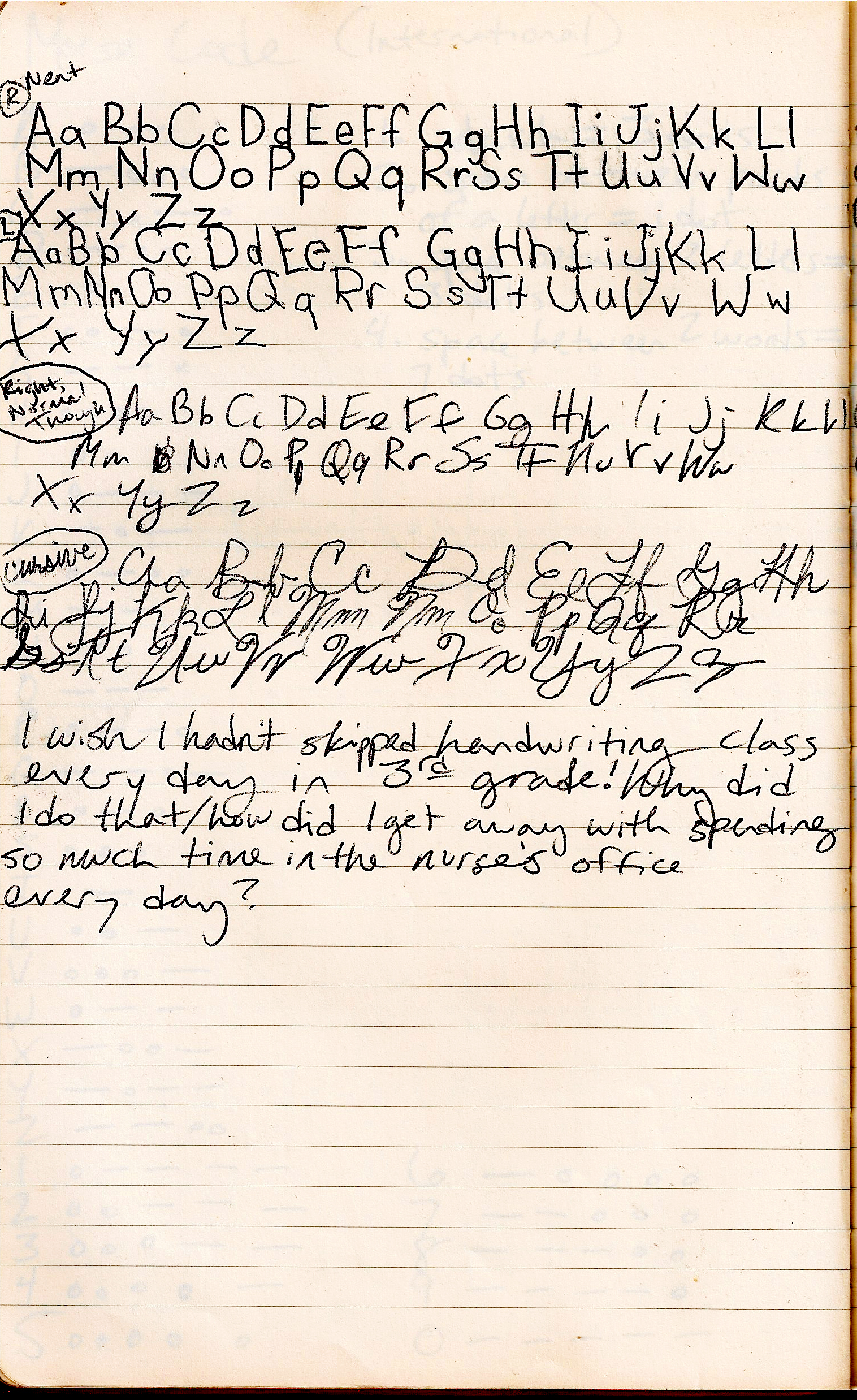
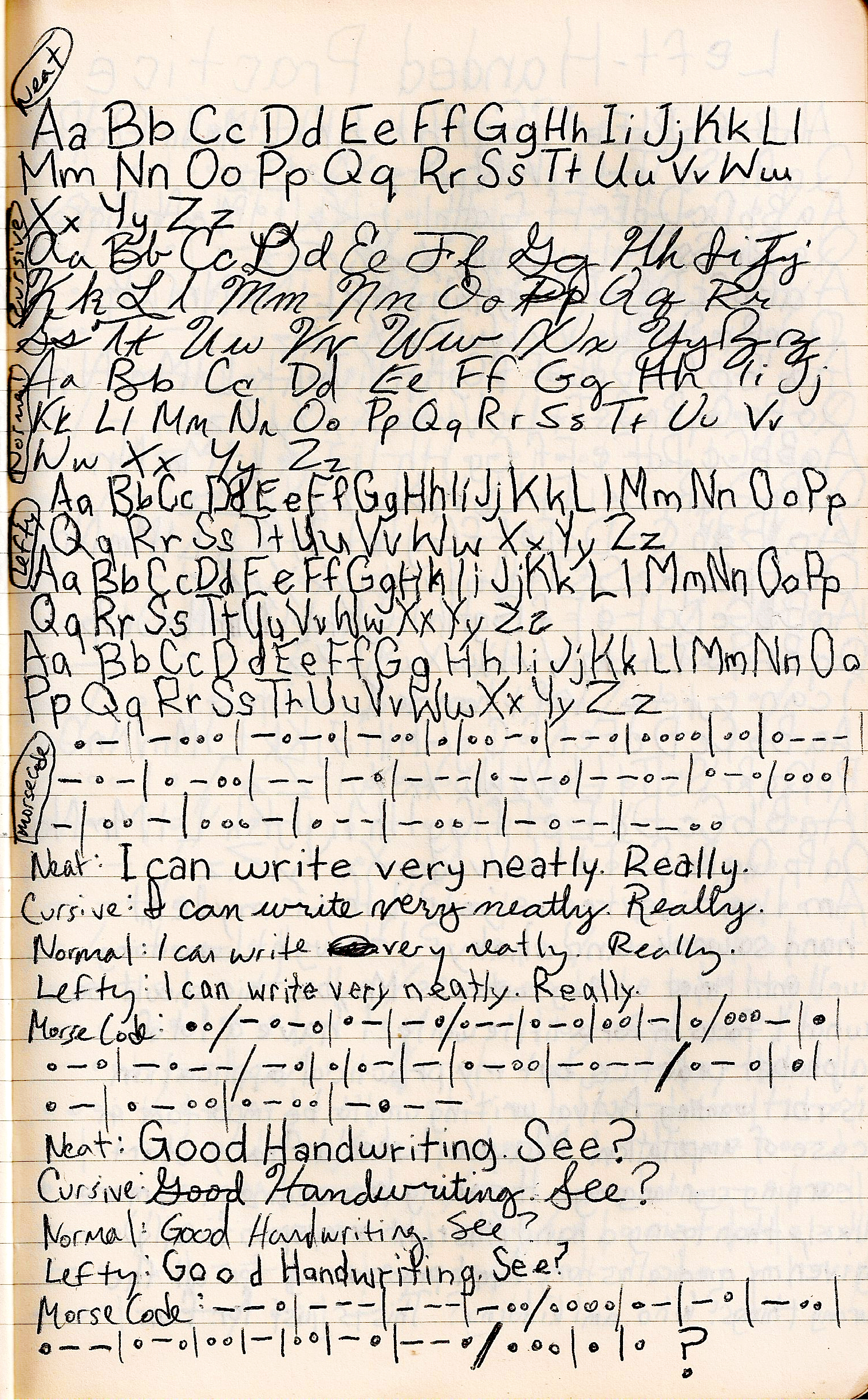
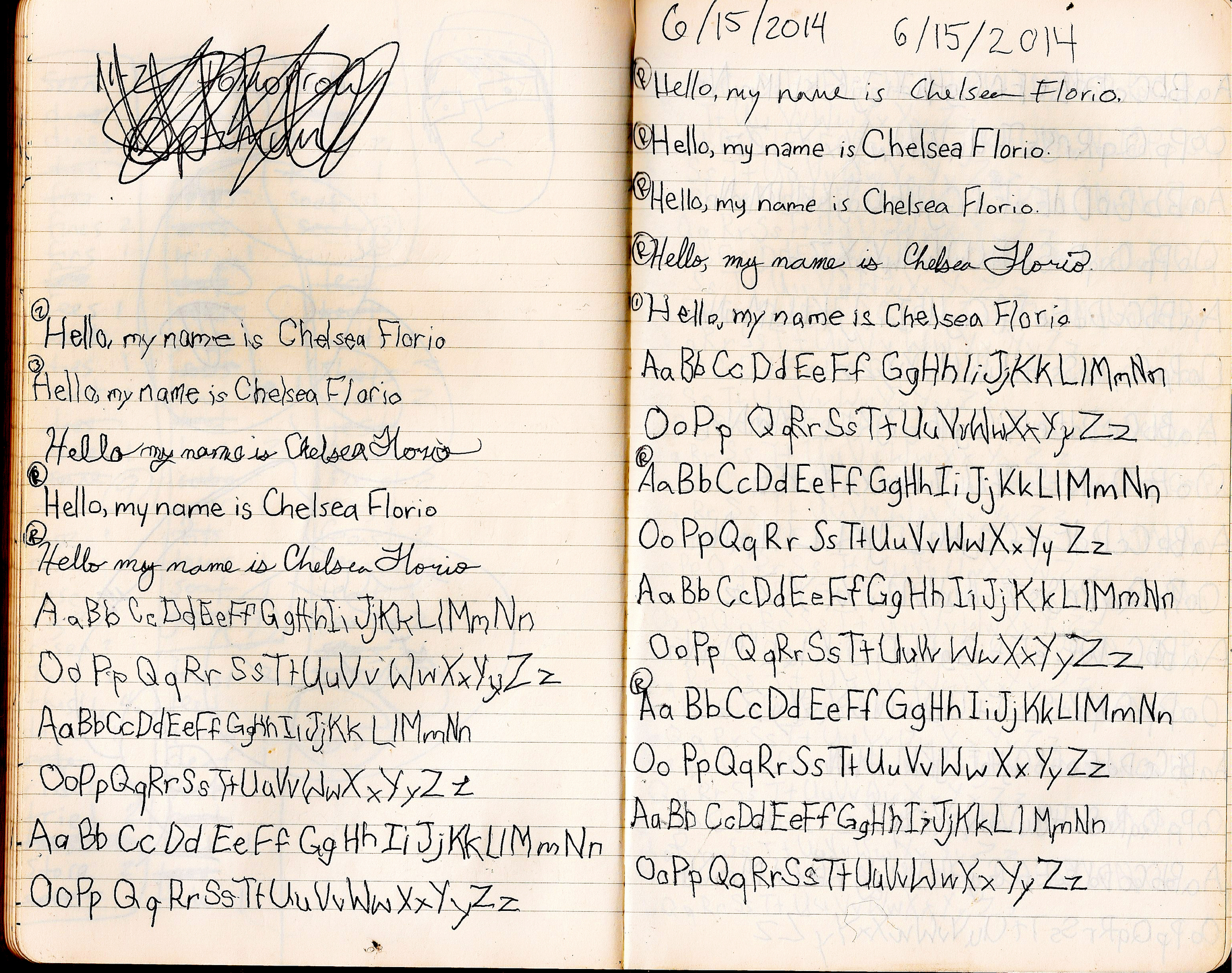
For as long as I can remember, I have loved language. Whether it's studying foreign languages (from Arabic to Elvish) or learning the rules of my native tongue (English) and playfully finding new ways to break them, I am completely enthralled with learning about the ways people communicate.

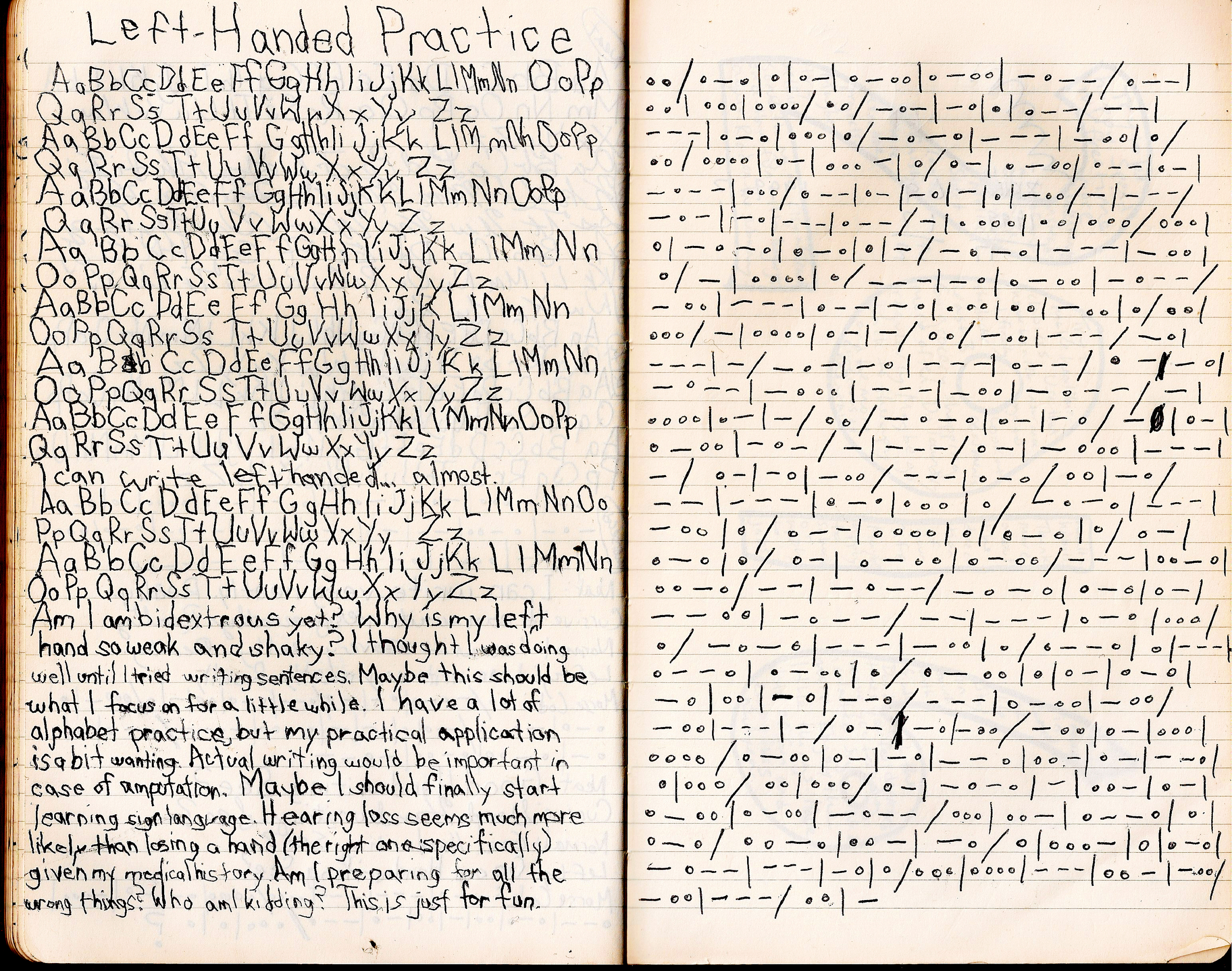
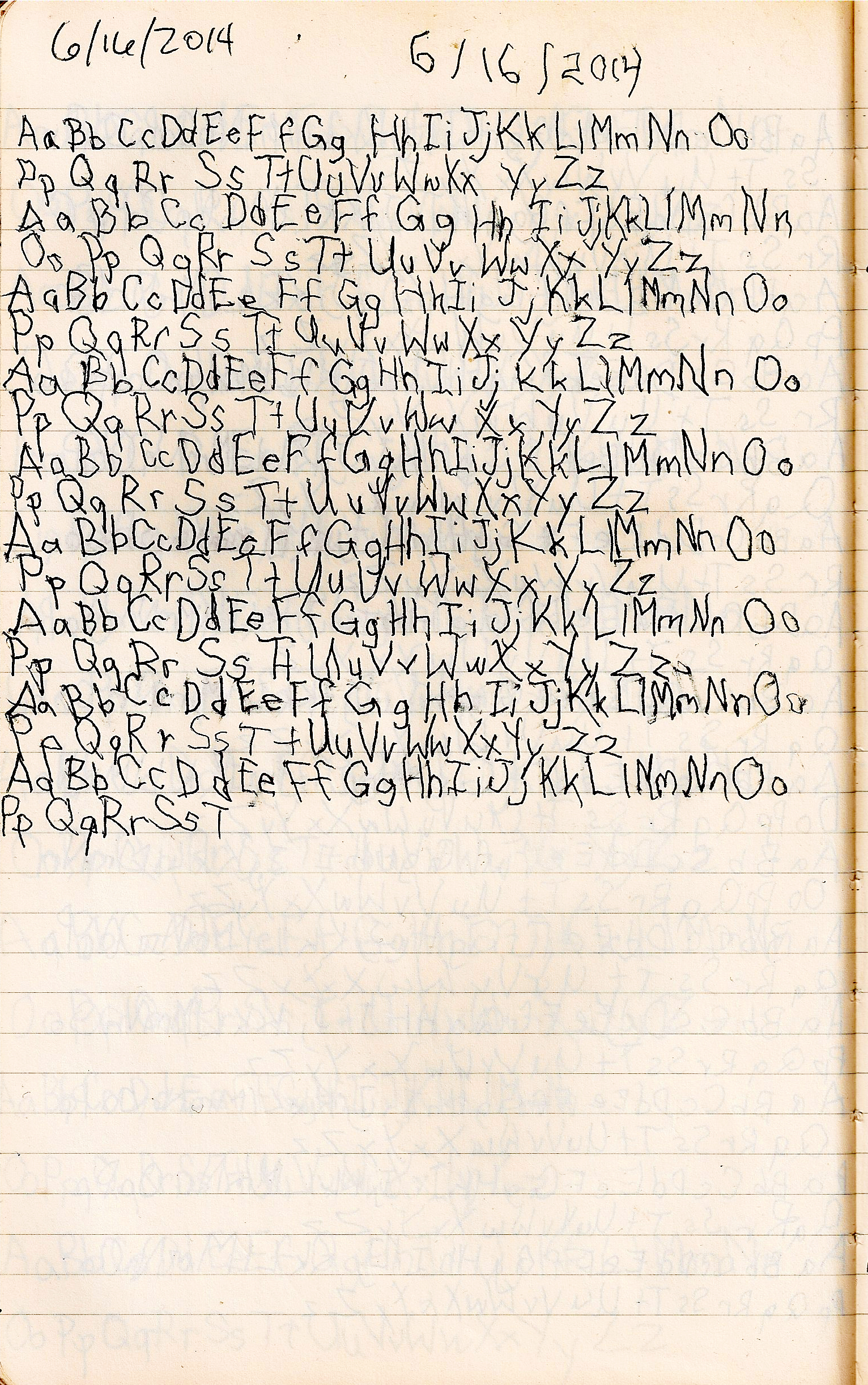
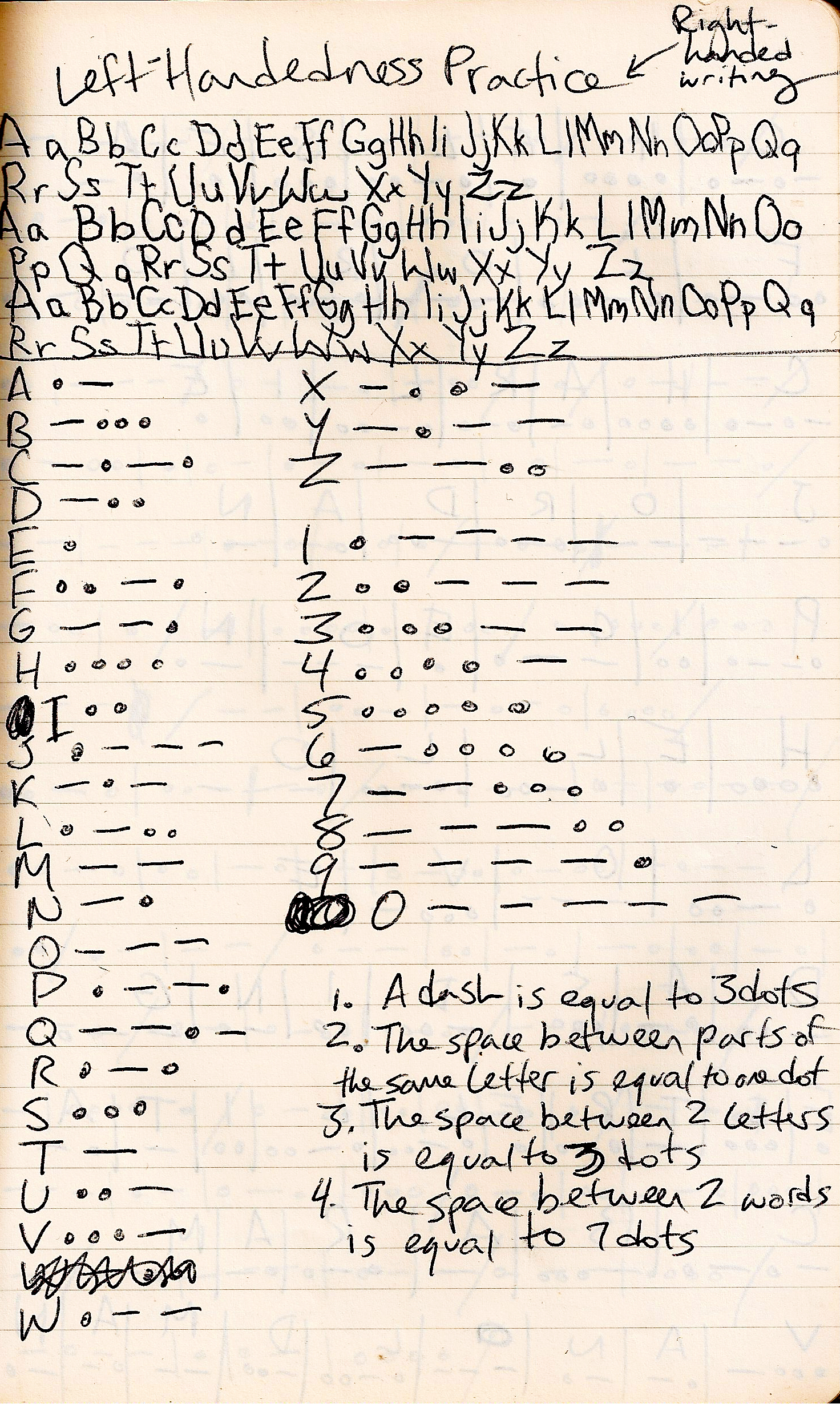
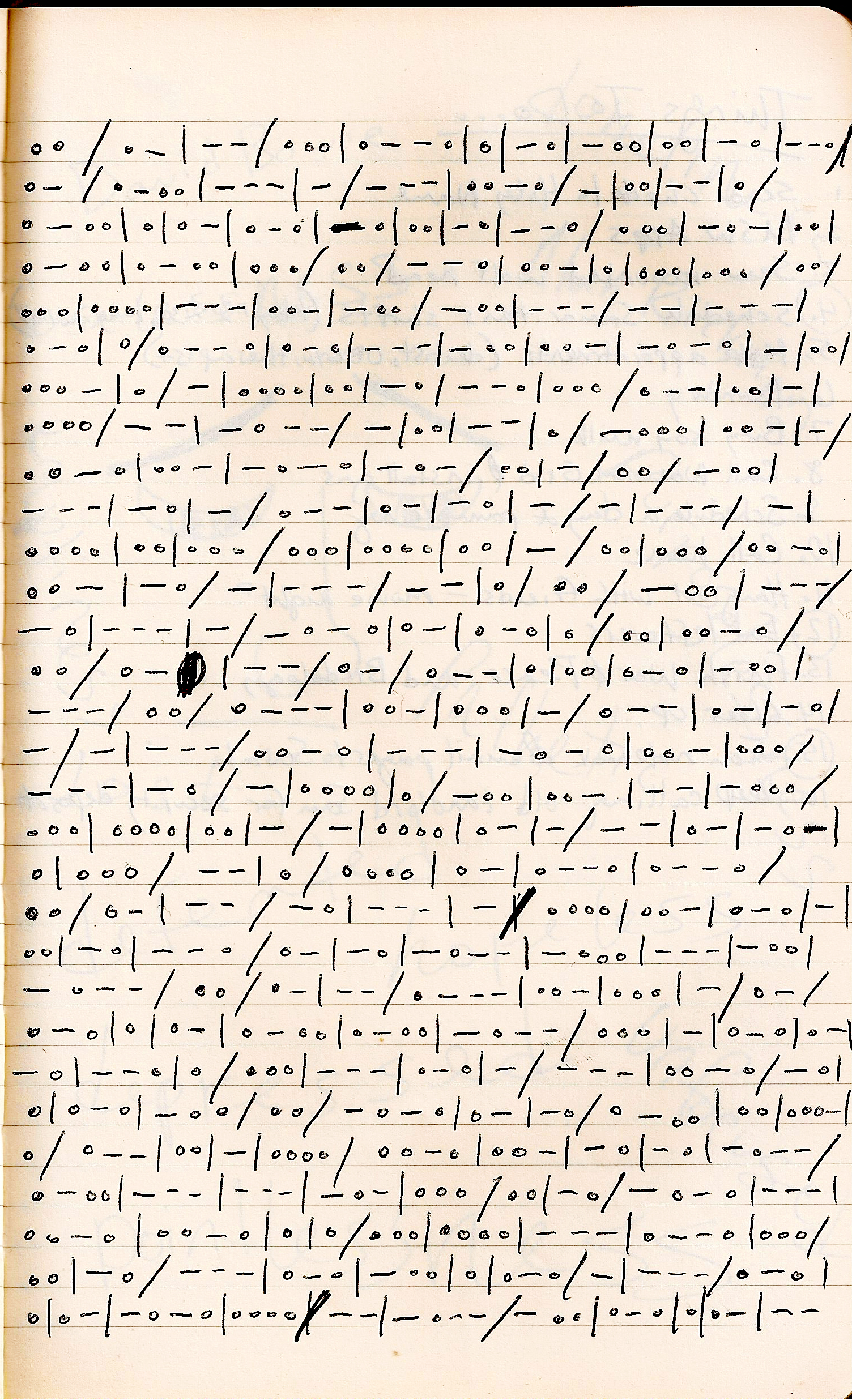
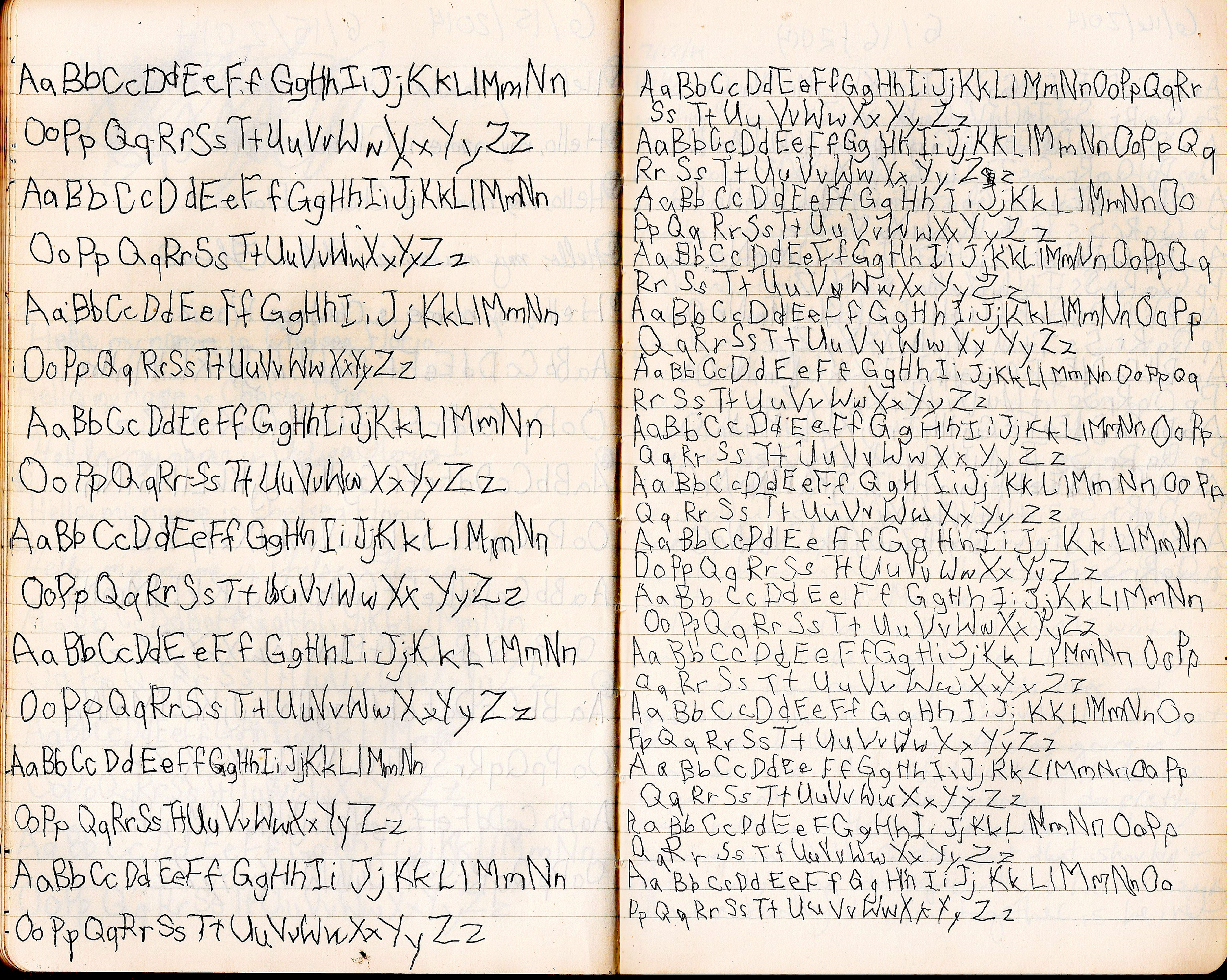
Above and below are journal entries spanning the last several years in which I played around with writing in new ways. Many of them are my attempts to learn how to write left-handed because I've always seen ambidexterity as one of the neatest skills on the planet. Interspersed are my attempts at learning Morse code, which I find to be a delightfully mysterious and pretty much forgotten form of clandestine communication. Neither of the skills I've been trying to acquire when very bored are really that practical, but it's a fun way to pass the time. 
Read More
Winter 2016, On Handwriting Bretty Rawson Winter 2016, On Handwriting Bretty Rawson

I Have Come to a Conclusion • Ali Osworth

In this micro-ritual, Ali Osworth lays out the key ingredients to safeguarding ink's elegance, and her daily quest for grace. For those of you looking to slow down your mornings, taking a look at what's on your desk is a good place to start.
BY ALI OSWORTH

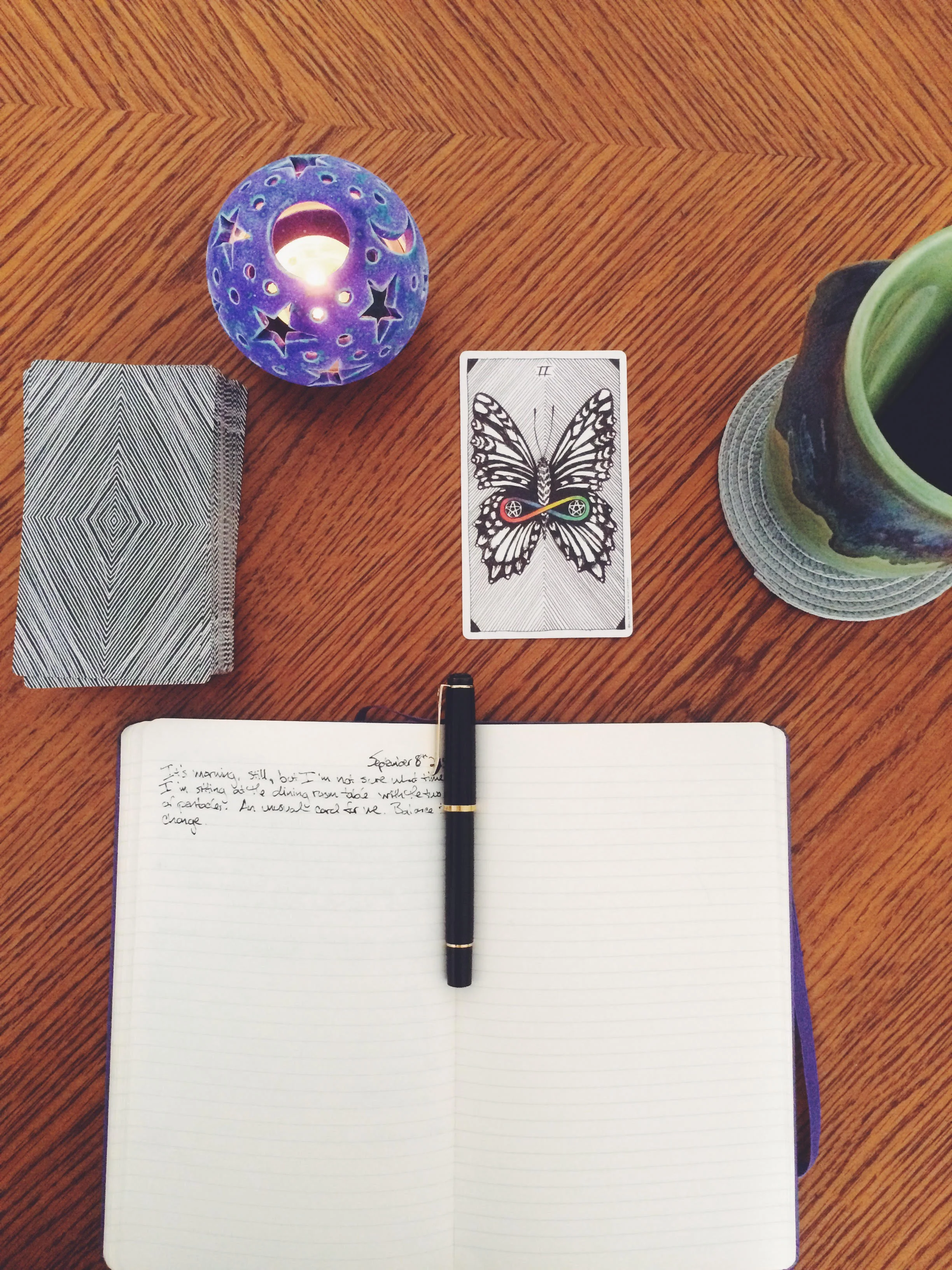
I have come to the conclusion that I'm a better, saner person when I slow down in the morning. I light a candle (the holder for which a dear friend gave me long ago), brew some tea (Lady Grey) and get out my tarot cards. The card in this photo is the two of pentacles — taking on new roles and balancing them, all with grace. It's the quest for grace that brings me to handwriting in my journal (most of the time, with a fountain pen that used to be my father's). Without the half-hour of journaling, of connecting my thoughts to my body as I use my fingers to move the pen across the page, I lose the grace. My movements become less refined. I lose ink's elegance. I become as fragmented as Tweets — 140 character, byte-sized.

Read More
In Handwriting Bretty Rawson In Handwriting Bretty Rawson

Up and Back Again • Chad Frisk

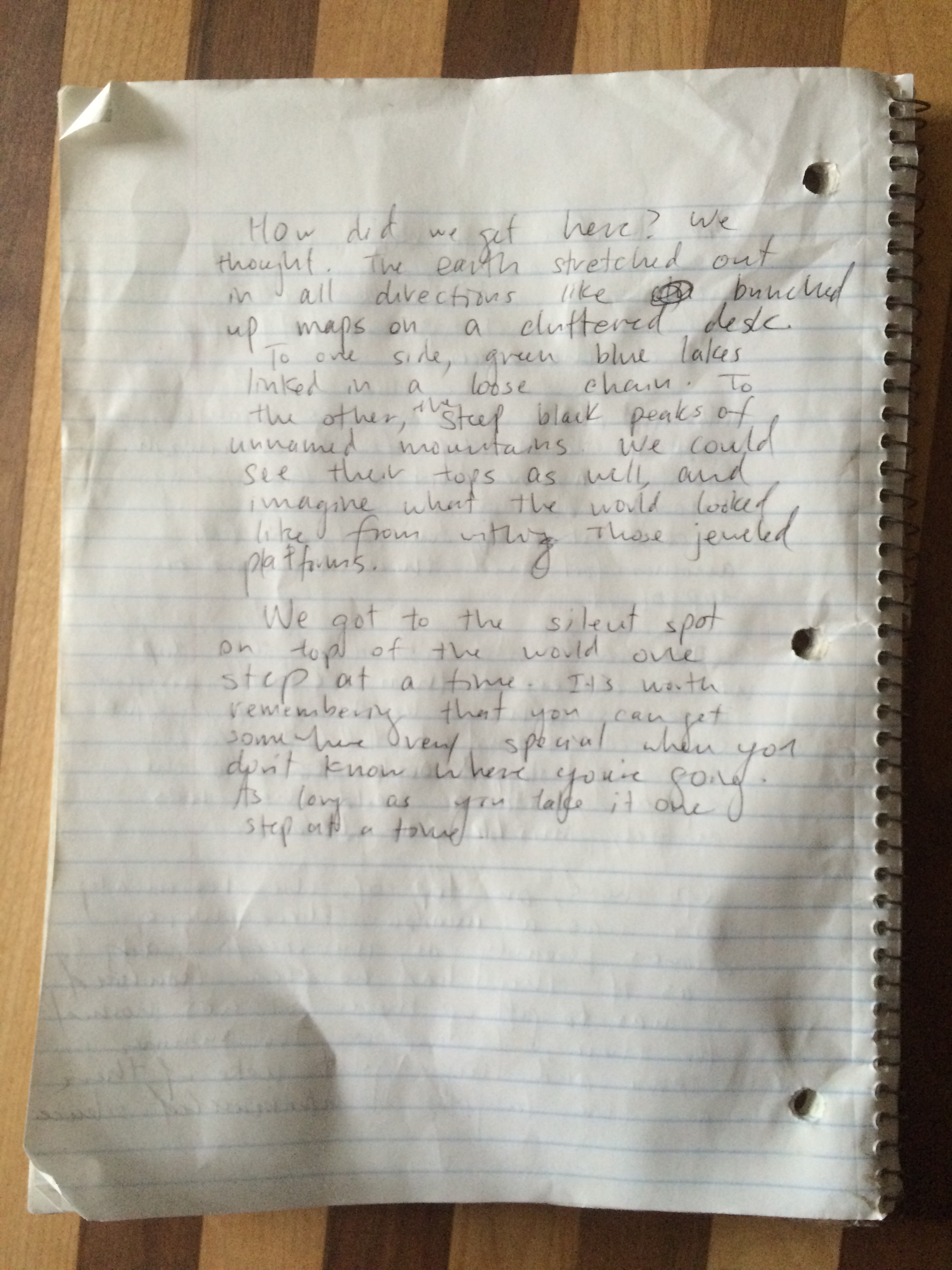
On the top of a mountain in the Pacific Northwest, author Chad Frisk came to a clearing. He didn't expect to write there, but he also didn't expect to be there, which is exactly why he wrote there. Below is the result in its original shape.

 
The top wasn’t what we thought it would be. There were no signs telling us what to expect. You just stepped up and into a world that was entirely invisible from below.
 
 
How did we get here? we thought. The earth stretched out in all directions like bunched up maps on a cluttered desk. To one side, bright blue lakes linked in a loose chain. To the other, the steep black peaks of unnamed mountains.


Read More
On Handwriting, Curators Bretty Rawson On Handwriting, Curators Bretty Rawson

Braiding Together Our Lives

A project that weaves together generations, experiences, and handwritten expressions. 

BY SARAH MADGES

When my grandfather died a few years ago, I realized I didn't know how to process the loss because I hardly knew the person I was losing — I hadn't gotten to know him in his lifetime. With one remaining grandparent, I decided I needed to make sure I got to hear her story before I was forced to hear it from someone else. I wrote her a letter asking if she would share her life story with me, in as much detail, and whatever order she felt most comfortable with. I didn't expect her to respond so quickly, or at such length — even less did I expect her to keep sending letters once I stopped writing her back with specific prompts and encouragement. 

As I gave her so few guidelines — tell me your story — it was interesting to see the way she segmented her life into chronological bits with titles corresponding to the content, like "Childhood Years," or "War Years." It was also fascinating the details she would include, recalling them in such vivid language — the white snakeskin tennis skirt she wore — while other sections she'd leap past, moving from her first date with her husband Clarence to marriage in a matter of paragraphs. 

What's more, I was struck by her handwriting. As I read letter after letter, I came to see her in the handwriting — the bodily trace pointing to the human body, my grandmother, herself. I was reading Susan Howe's That This, whose cut-up quotes from manuscripts overlap to create beautiful excised art-meets-poetry, when I realized that's exactly how I wanted to preserve my grandmother's penmanship. I decided to create a visual art piece splicing her handwritten account of her life with my own handwritten account of my life. A life she knows as much about as I knew of hers before the letters. In one sitting, I wrote a truncated autobiography on a legal pad, demarcating sections the way my grandmother had but with alternate titles (there's no war for me to tell a personal account of). I scanned and printed everything, and began cutting out phrases, creating a redacted work in the spirit of blackout poetry that I then arranged and pasted onto card stock. 

Braiding together our lives in this way brought me closer to her, and helped me contextualize my own life in its comparatively short run. As I keep working through our letters in sequence, the project grows in size and scope, and I can sense that the true subject will find itself in the process.

Read More
On Handwriting, Curators Bretty Rawson On Handwriting, Curators Bretty Rawson

The Materials Matter

BY SARAH MADGES

I am often asked, “What are you going to do with all of those?” in regards to my ever-amassing collection of notebooks.

The tone people adopt when they ask me registers as an accusation, or a warning that they’re going to turn me in to the reality show Hoarders’ producers and stage a televised intervention. True, the amount of notebooks I’ve accumulated makes moving daunting (the journals, both blank and filled-in, take up at least four standard file boxes, and are heavy). But these bound batches of scribbles mean the world to me. Because it isn’t just the words that matter — the content ranging from teen angst to amateur poetry to higher ed revelations — but the format. The tangibility. The way the words look on the page. The way my handwriting sometimes forms tight serpentine ribbons or grows looser and larger when tipsy or tired or both.

The materials matter; even the notebook choice tells a story. Moving chronologically, my notebooks upgrade in quality from flimsy composition notebooks (Harriet the Spy-grade Meads) or one-subject college ruled notebooks I also used for high school Trig, to those ubiquitous ribboned moleskines, or Germany’s analogue, the Leuchtturm, or even the notebook in which I composed this draft—a Stamford Notebook Co. lizard embossed cobalt beauty handbound in England.

The medium change means a few things: 1) I moved up one ladder rung in the service industry and could afford nicer products, 2) I was starting to take myself seriously as a writer, and each double-digit-$ notebook was an investment in that continued pursuit 3) other people were taking me seriously as a writer, and gifting me nice notebooks for holidays 4) I realized the paper quality, brightness, and thickness, all contributed to the actual look of the text.

I began to appreciate the aesthetic of each individual journal entry, independent of the actual written content. 

Read More