
The Best Work is Work You Don’t Understand Fully • A Conversation with Special Forces Medic & Poet Graham Barnhart

BY DEMETRI RAFTOPOULOS
Graham Barnhart is from Titusville, Pennsylvania, the birthplace of the oil industry. He is an 18D, Special Forces medical sergeant, and has been deployed twice: once in Iraq for nine months, and the other for seven months in Afghanistan. I didn’t know all this when I met him at Hotel El Greco in Thessaloniki. All I knew was that Graham Barnhart was a poet and my roommate for the summer. We were the only two men taking part in Writing Workshops in Greece on the island of Thassos. It being my first time living away from home and having a roommate other than my parents, there were a lot of question marks in my eyes.
The day we were to meet, I went for a long walk along the port to the White Tower and other landmarks drenched in Greek history. In between monuments, I wondered if Graham and I were searching for the same thing; if we would be capable of having a good time with a beer in one hand and a pen in the other; and if we could mix the sentimental with the comical, the work and the play. A few hours later when I returned to our hotel and skipped up the flights of stairs, I was stopped by an unfamiliar, familiar face. I wasn’t sure what Graham looked like—his Facebook profile picture was a black and white image of a random old bearded fisherman—but something told me this was him.
“You’re Graham,” I said, almost accusatory.
“That’s me,” he replied.
I would learn this to be his normal, quiet, calm exterior. I would also learn that he wildly records his surroundings, almost instantly rendering them into lines of expression. One of our first nights, we sat in the restaurant beneath our rooms, watching locals throw napkins over the others dancing to the live music. When Graham asked why they did this, I told him it was a sign of respect, to the musicians and to the dancers. During the first student reading, Graham read a poem about his time in the military and in Greece that centered around the image of the napkins.. He had this uncanny ability to live in the moment, to inhale all that was around him and let it all sink onto a page, and a poem, as he exhaled.
Throughout our time together, I learned something else about Graham — he handwrites wherever he goes. This makes sense, as he is always on the move in the military, but I wondered how he balances the two worlds — the military and literary. We caught up recently and talked about this: his time overseas, balancing the military world and the literary world, and his thoughts on the handwritten word.

DEMETRI RAFTOPOULOS: In Thassos, you carried around your notebook everywhere, especially on our excursions to other towns. What kinds of things were you writing?
GRAHAM BARNHART: I write down a mixture of notes and poems, usually more notes and lines than full ideas for a piece. I try to pursue an idea as far as I can in that first jotting, to get everything out as it occurs to me. I try not to list off ideas for what the poem will be about. That feels like a shying away from the sometimes (often) daunting moment of inspiration. That moment when you can feel but not yet articulate all the potential of the idea that has struck you. It’s too easy to try to categorize or outline that idea than put it aside. That avoids all the hard work and limits the creative potential to what you already understand or can conceive of.
The best work is work you don’t understand fully until you’ve written it. It’s better for me to have the image or handful of lines so that I can come back to them, hopefully experiencing again whatever it was that made me want to write them in the first place. A good idea or plan for a poem can sometimes turn into a trap.
RAFTOPOULOS: Yeah, I don’t think I ever fully follow through with an “idea” the way I thought I would when it first hits me. Always lands on the page differently than it does in my head. What’s your process like?
BARNHART: I tend to start by hand though I don’t usually think of my handwritten work as a first draft until it hits a computer. On paper I might complete a poem but keep marking it up, fussing with it really, until I get motivated enough to actually type it up. That’s when I know I have a draft rising up out of all the daily notes and scribbles that I really want to pursue.
Handwritten work feels more in-progress to me, like I haven’t quite found the right configuration of ideas and images to call it a poem. Once those components are present I do most of the finer tuning on a screen. That’s when I start thinking about outlining or diagraming the piece and when I add notes for further revision. The handwritten phase is not always a requirement, but it serves as a permanent record and a well of all the ideas and lines that might otherwise be forgotten. I love to flip through my current and older notebooks as a way to warm up to writing. I don’t always ending up working on the piece I sat down to revise but something usually happens. That’s all I can ask for sometimes.
RAFTOPOULOS: Absolutely. Do you always use the same notebook, or do you have different ones for different purposes?
BARNHART: I’ve always kept some sort of a notebook, though kept might mean that it sat in my room or desk for weeks without being used. I have a bad habit of writing down ideas in whatever paper is handy rather than using my designated writing notebooks. So I end up with notes and drafts scattered through everything else.
Having a pen and paper handy is a big deal in the military. There is always information being put out, whether it’s the time of the next formation, how many rounds of ammunition you’re drawing for the range, or a casualty description for a medevac request. It’s considered unprofessional to show up for a briefing or class without something to write with and on. That comes in handy when trying to take poetry notes. No one really questions what I’m doing. Not that writing poetry would be a problem, but explaining my writing to a soldier would be about as long and complicated a conversation as explaining what I do in the military to a civilian. It’s just easier most days for everyone to think I’m noting the effect range of a 60mm mortar.
RAFTOPOULOS: And one notebook specifically that you described to me as a “writeintherain” notebook.
BARNHART: Yes. Recently — the last 15 years maybe — little flipbooks kept in zip lock bags have been replaced with waterproof notebooks made by a company called “Rite in the Rain.” They have thick, waxy pages and only work with regular, old ballpoint pens, rather than the fine tip pilot pens I really like. In fact the notebooks even come with an “all weather pen” which is just a short, steel ballpoint.
RAFTOPOULOS: How about your handwriting — does it change from notebook to notebook? I imagine writing in the rain could “weather” your penmanship.
BARNHART: I don’t make the handwriting look different on purpose, but because of the materials used it just does. It actually feels harder to write on the all weather paper, kind of like the notebook is resisting anything not specifically military. Though of course it’s also a pain to write military stuff. That material tends to be short notes and lists rather than lines and stanzas.
I mentioned not being very good at keeping my writing consolidated. So on top of half filled moleskins lying around I also have a bunch of waterproof notebooks filled with operation orders, mortar targeting grids and the occasional poetry stanza. I don’t try to keep these things separate in the notebooks though. I like the juxtaposition.
RAFTOPOULOS: You have experience teaching and I know you want to teach in the future. Do you think you’ll assign writing prompts in class, just so your students are forced to write by hand as you sometimes are?
BARNHART: I think in class writing prompts are fantastic, especially when they’re handwritten. That format forces a sense of urgency but also of care. You have to physically create each letter, but you may only have 5 minutes, or 10. For me this frees me from my normal analytical and self-editing process. I just get something out there that follows whatever external guidelines the prompt demands. Some people don’t like prompts feeling they stifle their own creative process. I rather think that prompts free your creative process from you, if you are diligent and faithful to the restrictions. So in short, yes, I will absolutely assign handwritten prompts.
RAFTOPOULOS: How did you decide on pursuing an MFA?
BARNHART: I decided on the MFA in undergrad and actually started the application process before I decided to enlist. It seemed like the best way to pursue a writing career and avoid student loans for as long as possible. I knew I wanted to write and didn't much care what sort of real life job I ended up with so an MFA seemed like the right way to go.
RAFTOPOULOS: What was it like writing or attempting to write in places like Iraq and Afghanistan?
BARNHART: I wrote very little digitally during deployments. In fact I didn’t write much at all. I took sporadic handwritten notes when an image caught my attention, sometimes even a full poem but I didn’t spend much time actually working. I regret that now of course, I wish I had at least kept better daily logs.
On both trips I did have my own room with a desk, a bed and some books. I wouldn’t take my laptop out on patrols or missions of course but it was around. I always had a notebook in my pocket though. Actually it was in a pouch on my body armor. I kept pen and paper, some caffeine pills and a little iPod shuffle that was plugged into my ballistic hearing protection. The pouch was intended to hold shotgun shells so it had little elastic loops sewn all over the inside.
RAFTOPOULOS: How were you able to balance both of these worlds — military and literary?
BARNHART: Most days if I ended up with some notes or lines, I felt like that was a success. It was a sufficient sign that I hadn’t given up or lost writing which was a big concern for me post undergrad. I went from learning to write in an environment structured to support that to one structured to support a very different goal. I was also learning and studying in the military, but of course none of it was directly poetry related. It helped to think of it, especially the miserable stuff, as material.
RAFTOPOULOS: Were you ever worried that you would stop writing completely?
BARNHART: There was a point during the medical training when I actually thought I would. That course was intensive. We did physical training from 6:30-8:00, and then we were in class from 9:00-5:00. Afterwards, we spent three to four hours studying. There were written and practical tests every week. Learning that much medicine that fast pushed everything else out of my head. I completely forgot all of the Arabic I had spent the last six month learning. I didn’t feel like I had the capacity for any other kind of thinking.
RAFTOPOULOS: I can imagine. I’m happy you haven’t stopped writing. How much of your poetry is inspired by your time overseas?
BARNHART: Much of my writing is loosely inspired by my deployments, mainly Afghanistan because it was more combat-oriented and also more recent. Many of my poems are set there, though I prefer to rely on an ambiguity that implies the setting alludes to it. I think of the war and my military time in general as a useful context for exploring ideas in poetry but I don’t think many of them as “about” the war, or at least, the ones I find more interesting to write are not.
Then again, my time in the military is relatively short compared to most of the guys I worked with. Some of them have been to Afghanistan more than ten times, though some of those trips were as contractors. I’m hesitant to talk about what the war is like because I only know about my brief experience, leaving out the long history of this conflict, not to mention that largely silent or unheard voices of the people who actually live there. I never want to say this is what Afghanistan is like. I can only say this is what I saw in Afghanistan while I was there as an American soldier.

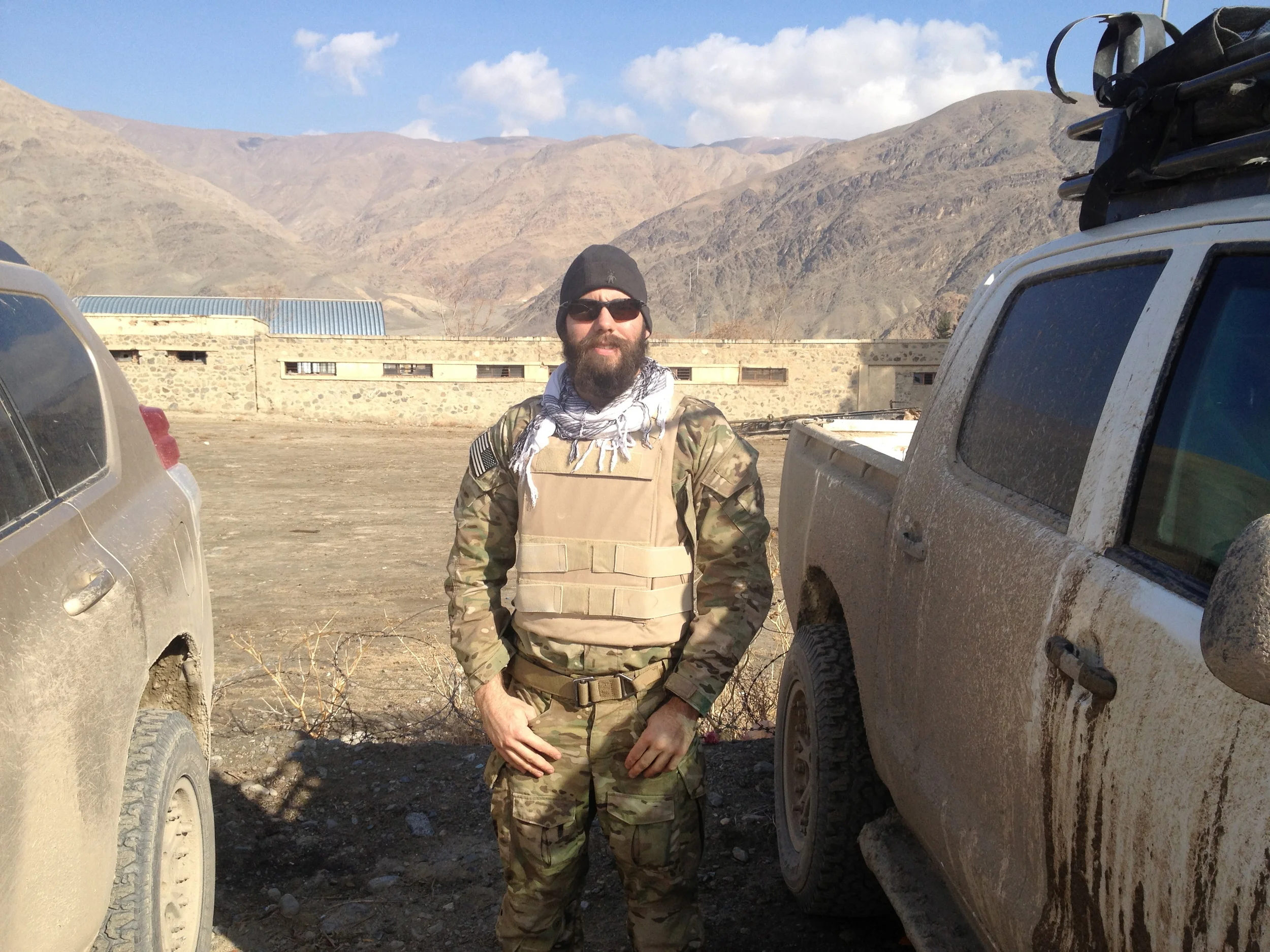
Graham Barnhart is an 18D, Special Forces medical sergeant, and is an MFA in Creative Writing candidate at The Ohio State University. His writing has appeared in the Beloit Poetry Journal, the Sycamore Review where he was a finalist for their 2014 Wabash prize, Subtropics, The Gettysburg Review, and Sewanee Review. He is also a finalist for the Indiana Review's poetry prize and the Iowa Review's Jeff Scharlett Memorial award for veterans. And is hoping to be back in Greece next summer so Demetri can continue drinking tsipouro with him and translating Greek for him.
Once A Writer, Now A Handwriter • Demetri Raftopoulos
A writer reflects on his first experience with a journal, which happened to coincide with living away for the first time as well, at the age of 26.

BY DEMETRI RAFTOPOULOS
I forgot my notebook.
It’s 5:30 in the morning and most of Thassos is still sleeping. The sun is hidden behind a couple moon colored clouds, just like the rest of the writing cohort behind their closed bedroom doors at Archodissa. I walk back past the kitchen and up the stairs towards the courtyard where the basil and oregano that is sprinkled into our dishes grows. A group of off-white stray cats lay spread out next to the garden. Their eyes are closed too.
I walk up to the balcony and reach my room. Clothes hanging to dry snap softly on a line extending the length of the balcony. I barge in and retrieve the small beige felt journal resting on my nightstand. My feet crunch against the sand I drag in from the beach every day, and close the door behind me, now ready to open my notebook on a boat that will sail through the Aegean.
Spending a month in Greece, that same notebook was next to me as much as bread was with tzatziki. With me at all times like uncertainty throughout the Greek government. Simple chance brought us together. A good friend gave it to me before leaving and if it wasn’t for him, I would have never clicked down on a pen. I would have never built another relationship alongside all the others formed around me with the clanking of glasses that month.
The notebook became my traveling companion. In a new environment, with new people, I felt safe with it. But I was also in constant need to protect it. So much so that instead of spending my last morning in Thassos on the beach, I sat at the restaurant and transcribed everything I had filled it with onto my laptop, in case something unfortunate occurred. I needed to know where it was always, the few times it wasn’t tucked into my back pocket or open in my hands. It was a friend that always gave, no matter how much I took and took and took.
I wasn’t a hand-writer. But in Greece, I became one.

The water looks dark, like the tip of a sharpened pencil. I grip the blue siding of the boat the way I grip my notebook. We move slowly, a pattern of tiny ripples follow us to the fishing trap Stamatis set last night, but the boat still rocks with the unsteadiness of the water. Stamatis is a fisherman, captain of the Evanthoula, and owner of Archodissa. He stands behind me clutching onto a small metallic wheel that sticks out from above the compartment like his worn-out overalls do over his blue polo. Greek music plays from a speaker next to the wheel and we pick up speed.
“S’Agapo pou eisai oreia,” Stamatis shouts, adjusting a strap falling off his shoulder. “I love you because you’re beautiful,” I repeat to myself, taking a seat on the ledge in front of him.
I wonder if he is singing to the sea, I write in my notebook. The swaying of the boat darts my pen upward and downward. Or if he is singing to his wife, Eva. The word ‘singing’ comes out the sloppiest but I can still read it. I use my thigh as a desk and rest the notebook right above my knee AKIMBO. It’s chilly this morning and the Aegean breeze whispers across my exposed head. I pull my hood up and continue writing.
This is his life: setting traps at night to pick them up in the morning. Sleep irrelevant. And whatever the sea offers him this morning, he will still be singing. Whatever the headlines say about his home’s economy, he will still be fishing.
I flip back to earlier pages in my notebook and admire how much I have already written only into the second week of this month-long writing residency. The pages are filled with sloppily written words as if I wrote them descending King Da Ka at Six Flags but my words are there, nonetheless, engraved into each sheet.
Light begins to creep out from behind the mountain to our left, as if rising like beer poured slowly into a mug.

Stamatis is still singing. His words hit me like the morning wind but stay and land on my page instead.
The captain continues to serenade his home, his sea. He knows these waters better than the fish that swim in them. The boat moves with ease and the music blasts louder. Stamatis is Thassos’ alarm clock. The snake charmer for the sun. The dry entertainment above for those living below. He could be trying to mask the harsh sound of the Evanthoula’s engine. Provide the sea with comfort instead of impending potential capture. Or he could just love the music his favorite singers produce. It could be his constant cheery nature. That he wishes to celebrate his life instead of worry about it.
I click the end of the pen and place it in my notebook’s crease so I can stand for the sunrise. I leave the notebook closed on the ledge and face the mountain, watching it give birth to the sun. The curved arc appears first and the morning already begins to warm. I remove my hood and look back toward the notebook, tempted, but keep my eyes focused on the slowly rising sun.
This will sound a bit silly but my notebook isn’t demanding or needy. Yes, I may write in it constantly but the notebook has also allowed me to live my life separately, away from it’s pages and soft jacket cover. To admire what’s around me alone, and then share the moment with it afterward. To truly capture a moment before putting my head down. Don’t get me wrong, I enjoy sharing. But I enjoy being able to experience something on my own first and then sharing it with others. With my notebook.
The sun is halfway through its entrance and I return to my ledge. I watch the day brighten a little more before opening the notebook again.

“Ti graphis?” Stamatis asks loudly, touching the brim of his blue hat, and then resumes his song. "What are you writing?"
I turn to face him. “Kati yia sena,” I tell him. He smiles and his graying goatie does too. "Something about you."
An orange buoy appears, softly twirling in the water like the final spins of a quarter. The engine and speaker both soften and the boat inches towards its marker.
Stamatis’ beard resembles my father’s, as does his work ethic. I’ve been to Greece before but it’s been seven years since I’ve experienced that sunrise from the blue of the Aegean. With someone like Stamatis, a patriotic man, doing all he can to keep his business and world afloat. The water doesn’t have a rank smell attached to it, like the beaches on Long Island. If anything, it smells like promise. Greece is constantly on display, shackled in the courtyard of Europe for everyone to poke at. It isn’t hidden like that which swims beneath us. Hopefully Stamati will reveal some of his hard work when he pulls up the trap.
In the past, I don’t know how I would have recorded all this. With my phone? Hope to remember as much of it with my fleeting memory? Fleeting, like my presence in Greece. It’s impossible to remember every detail but with this notebook at my side, I’ve been attempting to. Whatever I don’t remember or don’t see, I’ll write into my notebook the next time I’m here. And whatever I forget will be kept alive.
The orange buoy is now at arms reach and the boat slows even more. A couple of seagulls are awake now too, circling the boat for whatever we throw back, if anything. The sun is now completely over the mountain and shines on the rest of the waking Thassos. This is when Stamati will begin to reel in his trap and wait to see what he has caught.
“Re Demetri,” Stamatis says, turning the wheel slightly, “pigene na to piasis para kalo pedaki mou.”
The captain asks me to go pick up the buoy. An honor. He is asking me for assistance, someone who is simply learning in the presence of a master. Stamatis could do all this with one hand covering his eyes and the other flicking worry beads over his fingers. My assistance isn’t paramount to his trip because surely he does this alone. However, he has entrusted me in carrying out a duty that affects the well-being of his family.
I’m still tempted to stay seated and write. To witness something invaluable I could never see elsewhere and fill more pages. Write this scene of him picking up the traps. Write with detail the way each fish looks, how they move, and sound. Describe the definition of Stamatis' aging yet tone muscles flexing with each pull of the trap. How his blue shirt matches the water he’s pulling fish out of. How the mechanized pulley reeling in the trap sounds alongside the rest of the emptiness we are surrounded by.
Instead, I leave the next page blank. I close my notebook, stand, walk to the front of the boat, and reach for the buoy.