
In Person, Pen to Panel Bretty Rawson In Person, Pen to Panel Bretty Rawson

James McNeill Whistler and Work-Effacing Work • A Conversation With Lee Glazer

This project reminded me of the actual, physical connection between writing, writer, and words. It’s especially telling in the context of someone like Whistler, who was such a clever writer and for whom words were his weapon of choice in his battles against the (to his mind, at least) unappreciative British public.

James McNeill Whistler (153) letter to Charles Bowen Bigelow, October 5, 1891

James McNeill Whistler (153) letter to Charles Bowen Bigelow, October 5, 1891

BY SARAH MADGES

American Impressionist and portraitist ex-pat James McNeill Whistler espoused that art should be "an effortless expression of aesthetic principles," and his loose scrawl seems to echo that claim. Lee Glazer, Associate Curator of American Art at the Freer Gallery of Art and Arthur M. Sackler Gallery, however, counters in Pen to Paper that these letters indicate a more controlling figure. Written in the early 1890s, the documents on display here formed part of Whistler's anti-piracy campaign that intended both to protect and promote his art and art criticism in The Gentle Art of Making Enemies.

This conversation was a part of our collaboration with The Smithsonian's Archives of American Art, Pen to Panel, which celebrated the launch of their latest anthology, Pen to Paper.

SARAH MADGES: How did working on this project inform or change the way you think about handwriting?

LEE GLAZER: The entire Whistler correspondence—some 9000 documents—has been digitized, edited, and transcribed by the Whistler scholars at the University of Glasgow. I rely on that digital edition—so easy to search, to skim, to search! I rely on it in my day-to-day work as a curator of a collection (the Freer Gallery of Art) dominated by Whistler’s work. But this project reminded me of the actual, physical connection between writing, writer, and words. It’s especially telling in the context of someone like Whistler, who was such a clever writer and for whom words were his weapon of choice in his battles against the (to his mind, at least) unappreciative British public. His handwriting has this insouciant, off-the-cuff look that belies the careful thought and intense labor that preceded the final draft. Very similar, in fact, to his art, where, as he said, “work effaces work.”

MADGES: Why do you think these letters are so important, and how did you choose which to discuss?

GLAZER: These letters aren’t necessarily the most important in the Whistler corpus. They were more or less chosen for me, based on the holdings of the Archives of American Art. But, they are quite telling: written in the early 1890s, they were part of a concerted campaign that Whistler mounted to retain control over the publication and distribution of The Gentle Art of Making Enemies, a compendium of some of his pronouncements on art and art critics.

MADGES: What did you learn or what do you think others could learn about James McNeill Whistler from studying these letters that you couldn't from mere biographical record?

GLAZER: The handwriting in the letters is light and dashing, but beneath the surface is a determination to exert total control. They demonstrate Whistler’s idea that art should appear effortless, betraying no struggle or obvious strain of labor.

MADGES: Do you consider handwriting as visual art, writing, some combination, or something else entirely?

GLAZER: I don’t consider it visual art--but there is certainly a level or art and/or artifice about handwriting that makes it distinct from printed words. When we’re looking at printed words on a page, content and form exist as more or less at the conceptual level. The words themselves, as physical marks or presences recede--unless a lot of attention is paid to graphic design or there is a deliberately emotive use of typography. Handwriting certainly isn’t an unmediated form of personal expression – it conforms to certain conventions that change over time, it can be manipulated for effect, but I do think that it can tell us something about the writer that goes beyond the words themselves.

MADGES: Where do you think we could find qualitatively similar information and insight about an artist and their work today now that people use snail mail for personal correspondence less frequently? Do you think there's a comparable medium or mode of communication in use?

GLAZER: I think that we need look no farther than email and social media: the hand is absent, but there are lots of stylistic tics in “autograph” digital messages. Looking at patterns in these kinds of messages may well become the 21 st-century version of handwriting analysis.

Lee Glazer is curator of American art at the Smithsonian’s Freer Gallery of Art and Arthur M. Sackler Gallery where she has organized numerous exhibitions including, most recently, Chinamania and Peacock Room REMIX: Darren Waterston’s Filthy Lucre. She is the author of A Perfect Harmony: The American Collection in the Smithsonian’s Freer Gallery of Art and co-editor of James McNeill Whistler in Context, East West Interchanges in American Art, and Palaces of Art: Whistler and the Art Worlds of Aestheticism.


Read More
In Person, Pen to Panel Bretty Rawson In Person, Pen to Panel Bretty Rawson

Dan Flavin's Art & Life • A Conversation with Tiffany Bell

"It’s concerning that kids growing up today might not be able to read letters, read these manuscripts. Flavin’s early text is so difficult to read, you almost feel shut out. He has all these flourishes, especially the way he ends a word. It’s very sad when this kind of information becomes inaccessible."

SARAH MADGES: How did you get involved with this project?

TIFFANY BELL: I got a call from Mary [Savig] because she noticed my work on the Dan Flavin catalogue raisonné. I make use of the archives on a regular basis and so she asked if I would write about one of Flavin's letters that they had because his writing is so unique.

MADGES: How did you decide which letter to talk about?

BELL: She [Savig] asked me to choose one and I was already familiar with this one because it was available online. I was also interested in it because the content of the letter reflected his handwriting. It describes his interest in 19th century drawings and landscape art, and Ellen [Ellen Johnson, the letter's recipient] had a collection of these John Frederick Kensett drawings.

His handwriting is quite formal considering how innovative his art is. It was interesting to me that it looked so perfect, exactly the way it had been taught to him.

I also knew the artist and knew he took writing seriously; he took serious care...I think he had some idea his letters would be studied at some point. He was interested in the collected writings of Cezanne and would use some of them in lectures. He was very interested in traditional writing like that, capturing the artist's life, and so I thought this letter projected that aspect of his personality.

MADGES: Why do you think archives should be public access? Why are these letters, these archival documents, important?

BELL: It’s invaluable for the kind of research I do. I think archives should absolutely be public access--and there is so much online now, which is so exciting. Even the postmarks on letters tell you where the artist was on a certain date. It’s invaluable for putting together someone’s biography.

But now, with all of these emails exchanged instead--I don't know if or how they will be saved. The quantity of material might be overwhelming to sift through. A lot was done through phone calls, so a lot has been lost there too. My work on Agnes Martin — although not entirely relevant to this conversation — her letters in the Archives of American Art are completely essential as far as learning who people in her circle were, what she thought about her art, and where she would show it. There's no other way to find this information out because she didn't keep a record of anything. Flavin kept his stuff as a record, knowing; he was prepared for people to access his writing.

MADGES: You noted in your essay that Flavin’s art resisted associations with the handmade, and yet he took such care with his penmanship. What were his journal entries like compared to his letters? You said that his letters were copied from what he wrote in his journal--did you notice any edits made between first and second draft?

BELL: His final page has no crossouts, and his letters were often typed. There are more crossouts and edits in his journals. You can really see him working through a thought.

MADGES: A kind of related question here, but what did you learn or what do you think others could learn about Dan Flavin from studying his letters that you couldn’t from biographical record?

BELL: Access to letters gives access and insight into thinking. You get to see how he presents himself to people.

MADGES: Did he write for the duration of his career?

BELL: He started in the 60s--the journals begin in 1961 or ‘62 and he kept them going through the 80s. As a young artist he was very interested in recording what he was doing as an artist. Early letters reach out to people who might be interested in buying or showing his work. I think he already knew Ellen Johnson when he wrote to her--when Flavin made his fluorescent light works they were always untitled, but were often dedicated to people. One of them was dedicated to Ellen Johnson.

MADGES: How do you feel about the fact that the U.S. Core Curriculum no longer requires handwriting instruction?

BELL: I was shocked. I even feel sorrow because I type so much now and I very much miss the way writing by hand connects you to your thought in a different way. When you actually write something down it enhances your ability to think through the idea. The fact that handwriting is slower means you stay with the thought longer.

It’s concerning that kids growing up today might not be able to read letters, read these manuscripts. Flavin’s early text is so difficult to read, you almost feel shut out. He has all these flourishes, especially the way he ends a word. It’s very sad when this kind of information becomes inaccessible. 

MADGES: How did working on this project inform or change how you think about handwriting?

BELL: Well first of all, the book is really beautiful. I’m very pleased to be a part of it. It didn’t change how I think, but maybe it reinforced the idea of how wonderful handwritten letters are. Dan Flavin himself understood the beauty and great capacity of what you could convey in a handwritten letter. It’s interesting to look closely at them; you get more sense of personality, occasionally some humor. You can observe how he puts the date and place in each entry and fills the whole page, leaving no margins. He has this very meticulous handwriting that looks angular, even stylized, and always on unlined paper.

MADGES: Do you consider handwriting visual art, writing, or some combination?

BELL: For Flavin, I think it’s a lot like his drawings in some way. He used to carry a notebook around with him all the time and he would use the same pen to sketch. He collected drawings, like he mentioned in the letter: Kensett pieces. Kensett also did ink drawings on paper, often with little notes about where they were drawn and when. Flavin kind of took after him--he recorded the date and time. You can sense the connection to his past art, its influence on him.

Read More
On Handwriting, Pen to Panel Bretty Rawson On Handwriting, Pen to Panel Bretty Rawson

Thomas Eakins's Precise Pen • Akela Reason

"Eakins learned his elegant copperplate hand from his father, a skill that was reinforced at Central in his drawing classes. To the nineteenth-century mind, good penmanship and draftsmanship were seen as interrelated skills that reflected clarity of thought."

BY AKELA REASON

As the son of a writing master and a graduate of Philadelphia’s Central High School, Thomas Eakins understood the link between writing and drawing. Eakins learned his elegant copperplate hand from his father, a skill that was reinforced at Central in his drawing classes. To the nineteenth-century mind, good penmanship and draftsmanship were seen as interrelated skills that reflected clarity of thought. In fact, writing masters like Eakins’s father, Benjamin, often completed complex drawings crafted from the written text as a demonstration of their skill and confident control of the pen.

Official writing in the days before typewriters and photocopiers required the work of a professional writing master who would plot out the text to the scale appropriate for the document. The work of such writing in many ways mirrored Eakins’s own preparatory process as he plotted out his compositions with the same care, making few changes to his designs once they were established.

In order to prepare for his paintings, Eakins made some pencil sketches, detailed perspective drawings, and oil sketches to work out color and composition. He also used photographs to plot specific figures in his paintings. None of this work was visible to the art-going public, who saw only his finished works. Similarly, Eakins carefully drafted official correspondence in his elegantly trained hand, with all of the mental work coming before the pen was set to the final draft. These letters were usually brief and mistake-free. For his family and friends, however, he was much more carefree in his writing. His hand is casual, and one can see him thinking through cross-outs and insertions of text.

There is a clear divide between Eakins's public and private writing, just as there is between his public and private artwork. Occasionally Eakins injected his art with his formal, artful penmanship by adding his carefully crafted signature. These signatures flow in an elegant cursive that resembles his signature on formal documents, and they are plotted in perspective so that they become part of the painting, which gives some idea of the labor that Eakins took such pains to hide. 

While none of his works, written or painted, appear effortless, Eakins rarely revealed his thought process the outside eye, making his work appear uncannily precise. 

IMG_0768.JPG

Akela Reason holds a Ph.D. in Art History from the University of Maryland. She is Associate Professor of History at the University of Georgia and the author of Thomas Eakins and the Uses of History, University of Pennsylvania Press, 2010.

This essay was a part of our collaboration with The Smithsonian's Archives of American Art, Pen to Panel.

Read More
Project Bretty Rawson Project Bretty Rawson

What stories will your handwriting tell?

Is handwriting really a lost art? Mary Savig, Curator of Manuscripts at The Smithsonian's Archives of American Art, says no. And we agree, which is why we have bonded, and for two months, banded together to help celebrate the launch of their latest anthology, Pen to Paper. Edited by Savig, this art object brings together worlds of insight on handwriting: the personal with the professional, and the past as translated by the present. Published by the one and only Princeton Architectural Press, Pen to Paper showcases letters written between American artists, their intimates, and colleagues. In this online exhibition, you will find interviews and reflections from contributors expanding on their essays in the book alongside a selection of letters from the Archives. 

"And yet, handwriting continues to prove its fluidity. The craft of handwriting had flourished online, especially on social media. Artists, thinkers, and makers alike are experimenting with penmanship in innovative ways. Demonstrations of calligraphy can be found on YouTube and hand-scribed cards flourish on Etsy. In the past few years, curator Hans-Ulrich Obrist has rebooted autograph collecting by posting handwritten notes--usually jotted down on Post-It Notes--by contemporary artists on Instagram, where anyone is welcome to add comments. With this in mind, let's not mourn handwriting as a lost at, or even as a dying art. As snail mail fades from contemporary culture as a primary mode of communication. the vast array of handwritten letters in the Archives of American Art remains relevant and ready for new generations to discover. Let's celebrate how imaginative correspondence now exists in material and digital forms, posing new ways of thinking about art, history, and culture. In the spirit of this book, pick up your pen and write a letter today. What stories will your handwriting tell?"

- Mary Savig, Introduction, Pen to Paper (page 23)

Read More
Events, In Person, Press Release Bretty Rawson Events, In Person, Press Release Bretty Rawson

Handwritten & Smithsonian @ The Sketchbook Project (9/10)

Pen to Panel

Handwritten & Smithsonian at The Sketchbook Project

September 10, 2016

We are over the moon to be partnering with the Smithsonian's Archives of American Art to celebrate the launch of Pen to Paper, an object of art published by Princeton Architectural Press, by hosting this culminating event, “Pen to Panel,” at none other than the world-renowned The Sketchbook Project. What better setting than a massive room lined with thousands of sketchbooks from humans around the world?

Join us on September 10th, from 6 – 8pm, for an evening of conversation, Brooklyn lagers, and archives. Curator of Manuscripts Mary Savig will be bringing letters from their archives to exhibit in the space, and around 7pm, we'll be quieting down to listen to five incredibly bright minds talk about the art and act of writing by hand today. On the panel will be Mary Savig, Linda Shrewsbury, Tullis Johnson, Luis Jaramillo, and Barbara Bash. You can see more information about our panelists and get a sneak-peek at Pen to Paper by visiting our online exhibition here: www.handwrittenwork.com/pentopanel.

The event is free, and so is the beer thanks to Pipe Dreams NYC! So come one, come many. We hope to see you at The Sketchbook Project for a few hours of wild words. Until then, keep the beautiful pen busy, and ink responsibly.

Curator of Manuscripts, Mary Savig, will be bringing some of the letters from Pen to Paper, which was published by PA Press (2016).

See our Facebook Event here, or enjoy the Handwritten ExhibitionWhat Stories Will Your Handwriting Tell?, which showcases letters from Pen to Paper, as well as exclusive interviews, essays, and reflections with Mary Savig and several of the contributors from the anthology.

Read More
Winter 2016, On Handwriting Bretty Rawson Winter 2016, On Handwriting Bretty Rawson

The Distance Between our Public and Private Selves • Aine Greaney

In this essay on deleted pasts and new beginnings, Aine Greaney takes us around the world in an old composition notebook: the only one she brought with her when she emigrated to America. With the start of the new year just behind us, we find this piece more timely than ever, as we revisit filled pages from the past, and look toward the blank ones of the future.

BY AINE GREANEY

December 21, 2015
 
This morning, I ate some oatmeal, drank some coffee and penned the last page of my personal journal. I flip back to the first page: June 30,  2015. Inside this bound book are almost eight months' worth of thoughts, uncertainties, musings and arguments.

I don't write in my journal every day, but on those weekday mornings when I do, when I set the alarm to get up extra early, reflective writing makes the rest of my working day happier. On the weekends, journaling acts as my transition from working me to creative me—and believe me when I tell you that the latter is the more authentic version. In fact, journaling has taught me this: The shorter the distance between our public and private selves, the happier we are. Stephen King may have been referring to an entirely different type or genre of writing, but he was really on to something when he declared that writing is about “getting happy.”  

I started keeping a journal in my teenage years while I was attending a small-town convent day school in my native Ireland. Some days, I can still shut my eyes and see myself back there, still dressed in my navy-blue school uniform, sitting inside my bedroom window, my geography and math texts pushed aside as I scribbled in an old composition notebook.

We were the first generation to benefit from a 1967 law that granted free, secondary-level (high school) education to every child in the Irish nation. So I was supposed to be grateful for that school uniform and those textbooks that had been denied my mother and my grandmother. I was grateful. Still, I recall those school days and nights as being full of square-peg-round-hole malaise and anxiety. In public, I sang with the choir in the school assembly room. In private, I wanted, desperately, to raise my own, individual voice. Journaling was the only place where this was possible. 

However, when I emigrated to America at age twenty-four, I abandoned all but one of those notebooks. I think I believed that, in my bright, new country, in a nation founded on the notion of deleted pasts and new beginnings, that that melancholy, soul-searching me was best left behind, left where it belonged.

I did bring one hard-cover notebook into which I had transcribed some of those writings from my late teens and early 20s. In the flyleaf of this little red notebook, I grandly wrote,  “Collected poems, rhymes and thoughts.” Now, when I re-read those hand-written pages, I see just how wrong I was to believe that our past has ever really passed. I am shocked at how well those “assorted rhymes” still describe the middle-aged me.

For example, here’s one of those entries that I remember writing as I sat propped against the pillows in my twin bed in my parents' house:

My books stand orderly on the shelf
Masks for that hidden self
Hoping they can quench the flame
Of numberless passions with no name.
 
I talk and talk; I make my stance
‘You’re such good company,’ he said.
But what would he say if, perchance
He saw me sobbing in my bed?

I find it comforting to read this unchanged part of me, this struggle between the private and public self. I like that we have certain personality traits that are in-born or immutable, and that there is, at all of our cores, a perpetual and lifelong mystery.

In the basement of my house in Massachusetts, I keep boxes of my completed journals, each one chronicling six to twelve months over the course of my twenty-nine years living here. My arrival day at JFK Airport, New York. That hot, AugustSunday when my American husband and I said, “I do” before a town judge. The day an editor wrote to say she was going to publish my first short story. I remember these. But, if it weren't for those journals,  many or most of the less auspicious occasions, the ordinary mornings or afternoons, would be gone from memory recall. For example, in the journal I just completed, on August 18, 2015, I wrote that “I am here alone, finally, and the internet has made me vain and distracted, and these two things (vain and distracted) are very connected.” I cannot remember feeling that—not without re-reading my own handwriting on that page.

Without all of these hand-written journal pages, how much of the past two seasons would I actually remember? How well could I evoke the sounds or feelings or atmosphere of one ordinary hour or afternoon in July or August or September? What summertime walks did I take? When did the cherry blossoms drop their pink? When did the marsh grasses near my house turn dry and brown with summer heat?   Now that our garden is under snow, I find it hard to close my eyes and re-see that garden when it was lush and colorful with summer perennials.

Some days, I feel as if I am on a Japanese bullet train ride through a fast-disappearing landscape, where, by the time I sit up and look out the window, everything is already gliding out of eye view.  
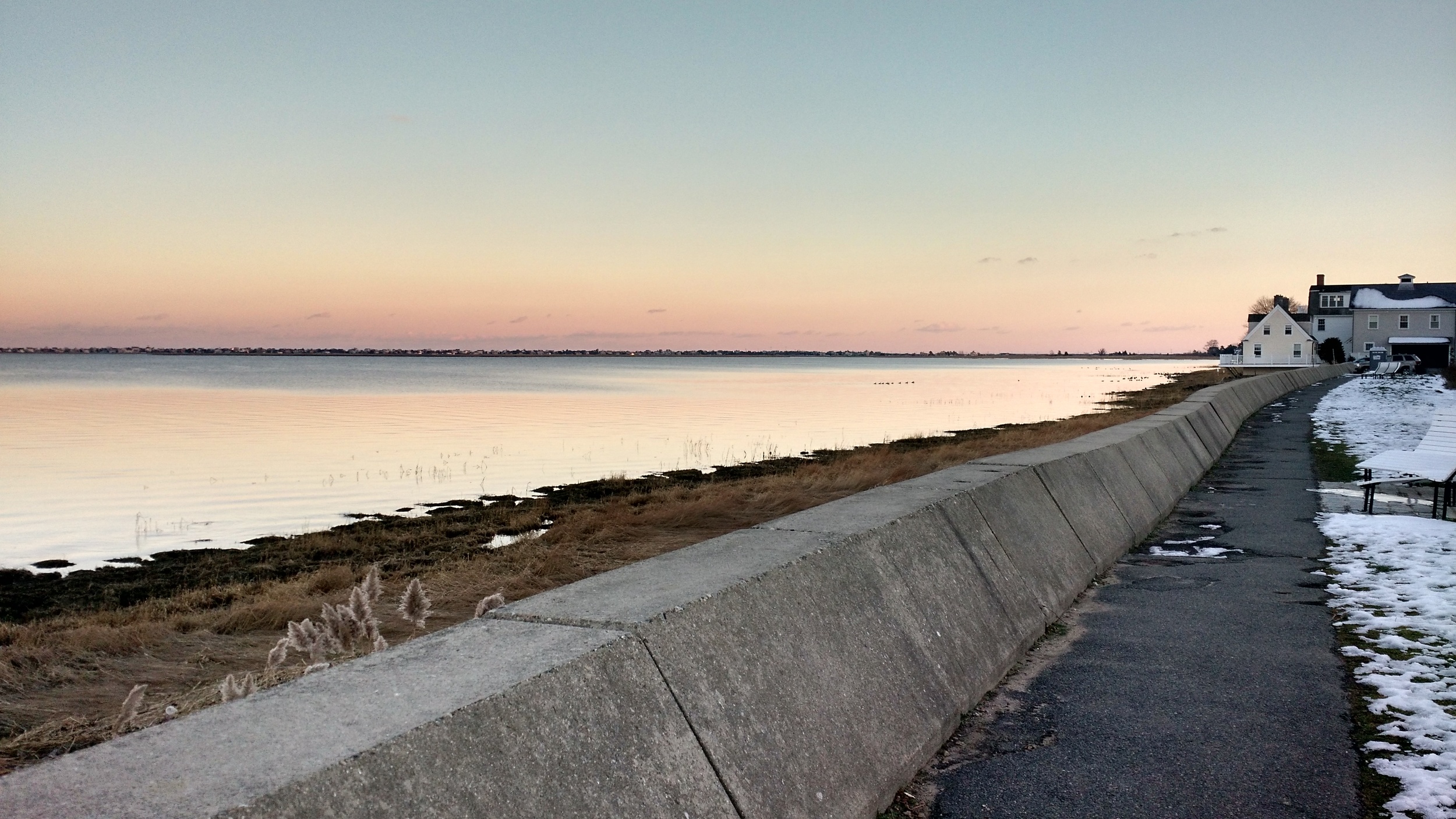
Then there are those days when I’m driving home from work, my head still buzzing with deadlines or with snippets of workplace conversations, and I look out my car windshield at the roadside pine trees, a flock of geese flying south through the paling sky and I think, This evening, this moment in time will never come again. So I’d better shush my mind to look---really look--around me.  How many of these afternoons are left in my life? I don’t know. None of us do.  Morbid?   I don’t think so.  These moments of mindfulness are how we hit the pause button, how we behold our own joy. When we write down those moments, when we record them in a journal, we are creating the narrative—the only half-way reliable narrative—of our precious and finite days.

Henry David Thoreau said that he traded his comfortable town home for a rustic woodland cabin because he wished to live deliberately.

At least in the abstract, some of us covet this concept of unplugging and retreating from our hectic and digitized lives. Who wouldn't like to slow down time so we can feel the heft and length of each passing hour?

But nowadays, how many of us would adapt this as a permanent and year-round lifestyle choice?  The woodland WiFi and cell phone connections would be spotty at best. And, as someone who grew up in a thatch-roof farmhouse without indoor plumbing or central heating, the discomforts and inconveniences of that bare-bones cabin life would, sooner or later, override the joy or mindfulness.

So in my cozy and well-heated writing studio I keep a set of ballpoint pens and write in my notebooks to record the ephemera of my life. Without these journals, without this writing, most of the past seven months would be gone.

This morning I closed my completed journal and crossed to my studio bookshelves to stash it there until, during one of my sudden and always overdue clean-outs, it will end up with all the others in those basement boxes. 

I know there will come a future day when I will go to the basement to search through the shelves for an old photo or a lost gadget and the journal box will call to me, as it has before.  I will open today’s completed journal at a random page and sit there under the basement’s Florescent strip light in the company of my previous self, reliving a day from 2015.  In all my past journals, I see recurring themes: the yearning for solitude;  the immigrant’s search for an existential home; and my almost lifelong struggle and vacillation between my public and private personae (as in the 1983 piece above).

When I read them, I’m also struck by how prophetic some of my past writings turn out to be.  It seems, in retrospect, that the writing knew much more than I did.  Too often, I see that I should have listened to or acted upon my own observations.

Today, I select a new book to set on my desk underneath the east-facing window of my writer’s studio.  The new blank journal sits here, empty and waiting for tomorrow.

Read More