The Keepers • Sharon W. Huget

BY SHARON W. HUGET
As I go through three months worth of papers that have accumulated in piles trying to put the keepers into files, I find the letter my Auntie Mary Ann wrote in early January. It was a response to our annual family Christmas card. It immediately catches me and I bring it to the table so I can re-read it over my Sunday tea. Ah Sunday—a day for quiet, un-hurried, sit down tea, sipped slowly while still hot.
The delicate handwriting with it's curves and fancy loops echoes the scalloped edged stationary, eggshell blue with pink roses framing the page. A what's happening letter—about life and change and questions about the happenings in our lives as my own kids grow up and we grow older.
It has been years since all my cousins were at her place searching for coloured hard-boiled Easter eggs hidden in corners of the basement, around storage boxes and in my uncle's work boots. Christmas memories of cousins relegated to playing in the basement and giggle fits as the pack of us are ordered to sleep, squished wonderfully side by side, sleeping bag to sleeping bag. I remember the sounds from the downstairs guest room and hearing the late night footsteps of clean up in the kitchen, lingering laughter of adult siblings and in-laws visiting upstairs and the early morning hurried stomps of getting breakfast out and the roast in before dressing in Sunday clothes and heading for church. So long ago—and yet, the familiar script has brought her close again for a moment of cherished remembering.
It’s a keeper—a piece of caring and love from my dear Aunt Mary Ann.

The Talloczy Family’s Hungarian Stuffed Peppers • Allison Radecki
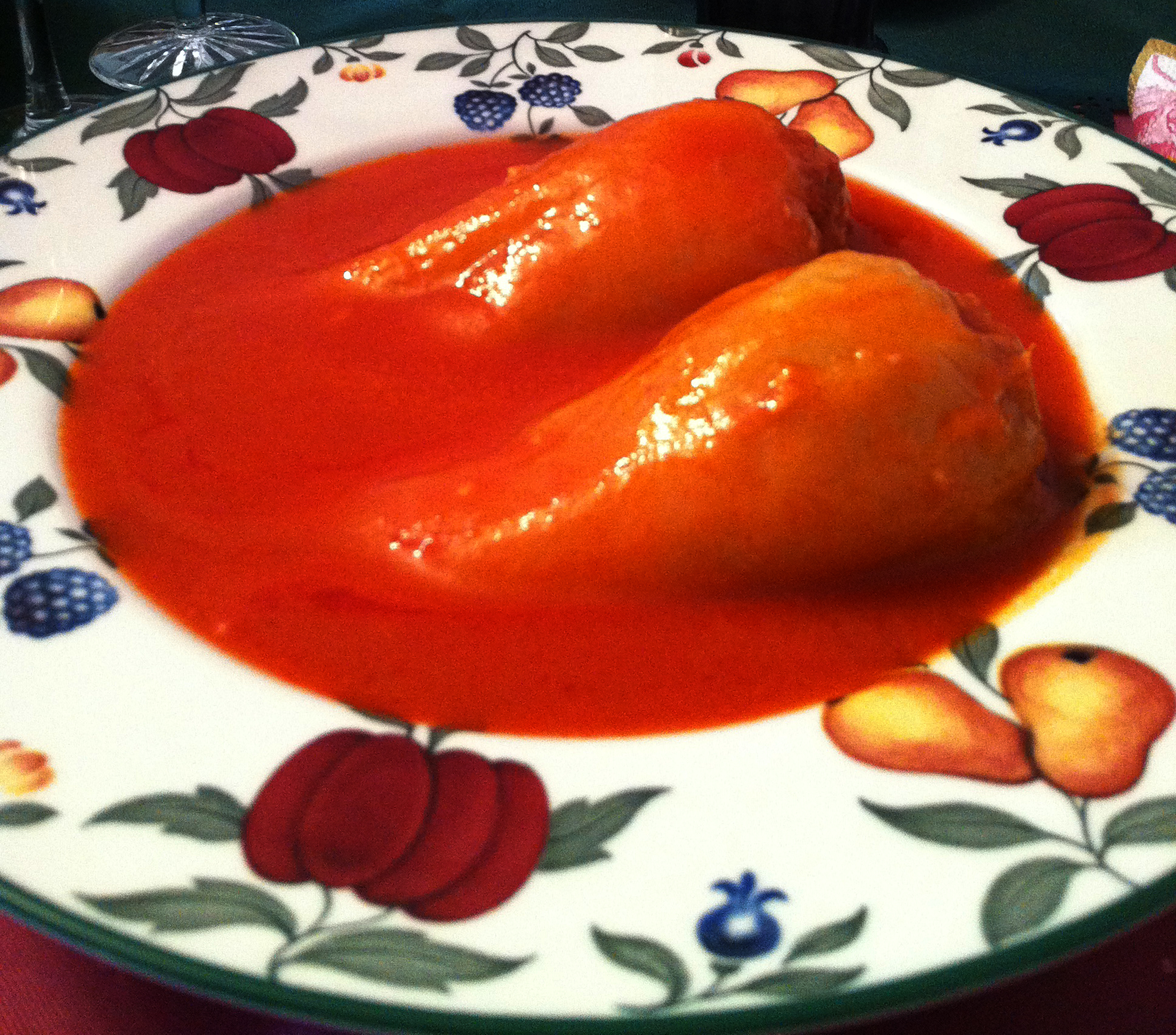

Note from curator Rozanne Gold: This week’s recipe comes to us via New York City caterer, professional chef, and former restaurateur Irene Khin Wong. It is an old Hungarian recipe, inherited without modifications, from the family of her Hungarian partner, Zsolt Talloczy. Three generations of Hungarian women have embraced this recipe, beginning with Zsolt’s great grandmother, Franciska, his grandmother, Anna, and his mother Agnes Zatonyi Talloczy. It is lovingly fastened to Zsolt and Irene’s refrigerator door. With that, a fourth generation now makes the treasured recipe in late spring and early summer, when tomatoes and wax peppers are freshly available. I especially love the grace and styling of Agnes’ European handwriting. With thanks to Irene and Zsolt for sharing this recipe — one that reminds me of my own childhood with my own beautiful Hungarian mother.

The Talloczy Family's Hungarian Stuffed Peppers By Allison Radecki
These lusty stuffed peppers remind Zsolt Talloczy of a cherished childhood and memories of his mother and grandmother. When he prepares them, he wistfully said, “It smells like spring and lazy sunny afternoons in Budapest.” Whiffs of the dish also dish trigger thoughts of his wife Irene’s first trip with him to Budapest and his parents’ home nearly 10 years ago.
Irene and Zsolt first made each other’s acquaintance while waiting to pick up tennis permits within a sporting goods store off of New York City’s Union Square. Zsolt, a trained scientist who now works in microbiology, was studying at Columbia University at the time.
“I wearing pajamas on a Saturday afternoon,” remembers Irene. “I had worked a late night, until 3 am, and just threw on a long jacket to accompany my eager friend to fill out the permit forms. ‘Who cares if you’re wearing pajamas,’ said my friend. WHO is going to see you?’”
A quick chat about tennis skills led Zsolt to offer Irene his e-mail address (“he didn’t even have a cell phone”). After a few e-mail exchanges, they met up to play. Irene then proposed that they meet up another day at the iconic Jewish appetizing store, Russ and Daughters, before trying out courts on the Lower East side.
“I figured that everyone in New York knew Russ and Daughters,” said Irene, who originally hails from Burma, “but Zsolt never arrived. I couldn’t call him, he had no cell phone, so I waited. Sitting in front, while eating my bagel and whitefish, I saw him running by. I almost missed him. I think I gave him the wrong address.” After an extended trip to Asia together (“four countries in six weeks and we never had an argument”) the couple realized that they had found a rare match, indeed.
A trip to Budapest was next on the horizon. “I remember thinking how Budapest was almost like Paris—but in the 1960s. Zsolt’s father, Imre, would buy trays and trays of different types of pastries—the most incredible pastries — it was like something you would get in Paris or Vienna.”
Zsolt’s mother, Àgnes, made these stuffed peppers for Irene to welcome her to Budapest. “Zsolt knows that I can eat spicy. They were so flavorful. It reminded me of home.”
The prototype for this family dish originated in Hungary and is based on a traditional recipe with some German-Hungarian influence from Budapest’s ninth district, Ferencvaros/Franzstadt. This zone was considered the ‘stomach of Budapest’ with a multitude of blooming family businesses, restaurants, butcher shops, and bakeries. It was the neighborhood where Budapest’s first chocolate factory, and famous brandy factory (Zwack Liqueur, maker of the beloved national digestive herbal drink, Unicum) were located, as well as the capital’s central slaughter house.
The typical pepper used in its preparation is the Hungarian Hot Wax Pepper variety, which is fragrant, smooth and ripens like the sunset from yellow to orange to red. This pepper, or paprika, as it is called in Hungarian, is usually harvested before maturity when its skin exhibits a yellow-greenish hue. It is easy to stuff and peel and produces fruits whose ends taper to a rounded point. Alternatively, you can make it with green bell peppers.
As anyone who has visited Hungary knows, you can hardly walk ten feet without encountering this pepper — whether it is threaded onto strings and hung from balconies to dry in its reddest, most mature state, piled high in a fragrant yellow tower in a food market, or taking its traditional place, in its red, pulverized version (as the ground spice, paprika) alongside the salt and pepper shaker on most Hungarian tabletops.
Zsolt is the chef when it comes to this family stuffed pepper dish which he cooks for Irene, so they both can remember their flavors of home. A yearly import of two kilos of Hungarian paprika, which his parents buy directly from a small producer in the nation’s Szeged region (and Zsolt carries back to New York on the plane) allows him to truly capture those authentic flavors. Zsolt also regularly imports frozen portions of his mother’s home-cooked stuffed peppers for his wife when she can not accompany him back to Budapest for his yearly visit “Àgnes freezes the peppers in a container, which she then wraps in three or four Ziploc bags,” describes Irene. “The dish is still cold by the time the plane lands.” Talk about take away.
As the famous Hungarian restaurateur and restaurant consultant, George Lang, wrote in his book, The Cuisine of Hungary, "Paprika is to the Hungarian cuisine as wit is to conversation- not just a superficial garnish, but an integral element…the marriage of paprika and Hungarian cooking was almost predestined." Considering that the wax pepper originated in the New World and made its way into to Hungary by way of the Turkish invasion in the 1500s, it covered a lot of ground before reaching its most famous culinary destination.
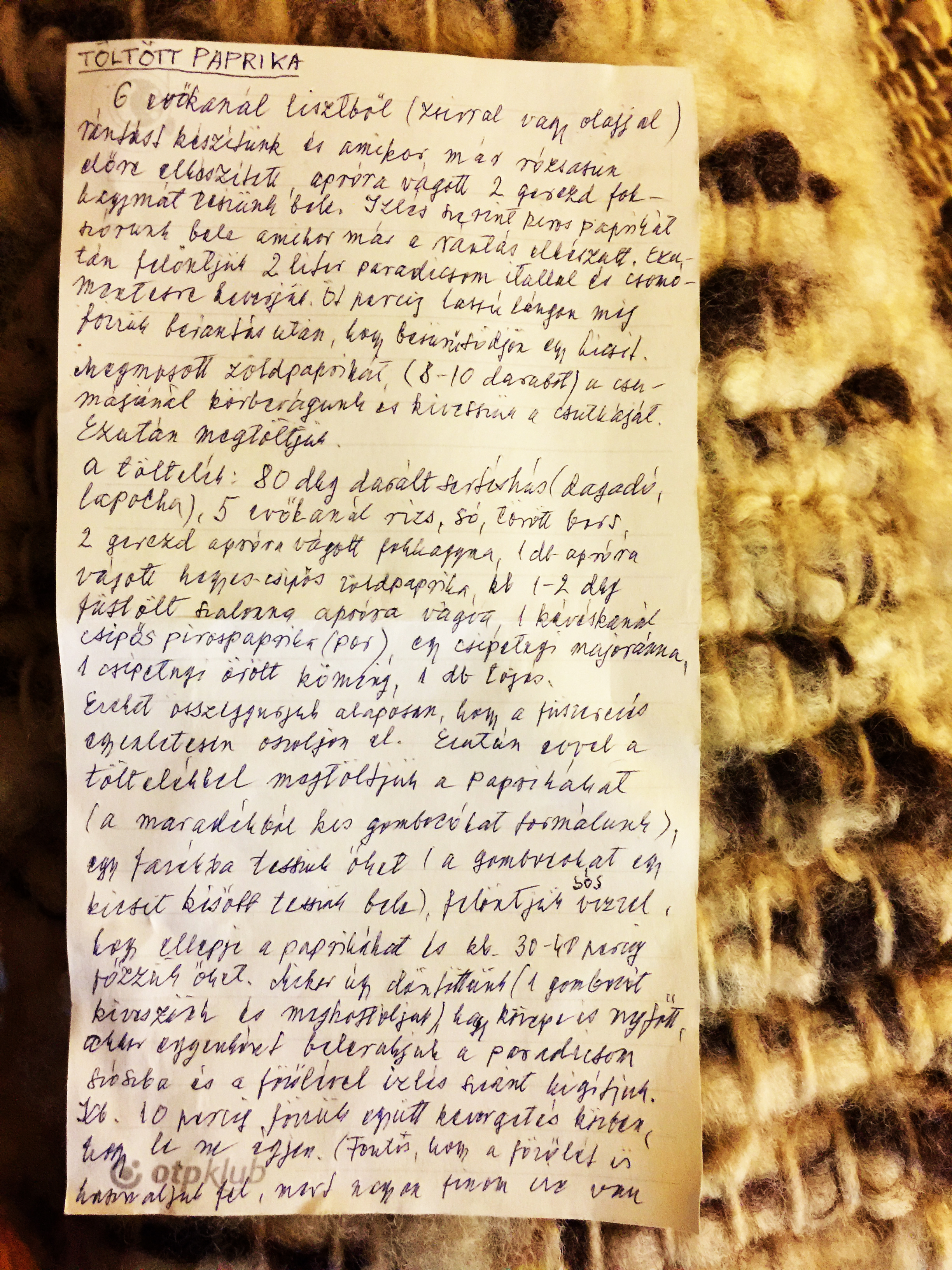
Hungarian Stuffed Peppers
For the Stuffing (to be prepared first):
1-3/4 pounds ground pork
Scant ½ cup raw rice
2 cloves of finely chopped garlic
1 hot pepper (jalapeño will do), finely chopped
2 tablespoons smoked bacon, chopped
1 teaspoon of Hungarian hot paprika
A pinch of dried marjoram
A pinch of ground cumin
1 whole egg, beaten
Salt and pepper to taste
For the peppers and cooking liquid:
6 tablespoons flour
Pork lard or oil
4 cloves of garlic
¼ cup Hungarian paprika powder (sweet or hot)
2 liters of tomato juice
8-10 Hungarian wax peppers (with seeds and stems removed)
•
1. In a large bowl, mix all the ingredients for the stuffing and set aside.
2. Brown flour in melted lard or oil until it turns light brown in the pot. Add chopped garlic and cook several minutes until soft (but not brown.) Add ¼ cup paprika to begin (add as much as you like according to taste – a mixture of sweet and hot paprika) and immediately remove pot from flame to avoid burning the paprika.
3. Pour in 2 liters of tomato juice and break up any clumps of flour by stirring. Simmer on low heat for 5 minutes to concentrate
4. Cut the Hungarian waxed peppers (8-10) around at the stem and pull out the seeds.
5. Fill the peppers with the stuffing. Any leftover stuffing can be rolled into meat balls. Add stuffed peppers to a separate pot from the tomato liquid, add any ‘naked,’ leftover meat balls a bit later to the pot. Fill the pot with water to cover all peppers. Salt and simmer for 30-40 minutes
6. When the stuffing in the peppers is cooked through the middle (cut and test to see when ready), transfer them to the tomato liquid pot and fill up with some chicken or beef broth as needed. Simmer on low heat for 10 minutes while constantly stirring to finish.

Braised Short Ribs with Fennel, Carrots, and Orange • William Poole

Note from curator Rozanne Gold: I was thrilled to get an email from Mr. William Poole, a stranger to me who has been enjoying reading Handwritten Recipes. Mr. Poole is a professional chef who specializes in pastry and confectionery and has extensive knowledge and experience working all over the world, including Slovenia. Naturally, I expected a nice recipe for strudel or some European baked good, but what I got instead was a fabulous recipe for short ribs perfumed with fennel, carrots, and orange. Only one teaspoon of sugar in sight. Bravo to Mr. Poole, who not only managed to devise such a lusty main course, but did so in his hotel room one night. And thanks to Allison Radecki for making the recipe and saving some for me. This handwritten recipe is an homage to William’s grandparents who inspired him to live life full tilt.
BY WILLIAM POOLE
I am from Eastern Nebraska, growing up in Omaha and moving to Phoenix in my early teens. My families are largely from Eastern Europe, the Bohemia region of what we now know as the Czech Republic, and settled in Nebraska in the late 19th century.
Afternoons after school, I would be glued to the television, watching the Great Chef's Series, The Frugal Gourmet and, of course, Julia Child and Jacques Pepin. They all influenced me in developing my cooking style, and to understand that the world, in a culinary sense, is a pretty large place.
I am a professional cook, specializing in pastry and confectionery. My career has taken me all over the states (restaurants, hotels, even a private luxury train) and to Europe, where I worked for a large catering company in Slovenia. I have kept many notebooks over the years that contain recipes, notes, techniques, and even drawings of the things that influence me, or inspire me to cook.
The recipe I am sharing comes from my latest notebook, Jokati z Babico (shedding tears with Grandmother). It is an homage to my biggest inspirations, my grandparents, Claire and William Pycha. The phrase Jokati z Babico is a term that represents the passing on of traditions, good ones that make you remember people who have passed on before you, sharing stories, eyes filled with joyful and melancholy tears.
My grandparents taught me to be adventurous in all things. My grandmother Pycha, all smiles and billowy (like a character in a Truman Capote novel), was always one to point out what was good to use in the yard for cooking; she would show me where the wild chives grew behind the garage, the spearmint below the low porch off the kitchen, and how to dry the picked bundles to make tea. She taught me how long to boil the potatoes we pulled earlier from the garden and how much butter, dill seed, salt and parsley to use when preparing them.
My grandfather, in addition to his great baking skills (kolache, dinner rolls and cinnamon buns were his best) had a strong talent in the arts. He painted in oils, in addition to painting yearly pisanki (colored Easter eggs with traditional or pastoral vignettes). I think of him (and thank him often) whenever I’m drawing out a new confection design, or composing a plate for a menu.
This handwritten recipe resulted from my recent travels when I learned that you can make something extraordinary with limited resources.
My partner of twenty-eight years had accepted a job that relocated us to the East Coast, but required nearly 100% travel. The neat part about this was that his company would fly me to his destination/base as needed for as long as I needed. This was great, as I was taking some time off while considering a location and menu for my new chocolate and confectionery company.
I found myself in Atlanta, Georgia, for most of 2014, in a residence hotel, the Hilton Midtown, which offered a refrigerator, basic cooking utensils, pans, a coffee maker, and a two- burner electric stove top, which to me, is a perfect challenge. This setup allowed me to cook nearly every night, using fresh ingredients, exploring farmer's markets and regional food shops so I could create great meals. A few times, seeing me carrying bags of fresh food back to my room, the hotel maids would ask what I would be making that day, and started asking me cooking questions. I guess they were intrigued by the aromas wafting into the hallway.
I created this recipe in October of 2014. It was raining the day I stepped out to make groceries (my partner is a New Orleans native, hence the regional expression...). It was balmy, but I knew that it would get colder later, and wanted to make something that was comforting and perfect for the evening ahead. At the market, a few blocks away, I found all the ingredients I needed; meaty short ribs, some baby carrots, a head of fennel, a can of low-sodium beef broth, and an orange. Back at the hotel, I had on hand a few cloves of garlic, onion, and some left over coffee. I borrowed a little apple cider vinegar and flour from the hotel kitchen.
This recipe always reminds me of my grandparents, a hearty and flavorful combination of aromas and textures, and a one-pot technique which is frugality at its best. The flavors of the fennel, carrot, and onion, with the delicate orange and coffee, are all scents that remind me of time at my grandparents’ house in Omaha, and a way of keeping their memory with me wherever I go.

Braised Short Ribs with Fennel, Carrot and Orange
This recipe is can feed four easily, or two people for a few days
4-6 beef short ribs**
2 tablespoons good-quality olive oil
1⁄2 large onion, finely diced
3 garlic cloves, smashed and coarsely chopped
1 large fennel bulb, cored and sliced thinly
1 bag baby carrots, rinsed
1 orange, juiced (about ¼ cup)
1-1/2 cups low-sodium beef broth
¼ to ½ cup of brewed coffee
¼ cup apple cider vinegar
- Heat oil in a deep, lidded pot, over medium high heat until it shimmers.
- Without crowding, add the short ribs, browning on all sides; remove to a plate.
- Add a touch more oil if needed, and sauté the vegetables until they begin to take color, adding the garlic last.
- Add the stock, vinegar, coffee and orange juice and bring to a boil. Nest the ribs into the liquid and vegetables, reduce the heat to low and cover for two hours until the meat is tender. Remove short ribs and vegetables to a platter. Boil juices in pan until thick and syrupy and pour over meat.
** dusted in a mixture “dry rub” of salt, pepper, flour and a little sugar (the only sugar I had on hand were there sugar packs in the hotel room, which reminded me of my grandparents again, as my grandmother used to sneak a pack or two home from the restaurant every time we went, as a memento). A dry rub is a personal choice for “how much”, but I generally use 1 cup flour, with 2 teaspoons each salt and pepper, and 1 teaspoon sugar).

The Story of My Signature Tattoos Started on a Night Punctuated with a Bottle of Irish Whisky • Nick Landwehr

BY NICK LANDWEHR
The story of my signature tattoos started on a night with my college roommate punctuated with a bottle of Irish whisky.
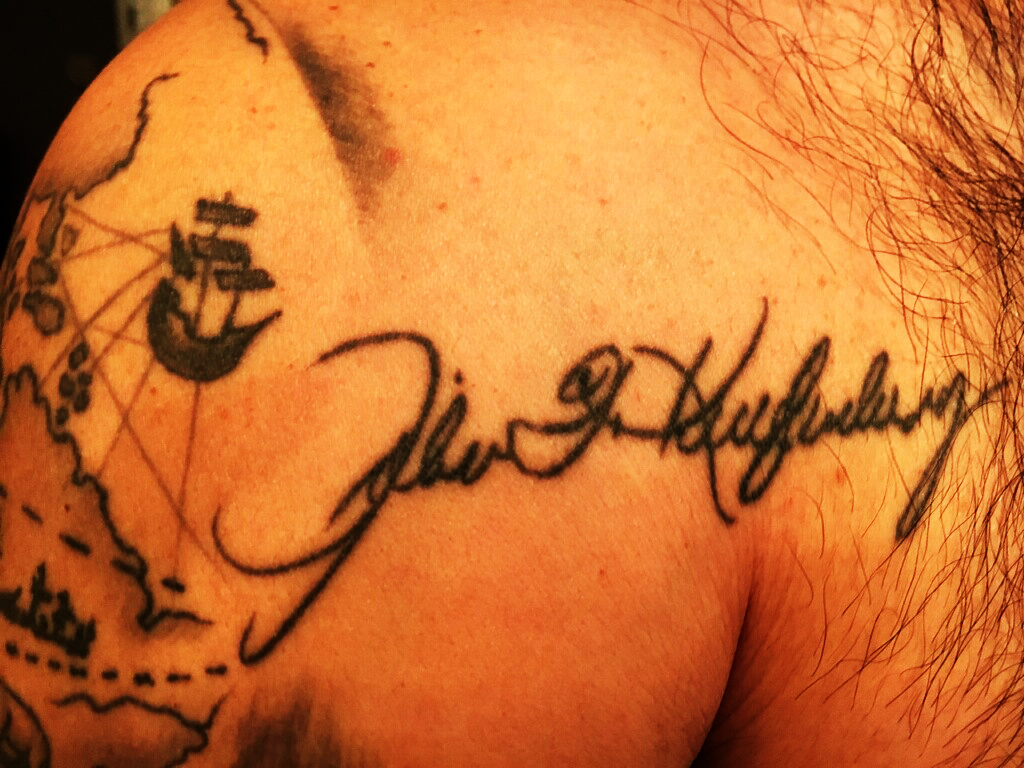
The justification for such a night was the recent passing of my father. We stayed up until the wee hours of the morning discussing life, music, girls, and many other places our liquor-induced conversations took us. Finally, we came to the topic of tattoos and what kind we would get if we were to ever get one. Together, we came up with the idea of having our parents’ signatures from our birth certificates tattooed onto our arms. Our rationale being that it was the signatures they used to "sign" us into their possession.
Anyway, after I had those tattoos inked on my inner arms, I felt the need to also pay tribute to my grandparents who had done so much for me. I tried to think of an important document which they would have signed which held significance in their own lives. My best idea was that I would use my grandfather's signature from his military discharge papers after the conclusion of WWII, and my grandmother's signature from their wedding certificates. Both to me seem to be two of the most important times they autographed their lives.


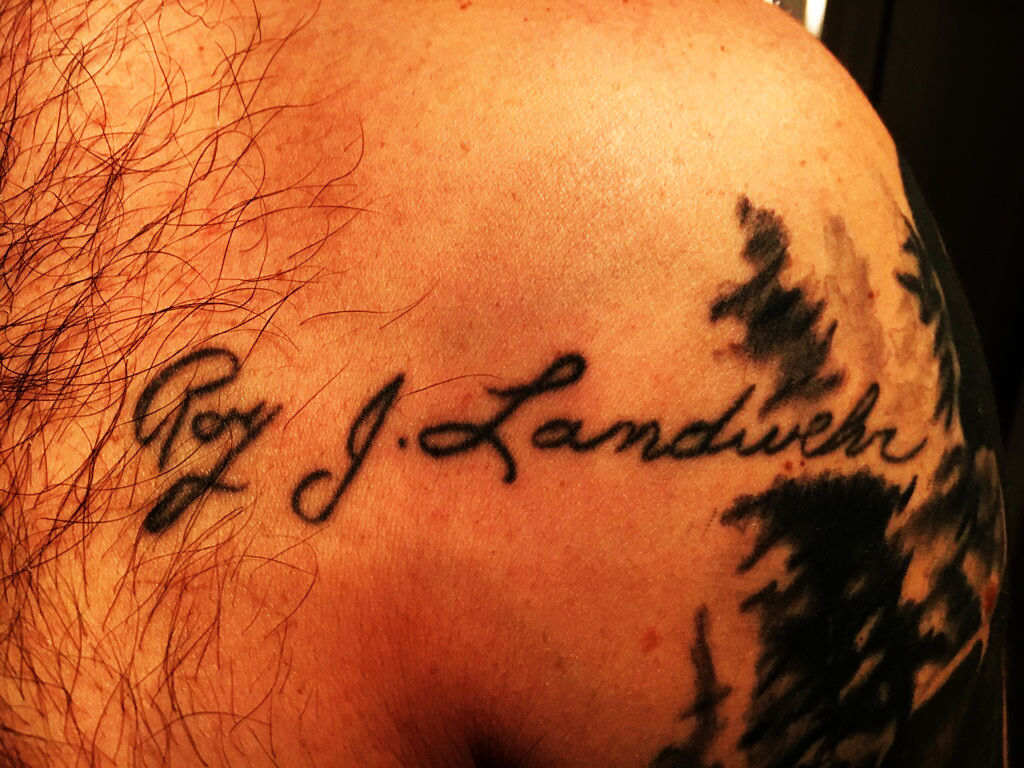
BY JIM LANDWEHR
Being a writer, when I first saw the call for images for National Handwriting Day, I immediately submitted a couple of my handwritten poem drafts, both of which made it into the exhibition.
Then, after thinking for a bit, I thought of my nephew Nick and his handwriting signature tattoos. He is a huge tattoo fan and has eight total signature tattoos amongst the many other beautiful works that adorn his arms. I remember when I first saw the tattoo of my mother and father's signatures on him. I instantly recognized my mother’s with her signature Stonehenge ‘M’ at the beginning of Mary. But seeing my father’s was a little haunting for me, probably because I’d never seen his handwriting before. He was beaten and killed in a bar at the age of 42, when I was just five years old. So seeing his signature on Nick, was a bit like discovering an old letter in the attic from the war. I guess it just shows how someone's signature can evoke an emotional response. So it goes with all handwriting, I think.
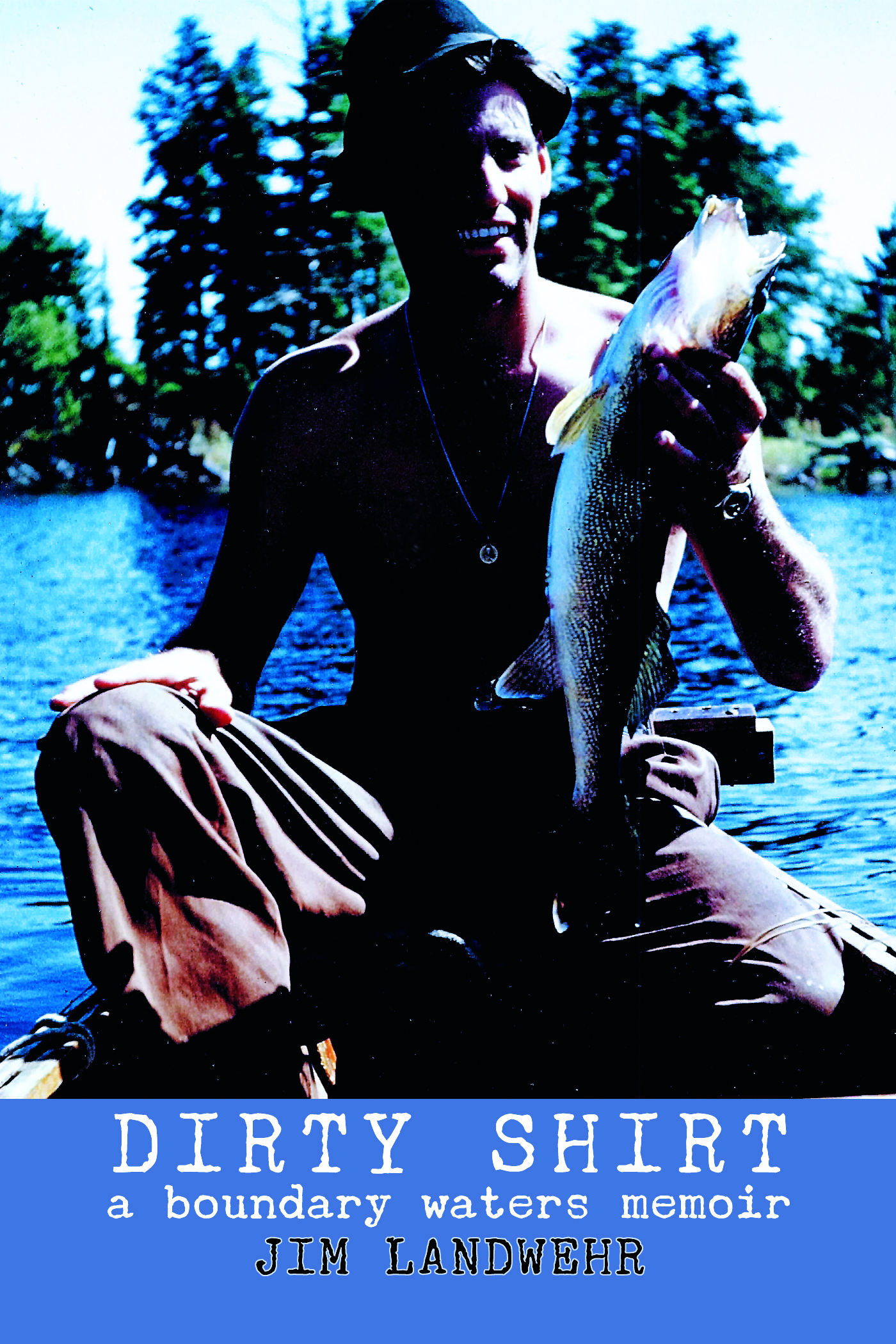
Being Nick’s godfather, the two of us have always been very close. Despite my moving away to Wisconsin in 1986, he and I still got together whenever I made it back to town to visit. In 2014, I wrote a book titled Dirty Shirt: A Boundary Waters Memoir. The book details trips I took to the Boundary Waters Canoe Area Wilderness with my brothers nearly thirty years ago and, more recently, with our kids. In 2012 we brought Nick with us to fill in for my brother Rob who passed away from cancer in 2011. Nick shared a canoe with Rob’s daughter, Alison, and it became known as the orphan canoe, (Nick’s father had passed away suddenly in 2005). On Father’s Day of that trip, we sprinkled some of Rob’s ashes over the waters of the BWCA, a place he loved much like Roy had. This event plus being around his uncles and cousins in such a remote region, impacted Nick in ways he never expected.
As a tribute to myself, his grandfather Roy and the Boundary Waters area, he got a tattoo of the picture that was used for the book’s cover of Roy holding a walleye in a canoe while on a BWCA trip in the 60’s. When Nick surprised me with a picture of the tattoo I was both flattered and deeply moved.

Every Sensitive Person Carries in Himself Old Cities Enclosed by Ancient Walls
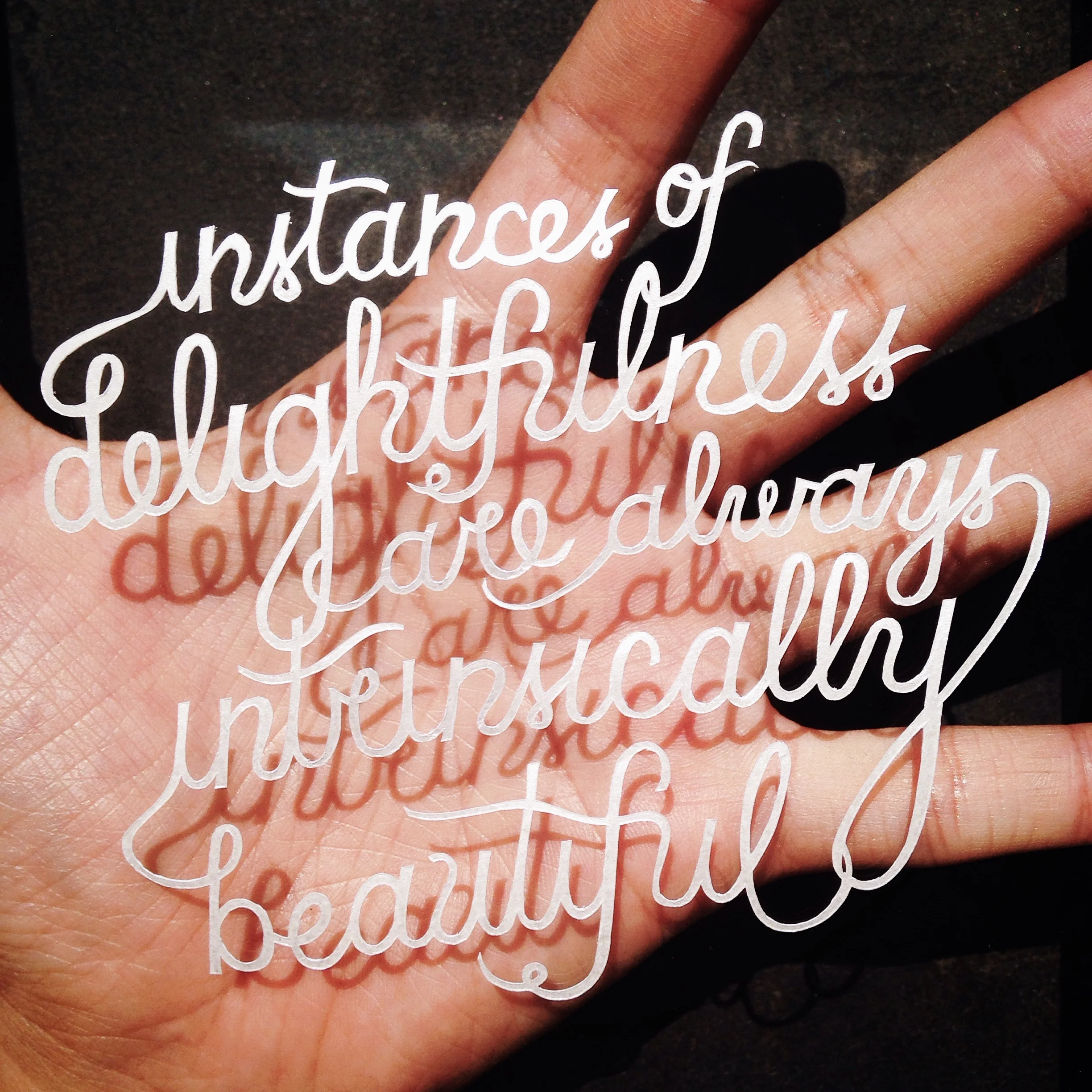
The second installment of Bina Vivien Santos' exploration, Not Your Average Ordinary.
BY BINA VIVIEN SANTOS
I am a firm believer that handwriting communicates a lot about a person. The curls of the g’s, the loops of the o’s can be as expressive as the actual words that are written. I can see the excitement in little quakes in my sister’s penmanship when she gives me good news. I can remember stress in my own cramped journals from college around final exams. I read love in birthday cards, and sometimes the rush of I-almost-forgot-but-I-didn’t. Handwriting is so unique to each person and can be affected so much by circumstance and situations. It’s fun to play detective to find these secret messages hidden in the lines and curves.


Just as fun as it is to play detective, it is equally fun to intentionally create meaning through design. As a graphic designer, I work with composition and typography, finding creative ways to marry the two into something significant. The same applies to my calligraphy cutouts, however without the convenient font library at my disposal. Instead, it falls to me to imagine and to create the perfect font. I spend a lot of time sketching out the word or quotation over and over and over, testing out serifs, weights, cursive, shapes, etc. I have in a sense created my own internal font library of styles that I frequently use, but I do try my best to branch out to the new and different, especially if it better complements the words. Is the quotation a proud statement meant for serifed capital letters, or is it delicate and dreamily flows in cursive loops? Or is it passionate and emotional like thickly, messily painted lines with imperfections? I weigh such questions whenever I start a cutout, or even when I come across an interesting bit of text. It’s a great creative exercise for crowded subway rides.

Sue Inoff's Double Crust Lemon Pie • Dale Bellisfield


From curator Rozanne Gold: This scrumptious recipe was submitted to Handwritten by Dale Bellisfield. From a fabulous career as one of New York’s premier graphic designers, she transformed herself into a clinical herbalist (and holistic nurse) who now makes her home in Pine, Arizona. Dale has a practice in integrative medicine and, like Hippocrates, thinks of food as medicine. She is a wonderful cook who once created a dish of black rice with gorgonzola, porcini and espresso for me. I am so grateful to have her wonderful mother’s handwritten recipe, and to share Dale’s memories. www.herbaldale.com

Sue Inoff's Double Crust Lemon Pie by Dale Bellisfield
I just dug this out of my overstuffed, seven-inch-thick file, a jumble of recipes I've been gathering over the past two years as inspirations for a “breast health” cookbook I’m working on. It fell out of the file so easily, it was like my Mom was saying hello. This copy of the recipe was meant for my two sisters, Joanne and Sally, and me. And it is one I will happily share with my daughter Samantha, and now with all of you!
My mother’s Double Crust Lemon Pie was her signature, and our favorite among many of her delicious home-made dishes. She was an adventurous and excellent cook, and a foodie before there was even such a designation. Much to my Dad's anxiety, though, she loved to experiment with new recipes whenever they hosted an event — be it birthday party, July 4th gathering, Thanksgiving dinner, family home-coming, baby shower, whatever. Although I never caught a whiff of any failures, this one was an experimental blockbuster-turned-mainstream, with many repeated command performances. And it never made Dad anxious.
Only Mom complained about it. She would rail about how time-consuming it was to slice those lemons "paper thin" after having grated and peeled them. And about the effort of making the two crusts it needed. But we didn't really care. We were only consumed with selfish greed about devouring that pie sometime in the very near future. Please, Mom??
This particular dessert was most often associated with our annual "crab fest" dinner, held in the hot Maryland summer at my folks' house. It was a big gathering of friends, neighbors and family that filled our entire basement. And it celebrated the peak of Maryland’s blue crab season. Every year we looked forward to the slimy, messy ritual of cracking open those bright red, steaming-hot, juicy crabs onto tables covered with layers of newspaper to absorb the excitement and the entrails. No plates.
There was a certain skill to separating the sweet, briny crabmeat from their tenacious salt and spice-encrusted shells. And as you cracked open the claws, and then sucked out the shell fragments to catch whatever fleshy morsels might still remain, your mouth/eyes/sinuses all dripped from the inescapable fiery spices caked on the shells, on your fingers, on your napkin and on your beer. But we knew relief was coming.
The lemon pie. This made it all calm down — the lemony sweetness of the creamy filling, the hit of those paper thin, gloriously tart lemon slices suspended within it, and the cinnamon-y crust. They formed the most exquisite combo of flavors that perfectly balanced the intensity of the spiced crabs and beer. More than 30 years have passed since I last ate that pie. But I can taste it still. Suddenly it feels like it’s summer.

Sue Inoff's Double Crust Lemon Pie
2-1/2 cups sugar
4 tablespoons flour
1/4 teaspoon salt
1/2 cup butter, room temperature
6 eggs (reserve 1 teaspoon egg white for top crust)
3 large lemons
1/2 cup lemon juice
(squeeze from additional lemons)
1/2 cup water
cinnamon-sugar for sprinkling
1. Preheat oven to 400 degrees.
2. Roll out bottom crust into pie tin.
3. In a mixing bowl, add sugar, flour and salt. Blend in butter and eggs until well mixed. Grate lemons to get 2 teaspoon zest. Add to bowl.
4. Cut rind and white pith from 3 lemons and slice lemons very thin. Add lemon slices to bowl with lemon juice (squeezed from additional lemons) and water. Stir well and pour into bottom crust.
5. Cover with top crust, sealing (I dampen bottom crust edge) and fluting edge. Brush top pie crust with egg white and sprinkle with cinnamon and sugar.
6. Bake for 30 to 40 minutes.
** Note from RG: Prepare enough pie crust for a deep-dish 9 or 10” pie, top and bottom crust. Place pie on baking sheet. Let cool before serving.

I Have No Choice But to Revise • Keith Baldwin

WRITTEN BY KEITH BALDWIN
My handwriting is fucked. The penmanship is not as illegible as some, but in terms of how I physically write by hand, it’s all messed up. I hold a pen against my ring finger, like the wrong half of a pair of chopsticks, and form a lot of my letters from the bottom up, rather than the top down.
When I was eleven, my dad finally noticed the issue and approached it with all the vigor and care he’d applied to the insufficient knots in my shoes a few years earlier — just enough to make me feel shitty about it, without solving anything.
He spent a few frustrated hours with me at the kitchen table, correcting the way I formed a handful of letters and the number nine. There was no progress at all toward fixing my wonky grip, which was already too ingrained to be altered so easily.
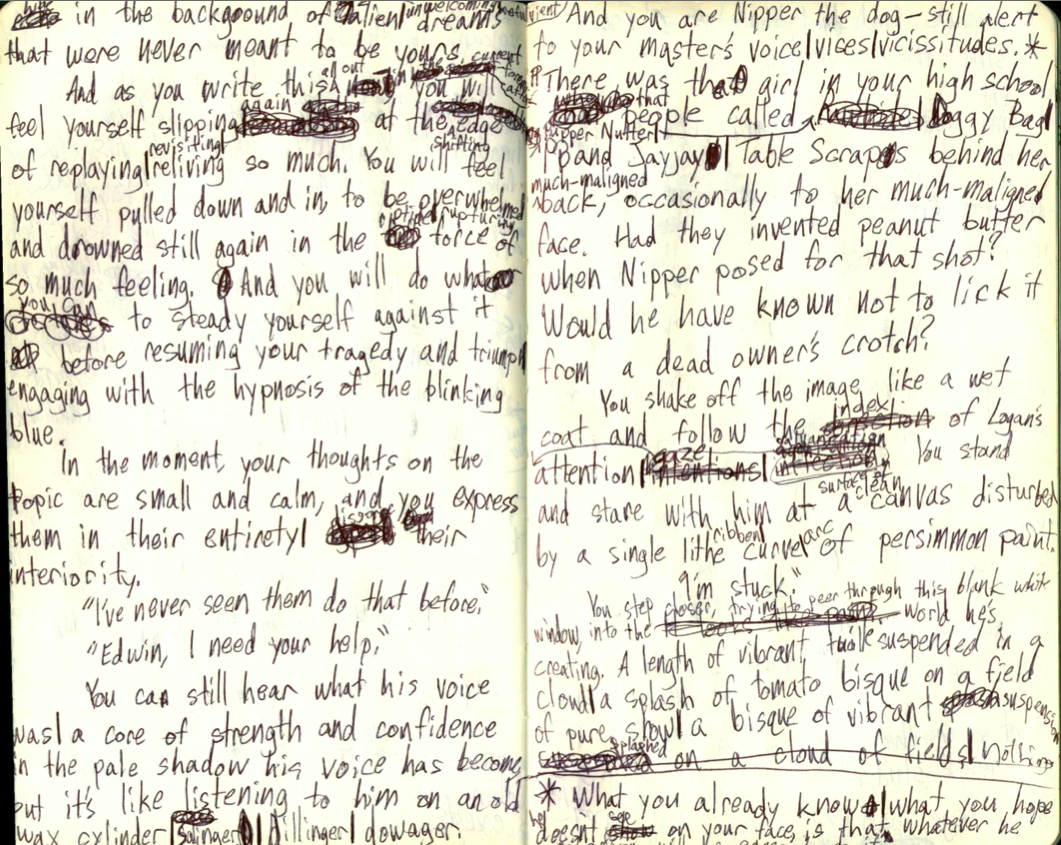
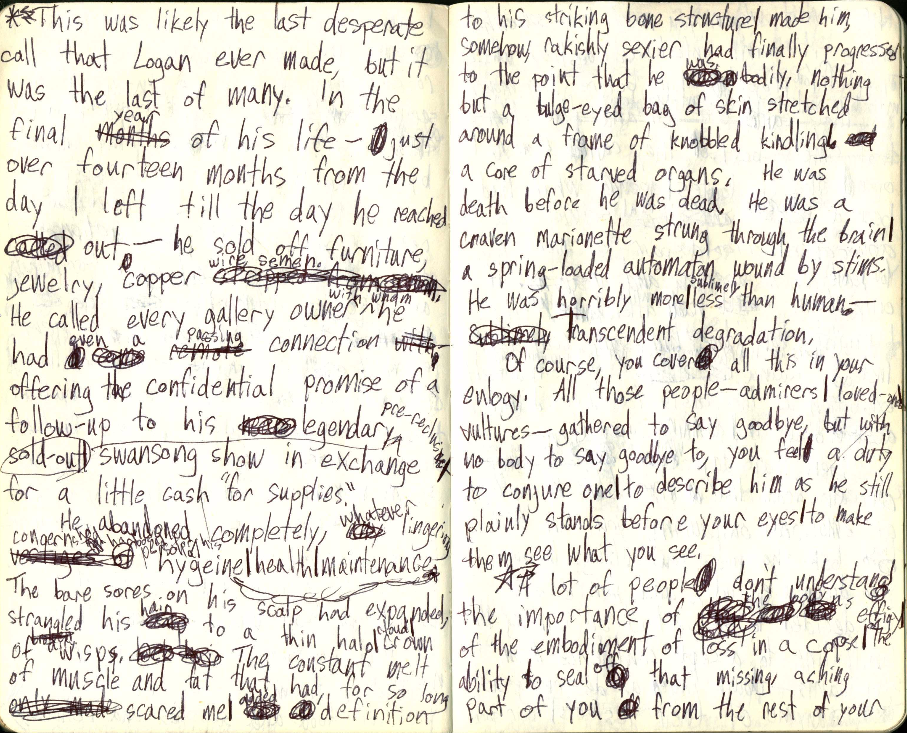
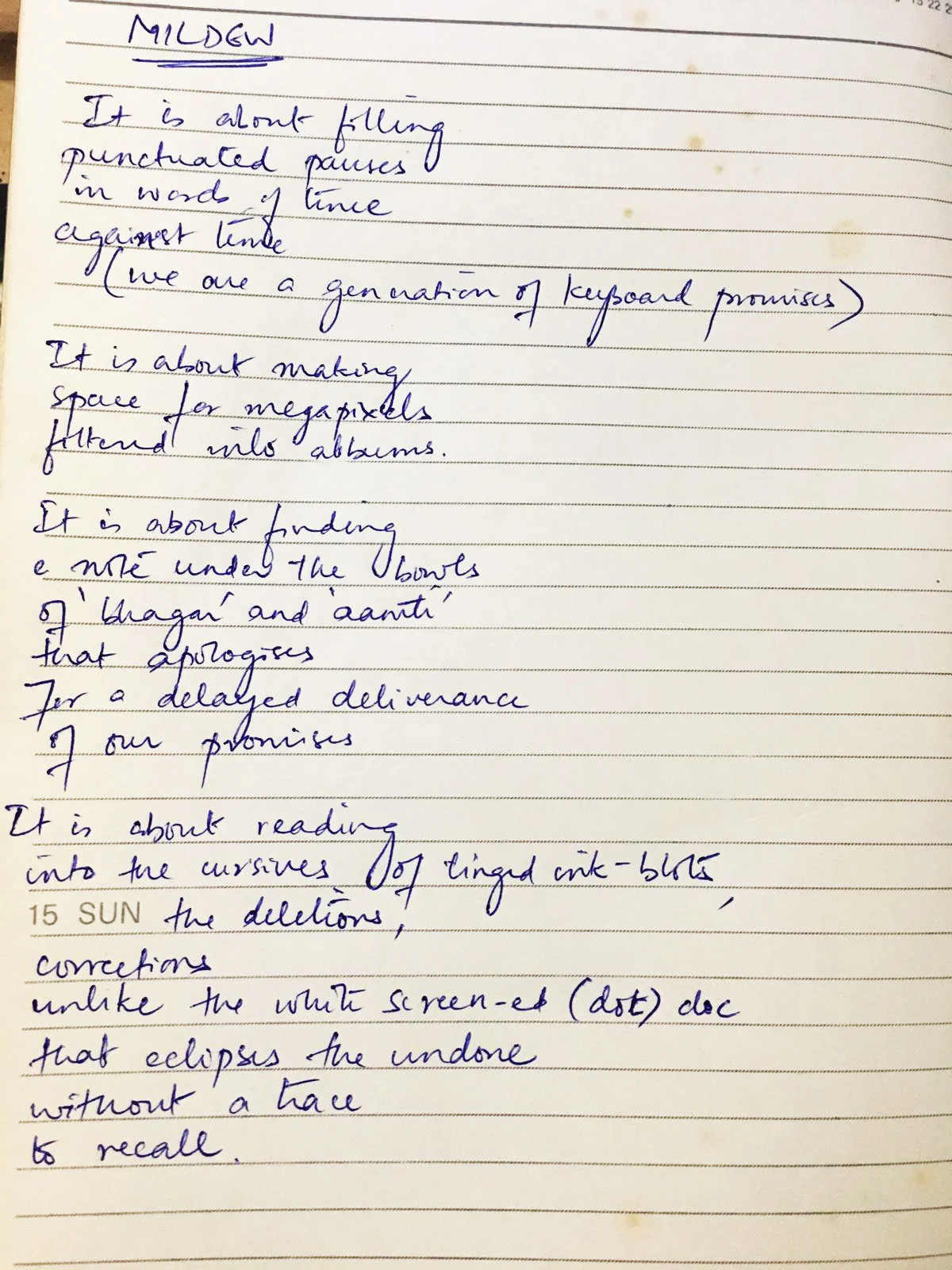
The upshot is that I don’t have the natural flow with a pen that other handwriting advocates rhapsodize. It’s always a slog for me. If I try to write too quickly, my hand and wrist start to cramp up, so my thoughts always remains three steps ahead of my pen. And while I work to close the gap, my mind is free to become distracted by flaws and omissions in what I’ve already written, leading to aggressive cross-outs and a morass of cramped footnotes that nest and crawl across margins — to be inserted in the main text later.


This would be enough to make a mess of my notebook, but on top of all that — rather than keeping everything in sequence — I have a bad habit of opening to a random blank page whenever I want to make a note, or a list, or play a game of hangman. In the middle of writing an extended scene of fiction, I will often turn the page to find story notes, shopping lists, and broken sentences for my ESL students to practice correcting. Typing up my work becomes a tedious chore of deciphering and reconstructing, tracking down where the story picks up when it’s suddenly interrupted by a sketch of my cat as an astronaut. It is almost as big a pain in the ass to work through it as it is for me to scrawl it out in the first place. So why do I even bother? Why do I keep returning to pen and ink whenever I’m writing something I care about? (You should see the rough draft of this essay…)


I know there are a lot of answers involving the way the brain works in different contexts, and how I formed these writing habits when all I could do on a keyboard was hunt and peck — and blah blah blah, a hundred other reasons why this website exists and longhand is the best. But I think the biggest factor for me is the same one that made me so much less anxious about sharing this mess of pages than I would have been about submitting something more polished. Because no one could ever confuse the contents of my notebook for a finished product — not even me.

On the one hand, this means that I can’t be held accountable for the contents, which frees me to be a little wilder in my first stab at a project. But it also means that I can’t avoid the work that still needs to be done. I have no choice but to revise.
My feelings about revision are pretty much the same as my feelings about flossing — I know I should do it, but it makes my gums bleed. And when my words are neatly typed and double-spaced, with numbered pages and no evidence of the disordered mind that composed them, I have to work to remind myself that it’s still a work in progress — that I can and should question every decision those collected words represent.

The process of transferring from the page to the screen forces me to consider every sentence with a critical eye while I retrace the whole erratic path. And I can’t even procrastinate for too long because, while a few days’ distance can bring fresh insights, a few weeks is liable to leave me incapable of piecing the whole mess together again. (It’s happened. It’s infuriating.)
I know that, for other people, writing by hand makes the whole process smoother. For me, it’s about making myself work harder, and getting better results for the effort.


Keith Baldwin is a writer and tutor living in subterranean Brooklyn while paying exorbitant tuition in Manhattan. He is sometimes worried that he might be one of those lizard people you hear about.
Connie Love’s Irish Soda Bread • Allison Radecki

Note from curator Rozanne Gold: I adore Irish Soda Bread and don’t eat it often enough. That will certainly change now that I have this fabulous recipe from Connie Love. Not only is her version filled with love and lore, but is lovingly written by Allison Radecki, who interviewed Connie for this story. It’s “Handwritten” doing what it does best. The recipe is written in Connie’s hand on thin, yellowed paper which she keeps protected, slipped into a small plastic sleeve. It is marked with lines and revisions. Many thanks to Connie, Allison, and her mother, Joanna.

Connie Love's Irish Soda Break by Allison Radecki
There are some homes where everything you see has a story attached to it; a place where life is lived in the company of objects that keep the memories of loved ones alive and where the spirit of a bygone era is still gloriously vibrant.
Such is the home of Connie Love, a close family friend with whom I have been lucky enough to share friendship, much kindness, and lots of laughter in both easy days and tough times over the years. A lover of recipes and a wonderful cook, Connie is the type of friend who will call you to say that there is an extra jar of homemade minestrone with your name on it, waiting for you on her front stoop. “Just remember to stop by and pick it up.”
My mother, Joanna, worked alongside Connie for many years as a realtor in Montclair, New Jersey, and benefited from many such surprises that emerged from Connie’s generous kitchen. Since Connie’s retirement, the two of them still manage to share adventures, whether it is an impromptu movie night or a game of Pickleball, the fantastically named hybrid of tennis and ping-pong, at the local YMCA.
In celebration of various holidays, Connie’s baked goods would appear in our home and soon be reduced to a plate of crumbs. This is how I first encountered her Irish soda bread, which often accompanied the first days of Spring and the Saint Patrick’s day season.
One afternoon this March, my mother and I sat down in Connie’s meticulous kitchen to talk about her soda bread recipe and found ourselves engaged in a whirlwind of memories, photographs, and stories. The recipe for her soda bread came from her mother, Amelia Malanga Ianucci (known as Minnie). Minnie, one of 14 children, was born in Newark, NJ, in 1895. She received this recipe as 17-year old bride from Mrs. Pollack, an Irish neighbor whose apartment shared a door to the same fire escape in a Newark tenement building. The recipe was said to be ‘the poor man’s soda bread’ since it did not use eggs or butter.
“My mother and Mrs. Pollack socialized on the balcony. Their apartments were side-by-side. The basement was filled with crocks with pickles and peppers. They kept the coal in the basements for the coal stoves.” Connie (Columbia Ianucci) and her twin sister, Betty (Elizabeth) were born in the midst of The Great Depression on Clifton Avenue in Newark, not far from The Cathedral Basilica of the Sacred Heart. “No one had a cookbook. No one had measurements. They just knew,” said Connie. “My mother knew the dough for knots. She knew the sweet crusts for Easter pies. My sister said, ‘we didn’t make an effort to know, so we didn’t know.’” Because of this, Connie, herself a young bride, had her mother dictate her soda bread process as she committed the steps to paper. Connie figures that she wrote the recipe down in the 1950s when she was already married and running her own house.
“The tenements smelled, not of garlic and food, but of bleach. The women would bleach the wooden floors until they were almost white.” Bleach was delivered to the women in the tenements by the bleach salesman. “These women didn’t have cars. They didn’t go to the stores.” She remembers the Jewish peddlers who sold linens, which her mother would buy — a tablecloth here, a sheet there — slowly stocking the Hope Chest for her and her sister. “The Stanley guys sold brooms, house products…brushes. The insurance guy came by to collect the insurance premiums — ten cents, twenty cents.”
A network of other relatives lived close by. Connie’s Grandmother’s tenement was on Stone Street. Aunt Tilly lived downstairs. Uncle Arthur and Aunt Ella lived in different tenements in the area. Connie’s father, Stephen Ianucci, was born in Italy in 1890. Connie remembers that at night, her father would read the paper out-loud and her mother would correct him, in an effort to erase his Italian accent. Dinner was always served at 5:30 p.m.
Connie reminisced some more. How she and her sister would harmonize with their mother as they washed the dishes -- “we had no tv and the radio was on top of the fridge. The Green Hornet, music, all sorts of shows.” And she remembered the big black stove with the chrome piece which she would have to polish when her grandmother said “Vieni qua."
Sadly, it was time for us to go. But I’ve got Connie’s recipe and an invitation to come back again. There would be more stories to tell.


Connie Love’s Irish Soda Bread
8 cups flour
3/4 cup of sugar
4 tsp. baking soda
2 tsp. baking powder
2 tsp. salt
2 cups of raisins
1 tsp. caraway seeds
About 4 cups of sour milk
(buttermilk or whole milk with one
tablespoon of lemon juice mixed in)
1. Sift dry ingredients together. Add 2 cups of raisins and caraway seeds, if desired. Add 4 to 5 cups of buttermilk (or whole milk with lemon juice). Mix to hold together.
2. Knead for 1 minute or just mix (not too soft, although never fails, whatever the texture).
3. Bake at 375 for 40 minutes until golden brown (loaf pans or a cake pan).
This recipe makes 3 loaves, which freeze well and are delicious when toasted.

Sweet Potatoes with Pineapple • Apryl Lee

Note from curator Rozanne Gold: Here is a beautiful piece written by Apryl Lee, whose stories have appeared in “Keyhole Press,” “Necessary Fction,” “Word Writer,” and “The Feminist Breeder.” It comes to me by way of her friend, Allison Radecki, who shared her own recipe for her father’s vodka sauce on Handwritten. I love how these stories and connections continue to grow, truly forming an exchange of collective memory and the transmission of taste beyond flavor — my very goal in creating this column. Here, Apryl shares a recipe for her Grandmother’s sweet potato dish with pineapple rings. It captures much; being young at the family table, the passing of time, and the taste memories that span decades. Though the recollections of this dish are vivid, the specific steps to recreate it were not. This lead Apryl to indelibly record it in her own hand on lined paper with blue pen, so that it will not be lost in time anymore. Thank you, Apryl Lee, and blessings to your Grandmother.

Sweet Potatoes with Pineapple by Apryl Lee
There are ten pineapple rings. Only eight fit in your lasagne pan. After you scoop on the sweet potatoes, sprinkle the topping and dot with a maraschino cherry, you're left with two pineapples and a cup of juice. Both the spare pineapples and juice should be put aside, covered with plastic wrap and offered to a grandchild when they are sad.
Did it used to have marshmallows, too? My grandmother's sweet potato dish was not the cornerstone of holiday meals. I don't remember it being a delicacy we kids eagerly awaited as we sat wearing sagging white tights and button-up shirts, legs dangling from tall chairs around our holiday table. The grown-ups, all swirling mugs of punch — the kind where islands of sherbet disappeared into a sea of Seven-Up and cranberry — never applauded as it entered the dining room on a golden tray, as if in some Rockwell painting. But everyone ate one. Just one, or half of one if you were small, since there were only eight and at our core family's capacity, before people left and people joined, we were ten large. And we liked them.
Over the last dozen holidays, my grandmother has taught me and my mom how to prepare them, instructing us as she did the work. But she's ninety now, and this Thanksgiving, we were mostly on our own as she sat on my mother's kitchen chair fenced in by her newly-acquired walker. I let her guide, though I knew it by heart. I sat beside her so we could do it together. Still trying to coordinate her arms and fingers after her stroke, she could manage to scoop only a few, uneven spoonfuls of sweet potatoes onto the pineapple rings. She moved slowly, pushing the orange mush off the spoon with her finger. When the time came to crush the cereal topping, she reminded us the best way was to pour it into a Ziplock and step on it. This became the job of my four-year-old, her great-grandson, who danced and leaped atop a baggie full of Oatmeal Crisp. We did not add cherries this year, even though that's my mom's favorite part.
In learning this, we've ensured that there will never be an empty space left by the sweet potatoes, like the empty space left by my grandfather's Waldorf salad. (We tried to reproduce it the Thanksgiving after he died, but he had only died a week prior, and there was no recipe and sadness is not an ingredient one should cook with. Besides, no one can slice apples that tiny.) It's committed to memory but one day, that sadness will overcome us again and what will memory serve? Will we remember the cherries or the cereal? These are the things that are important.
Today, I called her. When she answers the phone now, she sounds semi-absent, slurring, disconnected, but once she gets going, her jaw loosens, her mind catches up. I asked her if she could remember how to make the sweet potatoes. She snapped: "Of course, I do!"
I wrote the recipe exactly as she told me. It's captured in ink on paper, a record of holidays, of seeing my grandparents' car pull into the driveway, of a full table with family and sweet potatoes with cherries, a record of her voice, her peculiar nature. I can make it from memory and for now, this recipe is preserved, put aside, ready to be offered when we are sad along with two pineapple slices and a cup of juice. It has never actually had marshmallows, but she said I could add them.
That would probably taste real good.


Apryl Lee is the co-founder and co-creator of Halfway There: An Author’s Reading Series in Montclair, New Jersey, and teaches screenwriting at Seton Hall University.

And the Stars Look Very Different Today

I am a creative person. This seems like an obvious statement for any artist, but the truth is I can’t claim to have any particular allegiance to one art medium or form. I swing from painting, to graphic design, to photography, to stop motion film, to whatever next strikes my fancy, the unifying thread between them all being that they allow me to imagine and create things.
While the materials may vary, there are commonalities and patterns in my artwork. They are intricate and detailed, clean and controlled, simple and often with an element of whimsy. I draw inspiration from traveling and everyday minutiae, which I almost painstakingly observe for hiccups of oddity or flashes of notableness, sort of like finding the extraordinary within the ordinary. It is in these small details from moments within moments within moments that I find the spark for a new project.
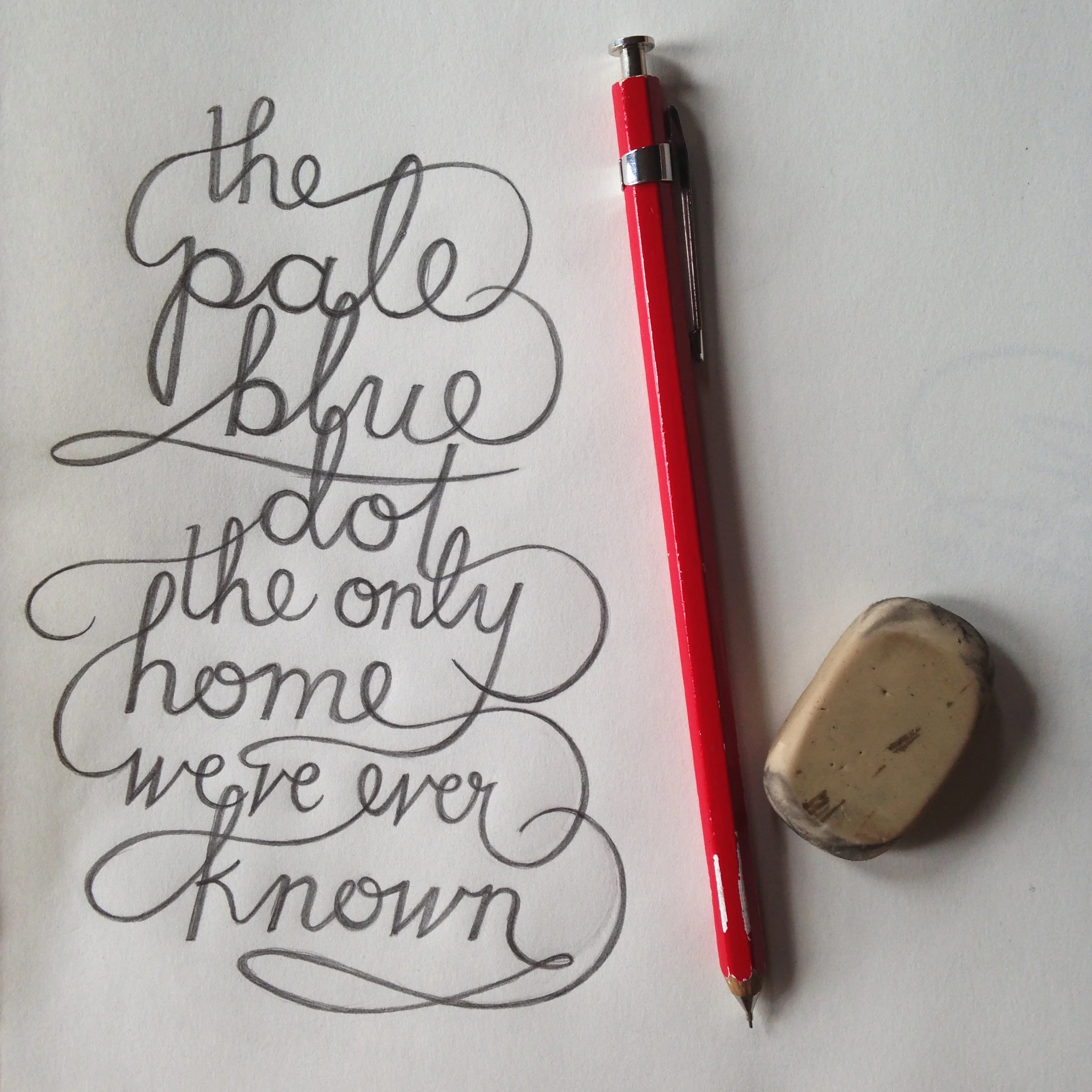
One of my favorite mediums is paper. It can be cut, layered, and shaped, lending itself very easily to whatever I imagine it to be. Lately, I’ve been using it to create calligraphy cutouts. It started first with individual words, then gradually grew to phrases and quotations. I pick these words based on the imagery and sentiments they inspire, which I then express through the design of the lettering, and the context of the composition. For instance, I created my first calligraphy cutout when I was homesick, and it was the outline of a bear with “California” inside of it, in a curly cursive script that echoed a childhood of practicing penmanship over dotted lines.
I like the challenge of translating intangible things into something visual and tactile. And especially with words, which are read and spoken and heard, transforming them into something that can be touched and that has tangible characteristics gives them not only physical dimension, but another layer of meaning.

Externally Obvious, Internally Mysterious • Minakshi Choudhary

BY MINAKSHI CHOUDHARY
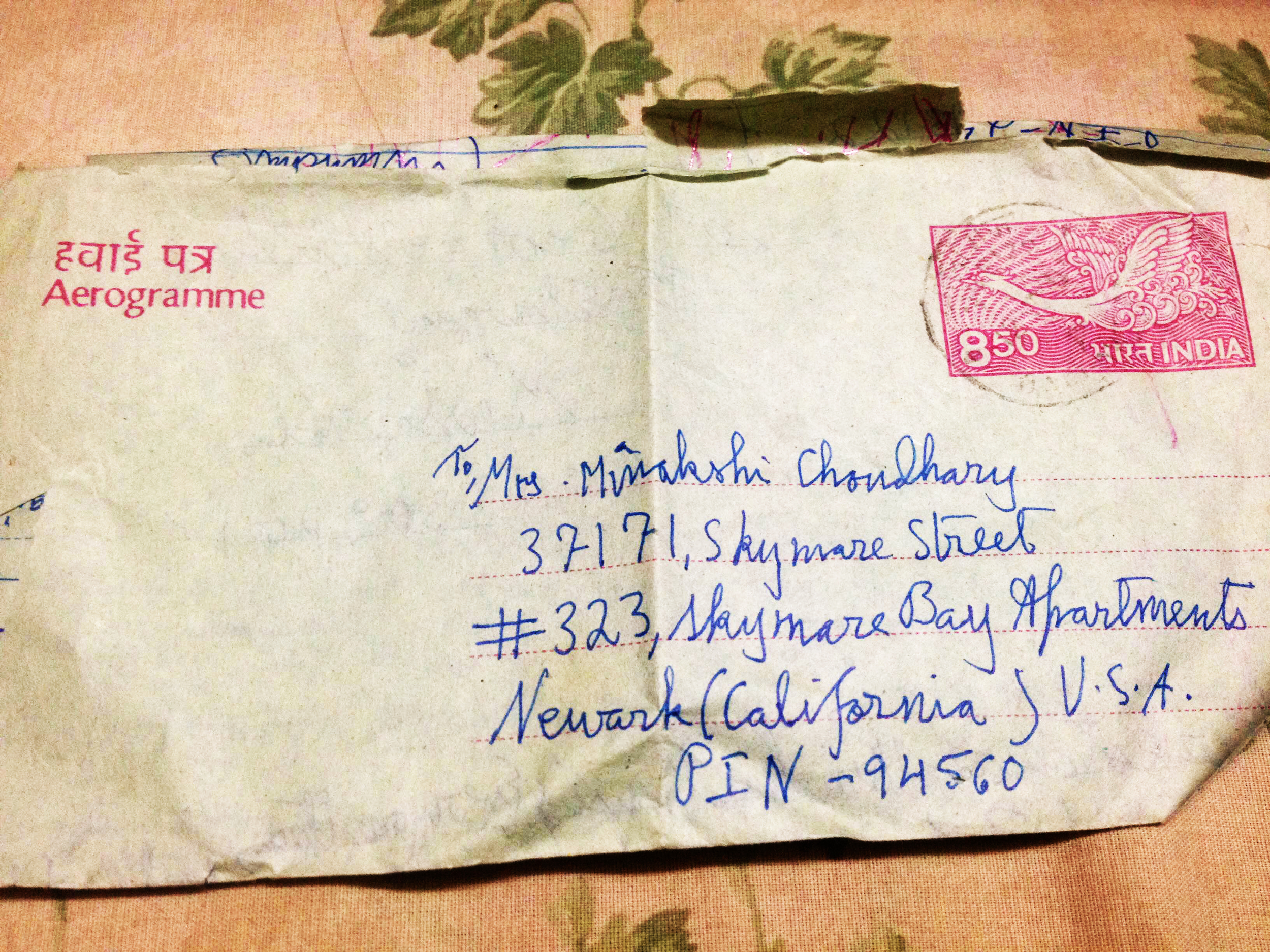
When my phone rang and I heard the voice of my community manager on the other side, I was shocked. There was an inland letter waiting to be received by me: that three-fold piece of paper, externally obvious, internally mysterious.
While I dressed up and on the way to post office, all the neurons of my brain were ringing bells to deafen me with thoughts pouring in and pouring out. Mostly thinking, what might have provoked someone to write a letter to me in this world of emails and phones? Turning the form section of that envelope made me more nervous. My hands were frozen with sweat, unable to unglue the piece of paper.
The letter was from my nephew studying in fourth grade in a fully residential school. Between reading the from address and ungluing the letter, I came to know how fast our brain processes and how far it can travel within seconds.
As soon as I opened it, I was all tears seeing this sweet little sender just wanting me to know his address as he left to boarding school. He was under impression that I hadn't written to him because I didn't know his address. This innocence touched me to the core, and at that moment, I wished to hug my sweet little nephew and tell him how we elders are so busy solving the pain of ourselves created by ourselves.
Now, when that sweet little boy is grown up and busy finishing his degrees, I believe he might have forgotten about this episode of his life. We all fall into this trap of forgetting, though our best friend in the form of black and white text always makes our lives colourful with varied emotion rewinded and reversed on timelines.


He Just Smiled, Said Hello, and Went On His Way • Lora Ackermann

BY LORA ACKERMANN
While searching for any of the many examples of handwritten cards and notes from my family, I came across a journal of mine. This is an incredibly special journal, entirely handwritten, spanning from my first of what would eventually be four ovarian surgeries (over the course of many years) in August of 1992, through the death of my maternal grandmother in March of 1995, her husband, my grandfather in May of 1995, and ending with my soon-to-be wedding in October of 1995. These pages hold such a roller coaster of euphoria and pain. So many entries that touch my heart, soul, and spirit, drawing memories from places long forgotten to the routines of daily life. So many memories bringing new pains of loss and journeyed paths now closed.
There truly is something to say about the handwritten page. There’s a certain comfort, a warmth, as though the lines are reaching forward, surrounding me in a hug, and drawing me in. As I re-read some of these entries, I can detect, in the formation of the letters, the slant of the words, the stains on the pages, changes in mood, emotion, stress level, time management, and so many other delicate strands that make up these layered memories; delicacies that would be but lost in simplified print. The handwriting, like the musical score of a movie, tells its very own story; separate from the worded memories they so eagerly record.


Even after reading these pieces of my life from those years, pieces that now seem centuries away from reality, the entry on those first pages still strikes me the most. I had only been home from my first major surgery at age 20 for a day or two. Having received the good news that what was thought to be ovarian cancer wasn’t, I was free to heal and live my life in gratitude. I had a renewed sense of awe and appreciation for the little things life tended to toss haphazardly in my path and it showed in this entry.
August 29, 1992
…..I just returned from a walk around the block—oh what memories lie in some of the houses around here—not just my own. I can look at Elizabeth’s house, or Suzy’s house, or LouAnne’s, and still see inside, 12-13 years ago….’youngins’ they’d call us. I see Liz and myself in her room, making stickers w/ double-sided tape—we made them out of just about anything—wrapping paper, pictures, things we’d colored, etc.
I see Suzy and I in her room—so pink—pink carpet, bedspread, walls, bright pink, light pink—if ever there was a pink room it was Suzy’s. I see the laundry chute and the poster of ‘Frank Poncherello’ from the TV show, “CHIPS” above her bed. (We had a crush on him, though I liked his partner better.) I see Suzy & I sitting on the floor in her ‘play room’ eating Fruitloops from the box and watching “Emergency 911” (or something like that)—she always said that one of the men was her daddy—They did look alike and for a while I believed her, too!
I see LouAnne & I in her room playing w/Barbie dolls—she had a loft bed with a yellow carpet underneath.
I also see inside another house down the street; a brown house next to the Woolsey’s and an elderly woman who used to live there alone. Unfortunately, I don’t remember her name—I wish I did. She used to read to me and she helped teach me to read so that when I was old enough—so to speak, I often read books to her. She was a very kind woman. I wonder how she faired after she moved. I was too young to remember why she moved—family reasons I suppose. I missed her for quite some time. I think sometimes I still do. Perhaps.
I find that at times I even miss ‘Joe.’ ‘Joe’ was a man who ever since I could remember walked every day. Twice a day he passed our house. ‘Joe’ wasn’t his real name. I don’t know what it is actually. ‘Joe’ was a friendly man who always had a wonderful smile to give any passerby—anyone at all. I think he had a stroke or heart attack. I think he may still be alive, but he doesn’t walk around here anymore. Perhaps he moved; perhaps he just doesn’t walk anymore. ‘Joe’ never corrected us in regard to his name—he just smiled, said hello, & went on his way—leaving smiles on our faces for a long time after. I really did think his name was ‘Joe’ until I was about 15 or 16 when Mom told us differently. She told us his real name, but I still call him ‘Joe.’ Perhaps it’s ‘Joe’ that I owe, in part, my smiling fetish to. Perhaps.
Even typing up these words—such layered memories; memories of people who touched my life, beneath memories of writing the entry itself, beneath those of healing, speaking volumes in the spaces between the letters, the lines between the lines; you know the ones—the ones that speak to our hearts, pulling in our soul’s deepest comforts, the ones that can dry a dampened spirit or bring light to the darkest corners. Yes, so many layers that can only be fully appreciated to the depths they desire in their original, handwritten form.
Today, I journal, too. Sometimes I type. Other times I dictate. But many a time, I pick up my pen, one of the many paper journals my amazing friends have gifted me recently, find a quiet space all my own, and, even for just a few blessed moments, I disappear into the notes of the score, the layers of the letters, the spaces between the words and lines, and the hidden pleasures and soul-soothing rhythms found only when pen, from hand to page, journeys forth.


Cabbage Rolls • Allison Goodings

From Curator Rozanne Gold: My assistant, Allison Radecki, was kind enough to share this wonderful handwritten story from her friend Allison Goodings. (Coincidentally, they have the same first name and spell it the same way, too.) They met each other in 2004 at Slow Food's first Terra Madre world conference of farmers and food communities in Turin, where 5,000 delegates from over 130 nations gathered. Allison R. was a first year student at Slow Food’s University of Gastronomic Sciences, which had just opened in the Piedmont region. Goodings was traveling around Europe and volunteered with the Canadian delegation at the Slow Food conference. Her recipe is authentically incomplete; it makes no mention of cabbage except in the title and is bereft of methodology. It is so succinct, it almost reads like a tweet! Here is where instinct and experience come into play. Thank you to both Allisons.

Cabbage Rolls by Allison Goodings
I never planned to be a migrant. In early spring 2006, I packed my bags and headed to London "for six months," I told myself, my friends, my family, especially my mom. "I'll be back." I really believed that.
It'll be 10 years this April that I bid farewell to my beloved Canada. Now I am a Londoner, and I suppose, an immigrant. Historically, the story of immigrants was based on political unrest, poverty, and a chance for a better life. I could list none of these reasons as my own. My story is a privileged one. Unlike many others, I was able to return to my homeland, to visit often, and to bring, over the years, the things I missed - a favorite book, a framed photograph, Grandma's crocheted cream blanket, a family recipe - to enjoy in my London home.
On my mother's side, our family immigrated to Canada from Ukraine four or five generations before me — which made us pretty darn Canadian. I wonder, what must my ancestors thought to bring on this journey. Very little I imagine. Of course there were memories, hopes, faith, traditions, and recipes to pack.
I have a little yellow spiral notebook that I have filled over the years with recipes, mostly copied from my own mother's notebooks, although not as neatly. As a teacher, her words were written precisely on lined pages, while mine are scrawled haphazardly, probably done in minutes before rushing to catch a flight back to London, or over the phone during one of our marathon mother-daughter conversations. These handwritten recipes would have been collected by my mother over the years, before the days of emails, iPad cooking apps and the Food Network. Likely, many of them copied from her own mother or one of my talented great aunts.
The first third of my notebook is wildly optimistic and shows my youth, filled with carefully cut out recipes that I would never cook, from magazines and lifestyles I aspired to embrace. I flip through the book and recognize the early periods of cooking and eating in my life — trials of vegetarianism and veganism, an early interest in dim sum and sushi, and myriad protein-rich recipes cut from fitness magazines.
The latter pages are far less prescriptive, filled with my own handwriting; recipes I grew to miss the longer I lived away from Canada, family recipes I never knew I wanted to make. Many of them are Ukrainian dishes, made from ingredients I didn't see regularly in my new country. These foods were still very foreign and strange to England, and I felt how my ancestors must have felt when they came to their new land.
The recipes are mostly just lists of ingredients, with little explanation or instruction. The cabbage roll recipe makes no mention of cabbage except in the title, too obvious to be written down I suppose. These family classics, perohy, headcheese, dill pickles, kutia, borscht and cabbage rolls, are likely the same recipes that my Baba, three aunties and mother prepared for us at Christmas and Easter. I hope that others in my family, like me, have these recipes written down and kept somewhere safe, on pages filled not only with handwritten words but with stains of vinegar, smears of tomato juice, and dusty with flour from years of use.


Cabbage Rolls
1.5 c. rice (arborio)
2 c water 1 tsp salt
Cook 7-8 mins then add 1/2 c tomato juice & fried onions & bacon & pepper & paprika (1/2 thyme). Cook another 7-8 mins
Pack in casserole with 1/2 tin tomato soup.
Use extra leaves under & on top. Add a bit of water, cover with foil for 1.5 - 2 hrs 325F.


The Everyday Mind • Chad Frisk
BY CHAD FRISK
I’d never before considered handwriting to be an art form.
For me, handwriting was always a tool. I used it to build thoughts on a page, or just to fill out forms. It was slow. It was blunt. It was annoying. That’s how I had always thought of handwriting in English, and for a long time I thought of handwriting in Japanese in the same way. That is, until I met Takemoto Sensei.
“Make sure you use an extra soft pencil,” Takemoto said.
I went to the college bookstore and bought one. Slouching in a hard wooden chair, I pressed the gray tip to the off-white page of the worksheet he had given me. I could hear his voice. "Trace the lines," he said. It came with a smile that was mildly irritating.
The work was both boring and a little bit humiliating. I had written those characters for four years as a high school student, but there I was, tracing lines like a fourth-grader. The connection was appropriate, however, because I actually spent the first week of fourth grade crying over my handwriting. Ms. Ramcke had given me back a writing assignment covered with red pen. “This isn’t fourth grade writing,” the comment read. My letters still used the kindergarten stencil, filling three lines. Ms. Ramcke wanted me to shrink them down to fourth-grade size. That night I told my mom I didn't want to go to school anymore. I was curled into a lump in the corner of my bed. She did what most parents would do. She said she was sorry and rubbed my back. But then she did something else. "Maybe Ms. Ramcke is right," she said. And before I could wipe my nose, she was poking me in the back with a notebook. "Let's practice."
*
English letters aren’t very complicated. There are twenty-six of them (a few more if you include capitals). They don’t require you to make very many strokes. You don’t even have to take your pencil off the paper most of the time.
Japanese letters aren’t like that. There are three writing systems: hiragana, katakana, and kanji. Two of them – hiragana and katakana - are relatively compact, with about 46 characters each. There are thousands of kanji characters, however. And neither hiragana, katakana, nor kanji are easy to write – at least, not if you want to write them well. In high school, I didn’t stand a chance. But in college, Takemoto gave me one.
I heard voices as I tried to control my soft pencil: "Trace the lines," Takemoto said. "Let's practice," my mom added.
I sighed and continued to trace. Slowly, something strange started to happen. As I sat there, moving the pencil from top to bottom and right to left across the page, I found myself enjoying it. I stopped to look at my handiwork.
“That’s not bad,” I thought.
I kept writing. Before long, all of my notebooks were covered with Japanese. Hiragana, katakana, progressively less misshaped kanji. I was hooked.
*
Takemoto Sensei's approach to handwriting was totally new to me. For me, handwriting had always been an annoyance; for him, it was a craft. There were ways to apply pressure to the pencil. There were proper paths to follow, angles to be aware of, particular compositions that looked better than others. I came to love writing because there were ways to do it better.
That was almost ten years ago. Since those days, I’ve occasionally exchanged the pencil for a brush. The game changes entirely. Kanji are fun to write with a pencil. Writing them with ink, however, is a trial. If you stop the brush, you will end up with blobs. If you press too softly, your lines will be weak. If you press too hard, your lines will blend into black mush. If art is about degree of difficulty, then the brush is the tool of a master.
I am not a master. In a normal calligraphy session, I write the same kanji character fifteen to twenty times before I feel satisfied. It’s hard! With a brush, every mistake compounds. One small mistake gets me thinking about what I’ll do better the next time which causes me to make another mistake which causes me to drown the rice-paper in ink.
For me, it’s about maintaining focus from the beginning of the first stroke to the end of the last one. If I do fifteen to twenty attempts, I’m usually able to maintain that level of focus one time. I used to think that there was nothing I could do about it. But now I’m not so sure. Obsessive reading in cognitive science and a semi-regular meditation routine have made me think that focus is something I can train. I thought maybe I could use kanji to do so.
So I decided to try an experiment. I chose to write one kanji compound every morning, selecting a word that I thought would put me in a constructive frame of mind for the day. Furthermore, I only gave myself one shot.

Fumei, Uncertainty
Sitting at the table, the stars still shining in a dark, winter sky, I stared at the blank piece of paper. I tried to map the coming kanji onto it. 不明. Fumei. “Uncertainty.” I looked at the brush, sitting in the black inkwell. “You only get one shot,” I thought. Then I picked up the brush and started to write.
Ideally, the lines would have flowed out of me. Ideally, the brush would have regulated itself, increasing and decreasing pressure on its own, flicking between strokes, pausing, trailing away as I held it. Unfortunately, that’s not what happened. I caught myself thinking of something else when I would have liked to be thinking of nothing but the tip of the brush. “Too bad,” I told myself, and, after scribbling some English in the margins, went to the sink to clean out the inkwell.
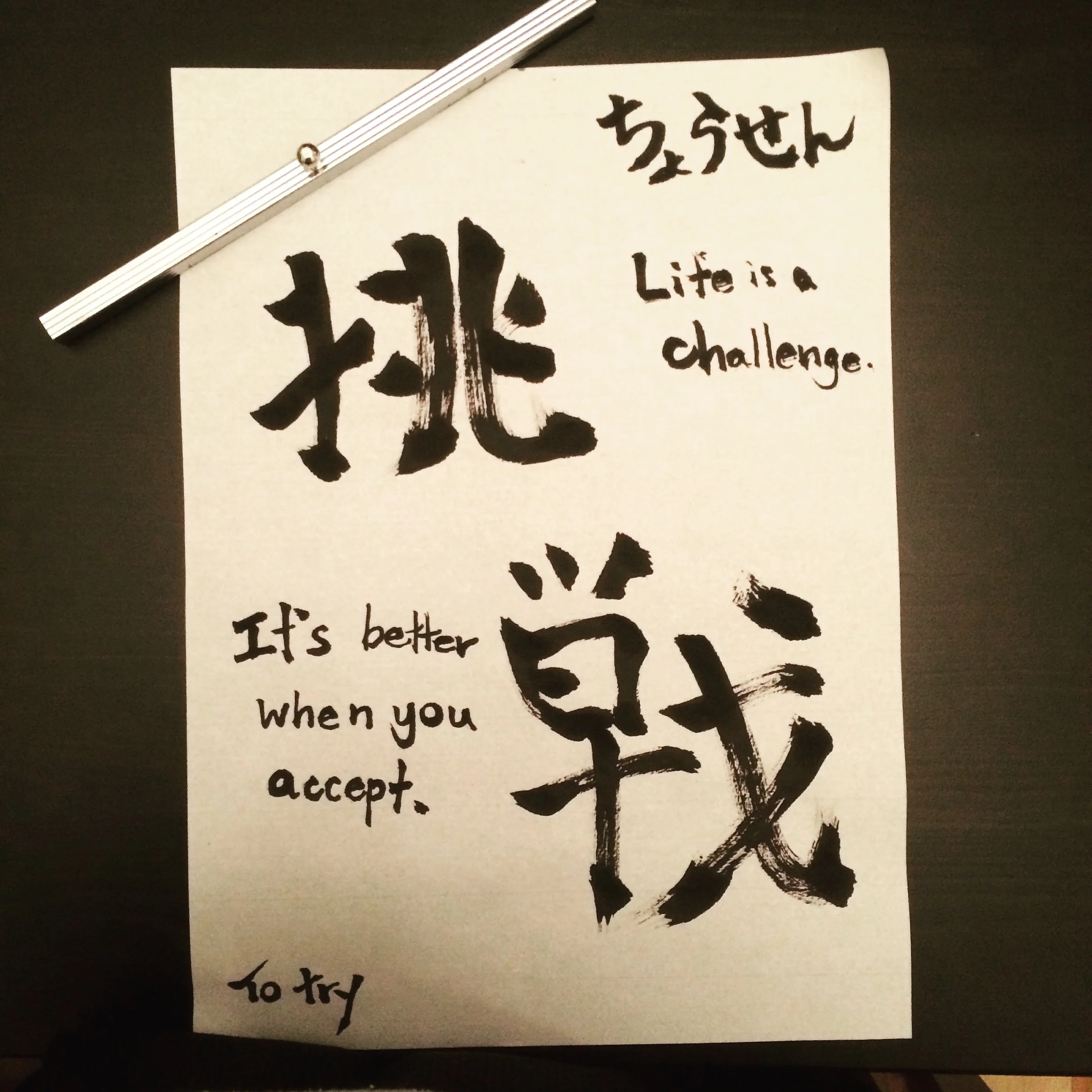
I came back the next day. “What word do I want today?” I asked myself, and waited for a response. I didn’t have to wait for long. 挑戦. Chōsen. A hard word to translate, but one that is often rendered as “to try”, or “to challenge”. I wrote it quickly, hoping that speed would equal elegance. It turned out alright.
Again, the white space at the corners of the page caught my eye. “Life is a challenge,” I felt myself writing. “It’s better when you accept.”

The word echoed in my mind throughout the morning. Chōsen. Did it make me act differently than I otherwise would have? It’s hard to say for sure. But even months later, the word still pops into my mind. I think it gives me a jolt of strength.
The next day I chose – again – the first thing that came to mind. Kansha. “Gratitude”. I felt a little bit nervous because I had been posting the calligraphy to Instagram. “Will people think I’m posting this just to look good?” I worried. The next thought was even more worrisome: “Am I actually posting this just to look good?”
I thought about it for a second. "Maybe not just to look good,” I reasoned. Then I paused. “But at least a little."
Then I posted it.
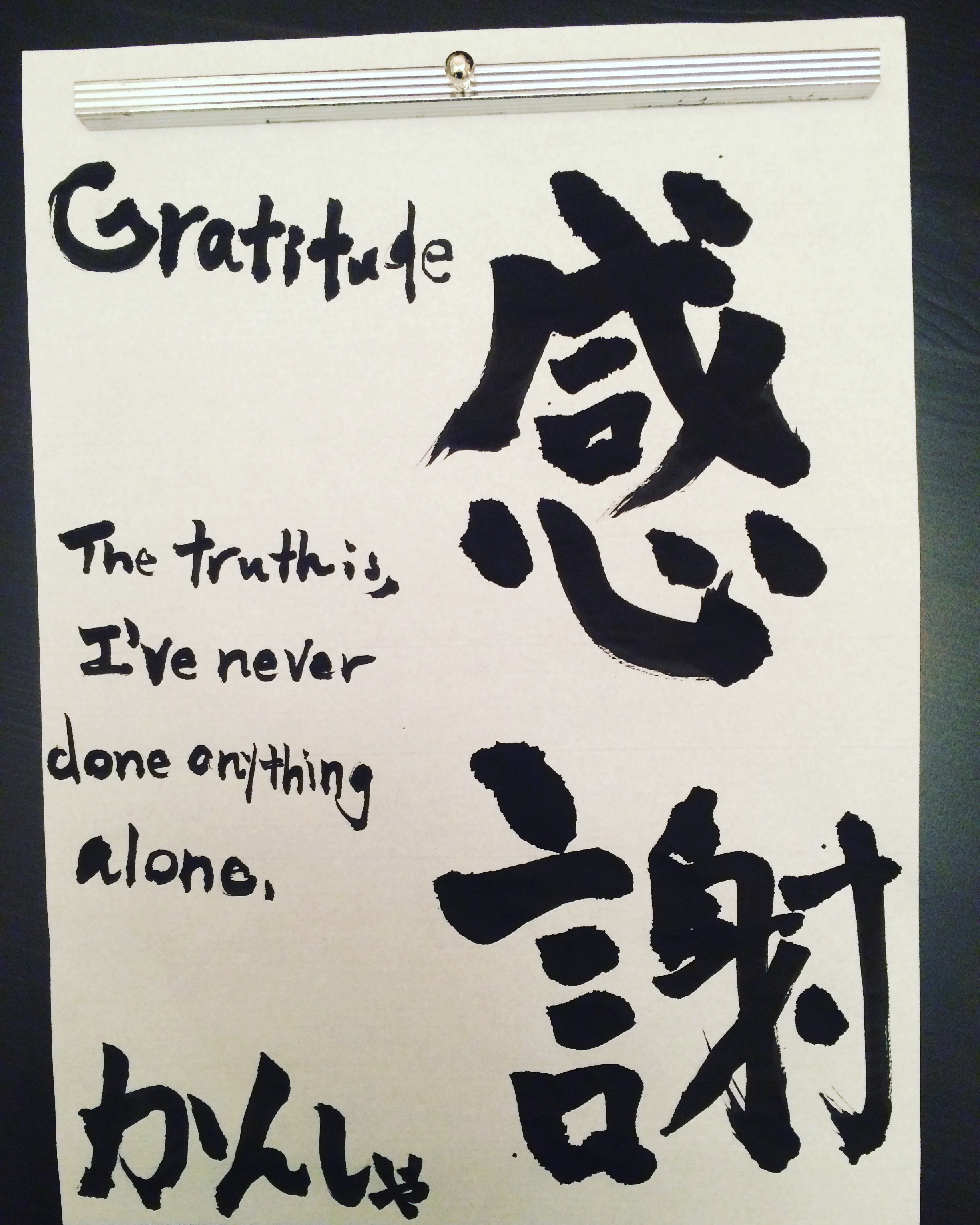
For three weeks, I didn’t run out of words. I found that every day I had something in my life to work on, and I was eventually able to find a word to express it. Here are some of the words that came to mind as I thought about what I wanted to bring to the day.
Nobiru. To grow. I’ve found that holding the intention to grow is enough to transform what would otherwise be the meaningless detritus of the everyday into (what at least feel like) important lessons.

Shuchu. Focus. Sometimes focus happens naturally, but usually I have to maintain it in the face of distraction. Intending to do so (and continually reaffirming that intention) is the first step.

Junan: flexible. Hansei: reflection. Norikiru: to get by.
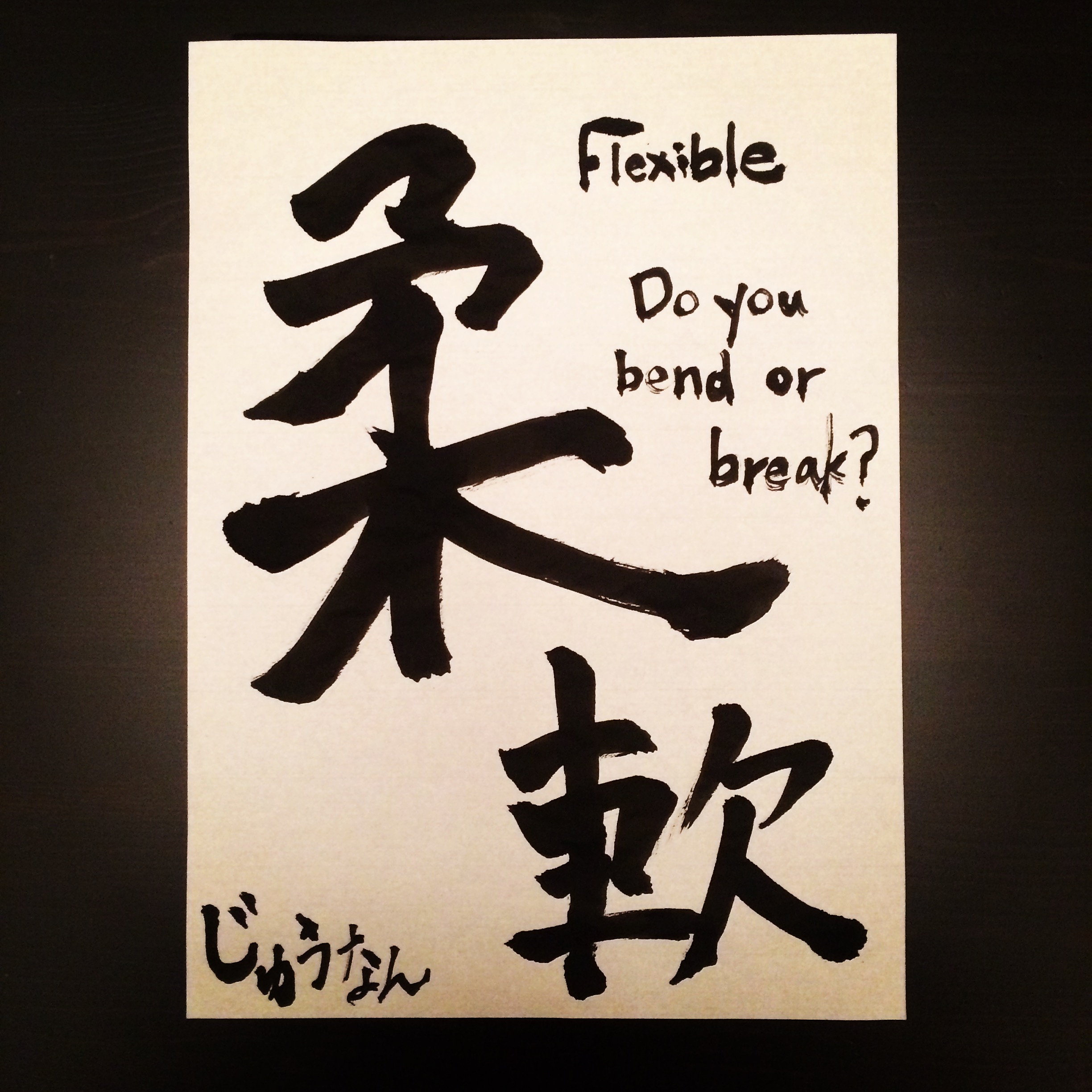
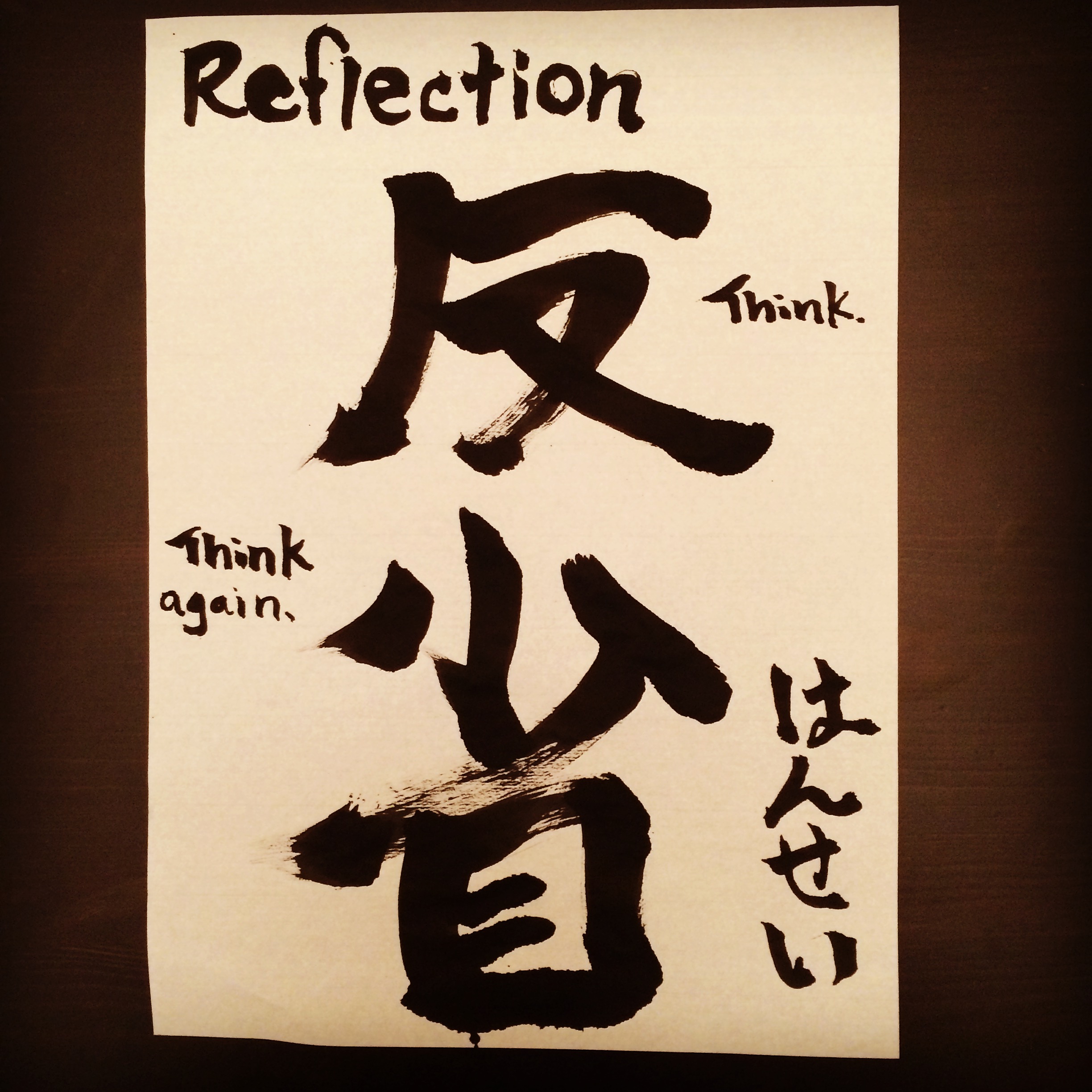
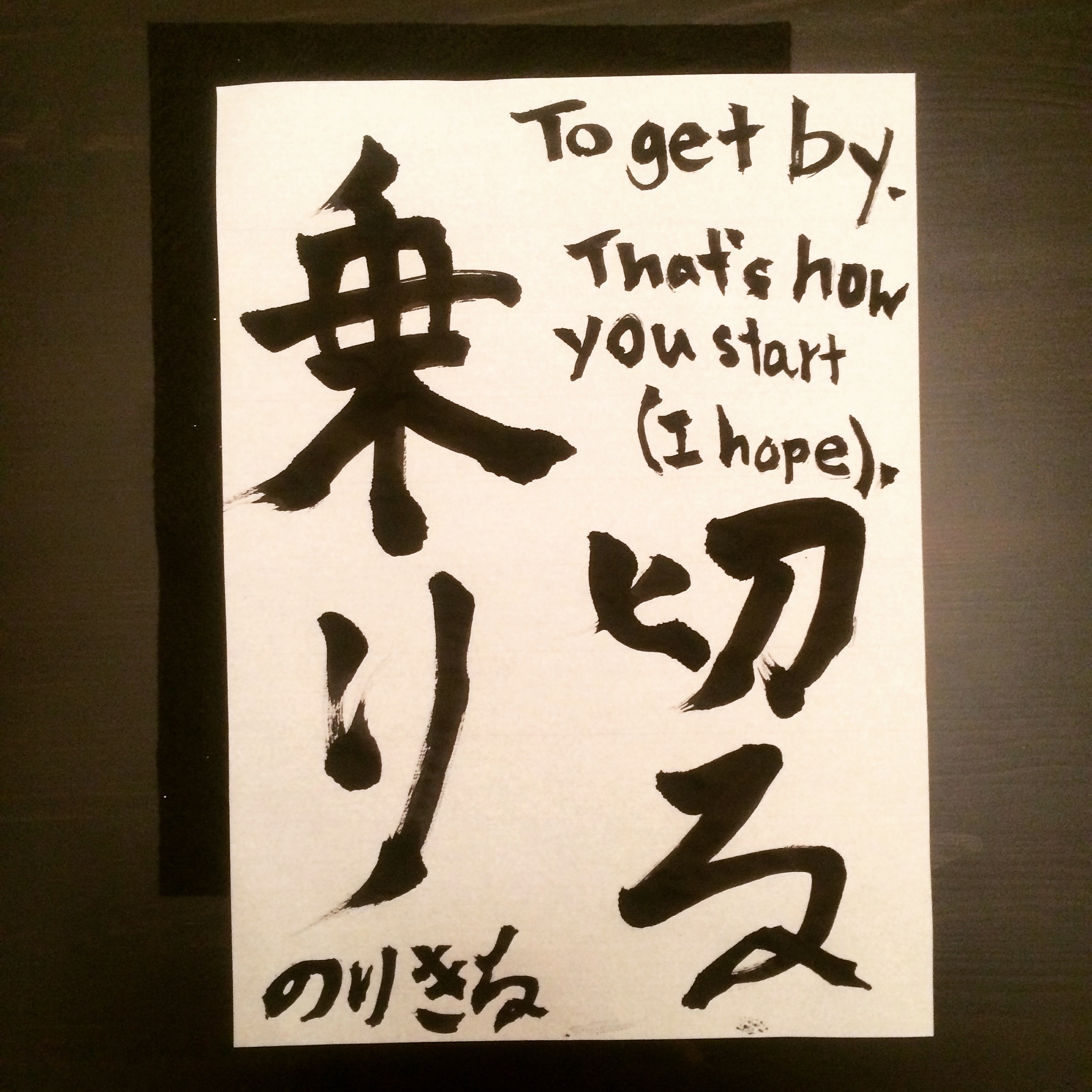
It was an interesting experiment. It lasted three weeks. It changed from a morning ritual to an evening one. It ended not because I ran out ink, but eventually, the drive. I also ran out of words. Once or twice, my first attempt was so bad that I had to allow myself a second. But more often than not I waited out the impulse.
What made one day better than another? What conditions allowed the brush take over one day, and prevented it from doing so on another? It’s hard to say. Sleep quality, maybe. My mood, definitely. To tell the truth, there were some, or maybe many, days that I really didn’t want to write anything.
“Let’s skip it today,” a voice often said. "Do you really want to take all that gear out just to write on kanji?"
“I know,” I always forced myself to reply. “It’s kind of annoying.
“But we’re doing it anyway.”
*
Handwriting has taught me that I don’t always want to do what is good for me. It started in fourth-grade. I didn't want to shrink my letters to fit in one line. My letters fit perfectly fine into three lines. But I needed to grow up; I would be in trouble today if my letters were still six-inches high. Ten years later, I didn’t want to change my Japanese handwriting either; however, if I hadn’t, I would have missed out on a chance to participate in what I now consider to be a very meaningful art form.
The lesson I took from the calligraphy experiment is the same: writing the characters took effort. I had to expend the energy to set up the equipment; I had to think of a word, either to jump-start my day or to encapsulate it; I had to submit myself to the pressure of having only one shot; and I had to live with whatever I came up with, though sometimes I failed at that.
But the effort was worth it. Takemoto gave me a seemingly remedial homework assignment that lead to a craft. In a lot of ways, life is also a craft – one that I’d like to master. Sadly, without conscious effort I tend to produce a scrawl, both in handwriting and life.
Happily, I think I know what to do about that. Now the challenge is to actually do it.
Bettymarie's Peach Meringue (Schaum Torte) • Lari Robling

A Note from Curator Rozanne Gold: This engaging story comes from Lari Robling, an independent radio producer and writer, currently producing “Voices in the Family” with Dr. Dan Gottlieb for WHYY in Philadelphia. A special pot of tea, carefully placed next to a handwritten recipe card, sets the scene to unlock the secrets to Bettymarie’s Peach Meringue. The card’s yellowed hue and tell-tale splotches hints at past mishaps, while a faded cursive “what’s cookin,” specifies Mom as the author, even calling her by name. Yet the story is not all peaches and cream. The cracked exterior of the cake becomes the metaphor for a complicated mother-daughter relationship, whose sweetness and love stand the test of time. A former restaurant critic for the Philadelphia Daily News, Lari is the author of a wonderful cookbook, Endangered Recipes, published by Stewart, Tabori & Chang. Lari believes that nostalgic memories created by food are the most evocative and compelling of all, especially if they’re handwritten. Thank you, Lari. Twitter handle @larirobling.

Bettymarie's Peach Meringue By Lari Robling
My mother was a terrible cook. I was about eight years old when I realized that calling the fire department wasn't a step in a recipe. Her impoverished cooking skills were always a puzzle because her mother, my grandmother, was an amazing cook. Grog's pies were legendary and people would find a reason to stop by around dinner — there was always enough food in the pot, and enough room around the table to set another place, or two, or even four! Yet, my mother left that home sadly lacking the ability to put a simple meal on the table. Maybe it’s no coincidence that I became passionate about food later in life.
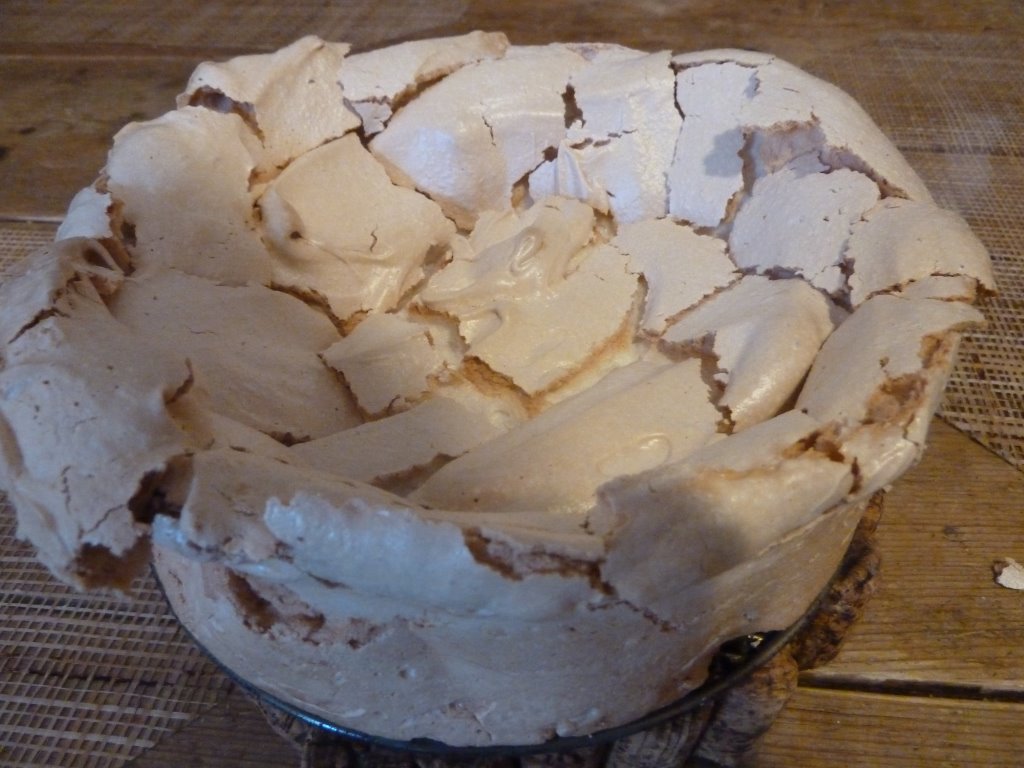
There were, however, one or two things she did learn from my grandmother, and my brother and I were grateful for them. One such confection was a mass of fluffy whiteness covered in whipped topping and decorated with fruit. Despite its light texture, and much to our mother's chagrin, we called it Cement Cake. Although she took this as one of endless insults attached to her skill-less cooking, it was an apt description of what the cake looked like prior to being dressed up with fruit and cream — a cracked sidewalk.
This dessert is Pavlova-like (sometimes called Pavlov), and baked in a spring-form pan rather than laboriously piped out of a pastry bag. Preparing it this way results in a dreamy, marshmallow-like interior encased in a brittle shell.
The original version came from my grandmother's neighbor and called for “tinned peaches.” Over time, we swapped the canned peaches for fresh, or sometimes substituted fresh strawberries or blueberries, or other fruit in season. I've even used kiwi, which adds a nice tart contrast to what is basically a very sweet meringue. But the most exciting version was the one I made with the gooseberries from my backyard bush.
Eventually, the non-dairy whipped topping gave way to whipped heavy cream. And what I’ve learned is that the recipe is almost foolproof, as even my mother could make it reliably.
I was always curious about the origin of this recipe — did some cook lack a pastry bag and plop a Pavlov into a spring-form pan? Was this dish a regional Ohio thing where I was from? I finally found the answer when researching my book, Endangered Recipes and read The Molly Goldberg Jewish Cookbook. There it was — Schaum Torte, a flour-less cake for Passover (that explained the non-dairy topping!).
I wonder how many countless handwritten recipes such as this one were passed over fences or across clothes lines over the years? From neighbor to neighbor, from mother-to-daughter, and now mother-to-son (my son Ben devours it anytime I make this cake), it is a beautiful testament to the nurturing bonds we share.
It’s nice to have a sweet memory of my mother to mollify our sometimes contentious relationship. And I don’t call it Cement Cake any more.

Bettymarie’s Peach Meringue
Cake
6 egg whites
2 cups, sugar
2 teaspoons, vanilla extract
2 teaspoons, apple cider vinegar
Topping
2 cups, heavy cream
1 pint, fresh strawberries, hulled and halved
(reserve some whole for garnish)
or fresh fruit of your choice.
1. Preheat oven to 300 degrees F.
2. To make the cake: Using an electric mixer, beat egg whites until stiff. Add sugar slowly while beating at slow speed. Blend in vanilla and vinegar. Spoon batter into a 9-inch springform pan. Bake for 45 minutes. Remove cake from oven and let cool (it will deflate and crack; don't worry you cover the whole affair up).
3. To make the topping: Just before serving, whip cream. Arrange fruit on top of cake, reserving some for garnish. Spread the cream on the top and sides of the cake.


Handwriting Gala at Pen + Brush Gallery this Saturday (3/5) from 2 - 7 pm
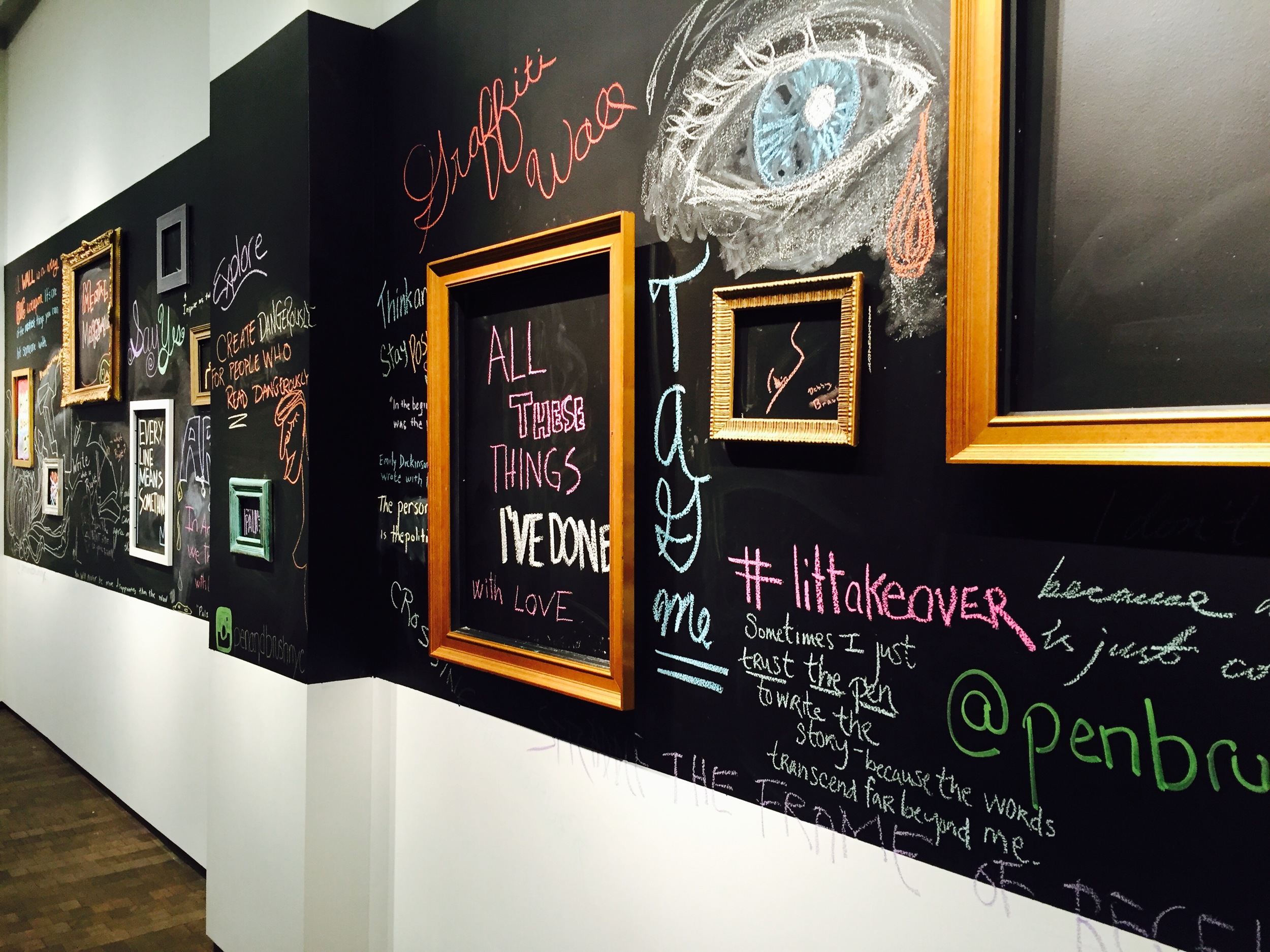
This coming Saturday, we will be at Pen + Brush hosting a Handwriting Gala, showcasing handwriting in all its glory. The day will begin with a letter writing playshop led by author and poet Karen Benke, and then unfold into a few presentations about where and how handwriting is surfacing in the world today.
Come write a letter, get enveloped by the handwritten word, and explore all the nooks and crannies in this beautiful space. For a full list of details for the day, check out our Events tab or click here.
The Viewer has the Freedom • Tatiana Roumelioti

BY TATIANA ROUMELIOTI
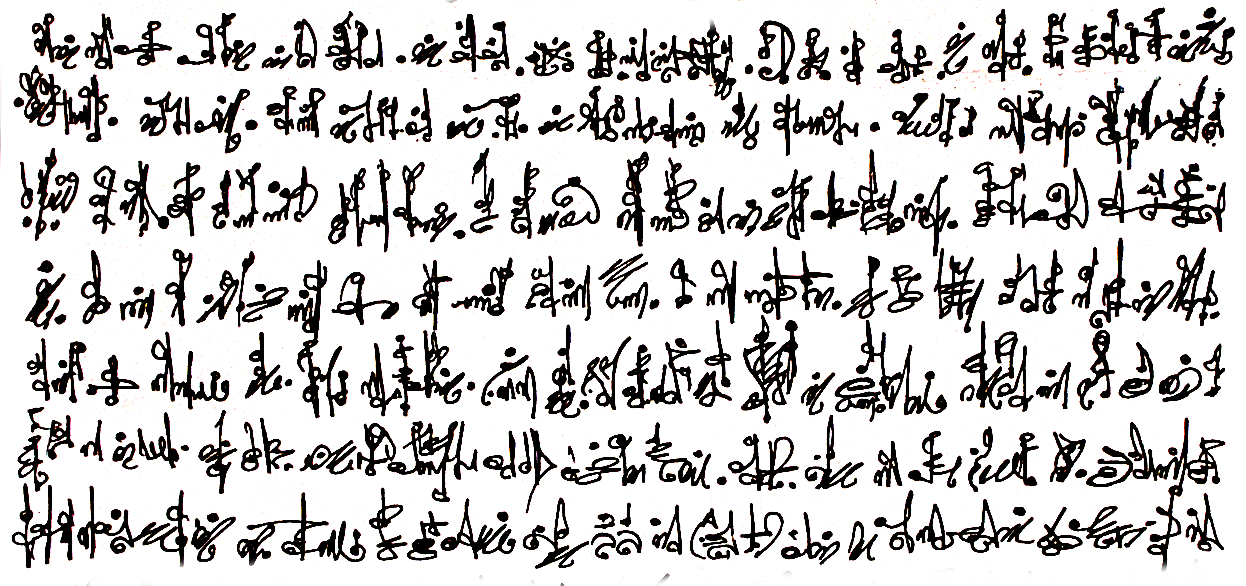
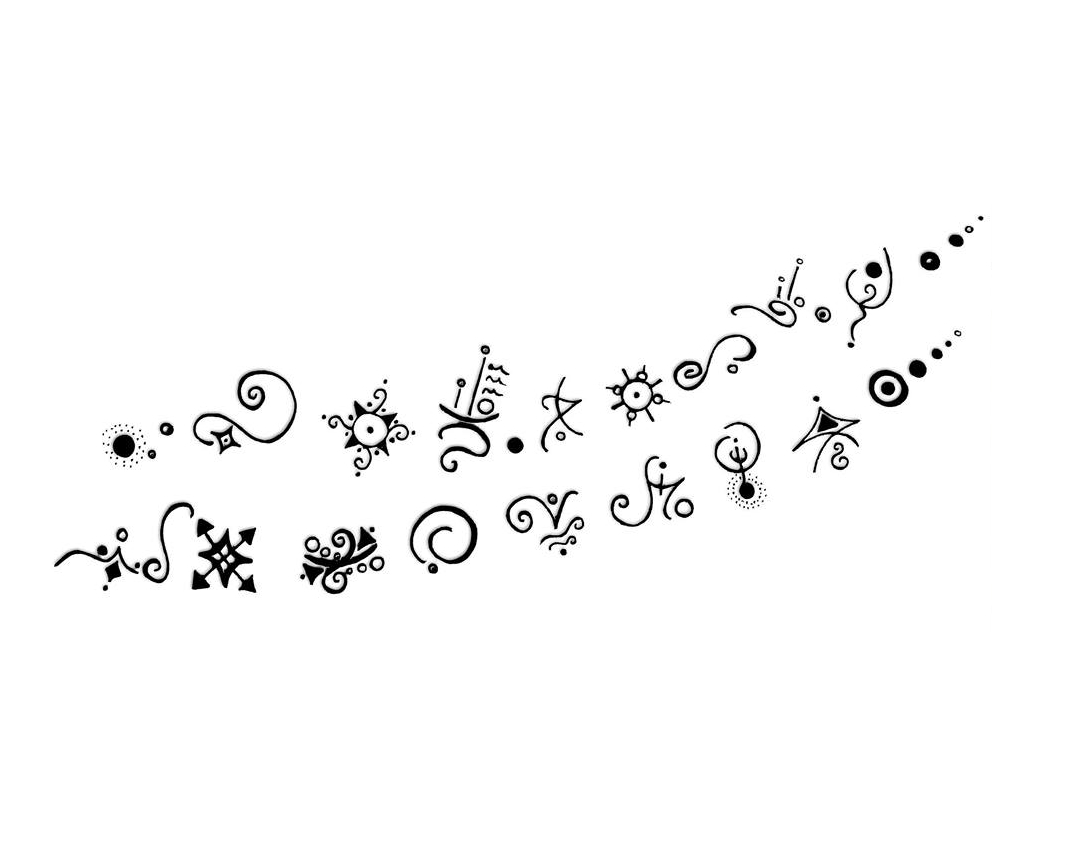
Inspired by ancient languages, healing symbols and manuscripts
in 2012 I started to create an aesthetically similar variety
of my own imaginary writings and hieroglyphs.
My work holds no intentional hidden meanings.
However it appears enigmatic
and the viewer has the freedom to make their own sense out of them.
I mostly use marker pen on paper
and usually write from left to right,
sometimes vertical and rarely right to left and diagonally.
I have created many different types of texts and hieroglyphs so far.
I write on a daily basis and it is something i am doing out of immense joy.
click any of the images to see them enlarged





Tatiana Roumelioti is a self-taught and intuitive artist from Athens, Greece. You can see more of her work here.
The One Who Wrote Back • Jim Landwehr

BY JIM LANDWEHR
It was writing that brought us together.
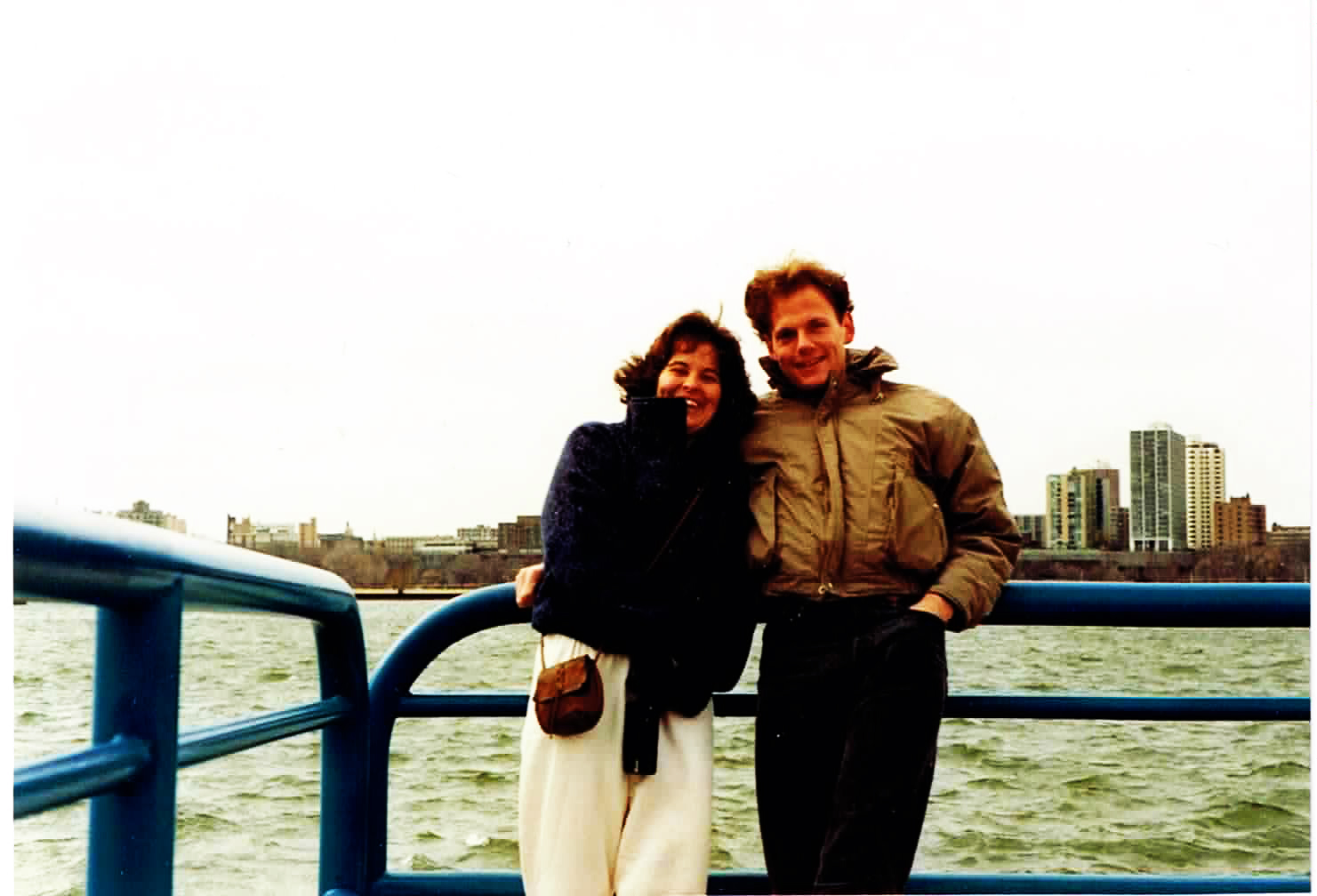
In 1986, I moved from my hometown of St. Paul Minnesota to Waukesha, Wisconsin just outside of Milwaukee for a new job. My brother Rob was also living away from home as a student in upstate New York. He and I wrote for a period of time and in one of his letters to me, he included letters from three of his female friends on his dorm floor. He’d told them I had just moved to Waukesha and didn’t really know anyone and that he thought it would brighten my spirits to receive some letters from them.
I don't remember exactly what each of the three had to say. Most of the letters were introductory in nature and seemed like honest attempts to be nice and cure me of my homesick loneliness. They were all away from their families as well, and we were all close in age, so had music, books and college life in common to talk about.
I was, of course, flattered that 3 women would take the time to write, so I wrote each of them individual letters back. Only one wrote back.
For a year and a half.
Donna and I became 20th century pen pals of sorts. This was before the age of e-mail, faxes, texting and Skype. Long distance calls were expensive. Postage for a letter was about a quarter.
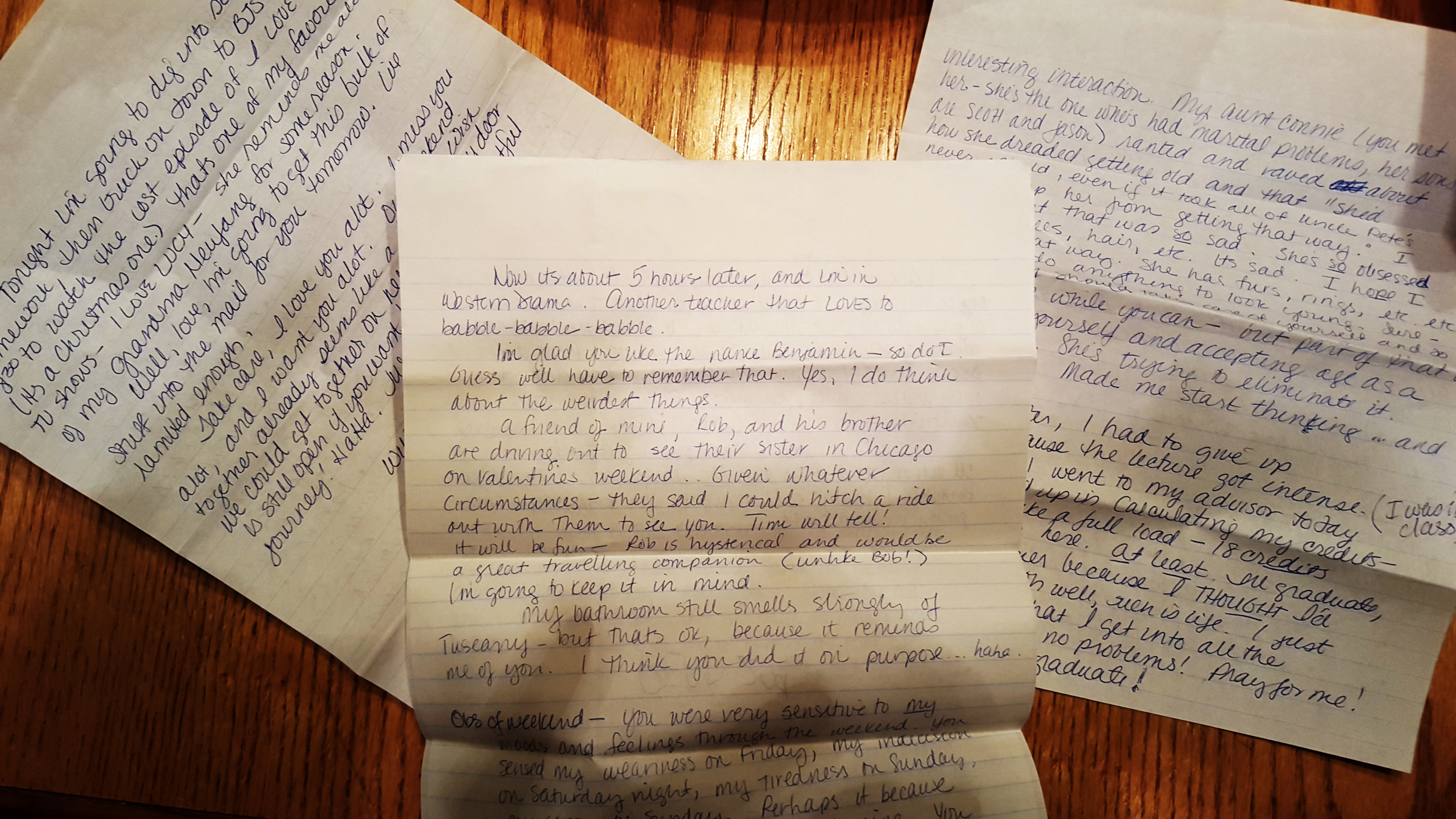
So we wrote, and we wrote, and we wrote. Short letters, long letters, letters about the trials of college and a new job, and roommates, and philosophy and religion, family, music, and books. We shared joys, concerns, doubts, beliefs and bad jokes. I sometimes took my writing to silly mediums like writing on napkins or the back of maps, just to keep it interesting. One of the things I recall her liking was my "Random Observations" which covered most subjects under the sun. Near the end of our writing things got a little spicier and flirtatious, neither of us knowing what the other would think, but daring to "go there" nonetheless.
Someone once said that writing is not a bad way to get to know someone – to become friends through writing before pursuing a relationship. I know it was true for me as it was sometimes easier to write things from the heart than it was to say them to someone I hardly knew.
Then one day she called. She said she was thinking about paying a visit and wondered what I'd think? I, of course, said I would love to see her. Both of us knew it would likely change our relationship forever.
And, man, did it ever.
I greeted her at the airport with a single red rose. We went to dinner at the Chancery and out to see the movie "Light Years" at the coolest theatre in Milwaukee, the Oriental. On the way home, "our song" came on the radio in the car, oddly enough, because it wasn't a big top 40 hit. When we got home we stayed up late and talked, and talked.

During the summer of 1989 she did an internship in Brookfield Wisconsin, which enabled us to try dating without five states between us. We were engaged that summer and married on June 16th, 1990. This past year we celebrated our twenty-fifth anniversary.

Looking back, it’s hard to say how this courtship would have played out in these modern times. Email, Skype and texting seem so impersonal compared to the anticipation of a letter from across the country. My wife saved every letter I sent her. In a fit of cleaning I threw most of hers out just before we were married. I managed to find a number from her that are post-engagement, but everything else is lost in the physical sense. What remains, are the memories and feelings of that time. I still cherish a handwritten letter from anyone. It is a lost art, one that we pursued with a passion so long ago. It’s my feeling that the emotional outpouring that goes into a letter is felt on the other end in a mystical way that is lost in an electronic medium.
I do know that it worked something special for us. To this day she says that my words were what attracted her to me. There must have been something in hers that drew me to her, as well.
It’s amazing what one simple letter can become.


