The Screen Test • Joyce Chen
Is the notebook half-empty or half-full? In this essay, Joyce Chen sets out to test and trust her hand, a routine tethered to time, with the hopes of avoiding the pitfalls of resolutions by resolving to reflect. Are you up for the screen test?
BY JOYCE CHEN
I’ve never been one for New Year’s resolutions.
Not because I don’t believe in the psychology behind them – God only knows how much I am an advocate for self-reflection and self-improvement – but because I’ve always had a sneaking suspicion that New Year’s resolutions are actually made to be broken. The way they’re worded and thought about almost always sets the resolution-maker up for failure: “This year, I resolve to work out more” (meaning, what? Buy a new pair of running shoes and use them thrice instead of once?); “This year, I resolve to be a better friend” (read: respond to emails in two months rather than four); “This year, I resolve to spend more time with family” (but more time with family doesn’t mean a thing if you’re still plugged into a device while sitting in the same room, right?).
This may sound a tad bitter, sure, but to be perfectly honest, I only feel okay making these jabs because I’ve made these resolutions before, and by that same token, I’ve also failed at these resolutions before. There’s something exciting about starting a new calendar year that nudges our inner navel gazers awake to notice our shortcomings and attempt to remedy them with a promise to “be better.” But what I’ve come to discover over the years is that while New Year’s resolutions are always well-intentioned, they are often more about finding a temporary, band-aid solution to problems than actually digging deeper to get to the core of the issue.
A desire to work out more, for instance, might stem from guilt over poor lifestyle choices (ie. late nights, fried foods, overindulgence of all kinds), not an actual desire to exercise more. The resolution is less about running and lifting, and perhaps more about thinking about and taking control over our daily routines.
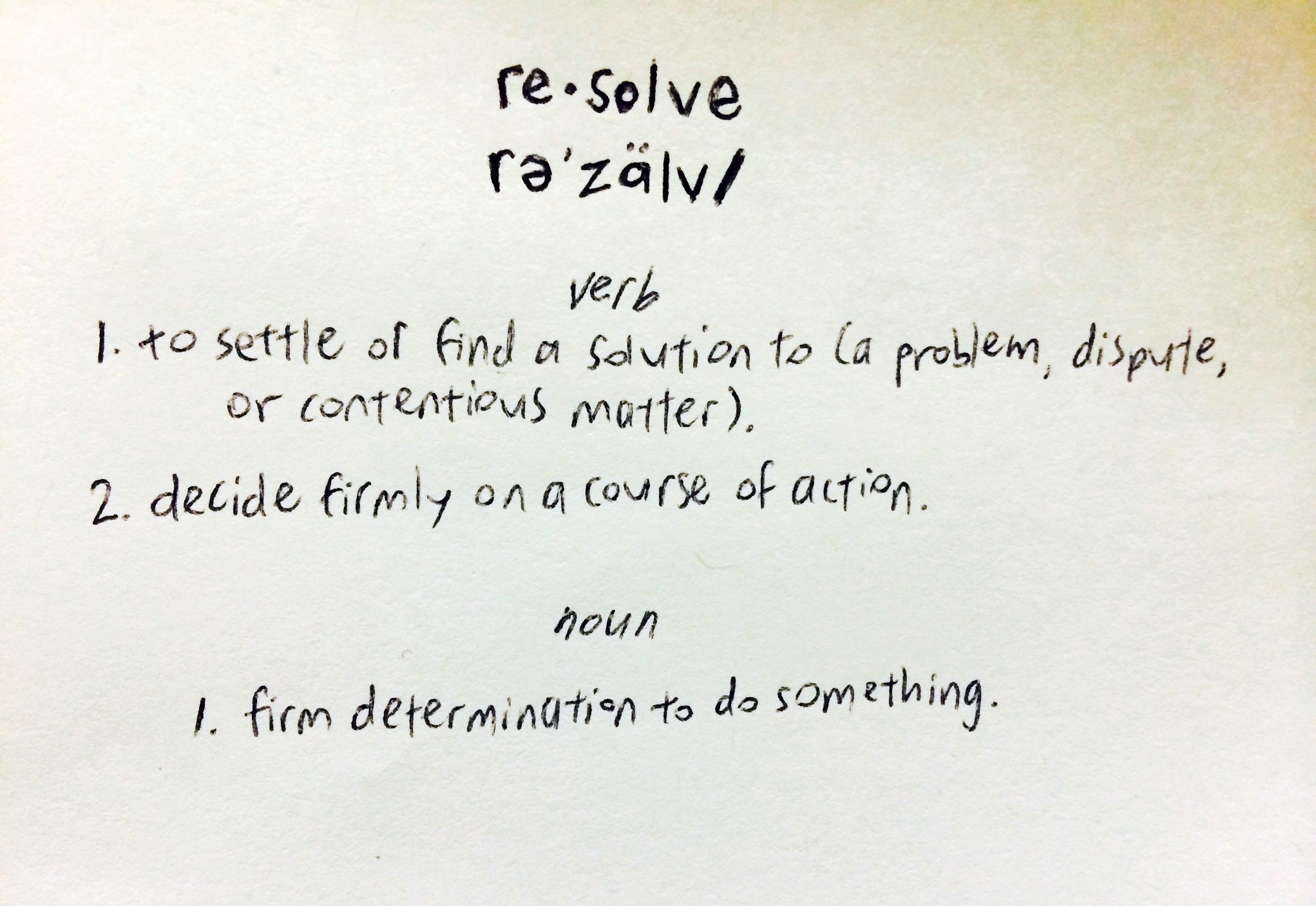
To that end, then, I would rather have resolve (n.) than to resolve (v.), because my goal isn’t to reach a conclusion right away; no, I want to understand my own process as it is unfolding. I would rather have the noun in my back pocket as a reminder than the verb in my front pocket, at the ready for a quick-fix solution. So this year, instead of a New Year’s resolution, I decided to have an anti-resolution. A plan to test my own willpower by opting not to do something that has become dangerously habitual to the point of dependency: stare at a screen all day.
I realize that as I am writing this, and as you are reading this, we are both staring at a screen – and that’s just fine. So to clarify, my decision to not stare at a screen is less a dramatic political statement and more a modified lifestyle choice, an experiment: Between the hours of 10:30 a.m. and 10:30 p.m., I allow myself to carry on as I always have – answering emails, scrolling through headlines, and laughing at silly GIFs. In those 12 hours, I feel connected to the greater community of the Interwebz, corresponding with friends halfway around the globe, pitching ideas to editors in other states, and engaging with a community beyond my immediate line of vision; I am in a digital portal and can free-float through both time and space.
And beyond the computer screen, I also allow myself to get lost in my iPhone, in the TV screen, in a number of other electronic means of communication; I express myself in words and emojis, and absorb new thoughts and ideas in the form of the news, news feeds, TV shows, Instagram, Facebook, Tumblr, Twitter. The sea of garbage, as a professor of mine once called this vast ocean of information, is alive and pulsing during those 12 hours.
This is what screens have given us, after all: a means to access other people, places, thoughts and head spaces, from wherever we happen to be at a given moment. And I am grateful for the distractions, as we all likely are, because that means that we can sometimes push aside the more immediate tasks at hand in favor of temporary escapes. But there is a threshold; there must be.
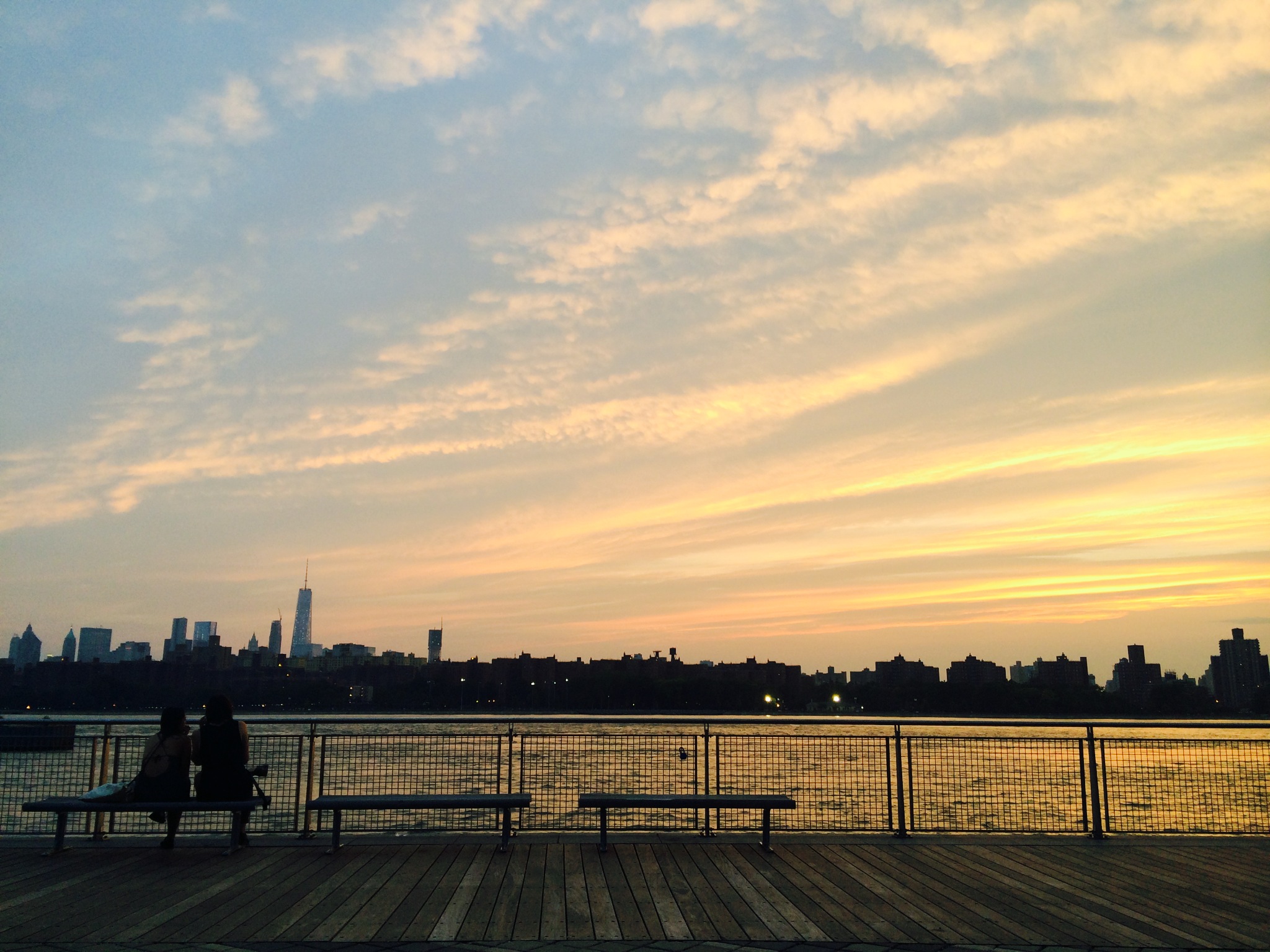
For me, that was last year, when I realized I was checking my email first thing in the morning and watching shows and films until I fell asleep at night. There was this feeling of dependency, of addiction, a light-bulb moment realization that I was literally spending all my waking hours as a slave to my many screens. I wasn’t getting good sleep, and I wondered sometimes if it was because my brain was going through withdrawal from not having a backlit device pointed straight at it during the hours I slept.
I realized that part of the problem with always being plugged into a device was that I was hop-scotching from distraction to distraction and was therefore not always quite here, the physical space I was occupying. And this meant, as a result, that hours and days and weeks and entire years were flying by without my ever having really experienced what was happening in the moment at the moment. I was living life in retrospect.
And that was a problem.
So though I still take part in the digital sphere between the hours of 10:30 a.m. and 10:30 p.m., these days, I’m opting to spend the hours prior to and after that off the grid a bit, focusing more on the who and the what of where I am during that time. Unplugging is the how. To experience life more vividly and fully is the why.
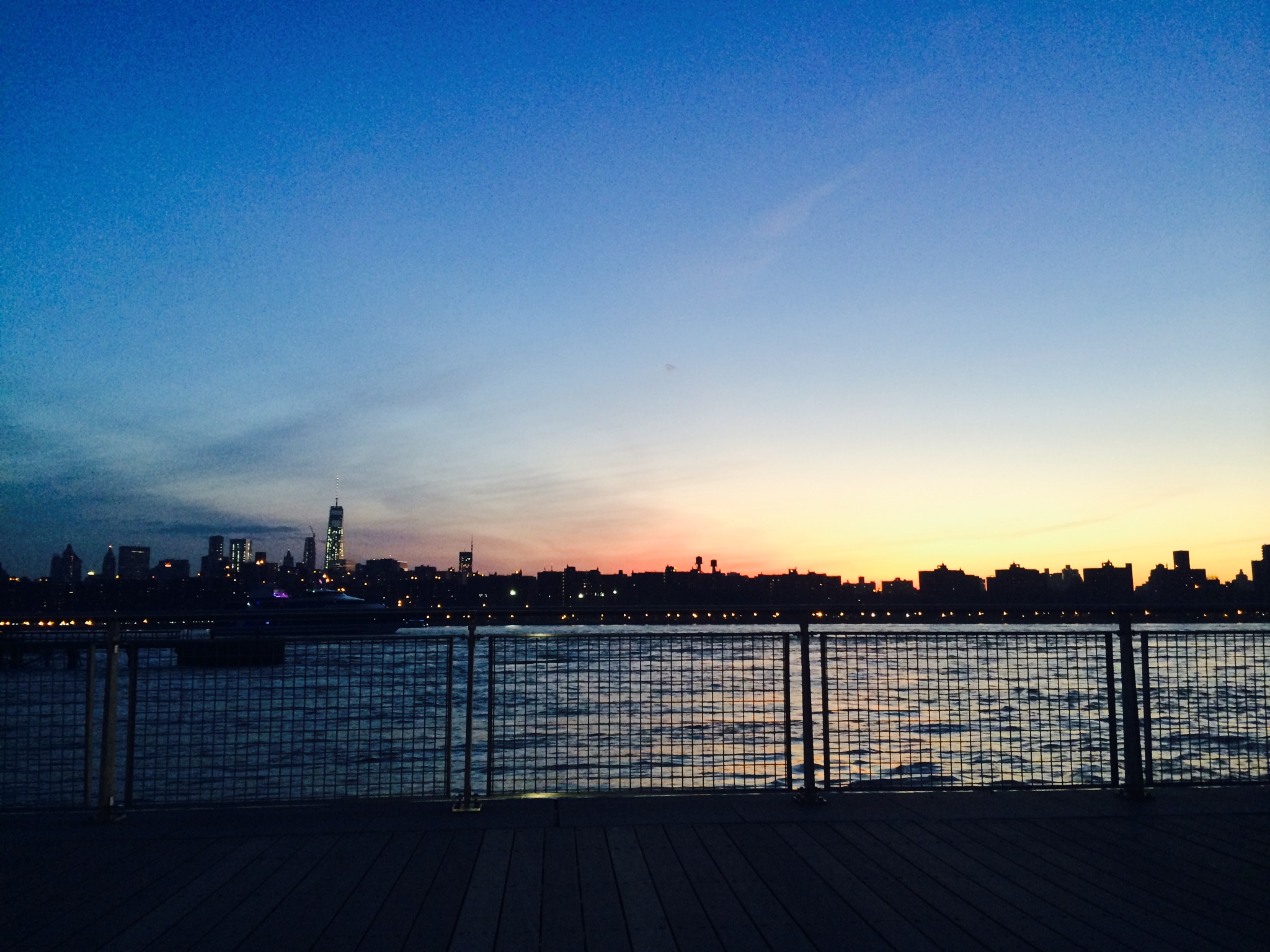
During those hours, I meditate and I think and I read and I write a lot (by hand, of course). There is a kind of stillness and peace I find in not being in front of or dictated by the influx of information found on a screen. It’s a feeling that I had long forgotten, and would most likely have continued to forget, if I hadn’t taken a step back and realized how my days had become inundated by thoughts and demands not my own. Being separate from the screen is giving me the luxury to do something I never thought I’d be able to do in this digital age: really hear myself think.
In the beginning, it was always tempting to cheat and take a quick peek through my phone in the morning just to see if there were any pressing emails or Facebook notifications or Instagram likes that took place overnight. But because I had given myself these rules and parameters, I felt a duty to keep myself in check, lest I disappoint myself with my own lack of willpower. I started to analyze that temptation, observe myself in third person during those morning handwriting sessions, and realized that much like Pavlov’s dogs, my instinct to check my inbox was more about the reward of attention (“so-and-so has replied to your email!”) and importance (“inbox: 52 from just one night? People really need to reach me”) than from an actual need to know information.
I am now finding that in those hours away from the screen, I am able to engage more fully not only with the present moment but also with myself, so that I know how to better navigate through the treacherous technological waters (and, to a certain extent, through social situations at large).

Now I write waterside, in cafes, in my room, in outdoor spaces that aren’t constrained by lack of wifi, outlets, or table-space. All I need is a pen, a notebook, and my fully focused mind. It is freeing.
Call it a reintroduction.
I feel more in touch with and honest with how I’m feeling because my thoughts are not as cloudy at the beginning and the end of each day, and I am starting to be able to translate some of that clarity into my daily living as well.
Call it a recalibration.
I sense myself being more selfish with my time and more careful in how and with whom I spend it.
Call it a reassessment.
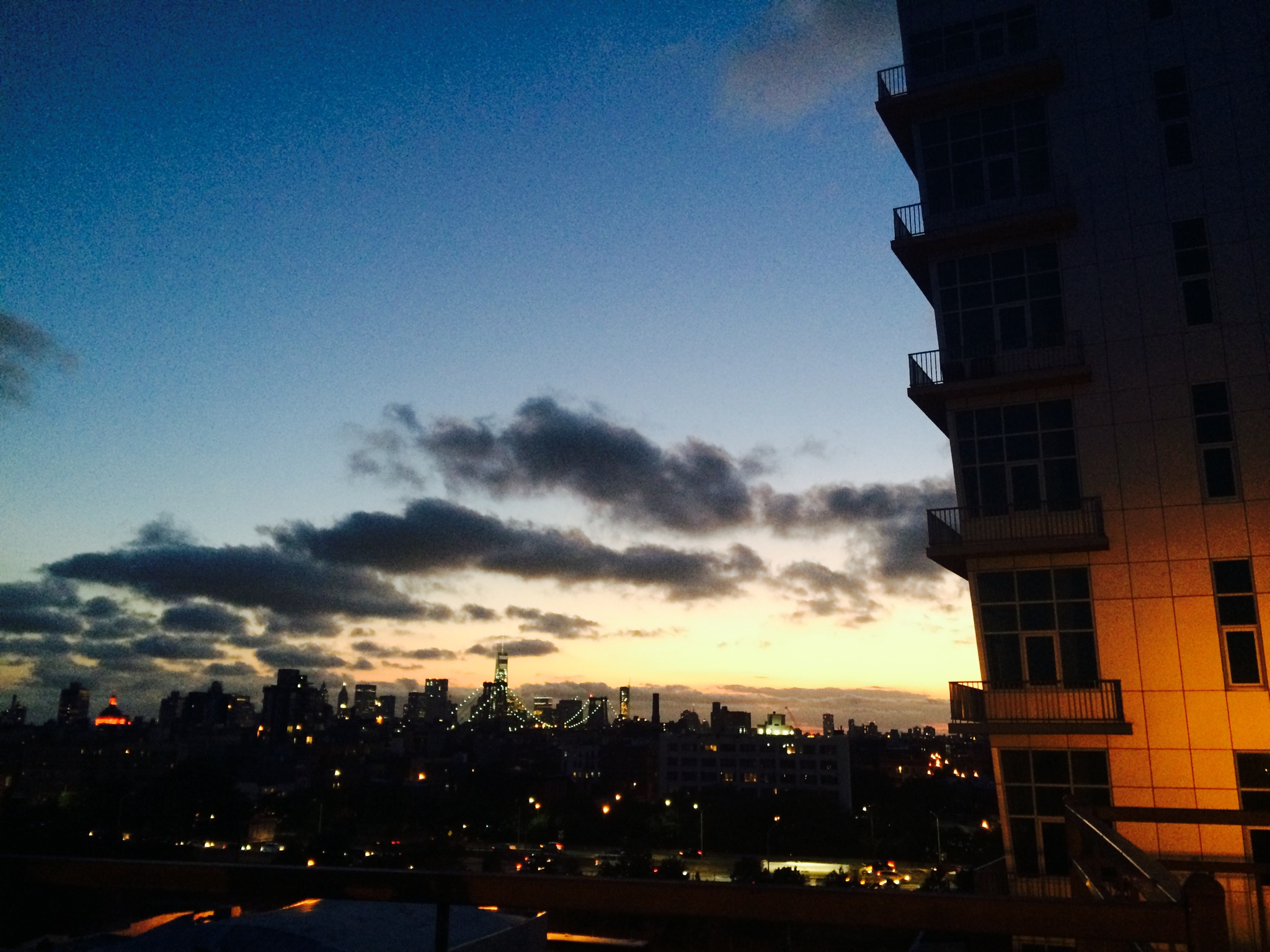
The way I see it, we already segment our lives into so many distinct compartments based on how we spend our time anyway: family time, work time, free time, leisure time, personal time, social time, food time, sleep time, and on and on and on. So why not look for new ways to section off hours of the day, to break down previous habits and routines and build something new and perhaps, hopefully, more sustainable?
I’ve never been one for New Year’s resolutions because making them is, I think, a way to feel the thrill of a personal promise without any real commitment. Being more physically active, communicating more with loved ones, and reprioritizing our actions and activities are all noble pursuits, but what all three require above all else is a space and place to really explore the reasons why we want those things. And for me, I’ve found that space and place in my hard-won now, and I want to hold onto that feeling.
Every year, in place of a New Year’s resolution, I like to think of a single word to hold in my mind for those times throughout the year when I start to lose focus. In 2013, it was Create. In 2014, it was Trust. This year, 2015, I decided that my word would be neither verb nor noun, but a state of being.
In 2015, I have resolve: I am Awake

Joyce Chen is a handwriter in Brooklyn. She is also a journalist who thinks she spends too much of her time staring at screens - writing for print and the web, watching and reviewing films, and sending strings of emojis to family and friends. When she's not plugged into the World Wide Wonder, she can often be found out on unplanned runs throughout New York City, taking long walks along the waterside, or otherwise stretching her legs and getting out from the great indoors.
From Mess to Less • Chad Frisk

BY CHAD FRISK
I don’t know about you, but my mind is a disaster. Things are constantly whizzing through and then clogging it up. Things proliferate and congregate, ideally like constellations in the sky but typically like commuters during rush-hour. It’s a mess. Writing is, as I see it, the process of making that mess suitable for display. I learned the hard way that there is an appropriate tool for each step. I wrote the draft of my first novel by hand. I thought it would be cool. It was actually very dumb.
I filled fifteen notebooks. I went through a dozen erasers. Oftentimes I chose not to revise because it would be too much of a pain to cross things out and scribble in the margins. When I finished, I typed the whole thing into a Word document anyway, one indecipherable page at a time from tiny, gold-tooled notebooks that refused to stay open on their own.
I didn't know what it was about when I started writing. One day, I walked past an old, abandoned clock shop and thought it would be interesting to write a book about time travel. That was my only idea. I bought a notebook, scoured my apartment for a pencil, and started writing.
I was living in Japan at the time, working at a junior high school as an assistant teacher. That year, I didn't have anything to do. It was my job to go to four hours of class a day and read from a textbook. The other four hours were my own.
I decided to write a book. When it was finished, it had nothing to do with time travel. In fact, it had very little to do with anything. It was four or five stories posing unconvincingly as one, scrawled across 100 Yen notebooks I purchased at convenience stores.
There was a psychiatrist. He was frustrated by his patients' lack of progress, and decided to pursue alternative therapy - which included breaking and entering, kidnapping, stalking, and mild psychological assault. There was a burned-out business man. He was so deep in self-help that he had lost sight of how good he already was. There was a server at a nightclub for the uber rich. She was tired of getting hit on by three-piece suits, but was making so much money that she had convinced herself it didn't matter. There was a ten-year old boy. His grandpa had died, leaving a hole in his after-school routine that he didn't know how to fill.
There were others. There was a detective possessed by the ghost of Dick Tracy, an old illusionist whose understanding and lifelong exploitation of cognitive biases had poisoned his view of humanity, and a girl who lived in a castle with a mother and father who didn't pay attention to her. There was also a beanstalk, a ruined city, and a sleeping giant.
It needed an almost complete overhaul. To do that, I abandoned my pencil for a keyboard. Computers are amazing because they make editing incredibly easy. Point, click, drag, delete. Done. It’s infinitely easier to revise already written words on a computer than on a pad of paper.
It took me about eight months to handwrite the first draft. I spent nearly an additional year revising it. I cringed while rereading my notebooks. The story didn't make any sense. Who were the characters? What did they want? How were they connected? What was the point?
From the flurry of keystrokes, slowly, something that could be called a narrative emerged. I knew that it wasn't good enough, but I tried to get it published anyway. After a half dozen rejection letters (and at least as many unreturned emails) I gave up.
But I had something. It was all thanks to the computer. Revising the original text by hand would have been impossible.
But I'm glad I started with pencil and paper.
Handwriting is good because it can go all over the place. Impulse is where my writing starts, and it’s easier to transcribe impulse with a pen than a keyboard. I can scribble, doodle, draw lines, cross things out, and generally be very messy. Out of this mess emerges something coherent enough to take to a laptop.
The process of refining continues digitally, because that’s what bits are good for. I find that the first step in mining my mind, however, is often best performed by hand.

Chad Frisk is a graduate student at the University of Washington working towards a Masters in Teaching English to Students of Other Languages. His books include Direct Translation Impossible: Tales from the Land of the Rising Sun, which was published in October of 2014; a Japanese version of the same to be published in March of this year; and and he's working on his next book - this time entirely on a computer. His website is nobodyelsewillpublishme.com.
The Materials Matter
BY SARAH MADGES
I am often asked, “What are you going to do with all of those?” in regards to my ever-amassing collection of notebooks.
The tone people adopt when they ask me registers as an accusation, or a warning that they’re going to turn me in to the reality show Hoarders’ producers and stage a televised intervention. True, the amount of notebooks I’ve accumulated makes moving daunting (the journals, both blank and filled-in, take up at least four standard file boxes, and are heavy). But these bound batches of scribbles mean the world to me. Because it isn’t just the words that matter — the content ranging from teen angst to amateur poetry to higher ed revelations — but the format. The tangibility. The way the words look on the page. The way my handwriting sometimes forms tight serpentine ribbons or grows looser and larger when tipsy or tired or both.
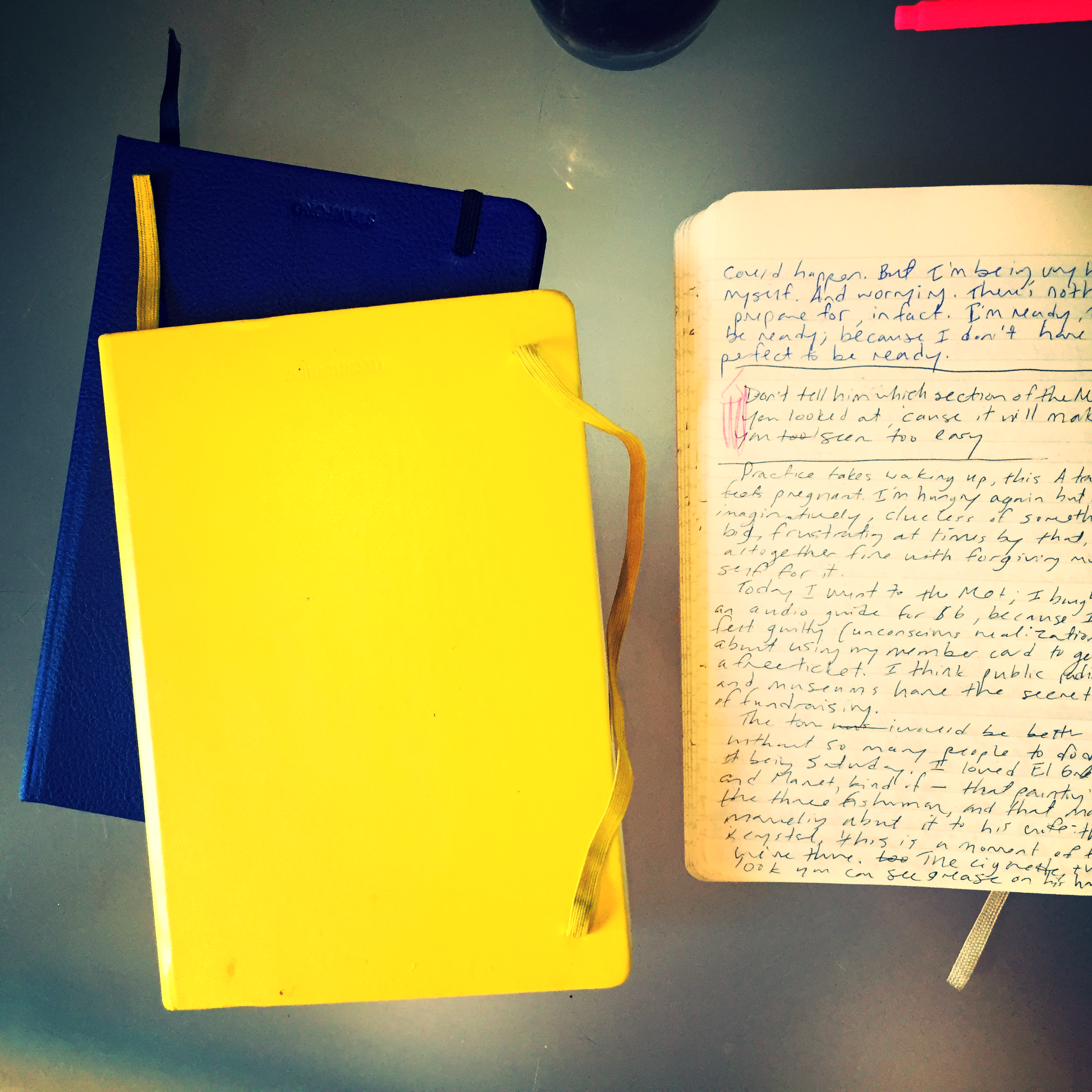
The materials matter; even the notebook choice tells a story. Moving chronologically, my notebooks upgrade in quality from flimsy composition notebooks (Harriet the Spy-grade Meads) or one-subject college ruled notebooks I also used for high school Trig, to those ubiquitous ribboned moleskines, or Germany’s analogue, the Leuchtturm, or even the notebook in which I composed this draft—a Stamford Notebook Co. lizard embossed cobalt beauty handbound in England.
The medium change means a few things: 1) I moved up one ladder rung in the service industry and could afford nicer products, 2) I was starting to take myself seriously as a writer, and each double-digit-$ notebook was an investment in that continued pursuit 3) other people were taking me seriously as a writer, and gifting me nice notebooks for holidays 4) I realized the paper quality, brightness, and thickness, all contributed to the actual look of the text.
I began to appreciate the aesthetic of each individual journal entry, independent of the actual written content.
A Kaleidoscopic Force of Creative Decoration • Andrea Rehani

WORDS FOR WALLPAPER is a kaleidoscopic force of creative decoration by Chicago-based poet and creative, Andrea Rehani. It combines the beauty and brevity of poetic expression with an artistic and aesthetic simplicity that is at once reminiscent of the modern and the antique.
Beginning by hand, Rehani creates a poem based upon a particular color or theme and allows them to take horizontal and vertical shapes as she frames them for the wall, where they will eventually live. There is an odd distance of intimacy to Rehani's work. The poems themselves contain a layer that can feel like a memory, but zooming out, the object itself represents something of the "now here," not "nowhere;" in that, they carry with them the sense of place that surrounds them.
To see the exhibit, click here.

I Don’t Keep a Journal the Way Most Journal Artists Do • A Conversation with Brian Singer of 1000 Journals Projects
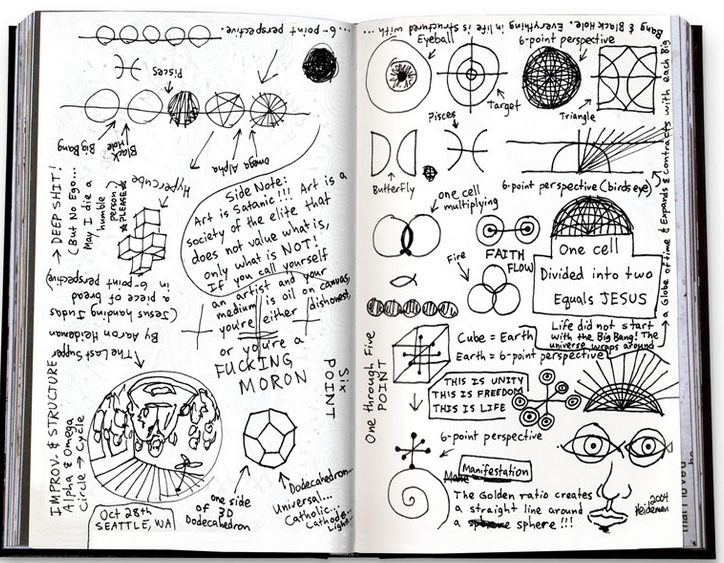
Brian Singer is a San Francisco-based fine artist whose sobriquet “Someguy” downplays the enormously unique body of work he has produced in the last decade or so. I first discovered his work at age 15, when I stumbled across the 1000 Journals Project book in my sister’s bedroom.
An ongoing collaborative experiment, The 1000 Journals Project attempts to track 1000 originally empty journals through their travels across the globe, accumulating stories, sketches, and photographs as they pass between friends’ and strangers’ hands. In addition to larger scale projects such as this, he creates visual art pieces that explore the layers of signification of the printed word, crossing out and redacting text in a process of mixed media décollage.

SARAH MADGES: The extensive, anonymous shared artifact network you created with The 1000 Journals Project speaks volumes about individuals' desires to be creative, without fear of criticism. Did you expect to find so many untapped talents waiting to give expression to their thoughts? Did you initially conceive of this project as a way to make collaborative art or did it just kind of happen?
BRIAN "SOMEGUY" SINGER: I think everyone is creative, but society tends to have a narrow definition of the word. Some people are creative when they cook, or garden, others make art. In the book Orbiting the Giant Hairball, Gordon MacKenzie talks about creativity—I’m paraphrasing here—he says that if you ask a room full of kindergarteners how many of them are artists, they’ll all raise their hands. Ask the same question of a bunch of 6th graders, and a few will raise their hands. Ask high school students, and you’ll be lucky to get a couple to raise their hands. So, what happens to us growing up? We begin to fear criticism and judgment of society.

When the project was conceived, it was based on what people write on bathroom walls. Not quite collaborative art, but more like public conversations. That said, I love the works of Dan Eldon, and sort of imagined what would happened if people just layered and layered their contributions until you got a density similar to his journals.
MADGES: In an increasingly tech- and text-based world, handwriting has lost some of its former relevance and ubiquity—cursive is no longer even required in U.S. school curricula and thousands of people have never written or received a letter in their entire life. How important is the handwritten aspect of these journal entries to you? How important is the written word to you as an artist?
SOMEGUY: The hand-crafted element is crucial to the journals. It’s almost like a signature, or hint of a person’s personality, beyond the words written. As an artist, for whatever reason, it has a little less meaning to me. Strange, now that I think about it. Perhaps because it’s so accessible and anyone can do it, it feels less precious or unique. Or maybe because I don’t incorporate handwriting into my art work — I’ve never really liked the look of my own handwriting. It’s more like chicken-scratch, which I blame my dad for.
MADGES: Do you keep a journal?
SOMEGUY: No. Yes. Sort of. I don’t keep a journal the way most journal artists do. When I was younger, I kept a journal which was more like a diary of sorts. Now, I have sketchbooks, which I use mostly for notes and ideas. Not really for freeform writing, or artwork, just lists and notes and sketches.
MADGES: As far as I can tell, the 1000 Journals Project was last on exhibition in Scottsdale in 2013. Where is it now? What are your plans for the project? Do you consider yourself its curator anymore?
SOMEGUY: There aren’t any exhibition plans for 1000J right now. A couple years back, I approached a few venues, and while there’s some interest, nothing panned out. As for plans, again, I don’t have any current plans. This is mostly due to time constraints, it takes a lot of energy to keep things going. I do consider myself the curator of the project, but am mostly playing a waiting game.. waiting for journals that have been out in the world for almost 15 years to be rediscovered and sent home. I imagine most are sitting on bookshelves, forgotten over the years.

MADGES: What do you think is the relationship between visual arts and creative writing? Do you think of yourself as a poet or writer when you create your cross-out and printed word pieces?
SOMEGUY: That’s a great question, because I haven’t given it much thought. I tend to gravitate towards certain types of works. These can be strictly visual in nature, or strictly written. I think the ability to combine the two opens up the best of both worlds when done well. They can live in harmony, or in contrast, and add value to each other, or amplify the artist’s intent. When I create my redacted works, I mostly consider myself an editor. I’m stripping away information and creating new meaning. I’d hesitate to call myself a poet or writer, which might be an insult to poets and writers, but there are some similarities in our goals to shape language and message.
MADGES: What have you been working on lately?
SOMEGUY: Lately, I’ve been working on building bodies of work around themes. So not really participatory, or journal based projects. One recent explorations was around visualizing number patterns (connect the dots) in unexpected ways. And the current exploration (no photos online yet), are process based works where I put a shape on every page of a book (imagine a circle or letter), and then cut the book up and reassemble the shape using the edges of the paper.
Indian Summer Evenings • Nivedita Nivi
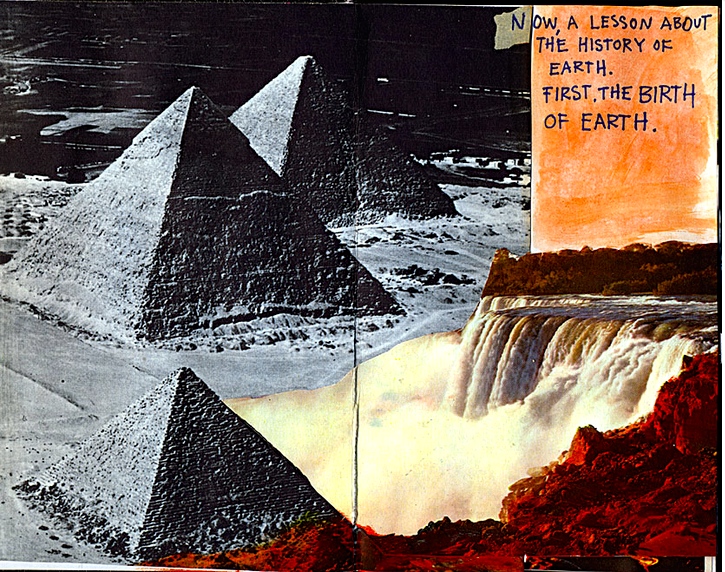
While some use their journals to capture the everyday experience, Nivi uses them as a space and place for her poetry to roam.


A Hyderabadi at heart, Nivedita Nivi dwells in nostalgia. When not editing, reading or writing, she daydreams and watches the squirrels from the balcony of her house in Wisconsin and hopes to meet the rabbit imprisoned in the moon, someday.
Snappy Stories in Bed
A Get Well card from an antique shop that is dated 1955. A cute cat, thoughtful note, and throw-back to getting better, hurriedly so.

What was the cure for the common cold in 1955? A cute cat. So cute that nary an extra word is needed.


Have any gems hiding in your deep storage? Send them on over: info@handwrittenwork.com
Clean


Sarah Madges is a handwriter living in Brooklyn. Her handwriting has appeared in numerous composition notebooks, a handful of three-subject college ruled notebooks, and a whole host of moleskines. She also works with typed words, which have appeared in places like the Village Voice, Killing the Angel, and various abandoned blog platforms.
300 Mg
Wellbutrin blues dose high dose low so close. closet blues
keep shoes rubber made walking. white round scribbles. Avoid
avoids. Walk away stomp shoes bouncing soles black.
colorful hyphen split open particles purged beads of feel
betters scattering scattered. Extend the release of. You might
experience. May include. Talk to your doctor.
Peristaltic magic make me whole soul bouncing.
Internal tremors shake off just wellbutrin blues.
Swallow swallows swallowed shallow breathing blue-
Ing. Better better better better. Walk out old life
matinee movie — much brighter than you
remembered. Glittering goldly sweetly scrim of
saccharine. Put it on peristaltic. Old life moth balls
closet blues forget forgot. Swallowing a white room
quiet white noise machine drown out therapy
drown out but what about tell me about talk
about I. Scratch pad for scars give coat for bag
rattling. Bouncing in bag walking out old life.
Ticking rattler reminder not quite not quite. Quit.


Sarah Madges is a handwriter living in Brooklyn. Her handwriting has appeared in numerous composition notebooks, a handful of three-subject college ruled notebooks, and a whole host of moleskines. She also works with typed words, which have appeared in places like the Village Voice, Killing the Angel, and various abandoned blog platforms.
Behind "The Bone Transfer" • Zachary Lutz
BY ZACHARY LUTZ
The sketch for “The Bone Transfer” was written in a subway car. Probably the B or the Q, headed to Manhattan. I keep a smaller notebook, pocket-sized, with a white cover. It helps that the surface area is more compact, as well the writing is compacted to fit. Tempts less spectators. In this particular type of free-writing, being surrounded by people comes in handy: there’s no contract for details on the subway. I’ll start with some image that’s been consistent and strange, some reoccurring thought. I’m generally writing narrative work, think non-autobiographical, so I’m not always drawing from experience. Easy to steal from something happening next to me on the train and makeup the rest.
The day I’m taking notes that will eventually turn into “The Bone Transfer,” I’m thinking about cartoon physics, TV tropes. For a few days, I’d been scanning this website/catalog of TV tropes, stumbling through entries. ‘Toon physics got me hooked. The page for the trope made note of “Who Framed Roger Rabbit?” as being a good example of the crossover between the “natural laws” of the human world versus that of the cartoon, and thus a good reference point for demarcation. I wanted to write something where character(s) experienced cartoon physics in the human world, but maintained their very human portentousness. I had been thinking for some time about how cartoons experience electrocution.
In addition, I’d received a phone call from a BBQ restaurant earlier that day assuring me that if I were to return to the location any time in the near future, I’d have a free meal voucher waiting for me. It was a wrong number call, but stuck with me. The writing I’m doing in my notebook is really just a way to process details. I try work with specificity as often as possible, and to link those details that might at the start appear un-linkable. (A rerun of an episode of “Shark Tank” introduced me to the Uro Club, which is referenced here alongside another sex organ-themed gift. It all returns to the body.)

When I transpose from my notebook to my computer, I’ll edit as I go. I’ll cut whole sections out, rearrange syntax. I change names or pump up the ambiguity. I want always for the mood of the piece to overshadow the context. Writing or thinking through a piece by hand provides me a necessary freedom which I make freer by movement—a faulty retractable leash that keeps threading out, a series of handkerchiefs from the sleeve of an encouraging magician. I recognize themes in handwriting, leave structure for the word processor. The shearing that results from the unmerciful typing-up of handwritten notes helps manage a pace, become more economical, say more heavily.

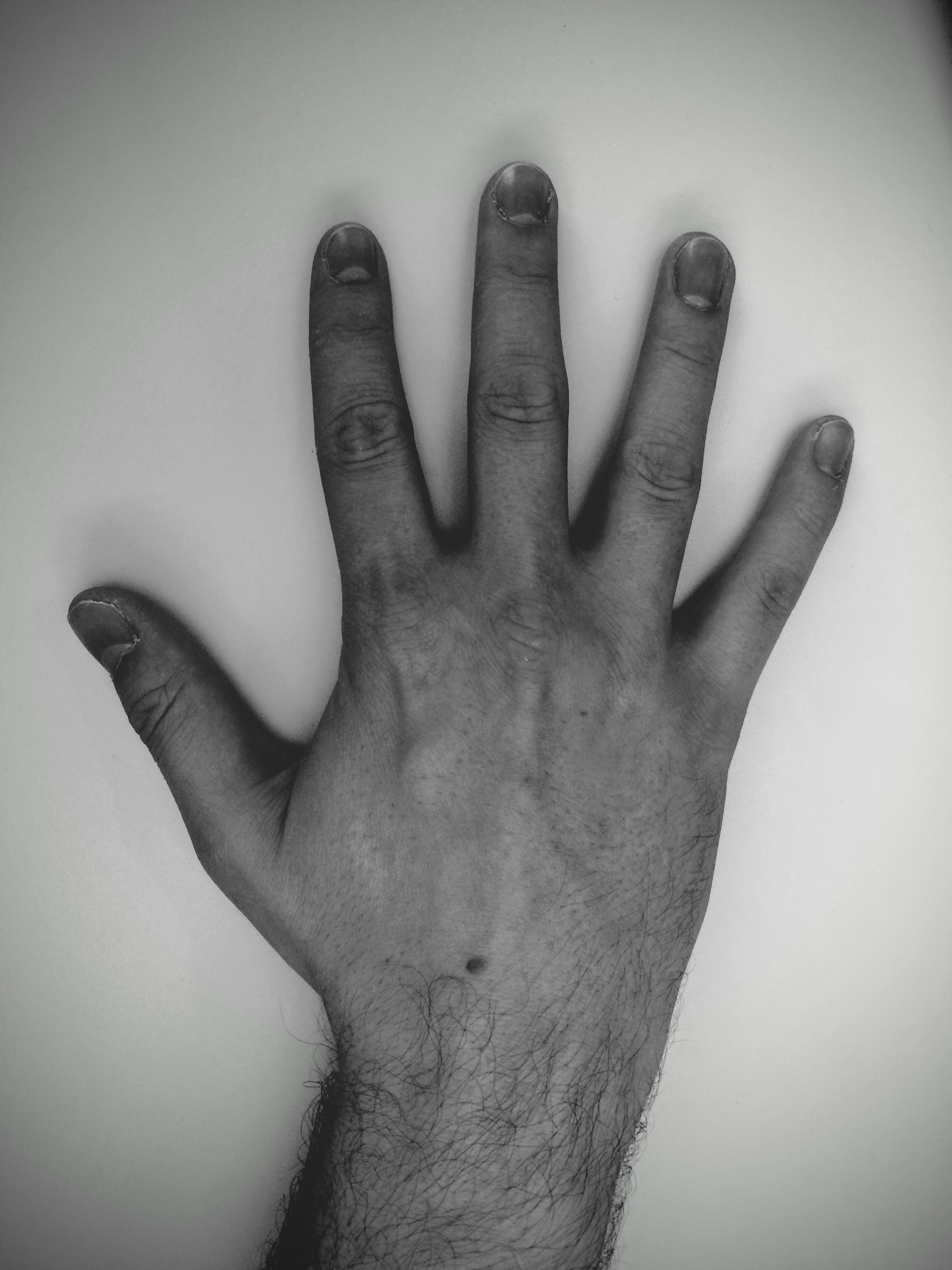
Zachary Lutz is a handwriter in Brooklyn. He holds an MFA in poetry from The New School and received an honorable mention for the Paul Violi Poetry Prize. His work has appeared in Luna Negra Magazine. To the left is his handprint.
Time is Our Wealth, Time is Our Slave • Nivedita Nivasini
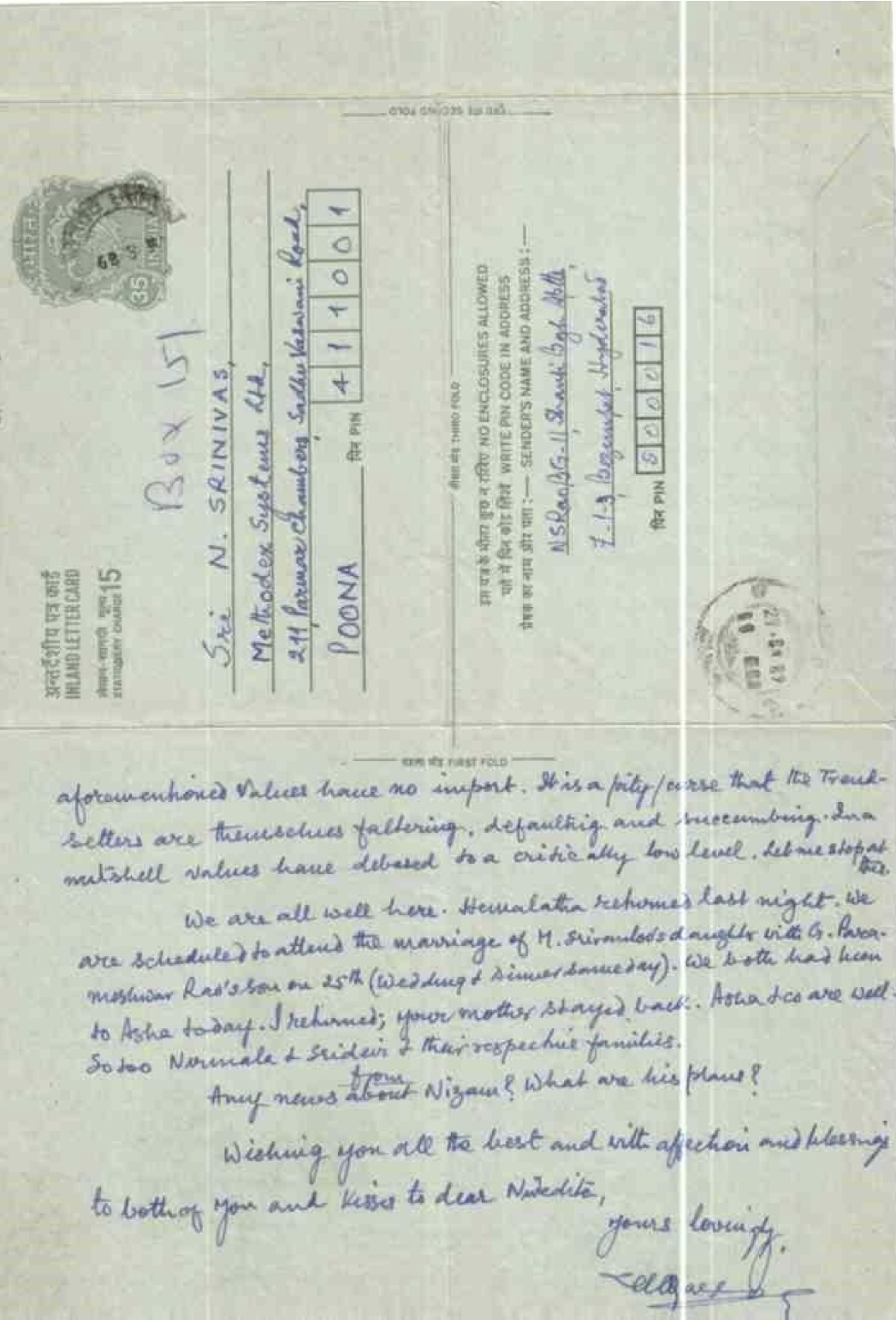
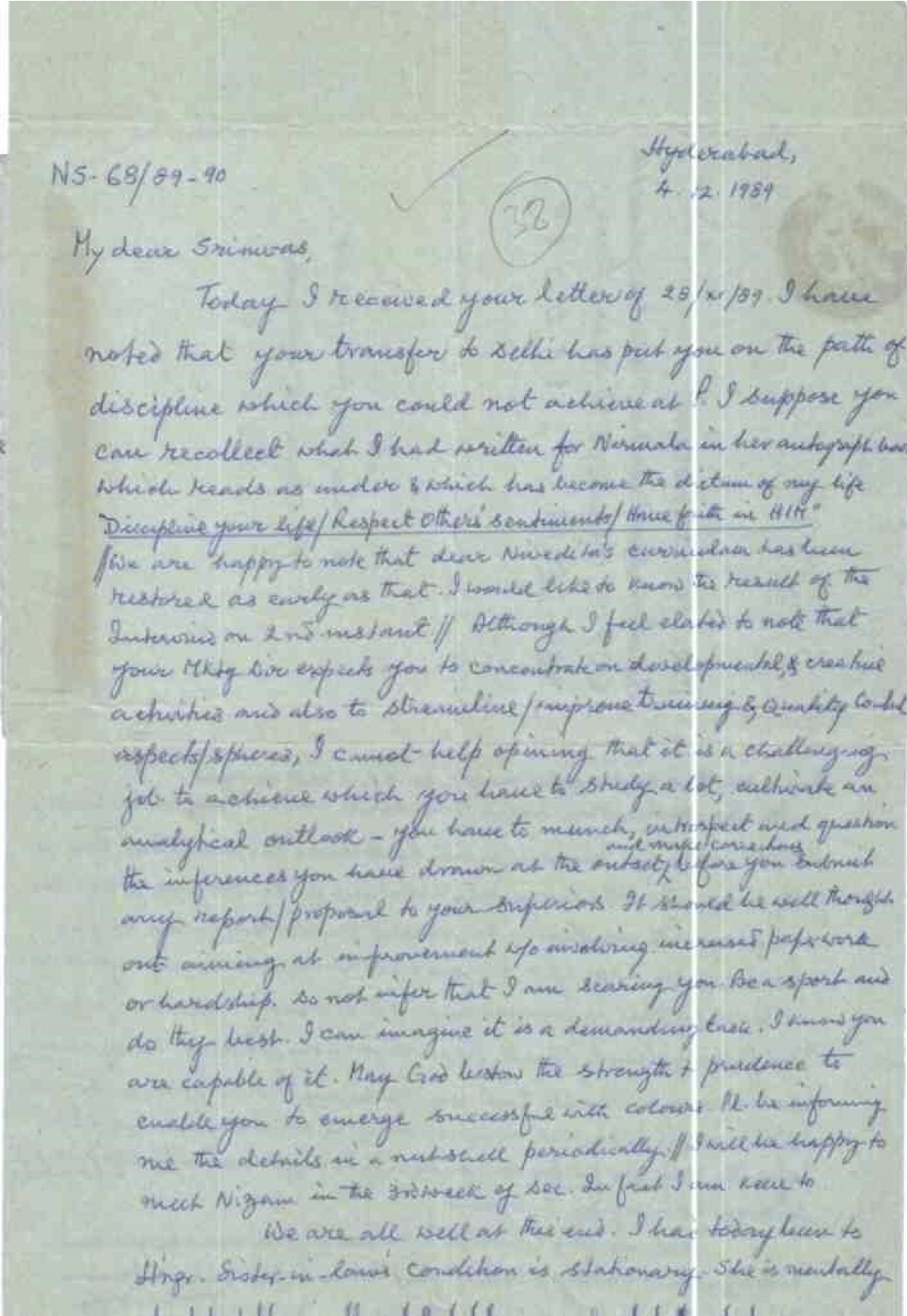
An inland letter that speaks of a generation when emotions, family values, morals and ethics were placed before the concept of individualism.

BY NIVEDITA NIVASINI
This letter, as dated, was written in the late 80s from my grandfather in Hyderabad to my father in Pune (India). In the late 80s, telephone connections took months to be installed, travel in the flights was still exorbitantly expensive and travel by train or a bus from one city to another took at least a day. The intercity telephone call or the STD phone call had to be planned when everybody was at home and the local telephone booth attendant had to be informed in advance to arrange for a telephone call. The arrangement would usually be done when every member of the joint family (i.e. at least two generations of the family living together in the same house) was present. The call would be only to ask about the well-being and each member would talk for 30 seconds to 1 minutes depending on their relation with the person.
As such, the emotions were lost in the technicalities of reaching to the members living out of the city or state or country. Hence, letters were the most comfortable option for a middle class person where he or she could pen their thoughts and emotions. The interesting aspect of writing a letter was patiently waiting for the reply of the letter. And, this letter is one such response.
Due to his profession’s demand, my father, along with me and my mother, left the city of Hyderabad to Pune. Having lived in a joint family, my father obviously missed his parents and the guidance that my grandfather provided. Since letters were the best way of communication, my grandfather and my father communicated often through the same.
My grandfather was (yes, he passed away in September, 2011) way ahead of his times. He believed in women empowerment, secularism, education, and most importantly, freedom of thought. He never bound any one with his chain of thoughts. He also played a pivotal role in my cousins’ and my life ensuring about our well-being and reprimanding us on our mistakes. His letters reflected his thoughts and responses to my father’s concerns while commencing a new life. He always ensured that the letters addressed everything that was asked. He thus carbon copied each letter. It was a practice he observed till the last letter he wrote in early 2011.
My grandfather wrote letters to most of my relatives who lived in other cities. When we collected the letters he wrote to my father and presented to each member of our extended family, they mentioned it to us how our grandfather was always concerned about their well-being too.
I think this inland letter speaks of a generation when emotions, family values, morals and ethics were placed before the concept of individualism. My grandfather always proudly spoke about his many brothers and sisters and the hard ships involved in completing his education. The letter is not only a reminder to us to keep the team or a family above an individualistic goal but also a biography of my grandfather’s generation.
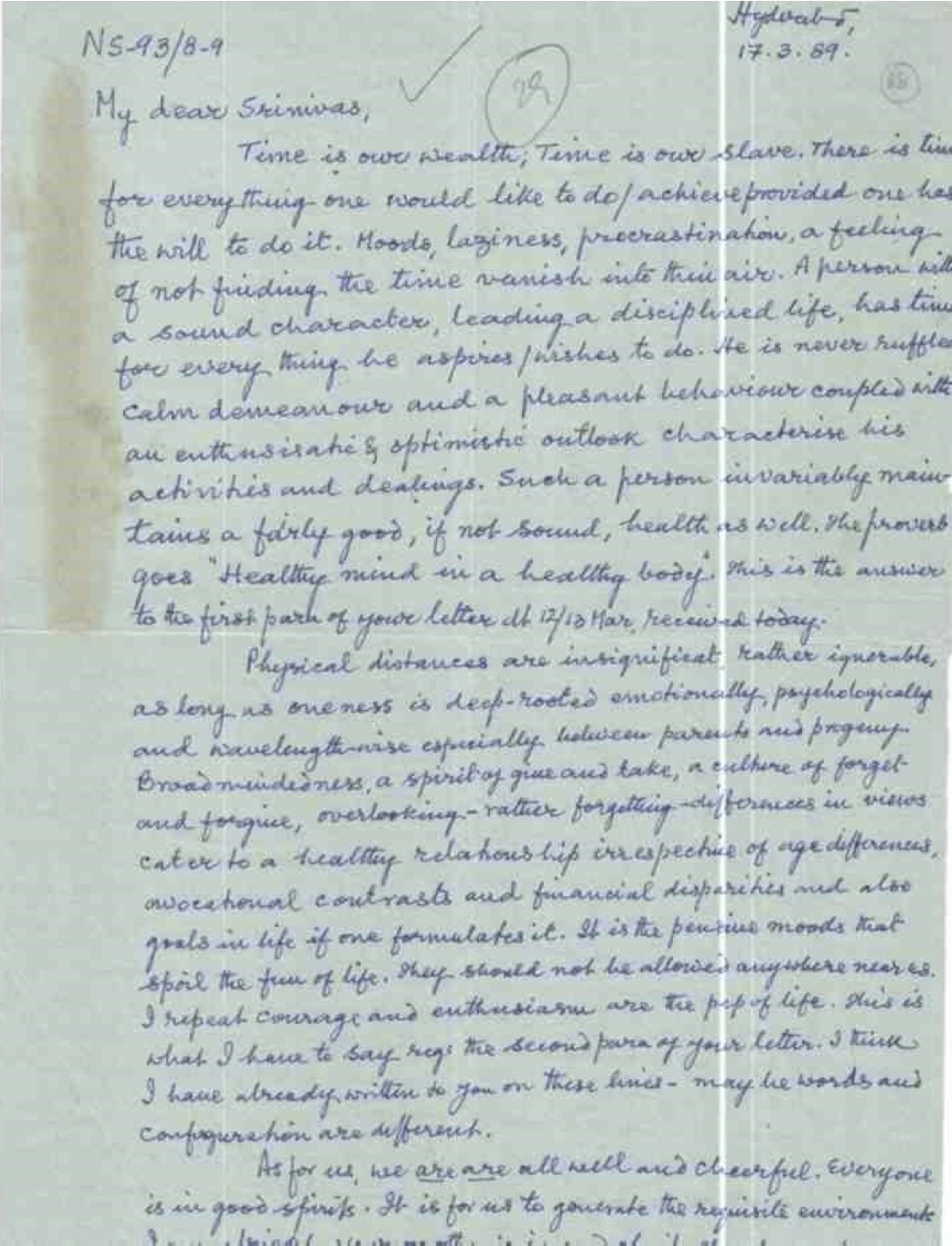
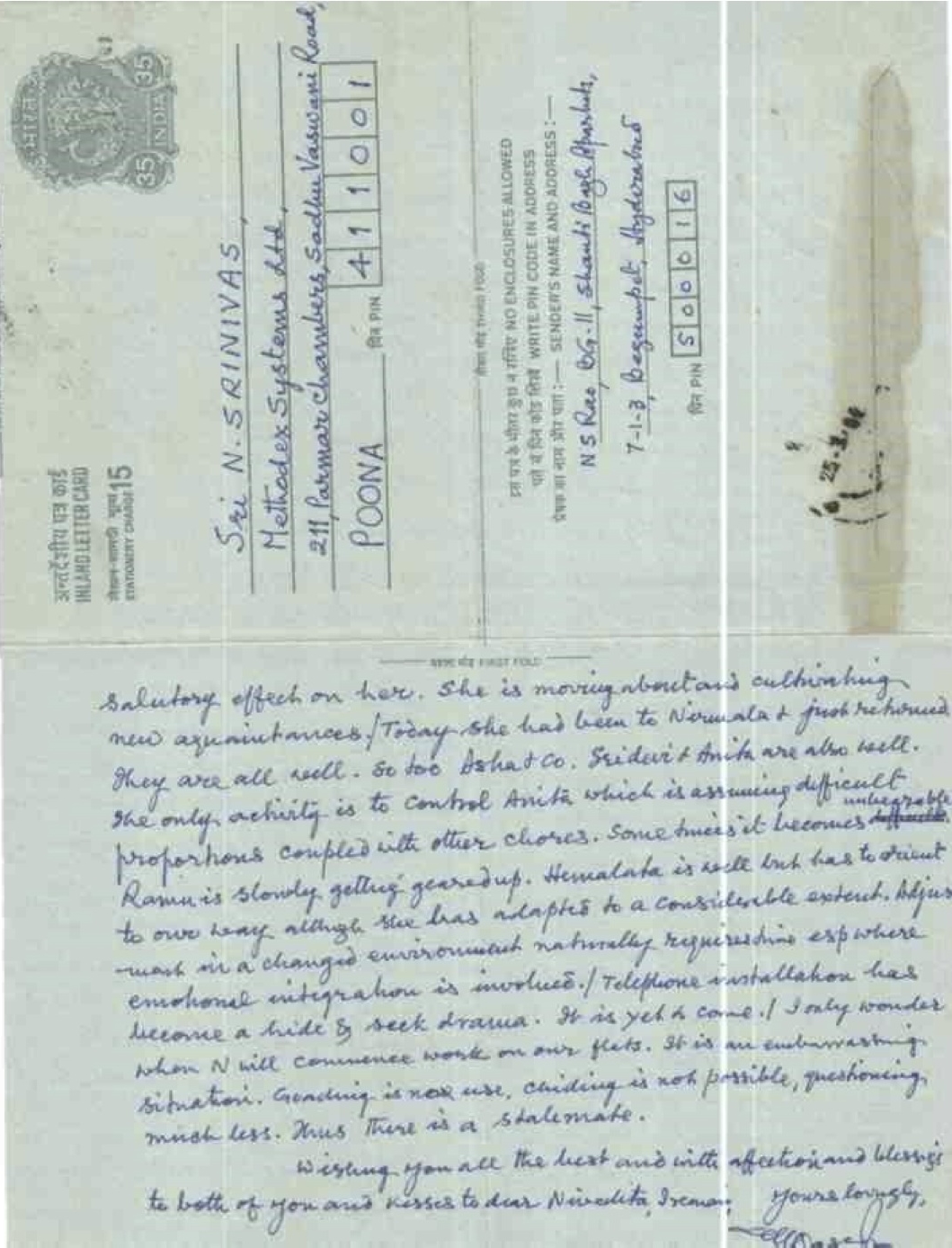
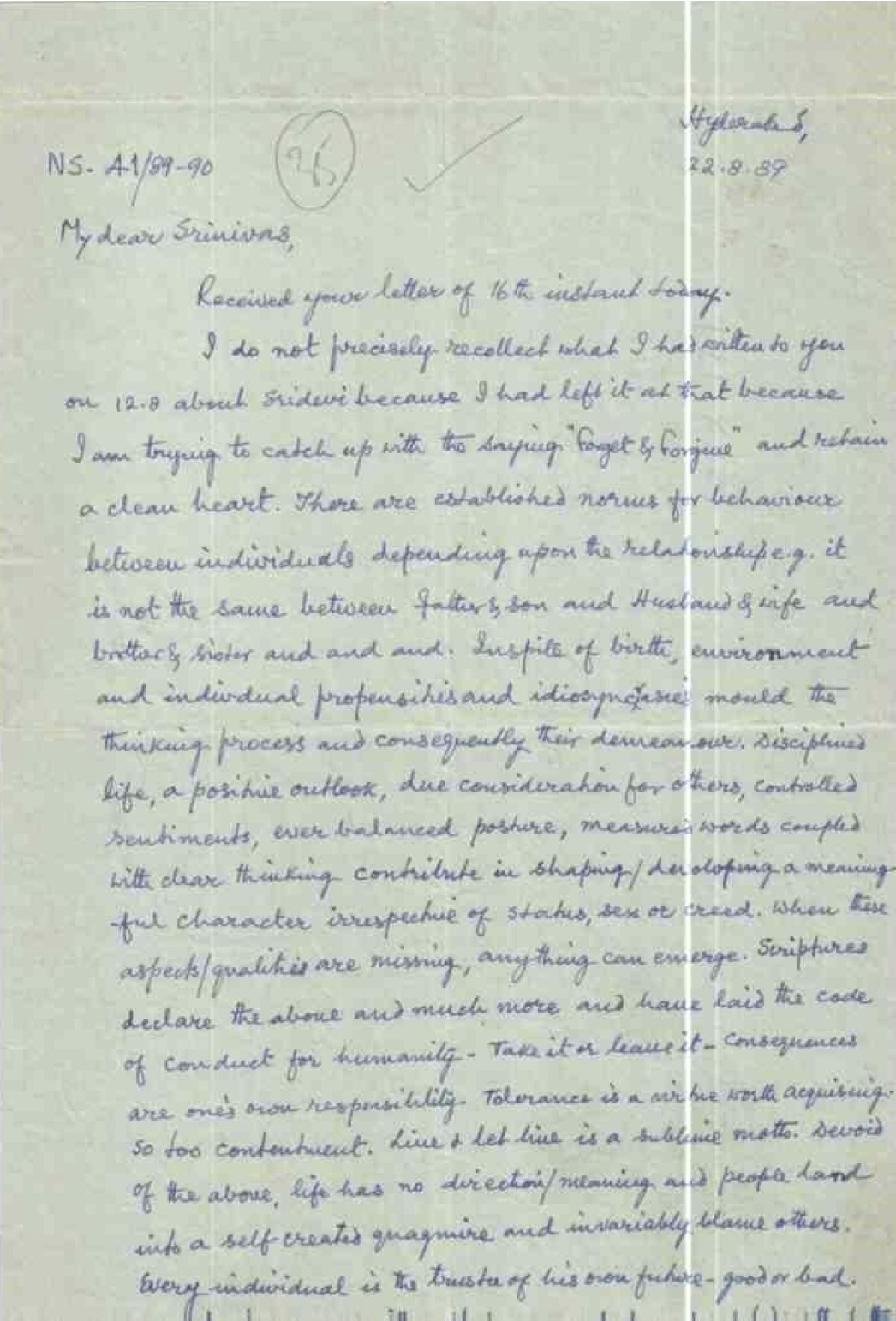
Hyderabad,
17-March-1989
My dear Srinivas,
Time is our wealth; Time is our slave. There is time for everything we would like to do/achieve provided one has the will to do it. Moods, laziness, procrastination, a feeling of not finding time vanish into thin air. A person with a sound character, leading a disciplined life has time for everything he aspired/wishes to do. He is never ruffled. Calm demeanor and a pleasant behaviour coupled with an enthusiastic and optimistic outlook characterise his activities and dealings. Such a person invariably maintains a fairly good, if not sound, health as well. The proverb, “Healthy mind is a healthy body.” This is the answer to the first part of your letter dated 12/13 March, received today.
Physical distances are insignificant, rather ignorable, as long as oneness is deep-rooted emotionally, psychologically, and wavelength-wise especially between parents and progeny. Broad mindedness, a spirit of give and take, a culture of forget and forgive, overlooking-rather forgetting — differences in views cater to a healthy relationship irrespective of age differences, avocational contrasts and financial disparities and also goals in life if one formulates it. It is the pensive moods that spoil the fun of life. They should not be allowed anywhere near us. I repeat courage and enthusiasm are the pep of life. This is what I have to say reg. the second para of your letter. I have already written to you on these lines – maybe the words and configuration are different.
All of us, we are are all well and cheerful. Everyone is in good spirits. It is for us to generate the requisite environments.
|
…. salutory effect on her. She is moving about and cultivating new acquaintances/Today she had been to Nirmala and just returned. They are all well. So too Asha & co. Sridevi & Amita are also well. The only activity is to control Amita which is assuming difficult portions couples with other chores. Sometimes it becomes unbearable. Ramu is slowly getting geared up. Hemalata is well but has to orient to our way although she has adapted to a considerable extent. Adjustment in a new environment naturally requires time esp. where emotional ingredient is involved/Telephone installation has become a hide & seek drama. It is yet to come/I only wonder when N will commence work on our flats. It is an embarrassing situation. Goading is no use, chiding is not possible, questioning much less. Thus there is a stalemate.
Wishing you all the best and wish affection and blessings to both of you and kisses to dear Nivedita.
Yours lovingly,
Satynarayana Rao (signed)
A Hyderabadi at heart, Nivedita N dwells in nostalgia. When not editing, reading or writing, she daydreams and watches the squirrels from the balcony of her house in Wisconsin and hopes to meet the rabbit imprisoned in the moon, someday.
You can find her work at Nivasini Publishers, follow her on twitter @DivenitaEr, and forthcoming is their new site, The Blue Stencil.
An Unsayable Inscription
Inside the weathered covers of Rainer Maria Rilke's 1954 The Way of Love and Death of Cornet Christoph Rilke, lies a very human note.

BY SARAH MADGES
I can't remember the occasion, but one day my then-boyfriend Chris gave me this copy of Rainer Maria Rilke's Die Weise von Liebe und Tod des Cornets Christoph Rilke. (The Way of Love and Death of Cornet Christoph Rilke). I'm a huge germanophone, not to mention a lover of Rilke's poetry, so the present would've wowed me without it being a weathered copy from 1954. Correction: without it being a weathered copy from 1954 typeset in German "Kurrentschrift" — the term for the beautiful script that was still standard in 20th century — along with handwritten annotations from previous owners.
At least two people owned this book before it reached my hands--on the inside cover there is an address sticker and small inscription from a Dr. Spiros Valentinus with an address in Frankurt Am Mein in Germany. The page just before the title page also includes a handwritten dedication in looser and larger felt penmanship that says "Eine kleine Erinnerung an unsern Abscheid am 4. November 1954. Möge Dir dieses Buch scheid bedeuten, wie es mir gibt. Deine, Inge." (Translation: "A small memory from our departure on November 4, 1954. May this book mean as much to you as it does to me. Sincerely, Inge")

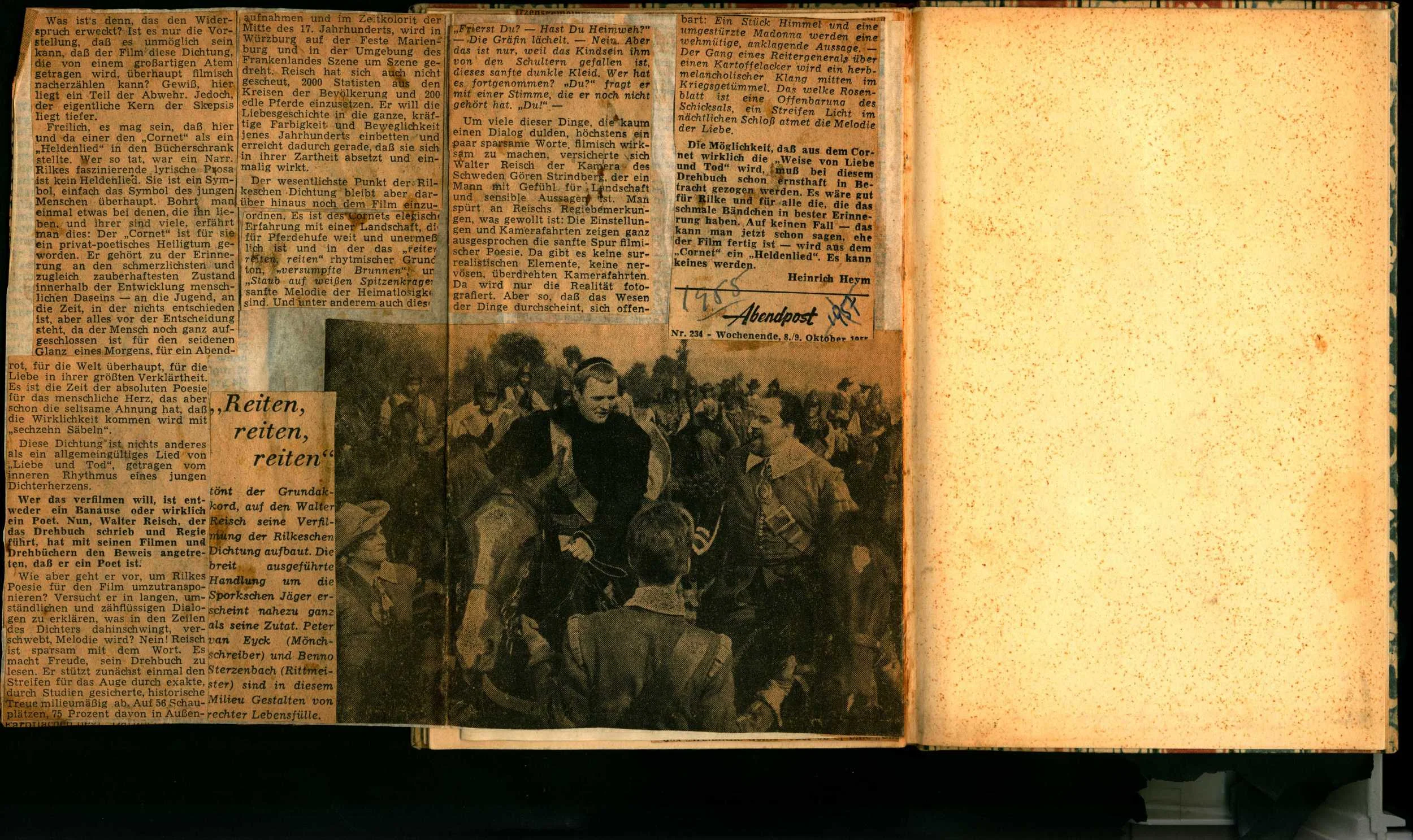
I'm not sure which former owner pasted in the film review from an old German newspaper, but it required careful craftmanship, with columns clipped and formatted to fold out of the book in printed order, accordion-style. Apparently the clipping comes from "Main Post", Saturday December 7, 1955, and discusses the film adaptation of this book.
Should anyone else get a hold of this book after me, they'll notice a third owner by virtue of Chris's slight alteration of the dedication page. He crossed out the "e" in "Deine" to indicate the masculine possessive: yours, and wrote in his name over poor Inge's, to indicate the gift was now for me.


No Other Place Publishes Process • The Origins of Handwritten

In early Spring of 2015, Sarah Madges set out on a project surrounding the Handwritten word and recalled Brett mentioning a project he had recently begun. She reached out to ask if the project was still alive. It was, barely. The exchange served to reignite the project and has since turned into this site, which Sarah is also to thank for, as she since came on board as a central curator for the project. Below is their initial exchange about the idea for the site you are seeing today, which is constantly evolving.

SARAH MADGES: What inspired you to develop a publication/project surrounding the handwritten word? What is your own experience with handwriting?
BRETT RAWSON: I knew I wanted to start something last winter. I took a course at The New School that had us look at digital storytelling, and I found great calm mixed with wild energy in this embrace of and attitude toward technology - how can we use technology to promote our passions, digital or otherwise? On a morning in February, I was on the L train brainstorming for a separate project when the word Handwritten appeared from somewhere. I had my notebook in hand so I scribbled it down. I happened to be heading toward a workshop put on by PEN, so I wonder if that had something to do with the whole thought. At any rate, the word opened up the idea itself: a home for the handwritten word online.
There is no place that publishes things other than finished products. I wanted to promote process. There's a bunch of theories and thoughts about handwriting, penmanship, and personalities. I do think about them, and I care about them, but I am not specifically concerned about them. I don't really care much about their outcomes or conclusions. For example, I find it interesting what people think my handwriting says about me, but I care more about saying things with and through my handwriting. What comes of it in the end is not really something I can consider while I am doing it.
The idea is pretty simple—for people to express themselves with pen and paper, and be published for it. It's also to be a preserve of sorts—for letters written by those who have passed, for example. I am always writing by hand. I don't always write my stories by hand, though most things usually begin on paper—in a journal, on a napkin, or a legal pad. I do, however, write a lot of letters. It's how I ease myself into writing for the day. I can't jump into writing on the computer without starting by hand. I have to start somewhere free. In this sense, it's like stretching, doing yoga, starting out slow, or warming up.
MADGES: What is the project's mission statement?
RAWSON: A place in space for pen and paper. But I have been thinking about changing it to something a mentor of mine once said: writing is a physical activity.
MADGES: Are you concerned that handwriting / cursive lessons are being eclipsed by keyboard proficiency lessons in U.S. elementary schools?
RAWSON: I'm not so sure I am that worried about cursive. But that's probably because mine is horrific. In fact, my regular handwriting sort of looks cursive. Or maybe it looks like it is cursing. It's hard to tell. Someone once said my handwriting looks like a string of wasted wingding characters, which is offensive, but true. But handwriting altogether, what a horrific waste of natural talent. The hand is how we gain access to our inner self. I really don't think the computer can access that wild, raw energy inside each of us. When using a computer, I get an external feeling (usually in the form of mild swells of panic), whereas when I write by hand, the noise from everywhere really quiets down, and I can finally hear my own voice.
The people making these policies, or mistakes, probably don't write by hand much. I imagine they see it as a waste of time, or something of the past, that we should get with the times and technology. This measurement feels imprecise. And it isn't a matter of sentimentality. It also isn't about one or the other. I wonder when people will wake up and coexist - to stop living in some world of ones. I write on the computer all the time. I have four twitter accounts, a Facebook profile, page, and group, five Instagram accounts, one tumblr, and three websites. You know? It's not like I don't get the beauty and power in the computer, let alone its efficiency, insanity, and amusement. I am a user, and I love using it. But what a fucking mistake to not teach kids how to write by hand. So I guess I am concerned.
MADGES: Do you notice a difference in the kinds of things you write when you use pen/pencil as opposed to a computer / word processor? How do you think the writing tool affects content/style/etc? How do you think it affects the editing process?
RAWSON: Absolutely. The medium affects everything. The effect is also bilateral. The reader adjusts his or her expectations based on the medium. A letter is sort of like dining out—there is an experience to it. An email is more like take-out, delivery, or TV dinner - it is often more quick, requires less from me, and can be done while doing something else.
That being said, I don't see it as a matter of good or bad, better or worse. It is simply different. Writing by word processor is more about a product or outcome—a finished something—and so pieces composed there are usually toward that end. But with handwriting, it is more so a work of progress, or process. It is, inherently, more private and intimate. Computers are meant to connect, gather, and scatter. And the screen in between becomes a kind of reflection and projection, which can be a disorienting feeling that registers at a deeper level. Handwriting is about process on two levels -- one, it is about the process, but two, it is a way to process things. Not necessarily produce a product.
MADGES: Phenomenologists have argued that the self falls away when we are engaged in an intense activity, usually one that collapses the sense of the mind-body split by activating both elements. Do you think the writing implement of choice could act as a bodily extension, and that writing by hand helps combine subject and object in ways that promote intimacy with a text, whereas typing into a word document promotes separateness of subject and object?
RAWSON: Fascinating. I imagine this has to be. There is a oneness when it comes to things like painting, the piano, or even running, and so it would make sense that it carries over to hand-writers. It makes me think of meditation for some reason, only I don't really know why. There is intense freedom within limitation, which might be why the computer is such an energy vampire. It pokes so many holes in our concentration containers that after a short period of time, we feel totally drained. Whereas with the handwritten word, I think of a dam and what happens when everything flows through a single thing—it harnesses a new kind of energy. Because with handwriting, you aren't concerned really with what you're writing. There is something hypnotic about the way in which the hands moves.
MADGES: Anything else you would like to add?
RAWSON: Keep the beautiful pen busy!
Linked Lines from a Faraway Home

HANDWRITTEN BY JENNY CURRIER, LIVIA MENEGHIN, AND DEIRDRE SCANLON