
This is Where I Battle My Writing Demons • Sheila Lamb

BY SHEILA LAMB
The first draft always begins on paper with ink. Sometimes, the first handwritten words are a line, a sentence, a phrase. Sometimes, a scene. Usually, these words will not be in the final story. But they mark the magical moment where the story began.
I find ideas flow better from paper to pen. When I handwrite, I write fast. Inspiration can be elusive and I want to get the words on paper without disruption. There is a smooth connection from pen to hand, something that, for me, pencils don’t give. Computers certainly don’t. The pen is, literally, a fluid implement. I favor gel pens (a Pilot G-2). It’s part of the whole flow of words, from thought to paper. I’ll use pencils in a pinch, but graphite tends to smudge and fade. There’s also a rub as the pencil hits the page, a dryness, a physical sensation, that gives me the shivers – like fingernails on the chalkboard. Occasionally, there is the issue of broken lead and the search for a pencil sharpener. Pencils, despite their simplicity, have too many complications and they are not my utensil of choice.
Ballpoint pens are another option. They are easy to find, ten to a pack. However, they are my second choice. Words don’t glide from a ballpoint as they do from a gel pen. Like the pencil, the ballpoint ink to paper has a palpable feel that is off-putting to me. Ballpoint ink can be thick and gloopy, and sometimes leaves thick globules at the end of sentences. Although ballpoints are certainly preferable to computer keyboards, they don’t have the smoothness of a gel pen.
*
Writing by hand is second nature to me. Perhaps because I’ve handwritten stories since elementary school, when they gave us green penmanship paper with fat, chunky pencils. I’ve kept paper and pen journals since high school. It’s easier for me to reach for pen and paper than trudge to the laptop, wait for it to start, find the folder, open the file, and pray the program doesn’t freeze or mysteriously return me to last week’s temp file draft. All those layers of technology slow the inspiration, that spark of a new story or pivot within a plot.
For short stories, I write the entire first draft — or what I think is the entire draft at the time — on paper. Most of it begins in my bedside journals. My recent story, “Hunger, Not Tame,” began after a camping trip to Assateague. I journaled about our trip and the feral horses. I was infuriated with the tourists, who petted and fed potato chips to the horses on the beach.
That incident was the scene that stuck, and the one that gave way to story. I began to play on paper, shifting from my journal to a spiral notebook — last-day-of-school perks of the teaching trade — expanding the scene into a story, in longhand. I witnessed Kate, the main character, grow from this exploration: a park employee who confronted the people tossing Doritos at the horses. I write until I come to what feels like a stopping point — the end of a scene or section of dialogue. If I’m lucky, I’ll discover the final sentence here. Something in the shape of the words lets me know that this is it — this phrase where the story will end.
*
In writing by hand, I’ve discovered that this is where I battle my writing demons. For me, past defines the present, so as a writer, I struggle with back-story. Actually, I revel in it. I spend a lot of time figuring out how my character made her way to the start of the story. I tend to develop psychology before I develop plot. Why is the character there? What makes her do what she is doing? Writing those back-story details by hand is necessary for me to create the character. I’m fine knowing many of those initial, raw words won’t make it into the next draft. The process paints a picture, so I know who I’m dealing with as I place her in situations she’d rather not be in. The potato-chip tourists barely made it into the final draft. Even though they were the beginning, in the end, they were a brief, two-sentence presence. They were simply a starting point for Kate to explain why she was at Assateague and what motivated her work. The longhand process, I’ve discovered, is a sort of third-person, in-character, journaling.
*
My conflicts with electronic writing are three fold: First, my creative energy, that burst that inspires a new story, vanishes when I start writing on an electric document. All of the green and red warnings that highlight misspellings and incorrect punctuation are like blaring sirens, taking me out of the story. Instead of writing, I go back and correct. That delete key is dangerous. It can very quickly disappear a phrase that might not fit in that sentence, but a phrase I may want to use later. Second, as I develop and revise the story, I prefer the kinesthetic, hands-on process of physically writing (educational researchers are looking at the correlations between student success and handwriting but I’ll save that tangent for another time). Instead of scrolling through track changes, highlights, and text colors, I make side notes on paper with the pen, underline an idea I want to develop, remind myself to go back and find a synonym, with a circle and the abbreviation: syn. The handwritten notes make the ideas and revisions stick. Finally, I’m incredibly distracted by the Internet. Turn off the Wi-Fi, a lot of people say. Yet the Internet is a necessary evil because many stories require research. I researched the feral — not wild — horses of Assateague, their history, and the park regulations, but the pull of social media is powerful. It is so easy to go from the National Park Service site to Facebook, to Twitter, and pass another hour without actually finding anything of substance, just scrolling from one site to the next.
Eventually, the story needs to go electronic. For me, this is where revision takes place. I find digital typing is great for the editing phase. I transcribe the paper page word for word into Scrivener. Then, I’ll take a look at chronology, scenes, and plot development. I love the way I can add a new text page or section, and stay organized as I work. With this, I’m able to move scenes around and bridge the story together. In “Hunger, Not Tame,” I played a lot with Kate’s past and how much to include in the story, the back-story burden. It took several revisions to refine the central scene, where her past and present collide.
But after the digital jump, I’m back to paper and pen. I print out the revised draft and I read through the story on paper. I edit, make notes, read it aloud. I mark it up. There, it develops shape and structure. Those changes are made again on the typed draft. Then, there is another printed version for a final read-through. Last minute changes are made, with pen on the paper, and corrected again on the laptop.
Handwritten work takes time. My electronically-inclined friends claim I’m doubling my time on a story. You could have been done by now. But good storytelling shouldn’t be fast or easy, no matter the method. Writing stories is, for me, a hands-on process, an artistic process of creating a world, of creating a person, of creating a story. Writing by hand allows my creative magic to have its space.

Better Smut by Hand • Wednesday Black
Publishing under a nom de plume, this rising novelist reflects on how writing the first draft of her erotic novella by hand led to all kinds of unforgettable feelings.

BY WEDNESDAY BLACK
I wrote the smutty little novella, How to Train Your Virgin, in the fall of 2014. Badlands Unlimited, a publishing company founded by artist and activist Paul Chan, had put out a call for erotic fiction the spring before, and I took a chance and entered a chapter. I thought there might be a little money in anonymous smut-making. The result was a somewhat bittersweet novella of feminist, fabulist fiction — oh, yeah, and fucking.
The real surprise for me was the enormous flow I experienced while writing it. I’d never written anything like it before, and it felt…good. It was as if my Inner Critic was so mortified she had no choice but to take a vacation. After all, I was working in cliché, striving to boost every scene over the top, and doing it all in a fantasy playground populated by evil bog women and clockwork sex carousels. Let’s not even get into the title! I mean, what could Inner Critic say that I didn’t know already? So I ran with the story — or maybe it ran with me.
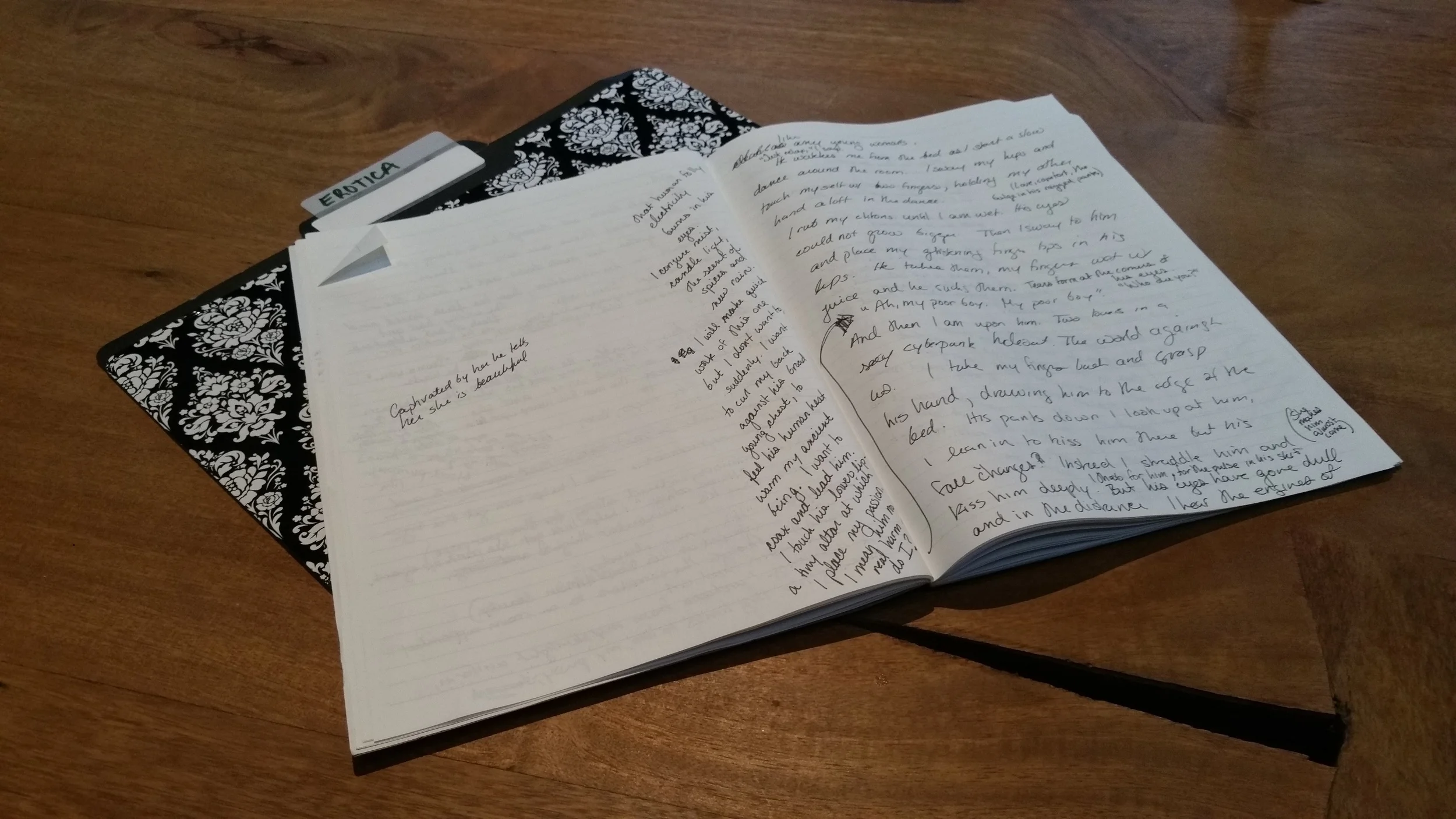
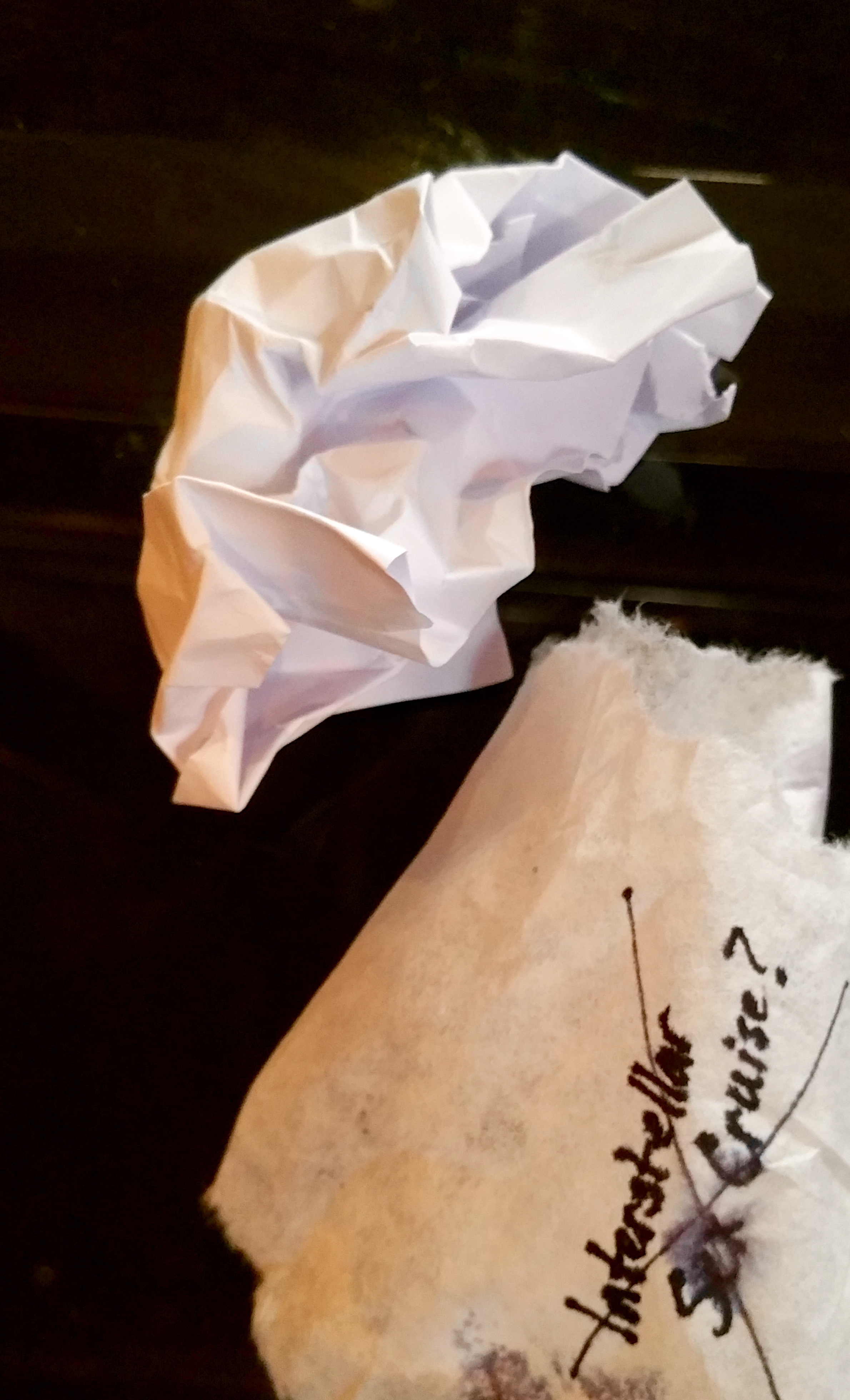
I wrote most of HTTYV by hand — in bed, on the subway, hunched over in any number of coffee shops throughout Amagansett and Manhattan. I scrawled over multiple notebooks, post-its, scraps of napkin, the backs of receipts, and along the way I lost as much as I wrote.

Sometimes I like to imagine someone picking up one of those lost scraps of prose. What might they make of the scribbled words about Minotaur fellatio, great, tiered foundries for sexual smelting (okay, that one didn’t make into the book), or numbered directions for seducing hipsters? This is one of the dangers and pleasures of writing with pen and paper. Such words have a way of fluttering away on mysterious wings and leading lives independent of those we imagined for them.

Looking back at these first-draft jottings more than a year later, I can see a childish exuberance in my pen strokes and slashes. In many cases the finished product was very different, of course, and I’ve included examples here and there where it is relevant.
What is it about writing by hand? I like seeing what I scribbled out, having it still there even though I’ve consigned it to ballpoint obscurity. I love the act of scrawling ideas, scenes, shreds of dialogue — when I do, it seems to come from my hand and not my brain.

Looking at it now, I can see by the physical state of my writing how I was feeling then: frustrated, ashamed, enthusiastic, bored. I can relive my process as it developed, see where my creativity tripped and fell, and the moment it brushed itself off to allow the show to go on. Here is the raw version of The Ruin Carnival scene and the published version:


Sure, the paragraph that made it into the published novella is clearer, contains more — but would not have existed at all without the notes. One was the organic, physical product of handwriting. The raw material. The other was processed until it became more effective and organized. That it was processed and finished with the rather sterile act of tapping away on a plastic and metal contraption is significant. A keyboard and a screen have a disciplining effect. Remember my Inner Critic? She was allowed to come home again during this part. Another example:


Often I didn’t feel certain necessary content deserved to be written by hand—why waste the ink and finger joints? Instead, I wrote a note to my future self to get on with it as in this note. Love scene is a euphemism for SEXSEXSEX. In fact, I wrote most of the actual sex scenes on the prudent keys of my Mac.
As for the passion, the obsession, the pain and heartache—all of those things I found were best rendered by hand. There is something about writing these human intrigues that required, for me at least, a body-word collaboration best engaged by planting elbows on table and pressing down with pen.
In the end, after all that scribbling and wild fun, it was a trip to get the published version. Rigid margins, clearly printed large-type, a cover…wow. That’s classy smut, I thought. But the most human part, the communication between individuals — that was handwritten.


Leia Menlove is Wednesday Black is Leia Menlove. Her writing has been published in Monkey Bicycle, Joyland, Joyland Retro Volume 2, The Artificial Selection Project and more. Her novella, How to Train Your Virgin, was released by arts publisher Badlands Unlimited in March 2015, and was featured at the The Solomon R. Guggenheim Museum Series, "Conversations with Artists and Writers.” She is a graduate of The New School MFA program for creative writing, and splits her time living and working in New Orleans and New York City. If anyone finds a notebook containing scribbled notes for a dirty novel about women who are attracted to deconstructivist architecture, please email her immediately: mswednesdayblack@gmail.com.