
Lemon Pound Cake • Kelly Spivey


A note from Curator Rozanne Gold: In this beautiful story about a memorable lemon cake (and Brunswick stew), Kelly shares her experience as both a pastry chef and as a devoted member of a tight-knit family. Kelly’s love of food led her to drop out of graduate school where she was pursuing a Master of Fine Arts to study baking (a girl after my own heart, I also dropped out of grad school long ago to pursue a career in New York’s food world. I later went back to get an MFA — who knows — so might Kelly). After ten years as pastry chef, Kelly now works at a specialty coffee roaster and coffee bar in Memphis, Tennessee, while she researches and writes about the history of baking and pastry in the south. Southern food ways are so in vogue that I await her gorgeous prose.

In the South, our relatives are our people.
My people come from North Carolina. They were farmers and owners of a general store. They lived in Northampton County, almost at the border of Virginia, where the pine trees were just as much a commodity as the peanuts and cotton.
My grandmother, Elizabeth Braswell Spivey, was born in Northampton County in 1925. She lived on a farm very far out in the country.
On the property was a long, rectangular cook-house and an adjoining family room with a fireplace, couches, and games. The cook-house had a large wood-fired brick oven that housed two large cast iron pots, and a cast iron, gas-fueled fryer that only was used for cornbread.
Starting somewhere in the ‘30s or ‘40s, my family has held a Brunswick Stew every year in the Fall. We would wake up early for an hour drive to my grandparents’ house, usually arriving around seven. The men hauled firewood to the brick oven and lit the fire. The women gathered in the cookhouse family room to peel pounds and pounds potatoes, and to empty huge cans of tomatoes into the cast iron pots.
Generally, the men did all the stirring with wooden paddles the size of boat oars, but as a defiant teenage girl, I refused to peel potatoes and insisted on stirring instead. I would sit on top of the warm bricks, next to the cast iron pots, and stir for hours. After three hours it was time to “take up the stew” and fry the cornbread.
I loved how we all came together and took hands as we gathered in a large circle. The head of the family (my grandfather and after he passed, my father), would lead us in giving thanks and each joined hand would gently squeeze the other before letting go.
Finally, we could reap the rewards for our work. Plates were filled with Brunswick stew, pulled pork, slaw, and fried cornbread. Then they filled again with brownies, pig pickin' cake, lemon pound cake, thick slices of pie, and occasionally, ice cream.
We made between 200 - 250 quarts of stew each year, to be shared with family and friends. It was kept in the freezer and sustained us all winter.
After my grandmother's death in 2013, I received boxes of her cookbooks and recipes jotted down on envelopes or advertisements for fertilizer. Some were just newspaper clippings. I received all of this during a time when, as a pastry chef, I was beginning to delve into my own history and re-create the desserts of my people.
The earlier recipes are written in cursive so neat you can almost see the lines of the grade school primer it was practiced in. The later recipes become smaller, cramped, and more hurried, making them illegible to the untrained eye. Sometimes there were just notes denoting "good" recipes.
As I worked my way through the scraps of paper and fragile books, I put the ingredients together in my head, tasting every dessert on the sideboard at Christmas and every contribution from my aunts at the annual Brunswick stew. But it was my grandmother’s lemon pound cake that was in evidence at every gathering.
The first bite was so good — the tart-sugary glaze on the pillowy, yellow-tasting cake. The second bite was to make sure that yes, you can taste yellow. To this day, it is the only cake my brother will eat.
My assumption that this cake was a made-from-scratch triumph was quickly shattered when I asked my mother for her copy of the recipe and saw that a box of Duncan Hines yellow cake mix and instant yellow pudding were two of the key ingredients. I wanted to make the legendary cake for my brother's birthday. This was years before my grandmother had passed and I was at the very beginning of my pastry career. (I’m now 33).
I tried to reverse-engineer it — omitting the instant pudding and cake mix (the horror!) and adding in real lemon zest and juice — but the results were never as good. Some things are best left alone. My grandmother understood, after all, that a cake is just a reason to gather together.
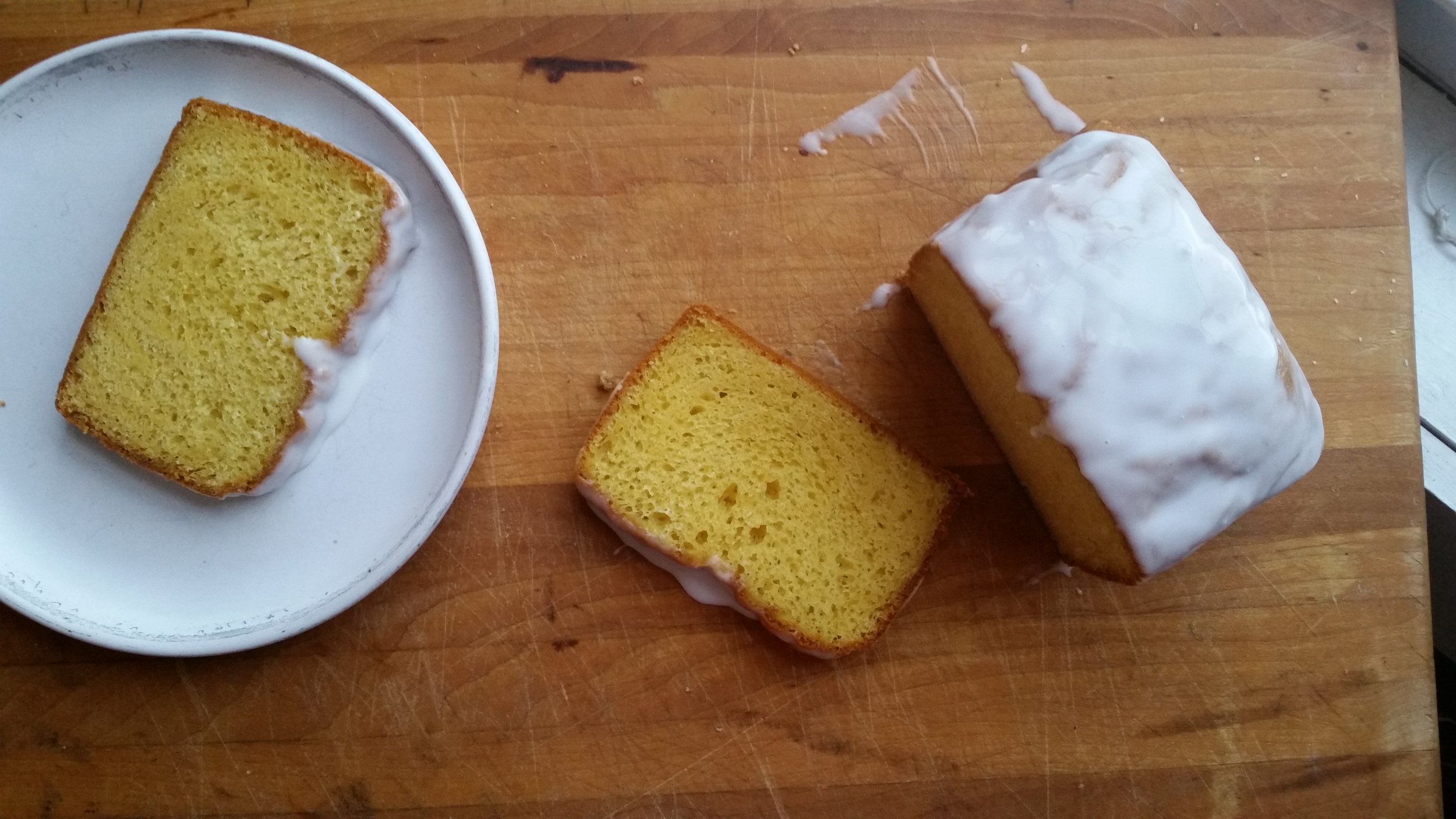
Lemon Pound Cake
Note: Kelly says that she often uses a Kitchen Aid with the paddle attachment and beats the batter for 8 minutes. Her grandmother did it by hand for 10. Pour the batter into a large loaf pan that has been brushed with oil and lightly floured. Although the handwritten recipe does not include instructions for icing, Kelly prepares a thin glaze made from 1 cup of sifted powdered sugar and 2 to 4 tablespoons of fresh lemon juice.
INGREDIENTS:
1 box Duncan Hines yellow cake mix
1 box instant lemon pudding
2/3 cups water
1/2 cup Mazola oil
4 eggs
Lemon flavoring to taste
DIRECTIONS:
Put in mixing bowl and beat for 10 min.
Preheat oven at 325. Cook for 1 hour
Does better if you do not open the oven door until the hour is up.
Makes 1 cake


Kelly Spivey (left) and her grandmother, Elizabeth Braswell Spivey (above)
A Mother’s Day Reflection • Interview with Rozanne Gold by Allison Radecki


A note from curator Rozanne Gold: It is Sunday morning, Mother’s Day, 2017 and I am missing my mother terribly. It is especially poignant, then, to be writing this curator’s note. I am grateful to Allison Radecki for conducting this interview with me about my beloved “Ma.” Always, “Ma.” Marion Gold, my best friend, soul mate, guiding light. She died in 2006 and never got to meet my daughter, Shayna, whom we adopted at age 11-1/2 less than a year after my mother died. They would have loved each other deeply. My mother’s love of food was infectious, but it was another level of nourishment — of a more spiritual, humanistic nature — that fed me best. It is also meaningful to write this today (our 30th feature) on the first-year anniversary of “Handwritten Recipes."

ALLISON RADECKI: Since the first handwritten recipe profiled in this column was one that you penned and framed as a gift to your own mother, Marion Gold, for Mother’s Day in 1980, it seems fitting that we feature one of her own recipes today. Which handwritten recipe of your mother’s were you drawn to as you approached this holiday weekend?
ROZANNE GOLD: I have a recipe for my mother’s Garlic Broiled Shrimp — with a debatable “s” at the end. She really never said “shrimps,” but she might have questioned herself while writing the title. Her handwriting is as elegant and finum (a Hungarian word for refined that she often used) as she was.
I was excited about the clarity and straightforward simplicity of this dish. Although I never follow a recipe — ever — I followed this one with great results. Michael (my husband) and I ate the whole thing standing up at the counter and were almost giddy from its clean, pure flavors, its stunning plainness. The second time I made it, I embellished a bit — a bit of tarragon and a splash of wine — and ruined it.
That day, with great intention, I summoned her up so that I could see her standing in her kitchen in Queens. There was a smile at the edge of her lips, her shoulders gently sloping, like the curve of her “m” in minced. She minced fresh garlic with her small, favorite knife that was never sharp enough. Would she peel and de-vein the shrimp? I imagine her long piano fingers delicately removing the black vein along the curve of each shrimp’s back. And there was all that curly parsley, meant to be finely chopped. I mean, curly parsley! When was the last time I bought curly parsley? This was a dish for company meant to be served with rice. A box of Carolina Rice was as iconic to me as a Warhol soup can.
RADECKI: Where did your Mom keep her recipes? And where do you now keep hers?
GOLD: My mother kept her recipes in a blue kitchen binder decorated with simple and colorful illustrations of kitchen utensils and ingredients. It has large yellow envelopes as dividers in which you could stuff too many recipe cards. After she died, I found a stash of additional recipes in an old-fashioned tin, filled with blue-lined index cards all in her graceful handwriting festooned with her beautiful swoops and swishes: chicken cutlets, fresh string beans, sour cream coffee cake. The binder and tin now nestle together in the drawer of my pine kitchen table.
RADECKI: Did your mom like to cook? Did she cook often? What do you remember about her cooking?
GOLD: Every night. She cooked every night and made the things we loved. Cabbage and noodles, another dish of stunning simplicity, was my comfort food growing up. Mornings were made special with her apricot-filled ultra-thin crepes called palascintas; meatloaf was always in the shape of a heart.
My mother also made something she called “Tunk-a-lee,” soft scrambled eggs with tomato, pepper, and onion — very Hungarian flavors — but every culture seems to have a version. Another dish I loved was a stew of hot dogs, cut on the bias, with potatoes and onions in a ketchup-y broth. And pot roast. She made the most fabulous pot roast with so many onions, a bay leaf, and splash of dry vermouth. She made it all the time and later revealed that she hated pot roast.
My mother loved to entertain. She’d take white bread, cut the crusts off, and roll it paper-thin with a rolling pin — so thin, it became like pastry. She’d then cover each slice with creamy blue cheese spread and put a fat canned asparagus on it. They would get rolled up tight, brushed with melted butter, and baked. Oh, how many of these I used to eat before company came! Lethal.
RADECKI: How would you describe your relationship with your mother?
GOLD: Ours was an amazing love story. It would be impossible to describe all the joys in our life together, but there was lots of sadness and loss, turmoil and drama, too. But there was also lots of happiness that we shared in big and small ways. I liked the small ways best. Laughing until we cried, playing scrabble; cooking, doing things to please or surprise each other, or just talking ten times a day on the phone. There were trips and travels and innumerable nights of splendor at The Rainbow Room and Windows on the World. There were victories and milestones to celebrate. And I got a chance to write about her in many of my books and magazine articles, too. She was modest and never believed in "tooting her own horn,” and told me never to toot my own. But, nothing came close just to being together.
RADECKI: You have often said that your mother was “More Zsa Zsa than Julia.” Can you paint a picture of the mom you see in your mind’s eye?
GOLD: My mother was a seeker of wisdom and beauty. She was such a beautiful woman. She loved people. She loved children. It always felt like she was doing something special, wanting to please.
She grew up in Florida in a tiny town called Belle Glade, near Pahokee. It was just her, her mom, and her dad. They were poor, but she didn’t know it. She grew up happy. She was always a tall drink of water, though her bosomy mother was only four foot ten.
Mom escaped to the University of Miami, back when it was just one building. Her parents died in her early thirties within six weeks of each other. My mother told me that when her mother died, she felt as though her heart had broken. She carried a lot of sadness. There were deep feelings.
She was a teacher, a hospital volunteer and a medical assistant, but I think she wanted to be an actress. She could be the most glamorous person; a bit like Zsa Zsa.
On her 80th birthday, three weeks before she died, it took her quite a while to get ready. We weren’t going anywhere but she wanted to make it a special occasion. She was so weak but spent hours in her bedroom getting ready. When she finally came out, there were high heels, a mink jacket, and sequined glasses. She could hardly breathe, but she dressed up like a movie star. This is how she wanted us to remember her.
RADECKI: You and I often talk about how recipes — especially handwritten ones — ignite connections. In the spirit of sparking a memory or two, let’s play a quick game. Tell me the first thing that comes to mind about your mother when I say:
Scent: Onions and her own sweet perfume. We each had our own scent. I wore Rive Gauche. She was a sexy, sensual woman.
Sight: It’s summertime, and she’s in the backyard drinking an iced cold Heineken. It’s so out of character, but that’s what I see.
Sayings: "Kickups." If I acted out, she would say, "kickups." As in, "Watch out. You’re about to head into trouble."
Right before she died my mother said the most amazing things. Look deep inside your heart and you will find the answer. Have the courage of your convictions, even if you are wrong. Have more faith in life. Have fun! And love and care will make everything all right. That one is most important. I still keep them with me: in my wallet, handwritten down.
RADECKI: When, do you think, was your mom proudest of you?
GOLD: One night, we had a real New York City evening planned. She came to meet me in the city to hear Michael Feinstein at the Regency. She came in by taxi from Queens. It was a real moment, to see us together in that way, dressed to the nines. We became elegant and adult together. Yet it was a moment of exquisite recognition of our separateness.
RADECKI: When were you proudest of your mom?
GOLD: Although we could get so angry with one another, there was never a time I was not proud of her. That may be my deepest connection to her. I always felt so proud of her.
RADECKI: You’ve credited your mother for recognizing that you had a future in food, and urging you to pursue that passion, even at a time when women were not prominent in professional kitchens. How did she see your path and encourage you to do what you loved?
GOLD: When I was in college at Tufts, I got a phone call from my mom. She had just heard an interview with the Hungarian restaurateur George Lang. That was the very first time I heard the idea of a restaurant consultant. I was a dual major in psych and education, but the food, she knew. I mean, she let me become a bartender at age sixteen, when she knew it wasn’t legal.
My mother was the one to see that I was spending more time cooking in the kitchen than working on my Masters degree. I dropped out of graduate school and became the first chef to New York Mayor Ed Koch when I was twenty-three. She enjoyed visiting me at Gracie Mansion, but felt bad about the grueling hours.
Again, always wanting to please. There was a restaurant, Villa Secondo, in Queens where my parents would always go. But, one day my mother called me to say, “Rozanne! Secondo, it’s gotten so much better!” Years later, I found out who the new chef was. It was Lidia Bastianich. She knew! My Mom just knew. She had that food sense.
RADECKI: In 2009, a few years after your mother’s death, you bought and saved over six thousand cookbooks from the library of Gourmet Magazine and donated them to the N.Y.U. Fales Library in your mother’s name. What does it mean to you to see her name Marion Gold on the nameplate of every book in that Gourmet collection?
GOLD: It felt so full circle…so right.

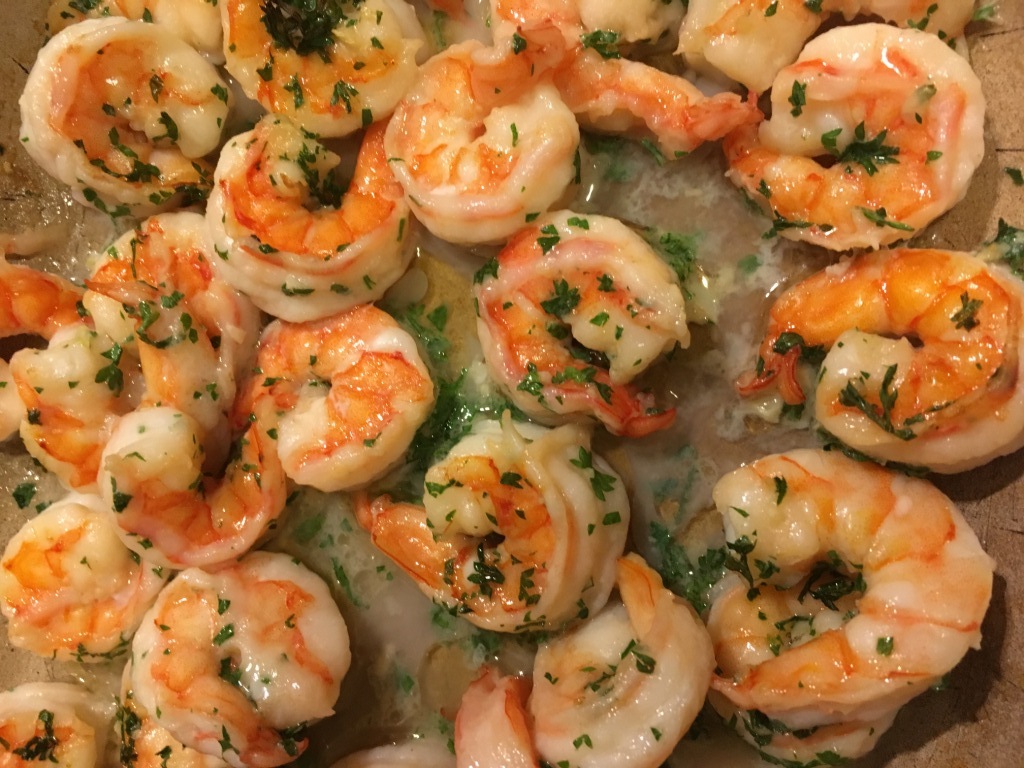
Garlic Broiled Shrimp
Note: You can buy large cleaned, deveined shrimp. Reduce cooking time depending on size of shrimp. Do not overcook.
INGREDIENTS:
Two lbs. raw shrimps
½ cup olive oil
2 garlic cloves, minced
2 Tsp. salt
½ cup chopped parsley
Lemon wedges
DIRECTIONS:
Arrange shrimps in shallow baking pan. Sprinkle with olive oil, garlic, salt, and half of parsley.
Broil about 4 inches from source of heat for 5 to 7 minutes on each side – Sprinkle with remaining parsley and serve with lemon wedges.

To see the rest of Rozanne Gold's "Handwritten Recipes," click here.
Grandma Rozie’s Pot Roast • Tina Barry
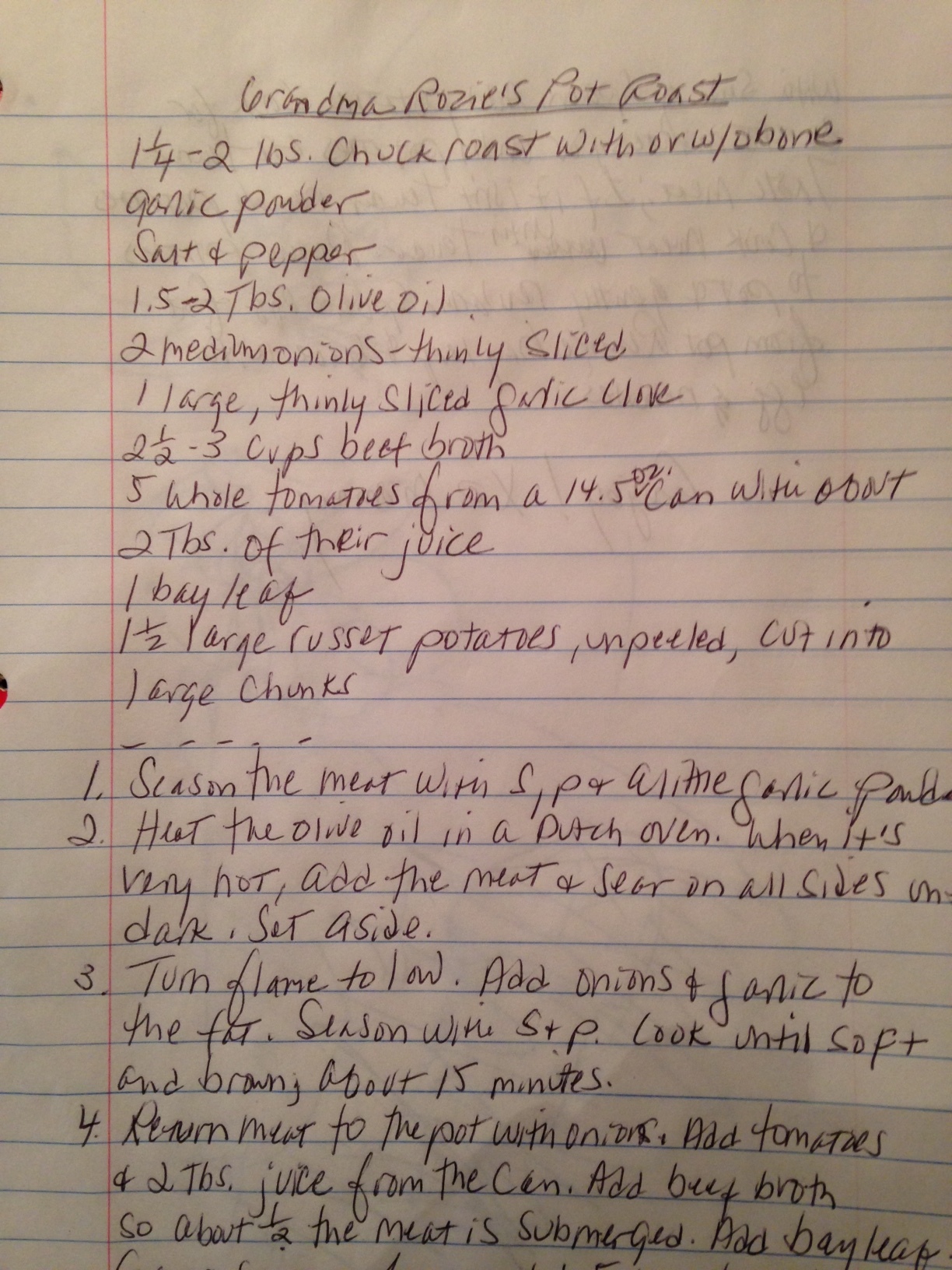
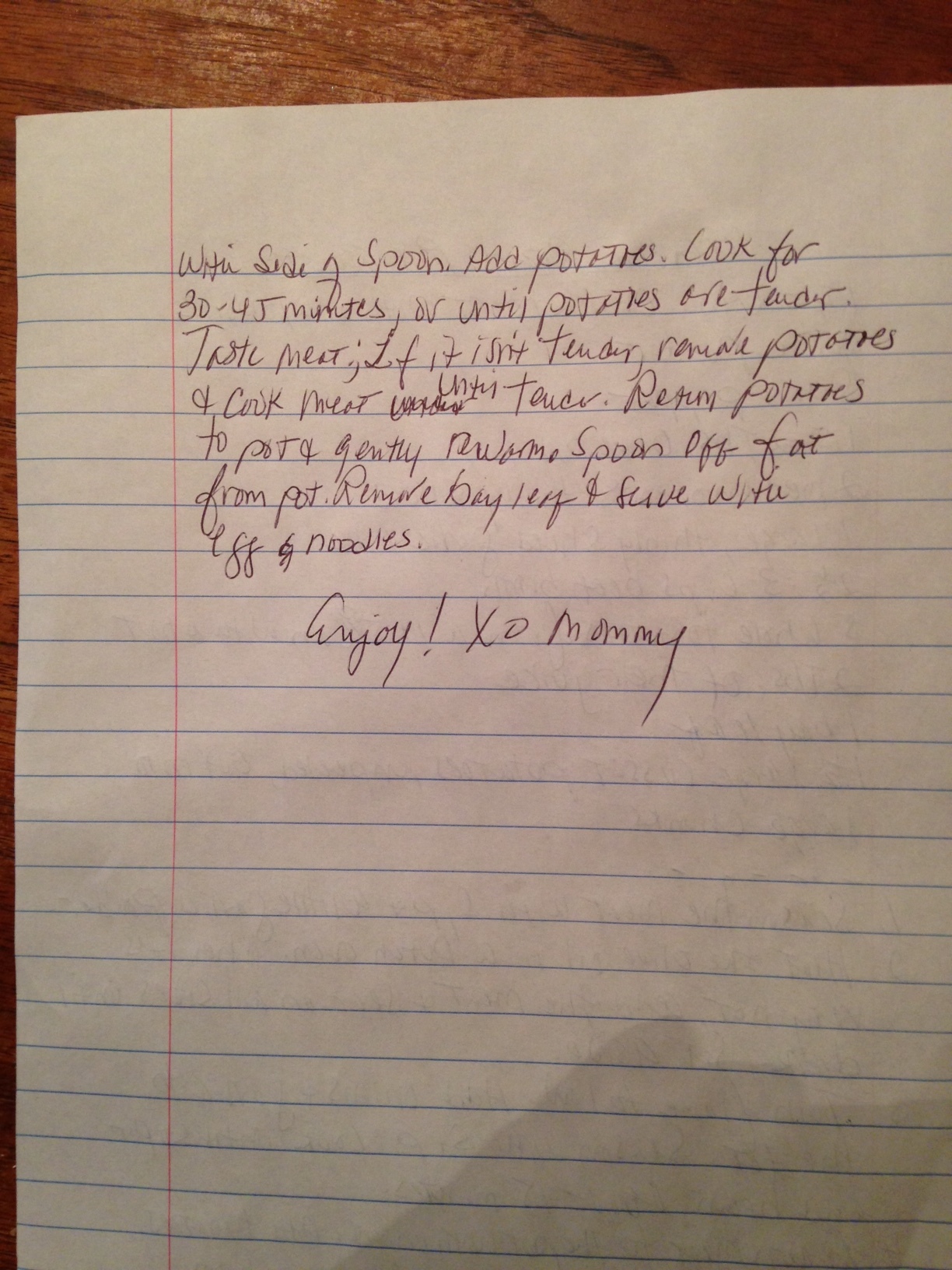
Note from curator Rozanne Gold: Tina Barry, poet, writer, and former restaurant critic for the Brooklyn Paper is a woman of myriad talents. Her poems and micro-fiction have appeared in numerous literary magazines and two pieces in her poetry book, Mall Flower, were nominated for Pushcart prizes. But her biggest prize may be the generational embrace she nurtures with her 91-year old mother, Roz (the creator of this story’s succulent pot roast), her beautiful 26-year old daughter Anya, and the precocious Vera, nearly two years old. A writer of great warmth and wit, Tina extends these qualities to everything she touches — her joie and appreciation for whiskey sours, the empowerment of women, great design, and great meals (especially in France). An evening at her upstate New York home includes feasting from husband Bob Barry’s exquisite handmade ceramic plates. Tina is a teaching artist at the Poetry Barn in West Hurley, New York, and is an editor for the restaurant and fashion industry. Many bows to her for this beautiful story.

Grandma Rozie’s Pot Roast by Tina Barry
My mother, Roz Ehlin, the daughter of Russian immigrants, cooked four dishes perfectly: pot roast, stuffed cabbage, roast chicken and chicken soup. She broiled lamb chops, boiled frozen vegetables. Mashed potatoes came from the box. She has never, and, at 91 years old, has no intention of ever owning measuring cups or spoons. “I’m creative,” she told my sister and me when we were children, “creative people don’t measure.”
As limited in variety as our meals were, everything she cooked tasted great to us. That was a good thing. Divorced with a full-time job, she didn’t have time for elaborate dishes and she didn’t tolerate picky eaters. A friend of mine, who asked for her food separated on the plate so nothing touched, was never asked back for dinner.
My mother may have kept her repertoire of meals well edited, but she loved, and still loves food, was curious about culinary trends and enjoyed reading recipes. Once a month she’d visit the library and, after perusing the latest Vogue and Cosmopolitan, head home with a stack of cookbooks. After dinner, she’d sit on the couch with a cookbook on her lap, my sister on one side, me on the other, and slowly turn the pages.
“Look at that,” she’d say. My sister and I sighed over quivering Jell-O molds, bubbling pots of fondue, crisp pastry shells cradling Chicken á la King. Pineapple Upside Down Cake left us speechless. “One day,” we’d say, staring at a delicately browned dome of Baked Alaska.
On our kitchen shelf she kept Peg Bracken’s I Hate to Cook Book; my mother appreciated Bracken’s dry wit. The other book was a tiny collection of recipes that my sister and I scribbled all over with purple crayon. One recipe for potted shrimp, turned up in my second grade class’s holiday cookbook, rechristened “Shrimp á la Ehlin.” She didn’t have a single handwritten recipe.
Out of the house and into my own kitchen, I vowed to cook and cook well. I bought measuring cups and spoons and used them. I baked apple pies and layer cakes, whisked batter for wisp-thin crepes. I mastered the perfect omelet.
I was not, though, “creative” the way my mother was. I needed recipes, at least in the beginning while I learned the basics. Recipe or not, I was determined to nail her pot roast. First attempts were okay, if lacking the joie de vivre of her dish. One trial produced tender meat but a sauce without much flavor; I should have used broth, not water. Once I added too many tomatoes, turning the dish into a kind of pot roast ragu. I overcooked the potatoes; my mother’s potatoes were soft, not mushy. It took awhile but one glorious night, I served a pot roast identical to my mother’s.
My daughter Anya married recently. She has asked me for recipes for the dishes she loves. I emailed them to her, until she requested Grandma Rozie’s Pot Roast. I have the recipe in my computer but I couldn’t bring myself to send it. Something so weighted with memories, so redolent of good times at the table, deserves more than clicks on the computer to attach and download.
Her pot roast recipe is a part of our history: my mother’s, daughter’s and mine. And will be a part of my granddaughter Vera’s history, too. When Anya cooks for Vera, my mother will be with them in all the flavors on the plate. There will be a little of me, too, in the slant of my “t,” the dot that never quite caps the “i.” That’s what a recipe does, especially one that’s handwritten: it brings loved ones closer with the proof of their hand on paper, the memory of clangs and chatter, the perfume of onions cooking slowly on the stove.


Roz Ehlin’s Pot Roast
1.5-2 lbs. chuck roast (with or without bone)
garlic powder, salt and pepper
1-1/2-2 tbs. olive oil
2 medium onions sliced thin
1 large, thinly sliced garlic clove
2-1/2 to 3 cups beef broth
5 14.5 oz. cans, whole tomatoes
(with 2 Tbs. of their juice)
1.5 large Idaho potatoes
(unpeeled, cut into large chunks)
1 bay leaf
1. Season the meat on both sides with salt, pepper and garlic powder. Heat the oil in a Dutch oven. When it’s very hot, add the meat to the pot and sear on all sides until dark. Set aside.
2. Turn heat to low. Add the sliced onions and garlic to the fat. Season with salt and pepper. Cook until soft and browned, about 15 minutes.
3. Return the meat and any juice collected on the plate to the pot with the onions. Add the tomatoes to the pot with the 2 Tbs. juice from the can. Add beef broth so about 1/2 of the meat is submerged. Add bay leaf. Cover and simmer for about 1.5 hours, then turn the meat to finish cooking.
4. After about 2 hours, add more broth if necessary; you want enough liquid to make a nice sauce. Crush tomatoes with side of spoon. Add potatoes. Cook for about 30-45 minutes. Remove potatoes when they’re soft. If meat is still chewy, cook until tender. Return potatoes to pot to warm. Cook for a few minutes. Spoon off fat from sauce. Remove bay leaf and serve. My mother always served pot roast with egg noodles.


Mr. L’s Onion Soup • Alan Seidman
Note from Curator Rozanne Gold: Alan Seidman, former legislator from Orange County District 12 in upstate New York, embodies what it means to be a distinguished citizen. Countless man-of-the year awards and lifetime-achievement awards do not do justice to the thousands of people he has helped through his philanthropic and professional endeavors. His personal journey – graduating with a master of science degree from Emerson College in speech, to owning a liquor store, a variety store, an ambulette company, to the ranks as Chairman of the Orange County Legislature, makes him one of the more interesting people I have met. Just last month this serial entrepreneur chaired an event for the Purple Heart Award with General Petraeus and more than 550 attendees to raise money for the “Purple Heart Hall of Honor” Museum. I'm a better person for knowing him.

Mr. L’s Onion Soup by Alan Seidman
It’s the beginning of June and hardly the time one stops to consider a bowl of onion soup but, nonetheless, it is what I made this week for my son Adam who is just home from college. A rising junior at Elon University in North Carolina, he is generally away at school during cooler weather and never gets to enjoy this soup anymore. Adam grew up loving this recipe, one I learned to make from the elderly gentleman who I transported to and from dialysis appointments three times a week in my shiny then-new ambulette more than 25 years ago.
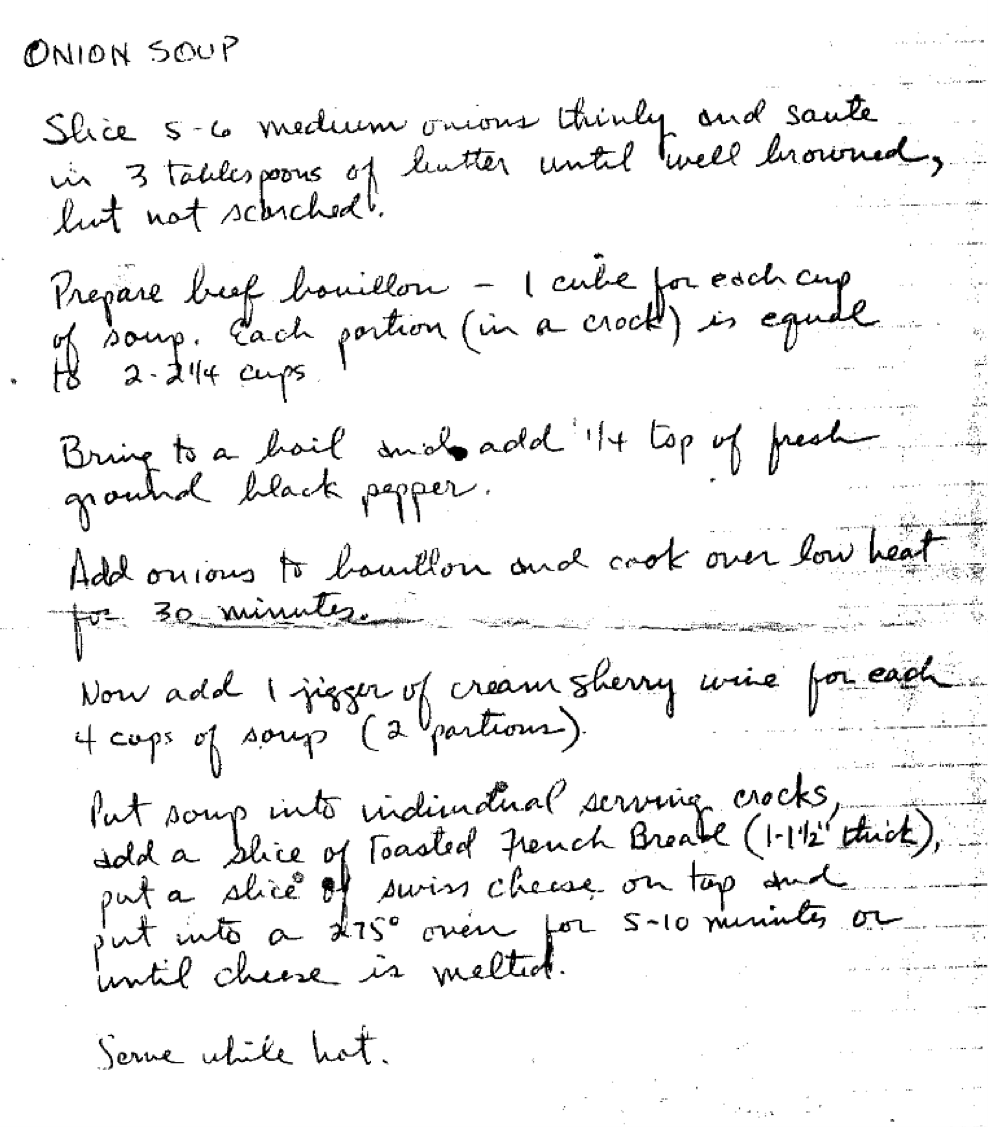
Mr. L. was an elegant man who was born and raised in Pennsylvania and worked his entire career for one employer here in the Hudson Valley, where I live. In spite of his physical challenges, he remained upbeat and we had great discussions during the trips…some of those chats were about our shared love of cooking. He held his recipes “close to the vest,” but I managed to get him to share a recipe for French onion soup. I’m not sure if it was his not wanting to divulge everything or wanting to make me do some experimenting, but he was never clear about the cup or crock measurement for bouillon, so I split the difference in his slightly oblique instructions. (I use eight bouillon cubes for twelve cups of water.) One thing Mr. L. was very specific about, however, was that the bouillon had to be Knorr’s Beef Bouillon or, he admonished, it would not come out right. I once tried it with another brand and it did not taste the same (nor was it as good). I even tried it with my own homemade beef broth long ago but, it too, was lacking in character.
The recipe is written in Mr. L’s own handwriting, since mine is rather illegible. It is prepared with the requisite slice of toasted French bread and topped with melted Swiss cheese. It is something I make frequently when we entertain over the winter and it is always a hit with our guests. I think it is the generous amount of Harvey’s Bristol Cream Sherry that makes it sing. (At times I have noted that a generous amount of this sherry also makes me sing.)
I had been an active member of the Cornwall volunteer Ambulance Corps. for decades and had my own transportation business for more than a dozen years, and I think about the thousands of wonderful people I met during those times. There is a quick intimacy that develops
in stressful times and a vulnerability that ensues when one is elderly or dealing with illness.
Mr. L. and I became good pals over the years. His handwritten recipe is now well-worn with numerous Xeroxed copies all over my kitchen.
(By the way, I am informed by Ms. Gold, that the original recipe for onion soup contained no broth whatsoever, because the French peasants who devised it could no way have afforded rich beef stock and one needed a saint's patience to darkly caramelize a massive quantity onions in order to get the right color and flavor.)
The first spoonful tastes a bit salty, but with the addition of booze it reaches perfection. I thought about what I might drink with the soup to make it more compatible for imbibing in warmer weather (I owned a liquor store for years) and thought a full-bodied rose from Bandol or a cellar-temperature pinot noir from Oregon might do. But I think Adam and I will drink a few beers instead.
Onion Soup
adapted by RG from Mr. L's recipe
Serves 6 - 8
Ingredients
5 to 6 medium onions (about 2 pounds)
3 tablespoons unsalted butter
6 (extra-large) Knorr beef bouillon cubes (2.3 oz. pkg.)
12 cups water
6 tablespoons Harvey’s Bristol Cream sherry
6 or 8 slices toasted French bread (cut 1-1/2 inch thick)
6 or 8 slices Swiss cheese
Note: a jigger is a measure of 3 tablespoons or 1-1/2 ounces.
Directions.
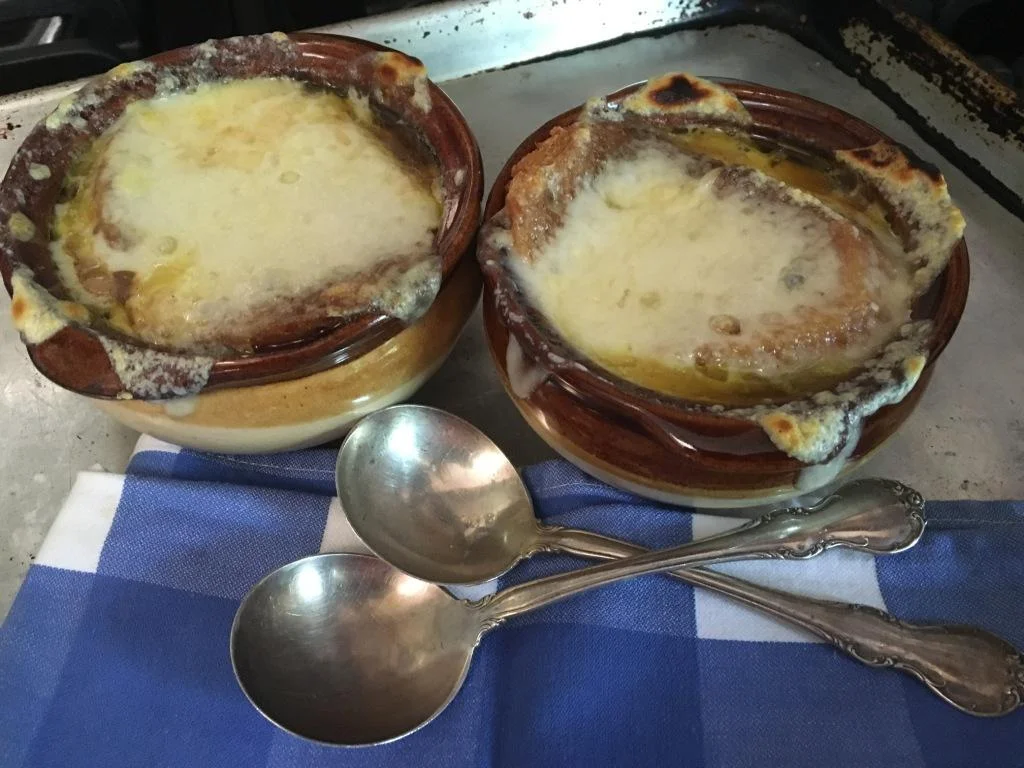
Peel and thinly slice onions. (Cut them in half lengthwise and then across into half circles.) Melt butter in a very large pan. Cook onions until very dark brown, stirring often, about 25 minutes. Do not scorch.
In a large pot, put bouillon cubes, 12 cups water, and ¼ teaspoon freshly ground black pepper. Bring to a boil, then whisk over low heat until bouillon dissolves. Add cooked onions to bouillon and bring to a boil. Lower heat to medium-low and cook 30 minutes. Add cream sherry. Put soup into individual serving crocks. Add a slice of toasted French bread, and put a slice of cheese on top. Put in a preheated 275 degree oven for 5 to 10 minutes or until cheese is melted. (You can put under the broiler for a minute to brown.) Serve while hot.

Nana's Cookies • Marie Simmons

Note from curator Rozanne Gold: Marie Simmons, a star in the culinary galaxy, shares reminiscences and recipes so vivid that we decided to feature her story in two parts. Part I includes a beautiful essay about her Italian family at the turn of last century and illustrates a cherished view of life – one that included hard work, strong familial ties and values, great meals, and a slew of handwritten recipes dictated by Marie’s grandmother and penned by her mother. The culmination of this is Marie’s love of cooking and her status in the food world. She is an award-winning author of numerous cookbooks and a beloved cooking teacher. Originally from New York, Marie now lives in Eugene, Oregon, a place she considers “paradise.” She bicycles everywhere and is smitten with the vast amount of culture that Eugene provides. The timing for our connection is fortuitous. Marie’s newest cookbook, Whole World Vegetarian (Houghton Mifflin Harcourt), is just out this week. Never mind that Nana’s addictive pepper cookies (known as taralli) are made with lard! Thank you, Marie, and congratulations on the publication of another wonderful cookbook.

Nana's Cookies by Marie Simmons
Antonette Abbruzzese, my grandmother, (I was named Marie Antonette for Nana) was born on the lower East Side of Manhattan on December 19, 1890. Her husband, my Grandpa, was a gentle, sweet man who was very proud of being able to read the daily English newspaper. He was born on January 20, 1880 in the village of Forenza in the remote region of Basilicata — the area of Southern Italy often referred to as the boot. His father died when Grandpa was a small boy and he eventually moved to live near relatives in New York City with his older brother Michael and his mother. Grandpa became a barber for a military installation on Long Island.
Nana and Grandpa maintained a small backyard farm where Grandpa sold produce, honey, fruit, fresh eggs, and beautifully grown vegetables. It was in a small Italian immigrant community in the Hudson Valley village of Milton, New York.
Nana enjoyed cooking healthful meals for her extended family of 9: She had 8 children: Marie Louise, (Tessie) Maria Theresa (Tessie taught school and never married), Grace, Rita, Joseph, Emmaline, and an adopted daughter Maggie, orphaned at the age of 9 and raised by Nana and Grandpa. Their home was always open to family and friends and many of the recipes in my cookbooks describe the hearty meals prepared there. I especially loved the big platter called Aunt Milie’s Cannellini Beans and Rice that made its way into my book, Rice the Amazing Grain. (page 132). It makes me hungry today even thinking about it.
My grandfather was remarkable in that he firmly believed in educating his daughters. (His son Joseph was in the Marines in the Pacific during the war.) Grandpa’s three oldest daughters all went to school and became teachers. But Aunt Rita, evidently extremely bright, obtained a scholarship to Cornell University when she was only 16 years old. Marie and Tessie borrowed money to help pay for books (they were teachers by now) and got Rita settled into her school year at Cornell. What I find amazing about this saga is how open minded my grandfather was. I remember a family saying: You give your children your love and the love of God and you give them wings. You let them fly. And, that is what they did.
My mother, Marie Louise, was a retired school teacher and a “super” organizer! She, along with Aunt Tess and Aunt Rita, ran a tight ship. Our family gatherings were always punctuated by “You, sit here; you, sit there.” No one sat on their own volition — You just waited to be told where!
Now to the handwritten recipes: Most of the recipes were printed by Mom as they were dictated by Nana. I retested many for accuracy. After all, Nana measured her ingredients with a large chipped ceramic mug. She would dip deep down into a big vat of flour and skimmed off the excess with the back of her hand. Not the most accurate measuring, I’d say, but the most immediate. I’d worked most of my life in the magazine test kitchen at Woman’s Day magazine and so I had precision and accuracy pounded into my head. After Woman’s Day I moved on to be Food Editor at Cuisine magazine and then cookbook author, so I thought I knew a little about recipe testing, and accuracy.
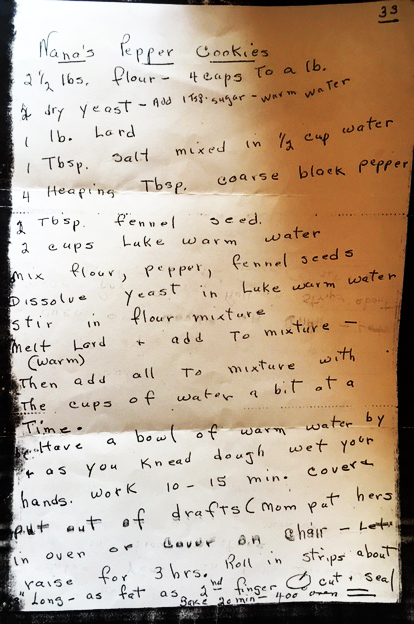
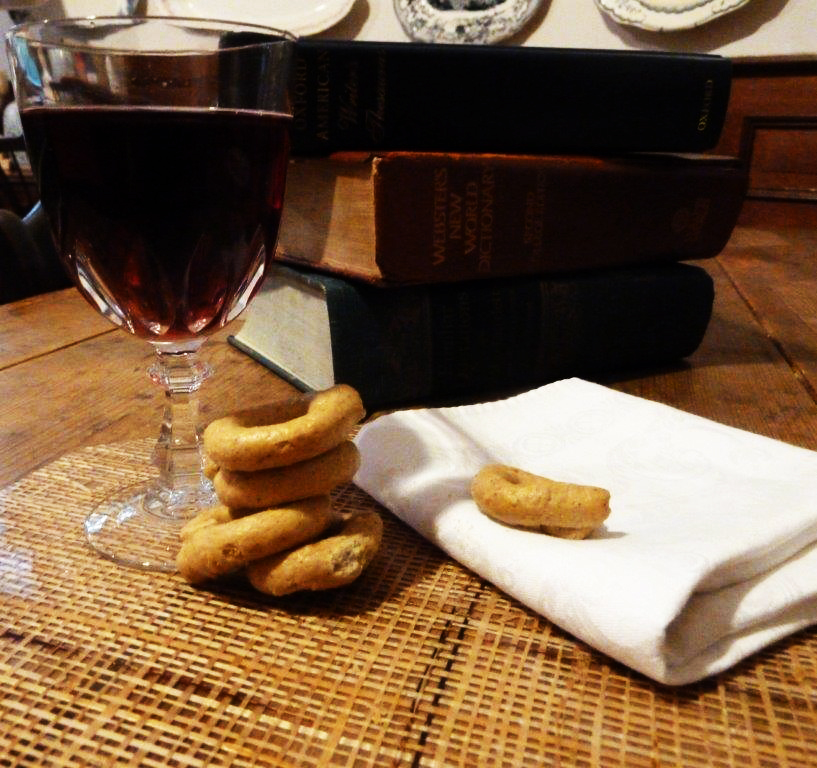
Now where to begin in the saga of Mom and Nana’s recipes? Nana’s Pepper Cookies are tiny savory rings made with yeast and lard and studded with coarse ground black pepper and fennel seeds. I discovered, later in life, how delicious they are with a glass of red wine. I have retested it, but here it is in its original form as written by Nana.
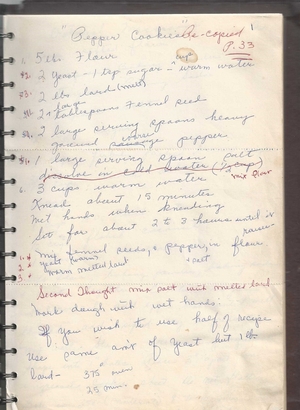
Ingredients
Nana's Pepper Cookies (as edited by Marie)
2-1/2 lbs. flour
2 tsp. dry yeast (add 1 tsp. sugar and warm water)
1 lb. lard
1 tbsp. salt mixed in 1/2 cup water
4 heaping tbsp. coarse black pepper
1 tbsp. fennel seed
2 cups lukewarm water
Directions
Mix flour, pepper, fennel seeds. Dissolve yeast (and sugar) in lukewarm water. Stir in flour mixture. Melt lard (warm) and add to mixture — then add all to mixture with the cups of water a bit at a time. have a bowl of warm water nearby and as you knead dough wet your hands. Work 10-15 minutes. Cover and put out of drafts (Mom put hers in oven or covered on a chair.) Let rise for 3 hours. Roll in strip about 8" inches and as fat as 2nd finger. Cut into small rings. Seal. Bake 20 minutes in a 400 degree oven.

Gina's Aunt's Rice Pudding • Stacey Harwood-Lehman


Note from curator Rozanne Gold: Gina’s Aunt’s Rice Pudding recipe comes to us by way of New York’s Poet Laureate of the Greenmarkets, Stacey Harwood-Lehman. I’m certain Stacey would love to garnish the rice pudding each season—perhaps a strawberry-rhubarb-ginger compote right now at the height of Spring? Poached pears and star anise in Fall? Either way, hers is a lovely story with a quixotic recipe scribbled in her own handwriting on a hotel pad of paper. I love it because it’s real…with a missing word or two, the very shorthand that makes cooking mysterious and sometimes serendipitous. Gina’s Aunt’s recipe is very sweet and could use a little scraping of fresh vanilla bean. It could feed your whole block. I messed around with a simple version of my own (see below), inspired by Stacey’s love of rice pudding!

Gina's Aunt's Rice Pudding By Stacey Harwood-Lehman
Gina and I had been working together for several years when she started dating Tony, a new employee in our agency’s IT department. Soon after Tony joined the staff, I noticed that the usually tech-savvy Gina seemed to be having an uncharacteristically difficult time mastering the new computer system and that Tony was making many visits to our floor to help her. Within a couple of months she announced their engagement. I was among the lucky few of her colleagues to be invited to the wedding.
At the time I was working in Albany, NY, as a policy analyst for the government agency that regulates gas, electric, water, and telephone utilities. I grew up in a suburb of New York City and had relocated to Albany to attend the state university. It wasn’t my intention to remain in Albany after college but there was a boyfriend and a job, so I stayed.
Gina’s work-station was situated near mine and we became friends even though when she joined the department she was only 19 — quite a bit younger than I was — and right out of secretarial school. She had a terrific fashion sense along with a lively sense of humor and an easy laugh. I was flattered that she liked to take a seat in my work cubicle to dish about office romances and such.
Gina liked to listen to the radio while she worked and I could hear her singing along, softly and slightly out of key, with the hits. A local rock station played the same two songs every Friday to usher in the weekend: Todd Rundgren’s “Bang on the Drum” (“I don’t wanna work; I wanna bang on the drum all day”) and Four in Legion’s “Party in My Pants,” the lyrics of which Gina heard as “There’s a party at my parents’, and you’re invited,” the perfect mondegreen to reveal her youthful innocence.
My proximity to Gina made me privy to her wedding plans. But before there was a wedding, there was a wedding shower to be held at the Italian Fraternal Club in Green Island, a small town roughly eight miles north of the state capitol. I was seated at a table of strangers, all of whom seemed to have known each other for decades. My attempts to enter the conversation mostly failed, until I learned that Gina’s aunt, who was seated across from me, had owned a small restaurant that she had recently closed in order to retire. The menu was red-sauce Italian and among her specialties was her rice pudding. I love rice pudding. Would she share her recipe?
Gina’s aunt was no-nonsense, someone you could imagine at the helm of a busy kitchen where everything was made from scratch and where the menu was likely the same from the day it opened until the day it closed. She explained that the recipe would feed a crowd, a large crowd, so unless I was planning to throw a big party, I shouldn’t bother with it. Never mind, I said. I want to give it try.
Something in her manner as she spoke, communicated doubt; doubt that I would be able to make a success of it. It was her rice pudding, after all. She dictated the recipe as I scribbled on a pad that I’d picked up from a hotel where I’d stayed during a recent trip.
That was decades ago. Gina had two children and divorced Tony. The recipe has been with me through several moves and life changes, stashed in an envelope stuffed with other recipes, some torn from magazines, others written hastily on scraps of paper.
When I ran into Gina’s aunt at the wedding, she asked if I had tried her recipe. I hadn’t. I was waiting for the right occasion. I’m still waiting.


Gina’s Aunt’s Rice Pudding
2 lbs. rice
½ gallon milk
5 cups sugar
18 eggs
½ box of raisins
1 stick butter
Cook rice 15 minutes. Drain in colander. Rinse. Beat eggs. Stir eggs over rice. Stir. Add sugar, stir, milk, stir. Put in stick of butter. Stir. Put in oven @350 covered with Reynolds wrap for 1 hour. Remove cover. Stir. Top w/nutmeg. Put back in oven until solid.
Creamy Rice Pudding
(without eggs)
1 quart 2%, or whole, milk
6 tablespoons sugar
¼ teaspoon salt
1 teaspoon vanilla extract (or scraping of vanilla bean)
2/3 cup long or medium-grain rice
1/3 cup raisins
Grated nutmeg and/or cinnamon
Put milk in a 3-quart saucepan. Add sugar, salt, vanilla, and rice. Bring to a boil; lower heat to medium and boil, stirring 3 minutes. Lower heat to simmer (tiny bubbles steady on top). Cook 20 to 25 minutes, stirring frequently. Add raisins and cook several minutes until rice is very soft and mixture is thick but still soupy. Will firm upon cooling. Pour into a deep dish. Sprinkle with nutmeg and/or cinnamon. Cover and chill. Serves 4 to 6
