
A Mother’s Day Reflection • Interview with Rozanne Gold by Allison Radecki


A note from curator Rozanne Gold: It is Sunday morning, Mother’s Day, 2017 and I am missing my mother terribly. It is especially poignant, then, to be writing this curator’s note. I am grateful to Allison Radecki for conducting this interview with me about my beloved “Ma.” Always, “Ma.” Marion Gold, my best friend, soul mate, guiding light. She died in 2006 and never got to meet my daughter, Shayna, whom we adopted at age 11-1/2 less than a year after my mother died. They would have loved each other deeply. My mother’s love of food was infectious, but it was another level of nourishment — of a more spiritual, humanistic nature — that fed me best. It is also meaningful to write this today (our 30th feature) on the first-year anniversary of “Handwritten Recipes."

ALLISON RADECKI: Since the first handwritten recipe profiled in this column was one that you penned and framed as a gift to your own mother, Marion Gold, for Mother’s Day in 1980, it seems fitting that we feature one of her own recipes today. Which handwritten recipe of your mother’s were you drawn to as you approached this holiday weekend?
ROZANNE GOLD: I have a recipe for my mother’s Garlic Broiled Shrimp — with a debatable “s” at the end. She really never said “shrimps,” but she might have questioned herself while writing the title. Her handwriting is as elegant and finum (a Hungarian word for refined that she often used) as she was.
I was excited about the clarity and straightforward simplicity of this dish. Although I never follow a recipe — ever — I followed this one with great results. Michael (my husband) and I ate the whole thing standing up at the counter and were almost giddy from its clean, pure flavors, its stunning plainness. The second time I made it, I embellished a bit — a bit of tarragon and a splash of wine — and ruined it.
That day, with great intention, I summoned her up so that I could see her standing in her kitchen in Queens. There was a smile at the edge of her lips, her shoulders gently sloping, like the curve of her “m” in minced. She minced fresh garlic with her small, favorite knife that was never sharp enough. Would she peel and de-vein the shrimp? I imagine her long piano fingers delicately removing the black vein along the curve of each shrimp’s back. And there was all that curly parsley, meant to be finely chopped. I mean, curly parsley! When was the last time I bought curly parsley? This was a dish for company meant to be served with rice. A box of Carolina Rice was as iconic to me as a Warhol soup can.
RADECKI: Where did your Mom keep her recipes? And where do you now keep hers?
GOLD: My mother kept her recipes in a blue kitchen binder decorated with simple and colorful illustrations of kitchen utensils and ingredients. It has large yellow envelopes as dividers in which you could stuff too many recipe cards. After she died, I found a stash of additional recipes in an old-fashioned tin, filled with blue-lined index cards all in her graceful handwriting festooned with her beautiful swoops and swishes: chicken cutlets, fresh string beans, sour cream coffee cake. The binder and tin now nestle together in the drawer of my pine kitchen table.
RADECKI: Did your mom like to cook? Did she cook often? What do you remember about her cooking?
GOLD: Every night. She cooked every night and made the things we loved. Cabbage and noodles, another dish of stunning simplicity, was my comfort food growing up. Mornings were made special with her apricot-filled ultra-thin crepes called palascintas; meatloaf was always in the shape of a heart.
My mother also made something she called “Tunk-a-lee,” soft scrambled eggs with tomato, pepper, and onion — very Hungarian flavors — but every culture seems to have a version. Another dish I loved was a stew of hot dogs, cut on the bias, with potatoes and onions in a ketchup-y broth. And pot roast. She made the most fabulous pot roast with so many onions, a bay leaf, and splash of dry vermouth. She made it all the time and later revealed that she hated pot roast.
My mother loved to entertain. She’d take white bread, cut the crusts off, and roll it paper-thin with a rolling pin — so thin, it became like pastry. She’d then cover each slice with creamy blue cheese spread and put a fat canned asparagus on it. They would get rolled up tight, brushed with melted butter, and baked. Oh, how many of these I used to eat before company came! Lethal.
RADECKI: How would you describe your relationship with your mother?
GOLD: Ours was an amazing love story. It would be impossible to describe all the joys in our life together, but there was lots of sadness and loss, turmoil and drama, too. But there was also lots of happiness that we shared in big and small ways. I liked the small ways best. Laughing until we cried, playing scrabble; cooking, doing things to please or surprise each other, or just talking ten times a day on the phone. There were trips and travels and innumerable nights of splendor at The Rainbow Room and Windows on the World. There were victories and milestones to celebrate. And I got a chance to write about her in many of my books and magazine articles, too. She was modest and never believed in "tooting her own horn,” and told me never to toot my own. But, nothing came close just to being together.
RADECKI: You have often said that your mother was “More Zsa Zsa than Julia.” Can you paint a picture of the mom you see in your mind’s eye?
GOLD: My mother was a seeker of wisdom and beauty. She was such a beautiful woman. She loved people. She loved children. It always felt like she was doing something special, wanting to please.
She grew up in Florida in a tiny town called Belle Glade, near Pahokee. It was just her, her mom, and her dad. They were poor, but she didn’t know it. She grew up happy. She was always a tall drink of water, though her bosomy mother was only four foot ten.
Mom escaped to the University of Miami, back when it was just one building. Her parents died in her early thirties within six weeks of each other. My mother told me that when her mother died, she felt as though her heart had broken. She carried a lot of sadness. There were deep feelings.
She was a teacher, a hospital volunteer and a medical assistant, but I think she wanted to be an actress. She could be the most glamorous person; a bit like Zsa Zsa.
On her 80th birthday, three weeks before she died, it took her quite a while to get ready. We weren’t going anywhere but she wanted to make it a special occasion. She was so weak but spent hours in her bedroom getting ready. When she finally came out, there were high heels, a mink jacket, and sequined glasses. She could hardly breathe, but she dressed up like a movie star. This is how she wanted us to remember her.
RADECKI: You and I often talk about how recipes — especially handwritten ones — ignite connections. In the spirit of sparking a memory or two, let’s play a quick game. Tell me the first thing that comes to mind about your mother when I say:
Scent: Onions and her own sweet perfume. We each had our own scent. I wore Rive Gauche. She was a sexy, sensual woman.
Sight: It’s summertime, and she’s in the backyard drinking an iced cold Heineken. It’s so out of character, but that’s what I see.
Sayings: "Kickups." If I acted out, she would say, "kickups." As in, "Watch out. You’re about to head into trouble."
Right before she died my mother said the most amazing things. Look deep inside your heart and you will find the answer. Have the courage of your convictions, even if you are wrong. Have more faith in life. Have fun! And love and care will make everything all right. That one is most important. I still keep them with me: in my wallet, handwritten down.
RADECKI: When, do you think, was your mom proudest of you?
GOLD: One night, we had a real New York City evening planned. She came to meet me in the city to hear Michael Feinstein at the Regency. She came in by taxi from Queens. It was a real moment, to see us together in that way, dressed to the nines. We became elegant and adult together. Yet it was a moment of exquisite recognition of our separateness.
RADECKI: When were you proudest of your mom?
GOLD: Although we could get so angry with one another, there was never a time I was not proud of her. That may be my deepest connection to her. I always felt so proud of her.
RADECKI: You’ve credited your mother for recognizing that you had a future in food, and urging you to pursue that passion, even at a time when women were not prominent in professional kitchens. How did she see your path and encourage you to do what you loved?
GOLD: When I was in college at Tufts, I got a phone call from my mom. She had just heard an interview with the Hungarian restaurateur George Lang. That was the very first time I heard the idea of a restaurant consultant. I was a dual major in psych and education, but the food, she knew. I mean, she let me become a bartender at age sixteen, when she knew it wasn’t legal.
My mother was the one to see that I was spending more time cooking in the kitchen than working on my Masters degree. I dropped out of graduate school and became the first chef to New York Mayor Ed Koch when I was twenty-three. She enjoyed visiting me at Gracie Mansion, but felt bad about the grueling hours.
Again, always wanting to please. There was a restaurant, Villa Secondo, in Queens where my parents would always go. But, one day my mother called me to say, “Rozanne! Secondo, it’s gotten so much better!” Years later, I found out who the new chef was. It was Lidia Bastianich. She knew! My Mom just knew. She had that food sense.
RADECKI: In 2009, a few years after your mother’s death, you bought and saved over six thousand cookbooks from the library of Gourmet Magazine and donated them to the N.Y.U. Fales Library in your mother’s name. What does it mean to you to see her name Marion Gold on the nameplate of every book in that Gourmet collection?
GOLD: It felt so full circle…so right.

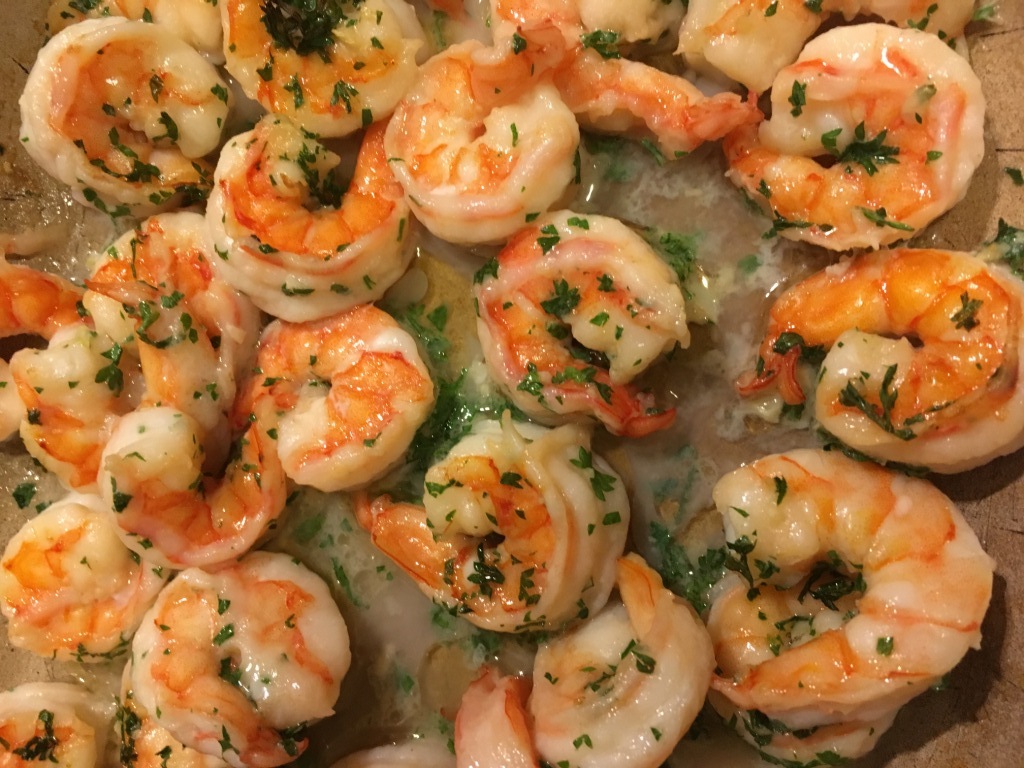
Garlic Broiled Shrimp
Note: You can buy large cleaned, deveined shrimp. Reduce cooking time depending on size of shrimp. Do not overcook.
INGREDIENTS:
Two lbs. raw shrimps
½ cup olive oil
2 garlic cloves, minced
2 Tsp. salt
½ cup chopped parsley
Lemon wedges
DIRECTIONS:
Arrange shrimps in shallow baking pan. Sprinkle with olive oil, garlic, salt, and half of parsley.
Broil about 4 inches from source of heat for 5 to 7 minutes on each side – Sprinkle with remaining parsley and serve with lemon wedges.

To see the rest of Rozanne Gold's "Handwritten Recipes," click here.
My Babcia’s Mizeria (Polish Cucumber Salad) • Allison Radecki
Note from curator Rozanne Gold: I’ve been reading a lot about cucumbers recently and so was delighted to get this wonderful recipe and memory jolt from food writer and cohort, Allison Radecki. The recipe is from her beloved Polish grandmother, her Babcia (pronounced BOB-cha), and it comes with a detailed history of a vanquished, but riveting, way of life. The handwriting belongs to Allison and the recipe has been handed down from at least three generations. Allison’s daughter, Tabitha, will no doubt be the fourth. She’s only five but will be making cucumber salad soon enough. After all, it’s fun to run the tines of the fork down the length of a cucumber to make a design before slicing. Cucumbers, by the way, belong to the cucurbitaceae family as do melons, squash, zucchini and pumpkin and contain potent anti-cancer compounds. Thank you to Allison, and to Babcia Genevieve.

My Babcia's Mizeria (Polish Cucumber Salad) by Allison Radecki
My Polish grandmother’s 1970s American kitchen was a place of transformation. The Formica countertops (whose pastel boomerang pattern always made me think of scattered rubber bands) were surfaces where wooden spoons, mason jars, and stoneware crocks reigned. This was a zone where things freshly picked from the backyard were crafted into dishes of incredible simplicity and deliciousness. There was always a soup bubbling on the stove or something caramelizing in a pan, just waiting for a hungry grandchild to say, “Babcia, I’m hungry.” To this day the scent of frying onions brings me back there, in a heartbeat.
Standing at her kitchen sink in Cedar Grove, New Jersey, my Babcia, Genevieve Baranowski, could survey her domain. Her backyard was a rolling expanse of grass and trees, complete with a stream (great for crayfish hunting), a goldfish pond, and a substantial vegetable garden, which was where the magic began.
Babcia’s first miraculous act was to transform red clay into black gold. Nothing in her kitchen was ever wasted. She knew how to incorporate peeled vegetable skins, coffee grounds, and eggshells into the soil, a spell which resulted in zucchini as large as baseball bats, and heirloom tomatoes you could barely palm with your hand. Every skunk, opossum, and raccoon within a ten-mile radius was drawn to her vegetal treasures, against which she continuously waged war.
Spending time in her kitchen came with a specific vocabulary: szczaw (sorrel), buraki (beets) and, of course, the mighty kapusta (cabbage), which she fermented in her basement with the help of river stones, used to weigh down the shredded leaves in the brine.
Trips to a Polish family friend’s dairy farm were quite common. The return journeys (with her wood-paneled station wagon’s windows rolled all the way down) not only brought raw milk back to her home, but also the finest dried cow manure, which she credited with the spectacular blooms on her roses and peonies.
Since my Babcia and her family were keepers of secrets, her detailed history is still murky. We know that she was born in Niagara Falls, New York, in November of 1913. Her family made the bad decision to sell the profitable family glove factory and tavern and return to Poland in the early 1920s. After an forced unwanted marriage in rural Poland, she ran away, boarding the M.S. Batory, an ocean liner of the Polish Merchant fleet, to return to the country of her birth during the Great Depression. Before the beginning of World War II, she managed to bring her two sisters, also natural-born citizens, back to America, where they all worked as wartime riveters on the East Coast.
Where and how my Grandmother learned to cook is still a mystery. She knew how to braise, how to roast, and could craft an encyclopedia of sauces from memory. Since my Great-Grandmother’s homemade donuts were rumored to break your toes if they fell on your foot, my Babcia’s skills were definitely not passed down the maternal line. My mother’s theory is that while working in Rockaway Beach, Queens as a domestic servant, her mother must have picked up on lessons taught in her employer’s kitchen.
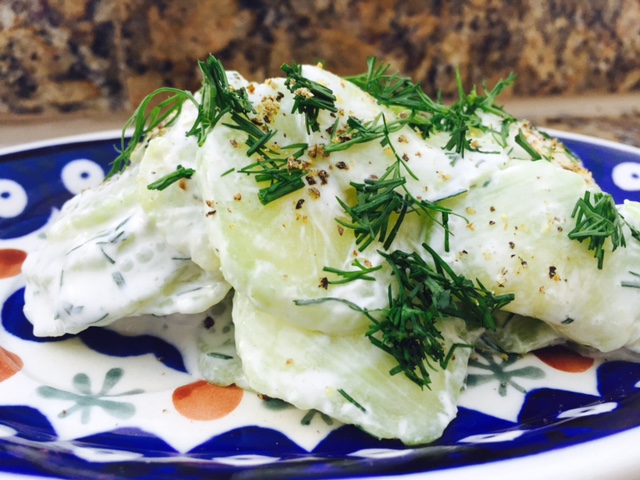
Mizeria, a cold Polish salad of wilted cucumbers, sour cream, salt, and fresh dill, was a popular dish in my Babcia’s summertime kitchen. In recent days, with East Coast temperatures rising to high levels, I have turned to it for its refreshing properties as a side dish, as well as for the family memories that accompany it. It is perfect to bring along to a barbecue, guaranteed to cool off the heat of a summer afternoon.
Though its gloomy name, Mizeria, is said to echo the fact that a Polish peasant’s life was full of misery, the dish leaves me with the opposite impression.
When I taste it, I think of lazy days in the backyard. I can see my grandmother, scented from tomato plant leaves, coming towards me from her garden with a basket of cucumbers. We have a lot of peeling to do.


Ingredients
- 2 large seedless English cucumbers (about 3 cups sliced)
- 1½ teaspoons salt
- 2 tablespoons chopped fresh dill
- ½ cup sour cream
- 2 tablespoons white vinegar
- ½ teaspoon freshly ground black pepper

Directions.
Peel the cucumbers. Run the tines of a fork, lengthwise, down the entire outside of the peeled cucumber, so that it is scored with the points of the fork (this action will give the slices a pretty scalloped edge -- see below).
Slice the cucumber as thinly as possible (so you can see a knife through the slices) and place in a bowl. Sprinkle slices with 1½ teaspoons salt and let sit for 30 minutes.
Drain water from the salted cucumbers and gently squeeze to expel remaining water. Pat cucumber slices dry with paper towels.
Toss cucumber slices in a medium bowl with sour cream, vinegar and dill. Allow the salad to marinate in the refrigerator for about one hour. Taste, adjust with salt and freshly ground pepper and serve.

Mrs. Cubbard’s Raisin-Stuffed Cookies • Marie Simmons

Note from curator Rozanne Gold: Marie is a trove of handwritten recipes and stories. An award-winning cookbook author and food writer, Marie Simmons wrote Bon Appetit’s “Cooking for Health” column for many years, and is the author of more than 20 cookbooks, including the wildly popular 365 Ways to Make Pasta, The Good Egg, and Lighter Quicker Better. Marie, a self-proclaimed story teller, is alight with thoughts of her mother and grandmother. She says, “These two family cooks taught me how important it is to make sure everyone has something good to eat. I hear their words, and I do the same.”

Mrs. Cubbard’s Raisin-Stuffed Cookies by Marie Simmons
Some children have play dates with friends. My play dates were with my grandmother Nana and we had them every Saturday morning. We made stuffed cookies from a recipe from a lady, whom I can’t quite visual anymore, by the name of Mrs. Cubbard. She was a neighbor who had a boarding house and Nana helped her in the kitchen.
Nana and I needed to keep her large dark-blue canning pot filled to the brim with Mrs. Cubbard’s signature cookies. You never knew when someone might stop by for coffee or iced tea or a glass of cold milk. What a smile it would bring to her face to know that sixty years later, I still keep a large container of cookie stuffing in my freezer so that I can prepare these nostalgic treats in a moment’s notice.
Nana and I had an assembly line going as we sat at her big round table in the center of her kitchen. (She, cutting out the dough, and me, stuffing the cookies.) The cabinets were painted a deep Greek sea blue. My Aunt Tess, the “decorator,” loved color so much that she filled her kitchen with her water colors and oil paintings and hung them on brightly-painted walls, making it quite festive. Imagine, ruffled white calico curtains billowing around the high-set windows that wrapped around the porch...and an apple pie cooling on the porch railing.
We began our morning by sipping weak tea. We always shared a tea bag. And we chatted. Nana said I inherited her gift for gab and anyone who has met me knows that can’t be denied. I sure do like — make that LOVE — to talk. I seem to always have a story to share.
Mrs. Cubbard’s (Stuffed Cookie) Recipe is a basic sugar cookie made with shortening (shortening is so 1950s!) and sugar, milk, nutmeg, vanilla and egg. I still make it with shortening, somehow surviving the nutrition police. The recipe calls for a “stuffing” of raisins, lemon sugar, and chopped lemon. I have updated the recipe with a filling of fig and prune. Nana would roll the dough on her big flannel-covered table top. Her rolling pin was a long broom handle she bought at the hardware store. She would use the rim of a glass dipped in flour to press out rounds for the cookies. It was my job to use her worn thimble (long misplaced, which makes me very sad) to cut out a circle out from the top of each round. Nana spread the raisin filling on the base of the rounds. I would carefully remove the thimble cut-out and hide it in my apron pocket so I could eat them later. Nana of course warned me, “Don’t eat the raw dough…you’ll get a tummy ache.” But I loved the taste of the raw dough. So I snuck it into my pocket and worried about the tummy ache later.
My Saturday morning play dates with Nana, my mentor, my soul mate, taught me to think about food, to love the taste and feel of food, to write about food and to make me want to be a cookbook author. I have now written more than twenty cookbooks with my latest, Whole World Vegetarian (Houghton Mifflin Harcourt), just published this month. I think I’ll make a batch of Mrs. Cubbard’s cookies…and celebrate.


Mrs. Cubbard’s Raisin-Stuffed Cookies
Makes approximately 12 cookies
3/4 cup sugar
6 tablespoons shortening or butter
1 egg
1-1/2 teaspoons vanilla
1-3/4 cups flour
2 teaspoons baking powder
½ teaspoon nutmeg
½ teaspoon salt
Several tablespoons milk, if needed
Filling:
1 cup chopped raisins
½ cup sugar
½ cup water
2 tablespoons flour (dissolved in 2 tablespoons water)
Grated zest of 1 lemon (or 1 teaspoon lemon juice)
Filling: Put raisins in small saucepan with sugar and water. Bring the mixture to a boil and boil 2 minutes. Add dissolved flour and lower heat to medium. Cook 5 minutes, stirring constantly, until mixture is soft, thick and dry. Stir in lemon zest or juice. Set aside and cool completely.
To make cookies: Beat together sugar and shortening (or butter.) Beat in egg and vanilla. Sift together flour, baking powder, nutmeg and salt. Fold into wet mixture. Add enough milk, as needed, to make a roll-able dough. Roll out onto floured surface to 1/8-inch thickness. Cut with 2 or 2-1/2-inch round cutter. Place on oiled cookie sheet and add 1 tablespoon raisin mixture to each cookie. Top with another round cookie (the center cut out with thimble!) and pinch sides together. Preheat oven to 350 degrees. Bake 12 to 15 minutes until just starting to brown. Let cool.
Note from RG: Instead of using a thimble to cut a small round from the top cookie, I used a tiny melon baller.

Vodka Sauce • Allison Radecki

Note from Curator Rozanne Gold: This touching story focuses on the re-kindling of father-daughter memories through the unexpected discovery of a handwritten recipe. It is testament to the emotional power that “chicken scratches” can hold. Told by Allison Radecki, a food writer and culinary tour guide, the poignant tale is as much character study as it is a love story. Allison’s neighborhood-based walks in Brownstone Brooklyn trace the history of immigration and culinary change, with each footstep an invocation of her dad’s love of food and people. This hastily scribbled handwritten note on a random piece of paper acts as a time machine to past meals. Over the years, other family members have added comments and drawings to the recipe’s edges, serving to preserve a multi-generational bond and all the memories it holds. Thank you, Allison.

Vodka Sauce By Allison Radecki
I always assume that everyone’s kitchen contains a recipe archive; a repository stuffed with newspaper clippings, ripped pages from notebooks and other treasured bits of chicken scratch. My collection lives in a practically un-openable kitchen drawer — a space stuffed so tightly, papers burst out at you like a canister of spring-loaded plastic snakes.
Sure, it would make more sense to gather these papers into a book, slip them within plastic sleeves for easier organization. Yet, for me, the rummaging is the process: the touching of old newsprint, the disarray, the bits of spiral edges that flutter to the kitchen floor like New Year’s confetti in Times Square. Each archive excavation unearths an unexpected relic that can awaken a vivid memory. This is what happened when I uncovered my father’s scrawled instructions for vodka sauce while rooting around for something completely different.
My father, Joseph Radecki, did not cook. He relied on a few simple dishes — scrambled eggs, plain pizza by the slice, ‘veal parm.’ He adored a good prime rib. “The man needs instructions to boil water,’ was my mother’s classic line. This was technically, not true. The only thing I remember him cooking at the stovetop were boiled ‘tube steaks,’ or hot dogs, as they are known to the rest of the world.
A former police detective and taxi driver, he stumbled into a post-retirement business of showing people “his NYC.” To his clients he was ‘Joe the Cop’, storyteller, procurer of hard-to-get tickets, scholar of city history. “I could get you a seat at the Last Supper if it happens again in New York,” was part of his spiel. I believed him. Many did, for good reason, and sent their friends to find him.
This recipe for vodka sauce, served with penne pasta, comes from a small, Manhattan dining room, Da Tommaso, with no more than 20 seats. There, the Albanian chef, raised in Italy, prepares classic, Italian meals and does it well.
My Dad used this restaurant as his second office (his first, being the fax-strewn passenger seat of his Chevy Suburban). He’d bring clients in to dine and used it as a pick-up location for purchases from ticket scalpers. And it was the site of countless family meals. Long after the post-theater diners had paid their checks, we’d stay late and gossip with the host and waiters as they loosened their white jackets, hearing the list of stars that were glimpsed in the dining room that week. If you spoke the words, “Joe the Cop sent me,” (or were recognized as one of his daughters), you never needed a reservation to get in the door, regardless of the time of day.
When my sister discovered the magic that occurred when tomato, vodka, and cream came together, she would rarely order anything else. After nudging my Dad to see if the chef would share his recipe, he came home with this rough outline. Fittingly, it is written on the back of a printed fax from a couple from Louisville, Kentucky, asking for transportation to the Plaza Hotel and suggestions for “things to see in the Big Apple."
Over the years, this recipe became a family collaboration. My mother, a gold medalist in the sport of highlighting, couldn’t resist illuminating words in fluorescent yellow. Her comments (“guard w/ your life!”) and queries (“sauce,” “1/4 cup?”) are scattered about the page of vague instructions. My sister’s doodles are the tell-tale sign of her presence. Perhaps she was imagining the meals to come.
I look at this recipe and I can hear my father’s pen. The short, solid motions he made when jotting down flight numbers from his ever-present Dictaphone. As a “graduate of the school of Hard Knocks,” but never college, he was self-conscious about his writing. Not once did I see him use cursive. Often, he would ask me or my sister to write the last names of clients on his airport arrival signs. When he discovered word-processing (and stopped fighting with the computer printer), he never looked back. “No one wants to see my boxy letters,” he would say.
I do. It’s been over two years since he died. I miss him terribly. I even miss his scattered papers. How unexpected it was to reconnect with him through his block print and this recipe.

Vodka Sauce
Virgin olive oil
Let oil get hot
Throw a little shallots
Speck of red pepper
Little vodka (1/2 shot)
Tomato
Touch of Cream

Candied Cranberries • Rozanne Gold

Candied Cranberries by Rozanne Gold
My cousin, Josh Rovner, knew more about food when he was twelve than most of my friends do now — and this was before the age of non-stop TV cooking shows. He was sophisticated in his taste and whenever this gastronaut's family came to New York, Josh had a knowing list of restaurants that had to be visited. He yearned to be a chef, but I believed my ambitious cousin from North Canton, Ohio, should extend his reach beyond the kitchen. So he went to Cornell and wound up being a big deal "revenue management guru" with Hilton Hotels.
So, I was surprised to receive this exceedingly simple recipe from him, but it is one he treasures. It had been handwritten to Josh by his Nana Gold (my Aunt Helen), sometime around 2000. Helen died at the age of 94 in 2006.
Naturally, Josh has upheld the quintessential American family tradition of serving them at Thanksgiving, but he now makes the sweet-and-tart syrupy confection all year long to spoon over a daily helping of yogurt. Josh keeps the recipe on the side of his refrigerator, so it always is in easy reach. I didn't remember Helen cooking. She was married to my father's brother, Leslie Gold, and they traveled all over the world. They lived in Avon, Massachusetts, not far from my own grandmother, Lottie Gold, who was a fantastic baker. I think of Helen as a solid New Englander with a hankering for lobster and my grandmother's ethereal blueberry muffins.
Josh is now married, lives in Texas, has a beautiful young daughter, and cooks dinner almost every night. He is a total foodie and up to date with every chef and kitchen trend. Aunt Helen's candied cranberries recipe is unusually precise, including altering some ingredient quantities for various batch sizes. Josh always makes the largest amount so he is guaranteed lots of leftovers. Nowadays, he recreates the recipe with a bit of grated orange zest at the end for depth of flavor— “not too much to mask the cranberry, but just enough to enhance and harmonize,” he adds. That said, he quietly confesses that his mother prefers the original recipe. Judging by the photo Josh sent of the finished product, his Nana’s cranberries indeed do look “candied” and glistening.
This is an effect I’ve always wanted but have failed to achieve! It was lovely to learn more about Helen through her recipe and Josh’s remembrance. That's the magic of handwritten.
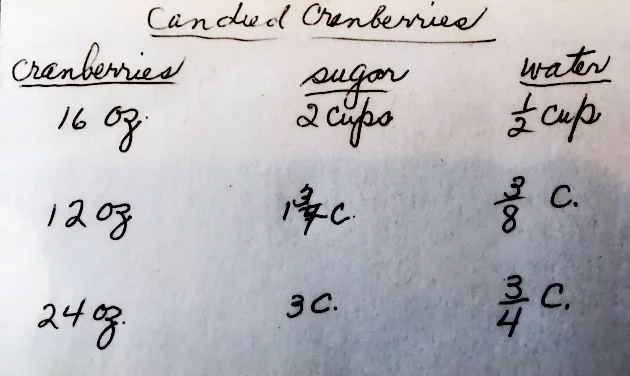
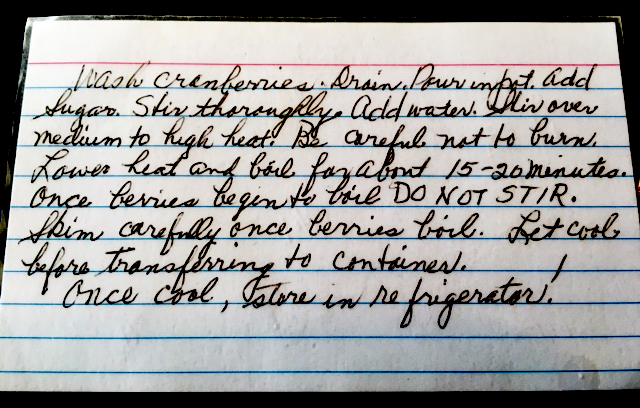
"Wash cranberries. Drain. Pour in pot. Add sugar. Stir thoroughly. Add water. Stir over medium to high heat. Be careful not to burn. Lower heat and boil for about 15 - 20 minutes. Once berries begin to boil DO NOT STIR. Skim carefully once berries boil. Let cool before transferring to container. Once cool, store in refrigerator!"
Caramel Custard • Rozanne Gold

Photograph taken by Shayna DePersia
BY ROZANNE GOLD
When I was in my mid-twenties, I penned this recipe as a gift for my beautiful mother Marion on Mother’s Day 1980. I placed it in a Lucite frame and she nailed it to the wall of her apartment kitchen in Fresh Meadows, Queens. My mother loved this custard, in all its simplicity, but could never quite remember how to make it. I thought these words would guide her when I was not around, but she never followed the instructions. Instead of the classic swirl of liquid caramel that coats the custard after baking, my mother skipped this step and dusted grated nutmeg on top. A whiff of memory? And she preferred to eat the custard directly from its little glass cup, instead of flipping it onto a plate so that the caramel would pool all around.
My mother and I were extraordinarily close. Too close, if that’s possible. She encouraged me to become a chef when women were anathema in professional kitchens. I dropped out of graduate school and became the first chef to New York Mayor Ed Koch when I was twenty-three. Being in the kitchen with my mother was the happiest place in the world for me. She would occasionally visit me in the kitchen of Gracie Mansion, and years later came to my kitchen in Park Slope, and yes, we’d make caramel custard together.
Our deep connection was expressed by cooking special things for each other. Custard for her, and for me she made cabbage and noodles – a homey Hungarian standard that she, too, ate in her childhood. It was the comfort food that connected us to previous generations of Hungarian women and also to each other. I have learned since that some recipes, even more than photographs, can provide the most intimate transfer of memory from mothers to daughters.
One grey day in October eight years ago, I removed the recipe now faded and worn, twenty-six years after I wrote it. And now my daughter makes custard for me.
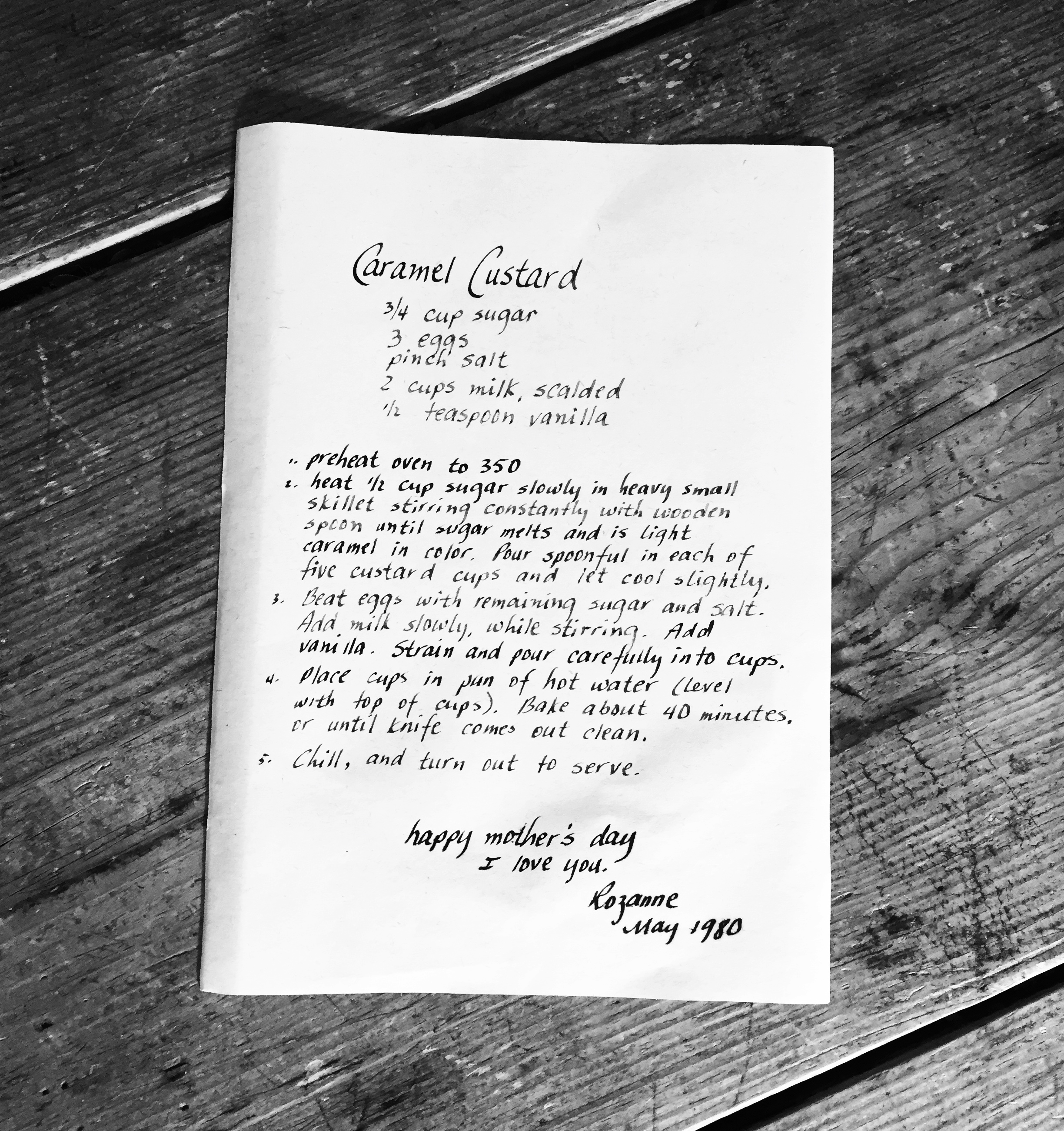
Caramel Custard
3/4 cup sugar
3 eggs
pinch salt
2 cups milk, scalded
1/2 teaspoon vanilla
1. Preheat oven to 350
2. Heat 1/2 cup sugar slowly in heavy small skillet stirring constantly with wooden spoon until sugar melts and is light caramel in color. Pour spoonful in each five custard cups and let is cool slightly.
3. Beat eggs with remaining sugar and salt. Add milk slowly, while stirring. Add vanilla. Strain and pour carefully into cups.
4. Place cups in pan of hot water (level with top of cups). Bake about 40 minutes, or until knife comes out clean.
5. Chill, and turn out to serve.
Rozanne Gold Joins Handwritten as Curator of Handwritten Recipes

Handwritten is full of happiness to announce its newest curator, world-renowned chef and food-writer Rozanne Gold, to the team. She will be dishing up a new column, Handwritten Recipes.
The column comes from a lifetime of experience: from the age of five, Rozanne was rarely without a cookbook in hand. Fast forwarding to now, she has written thirteen of her own, earning her international recognition, a collection of awards, and thousands of original recipes.

Rozanne Gold with Mayor Ed Koch, 1980
She's worked in some of the most legendary kitchens in New York City, such as Rainbow Room atop Rockefeller Center and Windows of the World, and just so happened to be the first executive chef for New York Mayor Ed Koch when she was only twenty-four years of age.
She's done just about everything, from creating her own catering business (Catering Artistique) to cooking up trend-setting concepts: as Chef-Director of Baum + Whiteman worldwide, she created the three-star Hudson River Club, New York's first pan-Mediterranean restaurant Cafe Greco, the highly-sought after "Cocktails and Little Meals" at the Rainbow Room, and her book Recipes 1-2-3, which gave rise to "The Minimalist Column" in The New York Times, turned into the internationally acclaimed series of 1-2-3 cookbooks. Her writing and recipes have surfaced in The New York Times, Wall Street Journal, Gourmet, Oprah, Bon Appetit, FoodArts and More), and she doesn't seem to be letting up: she's currently a guest columnist for Cooking Light and blogger for Huffington Post. It isn't surprising then to know Rozanne has been described as "New York's first lady of food" and "the food expert's expert."
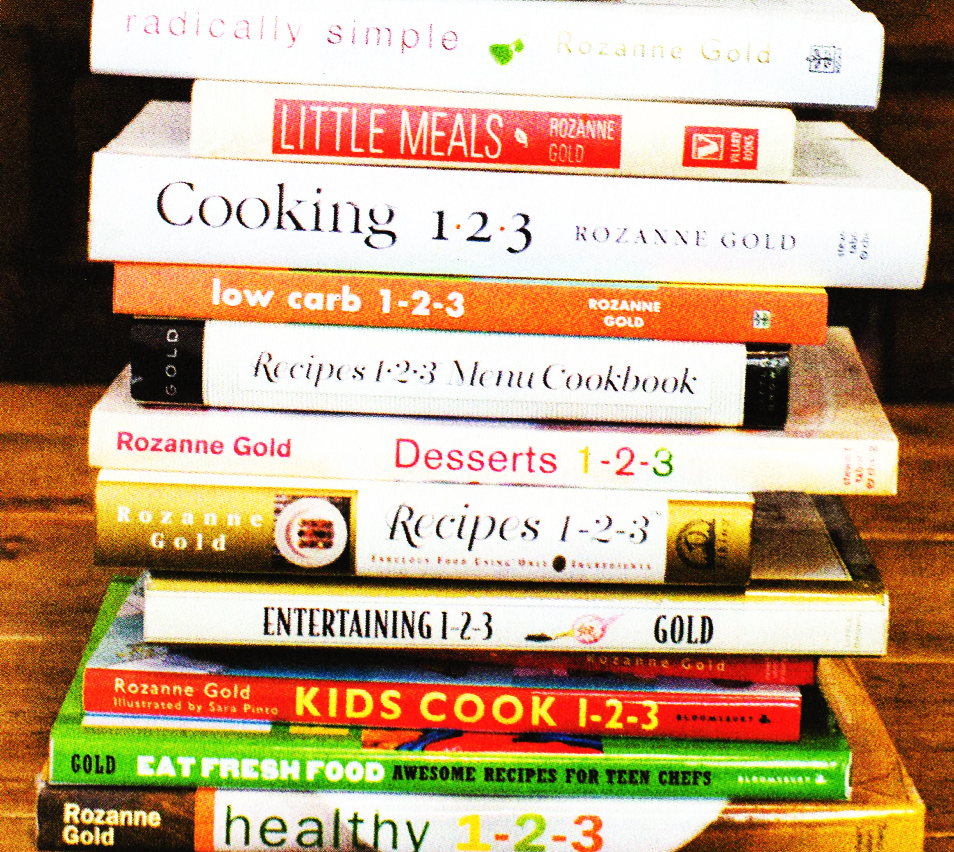
Rozanne's Recipes, stacked together.
On top of all this, Rozanne is an end-of-life doula, philanthropist, trustee of The New York Zen Center for Contemplative Care, and a poet. She is currently finishing up an MFA at The New School Creative Writing Program. Where she finds the time to make so many meals, we wish to know: a frequent guest on National Public Radio (earning Leonard Lopate a James Beard Award), Rozanne is a sought-after moderator – most recently of the New School’s 2015 program “Gotham on a Plate,” and “The Next Big Bite,” created by Les Dames d’Escoffier, a professional organization of women in food and wine, where Rozanne is a past President.
She's also a philanthropist: she saved Gourmet magazine's library by purchasing it and donating it to NYU, and after Hurricane Sandy, she established up a pop-up kitchen in Brooklyn to prepare and deliver 185,000 meals to those in need. Believing in the power of food to create community, she was one of Israel’s first “Women Chefs for Peace” and the recipient of the Jewish National Fund’s “Olive Tree Award” for her efforts in promoting Israel’s food and wine industry.
As creator and curator of this column, Handwritten Recipes, Rozanne hopes to re-ignite the connection between generations through the exploration of food, cooking, and memory — most profoundly and poignantly though the power of the pen. The first recipe will launch February 1st. What will it be? A caramel custard, which she wrote in 1980 for her mother.
To sign up for Rozanne's column, enter your email address below, and prepare your inbox for delicious, handwritten treats. Or, to submit your own recipe to Handwritten Recipes, email Rozanne at rozannegold@mindspring.com.
