
Sweetly Unadorned Bits of Proof • Lexi Wangler

BY LEXI WANGLER
“What are you writing?”
Sadie, my best friend’s fifteen-year-old sister, paused on the porch. On her way to the hair salon, she surveyed me over her sunglasses, the bridge slipping down her nose.
“The ceremony,” I told her, and ripped another page out of my notebook.
“Oh, God.” Underneath the layers of heavy-handed wedding makeup, she paled in horror. “I’ll, uh, let you finish then.”
I could have called after her, defended myself and explained to her the nonlinear experience of expectation, the impossibly rapid speed of time devoured by just existing, let alone creative expression. But with forty-five, no, forty-four minutes to go, I just decided to keep writing.

Last September, my best friend asked me to officiate his wedding. He’s been my best friend for going on seven years now, and at first, I thought it was a sop for not asking me to be his best (wo)man. I remember asking him, clearly, repeatedly, “Are you sure?”
But he and his fiancée were. They didn’t find it surprising when the wheels of my plane touched down in the city I used to call home without a single ceremonial word written. Well, to be fair, I filled out the paperwork, joined the American Ministers of Marriage, and mailed the affidavit to the court house. I took a risk and didn’t buy the officiating kit with an embossed certificate, but I did buy a dress — floor-length, fire-engine red with mesh cut-outs. That’s as far as I went until about forty-eight hours before the ceremony. Between cocktails at the rehearsal dinner, I typed out the first half of the ceremony on my phone, riding that familiar edge between writerly hubris and an absolute terror of failure. This was before I realized I probably shouldn’t be reading from an iPhone screen at the wedding.

I borrowed a bit from the Corinthians, and a little from a speech that Roxane Gay gave at St. Louis University about Catholicism and feminism — ironically, since the happy couple asked me, the atheist, the fallen Catholic with a vengeance, to presumably perform a secular ceremony at a refurbished airport decimated during Hurricane Katrina.
The word “millennial” gets tossed around a lot to describe our generation, commonly linked with, jeopardy-style, “What is the worst?” Sometimes our elders have problems processing how we can ever mature, how we can contribute, how we can function, having been raised not only attached to increasingly smaller screens, but in a world that keeps getting increasingly darker: politically, environmentally, globally. The answer, of course, is hope. By coming here today, you have shown incredibly deep reservoirs of hope, in each other and in the joint future you began to build the day you met. You show the world the difference between growing up, and growing older.
*
Before and after the wedding, I explained several times that no, I do not do this all the time, that I am not a minister, but simply a girl who happens to be friends with the groom, a friend who has been known to occasionally write things down.
*
“Love suffers long and is kind. It is not proud. It bears all things, believes all things. Hopes all things, endures all things. Love never fails. [After all else], these three remain: faith, hope and love. But the greatest of these is love.” (1 Corinthians, 13:4)
*
I’m told it’s a rising trend nowadays, having a friend do for free what you used to have to pay a churchman to do. For a millennial couple with no particular religious leanings, it was a cost-effective choice, though vastly more personal and intimate. In the South, however, it still raised a couple of eyebrows. Despite mandatory compliments and platitudes from attendants following the ceremony, I wasn’t actually sure how it went. I cried through most of it, the maid of honor patiently passing me tissue after tissue. I only cry when I’m happy — weddings and other moments of intense joy are something of an emotional minefield for me. More so when you watch friend after friend find what looks like incalculable joy in the arms of someone new, someone you haven’t grown up with, but someone you nevertheless would like to know. It’s a joy tinged with fear, envy, sadness, wondering, sure, but it’s still the kind of joy that leaks out of you.
*
You met by chance. You fell in love by chance. You are here today because you are making a choice. You have chosen hope. You have chosen faith. You have chosen each other. By being here, you promise to both provide the best version of yourself and to also accept nothing less than the best version of each other. These promises are ones you intend to keep. You vow to take care of each other, to stand up for one another, to find happiness in the other. Each vow shares the same, simple premise; you promise to experience, to share, to be there. You promise.
*
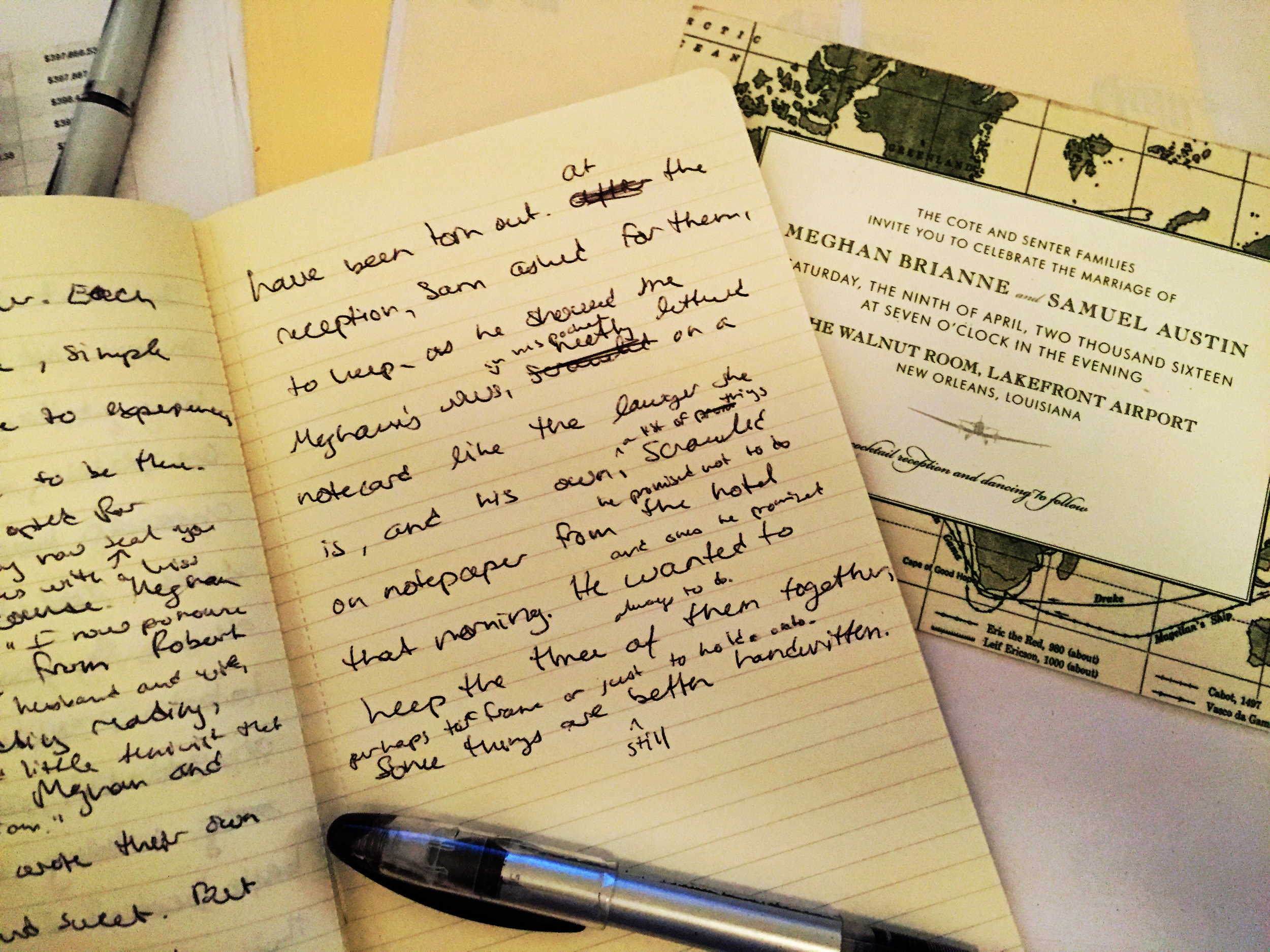
There is more, of course. I opted at the end for “You may now seal your vows with a kiss,” as opposed to “You may now kiss the bride,” and I switched out “I now pronounce you man and wife,” for “I now pronounce you husband and wife,” fervent little feminist that I am. They wrote their own vows, sweetly unadorned bits of proof. But these are not mine to share. Writing down my speech for the ceremony, my hand cramped over the teeth of the pages that have been torn out of my notebook. At the reception, Sam asked for them to keep. He showed me Meghan’s vows in his pocket, lettered neatly, firmly on a notecard like the lawyer she is, and his own, scrawled on notepaper with the letterhead from the hotel that morning, a list of things he promises never to do, followed by a list of promises he’ll always try to keep.
He wanted the three of them together, maybe to frame, or maybe just to hold onto. In this moment, I am glad to have something tangible, firmer than memory, to give them. Something handwritten.

Lexi Wangler holds an MFA from The New School in Fiction, soon to be joined by a dual concentration in Writing for Children. She works as an assistant at a literary agency and has so many books she has begun stacking them in her kitchen.
Mother's Day Handwritten Recipe • Arthur Schwartz’s Marble Meatloaf
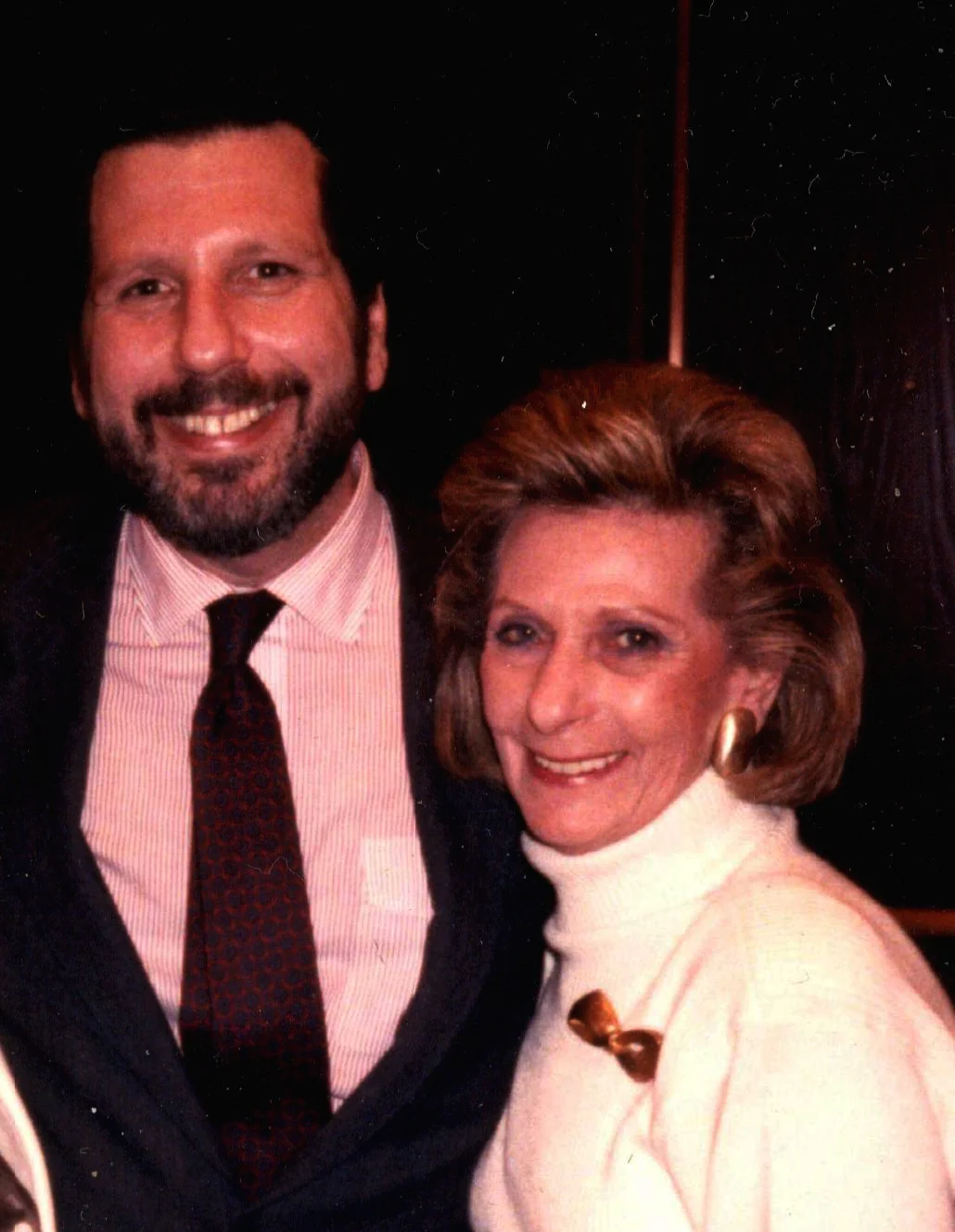
Note from curator Rozanne Gold: This priceless story, so perfect for Mother’s Day, is personal and poignant. It comes from New York’s beloved Food Maven, Arthur Schwartz who happens to be one of my closest friends. We met each other in 1978 in the kitchen of Gracie Mansion, when I was the chef for Mayor Ed Koch and Arthur was the restaurant critic for the New York Daily News. Arthur went on become a legendary food writer and radio personality, but also a well-respected cooking teacher and “walking encyclopedia” of all things Italian, Jewish, and New York. His is a rich and riveting portfolio of knowledge and experience. You can learn more about Arthur from his many cookbooks, including Jewish Home Cooking: Yiddish Recipes Revisited. Many thanks to Arthur for his “Mother’s Day” essay – a treatise on food and memory for sure, but also one, quite fittingly, about the art of handwriting.

Recipes My Mother and Grandmother Wrote by Arthur Schwartz
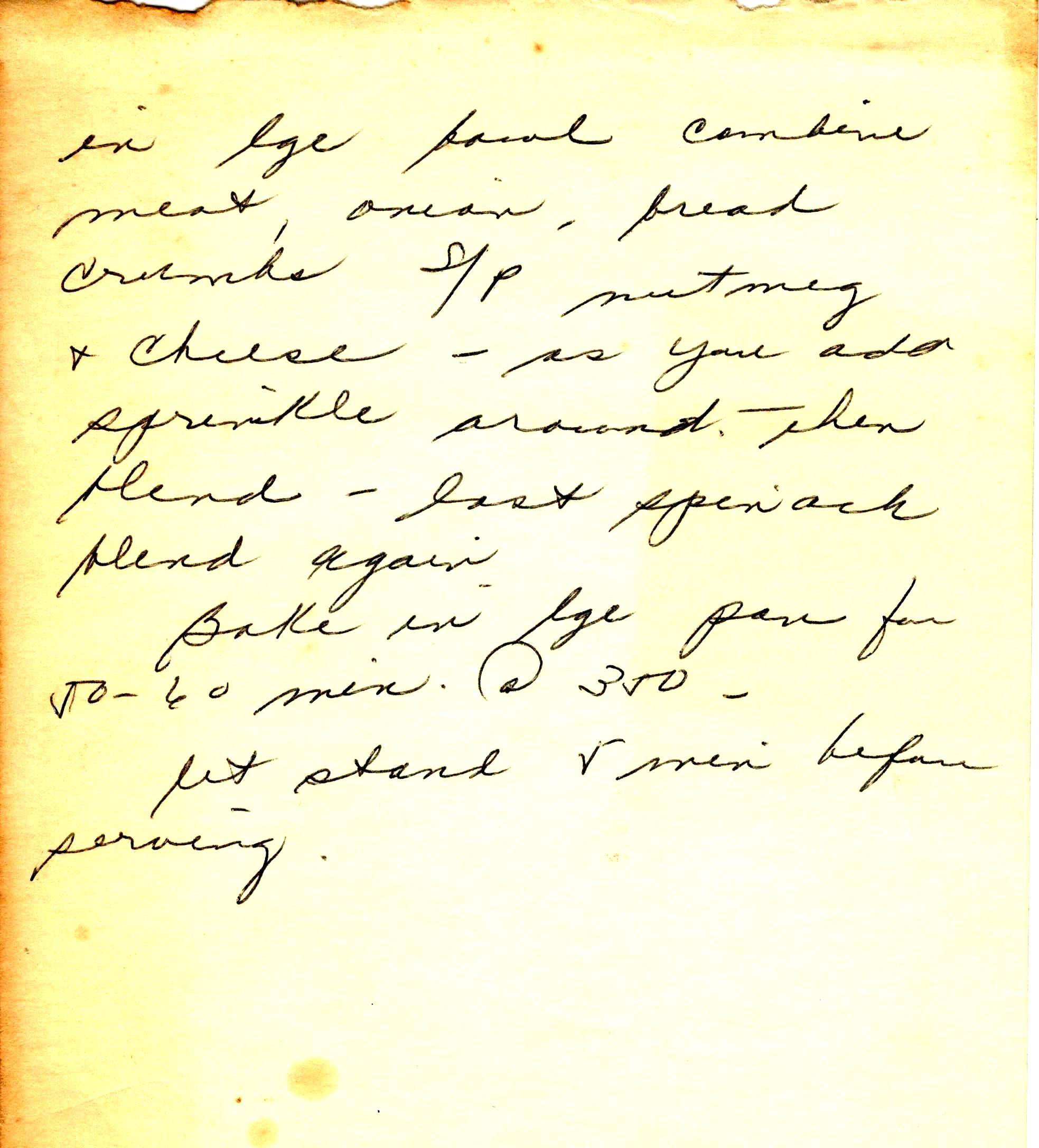
Elsie was a great and avid cook. My mother, Sydell, her daughter, was a good cook, but she never had the enthusiasm for cooking that Elsie had. It’s obvious from her recipes, however, that she at least wanted to continue family food traditions, which she did, more or less, after my grandmother died. Most of her recipes in that folder, written in my mother’s very neat, even beautiful, penmanship, are from my grandmother’s repertoire. I can tell which were written by Elsie herself because my grandmother’s handwriting was sloppier than my mother’s, though derived from the same New York City standard as my mother’s, and, in fact, my own handwriting, which is somewhere between the two in clarity.
We all learned the same style of penmanship in New York City schools. Called The Palmer Method, it was taught in New York from the late nineteenth or early twentieth century (as far as I can tell) until relatively recently, when cursive writing ceased to be taught altogether. When we all grew up, however, examples of The Palmer Method in which we were mercilessly drilled, was exemplified over every elementary-school blackboard in an alphabet printed on oak tag. For the longest time, I have been looking for a cache of recipes in a manila folder, mostly for Passover, handwritten by my grandmother and mother. They were on odd slips of paper, on the backs of envelopes (my grandmother’s favorite “note” paper, it seems), or scribed onto pages torn from notebooks. Some are mere ingredient lists, some have full or sketchy directions. But for the life of me, for years I couldn’t find them until just a few weeks ago.
Spring cleaning my office, I came across them in time to motivate me to make one of my family’s favorite Pesach dishes for our Seder. It is sweet potato and prune tzimmes, a sweet and sour casserole flavored with a goodly amount of flanken, which, to the Yiddish cook, is short ribs cut across the bone instead of between the bones. It’s one of the few recipes of my maternal grandmother, Elsie Binder Sonkin, that I have not published during the 47 years I have been a food writer and editor, and I was happy to see it outlined in my mother’s neat cursive. It was delicious, by the way.
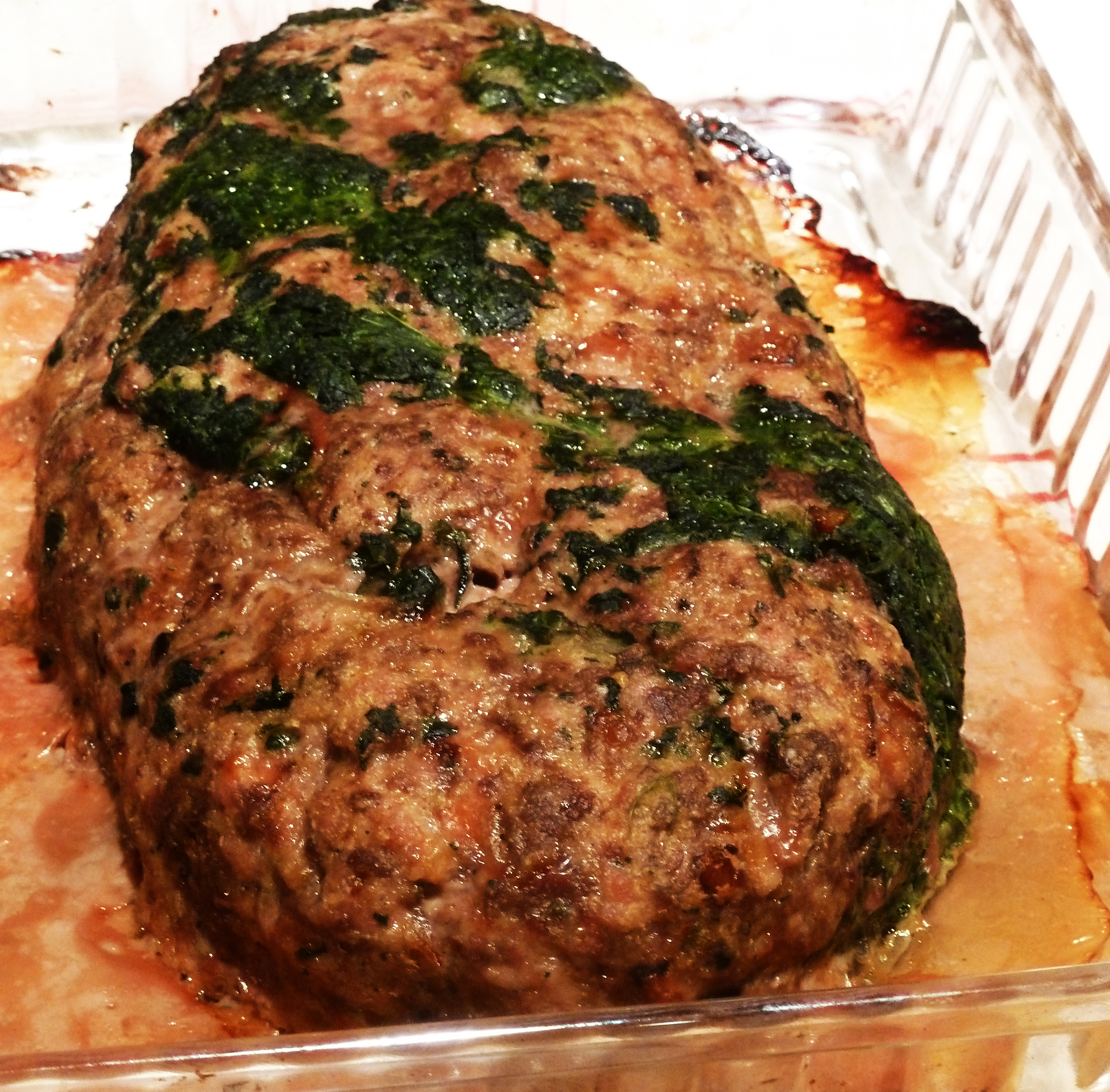
The most thrilling recipe I found in that folder, however, was not any of my grandmother’s, most of which I have already published in books, newspaper columns and magazine articles, but my own. It is for a meatloaf I created about 30-something years ago (before I would have put it on my computer) for the birthday of my long-time partner and now legal spouse, Bob Harned. Bob has fond memories of this meatloaf recipe, which was published in a weekly column called “Sundays in the Kitchen with Arthur” that I was writing for the New York Daily News Sunday magazine. I called it Marble Meatloaf, because it is streaked with spinach. Bob has asked me to make it again from time to time, but I’d lost track of the exact recipe. I am sure the magazine it appeared in is packed in one of the many archival boxes in our storage locker, but I’ve never gotten the energy to pursue the search.
Sydell’s handwritten version to the rescue, a gift from my mother, who died 26 years ago, on Mother’s Day. I think I have to make it this weekend.

Arthur Schwartz’s Marble Meatloaf
Ingredients
1 medium onion, finely diced
2 tablespoons butter or oil
1-1/2 lbs. ground chuck
½ cup fine dry bread crumbs
½ cup milk or water
1 egg
1 teaspoon salt
½ teaspoon freshly ground black pepper
1/8 teaspoons freshly ground nutmeg
3 to 4 tablespoons grated parmesan cheese
10-ounce package chopped spinach, thawed
Serves 4
Directions
- In a small skillet, sauté onion in butter until golden, about 8 minutes. Meanwhile, combine bread crumbs and milk; let stand so crumbs absorb milk, then, with a fork, beat in the egg.
- Take the chopped spinach in small handfuls and squeeze out excess moisture.
- In a large mixing bowl, combine the ground beef, the sautéed onion, the bread-crumb mixture, salt, pepper, nutmeg, and grated cheese. As you add the ingredients, distribute them around the surface of the meat, don't just plop them in.
- With your hands, blend everything together until mixed well. Add the spinach and mix again, just until all the ingredients seem equally distributed. Don't overmix or knead the meat.
- Turn the meat mixture into a rectangular baking dish and pat into a rye-bread shaped loaf about 4 inches across at the bottom and tapered towards the ends. Bake in a pre-heated 350-degree oven for 50 to 60 minutes, depending on doneness desired. Let rest 5 minutes before serving. Serve hot or at room temperature.

