Pen to Panel • An Evening of Archives, Conversation, and Lagers
This Saturday is our culminating event, Pen to Panel, with the Smithsonian's Archives of American Art. We'll be joined by five wildly creative minds for an hour of conversation about the past, present, and future of handwriting. We are thrilled to be hosting the event at The Sketchbook Project's newly-renovated home, which houses thousands of sketchbooks from around the globe. Below are the brief bios of our panelists, as well as a few links so that you can get a little lost, and find much more. But if you're in town, come see and hear from them in person. Did we mention the beer is on us?
The power in the pen is people, which is why we hosted Pen to Panel. It was our third of three events with The Smithsonian's Archives of American Art. Curator of Manuscripts Mary Savig doesn't believe handwriting is a dying art, and we agree, which is how we bonded, and it is which is why we have bonded, and for two months, banded together to help celebrate the launch of their latest anthology, Pen to Paper. We were thrilled to host this culminating event at The Sketchbook Project's newly-renovated home, which is the permanent home of the Brooklyn Art Library and houses thousands of sketchbooks from around the globe. We're in the midst of creating a short film from the event, as we recorded the conversation, but in the meantime, we hope you'll enjoy some of the images from the night, as well as info on the five wild minds that joined us to talk shop.
Info on our Five Panelists:
Mary Savig, Curator of Manuscripts, Smithsonian Archives of American Art
Mary Savig brings to the table years of experience in one of the largest archives today: The Smithsonian's Archives of American Art. We first bonded during a snowstorm. It happened to be National Handwriting Day, which is not only the best time to get snowed in, but the best time to write by hand. She doesn't believe that handwriting is a dying art, and we agree, which is why we bonded in the first place, but then banded together to create this collaboration and conversation. She talked about the issues archives face, how they keep the past present, and what steps The Smithsonian is taking to embrace the technologies of the future.
Luis Jaramillo, Author and Director of the MFA in Creative Writing at The New School
Luis Jaramillo is the author of The Doctor’s Wife, winner of the Dzanc Books Short Story Collection Contest, an Oprah Book of the Week, and one of NPR’s Best Books of 2012. Plot twist: he writes his drafts by hand. Luis talked about this particular experience, but also the role handwriting plays, in general, in the creative writing process. While this is one of the main reasons we were excited to have Luis on the panel, he also happens to be a part of Handwritten's origin story: the platform was first imagined during a course he co-taught called Writing & Publishing Lab at The New School's MFA Creative Writing Program, where he is currently the director.
Linda Shrewsbury, Creator of CrusiveLogic
We were thrilled to be joined by Founder of CursiveLogic Linda Shrewsbury. They have been one of our "Partners in the Pen" since the beginning. Whenever people say cursive writing is dead or dying, we say no it's not. And then we explain to them CursiveLogic: the patent-pending method for teaching cursive that has literally and figuratively reshaped the way students learn cursive in the classroom. Only two years in, CursiveLogic's future is bright, which is one of the things Linda talked about: the future, and reinvention, of cursive writing in the classroom. In addition to homeschooling her own three children, Linda has been privileged to work as a teacher and a college professor in both private and public institutions. Linda received her undergraduate degree from Harvard University and her Masters from Oklahoma State University.
Tullis Johnson, Author and Curator of Archives at Burchfield Penney Art Center
Tullis Johnson is the curator and manager of archives at the Burchfield Penney Art Center. He is what we would call a historical surgeon on Burchfield, but what others would call an emerging Burchfield Scholar. Tullis has organized multiple exhibitions of contemporary and historical significance, including the nationally touring exhibition, Charles Burchfield: Weather Event, which received the Award of Commendation at Museums in Conversation from the Museum Association of New York. You can see his exhibition Blistering Vision: Charles E. Burchfield’s Sublime American Landscapes, which is currently on view at the Burchfield Penney Art Center in Buffalo, NY. Using Burchfield as a portal, Tullis spoke about the necessity of zooming out when we look at the state of handwriting.
Barbara Bash, Calligrapher, Author, Illustrator, Performance Artist, and Teacher
Barbara Bash quintuples as a calligrapher, author, illustrator, performance artist and teacher of the creative process. Her love of the alphabet has taken her back to the study of their early origins in the nature: the writing of the world. She has written and illustrated a number of children’s book about trees, bats, urban birds and most recently, True Nature: An Illustrated Journal of Four Seasons in Solitude, which was completely handwritten except for the bar code. The embodied act of handwriting is one of her core practices for self connection. She is currently creating a book (working title, Leaping Letters) that explores why handwriting still matters. You can understand why we could not contain our wild happiness to have had Barbara on the panel.
You Can Stop Cursing at Cursive Writing Now • A Handwritten Review
HANDLED BY HANDWRITTEN
Meet Linda Shrewsbury and Prisca LeCroy, the mother-daughter team who has changed the world of cursive writing. Literally and figuratively, they have reshaped the way children, and adults, learn cursive writing: not in alphabetical order, but by shape. And in less than one week, their second campaign comes to a close. Their first, a Kickstarter last year, was successfully funded and raised $33,000.
This helped bring CursiveLogic, the workbook you see below, into existence, and now, Shrewsbury and LeCroy are set on taking it into the classroom with their new campaign, Cursive2Class.
What exactly is CursiveLogic's method? It reorders the alphabet into four shape-groups (oval, loop, swing, and mound), color-codes them with visual and audio cues, and fits into a single workbook that has — prepare yourself for this — regular paper and dry erase worksheets. Heaven, we know. Whereas old models required students to sit in place and etch the alphabet in order and silence onto recycled and photocopied sheets of paper, this four-lesson workbook takes students through each similarly-shaped group of letters, while at the same time teaching how to write full-length words. This model, workbook, and business is the absolute example of how, coupled with new technologies, we are finding more effective ways of teaching children the fundamental skills and knowledge necessary for cognitive development.
This is the answer the core curriculum has been waiting for, not to mention Town Hall Meetings and online forums. Cursive writing has been disappearing from the classrooms, but that is because the way it was being taught had not changed with the ways in which students are learning, and expected to learn, in the twenty-first century. We are preparing students for jobs that don't exist yet because we are still inventing them. But the thing most people don't see is that when cursive handwriting goes, a lot of other things we cannot see or feel vanish with it as well, including reading comprehension, articulation, writing and sensory motor skills.
The old model wasn't working. We live in a technological world, and one that is constantly changing, which means we have to change with it. And CursiveLogic is not just keeping up, but it is ahead of the curve: they have side-stepped the political impasse and built their own business, a patent-pending approach, in fact, and instead of arguing back and forth with adults, they were sitting down with students and watching them work. Ever since their model surfaced, they have been gaining support from handwriting experts, educators, politicians, psychologists, and scientists around the country.
You might be thinking, this looks great, but not for me. We understand not everyone will want to relearn cursive writing, though we actually encourage you to do so (we have bought their workbooks and are going through it ourselves), but there is still something you can do: spread the word, sponsor a workbook, and help CursiveLogic make its way into the classroom. Join us and participate in their Indiegogo Campaign. We selected the "Get One and Give One" option, which we recommend, but if you want to Give Two, then do your thing.
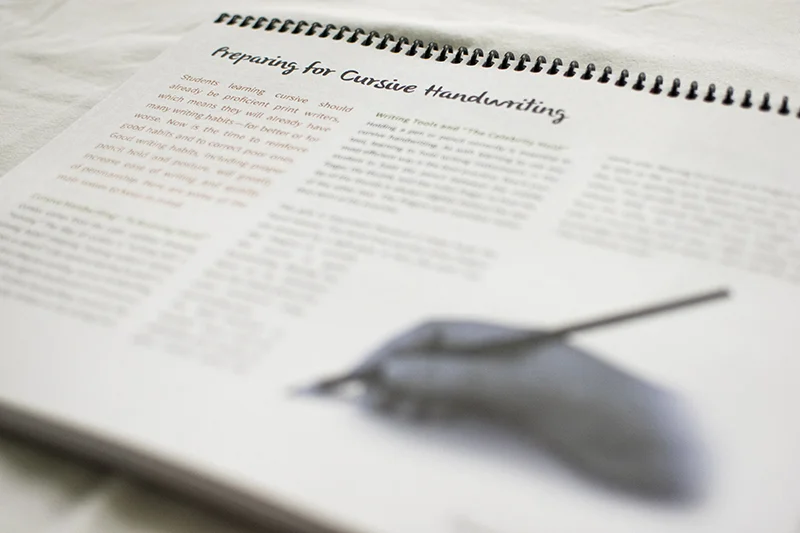
The next time you hear someone up in arms about cursive writing, you can pat them on the shoulder, hold the cursive book you bring with you everywhere just in case you feel the urge to loop or swirl, and say, "You can stop cursing at cursive writing now."
Follow the links below to help support the remaining days of their campaign (Cursive2Class) and help a kid. Spread the love by liking them on Facebook, and check out their story in their words.