Paul Laudiero's Shit Rough Drafts • A Handwritten Review

BY HANDWRITTEN
We recently came across Shit Rough Drafts by comedian Paul Laudiero. After reading through it in one sitting, we spent the next few days losing our marbles. Laudiero's humor is magnetic, often departing as quickly as it arrived, leaving us to enjoy his imaginary musings on the greatest works, shows, and plays of our times.
Chances are, you have experienced several of the 135 books, movies, and TV shows that appear within Shit Rough Drafts. While that'll enhance the experience, it doesn't exclude entertainment. You don't need to have read Eat, Pray, Love to deeply enjoy Laudiero's title-twists.
Shit Rough Drafts exposes process, and in the process, pokes fun at finished products. How do these "must-reads" make their way into the world, and did they ever take a different shape? Are those who we hoist high out of reach just as messy, confused, and lost as we are?
We spoke with Laudiero one early morning while he was strolling alongside Central Park, coffee cup in hand. It was eight in the morning. He was alert and awake, while we were on a porch shielding our eyes from the early morning sun. We told him about Handwritten, and how we wanted to keep the humor in handwriting. He said that was good, because a site like ours would bore people to death. We totally agreed.
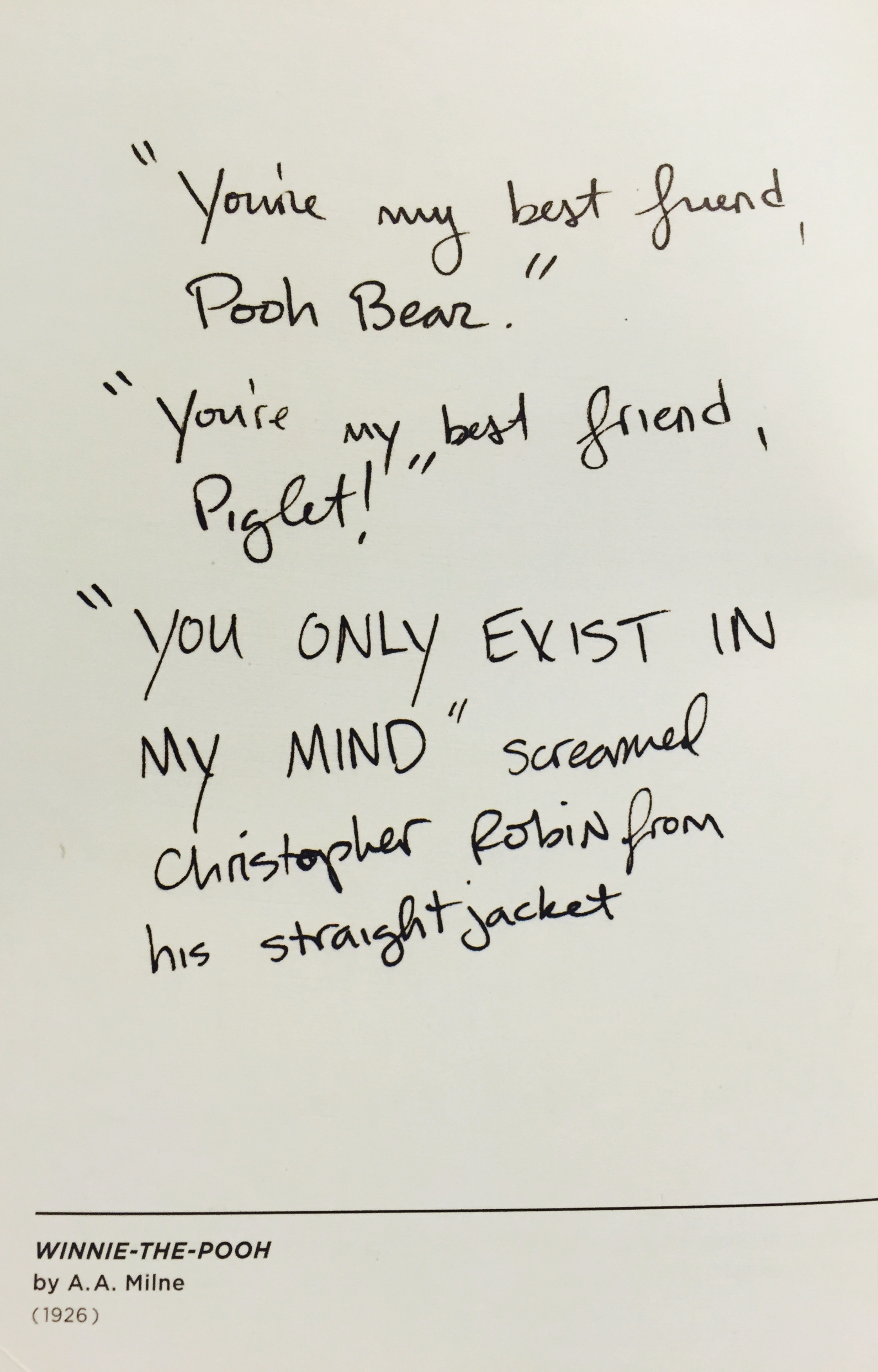
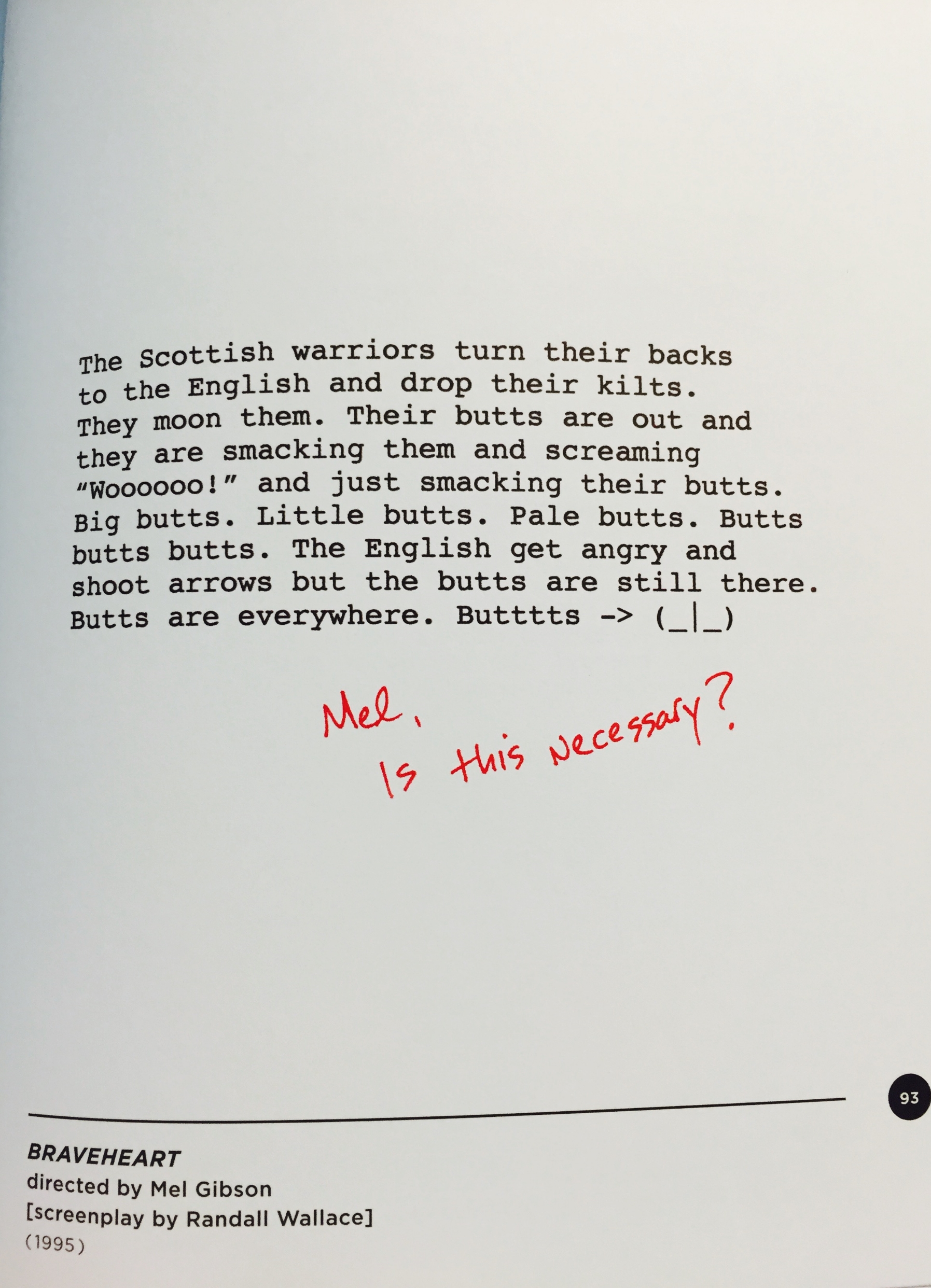
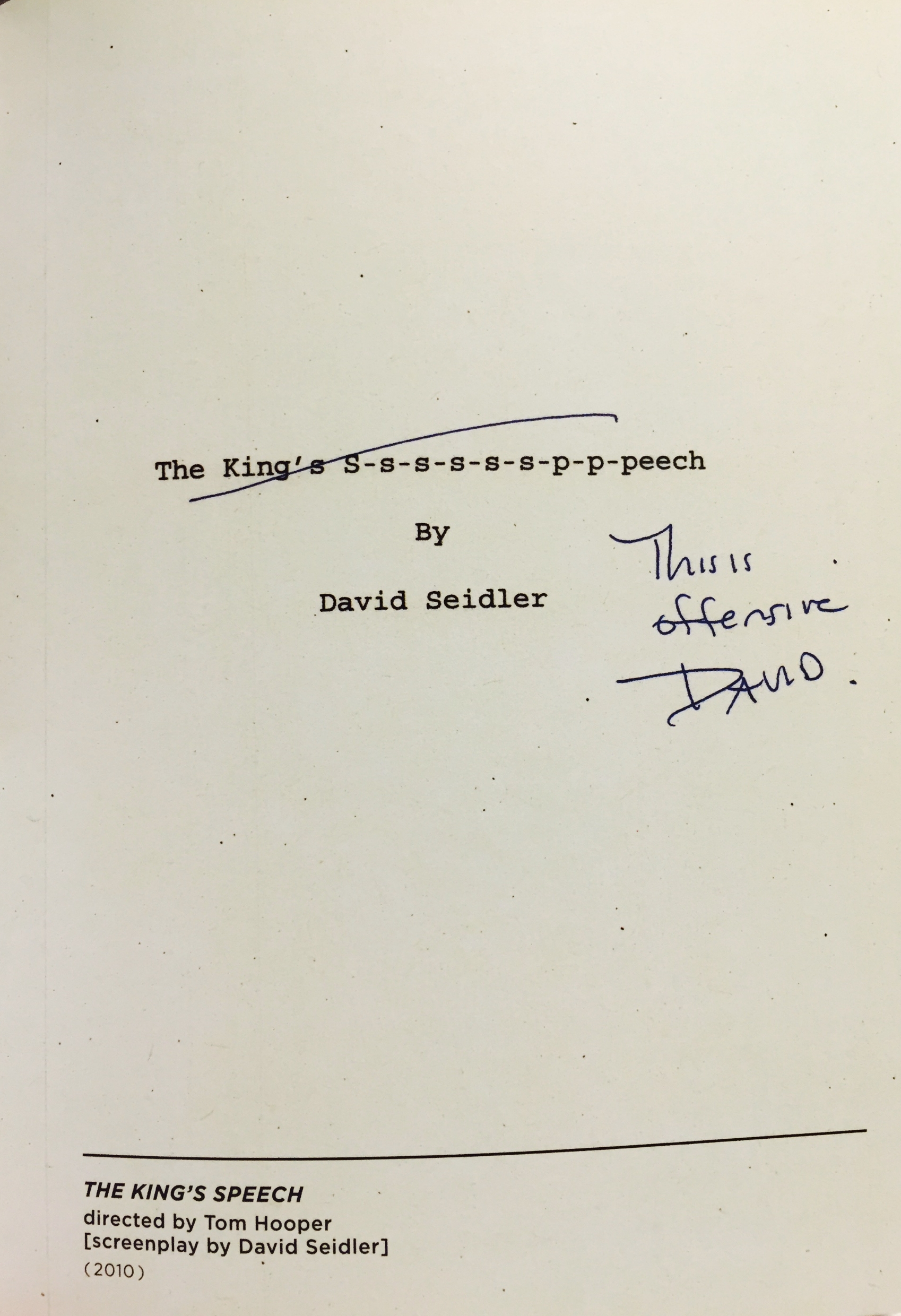
Shit Rough Drafts is a new wave of coffee table books. In that, it isn't idle. The book is impossible to not pick up, and difficult to put down. It's not easy then to pick our favorites, but since we had to, here are three that kept us laughing well into a deep sleep:
A Kaleidoscopic Force of Creative Decoration • Andrea Rehani

WORDS FOR WALLPAPER is a kaleidoscopic force of creative decoration by Chicago-based poet and creative, Andrea Rehani. It combines the beauty and brevity of poetic expression with an artistic and aesthetic simplicity that is at once reminiscent of the modern and the antique.
Beginning by hand, Rehani creates a poem based upon a particular color or theme and allows them to take horizontal and vertical shapes as she frames them for the wall, where they will eventually live. There is an odd distance of intimacy to Rehani's work. The poems themselves contain a layer that can feel like a memory, but zooming out, the object itself represents something of the "now here," not "nowhere;" in that, they carry with them the sense of place that surrounds them.
To see the exhibit, click here.

I Don’t Keep a Journal the Way Most Journal Artists Do • A Conversation with Brian Singer of 1000 Journals Projects
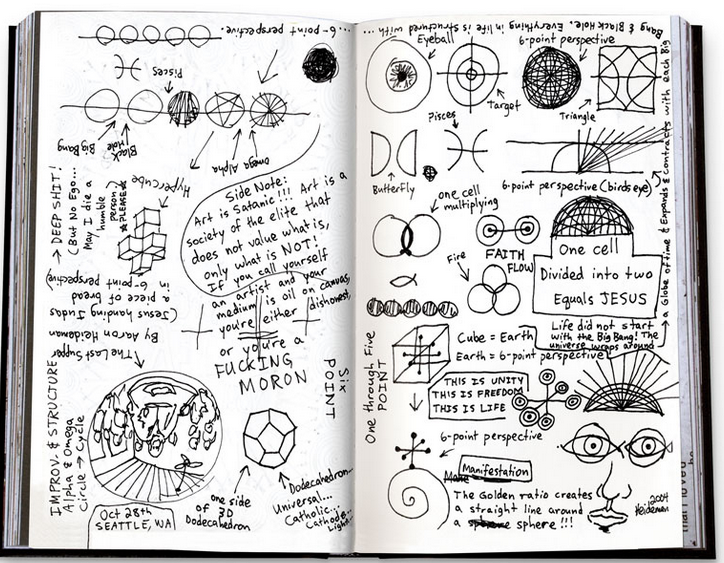
Brian Singer is a San Francisco-based fine artist whose sobriquet “Someguy” downplays the enormously unique body of work he has produced in the last decade or so. I first discovered his work at age 15, when I stumbled across the 1000 Journals Project book in my sister’s bedroom.
An ongoing collaborative experiment, The 1000 Journals Project attempts to track 1000 originally empty journals through their travels across the globe, accumulating stories, sketches, and photographs as they pass between friends’ and strangers’ hands. In addition to larger scale projects such as this, he creates visual art pieces that explore the layers of signification of the printed word, crossing out and redacting text in a process of mixed media décollage.

SARAH MADGES: The extensive, anonymous shared artifact network you created with The 1000 Journals Project speaks volumes about individuals' desires to be creative, without fear of criticism. Did you expect to find so many untapped talents waiting to give expression to their thoughts? Did you initially conceive of this project as a way to make collaborative art or did it just kind of happen?
BRIAN "SOMEGUY" SINGER: I think everyone is creative, but society tends to have a narrow definition of the word. Some people are creative when they cook, or garden, others make art. In the book Orbiting the Giant Hairball, Gordon MacKenzie talks about creativity—I’m paraphrasing here—he says that if you ask a room full of kindergarteners how many of them are artists, they’ll all raise their hands. Ask the same question of a bunch of 6th graders, and a few will raise their hands. Ask high school students, and you’ll be lucky to get a couple to raise their hands. So, what happens to us growing up? We begin to fear criticism and judgment of society.

When the project was conceived, it was based on what people write on bathroom walls. Not quite collaborative art, but more like public conversations. That said, I love the works of Dan Eldon, and sort of imagined what would happened if people just layered and layered their contributions until you got a density similar to his journals.
MADGES: In an increasingly tech- and text-based world, handwriting has lost some of its former relevance and ubiquity—cursive is no longer even required in U.S. school curricula and thousands of people have never written or received a letter in their entire life. How important is the handwritten aspect of these journal entries to you? How important is the written word to you as an artist?
SOMEGUY: The hand-crafted element is crucial to the journals. It’s almost like a signature, or hint of a person’s personality, beyond the words written. As an artist, for whatever reason, it has a little less meaning to me. Strange, now that I think about it. Perhaps because it’s so accessible and anyone can do it, it feels less precious or unique. Or maybe because I don’t incorporate handwriting into my art work — I’ve never really liked the look of my own handwriting. It’s more like chicken-scratch, which I blame my dad for.
MADGES: Do you keep a journal?
SOMEGUY: No. Yes. Sort of. I don’t keep a journal the way most journal artists do. When I was younger, I kept a journal which was more like a diary of sorts. Now, I have sketchbooks, which I use mostly for notes and ideas. Not really for freeform writing, or artwork, just lists and notes and sketches.
MADGES: As far as I can tell, the 1000 Journals Project was last on exhibition in Scottsdale in 2013. Where is it now? What are your plans for the project? Do you consider yourself its curator anymore?
SOMEGUY: There aren’t any exhibition plans for 1000J right now. A couple years back, I approached a few venues, and while there’s some interest, nothing panned out. As for plans, again, I don’t have any current plans. This is mostly due to time constraints, it takes a lot of energy to keep things going. I do consider myself the curator of the project, but am mostly playing a waiting game.. waiting for journals that have been out in the world for almost 15 years to be rediscovered and sent home. I imagine most are sitting on bookshelves, forgotten over the years.

MADGES: What do you think is the relationship between visual arts and creative writing? Do you think of yourself as a poet or writer when you create your cross-out and printed word pieces?
SOMEGUY: That’s a great question, because I haven’t given it much thought. I tend to gravitate towards certain types of works. These can be strictly visual in nature, or strictly written. I think the ability to combine the two opens up the best of both worlds when done well. They can live in harmony, or in contrast, and add value to each other, or amplify the artist’s intent. When I create my redacted works, I mostly consider myself an editor. I’m stripping away information and creating new meaning. I’d hesitate to call myself a poet or writer, which might be an insult to poets and writers, but there are some similarities in our goals to shape language and message.
MADGES: What have you been working on lately?
SOMEGUY: Lately, I’ve been working on building bodies of work around themes. So not really participatory, or journal based projects. One recent explorations was around visualizing number patterns (connect the dots) in unexpected ways. And the current exploration (no photos online yet), are process based works where I put a shape on every page of a book (imagine a circle or letter), and then cut the book up and reassemble the shape using the edges of the paper.
No Other Place Publishes Process • The Origins of Handwritten

In early Spring of 2015, Sarah Madges set out on a project surrounding the Handwritten word and recalled Brett mentioning a project he had recently begun. She reached out to ask if the project was still alive. It was, barely. The exchange served to reignite the project and has since turned into this site, which Sarah is also to thank for, as she since came on board as a central curator for the project. Below is their initial exchange about the idea for the site you are seeing today, which is constantly evolving.

SARAH MADGES: What inspired you to develop a publication/project surrounding the handwritten word? What is your own experience with handwriting?
BRETT RAWSON: I knew I wanted to start something last winter. I took a course at The New School that had us look at digital storytelling, and I found great calm mixed with wild energy in this embrace of and attitude toward technology - how can we use technology to promote our passions, digital or otherwise? On a morning in February, I was on the L train brainstorming for a separate project when the word Handwritten appeared from somewhere. I had my notebook in hand so I scribbled it down. I happened to be heading toward a workshop put on by PEN, so I wonder if that had something to do with the whole thought. At any rate, the word opened up the idea itself: a home for the handwritten word online.
There is no place that publishes things other than finished products. I wanted to promote process. There's a bunch of theories and thoughts about handwriting, penmanship, and personalities. I do think about them, and I care about them, but I am not specifically concerned about them. I don't really care much about their outcomes or conclusions. For example, I find it interesting what people think my handwriting says about me, but I care more about saying things with and through my handwriting. What comes of it in the end is not really something I can consider while I am doing it.
The idea is pretty simple—for people to express themselves with pen and paper, and be published for it. It's also to be a preserve of sorts—for letters written by those who have passed, for example. I am always writing by hand. I don't always write my stories by hand, though most things usually begin on paper—in a journal, on a napkin, or a legal pad. I do, however, write a lot of letters. It's how I ease myself into writing for the day. I can't jump into writing on the computer without starting by hand. I have to start somewhere free. In this sense, it's like stretching, doing yoga, starting out slow, or warming up.
MADGES: What is the project's mission statement?
RAWSON: A place in space for pen and paper. But I have been thinking about changing it to something a mentor of mine once said: writing is a physical activity.
MADGES: Are you concerned that handwriting / cursive lessons are being eclipsed by keyboard proficiency lessons in U.S. elementary schools?
RAWSON: I'm not so sure I am that worried about cursive. But that's probably because mine is horrific. In fact, my regular handwriting sort of looks cursive. Or maybe it looks like it is cursing. It's hard to tell. Someone once said my handwriting looks like a string of wasted wingding characters, which is offensive, but true. But handwriting altogether, what a horrific waste of natural talent. The hand is how we gain access to our inner self. I really don't think the computer can access that wild, raw energy inside each of us. When using a computer, I get an external feeling (usually in the form of mild swells of panic), whereas when I write by hand, the noise from everywhere really quiets down, and I can finally hear my own voice.
The people making these policies, or mistakes, probably don't write by hand much. I imagine they see it as a waste of time, or something of the past, that we should get with the times and technology. This measurement feels imprecise. And it isn't a matter of sentimentality. It also isn't about one or the other. I wonder when people will wake up and coexist - to stop living in some world of ones. I write on the computer all the time. I have four twitter accounts, a Facebook profile, page, and group, five Instagram accounts, one tumblr, and three websites. You know? It's not like I don't get the beauty and power in the computer, let alone its efficiency, insanity, and amusement. I am a user, and I love using it. But what a fucking mistake to not teach kids how to write by hand. So I guess I am concerned.
MADGES: Do you notice a difference in the kinds of things you write when you use pen/pencil as opposed to a computer / word processor? How do you think the writing tool affects content/style/etc? How do you think it affects the editing process?
RAWSON: Absolutely. The medium affects everything. The effect is also bilateral. The reader adjusts his or her expectations based on the medium. A letter is sort of like dining out—there is an experience to it. An email is more like take-out, delivery, or TV dinner - it is often more quick, requires less from me, and can be done while doing something else.
That being said, I don't see it as a matter of good or bad, better or worse. It is simply different. Writing by word processor is more about a product or outcome—a finished something—and so pieces composed there are usually toward that end. But with handwriting, it is more so a work of progress, or process. It is, inherently, more private and intimate. Computers are meant to connect, gather, and scatter. And the screen in between becomes a kind of reflection and projection, which can be a disorienting feeling that registers at a deeper level. Handwriting is about process on two levels -- one, it is about the process, but two, it is a way to process things. Not necessarily produce a product.
MADGES: Phenomenologists have argued that the self falls away when we are engaged in an intense activity, usually one that collapses the sense of the mind-body split by activating both elements. Do you think the writing implement of choice could act as a bodily extension, and that writing by hand helps combine subject and object in ways that promote intimacy with a text, whereas typing into a word document promotes separateness of subject and object?
RAWSON: Fascinating. I imagine this has to be. There is a oneness when it comes to things like painting, the piano, or even running, and so it would make sense that it carries over to hand-writers. It makes me think of meditation for some reason, only I don't really know why. There is intense freedom within limitation, which might be why the computer is such an energy vampire. It pokes so many holes in our concentration containers that after a short period of time, we feel totally drained. Whereas with the handwritten word, I think of a dam and what happens when everything flows through a single thing—it harnesses a new kind of energy. Because with handwriting, you aren't concerned really with what you're writing. There is something hypnotic about the way in which the hands moves.
MADGES: Anything else you would like to add?
RAWSON: Keep the beautiful pen busy!