
Mr. L’s Onion Soup • Alan Seidman
Note from Curator Rozanne Gold: Alan Seidman, former legislator from Orange County District 12 in upstate New York, embodies what it means to be a distinguished citizen. Countless man-of-the year awards and lifetime-achievement awards do not do justice to the thousands of people he has helped through his philanthropic and professional endeavors. His personal journey – graduating with a master of science degree from Emerson College in speech, to owning a liquor store, a variety store, an ambulette company, to the ranks as Chairman of the Orange County Legislature, makes him one of the more interesting people I have met. Just last month this serial entrepreneur chaired an event for the Purple Heart Award with General Petraeus and more than 550 attendees to raise money for the “Purple Heart Hall of Honor” Museum. I'm a better person for knowing him.

Mr. L’s Onion Soup by Alan Seidman
It’s the beginning of June and hardly the time one stops to consider a bowl of onion soup but, nonetheless, it is what I made this week for my son Adam who is just home from college. A rising junior at Elon University in North Carolina, he is generally away at school during cooler weather and never gets to enjoy this soup anymore. Adam grew up loving this recipe, one I learned to make from the elderly gentleman who I transported to and from dialysis appointments three times a week in my shiny then-new ambulette more than 25 years ago.
Mr. L. was an elegant man who was born and raised in Pennsylvania and worked his entire career for one employer here in the Hudson Valley, where I live. In spite of his physical challenges, he remained upbeat and we had great discussions during the trips…some of those chats were about our shared love of cooking. He held his recipes “close to the vest,” but I managed to get him to share a recipe for French onion soup. I’m not sure if it was his not wanting to divulge everything or wanting to make me do some experimenting, but he was never clear about the cup or crock measurement for bouillon, so I split the difference in his slightly oblique instructions. (I use eight bouillon cubes for twelve cups of water.) One thing Mr. L. was very specific about, however, was that the bouillon had to be Knorr’s Beef Bouillon or, he admonished, it would not come out right. I once tried it with another brand and it did not taste the same (nor was it as good). I even tried it with my own homemade beef broth long ago but, it too, was lacking in character.
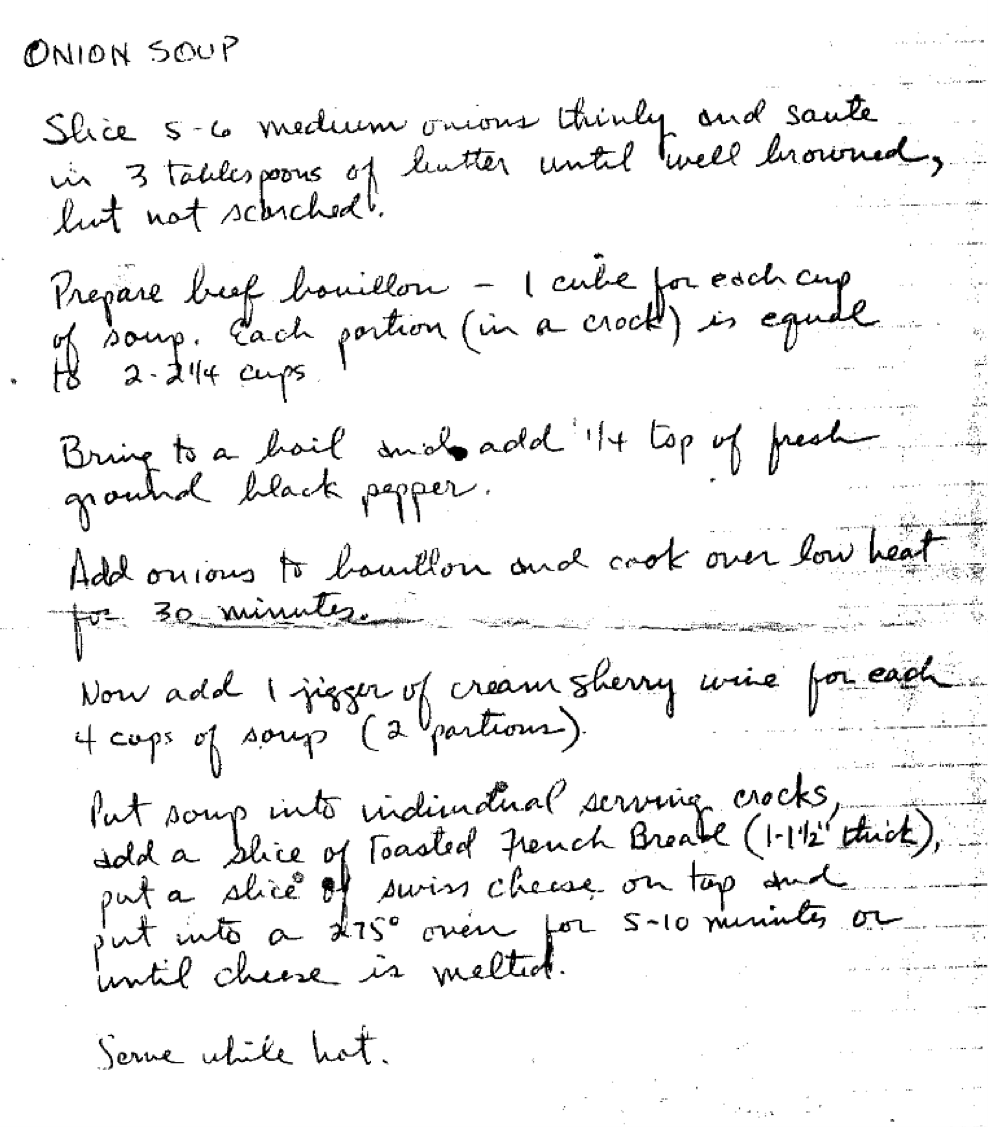
The recipe is written in Mr. L’s own handwriting, since mine is rather illegible. It is prepared with the requisite slice of toasted French bread and topped with melted Swiss cheese. It is something I make frequently when we entertain over the winter and it is always a hit with our guests. I think it is the generous amount of Harvey’s Bristol Cream Sherry that makes it sing. (At times I have noted that a generous amount of this sherry also makes me sing.)
I had been an active member of the Cornwall volunteer Ambulance Corps. for decades and had my own transportation business for more than a dozen years, and I think about the thousands of wonderful people I met during those times. There is a quick intimacy that develops
in stressful times and a vulnerability that ensues when one is elderly or dealing with illness.
Mr. L. and I became good pals over the years. His handwritten recipe is now well-worn with numerous Xeroxed copies all over my kitchen.
(By the way, I am informed by Ms. Gold, that the original recipe for onion soup contained no broth whatsoever, because the French peasants who devised it could no way have afforded rich beef stock and one needed a saint's patience to darkly caramelize a massive quantity onions in order to get the right color and flavor.)
The first spoonful tastes a bit salty, but with the addition of booze it reaches perfection. I thought about what I might drink with the soup to make it more compatible for imbibing in warmer weather (I owned a liquor store for years) and thought a full-bodied rose from Bandol or a cellar-temperature pinot noir from Oregon might do. But I think Adam and I will drink a few beers instead.
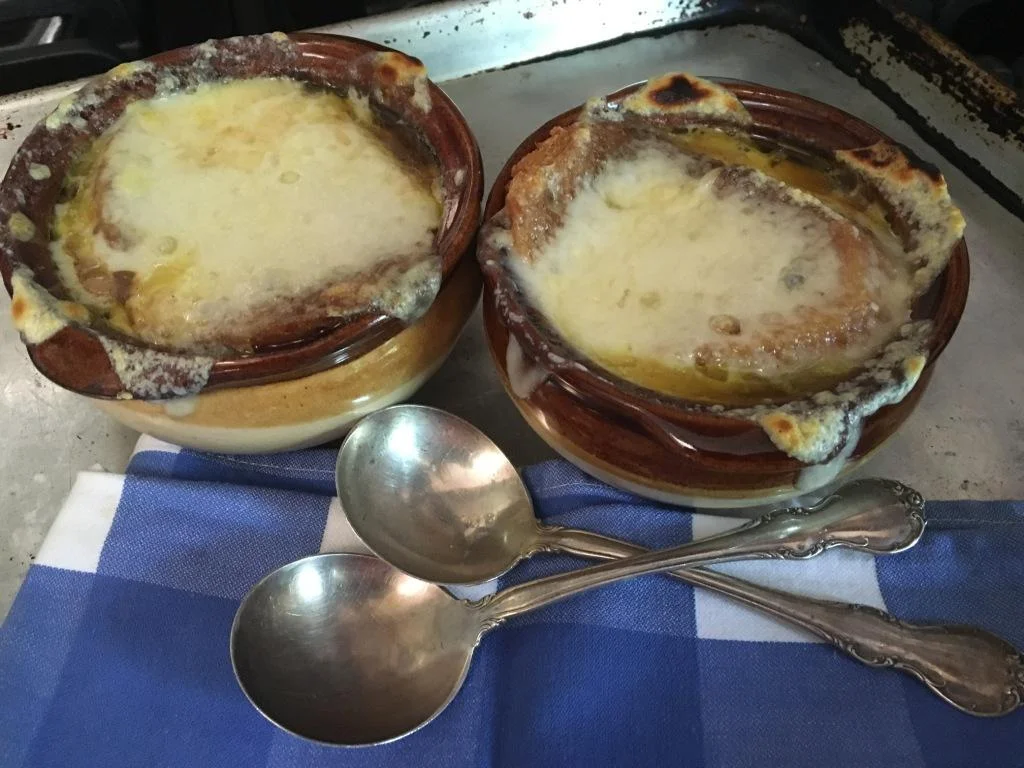
Onion Soup
adapted by RG from Mr. L's recipe
Serves 6 - 8
Ingredients
5 to 6 medium onions (about 2 pounds)
3 tablespoons unsalted butter
6 (extra-large) Knorr beef bouillon cubes (2.3 oz. pkg.)
12 cups water
6 tablespoons Harvey’s Bristol Cream sherry
6 or 8 slices toasted French bread (cut 1-1/2 inch thick)
6 or 8 slices Swiss cheese
Note: a jigger is a measure of 3 tablespoons or 1-1/2 ounces.
Directions.
Peel and thinly slice onions. (Cut them in half lengthwise and then across into half circles.) Melt butter in a very large pan. Cook onions until very dark brown, stirring often, about 25 minutes. Do not scorch.
In a large pot, put bouillon cubes, 12 cups water, and ¼ teaspoon freshly ground black pepper. Bring to a boil, then whisk over low heat until bouillon dissolves. Add cooked onions to bouillon and bring to a boil. Lower heat to medium-low and cook 30 minutes. Add cream sherry. Put soup into individual serving crocks. Add a slice of toasted French bread, and put a slice of cheese on top. Put in a preheated 275 degree oven for 5 to 10 minutes or until cheese is melted. (You can put under the broiler for a minute to brown.) Serve while hot.

Mrs. Cubbard’s Raisin-Stuffed Cookies • Marie Simmons

Note from curator Rozanne Gold: Marie is a trove of handwritten recipes and stories. An award-winning cookbook author and food writer, Marie Simmons wrote Bon Appetit’s “Cooking for Health” column for many years, and is the author of more than 20 cookbooks, including the wildly popular 365 Ways to Make Pasta, The Good Egg, and Lighter Quicker Better. Marie, a self-proclaimed story teller, is alight with thoughts of her mother and grandmother. She says, “These two family cooks taught me how important it is to make sure everyone has something good to eat. I hear their words, and I do the same.”

Mrs. Cubbard’s Raisin-Stuffed Cookies by Marie Simmons
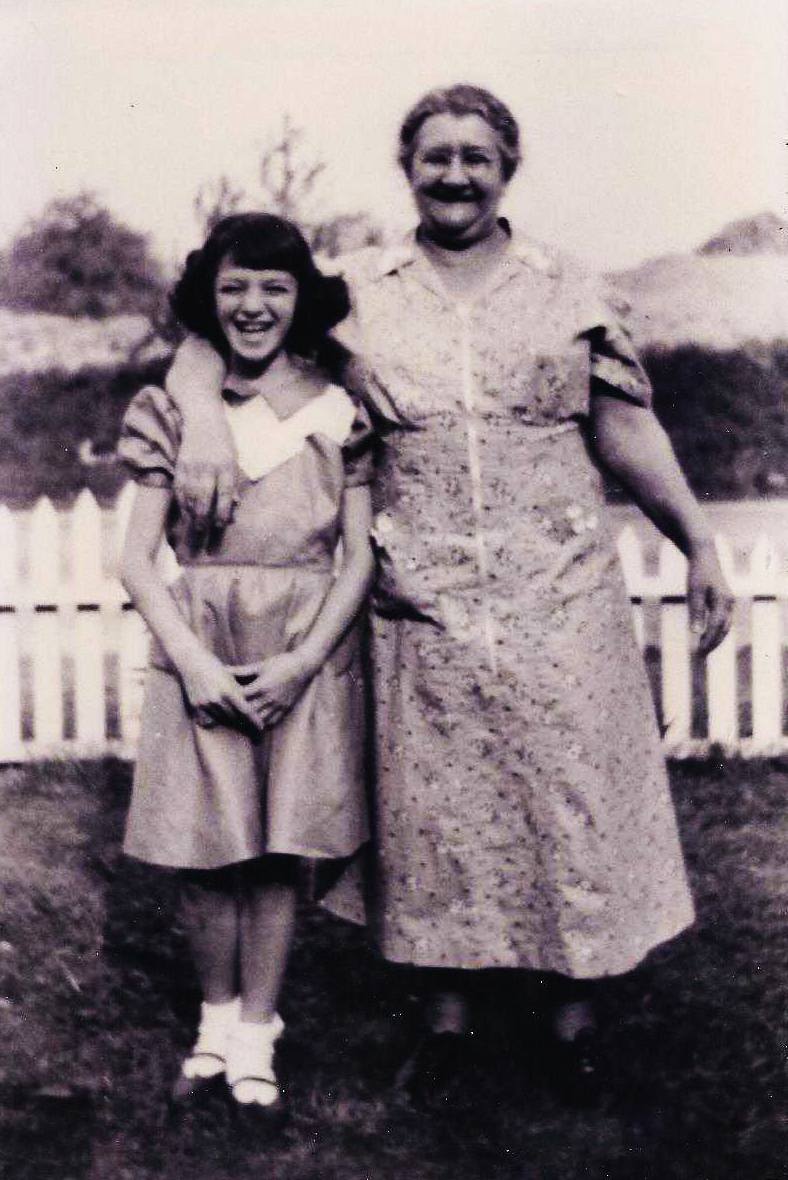
Some children have play dates with friends. My play dates were with my grandmother Nana and we had them every Saturday morning. We made stuffed cookies from a recipe from a lady, whom I can’t quite visual anymore, by the name of Mrs. Cubbard. She was a neighbor who had a boarding house and Nana helped her in the kitchen.
Nana and I needed to keep her large dark-blue canning pot filled to the brim with Mrs. Cubbard’s signature cookies. You never knew when someone might stop by for coffee or iced tea or a glass of cold milk. What a smile it would bring to her face to know that sixty years later, I still keep a large container of cookie stuffing in my freezer so that I can prepare these nostalgic treats in a moment’s notice.
Nana and I had an assembly line going as we sat at her big round table in the center of her kitchen. (She, cutting out the dough, and me, stuffing the cookies.) The cabinets were painted a deep Greek sea blue. My Aunt Tess, the “decorator,” loved color so much that she filled her kitchen with her water colors and oil paintings and hung them on brightly-painted walls, making it quite festive. Imagine, ruffled white calico curtains billowing around the high-set windows that wrapped around the porch...and an apple pie cooling on the porch railing.
We began our morning by sipping weak tea. We always shared a tea bag. And we chatted. Nana said I inherited her gift for gab and anyone who has met me knows that can’t be denied. I sure do like — make that LOVE — to talk. I seem to always have a story to share.
Mrs. Cubbard’s (Stuffed Cookie) Recipe is a basic sugar cookie made with shortening (shortening is so 1950s!) and sugar, milk, nutmeg, vanilla and egg. I still make it with shortening, somehow surviving the nutrition police. The recipe calls for a “stuffing” of raisins, lemon sugar, and chopped lemon. I have updated the recipe with a filling of fig and prune. Nana would roll the dough on her big flannel-covered table top. Her rolling pin was a long broom handle she bought at the hardware store. She would use the rim of a glass dipped in flour to press out rounds for the cookies. It was my job to use her worn thimble (long misplaced, which makes me very sad) to cut out a circle out from the top of each round. Nana spread the raisin filling on the base of the rounds. I would carefully remove the thimble cut-out and hide it in my apron pocket so I could eat them later. Nana of course warned me, “Don’t eat the raw dough…you’ll get a tummy ache.” But I loved the taste of the raw dough. So I snuck it into my pocket and worried about the tummy ache later.
My Saturday morning play dates with Nana, my mentor, my soul mate, taught me to think about food, to love the taste and feel of food, to write about food and to make me want to be a cookbook author. I have now written more than twenty cookbooks with my latest, Whole World Vegetarian (Houghton Mifflin Harcourt), just published this month. I think I’ll make a batch of Mrs. Cubbard’s cookies…and celebrate.


Mrs. Cubbard’s Raisin-Stuffed Cookies
Makes approximately 12 cookies
3/4 cup sugar
6 tablespoons shortening or butter
1 egg
1-1/2 teaspoons vanilla
1-3/4 cups flour
2 teaspoons baking powder
½ teaspoon nutmeg
½ teaspoon salt
Several tablespoons milk, if needed
Filling:
1 cup chopped raisins
½ cup sugar
½ cup water
2 tablespoons flour (dissolved in 2 tablespoons water)
Grated zest of 1 lemon (or 1 teaspoon lemon juice)
Filling: Put raisins in small saucepan with sugar and water. Bring the mixture to a boil and boil 2 minutes. Add dissolved flour and lower heat to medium. Cook 5 minutes, stirring constantly, until mixture is soft, thick and dry. Stir in lemon zest or juice. Set aside and cool completely.
To make cookies: Beat together sugar and shortening (or butter.) Beat in egg and vanilla. Sift together flour, baking powder, nutmeg and salt. Fold into wet mixture. Add enough milk, as needed, to make a roll-able dough. Roll out onto floured surface to 1/8-inch thickness. Cut with 2 or 2-1/2-inch round cutter. Place on oiled cookie sheet and add 1 tablespoon raisin mixture to each cookie. Top with another round cookie (the center cut out with thimble!) and pinch sides together. Preheat oven to 350 degrees. Bake 12 to 15 minutes until just starting to brown. Let cool.
Note from RG: Instead of using a thimble to cut a small round from the top cookie, I used a tiny melon baller.

Nana's Cookies • Marie Simmons

Note from curator Rozanne Gold: Marie Simmons, a star in the culinary galaxy, shares reminiscences and recipes so vivid that we decided to feature her story in two parts. Part I includes a beautiful essay about her Italian family at the turn of last century and illustrates a cherished view of life – one that included hard work, strong familial ties and values, great meals, and a slew of handwritten recipes dictated by Marie’s grandmother and penned by her mother. The culmination of this is Marie’s love of cooking and her status in the food world. She is an award-winning author of numerous cookbooks and a beloved cooking teacher. Originally from New York, Marie now lives in Eugene, Oregon, a place she considers “paradise.” She bicycles everywhere and is smitten with the vast amount of culture that Eugene provides. The timing for our connection is fortuitous. Marie’s newest cookbook, Whole World Vegetarian (Houghton Mifflin Harcourt), is just out this week. Never mind that Nana’s addictive pepper cookies (known as taralli) are made with lard! Thank you, Marie, and congratulations on the publication of another wonderful cookbook.

Nana's Cookies by Marie Simmons
Antonette Abbruzzese, my grandmother, (I was named Marie Antonette for Nana) was born on the lower East Side of Manhattan on December 19, 1890. Her husband, my Grandpa, was a gentle, sweet man who was very proud of being able to read the daily English newspaper. He was born on January 20, 1880 in the village of Forenza in the remote region of Basilicata — the area of Southern Italy often referred to as the boot. His father died when Grandpa was a small boy and he eventually moved to live near relatives in New York City with his older brother Michael and his mother. Grandpa became a barber for a military installation on Long Island.
Nana and Grandpa maintained a small backyard farm where Grandpa sold produce, honey, fruit, fresh eggs, and beautifully grown vegetables. It was in a small Italian immigrant community in the Hudson Valley village of Milton, New York.
Nana enjoyed cooking healthful meals for her extended family of 9: She had 8 children: Marie Louise, (Tessie) Maria Theresa (Tessie taught school and never married), Grace, Rita, Joseph, Emmaline, and an adopted daughter Maggie, orphaned at the age of 9 and raised by Nana and Grandpa. Their home was always open to family and friends and many of the recipes in my cookbooks describe the hearty meals prepared there. I especially loved the big platter called Aunt Milie’s Cannellini Beans and Rice that made its way into my book, Rice the Amazing Grain. (page 132). It makes me hungry today even thinking about it.
My grandfather was remarkable in that he firmly believed in educating his daughters. (His son Joseph was in the Marines in the Pacific during the war.) Grandpa’s three oldest daughters all went to school and became teachers. But Aunt Rita, evidently extremely bright, obtained a scholarship to Cornell University when she was only 16 years old. Marie and Tessie borrowed money to help pay for books (they were teachers by now) and got Rita settled into her school year at Cornell. What I find amazing about this saga is how open minded my grandfather was. I remember a family saying: You give your children your love and the love of God and you give them wings. You let them fly. And, that is what they did.
My mother, Marie Louise, was a retired school teacher and a “super” organizer! She, along with Aunt Tess and Aunt Rita, ran a tight ship. Our family gatherings were always punctuated by “You, sit here; you, sit there.” No one sat on their own volition — You just waited to be told where!
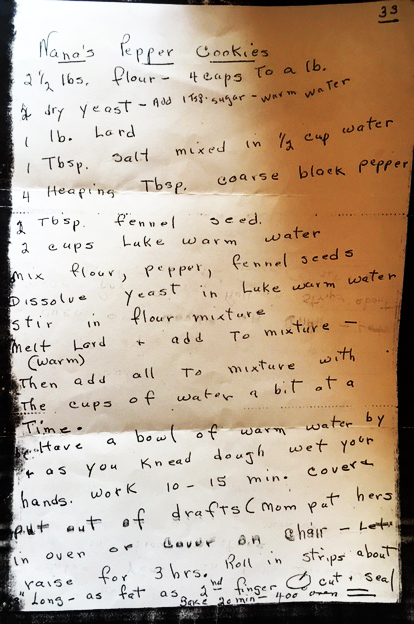
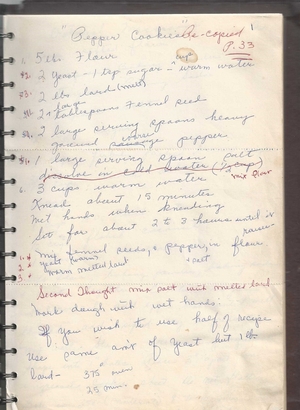
Now to the handwritten recipes: Most of the recipes were printed by Mom as they were dictated by Nana. I retested many for accuracy. After all, Nana measured her ingredients with a large chipped ceramic mug. She would dip deep down into a big vat of flour and skimmed off the excess with the back of her hand. Not the most accurate measuring, I’d say, but the most immediate. I’d worked most of my life in the magazine test kitchen at Woman’s Day magazine and so I had precision and accuracy pounded into my head. After Woman’s Day I moved on to be Food Editor at Cuisine magazine and then cookbook author, so I thought I knew a little about recipe testing, and accuracy.
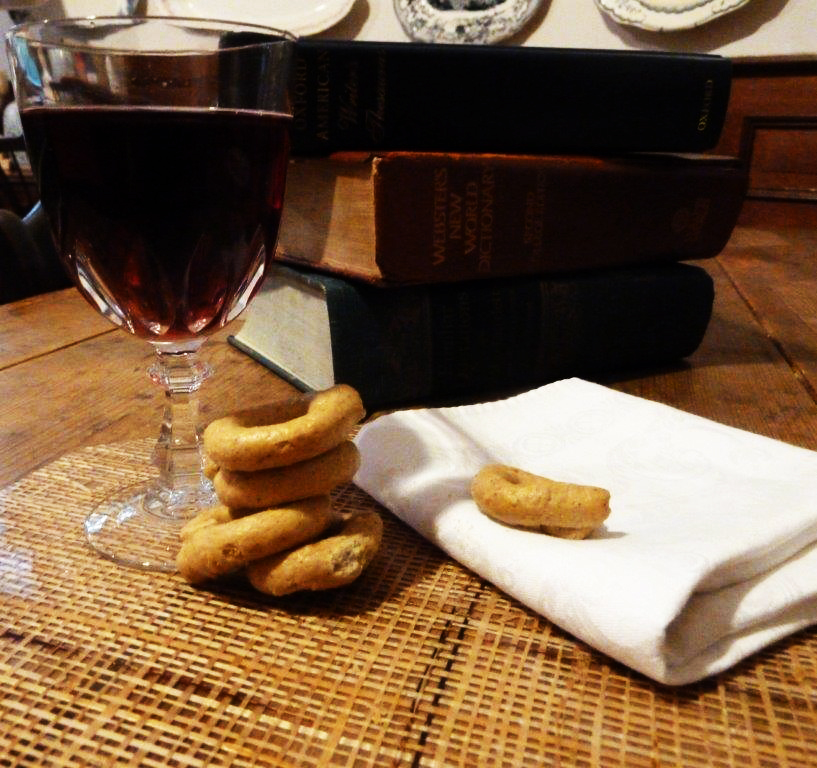
Now where to begin in the saga of Mom and Nana’s recipes? Nana’s Pepper Cookies are tiny savory rings made with yeast and lard and studded with coarse ground black pepper and fennel seeds. I discovered, later in life, how delicious they are with a glass of red wine. I have retested it, but here it is in its original form as written by Nana.
Ingredients
Nana's Pepper Cookies (as edited by Marie)
2-1/2 lbs. flour
2 tsp. dry yeast (add 1 tsp. sugar and warm water)
1 lb. lard
1 tbsp. salt mixed in 1/2 cup water
4 heaping tbsp. coarse black pepper
1 tbsp. fennel seed
2 cups lukewarm water
Directions
Mix flour, pepper, fennel seeds. Dissolve yeast (and sugar) in lukewarm water. Stir in flour mixture. Melt lard (warm) and add to mixture — then add all to mixture with the cups of water a bit at a time. have a bowl of warm water nearby and as you knead dough wet your hands. Work 10-15 minutes. Cover and put out of drafts (Mom put hers in oven or covered on a chair.) Let rise for 3 hours. Roll in strip about 8" inches and as fat as 2nd finger. Cut into small rings. Seal. Bake 20 minutes in a 400 degree oven.

Gina's Aunt's Rice Pudding • Stacey Harwood-Lehman


Note from curator Rozanne Gold: Gina’s Aunt’s Rice Pudding recipe comes to us by way of New York’s Poet Laureate of the Greenmarkets, Stacey Harwood-Lehman. I’m certain Stacey would love to garnish the rice pudding each season—perhaps a strawberry-rhubarb-ginger compote right now at the height of Spring? Poached pears and star anise in Fall? Either way, hers is a lovely story with a quixotic recipe scribbled in her own handwriting on a hotel pad of paper. I love it because it’s real…with a missing word or two, the very shorthand that makes cooking mysterious and sometimes serendipitous. Gina’s Aunt’s recipe is very sweet and could use a little scraping of fresh vanilla bean. It could feed your whole block. I messed around with a simple version of my own (see below), inspired by Stacey’s love of rice pudding!

Gina's Aunt's Rice Pudding By Stacey Harwood-Lehman
Gina and I had been working together for several years when she started dating Tony, a new employee in our agency’s IT department. Soon after Tony joined the staff, I noticed that the usually tech-savvy Gina seemed to be having an uncharacteristically difficult time mastering the new computer system and that Tony was making many visits to our floor to help her. Within a couple of months she announced their engagement. I was among the lucky few of her colleagues to be invited to the wedding.
At the time I was working in Albany, NY, as a policy analyst for the government agency that regulates gas, electric, water, and telephone utilities. I grew up in a suburb of New York City and had relocated to Albany to attend the state university. It wasn’t my intention to remain in Albany after college but there was a boyfriend and a job, so I stayed.
Gina’s work-station was situated near mine and we became friends even though when she joined the department she was only 19 — quite a bit younger than I was — and right out of secretarial school. She had a terrific fashion sense along with a lively sense of humor and an easy laugh. I was flattered that she liked to take a seat in my work cubicle to dish about office romances and such.
Gina liked to listen to the radio while she worked and I could hear her singing along, softly and slightly out of key, with the hits. A local rock station played the same two songs every Friday to usher in the weekend: Todd Rundgren’s “Bang on the Drum” (“I don’t wanna work; I wanna bang on the drum all day”) and Four in Legion’s “Party in My Pants,” the lyrics of which Gina heard as “There’s a party at my parents’, and you’re invited,” the perfect mondegreen to reveal her youthful innocence.
My proximity to Gina made me privy to her wedding plans. But before there was a wedding, there was a wedding shower to be held at the Italian Fraternal Club in Green Island, a small town roughly eight miles north of the state capitol. I was seated at a table of strangers, all of whom seemed to have known each other for decades. My attempts to enter the conversation mostly failed, until I learned that Gina’s aunt, who was seated across from me, had owned a small restaurant that she had recently closed in order to retire. The menu was red-sauce Italian and among her specialties was her rice pudding. I love rice pudding. Would she share her recipe?
Gina’s aunt was no-nonsense, someone you could imagine at the helm of a busy kitchen where everything was made from scratch and where the menu was likely the same from the day it opened until the day it closed. She explained that the recipe would feed a crowd, a large crowd, so unless I was planning to throw a big party, I shouldn’t bother with it. Never mind, I said. I want to give it try.
Something in her manner as she spoke, communicated doubt; doubt that I would be able to make a success of it. It was her rice pudding, after all. She dictated the recipe as I scribbled on a pad that I’d picked up from a hotel where I’d stayed during a recent trip.
That was decades ago. Gina had two children and divorced Tony. The recipe has been with me through several moves and life changes, stashed in an envelope stuffed with other recipes, some torn from magazines, others written hastily on scraps of paper.
When I ran into Gina’s aunt at the wedding, she asked if I had tried her recipe. I hadn’t. I was waiting for the right occasion. I’m still waiting.


Gina’s Aunt’s Rice Pudding
2 lbs. rice
½ gallon milk
5 cups sugar
18 eggs
½ box of raisins
1 stick butter
Cook rice 15 minutes. Drain in colander. Rinse. Beat eggs. Stir eggs over rice. Stir. Add sugar, stir, milk, stir. Put in stick of butter. Stir. Put in oven @350 covered with Reynolds wrap for 1 hour. Remove cover. Stir. Top w/nutmeg. Put back in oven until solid.
Creamy Rice Pudding
(without eggs)
1 quart 2%, or whole, milk
6 tablespoons sugar
¼ teaspoon salt
1 teaspoon vanilla extract (or scraping of vanilla bean)
2/3 cup long or medium-grain rice
1/3 cup raisins
Grated nutmeg and/or cinnamon
Put milk in a 3-quart saucepan. Add sugar, salt, vanilla, and rice. Bring to a boil; lower heat to medium and boil, stirring 3 minutes. Lower heat to simmer (tiny bubbles steady on top). Cook 20 to 25 minutes, stirring frequently. Add raisins and cook several minutes until rice is very soft and mixture is thick but still soupy. Will firm upon cooling. Pour into a deep dish. Sprinkle with nutmeg and/or cinnamon. Cover and chill. Serves 4 to 6
