
Mr. L’s Onion Soup • Alan Seidman
Note from Curator Rozanne Gold: Alan Seidman, former legislator from Orange County District 12 in upstate New York, embodies what it means to be a distinguished citizen. Countless man-of-the year awards and lifetime-achievement awards do not do justice to the thousands of people he has helped through his philanthropic and professional endeavors. His personal journey – graduating with a master of science degree from Emerson College in speech, to owning a liquor store, a variety store, an ambulette company, to the ranks as Chairman of the Orange County Legislature, makes him one of the more interesting people I have met. Just last month this serial entrepreneur chaired an event for the Purple Heart Award with General Petraeus and more than 550 attendees to raise money for the “Purple Heart Hall of Honor” Museum. I'm a better person for knowing him.

Mr. L’s Onion Soup by Alan Seidman
It’s the beginning of June and hardly the time one stops to consider a bowl of onion soup but, nonetheless, it is what I made this week for my son Adam who is just home from college. A rising junior at Elon University in North Carolina, he is generally away at school during cooler weather and never gets to enjoy this soup anymore. Adam grew up loving this recipe, one I learned to make from the elderly gentleman who I transported to and from dialysis appointments three times a week in my shiny then-new ambulette more than 25 years ago.
Mr. L. was an elegant man who was born and raised in Pennsylvania and worked his entire career for one employer here in the Hudson Valley, where I live. In spite of his physical challenges, he remained upbeat and we had great discussions during the trips…some of those chats were about our shared love of cooking. He held his recipes “close to the vest,” but I managed to get him to share a recipe for French onion soup. I’m not sure if it was his not wanting to divulge everything or wanting to make me do some experimenting, but he was never clear about the cup or crock measurement for bouillon, so I split the difference in his slightly oblique instructions. (I use eight bouillon cubes for twelve cups of water.) One thing Mr. L. was very specific about, however, was that the bouillon had to be Knorr’s Beef Bouillon or, he admonished, it would not come out right. I once tried it with another brand and it did not taste the same (nor was it as good). I even tried it with my own homemade beef broth long ago but, it too, was lacking in character.
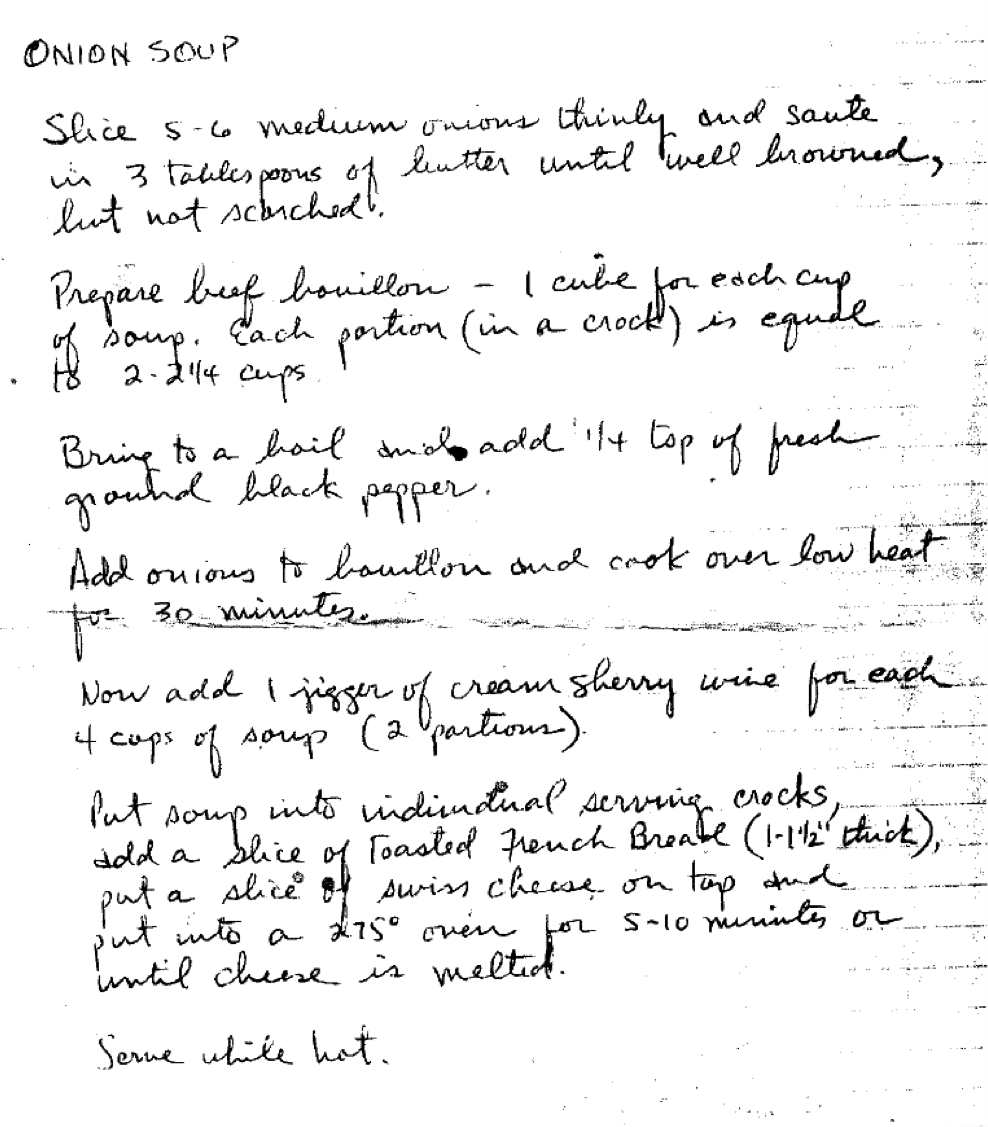
The recipe is written in Mr. L’s own handwriting, since mine is rather illegible. It is prepared with the requisite slice of toasted French bread and topped with melted Swiss cheese. It is something I make frequently when we entertain over the winter and it is always a hit with our guests. I think it is the generous amount of Harvey’s Bristol Cream Sherry that makes it sing. (At times I have noted that a generous amount of this sherry also makes me sing.)
I had been an active member of the Cornwall volunteer Ambulance Corps. for decades and had my own transportation business for more than a dozen years, and I think about the thousands of wonderful people I met during those times. There is a quick intimacy that develops
in stressful times and a vulnerability that ensues when one is elderly or dealing with illness.
Mr. L. and I became good pals over the years. His handwritten recipe is now well-worn with numerous Xeroxed copies all over my kitchen.
(By the way, I am informed by Ms. Gold, that the original recipe for onion soup contained no broth whatsoever, because the French peasants who devised it could no way have afforded rich beef stock and one needed a saint's patience to darkly caramelize a massive quantity onions in order to get the right color and flavor.)
The first spoonful tastes a bit salty, but with the addition of booze it reaches perfection. I thought about what I might drink with the soup to make it more compatible for imbibing in warmer weather (I owned a liquor store for years) and thought a full-bodied rose from Bandol or a cellar-temperature pinot noir from Oregon might do. But I think Adam and I will drink a few beers instead.
Onion Soup
adapted by RG from Mr. L's recipe
Serves 6 - 8
Ingredients
5 to 6 medium onions (about 2 pounds)
3 tablespoons unsalted butter
6 (extra-large) Knorr beef bouillon cubes (2.3 oz. pkg.)
12 cups water
6 tablespoons Harvey’s Bristol Cream sherry
6 or 8 slices toasted French bread (cut 1-1/2 inch thick)
6 or 8 slices Swiss cheese
Note: a jigger is a measure of 3 tablespoons or 1-1/2 ounces.
Directions.
Peel and thinly slice onions. (Cut them in half lengthwise and then across into half circles.) Melt butter in a very large pan. Cook onions until very dark brown, stirring often, about 25 minutes. Do not scorch.
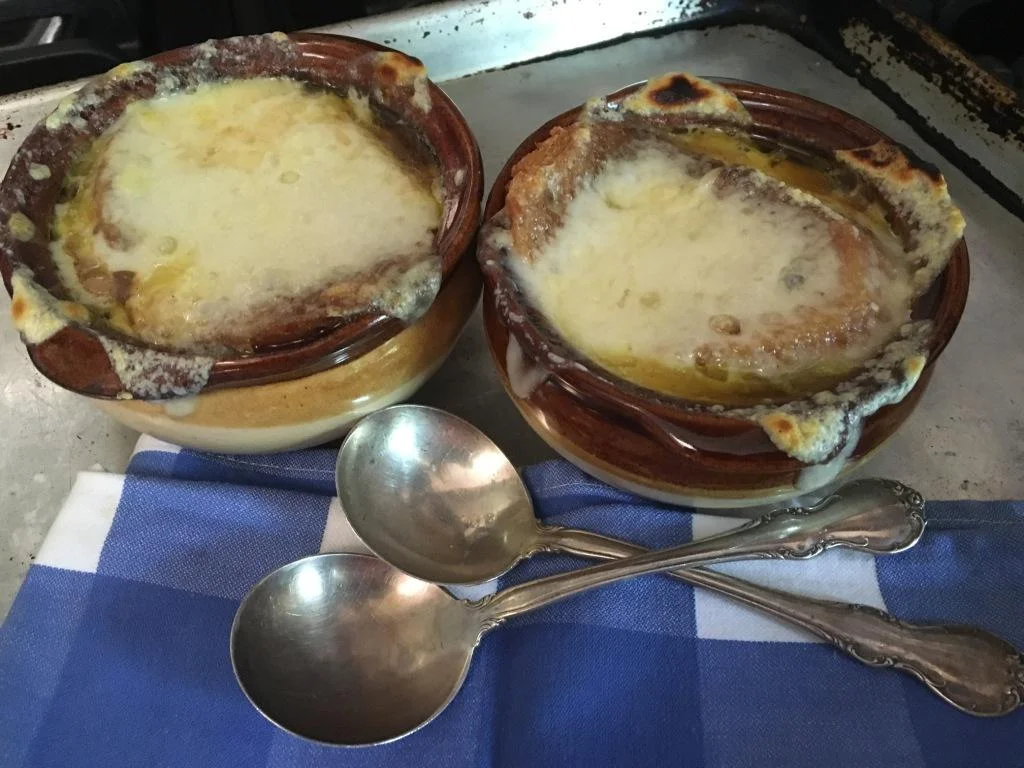
In a large pot, put bouillon cubes, 12 cups water, and ¼ teaspoon freshly ground black pepper. Bring to a boil, then whisk over low heat until bouillon dissolves. Add cooked onions to bouillon and bring to a boil. Lower heat to medium-low and cook 30 minutes. Add cream sherry. Put soup into individual serving crocks. Add a slice of toasted French bread, and put a slice of cheese on top. Put in a preheated 275 degree oven for 5 to 10 minutes or until cheese is melted. (You can put under the broiler for a minute to brown.) Serve while hot.

The Talloczy Family’s Hungarian Stuffed Peppers • Allison Radecki

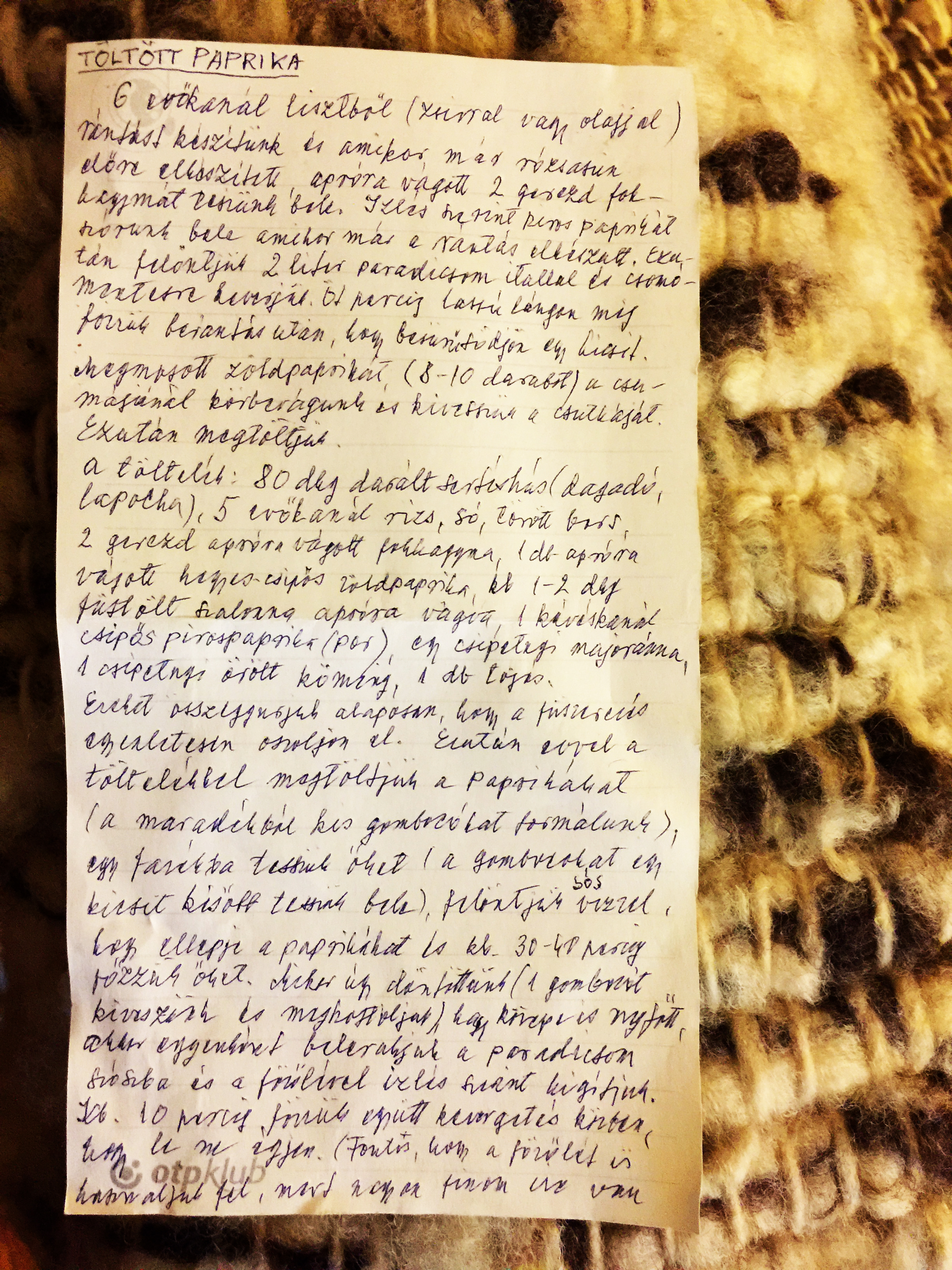
Note from curator Rozanne Gold: This week’s recipe comes to us via New York City caterer, professional chef, and former restaurateur Irene Khin Wong. It is an old Hungarian recipe, inherited without modifications, from the family of her Hungarian partner, Zsolt Talloczy. Three generations of Hungarian women have embraced this recipe, beginning with Zsolt’s great grandmother, Franciska, his grandmother, Anna, and his mother Agnes Zatonyi Talloczy. It is lovingly fastened to Zsolt and Irene’s refrigerator door. With that, a fourth generation now makes the treasured recipe in late spring and early summer, when tomatoes and wax peppers are freshly available. I especially love the grace and styling of Agnes’ European handwriting. With thanks to Irene and Zsolt for sharing this recipe — one that reminds me of my own childhood with my own beautiful Hungarian mother.

The Talloczy Family's Hungarian Stuffed Peppers By Allison Radecki
These lusty stuffed peppers remind Zsolt Talloczy of a cherished childhood and memories of his mother and grandmother. When he prepares them, he wistfully said, “It smells like spring and lazy sunny afternoons in Budapest.” Whiffs of the dish also dish trigger thoughts of his wife Irene’s first trip with him to Budapest and his parents’ home nearly 10 years ago.
Irene and Zsolt first made each other’s acquaintance while waiting to pick up tennis permits within a sporting goods store off of New York City’s Union Square. Zsolt, a trained scientist who now works in microbiology, was studying at Columbia University at the time.
“I wearing pajamas on a Saturday afternoon,” remembers Irene. “I had worked a late night, until 3 am, and just threw on a long jacket to accompany my eager friend to fill out the permit forms. ‘Who cares if you’re wearing pajamas,’ said my friend. WHO is going to see you?’”
A quick chat about tennis skills led Zsolt to offer Irene his e-mail address (“he didn’t even have a cell phone”). After a few e-mail exchanges, they met up to play. Irene then proposed that they meet up another day at the iconic Jewish appetizing store, Russ and Daughters, before trying out courts on the Lower East side.
“I figured that everyone in New York knew Russ and Daughters,” said Irene, who originally hails from Burma, “but Zsolt never arrived. I couldn’t call him, he had no cell phone, so I waited. Sitting in front, while eating my bagel and whitefish, I saw him running by. I almost missed him. I think I gave him the wrong address.” After an extended trip to Asia together (“four countries in six weeks and we never had an argument”) the couple realized that they had found a rare match, indeed.
A trip to Budapest was next on the horizon. “I remember thinking how Budapest was almost like Paris—but in the 1960s. Zsolt’s father, Imre, would buy trays and trays of different types of pastries—the most incredible pastries — it was like something you would get in Paris or Vienna.”
Zsolt’s mother, Àgnes, made these stuffed peppers for Irene to welcome her to Budapest. “Zsolt knows that I can eat spicy. They were so flavorful. It reminded me of home.”
The prototype for this family dish originated in Hungary and is based on a traditional recipe with some German-Hungarian influence from Budapest’s ninth district, Ferencvaros/Franzstadt. This zone was considered the ‘stomach of Budapest’ with a multitude of blooming family businesses, restaurants, butcher shops, and bakeries. It was the neighborhood where Budapest’s first chocolate factory, and famous brandy factory (Zwack Liqueur, maker of the beloved national digestive herbal drink, Unicum) were located, as well as the capital’s central slaughter house.
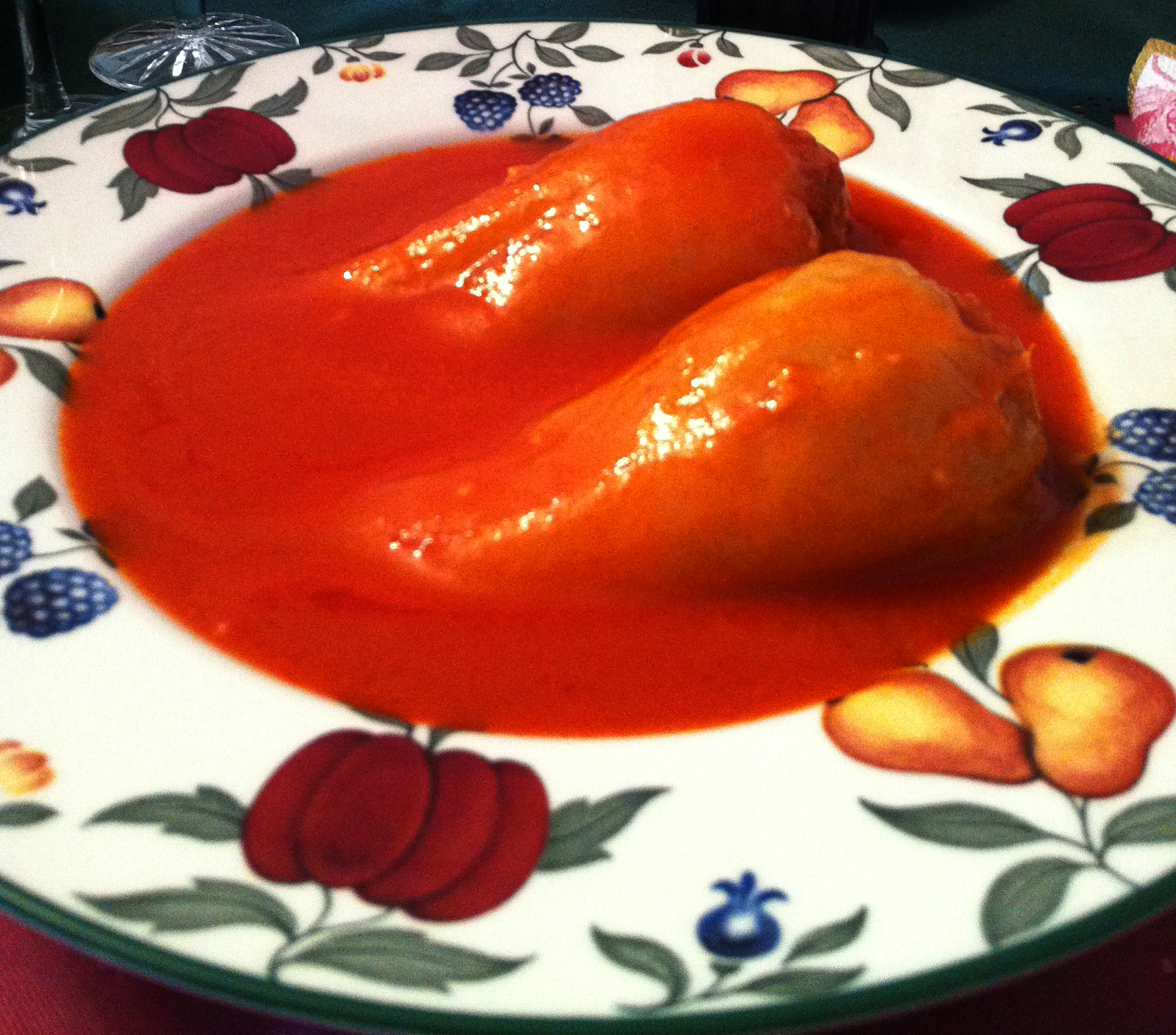
The typical pepper used in its preparation is the Hungarian Hot Wax Pepper variety, which is fragrant, smooth and ripens like the sunset from yellow to orange to red. This pepper, or paprika, as it is called in Hungarian, is usually harvested before maturity when its skin exhibits a yellow-greenish hue. It is easy to stuff and peel and produces fruits whose ends taper to a rounded point. Alternatively, you can make it with green bell peppers.
As anyone who has visited Hungary knows, you can hardly walk ten feet without encountering this pepper — whether it is threaded onto strings and hung from balconies to dry in its reddest, most mature state, piled high in a fragrant yellow tower in a food market, or taking its traditional place, in its red, pulverized version (as the ground spice, paprika) alongside the salt and pepper shaker on most Hungarian tabletops.
Zsolt is the chef when it comes to this family stuffed pepper dish which he cooks for Irene, so they both can remember their flavors of home. A yearly import of two kilos of Hungarian paprika, which his parents buy directly from a small producer in the nation’s Szeged region (and Zsolt carries back to New York on the plane) allows him to truly capture those authentic flavors. Zsolt also regularly imports frozen portions of his mother’s home-cooked stuffed peppers for his wife when she can not accompany him back to Budapest for his yearly visit “Àgnes freezes the peppers in a container, which she then wraps in three or four Ziploc bags,” describes Irene. “The dish is still cold by the time the plane lands.” Talk about take away.
As the famous Hungarian restaurateur and restaurant consultant, George Lang, wrote in his book, The Cuisine of Hungary, "Paprika is to the Hungarian cuisine as wit is to conversation- not just a superficial garnish, but an integral element…the marriage of paprika and Hungarian cooking was almost predestined." Considering that the wax pepper originated in the New World and made its way into to Hungary by way of the Turkish invasion in the 1500s, it covered a lot of ground before reaching its most famous culinary destination.
Hungarian Stuffed Peppers
For the Stuffing (to be prepared first):
1-3/4 pounds ground pork
Scant ½ cup raw rice
2 cloves of finely chopped garlic
1 hot pepper (jalapeño will do), finely chopped
2 tablespoons smoked bacon, chopped
1 teaspoon of Hungarian hot paprika
A pinch of dried marjoram
A pinch of ground cumin
1 whole egg, beaten
Salt and pepper to taste
For the peppers and cooking liquid:
6 tablespoons flour
Pork lard or oil
4 cloves of garlic
¼ cup Hungarian paprika powder (sweet or hot)
2 liters of tomato juice
8-10 Hungarian wax peppers (with seeds and stems removed)
•
1. In a large bowl, mix all the ingredients for the stuffing and set aside.
2. Brown flour in melted lard or oil until it turns light brown in the pot. Add chopped garlic and cook several minutes until soft (but not brown.) Add ¼ cup paprika to begin (add as much as you like according to taste – a mixture of sweet and hot paprika) and immediately remove pot from flame to avoid burning the paprika.
3. Pour in 2 liters of tomato juice and break up any clumps of flour by stirring. Simmer on low heat for 5 minutes to concentrate
4. Cut the Hungarian waxed peppers (8-10) around at the stem and pull out the seeds.
5. Fill the peppers with the stuffing. Any leftover stuffing can be rolled into meat balls. Add stuffed peppers to a separate pot from the tomato liquid, add any ‘naked,’ leftover meat balls a bit later to the pot. Fill the pot with water to cover all peppers. Salt and simmer for 30-40 minutes
6. When the stuffing in the peppers is cooked through the middle (cut and test to see when ready), transfer them to the tomato liquid pot and fill up with some chicken or beef broth as needed. Simmer on low heat for 10 minutes while constantly stirring to finish.
