
Gina's Aunt's Rice Pudding • Stacey Harwood-Lehman


Note from curator Rozanne Gold: Gina’s Aunt’s Rice Pudding recipe comes to us by way of New York’s Poet Laureate of the Greenmarkets, Stacey Harwood-Lehman. I’m certain Stacey would love to garnish the rice pudding each season—perhaps a strawberry-rhubarb-ginger compote right now at the height of Spring? Poached pears and star anise in Fall? Either way, hers is a lovely story with a quixotic recipe scribbled in her own handwriting on a hotel pad of paper. I love it because it’s real…with a missing word or two, the very shorthand that makes cooking mysterious and sometimes serendipitous. Gina’s Aunt’s recipe is very sweet and could use a little scraping of fresh vanilla bean. It could feed your whole block. I messed around with a simple version of my own (see below), inspired by Stacey’s love of rice pudding!

Gina's Aunt's Rice Pudding By Stacey Harwood-Lehman
Gina and I had been working together for several years when she started dating Tony, a new employee in our agency’s IT department. Soon after Tony joined the staff, I noticed that the usually tech-savvy Gina seemed to be having an uncharacteristically difficult time mastering the new computer system and that Tony was making many visits to our floor to help her. Within a couple of months she announced their engagement. I was among the lucky few of her colleagues to be invited to the wedding.
At the time I was working in Albany, NY, as a policy analyst for the government agency that regulates gas, electric, water, and telephone utilities. I grew up in a suburb of New York City and had relocated to Albany to attend the state university. It wasn’t my intention to remain in Albany after college but there was a boyfriend and a job, so I stayed.
Gina’s work-station was situated near mine and we became friends even though when she joined the department she was only 19 — quite a bit younger than I was — and right out of secretarial school. She had a terrific fashion sense along with a lively sense of humor and an easy laugh. I was flattered that she liked to take a seat in my work cubicle to dish about office romances and such.
Gina liked to listen to the radio while she worked and I could hear her singing along, softly and slightly out of key, with the hits. A local rock station played the same two songs every Friday to usher in the weekend: Todd Rundgren’s “Bang on the Drum” (“I don’t wanna work; I wanna bang on the drum all day”) and Four in Legion’s “Party in My Pants,” the lyrics of which Gina heard as “There’s a party at my parents’, and you’re invited,” the perfect mondegreen to reveal her youthful innocence.
My proximity to Gina made me privy to her wedding plans. But before there was a wedding, there was a wedding shower to be held at the Italian Fraternal Club in Green Island, a small town roughly eight miles north of the state capitol. I was seated at a table of strangers, all of whom seemed to have known each other for decades. My attempts to enter the conversation mostly failed, until I learned that Gina’s aunt, who was seated across from me, had owned a small restaurant that she had recently closed in order to retire. The menu was red-sauce Italian and among her specialties was her rice pudding. I love rice pudding. Would she share her recipe?
Gina’s aunt was no-nonsense, someone you could imagine at the helm of a busy kitchen where everything was made from scratch and where the menu was likely the same from the day it opened until the day it closed. She explained that the recipe would feed a crowd, a large crowd, so unless I was planning to throw a big party, I shouldn’t bother with it. Never mind, I said. I want to give it try.
Something in her manner as she spoke, communicated doubt; doubt that I would be able to make a success of it. It was her rice pudding, after all. She dictated the recipe as I scribbled on a pad that I’d picked up from a hotel where I’d stayed during a recent trip.
That was decades ago. Gina had two children and divorced Tony. The recipe has been with me through several moves and life changes, stashed in an envelope stuffed with other recipes, some torn from magazines, others written hastily on scraps of paper.
When I ran into Gina’s aunt at the wedding, she asked if I had tried her recipe. I hadn’t. I was waiting for the right occasion. I’m still waiting.


Gina’s Aunt’s Rice Pudding
2 lbs. rice
½ gallon milk
5 cups sugar
18 eggs
½ box of raisins
1 stick butter
Cook rice 15 minutes. Drain in colander. Rinse. Beat eggs. Stir eggs over rice. Stir. Add sugar, stir, milk, stir. Put in stick of butter. Stir. Put in oven @350 covered with Reynolds wrap for 1 hour. Remove cover. Stir. Top w/nutmeg. Put back in oven until solid.
Creamy Rice Pudding
(without eggs)
1 quart 2%, or whole, milk
6 tablespoons sugar
¼ teaspoon salt
1 teaspoon vanilla extract (or scraping of vanilla bean)
2/3 cup long or medium-grain rice
1/3 cup raisins
Grated nutmeg and/or cinnamon
Put milk in a 3-quart saucepan. Add sugar, salt, vanilla, and rice. Bring to a boil; lower heat to medium and boil, stirring 3 minutes. Lower heat to simmer (tiny bubbles steady on top). Cook 20 to 25 minutes, stirring frequently. Add raisins and cook several minutes until rice is very soft and mixture is thick but still soupy. Will firm upon cooling. Pour into a deep dish. Sprinkle with nutmeg and/or cinnamon. Cover and chill. Serves 4 to 6

Braised Short Ribs with Fennel, Carrots, and Orange • William Poole

Note from curator Rozanne Gold: I was thrilled to get an email from Mr. William Poole, a stranger to me who has been enjoying reading Handwritten Recipes. Mr. Poole is a professional chef who specializes in pastry and confectionery and has extensive knowledge and experience working all over the world, including Slovenia. Naturally, I expected a nice recipe for strudel or some European baked good, but what I got instead was a fabulous recipe for short ribs perfumed with fennel, carrots, and orange. Only one teaspoon of sugar in sight. Bravo to Mr. Poole, who not only managed to devise such a lusty main course, but did so in his hotel room one night. And thanks to Allison Radecki for making the recipe and saving some for me. This handwritten recipe is an homage to William’s grandparents who inspired him to live life full tilt.
BY WILLIAM POOLE
I am from Eastern Nebraska, growing up in Omaha and moving to Phoenix in my early teens. My families are largely from Eastern Europe, the Bohemia region of what we now know as the Czech Republic, and settled in Nebraska in the late 19th century.
Afternoons after school, I would be glued to the television, watching the Great Chef's Series, The Frugal Gourmet and, of course, Julia Child and Jacques Pepin. They all influenced me in developing my cooking style, and to understand that the world, in a culinary sense, is a pretty large place.
I am a professional cook, specializing in pastry and confectionery. My career has taken me all over the states (restaurants, hotels, even a private luxury train) and to Europe, where I worked for a large catering company in Slovenia. I have kept many notebooks over the years that contain recipes, notes, techniques, and even drawings of the things that influence me, or inspire me to cook.
The recipe I am sharing comes from my latest notebook, Jokati z Babico (shedding tears with Grandmother). It is an homage to my biggest inspirations, my grandparents, Claire and William Pycha. The phrase Jokati z Babico is a term that represents the passing on of traditions, good ones that make you remember people who have passed on before you, sharing stories, eyes filled with joyful and melancholy tears.
My grandparents taught me to be adventurous in all things. My grandmother Pycha, all smiles and billowy (like a character in a Truman Capote novel), was always one to point out what was good to use in the yard for cooking; she would show me where the wild chives grew behind the garage, the spearmint below the low porch off the kitchen, and how to dry the picked bundles to make tea. She taught me how long to boil the potatoes we pulled earlier from the garden and how much butter, dill seed, salt and parsley to use when preparing them.
My grandfather, in addition to his great baking skills (kolache, dinner rolls and cinnamon buns were his best) had a strong talent in the arts. He painted in oils, in addition to painting yearly pisanki (colored Easter eggs with traditional or pastoral vignettes). I think of him (and thank him often) whenever I’m drawing out a new confection design, or composing a plate for a menu.
This handwritten recipe resulted from my recent travels when I learned that you can make something extraordinary with limited resources.
My partner of twenty-eight years had accepted a job that relocated us to the East Coast, but required nearly 100% travel. The neat part about this was that his company would fly me to his destination/base as needed for as long as I needed. This was great, as I was taking some time off while considering a location and menu for my new chocolate and confectionery company.
I found myself in Atlanta, Georgia, for most of 2014, in a residence hotel, the Hilton Midtown, which offered a refrigerator, basic cooking utensils, pans, a coffee maker, and a two- burner electric stove top, which to me, is a perfect challenge. This setup allowed me to cook nearly every night, using fresh ingredients, exploring farmer's markets and regional food shops so I could create great meals. A few times, seeing me carrying bags of fresh food back to my room, the hotel maids would ask what I would be making that day, and started asking me cooking questions. I guess they were intrigued by the aromas wafting into the hallway.
I created this recipe in October of 2014. It was raining the day I stepped out to make groceries (my partner is a New Orleans native, hence the regional expression...). It was balmy, but I knew that it would get colder later, and wanted to make something that was comforting and perfect for the evening ahead. At the market, a few blocks away, I found all the ingredients I needed; meaty short ribs, some baby carrots, a head of fennel, a can of low-sodium beef broth, and an orange. Back at the hotel, I had on hand a few cloves of garlic, onion, and some left over coffee. I borrowed a little apple cider vinegar and flour from the hotel kitchen.
This recipe always reminds me of my grandparents, a hearty and flavorful combination of aromas and textures, and a one-pot technique which is frugality at its best. The flavors of the fennel, carrot, and onion, with the delicate orange and coffee, are all scents that remind me of time at my grandparents’ house in Omaha, and a way of keeping their memory with me wherever I go.

Braised Short Ribs with Fennel, Carrot and Orange
This recipe is can feed four easily, or two people for a few days
4-6 beef short ribs**
2 tablespoons good-quality olive oil
1⁄2 large onion, finely diced
3 garlic cloves, smashed and coarsely chopped
1 large fennel bulb, cored and sliced thinly
1 bag baby carrots, rinsed
1 orange, juiced (about ¼ cup)
1-1/2 cups low-sodium beef broth
¼ to ½ cup of brewed coffee
¼ cup apple cider vinegar
- Heat oil in a deep, lidded pot, over medium high heat until it shimmers.
- Without crowding, add the short ribs, browning on all sides; remove to a plate.
- Add a touch more oil if needed, and sauté the vegetables until they begin to take color, adding the garlic last.
- Add the stock, vinegar, coffee and orange juice and bring to a boil. Nest the ribs into the liquid and vegetables, reduce the heat to low and cover for two hours until the meat is tender. Remove short ribs and vegetables to a platter. Boil juices in pan until thick and syrupy and pour over meat.
** dusted in a mixture “dry rub” of salt, pepper, flour and a little sugar (the only sugar I had on hand were there sugar packs in the hotel room, which reminded me of my grandparents again, as my grandmother used to sneak a pack or two home from the restaurant every time we went, as a memento). A dry rub is a personal choice for “how much”, but I generally use 1 cup flour, with 2 teaspoons each salt and pepper, and 1 teaspoon sugar).

Connie Love’s Irish Soda Bread • Allison Radecki

Note from curator Rozanne Gold: I adore Irish Soda Bread and don’t eat it often enough. That will certainly change now that I have this fabulous recipe from Connie Love. Not only is her version filled with love and lore, but is lovingly written by Allison Radecki, who interviewed Connie for this story. It’s “Handwritten” doing what it does best. The recipe is written in Connie’s hand on thin, yellowed paper which she keeps protected, slipped into a small plastic sleeve. It is marked with lines and revisions. Many thanks to Connie, Allison, and her mother, Joanna.

Connie Love's Irish Soda Break by Allison Radecki
There are some homes where everything you see has a story attached to it; a place where life is lived in the company of objects that keep the memories of loved ones alive and where the spirit of a bygone era is still gloriously vibrant.
Such is the home of Connie Love, a close family friend with whom I have been lucky enough to share friendship, much kindness, and lots of laughter in both easy days and tough times over the years. A lover of recipes and a wonderful cook, Connie is the type of friend who will call you to say that there is an extra jar of homemade minestrone with your name on it, waiting for you on her front stoop. “Just remember to stop by and pick it up.”
My mother, Joanna, worked alongside Connie for many years as a realtor in Montclair, New Jersey, and benefited from many such surprises that emerged from Connie’s generous kitchen. Since Connie’s retirement, the two of them still manage to share adventures, whether it is an impromptu movie night or a game of Pickleball, the fantastically named hybrid of tennis and ping-pong, at the local YMCA.
In celebration of various holidays, Connie’s baked goods would appear in our home and soon be reduced to a plate of crumbs. This is how I first encountered her Irish soda bread, which often accompanied the first days of Spring and the Saint Patrick’s day season.
One afternoon this March, my mother and I sat down in Connie’s meticulous kitchen to talk about her soda bread recipe and found ourselves engaged in a whirlwind of memories, photographs, and stories. The recipe for her soda bread came from her mother, Amelia Malanga Ianucci (known as Minnie). Minnie, one of 14 children, was born in Newark, NJ, in 1895. She received this recipe as 17-year old bride from Mrs. Pollack, an Irish neighbor whose apartment shared a door to the same fire escape in a Newark tenement building. The recipe was said to be ‘the poor man’s soda bread’ since it did not use eggs or butter.
“My mother and Mrs. Pollack socialized on the balcony. Their apartments were side-by-side. The basement was filled with crocks with pickles and peppers. They kept the coal in the basements for the coal stoves.” Connie (Columbia Ianucci) and her twin sister, Betty (Elizabeth) were born in the midst of The Great Depression on Clifton Avenue in Newark, not far from The Cathedral Basilica of the Sacred Heart. “No one had a cookbook. No one had measurements. They just knew,” said Connie. “My mother knew the dough for knots. She knew the sweet crusts for Easter pies. My sister said, ‘we didn’t make an effort to know, so we didn’t know.’” Because of this, Connie, herself a young bride, had her mother dictate her soda bread process as she committed the steps to paper. Connie figures that she wrote the recipe down in the 1950s when she was already married and running her own house.
“The tenements smelled, not of garlic and food, but of bleach. The women would bleach the wooden floors until they were almost white.” Bleach was delivered to the women in the tenements by the bleach salesman. “These women didn’t have cars. They didn’t go to the stores.” She remembers the Jewish peddlers who sold linens, which her mother would buy — a tablecloth here, a sheet there — slowly stocking the Hope Chest for her and her sister. “The Stanley guys sold brooms, house products…brushes. The insurance guy came by to collect the insurance premiums — ten cents, twenty cents.”
A network of other relatives lived close by. Connie’s Grandmother’s tenement was on Stone Street. Aunt Tilly lived downstairs. Uncle Arthur and Aunt Ella lived in different tenements in the area. Connie’s father, Stephen Ianucci, was born in Italy in 1890. Connie remembers that at night, her father would read the paper out-loud and her mother would correct him, in an effort to erase his Italian accent. Dinner was always served at 5:30 p.m.
Connie reminisced some more. How she and her sister would harmonize with their mother as they washed the dishes -- “we had no tv and the radio was on top of the fridge. The Green Hornet, music, all sorts of shows.” And she remembered the big black stove with the chrome piece which she would have to polish when her grandmother said “Vieni qua."
Sadly, it was time for us to go. But I’ve got Connie’s recipe and an invitation to come back again. There would be more stories to tell.


Connie Love’s Irish Soda Bread
8 cups flour
3/4 cup of sugar
4 tsp. baking soda
2 tsp. baking powder
2 tsp. salt
2 cups of raisins
1 tsp. caraway seeds
About 4 cups of sour milk
(buttermilk or whole milk with one
tablespoon of lemon juice mixed in)
1. Sift dry ingredients together. Add 2 cups of raisins and caraway seeds, if desired. Add 4 to 5 cups of buttermilk (or whole milk with lemon juice). Mix to hold together.
2. Knead for 1 minute or just mix (not too soft, although never fails, whatever the texture).
3. Bake at 375 for 40 minutes until golden brown (loaf pans or a cake pan).
This recipe makes 3 loaves, which freeze well and are delicious when toasted.

Bettymarie's Peach Meringue (Schaum Torte) • Lari Robling

A Note from Curator Rozanne Gold: This engaging story comes from Lari Robling, an independent radio producer and writer, currently producing “Voices in the Family” with Dr. Dan Gottlieb for WHYY in Philadelphia. A special pot of tea, carefully placed next to a handwritten recipe card, sets the scene to unlock the secrets to Bettymarie’s Peach Meringue. The card’s yellowed hue and tell-tale splotches hints at past mishaps, while a faded cursive “what’s cookin,” specifies Mom as the author, even calling her by name. Yet the story is not all peaches and cream. The cracked exterior of the cake becomes the metaphor for a complicated mother-daughter relationship, whose sweetness and love stand the test of time. A former restaurant critic for the Philadelphia Daily News, Lari is the author of a wonderful cookbook, Endangered Recipes, published by Stewart, Tabori & Chang. Lari believes that nostalgic memories created by food are the most evocative and compelling of all, especially if they’re handwritten. Thank you, Lari. Twitter handle @larirobling.

Bettymarie's Peach Meringue By Lari Robling
My mother was a terrible cook. I was about eight years old when I realized that calling the fire department wasn't a step in a recipe. Her impoverished cooking skills were always a puzzle because her mother, my grandmother, was an amazing cook. Grog's pies were legendary and people would find a reason to stop by around dinner — there was always enough food in the pot, and enough room around the table to set another place, or two, or even four! Yet, my mother left that home sadly lacking the ability to put a simple meal on the table. Maybe it’s no coincidence that I became passionate about food later in life.
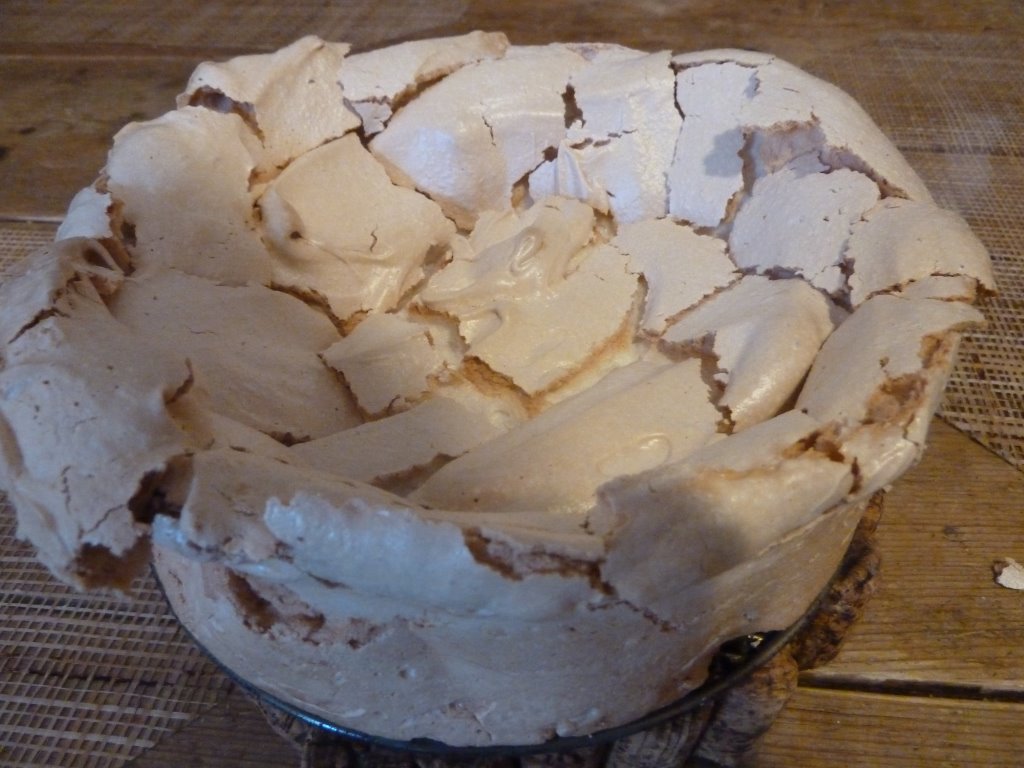
There were, however, one or two things she did learn from my grandmother, and my brother and I were grateful for them. One such confection was a mass of fluffy whiteness covered in whipped topping and decorated with fruit. Despite its light texture, and much to our mother's chagrin, we called it Cement Cake. Although she took this as one of endless insults attached to her skill-less cooking, it was an apt description of what the cake looked like prior to being dressed up with fruit and cream — a cracked sidewalk.
This dessert is Pavlova-like (sometimes called Pavlov), and baked in a spring-form pan rather than laboriously piped out of a pastry bag. Preparing it this way results in a dreamy, marshmallow-like interior encased in a brittle shell.
The original version came from my grandmother's neighbor and called for “tinned peaches.” Over time, we swapped the canned peaches for fresh, or sometimes substituted fresh strawberries or blueberries, or other fruit in season. I've even used kiwi, which adds a nice tart contrast to what is basically a very sweet meringue. But the most exciting version was the one I made with the gooseberries from my backyard bush.
Eventually, the non-dairy whipped topping gave way to whipped heavy cream. And what I’ve learned is that the recipe is almost foolproof, as even my mother could make it reliably.
I was always curious about the origin of this recipe — did some cook lack a pastry bag and plop a Pavlov into a spring-form pan? Was this dish a regional Ohio thing where I was from? I finally found the answer when researching my book, Endangered Recipes and read The Molly Goldberg Jewish Cookbook. There it was — Schaum Torte, a flour-less cake for Passover (that explained the non-dairy topping!).
I wonder how many countless handwritten recipes such as this one were passed over fences or across clothes lines over the years? From neighbor to neighbor, from mother-to-daughter, and now mother-to-son (my son Ben devours it anytime I make this cake), it is a beautiful testament to the nurturing bonds we share.
It’s nice to have a sweet memory of my mother to mollify our sometimes contentious relationship. And I don’t call it Cement Cake any more.

Bettymarie’s Peach Meringue
Cake
6 egg whites
2 cups, sugar
2 teaspoons, vanilla extract
2 teaspoons, apple cider vinegar
Topping
2 cups, heavy cream
1 pint, fresh strawberries, hulled and halved
(reserve some whole for garnish)
or fresh fruit of your choice.
1. Preheat oven to 300 degrees F.
2. To make the cake: Using an electric mixer, beat egg whites until stiff. Add sugar slowly while beating at slow speed. Blend in vanilla and vinegar. Spoon batter into a 9-inch springform pan. Bake for 45 minutes. Remove cake from oven and let cool (it will deflate and crack; don't worry you cover the whole affair up).
3. To make the topping: Just before serving, whip cream. Arrange fruit on top of cake, reserving some for garnish. Spread the cream on the top and sides of the cake.


Spinach Pie • Rozanne Gold


Note from Curator Rozanne Gold: I am grateful to Steve North and his mother Bunny North for sending me this wonderful recipe belonging to Grace Cohen. Steve is one of my oldest friends and an award-winning journalist, and Bunny is one of the best bakers I know. Grace and Bunny were close friends for years. This poignant story was told to me by Michael Cohen, whose mother Grace was the owner/creator/handwriter of this delicious recipe. Thank you to Steve, Bunny, and Michael Cohen for the heartfelt memories.

Spinach Pie by Rozanne Gold
Imagine starting your day by breaking bread with both sets of grandparents and eating the same dish for seven consecutive years. Michael Cohen did. Talking (and thinking) about this handwritten recipe for spinach pie brought back memories of these breakfasts and illuminated an immigrant history that connected the Ottoman empire with the New World.
“I was so excited by this,” said Michael to me about receiving my phone call to discuss his mother’s handwritten recipe. “I called my sister, Sarita, immediately.”
Michael’s mother, Grace Cohen (née Matalon), came from a Sephardic Jewish family whose origins were rooted in Turkey and Greece.
Grace’s mother, Anna, was born in Istanbul. Anna attended the Alliance Française in her birthplace and spoke six languages: Spanish, Greek, Turkish, French, English and Ladino. Ladino, also known as Judeo-Spanish, was a Romance language derived from Old Spanish that was once the common language of the Jews who lived in the region of the Adriatic Sea, the Balkans, and the Middle-East. Grace's father, Meyer, was born in Salonika (also known as Thessaloniki) a port city located in Northern Greece.
Meyer and Anna met on a boat in the early 1900s en voyage to New York. They settled on the Lower East Side where a large Sephardic community gravitated towards each other and supported new immigrants. This was a time of no social welfare, so the community was quite insular and tightly knit. They were not very religious but the Sephardim leaned towards traditions.
Anna and Meyer eventually moved to Williamsburg, Brooklyn and had Grace, who was an only child. Grace married Michael's father, Sam Cohen, (who is now ninety-three and lives in Coconut Creek, Florida). Grace was 22 when she married Sam at the Roosevelt Hotel in New York City.
Grace and Samuel moved to Queens after Michael and his sister was born. Sarita has two children, Matthew and Gayle. Michael Cohen and his wife Marcia have one daughter, named Grace, who is seventeen.
Michael remembers his mother as a housewife and a very good cook. Grace passed away when he was thirty years old, more than three decades ago. He says that feeling never goes away.
"Whatever she cooked, we all ate and loved it. But actually, both of my grandmothers, Anna and Sara, made this dish. They called it desayuno and it was eaten for desayuno (which means breakfast.) Every day there was spinach pie, bourekas stuffed with cheeses or eggplant, and watermelon, fruits, figs, olives, feta cheese—every day! The only eggs we had were brown eggs boiled overnight on a low flame.”
Michael's paternal grandparents were also from Salonika. They all lived near each other for years in a bungalow in the Rockaways where they would share this glorious repast.
Ladino was spoken all the time. Michael doesn't speak it well but understands it. After all the grandparents died there was no more spinach pie for breakfast.
Since being reacquainted with this recipe, however, thanks to Michael's friend Steve North and his mother, Bunny North, who is the keeper of Grace's handwritten recipe, Michael is excited to make his mother's spinach pie again (…just maybe not every day). Sarita is the one who still makes it often.
The Sfongato or Fritada is like a pie, solid, and baked in a large tin. It is served warm and cut into large squares.
See the recipe made recently by Allison Radecki.


Spinach Pie
Fritada Sfongato
2 packages, 10 oz. frozen chopped spinach
4 eggs
1/2 cup Matzo meal
1/2 cup water
3/4 lb. feta cheese or farmer cheese**
1/4 tsp. salt
1/8 tsp. pepper
About 4 Tablespoons oil
1. Thaw the spinach. Press out water from frozen spinach.
2. Mix all ingredients together.
3. Put about 4 Tablespoons of oil in a baking pan. When oil gets very hot, sprinkle some matzo meal in pan. It should sizzle and get brown.
4. Pour mixture into hot pan and spread evenly.
5. Bake at 375 for about 1 hour or until the top and sides are brown.
**Even though Grace wrote farmer's in the recipe, it is much tastier made with feta. Bunny North said that feta wasn't that readily available 40 years ago, or that "kosher for Passover" feta wasn't available at all back then. And she always makes this recipe during Passover (as well as during the rest of the year).

Candied Cranberries • Rozanne Gold

Candied Cranberries by Rozanne Gold
My cousin, Josh Rovner, knew more about food when he was twelve than most of my friends do now — and this was before the age of non-stop TV cooking shows. He was sophisticated in his taste and whenever this gastronaut's family came to New York, Josh had a knowing list of restaurants that had to be visited. He yearned to be a chef, but I believed my ambitious cousin from North Canton, Ohio, should extend his reach beyond the kitchen. So he went to Cornell and wound up being a big deal "revenue management guru" with Hilton Hotels.
So, I was surprised to receive this exceedingly simple recipe from him, but it is one he treasures. It had been handwritten to Josh by his Nana Gold (my Aunt Helen), sometime around 2000. Helen died at the age of 94 in 2006.
Naturally, Josh has upheld the quintessential American family tradition of serving them at Thanksgiving, but he now makes the sweet-and-tart syrupy confection all year long to spoon over a daily helping of yogurt. Josh keeps the recipe on the side of his refrigerator, so it always is in easy reach. I didn't remember Helen cooking. She was married to my father's brother, Leslie Gold, and they traveled all over the world. They lived in Avon, Massachusetts, not far from my own grandmother, Lottie Gold, who was a fantastic baker. I think of Helen as a solid New Englander with a hankering for lobster and my grandmother's ethereal blueberry muffins.
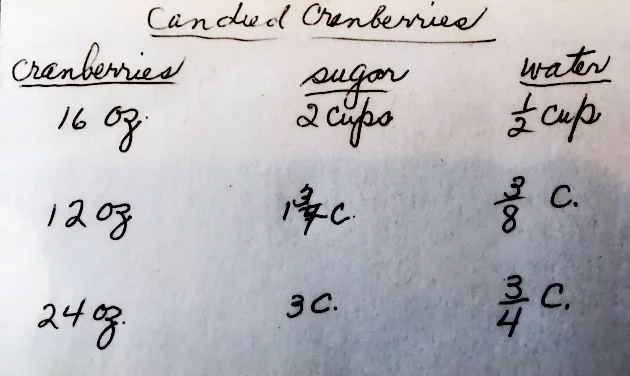
Josh is now married, lives in Texas, has a beautiful young daughter, and cooks dinner almost every night. He is a total foodie and up to date with every chef and kitchen trend. Aunt Helen's candied cranberries recipe is unusually precise, including altering some ingredient quantities for various batch sizes. Josh always makes the largest amount so he is guaranteed lots of leftovers. Nowadays, he recreates the recipe with a bit of grated orange zest at the end for depth of flavor— “not too much to mask the cranberry, but just enough to enhance and harmonize,” he adds. That said, he quietly confesses that his mother prefers the original recipe. Judging by the photo Josh sent of the finished product, his Nana’s cranberries indeed do look “candied” and glistening.
This is an effect I’ve always wanted but have failed to achieve! It was lovely to learn more about Helen through her recipe and Josh’s remembrance. That's the magic of handwritten.
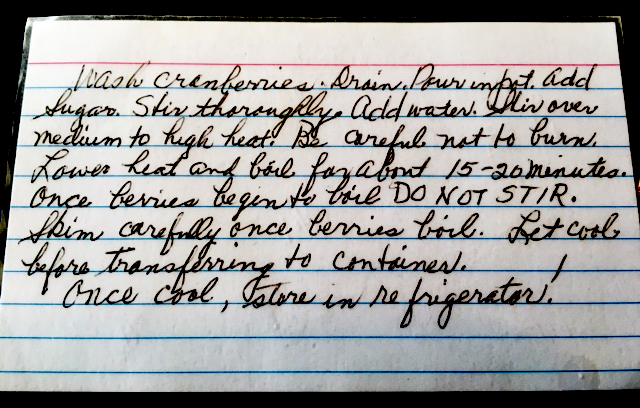
"Wash cranberries. Drain. Pour in pot. Add sugar. Stir thoroughly. Add water. Stir over medium to high heat. Be careful not to burn. Lower heat and boil for about 15 - 20 minutes. Once berries begin to boil DO NOT STIR. Skim carefully once berries boil. Let cool before transferring to container. Once cool, store in refrigerator!"