
The Talloczy Family’s Hungarian Stuffed Peppers • Allison Radecki
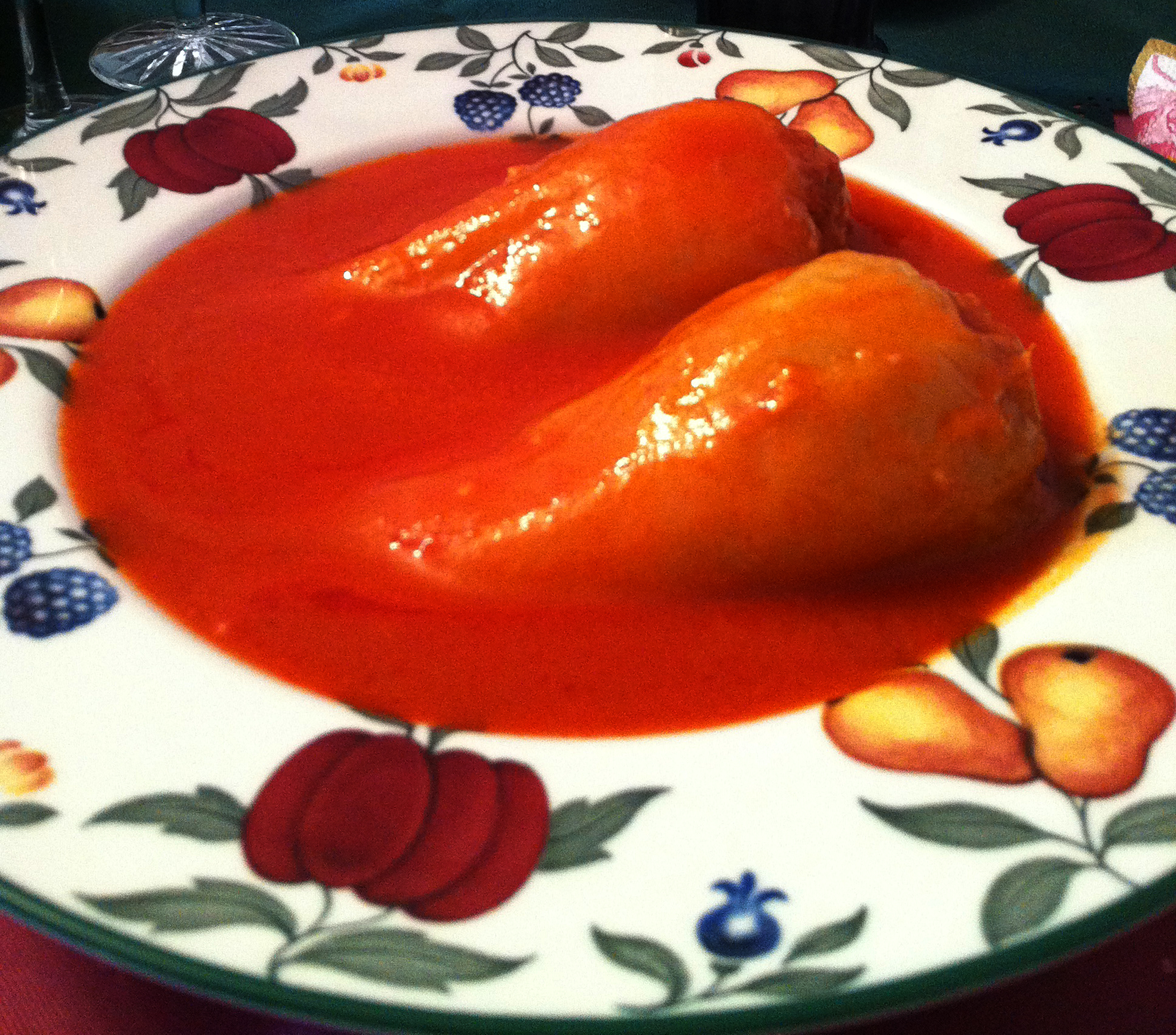

Note from curator Rozanne Gold: This week’s recipe comes to us via New York City caterer, professional chef, and former restaurateur Irene Khin Wong. It is an old Hungarian recipe, inherited without modifications, from the family of her Hungarian partner, Zsolt Talloczy. Three generations of Hungarian women have embraced this recipe, beginning with Zsolt’s great grandmother, Franciska, his grandmother, Anna, and his mother Agnes Zatonyi Talloczy. It is lovingly fastened to Zsolt and Irene’s refrigerator door. With that, a fourth generation now makes the treasured recipe in late spring and early summer, when tomatoes and wax peppers are freshly available. I especially love the grace and styling of Agnes’ European handwriting. With thanks to Irene and Zsolt for sharing this recipe — one that reminds me of my own childhood with my own beautiful Hungarian mother.

The Talloczy Family's Hungarian Stuffed Peppers By Allison Radecki
These lusty stuffed peppers remind Zsolt Talloczy of a cherished childhood and memories of his mother and grandmother. When he prepares them, he wistfully said, “It smells like spring and lazy sunny afternoons in Budapest.” Whiffs of the dish also dish trigger thoughts of his wife Irene’s first trip with him to Budapest and his parents’ home nearly 10 years ago.
Irene and Zsolt first made each other’s acquaintance while waiting to pick up tennis permits within a sporting goods store off of New York City’s Union Square. Zsolt, a trained scientist who now works in microbiology, was studying at Columbia University at the time.
“I wearing pajamas on a Saturday afternoon,” remembers Irene. “I had worked a late night, until 3 am, and just threw on a long jacket to accompany my eager friend to fill out the permit forms. ‘Who cares if you’re wearing pajamas,’ said my friend. WHO is going to see you?’”
A quick chat about tennis skills led Zsolt to offer Irene his e-mail address (“he didn’t even have a cell phone”). After a few e-mail exchanges, they met up to play. Irene then proposed that they meet up another day at the iconic Jewish appetizing store, Russ and Daughters, before trying out courts on the Lower East side.
“I figured that everyone in New York knew Russ and Daughters,” said Irene, who originally hails from Burma, “but Zsolt never arrived. I couldn’t call him, he had no cell phone, so I waited. Sitting in front, while eating my bagel and whitefish, I saw him running by. I almost missed him. I think I gave him the wrong address.” After an extended trip to Asia together (“four countries in six weeks and we never had an argument”) the couple realized that they had found a rare match, indeed.
A trip to Budapest was next on the horizon. “I remember thinking how Budapest was almost like Paris—but in the 1960s. Zsolt’s father, Imre, would buy trays and trays of different types of pastries—the most incredible pastries — it was like something you would get in Paris or Vienna.”
Zsolt’s mother, Àgnes, made these stuffed peppers for Irene to welcome her to Budapest. “Zsolt knows that I can eat spicy. They were so flavorful. It reminded me of home.”
The prototype for this family dish originated in Hungary and is based on a traditional recipe with some German-Hungarian influence from Budapest’s ninth district, Ferencvaros/Franzstadt. This zone was considered the ‘stomach of Budapest’ with a multitude of blooming family businesses, restaurants, butcher shops, and bakeries. It was the neighborhood where Budapest’s first chocolate factory, and famous brandy factory (Zwack Liqueur, maker of the beloved national digestive herbal drink, Unicum) were located, as well as the capital’s central slaughter house.
The typical pepper used in its preparation is the Hungarian Hot Wax Pepper variety, which is fragrant, smooth and ripens like the sunset from yellow to orange to red. This pepper, or paprika, as it is called in Hungarian, is usually harvested before maturity when its skin exhibits a yellow-greenish hue. It is easy to stuff and peel and produces fruits whose ends taper to a rounded point. Alternatively, you can make it with green bell peppers.
As anyone who has visited Hungary knows, you can hardly walk ten feet without encountering this pepper — whether it is threaded onto strings and hung from balconies to dry in its reddest, most mature state, piled high in a fragrant yellow tower in a food market, or taking its traditional place, in its red, pulverized version (as the ground spice, paprika) alongside the salt and pepper shaker on most Hungarian tabletops.
Zsolt is the chef when it comes to this family stuffed pepper dish which he cooks for Irene, so they both can remember their flavors of home. A yearly import of two kilos of Hungarian paprika, which his parents buy directly from a small producer in the nation’s Szeged region (and Zsolt carries back to New York on the plane) allows him to truly capture those authentic flavors. Zsolt also regularly imports frozen portions of his mother’s home-cooked stuffed peppers for his wife when she can not accompany him back to Budapest for his yearly visit “Àgnes freezes the peppers in a container, which she then wraps in three or four Ziploc bags,” describes Irene. “The dish is still cold by the time the plane lands.” Talk about take away.
As the famous Hungarian restaurateur and restaurant consultant, George Lang, wrote in his book, The Cuisine of Hungary, "Paprika is to the Hungarian cuisine as wit is to conversation- not just a superficial garnish, but an integral element…the marriage of paprika and Hungarian cooking was almost predestined." Considering that the wax pepper originated in the New World and made its way into to Hungary by way of the Turkish invasion in the 1500s, it covered a lot of ground before reaching its most famous culinary destination.
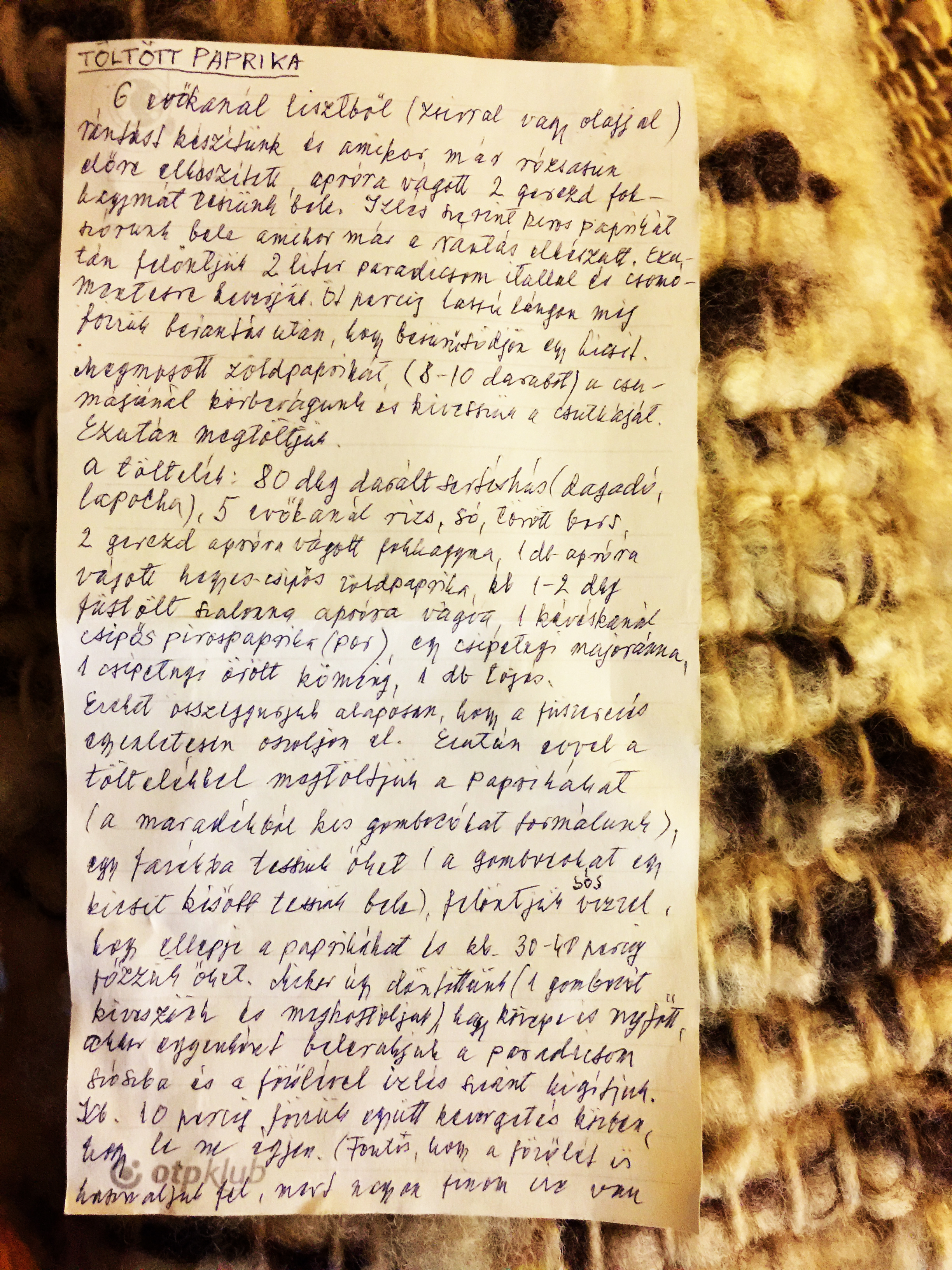
Hungarian Stuffed Peppers
For the Stuffing (to be prepared first):
1-3/4 pounds ground pork
Scant ½ cup raw rice
2 cloves of finely chopped garlic
1 hot pepper (jalapeño will do), finely chopped
2 tablespoons smoked bacon, chopped
1 teaspoon of Hungarian hot paprika
A pinch of dried marjoram
A pinch of ground cumin
1 whole egg, beaten
Salt and pepper to taste
For the peppers and cooking liquid:
6 tablespoons flour
Pork lard or oil
4 cloves of garlic
¼ cup Hungarian paprika powder (sweet or hot)
2 liters of tomato juice
8-10 Hungarian wax peppers (with seeds and stems removed)
•
1. In a large bowl, mix all the ingredients for the stuffing and set aside.
2. Brown flour in melted lard or oil until it turns light brown in the pot. Add chopped garlic and cook several minutes until soft (but not brown.) Add ¼ cup paprika to begin (add as much as you like according to taste – a mixture of sweet and hot paprika) and immediately remove pot from flame to avoid burning the paprika.
3. Pour in 2 liters of tomato juice and break up any clumps of flour by stirring. Simmer on low heat for 5 minutes to concentrate
4. Cut the Hungarian waxed peppers (8-10) around at the stem and pull out the seeds.
5. Fill the peppers with the stuffing. Any leftover stuffing can be rolled into meat balls. Add stuffed peppers to a separate pot from the tomato liquid, add any ‘naked,’ leftover meat balls a bit later to the pot. Fill the pot with water to cover all peppers. Salt and simmer for 30-40 minutes
6. When the stuffing in the peppers is cooked through the middle (cut and test to see when ready), transfer them to the tomato liquid pot and fill up with some chicken or beef broth as needed. Simmer on low heat for 10 minutes while constantly stirring to finish.

Sue Inoff's Double Crust Lemon Pie • Dale Bellisfield


From curator Rozanne Gold: This scrumptious recipe was submitted to Handwritten by Dale Bellisfield. From a fabulous career as one of New York’s premier graphic designers, she transformed herself into a clinical herbalist (and holistic nurse) who now makes her home in Pine, Arizona. Dale has a practice in integrative medicine and, like Hippocrates, thinks of food as medicine. She is a wonderful cook who once created a dish of black rice with gorgonzola, porcini and espresso for me. I am so grateful to have her wonderful mother’s handwritten recipe, and to share Dale’s memories. www.herbaldale.com

Sue Inoff's Double Crust Lemon Pie by Dale Bellisfield
I just dug this out of my overstuffed, seven-inch-thick file, a jumble of recipes I've been gathering over the past two years as inspirations for a “breast health” cookbook I’m working on. It fell out of the file so easily, it was like my Mom was saying hello. This copy of the recipe was meant for my two sisters, Joanne and Sally, and me. And it is one I will happily share with my daughter Samantha, and now with all of you!
My mother’s Double Crust Lemon Pie was her signature, and our favorite among many of her delicious home-made dishes. She was an adventurous and excellent cook, and a foodie before there was even such a designation. Much to my Dad's anxiety, though, she loved to experiment with new recipes whenever they hosted an event — be it birthday party, July 4th gathering, Thanksgiving dinner, family home-coming, baby shower, whatever. Although I never caught a whiff of any failures, this one was an experimental blockbuster-turned-mainstream, with many repeated command performances. And it never made Dad anxious.
Only Mom complained about it. She would rail about how time-consuming it was to slice those lemons "paper thin" after having grated and peeled them. And about the effort of making the two crusts it needed. But we didn't really care. We were only consumed with selfish greed about devouring that pie sometime in the very near future. Please, Mom??
This particular dessert was most often associated with our annual "crab fest" dinner, held in the hot Maryland summer at my folks' house. It was a big gathering of friends, neighbors and family that filled our entire basement. And it celebrated the peak of Maryland’s blue crab season. Every year we looked forward to the slimy, messy ritual of cracking open those bright red, steaming-hot, juicy crabs onto tables covered with layers of newspaper to absorb the excitement and the entrails. No plates.
There was a certain skill to separating the sweet, briny crabmeat from their tenacious salt and spice-encrusted shells. And as you cracked open the claws, and then sucked out the shell fragments to catch whatever fleshy morsels might still remain, your mouth/eyes/sinuses all dripped from the inescapable fiery spices caked on the shells, on your fingers, on your napkin and on your beer. But we knew relief was coming.
The lemon pie. This made it all calm down — the lemony sweetness of the creamy filling, the hit of those paper thin, gloriously tart lemon slices suspended within it, and the cinnamon-y crust. They formed the most exquisite combo of flavors that perfectly balanced the intensity of the spiced crabs and beer. More than 30 years have passed since I last ate that pie. But I can taste it still. Suddenly it feels like it’s summer.

Sue Inoff's Double Crust Lemon Pie
2-1/2 cups sugar
4 tablespoons flour
1/4 teaspoon salt
1/2 cup butter, room temperature
6 eggs (reserve 1 teaspoon egg white for top crust)
3 large lemons
1/2 cup lemon juice
(squeeze from additional lemons)
1/2 cup water
cinnamon-sugar for sprinkling
1. Preheat oven to 400 degrees.
2. Roll out bottom crust into pie tin.
3. In a mixing bowl, add sugar, flour and salt. Blend in butter and eggs until well mixed. Grate lemons to get 2 teaspoon zest. Add to bowl.
4. Cut rind and white pith from 3 lemons and slice lemons very thin. Add lemon slices to bowl with lemon juice (squeezed from additional lemons) and water. Stir well and pour into bottom crust.
5. Cover with top crust, sealing (I dampen bottom crust edge) and fluting edge. Brush top pie crust with egg white and sprinkle with cinnamon and sugar.
6. Bake for 30 to 40 minutes.
** Note from RG: Prepare enough pie crust for a deep-dish 9 or 10” pie, top and bottom crust. Place pie on baking sheet. Let cool before serving.

Vodka Sauce • Allison Radecki

Note from Curator Rozanne Gold: This touching story focuses on the re-kindling of father-daughter memories through the unexpected discovery of a handwritten recipe. It is testament to the emotional power that “chicken scratches” can hold. Told by Allison Radecki, a food writer and culinary tour guide, the poignant tale is as much character study as it is a love story. Allison’s neighborhood-based walks in Brownstone Brooklyn trace the history of immigration and culinary change, with each footstep an invocation of her dad’s love of food and people. This hastily scribbled handwritten note on a random piece of paper acts as a time machine to past meals. Over the years, other family members have added comments and drawings to the recipe’s edges, serving to preserve a multi-generational bond and all the memories it holds. Thank you, Allison.

Vodka Sauce By Allison Radecki
I always assume that everyone’s kitchen contains a recipe archive; a repository stuffed with newspaper clippings, ripped pages from notebooks and other treasured bits of chicken scratch. My collection lives in a practically un-openable kitchen drawer — a space stuffed so tightly, papers burst out at you like a canister of spring-loaded plastic snakes.
Sure, it would make more sense to gather these papers into a book, slip them within plastic sleeves for easier organization. Yet, for me, the rummaging is the process: the touching of old newsprint, the disarray, the bits of spiral edges that flutter to the kitchen floor like New Year’s confetti in Times Square. Each archive excavation unearths an unexpected relic that can awaken a vivid memory. This is what happened when I uncovered my father’s scrawled instructions for vodka sauce while rooting around for something completely different.
My father, Joseph Radecki, did not cook. He relied on a few simple dishes — scrambled eggs, plain pizza by the slice, ‘veal parm.’ He adored a good prime rib. “The man needs instructions to boil water,’ was my mother’s classic line. This was technically, not true. The only thing I remember him cooking at the stovetop were boiled ‘tube steaks,’ or hot dogs, as they are known to the rest of the world.
A former police detective and taxi driver, he stumbled into a post-retirement business of showing people “his NYC.” To his clients he was ‘Joe the Cop’, storyteller, procurer of hard-to-get tickets, scholar of city history. “I could get you a seat at the Last Supper if it happens again in New York,” was part of his spiel. I believed him. Many did, for good reason, and sent their friends to find him.
This recipe for vodka sauce, served with penne pasta, comes from a small, Manhattan dining room, Da Tommaso, with no more than 20 seats. There, the Albanian chef, raised in Italy, prepares classic, Italian meals and does it well.
My Dad used this restaurant as his second office (his first, being the fax-strewn passenger seat of his Chevy Suburban). He’d bring clients in to dine and used it as a pick-up location for purchases from ticket scalpers. And it was the site of countless family meals. Long after the post-theater diners had paid their checks, we’d stay late and gossip with the host and waiters as they loosened their white jackets, hearing the list of stars that were glimpsed in the dining room that week. If you spoke the words, “Joe the Cop sent me,” (or were recognized as one of his daughters), you never needed a reservation to get in the door, regardless of the time of day.
When my sister discovered the magic that occurred when tomato, vodka, and cream came together, she would rarely order anything else. After nudging my Dad to see if the chef would share his recipe, he came home with this rough outline. Fittingly, it is written on the back of a printed fax from a couple from Louisville, Kentucky, asking for transportation to the Plaza Hotel and suggestions for “things to see in the Big Apple."
Over the years, this recipe became a family collaboration. My mother, a gold medalist in the sport of highlighting, couldn’t resist illuminating words in fluorescent yellow. Her comments (“guard w/ your life!”) and queries (“sauce,” “1/4 cup?”) are scattered about the page of vague instructions. My sister’s doodles are the tell-tale sign of her presence. Perhaps she was imagining the meals to come.
I look at this recipe and I can hear my father’s pen. The short, solid motions he made when jotting down flight numbers from his ever-present Dictaphone. As a “graduate of the school of Hard Knocks,” but never college, he was self-conscious about his writing. Not once did I see him use cursive. Often, he would ask me or my sister to write the last names of clients on his airport arrival signs. When he discovered word-processing (and stopped fighting with the computer printer), he never looked back. “No one wants to see my boxy letters,” he would say.
I do. It’s been over two years since he died. I miss him terribly. I even miss his scattered papers. How unexpected it was to reconnect with him through his block print and this recipe.

Vodka Sauce
Virgin olive oil
Let oil get hot
Throw a little shallots
Speck of red pepper
Little vodka (1/2 shot)
Tomato
Touch of Cream
