
Gwen Beinart's Teiglach • Charlene Beinart


Note from Curator Rozanne Gold: What a lovely surprise to receive this beautiful story all the way from New Zealand. Psychologist Charlene Beinart learned about “Handwritten Recipes” while listening to a podcast of “A Taste of the Past,” hosted by culinary historian Linda Pelaccio. The show, recorded in a hip studio at Roberta’s restaurant in Bushwick, Brooklyn, managed to tickle the tastebuds of a childhood in Durban (South Africa.) How I love that connection! Teiglach (also spelled taiglach) is a sweet treat eaten on Jewish holidays, but most popular for Rosh Hashanah (the Jewish New Year). This recipe is particularly fascinating to me because the teiglach of my youth were small balls of pastry boiled in honey and stuck together in pyramids with bits of candied fruit. Gwen’s teiglach are, instead, large, oval rings of pastry afloat in amber syrup. Who needs to wait for a holiday?

BY CHARLENE BEINART
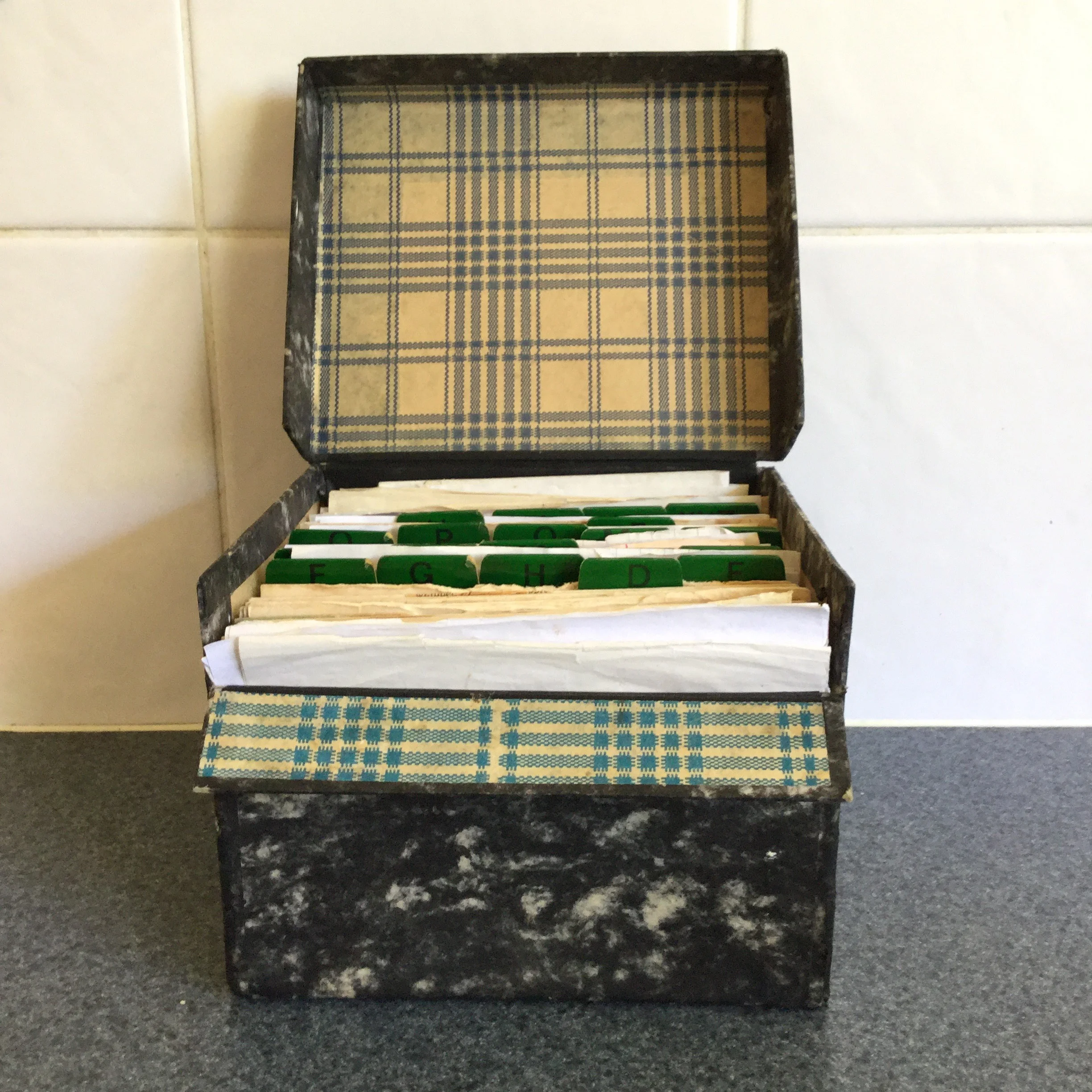
My mom, Gwen Beinart (nee Sackstein), born in 1936, has always been the heartbeat of my love for baking. Over her lifetime she gathered a collection of recipes handwritten onto small cards — some her own, and others gathered from family and friends, tested, tasted, and kept as part of her core repertoire.
Of Lithuanian and German Jewish heritage, I am the second generation born in South Africa, and the youngest of three girls. A typical Jewish immigrant history, my grandparents on both sides came to South Africa looking for a better life. They were very poor and my parents wanted nothing more than to give us the best possible life and education. My father was a self-made businessman and my mother was a very creative homemaker.
Of all of her recipes, there’s one that brings back the most vivid memories of delicious family time: Teiglach. Syrupy, crunchy, chewy donut-shaped biscuits, these sweet offerings were at the centre of every gathering and a symbol of the importance of the occasion being celebrated. This recipe was what my mother was best known for. My emotional attachment to it was so profound that it took me more than 20 years after her death to make them.
I am remembering, from my childhood in Durban, all the many conditions needed to make perfect teiglach. First: the weather. It must be a humid-less, sunny day, because the teiglach got dried out on my parents’ brick-paved patio before being boiled in syrup. Next: the equipment. You had to have the right pot, with a heavy metal lid and a brick placed on top to make it completely airtight. Then: no draughts! My sisters and I knew to never open the kitchen door and let in a draught when the teiglach were boiling on the stovetop!
I was always excited when my mom made them because it meant something important was happening! Most likely, we were going to Johannesburg to be with my aunts, uncles, and cousins for Rosh Hashanah or Pesach. Huge round Tupperware containers would be filled with my mom's teiglach and offered as gifts. Everyone made a fuss: teiglach were considered a great delicacy. Best of all, the containers were never returned empty — my aunts filled them to the brim with treats for our long car journey back to Durban.
After my mom passed away in 1991, we (my husband, three sons, and I) moved to New Zealand. Naturally, my mother’s treasured box of handwritten recipe cards came with us. But making teiglach felt far too daunting (emotionally and otherwise) to do on my own. Good results never seemed attainable.
Just a few years ago, when my sister Kerry visited from London, we agreed to set aside a day to (finally!) make my mom’s teiglach. We had her Kenwood mixer, the right heavy-lidded pot, her lengthy handwritten recipe, and we felt her loving guidance — along with that of our other sister Elona, supporting us from England.
The family was well briefed: no opening the kitchen door, no draughts!
Kerry and I put our memories together and got started. Kerry remembered the teigel shape and we molded the dough before setting them out to dry in the sun. I remembered the three-step process to stir the teiglach once they were boiling in the pot: lift the lid, wipe off the condensation, and stir. Do this all quickly (remember, no draughts!) Of course this resulted in many hot syrup burns — scars I wear with pride!
While I always knew making teiglach was far more than following a recipe, I was not prepared for the overwhelming feeling I experienced when we opened the pot of the boiling treats for the first of six stirs. The sweet, syrupy smell flooded me with lifelong memories of love, happiness, and of our beloved mom.

Mommy’s Teiglach (Gwen Beinart)
Note: Adjustments for gas stove made by Charlene

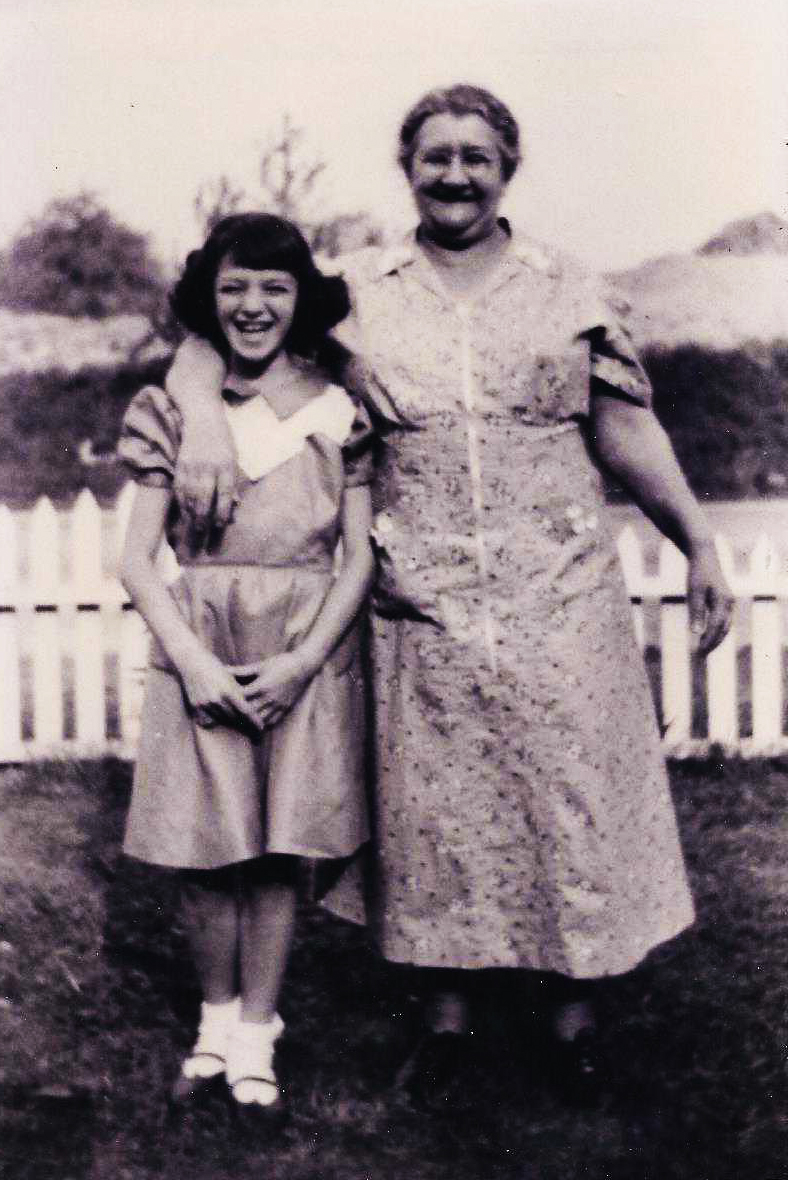
A Photo of Charlene's mother, Gwen Beinart
Ingredients:
6 eggs
1 Tablespoon Oil
1 Tablespoon Brandy
Pinch salt
2 teaspoons grated orange zest
½ teaspoon baking powder
Flour: 3 cups to start
Syrup: 2 lbs or 1 kilo tin golden syrup,
3 cups sugar, and 2 ½ cups water
Directions:
1. Slightly beat 6 eggs with oil, add brandy, salt, orange rind and then baking powder.
2. Add 3 cups flour sifted (one at a time).
3. Take a little bit on a small heap of flour and work in flour until dough is soft, slightly sticky but pliable. Roll into shapes in floured hands.
4. Put into floured tray to dry – preferably in sun for approximately 20 minutes, s turning over after 10 minutes
5. In the meantime, put syrup, sugar and water on to boil in large heavy pot (or weighted lid).
6. When boiling fast add teiglach. Close lid and boil on high for 5 mins
7. Then turn down to medium/high (low to medium on gas) to boil for 30-35 mins (26 – 30 on gas) before lifting lid. (Very important to weigh down the lid!)
8. Wipe lid and stir in quick motion every 5 mins until done (an additional approximately 20-30 minutes, or six stirs). Total time on the stove is 1 hour 10 mins according to Mommy but on gas probably a total of 55 mins)
9. Special note for gas : after 1st 5 min fast boil move pot to medium size plate on medium gas for 30 mins. Then do the lid/wipe/stir @ 5 min interval either 5 or 6 times in total.
10. When done take off 1 ½ cups of syrup for next batch
11. Then put in 1 heaped teaspoon ground ginger andhalf to ¾ cup boiling water down the side of the pot.
12. Stir until bubbling stops and take out teiglach onto damp board or plate. Leave to cool.
13. Can roll in chopped nuts if desired.
14. Store in plastic air tight container.
15. If making further batch add ½ used syrup and ½ new to same other ingredients – usually better

Charlene Beinart works as a psychologist in private practice and her husband is a university lecturer. She writes, "Our sons have turned out to be far better cooks than me, and their interest in food history has captured my own. We are regular listeners of Linda Pelaccio's podcast, A Taste of the Past. Our oldest son is currently a MA student at Hebrew University, researching the lives and stories of Lithuanian Jewish immigrants to South Africa through the cookbooks they created and the recipes they passed down to their children."
Krautsalat (Cabbage Slaw) • Sonya Gropman
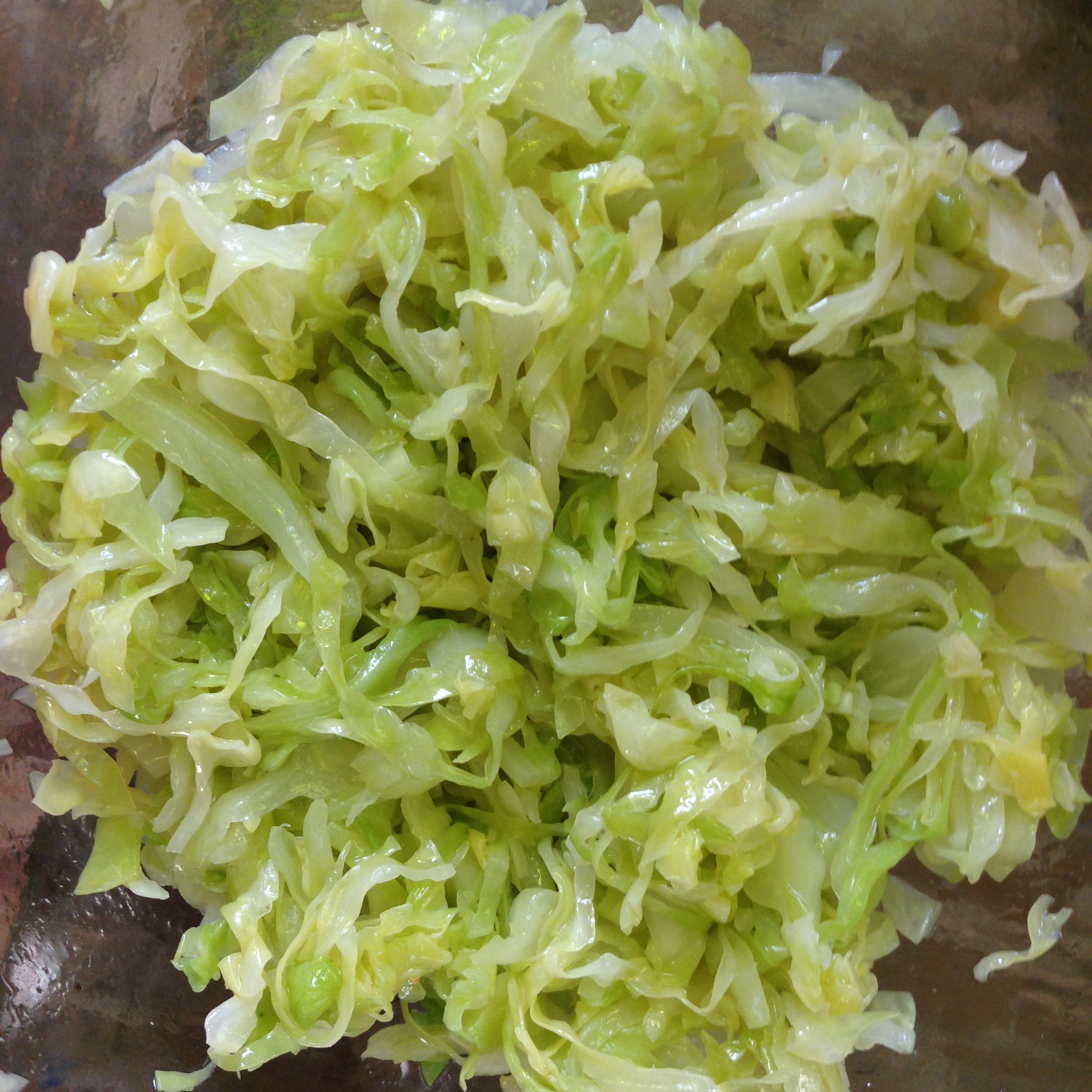
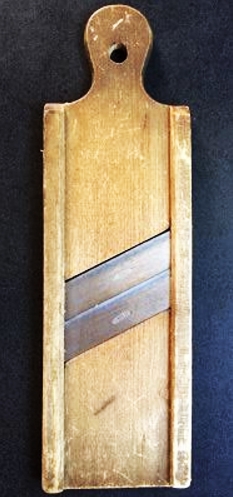
Note from curator Rozanne Gold: We are delighted to have this beloved recipe for Emma Marx’s cabbage slaw, translated and submitted by her great granddaughter, Sonya Gropman. It is but one of more than 100 recipes to be published next year in “The German-Jewish Cookbook: Recipes and History of a Cuisine,” co-written by Sonya and her mother, Gabrielle Rossmer Gropman (University Press of New England). The gorgeous narrative, spanning the kitchens of four generations, is part of the HBI Series on Jewish Women (the Hadassah-Brandeis Institute.) I especially love the photo of Emma’s old-fashioned wooden mandolin that was used to shred cabbage, cucumbers, and onions. And you will no doubt enjoy preparing the dish, faithfully, just as much as I did. We look forward to the book’s publication in September 2017.

Krautsalat (Cabbage Slaw) by Sonya Gropman
My mother grew up in a household where three adults cooked on a regular basis — her mother, grandmother, and father (her grandfather, who also lived with them, didn’t cook). The family had fled Nazi Germany in 1939, when my mother was a one-year old baby and settled in Washington Heights, a neighborhood in upper Manhattan that was home to approximately 20,000 German-Jews. German was frequently heard spoken by people on the street and there were many businesses that catered to the community, including food shops. Thus, it was easy for people to continue eating the same foods they had eaten in Germany.
Many German-Jewish families arrived in the U.S. with a household worth of personal belongings. Unlike most other refugees — who might arrive with just a single bag or suitcase after fleeing their homeland — German-Jews often brought the entire contents of their homes, which had been packed into enormous wooden crates called a lift van. This box of possessions included all the usual items that fill a household, both big and small — from furniture, to clothing, to cookware, and everything in between. That this happened was due to a perverse policy of the Nazis. It was a way for them to collect taxes on everything Jews packed, and it also demonstrated their imminent departure from Germany.
Much of the cookware and dishes brought by our family, which dates from the early 1900s to the 1930s, survives and is still in use by both me in my kitchen, and by my mother in hers. There are family objects that I use on a daily basis, including knives, a colander, and sauce pans. It is a testament to how well-made these objects are and still functional many decades later.
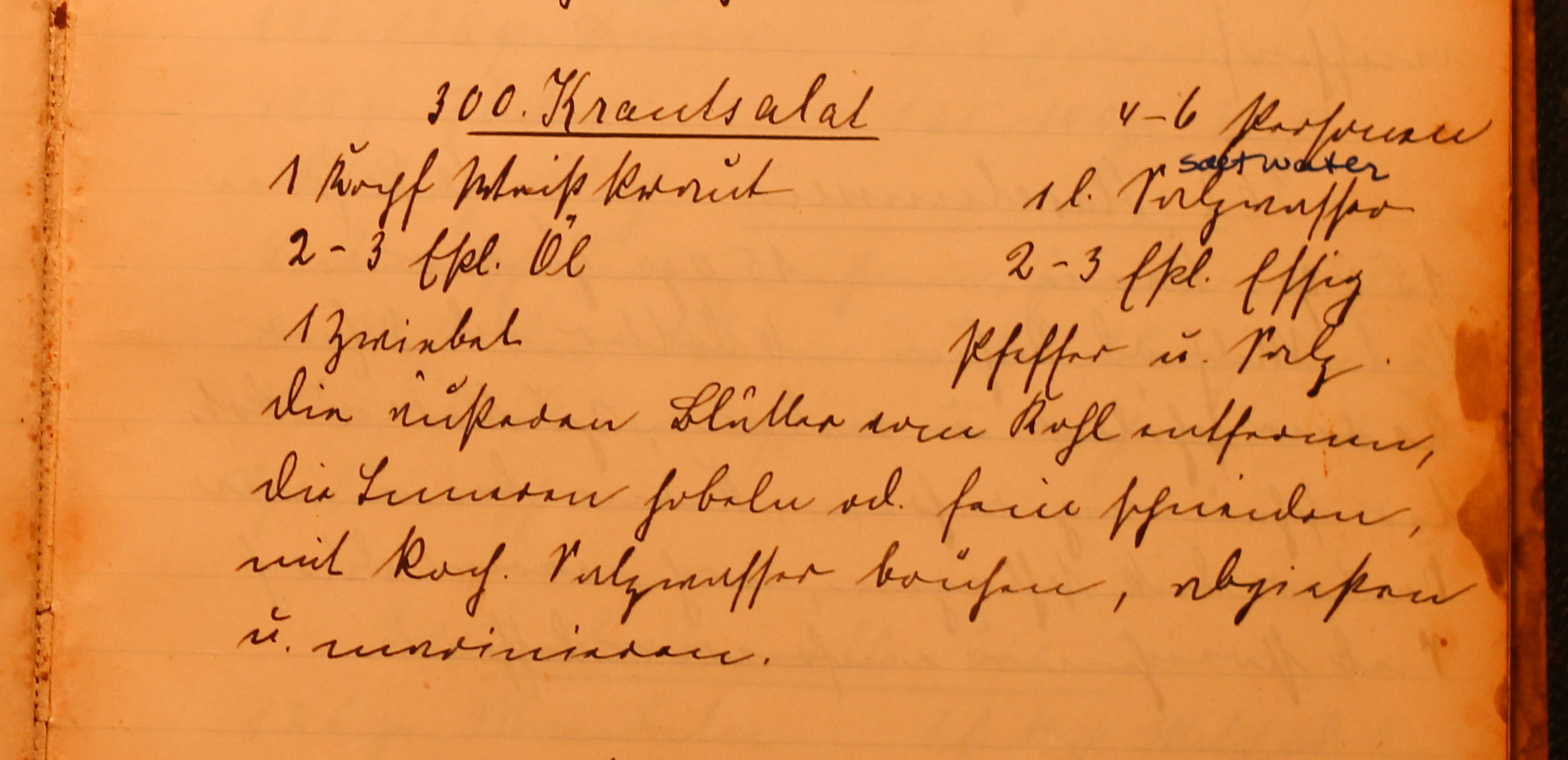
My mother has a wooden mandolin that belonged to her grandmother, Emma. By today’s standards, it seems very basic as it lacks folding legs to prop up the blade (instead it must be held at an angle with one’s hand), and is has a fixed blade, so that the thickness of the slices is not adjustable. To our knowledge, the blade has never been sharpened, yet it remains quite sharp. My mother uses it regularly to slice vegetables such as cucumbers and onions. She also uses it to shred green cabbage in order to make Green Cabbage Slaw, or Krautsalat, a dish that her grandmother frequently made for holiday meals during her childhood. It accompanied any number of meat meals, such as roast duck or goose, tongue, or veal roast. It was a favorite dish of my mother’s and she was thrilled to find the recipe in a cookbook her grandmother had handwritten when she attended cooking school in Germany before she was married in the early 1900s. My mother set about making the recipe, but the finished dish didn’t quite match her memory of how it tasted during her childhood. She tinkered with the recipe, comparing the list of ingredients and the written instructions with her memory of it. She realized that even though the written recipe included onion, Emma had not used it in her version. Eventually she came up with a recipe for the dish that tasted exactly the way she remembered it.
When I first saw the recipe, I was struck by my great-grandmother’s beautiful, fluid script, written in a form of Old German that is very difficult to read. I then noticed a translation for “salt water” written in blue ink, jotted down by a frustrated translator (my mom), who was relieved to figure out the word. At first I was sorry to see the page marred by contemporary writing, but I later realized that it adds another layer to the history of the recipe, keeping it alive and in the present.
This recipe is remarkable in that a short list of ingredients is transformed, seemingly through a bit of alchemy, into something so addictively delicious. Falling somewhere between coleslaw and sauerkraut, it uses boiling salt water to break down the shredded cabbage into a slightly wilted and softened state. A light vinaigrette dresses the cabbage, while brightening its taste with the acidity of vinegar.
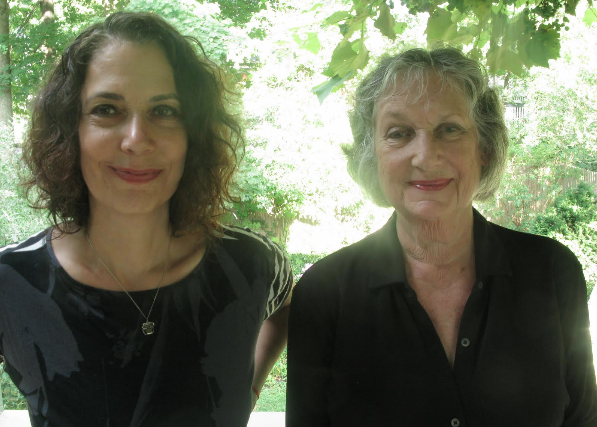
Cabbage Slaw (Krautsalat)
8-10 servings
This dish is best if the cabbage is finely shredded. If you do not have a mandolin, use the long blade on a box grater, the slicer attachment on a food processor, or a sharp knife to slice the cabbage as thinly as possible. This recipe is the original version, but feel free to try the variation we discovered below which uses a few non-traditional additions.
1 medium sized head of green cabbage
1 quart of water
2 tablespoons of salt + extra if needed
4 tablespoons white wine vinegar
ground white, or black pepper, to taste
2 tablespoons neutral oil, such as canola or safflower
Prepare the cabbage:
Shred the cabbage into a large glass, ceramic, or stainless steel bowl. Boil the water with the salt. Pour the boiling saltwater over the shredded cabbage. Let it sit until the water is cool, between 30 minutes to 1 hour. Pour the cabbage into a colander set in the sink to drain the water. Press down with a plate that is slightly smaller than the colander to press out as much water as possible. Put the shredded cabbage in a serving bowl.
Make the Vinaigrette:
Pour the vinegar and pepper into a small bowl. Slowly add the oil, while whisking, until blended. Pour the vinaigrette over the cabbage, tossing to coat evenly. Taste for salt, adding more if needed.
Serve:
The slaw will be ready to eat immediately, though the taste and texture will mellow and improve if allowed to stand for an hour or more. Serve chilled, or at room temperature.
Variation: Prepare cabbage as in step #1 above, adding some or all of the following ingredients to the drained cabbage in the bowl:
2 carrots, shredded on large holes of a box grater
1 small shallot, minced
1 bunch arugula, finely chopped
1-2 tablespoons minced fresh herbs, such as marjoram, parsley, or thyme
Continue with steps #2 and #3
© 2016 Gabrielle Rossmer Gropman & Sonya Gropman The German-Jewish Cookbook: Recipes and History of a Cuisine
*HBI is the Hadassah-Brandeis Institute, an academic center at Brandeis University which promotes scholarly research, artistic projects and public engagement.

Grandma Rozie’s Pot Roast • Tina Barry
Note from curator Rozanne Gold: Tina Barry, poet, writer, and former restaurant critic for the Brooklyn Paper is a woman of myriad talents. Her poems and micro-fiction have appeared in numerous literary magazines and two pieces in her poetry book, Mall Flower, were nominated for Pushcart prizes. But her biggest prize may be the generational embrace she nurtures with her 91-year old mother, Roz (the creator of this story’s succulent pot roast), her beautiful 26-year old daughter Anya, and the precocious Vera, nearly two years old. A writer of great warmth and wit, Tina extends these qualities to everything she touches — her joie and appreciation for whiskey sours, the empowerment of women, great design, and great meals (especially in France). An evening at her upstate New York home includes feasting from husband Bob Barry’s exquisite handmade ceramic plates. Tina is a teaching artist at the Poetry Barn in West Hurley, New York, and is an editor for the restaurant and fashion industry. Many bows to her for this beautiful story.

Grandma Rozie’s Pot Roast by Tina Barry
My mother, Roz Ehlin, the daughter of Russian immigrants, cooked four dishes perfectly: pot roast, stuffed cabbage, roast chicken and chicken soup. She broiled lamb chops, boiled frozen vegetables. Mashed potatoes came from the box. She has never, and, at 91 years old, has no intention of ever owning measuring cups or spoons. “I’m creative,” she told my sister and me when we were children, “creative people don’t measure.”
As limited in variety as our meals were, everything she cooked tasted great to us. That was a good thing. Divorced with a full-time job, she didn’t have time for elaborate dishes and she didn’t tolerate picky eaters. A friend of mine, who asked for her food separated on the plate so nothing touched, was never asked back for dinner.
My mother may have kept her repertoire of meals well edited, but she loved, and still loves food, was curious about culinary trends and enjoyed reading recipes. Once a month she’d visit the library and, after perusing the latest Vogue and Cosmopolitan, head home with a stack of cookbooks. After dinner, she’d sit on the couch with a cookbook on her lap, my sister on one side, me on the other, and slowly turn the pages.
“Look at that,” she’d say. My sister and I sighed over quivering Jell-O molds, bubbling pots of fondue, crisp pastry shells cradling Chicken á la King. Pineapple Upside Down Cake left us speechless. “One day,” we’d say, staring at a delicately browned dome of Baked Alaska.
On our kitchen shelf she kept Peg Bracken’s I Hate to Cook Book; my mother appreciated Bracken’s dry wit. The other book was a tiny collection of recipes that my sister and I scribbled all over with purple crayon. One recipe for potted shrimp, turned up in my second grade class’s holiday cookbook, rechristened “Shrimp á la Ehlin.” She didn’t have a single handwritten recipe.
Out of the house and into my own kitchen, I vowed to cook and cook well. I bought measuring cups and spoons and used them. I baked apple pies and layer cakes, whisked batter for wisp-thin crepes. I mastered the perfect omelet.
I was not, though, “creative” the way my mother was. I needed recipes, at least in the beginning while I learned the basics. Recipe or not, I was determined to nail her pot roast. First attempts were okay, if lacking the joie de vivre of her dish. One trial produced tender meat but a sauce without much flavor; I should have used broth, not water. Once I added too many tomatoes, turning the dish into a kind of pot roast ragu. I overcooked the potatoes; my mother’s potatoes were soft, not mushy. It took awhile but one glorious night, I served a pot roast identical to my mother’s.
My daughter Anya married recently. She has asked me for recipes for the dishes she loves. I emailed them to her, until she requested Grandma Rozie’s Pot Roast. I have the recipe in my computer but I couldn’t bring myself to send it. Something so weighted with memories, so redolent of good times at the table, deserves more than clicks on the computer to attach and download.
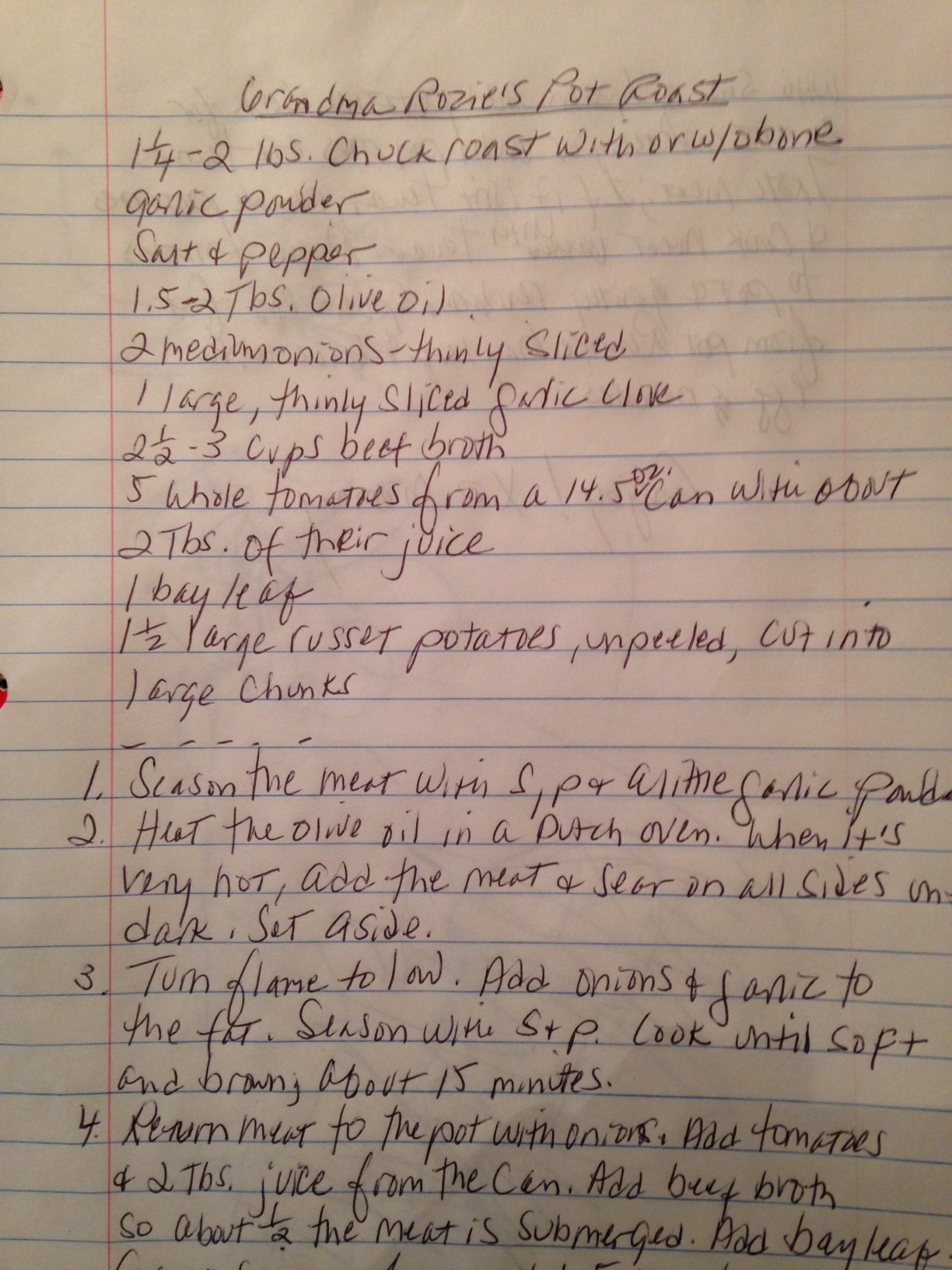
Her pot roast recipe is a part of our history: my mother’s, daughter’s and mine. And will be a part of my granddaughter Vera’s history, too. When Anya cooks for Vera, my mother will be with them in all the flavors on the plate. There will be a little of me, too, in the slant of my “t,” the dot that never quite caps the “i.” That’s what a recipe does, especially one that’s handwritten: it brings loved ones closer with the proof of their hand on paper, the memory of clangs and chatter, the perfume of onions cooking slowly on the stove.


Roz Ehlin’s Pot Roast
1.5-2 lbs. chuck roast (with or without bone)
garlic powder, salt and pepper
1-1/2-2 tbs. olive oil
2 medium onions sliced thin
1 large, thinly sliced garlic clove
2-1/2 to 3 cups beef broth
5 14.5 oz. cans, whole tomatoes
(with 2 Tbs. of their juice)
1.5 large Idaho potatoes
(unpeeled, cut into large chunks)
1 bay leaf
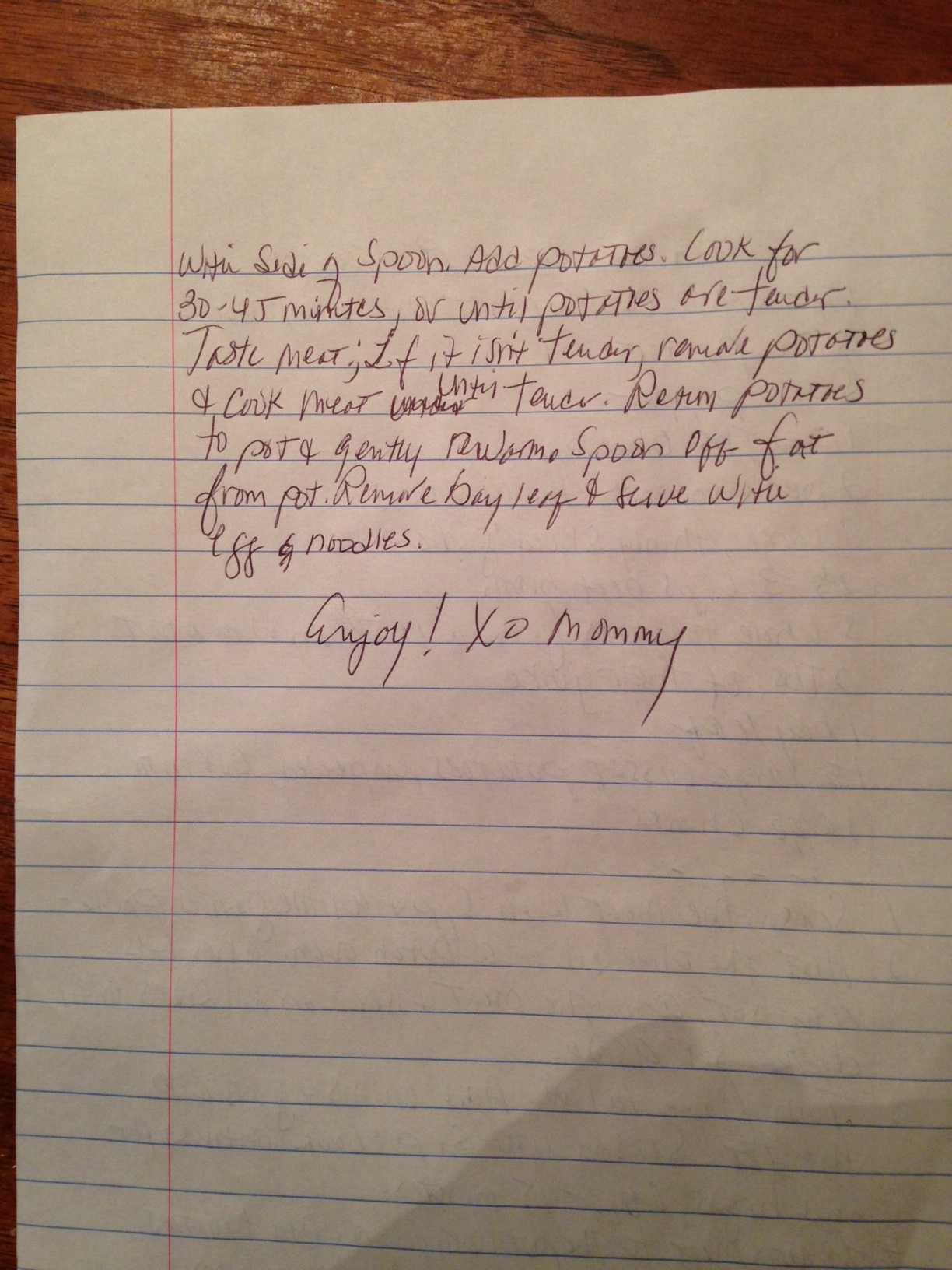
1. Season the meat on both sides with salt, pepper and garlic powder. Heat the oil in a Dutch oven. When it’s very hot, add the meat to the pot and sear on all sides until dark. Set aside.
2. Turn heat to low. Add the sliced onions and garlic to the fat. Season with salt and pepper. Cook until soft and browned, about 15 minutes.
3. Return the meat and any juice collected on the plate to the pot with the onions. Add the tomatoes to the pot with the 2 Tbs. juice from the can. Add beef broth so about 1/2 of the meat is submerged. Add bay leaf. Cover and simmer for about 1.5 hours, then turn the meat to finish cooking.
4. After about 2 hours, add more broth if necessary; you want enough liquid to make a nice sauce. Crush tomatoes with side of spoon. Add potatoes. Cook for about 30-45 minutes. Remove potatoes when they’re soft. If meat is still chewy, cook until tender. Return potatoes to pot to warm. Cook for a few minutes. Spoon off fat from sauce. Remove bay leaf and serve. My mother always served pot roast with egg noodles.


Stuffed Cabbage, Hungarian-Style • Jolie Mansky

Note from curator Rozanne Gold: Jolie Mansky’s memories of her grandmother’s stuffed cabbage are mouthwatering. The same can be said of the recipe I enjoyed making so much — knowing I would serve it sometime during this year’s Rosh Hashanah holiday (year 5777), and well into the wintery months. Appropriately seasoned with sweetness (apples, raisins, honey, brown sugar and onions) and quite in contrast to the sauerkraut-y flavors of my own Hungarian mother’s version, its dulcet notes are perfectly in tune. Jolie, an ebullient New Yorker, is the proprietor of Urban Concierge U.S., a company that enables others to “fulfill a desire or a dream — from the perfect meal or sold-out event ticket, to a unique getaway day trip or global vacation.” I would say she should add sharing treasured recipes to that list and I encourage her to turn her family memoir First, You Brown the Onions, into a cookbook for a wider audience. Thanks, too, to Allison Radecki for her editing prowess.

Stuffed Cabbage, Hungarian-style by Jolie Mansky
I have many memories of cabbage — from my Mom’s cabbage soup to the stuffed leaves featured here. But it is this recipe, unbelievably delicious, schmaltzy, tasting both sweet and tart, that brings back incredible memories of childhood: Family gatherings, holidays, the powerful aroma of onions and tomatoes slowly cooking, that first taste of sweet-and-sour flavors, and being at my grandparents’ home joined by many cousins.
All the women in my family (great-grandmother, maternal grandmother, great aunts, mother, and aunts) made this dish for the holidays. It particularly links me to the three generations of women that came before me: my mother, Sherry Stauber Roberts, my grandmother, Lillian Adler Stauber, and Mechlya Popovitz Adler-Weiss, my great grandmother.
Sherry was born at home in Brooklyn; Lillian in 1905 in Viseu de Sus, Romania (or Hungary, depending on who you ask and who was in power); Mechlya was born in Hungary-Romania in 1883.
Mechlya was a midwife and became a professional caterer in the U.S. I don’t know that she loved to do anything. She was just constantly busy doing what she had to do.
Lilly was an amazing balaboosta (the Yiddish term for the perfect housewife and someone who provides sustenance to the family); she cooked, she cleaned, she hosted. Besides having and maintaining a beautiful home, Lilly also loved to play cards.
Sherry, my mother, is also a fantastic balaboosta. At age 90, a retired buyer, she now loves to read, knit, play Lexulous online, watch HGTV (Bobby Flay and Cook or Con) and follow everyone on Facebook. My mother has written this recipe out for me for over thirty years. Not surprisingly, the recipe changes a bit each time.
When I compiled a family memoir called First, You Brown the Onions, I made sure to include a copy of this dish within its pages. I also have several copies of my mother’s handwritten “originals.”
I have always been fascinated how different cultures make similar dishes with what is available. I love stuffed grape leaves. The Iranian version, cooked in a pomegranate reduction, is divine. Then, there is the Levant, where every conceivable vegetable is stuffed, zucchini, peppers, tomatoes, and even onions.
My earliest recollections of my grandparents’ home involve food and ritual. I remember my grandfather, Izzie, getting up at the crack of dawn and faithfully laining his tefillin, putting on the black leather boxes which contain Hebrew parchment scrolls. He would mumble his prayers rapidly and say “shah” if anyone interrupted.
My grandmother, Lilly, was always cooking, even after a stroke rendered her partially paralyzed at age 58. She had to cut the vegetables perfectly even then. Lilly had set menus for every night of the week, which must have made life easier. Everything she made was delicious.
To this day, I can still lovingly detect a Jewish-Romanian accent. When I hear this accent, and see the sparkling gold teeth of immigrants, I close my eyes and remember the love I felt as a child.

STUFFED CABBAGE (Hungarian Style)
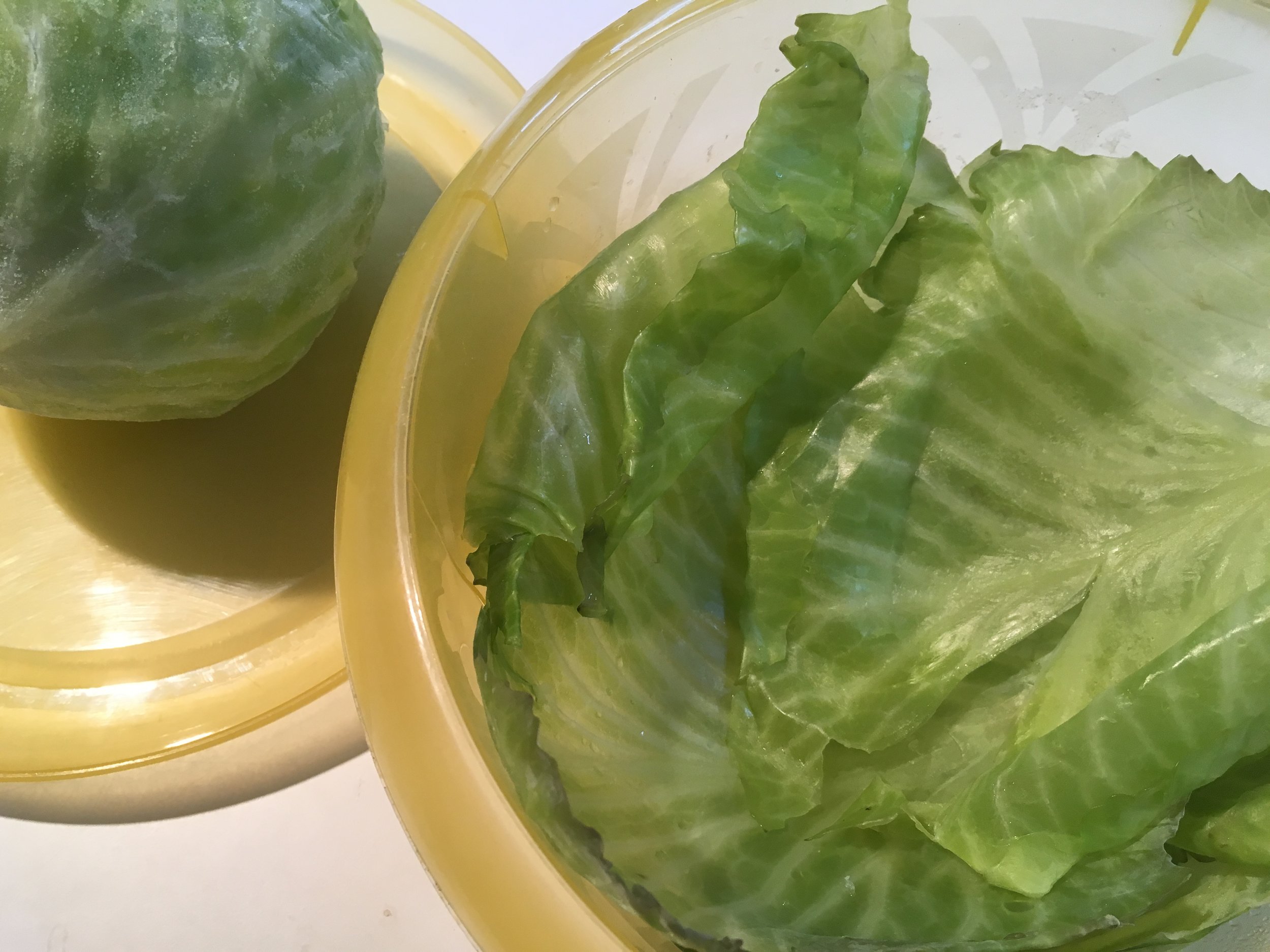
SOFTEN CABBAGE LEAVES (can be done in one of two ways):
1. Cut out, core and wash cabbage. Cover in plastic wrap and place in freezer overnight. When thawed, leaves are soft and ready to take off. –OR-
2. Cut out core and place cabbage in large pot of boiling water. Steam until soft enough to remove leaves. You may have to put it in boiling water a few times.
SAUCE: In bottom of large pot:
Shred cabbage (all leaves not used for filling)
2 Onions, chopped
1 large can crushed tomatoes
1 small can tomato paste
1-2 sliced apples
1/2 cup raisins
1/2 cup brown sugar & 3 Tbsp. sugar
Juice of 1 lemon
(Adjust seasoning during cooking)
Salt & pepper
2 Tbsp. honey
2 cups water - watch if more needed
FILLING:
1 1/2 lbs. ground beef
Salt & pepper
Bread crumbs (or Matzo meal)
3 Tbsp. of prepared sauce
1 grated onion
1/2 cup raw rice (rinsed)
COOKING:
- Place cabbage rolls - rolled with 2 ends tucked in (they hold closed) on top of sauce.
- Simmer to a slow boil. Cover and cook about 2 hours.
- During cooking, watch to make sure that the rolls are not sticking to the bottom of the pot. Gently shake pot to keep rolls from sticking.
- I separate the prepared sauce into two parts and pour the last half over the cabbage rolls.
- When cooled, place the cooked rolls in a baking pan, in rows. Dribble a little honey over the cabbage rolls and brown before serving.

Beatrice Nisenson’s Prune Cake • Evan Nisenson
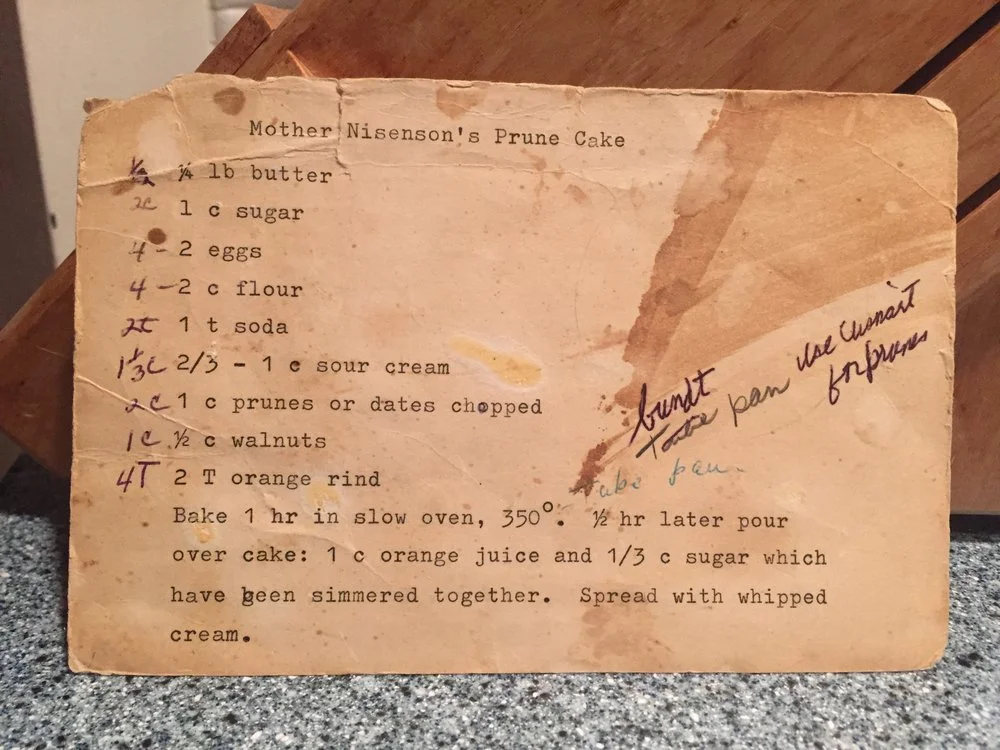
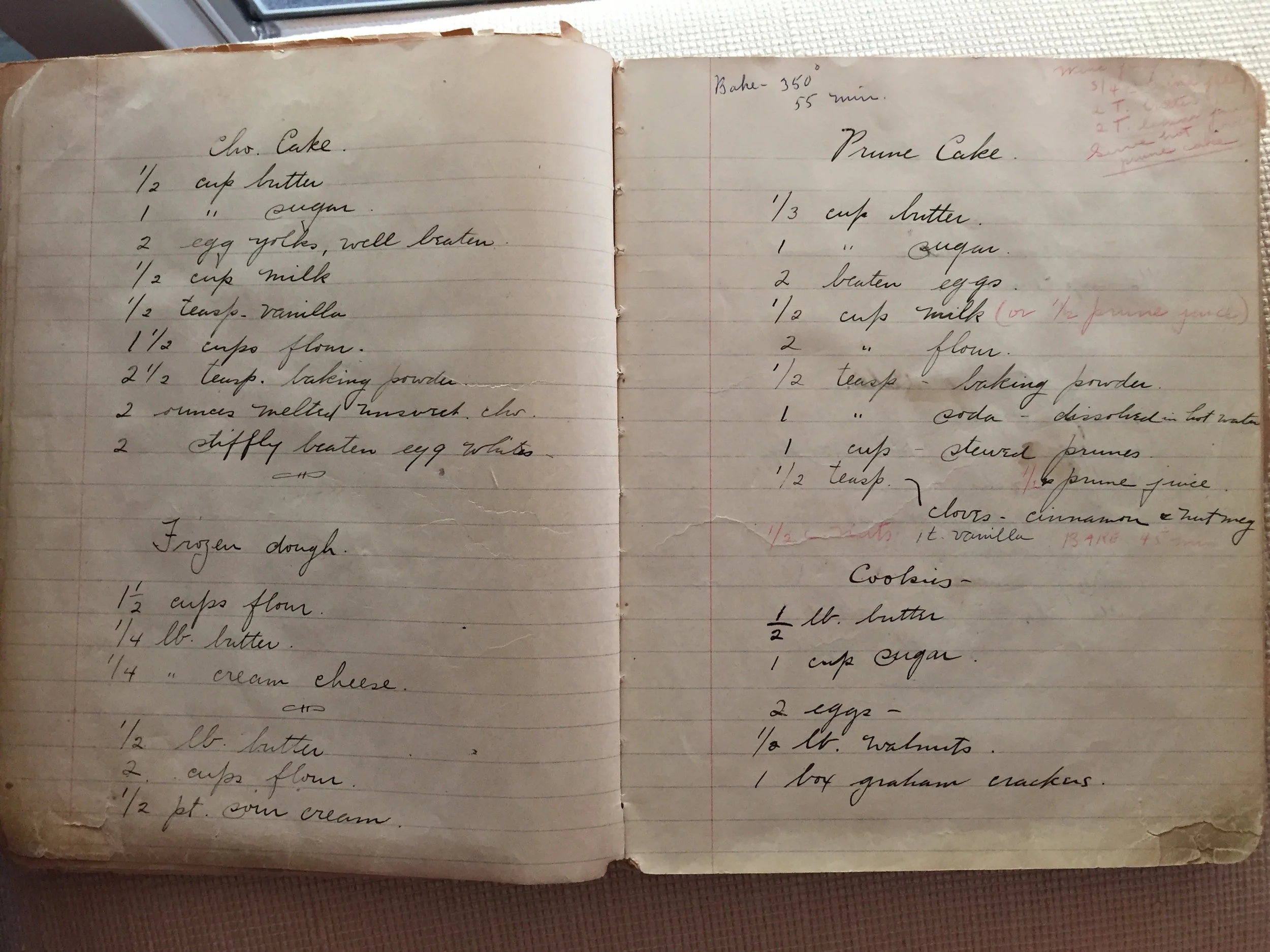
"I noticed there were additional comments made in red, and a wine jelly stain, somewhat faded in the upper right-hand page corner, which came from a syrup that was poured over the cake. I also found a typed version that had been altered slightly, most likely by my grandmother, evolving with the taste buds of time."
Note from curator Rozanne Gold: Evan Nisenson, a father, husband, and Director of Alumni Relations at Newark Academy, among many other virtues (he has even been featured on Martha Stewart), wrote his Master’s thesis on “The Characteristics of Collectors.” He, too, is a collector of things, including Nisenson Hats made by a distant relative in Newark. He especially respects this quality in others, and so was smitten by a collection of recipes belonging to his beloved grandmother. I am grateful to Evan for many things, including these wonderful remembrances punctuated by a delicious cake. But it is his wisdom and technological prowess that have allowed me to live my life more fully and with greater calm. He is one of my own life’s key ingredients.

Beatrice Nisenson's Prune Cake by Evan Nisenson
When I think of my life’s recipe thus far, my grandmother, Emilie Nisenson, is one of the key ingredients. She has shared her love of cooking and baking since I was a kid spending a week every summer in Spring Lake, New Jersey, with my grandparents.
Often tasked with snipping chives from the garden for morning scrambled eggs, prepping salads for dinner, and assisting in the production of wondrous desserts, I quickly became enamored with being in the kitchen, preparing family meals, and copying recipes from my grandmother’s collection onto recipe cards for my own keeping. Over the years, I began to understand where my father’s love of the kitchen came from. I attribute my love of cooking to him (a well-respected podiatrist) as well.
During a recent visit to the Jersey shore with my wife Lauren and 18-month-old son Harris, I spent some time thumbing through my grandmother’s silver tinned box of handwritten recipes, weathered by the salty and bittersweet years but still intact, legible, and organized by genre. I jumped to the cakes tab to see what I could find.
Simultaneously, my grandmother sauntered to her bookshelf trying to find a certain book. She carefully pulled out a composition book whose bindings were failing. Having never seen this book before, I was intrigued. Like Indiana Jones, I delicately opened the book, wondering if my handling of its frail pages would release a giant booby-trapped meatball from the rafters. My knife and fork were at the ready.
I was told that this manuscript belonged to Beatrice Nisenson, my great-grandmother, who had handwritten an entire book of recipes. Many were her own but some were those of her friends, their names included in the recipe titles. I had never met my great-grandmother, but felt an immediate connection to her. My grandmother then told me that one of great-grandma Bea’s favorite recipes was her prune cake.
Prunes are not the most glamorous dried fruit, yet I had the urge to bake this cake. But first, I had to find the recipe. I turned fragile page after fragile page until I saw it before for me: “Prune Cake.” I noticed there were additional comments made in red, and a wine jelly stain, somewhat faded in the upper right-hand page corner, which came from a syrup that was poured over the cake. I also found a typed version that had been altered slightly, most likely by my grandmother, evolving with the taste buds of time. The recipe I used when I returned to my kitchen was a combination of old and new, bridging together generations of Nisensons. The tradition continued as I watched my 18-month old son take a bite of the moist cake, which he very much enjoyed.


My wife and I recently devoured the third season of The Great British Baking Show, which is a delight for those of us fascinated by the art of baking. In each episode, the bakers are presented with a technical challenge, tasked with recreating a complicated recipe given to them with incomplete baking directions.
Upon noticing that the prune cake directions were incomplete, I realized this would be my own technical challenge. For the seasoned baker this would not be a problem, but for those of us who need step-by-step instructions, it poses a serious issue. Luckily, I successfully navigated the recipe, taking notes along the way and ended up with a very flavorful cake.
With every chop of prunes, with every stir, with every glorious scent, I was instantly reconnected with the past, transported to my great-grandmother’s kitchen, which I had never seen but could immediately envision. Such is the power of a handwritten recipe.


Beatrice Nisenson’s Prune Cake
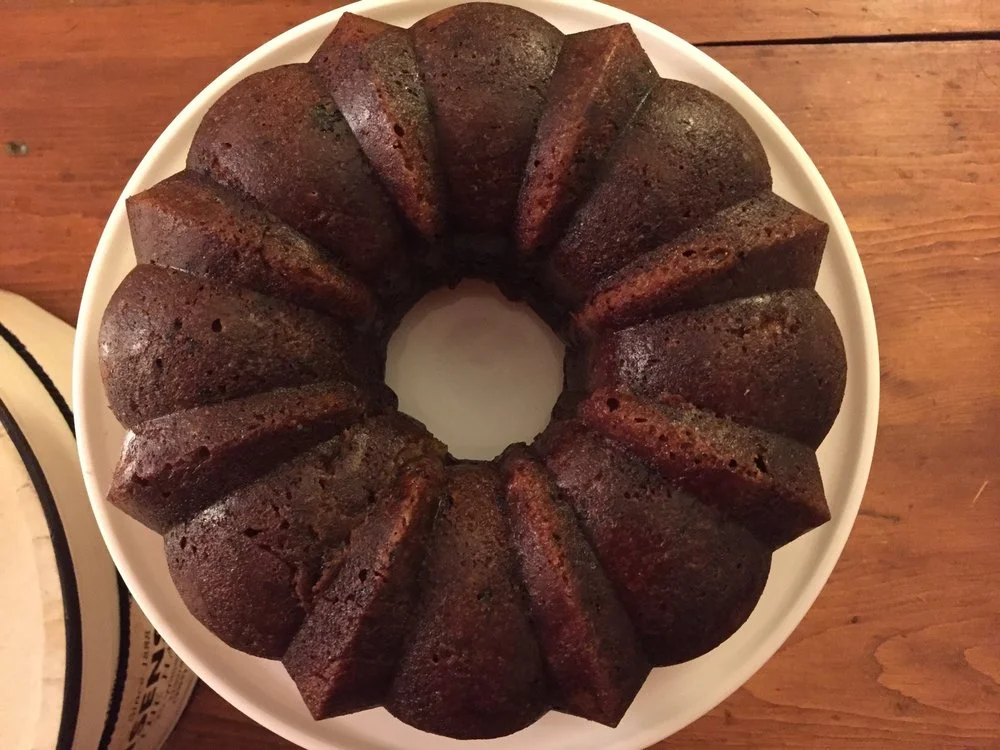
Moist and flavor-packed, this version was inspired by my great-grandmother’s original recipe and adapted by me – her great grandson. Whereas this recipe does not mention salt, it is always good to add a pinch of it, along with the spices.
Directions.
Preheat oven to 350 degrees. In a mixing bowl, cream together the butter and sugar. Add the eggs and vanilla and beat until creamy. Add sour cream and chopped prunes and slowly mix until evenly distributed. In a separate bowl combine the flour, baking powder, cloves, cinnamon and nutmeg. Slowly add the flour to the butter and egg mixture and mix thoroughly. Stir in chopped nuts and orange zest. Pour batter into a bundt pan and bake for 55 minutes. For glaze, simmer orange juice and sugar until sugar dissolves. After the cake has cooled for 30 minutes, pour glaze over cake. Serves 10
Ingredients.
¼ lb unsalted butter
1 cup sugar
2 eggs
2 cups flour
1 teaspoon baking soda
1 cup sour cream
1 cup prunes or dates chopped
½ cup walnuts chopped
2 tablespoons orange rind
½ tsp baking powder
½ tsp cloves
½ tsp cinnamon
½ tsp nutmeg
1 tsp pure vanilla extract
Orange Glaze
1 cup orange juice
⅓ cup sugar

My Babcia’s Mizeria (Polish Cucumber Salad) • Allison Radecki
Note from curator Rozanne Gold: I’ve been reading a lot about cucumbers recently and so was delighted to get this wonderful recipe and memory jolt from food writer and cohort, Allison Radecki. The recipe is from her beloved Polish grandmother, her Babcia (pronounced BOB-cha), and it comes with a detailed history of a vanquished, but riveting, way of life. The handwriting belongs to Allison and the recipe has been handed down from at least three generations. Allison’s daughter, Tabitha, will no doubt be the fourth. She’s only five but will be making cucumber salad soon enough. After all, it’s fun to run the tines of the fork down the length of a cucumber to make a design before slicing. Cucumbers, by the way, belong to the cucurbitaceae family as do melons, squash, zucchini and pumpkin and contain potent anti-cancer compounds. Thank you to Allison, and to Babcia Genevieve.

My Babcia's Mizeria (Polish Cucumber Salad) by Allison Radecki
My Polish grandmother’s 1970s American kitchen was a place of transformation. The Formica countertops (whose pastel boomerang pattern always made me think of scattered rubber bands) were surfaces where wooden spoons, mason jars, and stoneware crocks reigned. This was a zone where things freshly picked from the backyard were crafted into dishes of incredible simplicity and deliciousness. There was always a soup bubbling on the stove or something caramelizing in a pan, just waiting for a hungry grandchild to say, “Babcia, I’m hungry.” To this day the scent of frying onions brings me back there, in a heartbeat.
Standing at her kitchen sink in Cedar Grove, New Jersey, my Babcia, Genevieve Baranowski, could survey her domain. Her backyard was a rolling expanse of grass and trees, complete with a stream (great for crayfish hunting), a goldfish pond, and a substantial vegetable garden, which was where the magic began.
Babcia’s first miraculous act was to transform red clay into black gold. Nothing in her kitchen was ever wasted. She knew how to incorporate peeled vegetable skins, coffee grounds, and eggshells into the soil, a spell which resulted in zucchini as large as baseball bats, and heirloom tomatoes you could barely palm with your hand. Every skunk, opossum, and raccoon within a ten-mile radius was drawn to her vegetal treasures, against which she continuously waged war.
Spending time in her kitchen came with a specific vocabulary: szczaw (sorrel), buraki (beets) and, of course, the mighty kapusta (cabbage), which she fermented in her basement with the help of river stones, used to weigh down the shredded leaves in the brine.
Trips to a Polish family friend’s dairy farm were quite common. The return journeys (with her wood-paneled station wagon’s windows rolled all the way down) not only brought raw milk back to her home, but also the finest dried cow manure, which she credited with the spectacular blooms on her roses and peonies.
Since my Babcia and her family were keepers of secrets, her detailed history is still murky. We know that she was born in Niagara Falls, New York, in November of 1913. Her family made the bad decision to sell the profitable family glove factory and tavern and return to Poland in the early 1920s. After an forced unwanted marriage in rural Poland, she ran away, boarding the M.S. Batory, an ocean liner of the Polish Merchant fleet, to return to the country of her birth during the Great Depression. Before the beginning of World War II, she managed to bring her two sisters, also natural-born citizens, back to America, where they all worked as wartime riveters on the East Coast.
Where and how my Grandmother learned to cook is still a mystery. She knew how to braise, how to roast, and could craft an encyclopedia of sauces from memory. Since my Great-Grandmother’s homemade donuts were rumored to break your toes if they fell on your foot, my Babcia’s skills were definitely not passed down the maternal line. My mother’s theory is that while working in Rockaway Beach, Queens as a domestic servant, her mother must have picked up on lessons taught in her employer’s kitchen.
Mizeria, a cold Polish salad of wilted cucumbers, sour cream, salt, and fresh dill, was a popular dish in my Babcia’s summertime kitchen. In recent days, with East Coast temperatures rising to high levels, I have turned to it for its refreshing properties as a side dish, as well as for the family memories that accompany it. It is perfect to bring along to a barbecue, guaranteed to cool off the heat of a summer afternoon.
Though its gloomy name, Mizeria, is said to echo the fact that a Polish peasant’s life was full of misery, the dish leaves me with the opposite impression.
When I taste it, I think of lazy days in the backyard. I can see my grandmother, scented from tomato plant leaves, coming towards me from her garden with a basket of cucumbers. We have a lot of peeling to do.


Ingredients
- 2 large seedless English cucumbers (about 3 cups sliced)
- 1½ teaspoons salt
- 2 tablespoons chopped fresh dill
- ½ cup sour cream
- 2 tablespoons white vinegar
- ½ teaspoon freshly ground black pepper

Directions.
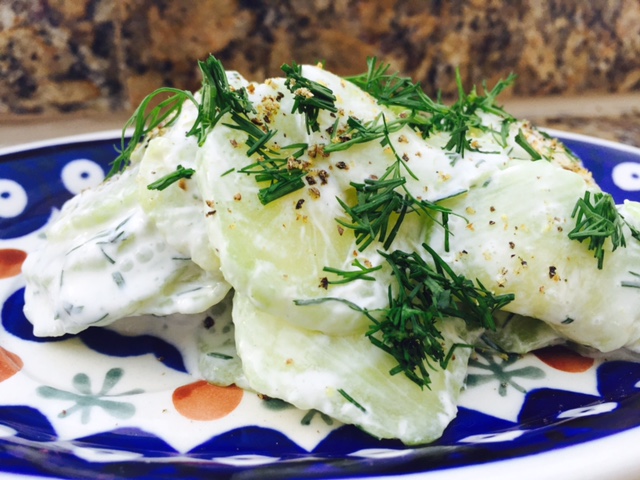
Peel the cucumbers. Run the tines of a fork, lengthwise, down the entire outside of the peeled cucumber, so that it is scored with the points of the fork (this action will give the slices a pretty scalloped edge -- see below).
Slice the cucumber as thinly as possible (so you can see a knife through the slices) and place in a bowl. Sprinkle slices with 1½ teaspoons salt and let sit for 30 minutes.
Drain water from the salted cucumbers and gently squeeze to expel remaining water. Pat cucumber slices dry with paper towels.
Toss cucumber slices in a medium bowl with sour cream, vinegar and dill. Allow the salad to marinate in the refrigerator for about one hour. Taste, adjust with salt and freshly ground pepper and serve.

Mrs. Cubbard’s Raisin-Stuffed Cookies • Marie Simmons

Note from curator Rozanne Gold: Marie is a trove of handwritten recipes and stories. An award-winning cookbook author and food writer, Marie Simmons wrote Bon Appetit’s “Cooking for Health” column for many years, and is the author of more than 20 cookbooks, including the wildly popular 365 Ways to Make Pasta, The Good Egg, and Lighter Quicker Better. Marie, a self-proclaimed story teller, is alight with thoughts of her mother and grandmother. She says, “These two family cooks taught me how important it is to make sure everyone has something good to eat. I hear their words, and I do the same.”

Mrs. Cubbard’s Raisin-Stuffed Cookies by Marie Simmons
Some children have play dates with friends. My play dates were with my grandmother Nana and we had them every Saturday morning. We made stuffed cookies from a recipe from a lady, whom I can’t quite visual anymore, by the name of Mrs. Cubbard. She was a neighbor who had a boarding house and Nana helped her in the kitchen.
Nana and I needed to keep her large dark-blue canning pot filled to the brim with Mrs. Cubbard’s signature cookies. You never knew when someone might stop by for coffee or iced tea or a glass of cold milk. What a smile it would bring to her face to know that sixty years later, I still keep a large container of cookie stuffing in my freezer so that I can prepare these nostalgic treats in a moment’s notice.
Nana and I had an assembly line going as we sat at her big round table in the center of her kitchen. (She, cutting out the dough, and me, stuffing the cookies.) The cabinets were painted a deep Greek sea blue. My Aunt Tess, the “decorator,” loved color so much that she filled her kitchen with her water colors and oil paintings and hung them on brightly-painted walls, making it quite festive. Imagine, ruffled white calico curtains billowing around the high-set windows that wrapped around the porch...and an apple pie cooling on the porch railing.
We began our morning by sipping weak tea. We always shared a tea bag. And we chatted. Nana said I inherited her gift for gab and anyone who has met me knows that can’t be denied. I sure do like — make that LOVE — to talk. I seem to always have a story to share.
Mrs. Cubbard’s (Stuffed Cookie) Recipe is a basic sugar cookie made with shortening (shortening is so 1950s!) and sugar, milk, nutmeg, vanilla and egg. I still make it with shortening, somehow surviving the nutrition police. The recipe calls for a “stuffing” of raisins, lemon sugar, and chopped lemon. I have updated the recipe with a filling of fig and prune. Nana would roll the dough on her big flannel-covered table top. Her rolling pin was a long broom handle she bought at the hardware store. She would use the rim of a glass dipped in flour to press out rounds for the cookies. It was my job to use her worn thimble (long misplaced, which makes me very sad) to cut out a circle out from the top of each round. Nana spread the raisin filling on the base of the rounds. I would carefully remove the thimble cut-out and hide it in my apron pocket so I could eat them later. Nana of course warned me, “Don’t eat the raw dough…you’ll get a tummy ache.” But I loved the taste of the raw dough. So I snuck it into my pocket and worried about the tummy ache later.
My Saturday morning play dates with Nana, my mentor, my soul mate, taught me to think about food, to love the taste and feel of food, to write about food and to make me want to be a cookbook author. I have now written more than twenty cookbooks with my latest, Whole World Vegetarian (Houghton Mifflin Harcourt), just published this month. I think I’ll make a batch of Mrs. Cubbard’s cookies…and celebrate.


Mrs. Cubbard’s Raisin-Stuffed Cookies
Makes approximately 12 cookies
3/4 cup sugar
6 tablespoons shortening or butter
1 egg
1-1/2 teaspoons vanilla
1-3/4 cups flour
2 teaspoons baking powder
½ teaspoon nutmeg
½ teaspoon salt
Several tablespoons milk, if needed
Filling:
1 cup chopped raisins
½ cup sugar
½ cup water
2 tablespoons flour (dissolved in 2 tablespoons water)
Grated zest of 1 lemon (or 1 teaspoon lemon juice)
Filling: Put raisins in small saucepan with sugar and water. Bring the mixture to a boil and boil 2 minutes. Add dissolved flour and lower heat to medium. Cook 5 minutes, stirring constantly, until mixture is soft, thick and dry. Stir in lemon zest or juice. Set aside and cool completely.
To make cookies: Beat together sugar and shortening (or butter.) Beat in egg and vanilla. Sift together flour, baking powder, nutmeg and salt. Fold into wet mixture. Add enough milk, as needed, to make a roll-able dough. Roll out onto floured surface to 1/8-inch thickness. Cut with 2 or 2-1/2-inch round cutter. Place on oiled cookie sheet and add 1 tablespoon raisin mixture to each cookie. Top with another round cookie (the center cut out with thimble!) and pinch sides together. Preheat oven to 350 degrees. Bake 12 to 15 minutes until just starting to brown. Let cool.
Note from RG: Instead of using a thimble to cut a small round from the top cookie, I used a tiny melon baller.

Sue Inoff's Double Crust Lemon Pie • Dale Bellisfield


From curator Rozanne Gold: This scrumptious recipe was submitted to Handwritten by Dale Bellisfield. From a fabulous career as one of New York’s premier graphic designers, she transformed herself into a clinical herbalist (and holistic nurse) who now makes her home in Pine, Arizona. Dale has a practice in integrative medicine and, like Hippocrates, thinks of food as medicine. She is a wonderful cook who once created a dish of black rice with gorgonzola, porcini and espresso for me. I am so grateful to have her wonderful mother’s handwritten recipe, and to share Dale’s memories. www.herbaldale.com

Sue Inoff's Double Crust Lemon Pie by Dale Bellisfield
I just dug this out of my overstuffed, seven-inch-thick file, a jumble of recipes I've been gathering over the past two years as inspirations for a “breast health” cookbook I’m working on. It fell out of the file so easily, it was like my Mom was saying hello. This copy of the recipe was meant for my two sisters, Joanne and Sally, and me. And it is one I will happily share with my daughter Samantha, and now with all of you!
My mother’s Double Crust Lemon Pie was her signature, and our favorite among many of her delicious home-made dishes. She was an adventurous and excellent cook, and a foodie before there was even such a designation. Much to my Dad's anxiety, though, she loved to experiment with new recipes whenever they hosted an event — be it birthday party, July 4th gathering, Thanksgiving dinner, family home-coming, baby shower, whatever. Although I never caught a whiff of any failures, this one was an experimental blockbuster-turned-mainstream, with many repeated command performances. And it never made Dad anxious.
Only Mom complained about it. She would rail about how time-consuming it was to slice those lemons "paper thin" after having grated and peeled them. And about the effort of making the two crusts it needed. But we didn't really care. We were only consumed with selfish greed about devouring that pie sometime in the very near future. Please, Mom??
This particular dessert was most often associated with our annual "crab fest" dinner, held in the hot Maryland summer at my folks' house. It was a big gathering of friends, neighbors and family that filled our entire basement. And it celebrated the peak of Maryland’s blue crab season. Every year we looked forward to the slimy, messy ritual of cracking open those bright red, steaming-hot, juicy crabs onto tables covered with layers of newspaper to absorb the excitement and the entrails. No plates.
There was a certain skill to separating the sweet, briny crabmeat from their tenacious salt and spice-encrusted shells. And as you cracked open the claws, and then sucked out the shell fragments to catch whatever fleshy morsels might still remain, your mouth/eyes/sinuses all dripped from the inescapable fiery spices caked on the shells, on your fingers, on your napkin and on your beer. But we knew relief was coming.
The lemon pie. This made it all calm down — the lemony sweetness of the creamy filling, the hit of those paper thin, gloriously tart lemon slices suspended within it, and the cinnamon-y crust. They formed the most exquisite combo of flavors that perfectly balanced the intensity of the spiced crabs and beer. More than 30 years have passed since I last ate that pie. But I can taste it still. Suddenly it feels like it’s summer.

Sue Inoff's Double Crust Lemon Pie
2-1/2 cups sugar
4 tablespoons flour
1/4 teaspoon salt
1/2 cup butter, room temperature
6 eggs (reserve 1 teaspoon egg white for top crust)
3 large lemons
1/2 cup lemon juice
(squeeze from additional lemons)
1/2 cup water
cinnamon-sugar for sprinkling
1. Preheat oven to 400 degrees.
2. Roll out bottom crust into pie tin.
3. In a mixing bowl, add sugar, flour and salt. Blend in butter and eggs until well mixed. Grate lemons to get 2 teaspoon zest. Add to bowl.
4. Cut rind and white pith from 3 lemons and slice lemons very thin. Add lemon slices to bowl with lemon juice (squeezed from additional lemons) and water. Stir well and pour into bottom crust.
5. Cover with top crust, sealing (I dampen bottom crust edge) and fluting edge. Brush top pie crust with egg white and sprinkle with cinnamon and sugar.
6. Bake for 30 to 40 minutes.
** Note from RG: Prepare enough pie crust for a deep-dish 9 or 10” pie, top and bottom crust. Place pie on baking sheet. Let cool before serving.
