An Unconcious Prayer Without Ceasing by Deborah Halbfoster
I watch as people are simplifying their lives, casting away of their once favorite and now dogeared books. I started asking questions about the books they tossed, as well as the ones they treasured. Why keep this one, which had the biggest impact on you as a child, and what will you never get rid of?
BY DEBORAH HALBFOSTER
This collage is the first of a series of book jackets from a favorite or most memorable book of mine and others.
I watch as people are simplifying their lives, casting away of their once favorite and now dogeared books. I started asking questions about the books they tossed, as well as the ones they treasured. Why keep this one, which had the biggest impact on you as a child, what will you never get rid of?
Franny and Zooey is my remaining memory fragment of high school and literature. Franny is a mysterious creature that I adored and the Glass family is as idiosyncratic as any family I've ever met, even still today. I liked this fact: that they were not "regular." I liked that Franny noted the hypocrisy of the times and her perspicacity in her search to find a way to deal with the world as it was, or was not.
Her response? "The Way of a Pilgrim." A Zen koan. An unconscious prayer without ceasing. This was my early introduction to Zen Buddhism, and even now, I draw on this response when most disturbed by things about me and wish I could pray without ceasing. I haven't gotten there yet, but this collage will remind me not to give up.
Deborah Halbfoster is often seeing walking into the distance. She enjoys the peace of being left alone, but also leaving, wondering, and wandering. A graduate of Rutgers University (English Literature), Deborah worked in Human Resources for years until quitting to take care of her aging mother. It is the hardest, most rewarding job she's ever had. It led her back to writing, creating collages, painting in watercolors and ink, and finding 'her' again, outside of a work environment. Staying at her mother's side until the very end, where she could no longer follow, has helped her find a new way of living, caring and communicating. What did she learn from all this? We need more kindness in this world, along with laughter to help us through each day. Walking away is always walking towards something else.
Dan Flavin's Art & Life • A Conversation with Tiffany Bell
"It’s concerning that kids growing up today might not be able to read letters, read these manuscripts. Flavin’s early text is so difficult to read, you almost feel shut out. He has all these flourishes, especially the way he ends a word. It’s very sad when this kind of information becomes inaccessible."
SARAH MADGES: How did you get involved with this project?
TIFFANY BELL: I got a call from Mary [Savig] because she noticed my work on the Dan Flavin catalogue raisonné. I make use of the archives on a regular basis and so she asked if I would write about one of Flavin's letters that they had because his writing is so unique.
MADGES: How did you decide which letter to talk about?
BELL: She [Savig] asked me to choose one and I was already familiar with this one because it was available online. I was also interested in it because the content of the letter reflected his handwriting. It describes his interest in 19th century drawings and landscape art, and Ellen [Ellen Johnson, the letter's recipient] had a collection of these John Frederick Kensett drawings.
His handwriting is quite formal considering how innovative his art is. It was interesting to me that it looked so perfect, exactly the way it had been taught to him.
I also knew the artist and knew he took writing seriously; he took serious care...I think he had some idea his letters would be studied at some point. He was interested in the collected writings of Cezanne and would use some of them in lectures. He was very interested in traditional writing like that, capturing the artist's life, and so I thought this letter projected that aspect of his personality.
MADGES: Why do you think archives should be public access? Why are these letters, these archival documents, important?
BELL: It’s invaluable for the kind of research I do. I think archives should absolutely be public access--and there is so much online now, which is so exciting. Even the postmarks on letters tell you where the artist was on a certain date. It’s invaluable for putting together someone’s biography.
But now, with all of these emails exchanged instead--I don't know if or how they will be saved. The quantity of material might be overwhelming to sift through. A lot was done through phone calls, so a lot has been lost there too. My work on Agnes Martin — although not entirely relevant to this conversation — her letters in the Archives of American Art are completely essential as far as learning who people in her circle were, what she thought about her art, and where she would show it. There's no other way to find this information out because she didn't keep a record of anything. Flavin kept his stuff as a record, knowing; he was prepared for people to access his writing.
MADGES: You noted in your essay that Flavin’s art resisted associations with the handmade, and yet he took such care with his penmanship. What were his journal entries like compared to his letters? You said that his letters were copied from what he wrote in his journal--did you notice any edits made between first and second draft?
BELL: His final page has no crossouts, and his letters were often typed. There are more crossouts and edits in his journals. You can really see him working through a thought.
MADGES: A kind of related question here, but what did you learn or what do you think others could learn about Dan Flavin from studying his letters that you couldn’t from biographical record?
BELL: Access to letters gives access and insight into thinking. You get to see how he presents himself to people.
MADGES: Did he write for the duration of his career?
BELL: He started in the 60s--the journals begin in 1961 or ‘62 and he kept them going through the 80s. As a young artist he was very interested in recording what he was doing as an artist. Early letters reach out to people who might be interested in buying or showing his work. I think he already knew Ellen Johnson when he wrote to her--when Flavin made his fluorescent light works they were always untitled, but were often dedicated to people. One of them was dedicated to Ellen Johnson.
MADGES: How do you feel about the fact that the U.S. Core Curriculum no longer requires handwriting instruction?
BELL: I was shocked. I even feel sorrow because I type so much now and I very much miss the way writing by hand connects you to your thought in a different way. When you actually write something down it enhances your ability to think through the idea. The fact that handwriting is slower means you stay with the thought longer.
It’s concerning that kids growing up today might not be able to read letters, read these manuscripts. Flavin’s early text is so difficult to read, you almost feel shut out. He has all these flourishes, especially the way he ends a word. It’s very sad when this kind of information becomes inaccessible.
MADGES: How did working on this project inform or change how you think about handwriting?
BELL: Well first of all, the book is really beautiful. I’m very pleased to be a part of it. It didn’t change how I think, but maybe it reinforced the idea of how wonderful handwritten letters are. Dan Flavin himself understood the beauty and great capacity of what you could convey in a handwritten letter. It’s interesting to look closely at them; you get more sense of personality, occasionally some humor. You can observe how he puts the date and place in each entry and fills the whole page, leaving no margins. He has this very meticulous handwriting that looks angular, even stylized, and always on unlined paper.
MADGES: Do you consider handwriting visual art, writing, or some combination?
BELL: For Flavin, I think it’s a lot like his drawings in some way. He used to carry a notebook around with him all the time and he would use the same pen to sketch. He collected drawings, like he mentioned in the letter: Kensett pieces. Kensett also did ink drawings on paper, often with little notes about where they were drawn and when. Flavin kind of took after him--he recorded the date and time. You can sense the connection to his past art, its influence on him.
What stories will your handwriting tell?
Is handwriting really a lost art? Mary Savig, Curator of Manuscripts at The Smithsonian's Archives of American Art, says no. And we agree, which is why we have bonded, and for two months, banded together to help celebrate the launch of their latest anthology, Pen to Paper. Edited by Savig, this art object brings together worlds of insight on handwriting: the personal with the professional, and the past as translated by the present. Published by the one and only Princeton Architectural Press, Pen to Paper showcases letters written between American artists, their intimates, and colleagues. In this online exhibition, you will find interviews and reflections from contributors expanding on their essays in the book alongside a selection of letters from the Archives.
"And yet, handwriting continues to prove its fluidity. The craft of handwriting had flourished online, especially on social media. Artists, thinkers, and makers alike are experimenting with penmanship in innovative ways. Demonstrations of calligraphy can be found on YouTube and hand-scribed cards flourish on Etsy. In the past few years, curator Hans-Ulrich Obrist has rebooted autograph collecting by posting handwritten notes--usually jotted down on Post-It Notes--by contemporary artists on Instagram, where anyone is welcome to add comments. With this in mind, let's not mourn handwriting as a lost at, or even as a dying art. As snail mail fades from contemporary culture as a primary mode of communication. the vast array of handwritten letters in the Archives of American Art remains relevant and ready for new generations to discover. Let's celebrate how imaginative correspondence now exists in material and digital forms, posing new ways of thinking about art, history, and culture. In the spirit of this book, pick up your pen and write a letter today. What stories will your handwriting tell?"
- Mary Savig, Introduction, Pen to Paper (page 23)
Handwritten & Smithsonian @ The Sketchbook Project (9/10)
Pen to Panel
Handwritten & Smithsonian at The Sketchbook Project
September 10, 2016
We are over the moon to be partnering with the Smithsonian's Archives of American Art to celebrate the launch of Pen to Paper, an object of art published by Princeton Architectural Press, by hosting this culminating event, “Pen to Panel,” at none other than the world-renowned The Sketchbook Project. What better setting than a massive room lined with thousands of sketchbooks from humans around the world?
Join us on September 10th, from 6 – 8pm, for an evening of conversation, Brooklyn lagers, and archives. Curator of Manuscripts Mary Savig will be bringing letters from their archives to exhibit in the space, and around 7pm, we'll be quieting down to listen to five incredibly bright minds talk about the art and act of writing by hand today. On the panel will be Mary Savig, Linda Shrewsbury, Tullis Johnson, Luis Jaramillo, and Barbara Bash. You can see more information about our panelists and get a sneak-peek at Pen to Paper by visiting our online exhibition here: www.handwrittenwork.com/pentopanel.
The event is free, and so is the beer thanks to Pipe Dreams NYC! So come one, come many. We hope to see you at The Sketchbook Project for a few hours of wild words. Until then, keep the beautiful pen busy, and ink responsibly.
Curator of Manuscripts, Mary Savig, will be bringing some of the letters from Pen to Paper, which was published by PA Press (2016).
See our Facebook Event here, or enjoy the Handwritten Exhibition, What Stories Will Your Handwriting Tell?, which showcases letters from Pen to Paper, as well as exclusive interviews, essays, and reflections with Mary Savig and several of the contributors from the anthology.
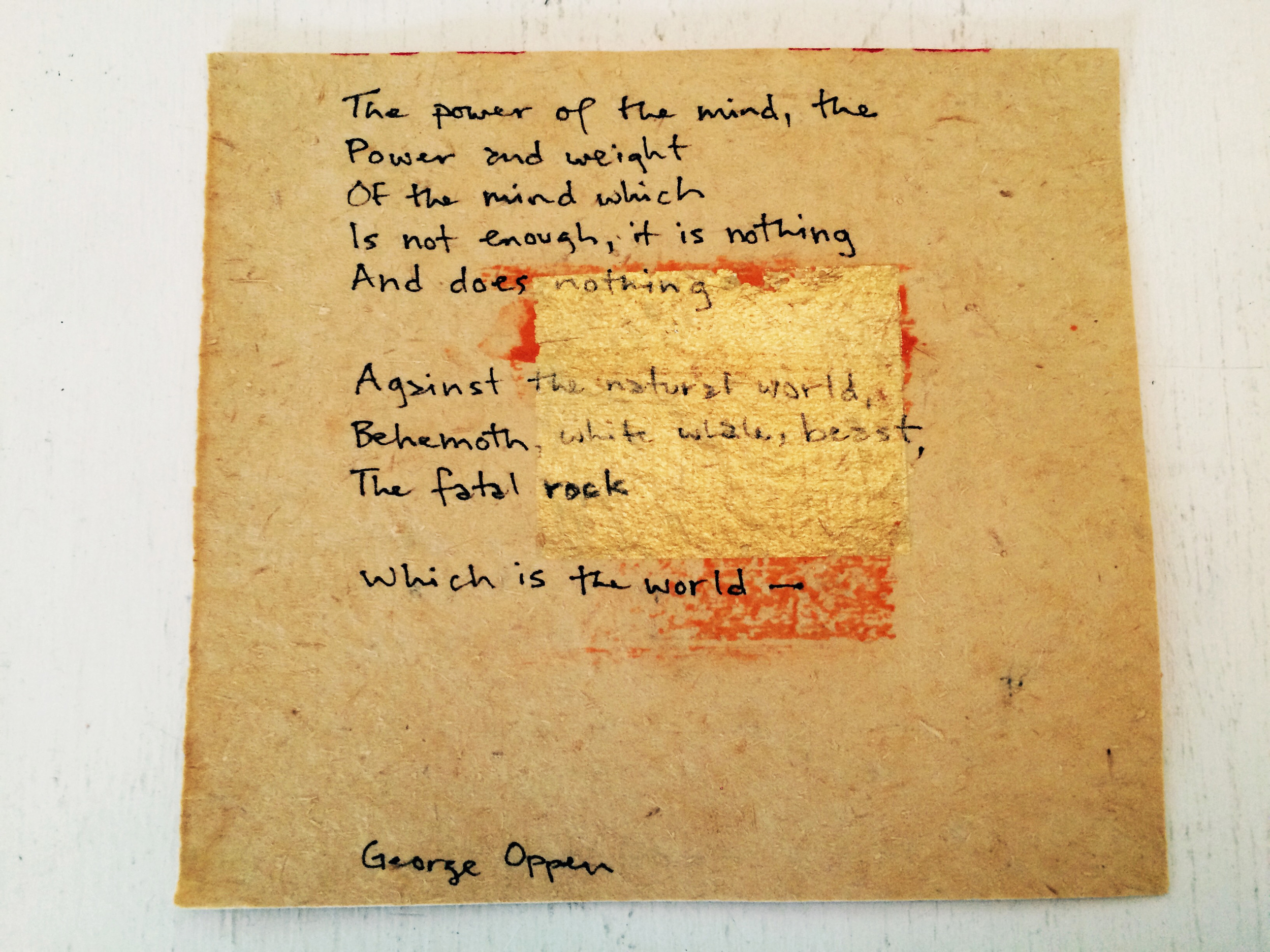
The Power and Weight of the Mind Which is Not Enough • LB Thompson
The paper is from Chinatown, and the quote is from poet George Oppen