
My Babcia’s Mizeria (Polish Cucumber Salad) • Allison Radecki
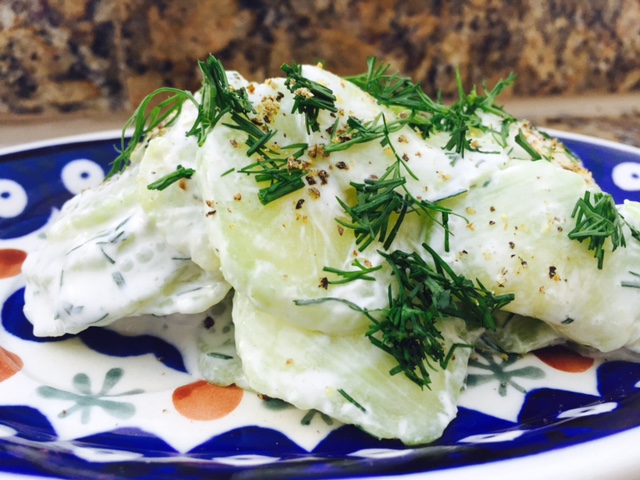
Note from curator Rozanne Gold: I’ve been reading a lot about cucumbers recently and so was delighted to get this wonderful recipe and memory jolt from food writer and cohort, Allison Radecki. The recipe is from her beloved Polish grandmother, her Babcia (pronounced BOB-cha), and it comes with a detailed history of a vanquished, but riveting, way of life. The handwriting belongs to Allison and the recipe has been handed down from at least three generations. Allison’s daughter, Tabitha, will no doubt be the fourth. She’s only five but will be making cucumber salad soon enough. After all, it’s fun to run the tines of the fork down the length of a cucumber to make a design before slicing. Cucumbers, by the way, belong to the cucurbitaceae family as do melons, squash, zucchini and pumpkin and contain potent anti-cancer compounds. Thank you to Allison, and to Babcia Genevieve.

My Babcia's Mizeria (Polish Cucumber Salad) by Allison Radecki
My Polish grandmother’s 1970s American kitchen was a place of transformation. The Formica countertops (whose pastel boomerang pattern always made me think of scattered rubber bands) were surfaces where wooden spoons, mason jars, and stoneware crocks reigned. This was a zone where things freshly picked from the backyard were crafted into dishes of incredible simplicity and deliciousness. There was always a soup bubbling on the stove or something caramelizing in a pan, just waiting for a hungry grandchild to say, “Babcia, I’m hungry.” To this day the scent of frying onions brings me back there, in a heartbeat.
Standing at her kitchen sink in Cedar Grove, New Jersey, my Babcia, Genevieve Baranowski, could survey her domain. Her backyard was a rolling expanse of grass and trees, complete with a stream (great for crayfish hunting), a goldfish pond, and a substantial vegetable garden, which was where the magic began.
Babcia’s first miraculous act was to transform red clay into black gold. Nothing in her kitchen was ever wasted. She knew how to incorporate peeled vegetable skins, coffee grounds, and eggshells into the soil, a spell which resulted in zucchini as large as baseball bats, and heirloom tomatoes you could barely palm with your hand. Every skunk, opossum, and raccoon within a ten-mile radius was drawn to her vegetal treasures, against which she continuously waged war.
Spending time in her kitchen came with a specific vocabulary: szczaw (sorrel), buraki (beets) and, of course, the mighty kapusta (cabbage), which she fermented in her basement with the help of river stones, used to weigh down the shredded leaves in the brine.
Trips to a Polish family friend’s dairy farm were quite common. The return journeys (with her wood-paneled station wagon’s windows rolled all the way down) not only brought raw milk back to her home, but also the finest dried cow manure, which she credited with the spectacular blooms on her roses and peonies.
Since my Babcia and her family were keepers of secrets, her detailed history is still murky. We know that she was born in Niagara Falls, New York, in November of 1913. Her family made the bad decision to sell the profitable family glove factory and tavern and return to Poland in the early 1920s. After an forced unwanted marriage in rural Poland, she ran away, boarding the M.S. Batory, an ocean liner of the Polish Merchant fleet, to return to the country of her birth during the Great Depression. Before the beginning of World War II, she managed to bring her two sisters, also natural-born citizens, back to America, where they all worked as wartime riveters on the East Coast.
Where and how my Grandmother learned to cook is still a mystery. She knew how to braise, how to roast, and could craft an encyclopedia of sauces from memory. Since my Great-Grandmother’s homemade donuts were rumored to break your toes if they fell on your foot, my Babcia’s skills were definitely not passed down the maternal line. My mother’s theory is that while working in Rockaway Beach, Queens as a domestic servant, her mother must have picked up on lessons taught in her employer’s kitchen.
Mizeria, a cold Polish salad of wilted cucumbers, sour cream, salt, and fresh dill, was a popular dish in my Babcia’s summertime kitchen. In recent days, with East Coast temperatures rising to high levels, I have turned to it for its refreshing properties as a side dish, as well as for the family memories that accompany it. It is perfect to bring along to a barbecue, guaranteed to cool off the heat of a summer afternoon.
Though its gloomy name, Mizeria, is said to echo the fact that a Polish peasant’s life was full of misery, the dish leaves me with the opposite impression.
When I taste it, I think of lazy days in the backyard. I can see my grandmother, scented from tomato plant leaves, coming towards me from her garden with a basket of cucumbers. We have a lot of peeling to do.


Ingredients
- 2 large seedless English cucumbers (about 3 cups sliced)
- 1½ teaspoons salt
- 2 tablespoons chopped fresh dill
- ½ cup sour cream
- 2 tablespoons white vinegar
- ½ teaspoon freshly ground black pepper

Directions.
Peel the cucumbers. Run the tines of a fork, lengthwise, down the entire outside of the peeled cucumber, so that it is scored with the points of the fork (this action will give the slices a pretty scalloped edge -- see below).
Slice the cucumber as thinly as possible (so you can see a knife through the slices) and place in a bowl. Sprinkle slices with 1½ teaspoons salt and let sit for 30 minutes.
Drain water from the salted cucumbers and gently squeeze to expel remaining water. Pat cucumber slices dry with paper towels.
Toss cucumber slices in a medium bowl with sour cream, vinegar and dill. Allow the salad to marinate in the refrigerator for about one hour. Taste, adjust with salt and freshly ground pepper and serve.

The Talloczy Family’s Hungarian Stuffed Peppers • Allison Radecki
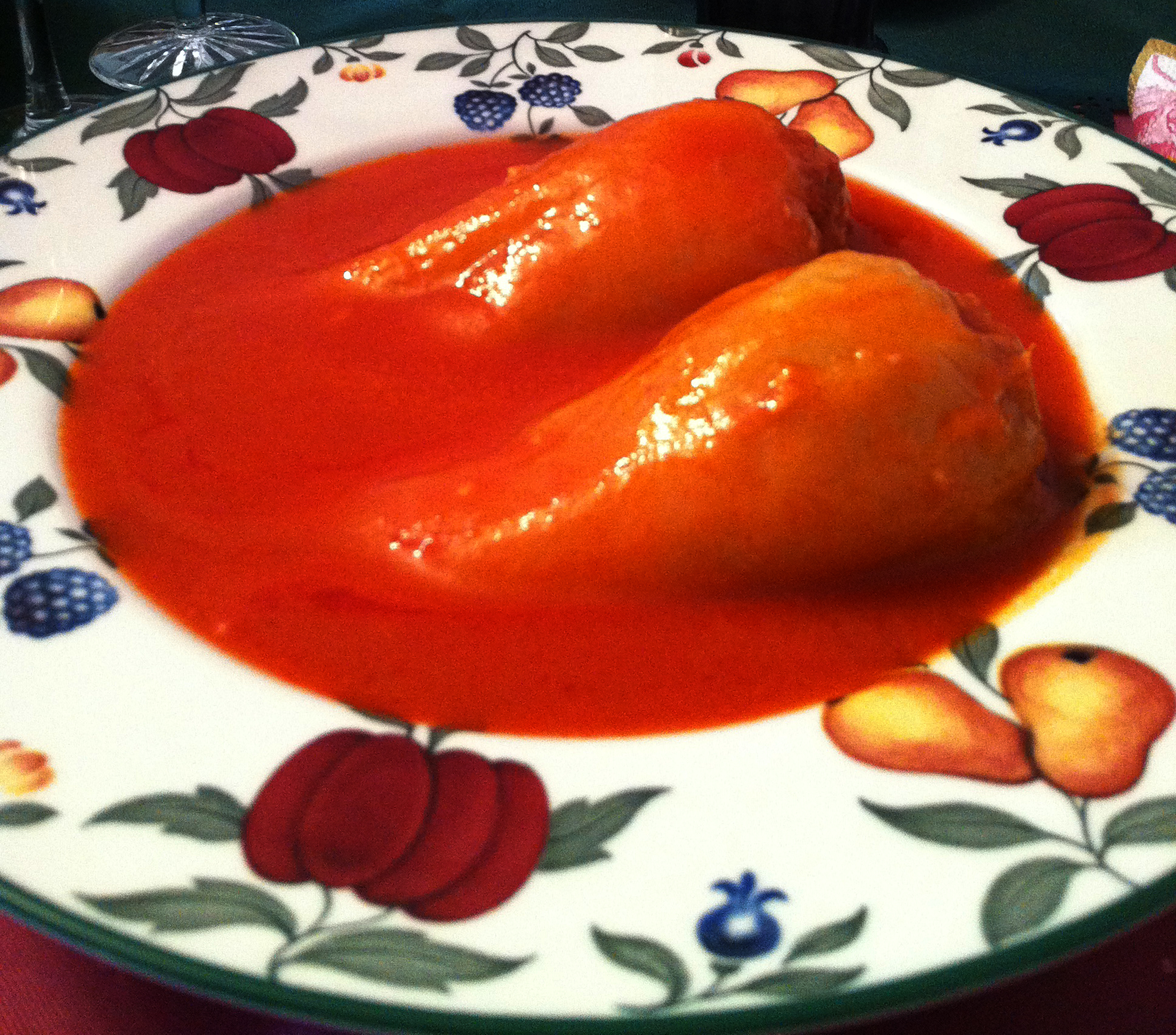

Note from curator Rozanne Gold: This week’s recipe comes to us via New York City caterer, professional chef, and former restaurateur Irene Khin Wong. It is an old Hungarian recipe, inherited without modifications, from the family of her Hungarian partner, Zsolt Talloczy. Three generations of Hungarian women have embraced this recipe, beginning with Zsolt’s great grandmother, Franciska, his grandmother, Anna, and his mother Agnes Zatonyi Talloczy. It is lovingly fastened to Zsolt and Irene’s refrigerator door. With that, a fourth generation now makes the treasured recipe in late spring and early summer, when tomatoes and wax peppers are freshly available. I especially love the grace and styling of Agnes’ European handwriting. With thanks to Irene and Zsolt for sharing this recipe — one that reminds me of my own childhood with my own beautiful Hungarian mother.

The Talloczy Family's Hungarian Stuffed Peppers By Allison Radecki
These lusty stuffed peppers remind Zsolt Talloczy of a cherished childhood and memories of his mother and grandmother. When he prepares them, he wistfully said, “It smells like spring and lazy sunny afternoons in Budapest.” Whiffs of the dish also dish trigger thoughts of his wife Irene’s first trip with him to Budapest and his parents’ home nearly 10 years ago.
Irene and Zsolt first made each other’s acquaintance while waiting to pick up tennis permits within a sporting goods store off of New York City’s Union Square. Zsolt, a trained scientist who now works in microbiology, was studying at Columbia University at the time.
“I wearing pajamas on a Saturday afternoon,” remembers Irene. “I had worked a late night, until 3 am, and just threw on a long jacket to accompany my eager friend to fill out the permit forms. ‘Who cares if you’re wearing pajamas,’ said my friend. WHO is going to see you?’”
A quick chat about tennis skills led Zsolt to offer Irene his e-mail address (“he didn’t even have a cell phone”). After a few e-mail exchanges, they met up to play. Irene then proposed that they meet up another day at the iconic Jewish appetizing store, Russ and Daughters, before trying out courts on the Lower East side.
“I figured that everyone in New York knew Russ and Daughters,” said Irene, who originally hails from Burma, “but Zsolt never arrived. I couldn’t call him, he had no cell phone, so I waited. Sitting in front, while eating my bagel and whitefish, I saw him running by. I almost missed him. I think I gave him the wrong address.” After an extended trip to Asia together (“four countries in six weeks and we never had an argument”) the couple realized that they had found a rare match, indeed.
A trip to Budapest was next on the horizon. “I remember thinking how Budapest was almost like Paris—but in the 1960s. Zsolt’s father, Imre, would buy trays and trays of different types of pastries—the most incredible pastries — it was like something you would get in Paris or Vienna.”
Zsolt’s mother, Àgnes, made these stuffed peppers for Irene to welcome her to Budapest. “Zsolt knows that I can eat spicy. They were so flavorful. It reminded me of home.”
The prototype for this family dish originated in Hungary and is based on a traditional recipe with some German-Hungarian influence from Budapest’s ninth district, Ferencvaros/Franzstadt. This zone was considered the ‘stomach of Budapest’ with a multitude of blooming family businesses, restaurants, butcher shops, and bakeries. It was the neighborhood where Budapest’s first chocolate factory, and famous brandy factory (Zwack Liqueur, maker of the beloved national digestive herbal drink, Unicum) were located, as well as the capital’s central slaughter house.
The typical pepper used in its preparation is the Hungarian Hot Wax Pepper variety, which is fragrant, smooth and ripens like the sunset from yellow to orange to red. This pepper, or paprika, as it is called in Hungarian, is usually harvested before maturity when its skin exhibits a yellow-greenish hue. It is easy to stuff and peel and produces fruits whose ends taper to a rounded point. Alternatively, you can make it with green bell peppers.
As anyone who has visited Hungary knows, you can hardly walk ten feet without encountering this pepper — whether it is threaded onto strings and hung from balconies to dry in its reddest, most mature state, piled high in a fragrant yellow tower in a food market, or taking its traditional place, in its red, pulverized version (as the ground spice, paprika) alongside the salt and pepper shaker on most Hungarian tabletops.
Zsolt is the chef when it comes to this family stuffed pepper dish which he cooks for Irene, so they both can remember their flavors of home. A yearly import of two kilos of Hungarian paprika, which his parents buy directly from a small producer in the nation’s Szeged region (and Zsolt carries back to New York on the plane) allows him to truly capture those authentic flavors. Zsolt also regularly imports frozen portions of his mother’s home-cooked stuffed peppers for his wife when she can not accompany him back to Budapest for his yearly visit “Àgnes freezes the peppers in a container, which she then wraps in three or four Ziploc bags,” describes Irene. “The dish is still cold by the time the plane lands.” Talk about take away.
As the famous Hungarian restaurateur and restaurant consultant, George Lang, wrote in his book, The Cuisine of Hungary, "Paprika is to the Hungarian cuisine as wit is to conversation- not just a superficial garnish, but an integral element…the marriage of paprika and Hungarian cooking was almost predestined." Considering that the wax pepper originated in the New World and made its way into to Hungary by way of the Turkish invasion in the 1500s, it covered a lot of ground before reaching its most famous culinary destination.
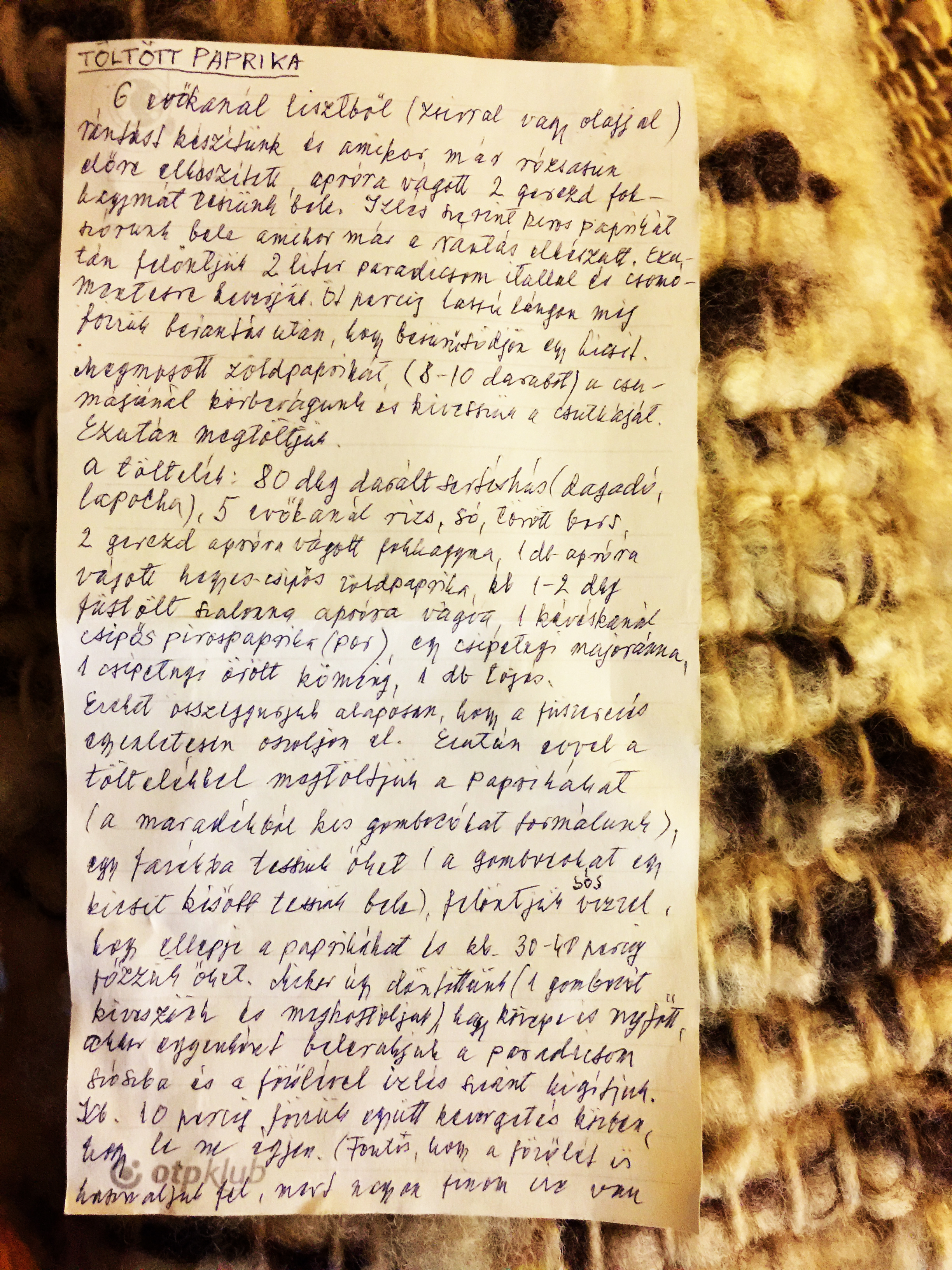
Hungarian Stuffed Peppers
For the Stuffing (to be prepared first):
1-3/4 pounds ground pork
Scant ½ cup raw rice
2 cloves of finely chopped garlic
1 hot pepper (jalapeño will do), finely chopped
2 tablespoons smoked bacon, chopped
1 teaspoon of Hungarian hot paprika
A pinch of dried marjoram
A pinch of ground cumin
1 whole egg, beaten
Salt and pepper to taste
For the peppers and cooking liquid:
6 tablespoons flour
Pork lard or oil
4 cloves of garlic
¼ cup Hungarian paprika powder (sweet or hot)
2 liters of tomato juice
8-10 Hungarian wax peppers (with seeds and stems removed)
•
1. In a large bowl, mix all the ingredients for the stuffing and set aside.
2. Brown flour in melted lard or oil until it turns light brown in the pot. Add chopped garlic and cook several minutes until soft (but not brown.) Add ¼ cup paprika to begin (add as much as you like according to taste – a mixture of sweet and hot paprika) and immediately remove pot from flame to avoid burning the paprika.
3. Pour in 2 liters of tomato juice and break up any clumps of flour by stirring. Simmer on low heat for 5 minutes to concentrate
4. Cut the Hungarian waxed peppers (8-10) around at the stem and pull out the seeds.
5. Fill the peppers with the stuffing. Any leftover stuffing can be rolled into meat balls. Add stuffed peppers to a separate pot from the tomato liquid, add any ‘naked,’ leftover meat balls a bit later to the pot. Fill the pot with water to cover all peppers. Salt and simmer for 30-40 minutes
6. When the stuffing in the peppers is cooked through the middle (cut and test to see when ready), transfer them to the tomato liquid pot and fill up with some chicken or beef broth as needed. Simmer on low heat for 10 minutes while constantly stirring to finish.

Connie Love’s Irish Soda Bread • Allison Radecki

Note from curator Rozanne Gold: I adore Irish Soda Bread and don’t eat it often enough. That will certainly change now that I have this fabulous recipe from Connie Love. Not only is her version filled with love and lore, but is lovingly written by Allison Radecki, who interviewed Connie for this story. It’s “Handwritten” doing what it does best. The recipe is written in Connie’s hand on thin, yellowed paper which she keeps protected, slipped into a small plastic sleeve. It is marked with lines and revisions. Many thanks to Connie, Allison, and her mother, Joanna.

Connie Love's Irish Soda Break by Allison Radecki
There are some homes where everything you see has a story attached to it; a place where life is lived in the company of objects that keep the memories of loved ones alive and where the spirit of a bygone era is still gloriously vibrant.
Such is the home of Connie Love, a close family friend with whom I have been lucky enough to share friendship, much kindness, and lots of laughter in both easy days and tough times over the years. A lover of recipes and a wonderful cook, Connie is the type of friend who will call you to say that there is an extra jar of homemade minestrone with your name on it, waiting for you on her front stoop. “Just remember to stop by and pick it up.”
My mother, Joanna, worked alongside Connie for many years as a realtor in Montclair, New Jersey, and benefited from many such surprises that emerged from Connie’s generous kitchen. Since Connie’s retirement, the two of them still manage to share adventures, whether it is an impromptu movie night or a game of Pickleball, the fantastically named hybrid of tennis and ping-pong, at the local YMCA.
In celebration of various holidays, Connie’s baked goods would appear in our home and soon be reduced to a plate of crumbs. This is how I first encountered her Irish soda bread, which often accompanied the first days of Spring and the Saint Patrick’s day season.
One afternoon this March, my mother and I sat down in Connie’s meticulous kitchen to talk about her soda bread recipe and found ourselves engaged in a whirlwind of memories, photographs, and stories. The recipe for her soda bread came from her mother, Amelia Malanga Ianucci (known as Minnie). Minnie, one of 14 children, was born in Newark, NJ, in 1895. She received this recipe as 17-year old bride from Mrs. Pollack, an Irish neighbor whose apartment shared a door to the same fire escape in a Newark tenement building. The recipe was said to be ‘the poor man’s soda bread’ since it did not use eggs or butter.
“My mother and Mrs. Pollack socialized on the balcony. Their apartments were side-by-side. The basement was filled with crocks with pickles and peppers. They kept the coal in the basements for the coal stoves.” Connie (Columbia Ianucci) and her twin sister, Betty (Elizabeth) were born in the midst of The Great Depression on Clifton Avenue in Newark, not far from The Cathedral Basilica of the Sacred Heart. “No one had a cookbook. No one had measurements. They just knew,” said Connie. “My mother knew the dough for knots. She knew the sweet crusts for Easter pies. My sister said, ‘we didn’t make an effort to know, so we didn’t know.’” Because of this, Connie, herself a young bride, had her mother dictate her soda bread process as she committed the steps to paper. Connie figures that she wrote the recipe down in the 1950s when she was already married and running her own house.
“The tenements smelled, not of garlic and food, but of bleach. The women would bleach the wooden floors until they were almost white.” Bleach was delivered to the women in the tenements by the bleach salesman. “These women didn’t have cars. They didn’t go to the stores.” She remembers the Jewish peddlers who sold linens, which her mother would buy — a tablecloth here, a sheet there — slowly stocking the Hope Chest for her and her sister. “The Stanley guys sold brooms, house products…brushes. The insurance guy came by to collect the insurance premiums — ten cents, twenty cents.”
A network of other relatives lived close by. Connie’s Grandmother’s tenement was on Stone Street. Aunt Tilly lived downstairs. Uncle Arthur and Aunt Ella lived in different tenements in the area. Connie’s father, Stephen Ianucci, was born in Italy in 1890. Connie remembers that at night, her father would read the paper out-loud and her mother would correct him, in an effort to erase his Italian accent. Dinner was always served at 5:30 p.m.
Connie reminisced some more. How she and her sister would harmonize with their mother as they washed the dishes -- “we had no tv and the radio was on top of the fridge. The Green Hornet, music, all sorts of shows.” And she remembered the big black stove with the chrome piece which she would have to polish when her grandmother said “Vieni qua."
Sadly, it was time for us to go. But I’ve got Connie’s recipe and an invitation to come back again. There would be more stories to tell.


Connie Love’s Irish Soda Bread
8 cups flour
3/4 cup of sugar
4 tsp. baking soda
2 tsp. baking powder
2 tsp. salt
2 cups of raisins
1 tsp. caraway seeds
About 4 cups of sour milk
(buttermilk or whole milk with one
tablespoon of lemon juice mixed in)
1. Sift dry ingredients together. Add 2 cups of raisins and caraway seeds, if desired. Add 4 to 5 cups of buttermilk (or whole milk with lemon juice). Mix to hold together.
2. Knead for 1 minute or just mix (not too soft, although never fails, whatever the texture).
3. Bake at 375 for 40 minutes until golden brown (loaf pans or a cake pan).
This recipe makes 3 loaves, which freeze well and are delicious when toasted.

Vodka Sauce • Allison Radecki

Note from Curator Rozanne Gold: This touching story focuses on the re-kindling of father-daughter memories through the unexpected discovery of a handwritten recipe. It is testament to the emotional power that “chicken scratches” can hold. Told by Allison Radecki, a food writer and culinary tour guide, the poignant tale is as much character study as it is a love story. Allison’s neighborhood-based walks in Brownstone Brooklyn trace the history of immigration and culinary change, with each footstep an invocation of her dad’s love of food and people. This hastily scribbled handwritten note on a random piece of paper acts as a time machine to past meals. Over the years, other family members have added comments and drawings to the recipe’s edges, serving to preserve a multi-generational bond and all the memories it holds. Thank you, Allison.

Vodka Sauce By Allison Radecki
I always assume that everyone’s kitchen contains a recipe archive; a repository stuffed with newspaper clippings, ripped pages from notebooks and other treasured bits of chicken scratch. My collection lives in a practically un-openable kitchen drawer — a space stuffed so tightly, papers burst out at you like a canister of spring-loaded plastic snakes.
Sure, it would make more sense to gather these papers into a book, slip them within plastic sleeves for easier organization. Yet, for me, the rummaging is the process: the touching of old newsprint, the disarray, the bits of spiral edges that flutter to the kitchen floor like New Year’s confetti in Times Square. Each archive excavation unearths an unexpected relic that can awaken a vivid memory. This is what happened when I uncovered my father’s scrawled instructions for vodka sauce while rooting around for something completely different.
My father, Joseph Radecki, did not cook. He relied on a few simple dishes — scrambled eggs, plain pizza by the slice, ‘veal parm.’ He adored a good prime rib. “The man needs instructions to boil water,’ was my mother’s classic line. This was technically, not true. The only thing I remember him cooking at the stovetop were boiled ‘tube steaks,’ or hot dogs, as they are known to the rest of the world.
A former police detective and taxi driver, he stumbled into a post-retirement business of showing people “his NYC.” To his clients he was ‘Joe the Cop’, storyteller, procurer of hard-to-get tickets, scholar of city history. “I could get you a seat at the Last Supper if it happens again in New York,” was part of his spiel. I believed him. Many did, for good reason, and sent their friends to find him.
This recipe for vodka sauce, served with penne pasta, comes from a small, Manhattan dining room, Da Tommaso, with no more than 20 seats. There, the Albanian chef, raised in Italy, prepares classic, Italian meals and does it well.
My Dad used this restaurant as his second office (his first, being the fax-strewn passenger seat of his Chevy Suburban). He’d bring clients in to dine and used it as a pick-up location for purchases from ticket scalpers. And it was the site of countless family meals. Long after the post-theater diners had paid their checks, we’d stay late and gossip with the host and waiters as they loosened their white jackets, hearing the list of stars that were glimpsed in the dining room that week. If you spoke the words, “Joe the Cop sent me,” (or were recognized as one of his daughters), you never needed a reservation to get in the door, regardless of the time of day.
When my sister discovered the magic that occurred when tomato, vodka, and cream came together, she would rarely order anything else. After nudging my Dad to see if the chef would share his recipe, he came home with this rough outline. Fittingly, it is written on the back of a printed fax from a couple from Louisville, Kentucky, asking for transportation to the Plaza Hotel and suggestions for “things to see in the Big Apple."
Over the years, this recipe became a family collaboration. My mother, a gold medalist in the sport of highlighting, couldn’t resist illuminating words in fluorescent yellow. Her comments (“guard w/ your life!”) and queries (“sauce,” “1/4 cup?”) are scattered about the page of vague instructions. My sister’s doodles are the tell-tale sign of her presence. Perhaps she was imagining the meals to come.
I look at this recipe and I can hear my father’s pen. The short, solid motions he made when jotting down flight numbers from his ever-present Dictaphone. As a “graduate of the school of Hard Knocks,” but never college, he was self-conscious about his writing. Not once did I see him use cursive. Often, he would ask me or my sister to write the last names of clients on his airport arrival signs. When he discovered word-processing (and stopped fighting with the computer printer), he never looked back. “No one wants to see my boxy letters,” he would say.
I do. It’s been over two years since he died. I miss him terribly. I even miss his scattered papers. How unexpected it was to reconnect with him through his block print and this recipe.

Vodka Sauce
Virgin olive oil
Let oil get hot
Throw a little shallots
Speck of red pepper
Little vodka (1/2 shot)
Tomato
Touch of Cream
